



Q COSTARICA — Under the headline, “Family seeks answers after ICE deports man in vegetative state to Costa Rica,” the prestigious UK-based newspaper The Guardian published the story of Gamboa Esquivel, the Costa Rican who was deported from the United States in a vegetative state and later died on his home soil.
In its online edition, the newspaper presents the story as an “exclusive” and highlights the Gamboa family’s helplessness, the lack of answers, and the doubts surrounding the deceased’s alleged mental illness, as indicated by U.S. authorities.
Before leaving for the United States in 2024, in search of the American dream, Gamboa was in excellent health, while at the time of his deportation, his condition was deplorable.
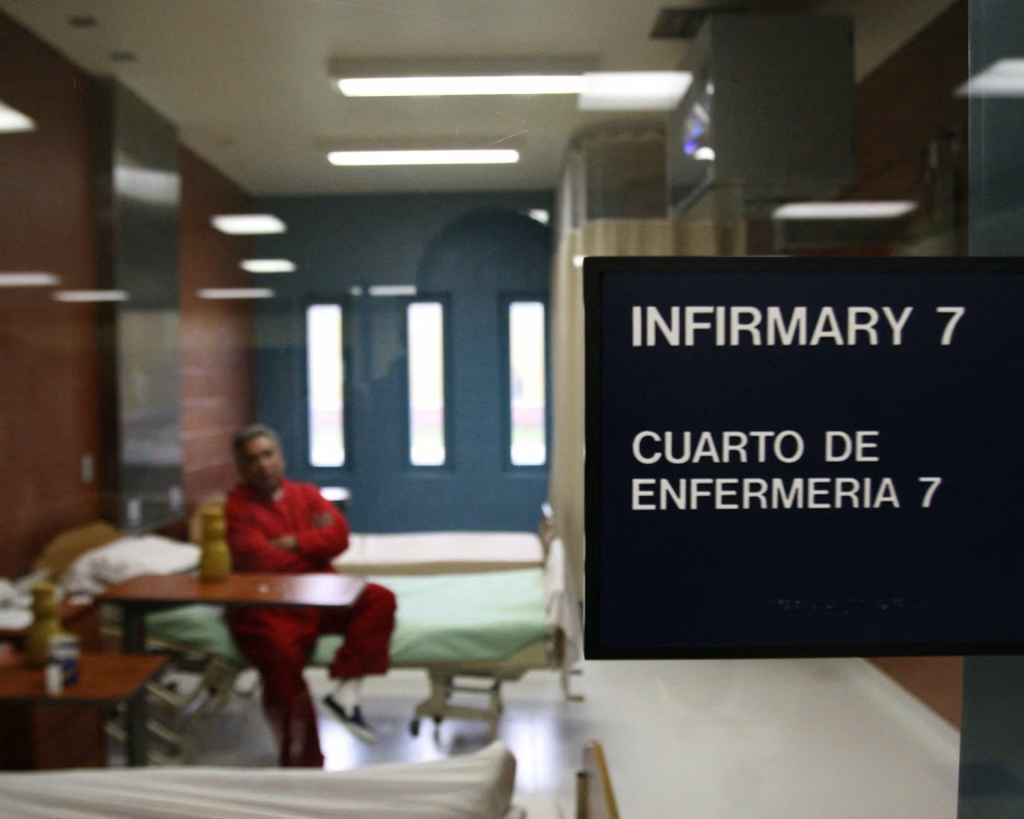
According to The Guardian, Gamboa was initially detained at the Webb County Detention Center in Laredo, and later transferred to the Port Isabel Detention Center in Los Fresnos, both in South Texas.
Nearly ten months later, in September 2025, the Trump administration airlifted the 52-year-old to Costa Rica.
“He never regained consciousness, and five weeks later, Gamboa was pronounced dead at a hospital in Pérez Zeledón, his hometown,” the publication states.
His younger sister, Greidy Mata, said she is still trying to understand how his health deteriorated so drastically while in the custody of U.S. Immigration and Customs Enforcement (ICE).
Mata recounted that Gamboa sounded and looked healthy during video calls while he was detained, until June 12, the date of their last conversation, after which he seemed to disappear.
Mata waited for weeks for news of him, unaware that Gamboa had suffered a health crisis.
“My brother disappeared, and we had to go to agencies, lawyers, consulates, anyone who would help us. How is it possible that a man who left healthy, tall, chubby, and robust, returned dirty, looking neglected, with ulcers all over his body, in a vegetative state?” she added.
According to a document included in the medical records and issued by the ICE Health Service Corps (IHSC)—a service within ICE that provides medical care in immigration custody and evaluates people scheduled for deportation—Gamboa was hospitalized with an “altered mental state.”
The document also indicates that he was taking antipsychotic and antidepressant medications.
Family and friends denied that Gamboa had a history of mental illness before migrating to the United States.
Tricia McLaughlin, Under Secretary of the U.S. Department of Homeland Security (DHS), the agency to which ICE belongs, stated in an email response when asked about Gamboa’s arrest and health status:
“While in custody, he was diagnosed with unspecified psychosis by medical professionals and hospitalized at Valley Baptist Hospital to receive appropriate medical and mental health care.”
By July 7, Gamboa had been diagnosed with at least ten conditions, according to hospital medical records.
Sepsis—a life-threatening reaction to infection—was listed as the primary diagnosis, followed by rhabdomyolysis, a condition in which damaged muscle tissue breaks down rapidly.
Other conditions described in the records include protein malnutrition and toxic encephalopathy, caused by infection or prolonged exposure to drugs, radiation, or metals, which impairs brain function.
He also did not answer a series of questions, including whether any of his consular officials visited Gamboa during his hospitalization in Texas.
Demanding explanations
On October 27, the government of Rodrigo Chaves announced that it would take all necessary steps to clarify Randall’s death.
“The Ministry of Foreign Affairs deeply regrets the passing of Costa Rican citizen Randall Gamboa Esquivel and expresses its sincerest condolences to his family and loved ones during this difficult time. The Ministry will continue to make every effort to clarify the circumstances surrounding his detention and subsequent transfer to Costa Rica,” the government said in a statement.
During the time Mr. Gamboa was in the custody of U.S. Customs and Border Protection, the Costa Rican Consulate General in Houston monitored his case, taking all possible actions within the framework of international law and applicable local regulations, according to the Ministry of Foreign Affairs.
One political figure in Costa Rica who has expressed support for Gamboa’s family is the nation’s former president, Óscar Arias, the winner of the 1987 Nobel Peace Prize.
“Randall Gamboa entered the [US] illegally but in perfect physical condition,” Arias wrote on the social media platform X (formerly Twitter).
Condemning what he called the “complicit silence” of Costa Rica and the US, he added, “Randall’s family deserves to know the truth and to learn what happened when he was in custody of American immigration authorities.”