



Q COSTARICA (iNFOBAE) On the night of April 1, 1857, the inhabitants of the Central Valley in Costa Rica observed a rare phenomenon: a chondritic meteorite impacted the city of Heredia, an event that transformed the town into a point of interest for international science.
According to historical reports and the Revista Geológica de América Central (Geological Journal of Central America), the event was recorded by numerous witnesses and left fragments that are now distributed in museums and laboratories in at least nine countries.
The fall of the Heredia meteorite was first documented in the Costa Rican press and in accounts collected years later by the historian Cleto González.
The phenomenon, as described by witnesses, included a very bright fireball that crossed the sky between the provinces of San José and Heredia, followed by detonations that were heard throughout the region.
The recovery of fragments was swift and allowed for their analysis in Europe and North America. According to El País, the specimen was formally cataloged in 1863 under the name of the city where it fell.
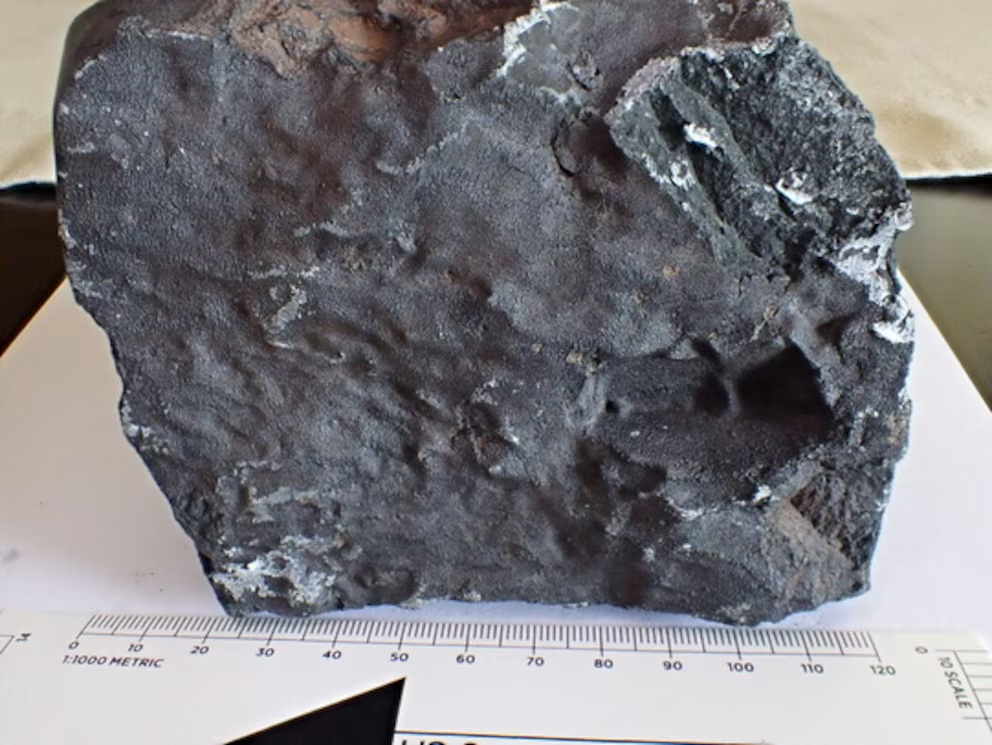
Scientific studies determined that the Heredia meteorite belongs to the H5 brecciated chondrite class, a variety of stony meteorites characterized by their high iron content and the presence of olivine, bronzite, and metallic minerals.
Subsequent investigations, cited by The Guardian, established that the material likely originated from asteroid 6 Hebe, located between Mars and Jupiter.
Detailed mineralogical analysis, first conducted in the 19th century and later in modern laboratories, allowed for a more precise classification and the reconstruction of the fragment’s cosmic history.
The International Dispersal of the Heredia Meteorite Fragments and Their Rarity in Central America
One of the most striking aspects of this case is the wide dispersal of the meteorite fragments. The largest fragment, weighing 410 grams, is housed at the Institute of Mineralogy at the University of Göttingen in Germany.
Other specimens are located at the École des Mines in Paris, the Natural History Museum in London, and the Royal Ontario Museum in Canada, as well as institutions in Switzerland, Austria, the United States, and France.
However, in Costa Rica, a small fragment weighing 2.9 grams is on display at the School of Geology at the Universidad de Costa Rica (UCR)—University of Costa Rica, donated by geologist Gerardo J. Soto after he acquired it on the international meteorite market.
According to the International Meteorite Catalog, only three similar events were documented in Central America during the 19th century:
- “Heredia” in 1857
- “Rosario” in Honduras in 1896
- “Chinautla” in Guatemala in 1902.
This scarcity is explained by the fact that most meteorites fall in unpopulated areas or at sea, making their recovery and study difficult. An analysis published by the Central American Geological Journal calculated that Costa Rica could expect to recover a meteorite approximately every 1,200 years.
The meteorite connects Costa Rica’s natural history with the formation processes of the solar system, since chondrite meteorites preserve information about the evolution of asteroids and the primordial composition of rocky planets.
The Heredia meteorite remains relevant because it is one of the few verified cases in Central America and because of its value as an object of international study. Its story illustrates how an event witnessed in the 19th century continues to generate questions and allow for research on the origin and dynamics of the solar system.