



Q COSTA RICA — A total of 24 Costa Ricans are facing extradition proceedings to the United States, Panama, and France for crimes related to international drug trafficking.
This scenario was enabled by the reform of Article 32 of the Political Constitution, approved on May 15, 2025, which for the first time allowed the extradition of nationals in drug trafficking and terrorism cases under certain conditions and procedural guarantees.
According to the Office of Technical Advice and International Relations of the Public Prosecutor’s Office, 20 of the requests come from the United States, while Panama and France have each requested two individuals.
The current constitutional wording stipulates that no Costa Rican citizen can be forced to leave the country, except in cases of international drug trafficking or terrorism, provided that extradition is granted by the Courts of Justice and that fundamental rights and procedural guarantees recognized in the Constitution, international treaties, and national laws are respected.
This legal change opened the way for the Costa Rican justice system to process extradition requests exclusively for these two crimes.
Currently, legislators are discussing a bill to expand the grounds for extradition beyond international drug trafficking and terrorism.
France and Panama requested extraditions for drug trafficking
In the case of France, authorities requested the extradition of two men, Restrepo and Pablot, both Colombian citizens who became naturalized Costa Ricans, linked to international drug trafficking.
According to reports, Restrepo escaped from a prison hospital in Panama in 2014.
One of the extradition requests from Panama involves Villalobos, alias “Boligoma,” who was arrested in that country for drug trafficking and returned to Costa Rica after being released in 2016. The second person sought is Martínez, also for drug trafficking, who was among the most wanted by Panamanian authorities and was captured last June.
The U.S. accounts for the majority of extradition requests
The United States accounts for the majority of extradition requests. Among the first Costa Ricans extradited to that country were former magistrate and former minister Celso Gamboa Sánchez and Edwin López Vega, alias “Pecho de Rata”, who were handed over on March 20. Later, on July 9, 2025, a federal grand jury in the Eastern District of Texas returned a formal indictment against Gamboa.
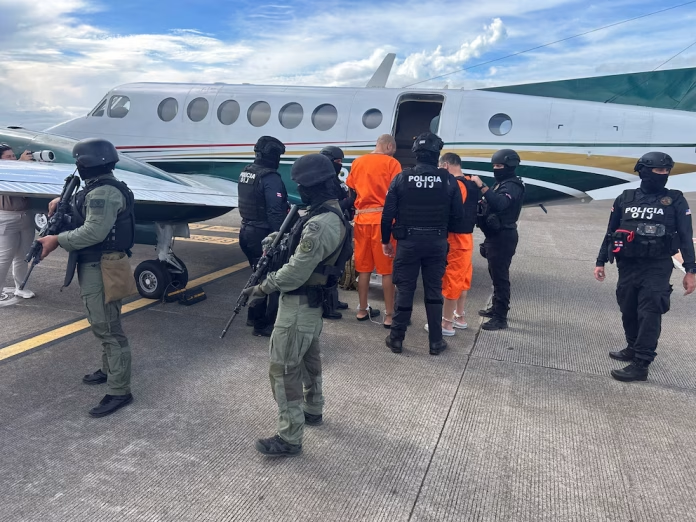
The most recent extraditions are Gilberth Bell Fernández, alias “Macho Coca,” and Gabriel Lozano Bonilla, alias “Compadre,” a Colombian who became a naturalized Costa Rican citizen. Both were transferred to New York on August 13 and placed in the custody of the Southern District Court of that city.
U.S. authorities consider Bell Fernández one of Costa Rica’s top cocaine traffickers. Federal prosecutor Jamie McDonald and DEA Administrator Terrance C. Cole filed the formal indictment for conspiracy to traffic drugs into the United States.
According to the prosecutor, Bell Fernández allegedly obtained cocaine shipments from Colombia for years and transported them through Costa Rica for distribution in the United States. Lozano Bonilla, meanwhile, is identified as the leader of a group that exported drugs to Europe and Asia.
The extradition of Costa Ricans to other countries is governed by the new legal framework, which requires the approval of national courts and compliance with procedural guarantees and fundamental rights recognized by Costa Rican and international law.