

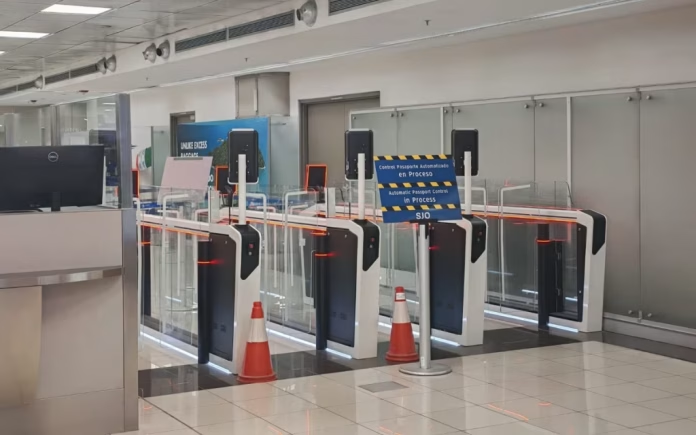


Q COSTA RICA — The Juan Santamaría International Airport (SJO) or San José Airport will debut biometric gates to expedite passenger flow through immigration control.
Aeris, the airport’s concessionaire, aims to have the system operational by the end of July.
Four gates will be installed in the arrivals area and two in departures. More gates will be added as demand for the project grows.
This automated access technology, known as e-gates, is common in airports and border crossings. It uses facial biometrics to verify a person’s identity.
For San José Airport, this represents a key step forward with the implementation of this system after two years of testing.
Phased Operation
The biometric gates will be activated in phases. In the first phase, they will only be available to Costa Rican citizens with biometric passports. This is because facial geometry is already embedded in the passport’s chip, so no additional registration is required.
The next phase will be for Costa Ricans without biometric passports. In this case, a single pre-registration will be required to capture facial features.
Subsequently, the e-gates will also be available for foreigners with biometric documents.
There are no start dates yet for these phases, as the results of the first phase will be analyzed first.
Ricardo Hernández, CEO of Aeris, explained that the implementation of the gates was achieved after a complex process that included software, technological integrations, and constant testing to reach the expected reliability.
How do they work?
Costa Ricans only need to perform two simple steps to use the biometric gates:
- Place their passport to be scanned.
- Look at the camera.
In a matter of seconds, the system consults the database to obtain the traveler’s history and thus determines whether or not to grant them entry to the country.
A green light will open the gate, and the passenger can continue. Conversely, a red light will prevent entry and mean that further verification by an immigration officer is required.
The system aims to provide fast and secure processing to increase the airport’s capacity, especially during peak hours.