



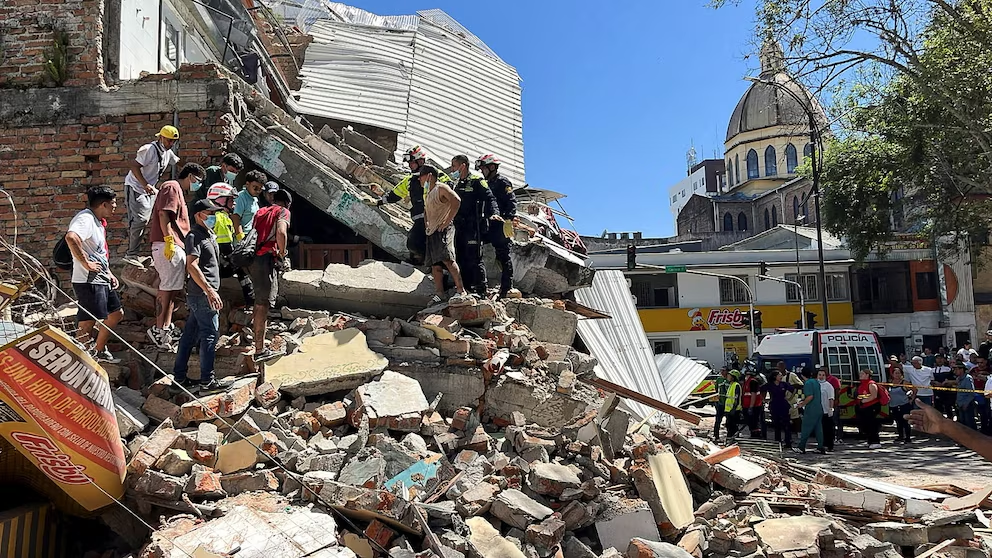
Q COSTA RICA — Costa Rica, Nicaragua, Guatemala, Honduras, Panama, and El Salvador, expressed their support for Colombia following Monday’s 7.4 magnitude earthquake that left at least 200 dead and 3,800 missing. The Colombian government declared a national disaster, as damage was reported to homes, buildings, roads, airports, health centers, and schools.
The official tally released by Colombian President Abelardo de la Espriella included hundreds injured, some 1,575 damaged homes, of which 37 completely destroyed, 61 collapsed buildings, 18 affected health centers, and 52 damaged schools. The president said in Bogotá that this was a preliminary figure and that an increase was expected.
The Colombian president stated that at least five departments (known as provinces in some countries) suffered extensive damage. He added that 18 highways were affected and that seven airports—Pereira, Manizales, Quibdó, Armenia, Cartago, Cali, and Buenaventura—were closed and unable to operate commercial flights due to infrastructure damage.
According to the Colombian Geological Survey, the epicenter was in San José del Palmar, in the department of Chocó, on the Pacific coast, at a depth of 82 kilometers (51 miles). In Quibdó, the departmental capital and the city closest to the epicenter, authorities reported injuries and serious damage to buildings.
In Cali, 20 buildings collapsed, according to reports from the Cali Mayor’s Office and the Civil Aeronautics Authority. The coffee-growing region of central Colombia was one of the areas most affected by the earthquake.
The quake overwhelmed parts of the health system, turning the rescue effort into one of Colombia’s largest disaster responses in years.
Colombia declared three days of mourning on Wednesday for the victims of an earthquake.
Costa Rica expressed its solidarity through a statement from the Ministry of Foreign Affairs. “The Government and people of the Republic of Costa Rica express their deepest condolences to the Government and people of Colombia in the face of the emergency caused by the earthquake,” the Ministry stated.
The Ministry also indicated that none of the approximately 2,000 Costa Ricans residing in Colombia are among those affected. It explained that its Consulate General in Colombia is closely monitoring the situation and has made its telephone lines and email available to handle requests for consular assistance.
El Salvador’s President Nayib Bukele offered on Monday the immediate dispatch of rescue teams, medical personnel, paramedics, and supplies to Colombia following the earthquake.
Bukele stated in a press release published on his X (formerly Twitter) account that his government was closely monitoring the aftermath of the earthquake. Bukele affirmed: “We are closely following the consequences of the powerful earthquake that struck Colombia this morning.”
He added that his country is “in communication and ready to provide immediate support” with whatever resources the Colombian authorities deem necessary. He also acknowledged the responsiveness of Colombian emergency teams and noted that El Salvador remains on alert to act without delay should it receive a formal request.
The Nicaraguan regime sent a message signed by Daniel Ortega and Rosario Murillo. “In these tragic times, on behalf of the Nicaraguan people and ourselves, we send you our solidarity and prayers, trusting in God that normalcy will soon be restored,” they wrote in a letter.
They also addressed a message to those who lost family members and to the communities affected by the destruction of their livelihoods. In that communication, they sent a “fraternal embrace” and prayers for comfort.
The president of Guatemala, Bernardo Arévalo de León, said in his regular press conference at the National Palace of Culture that he was following the events in Colombia “with great concern and sorrow.” He indicated that he had already conveyed his country’s solidarity to the Colombian president and offered any necessary support.
Arévalo added that the executive secretary of the National Coordinator for Disaster Reduction, Claudinne Ogaldes, is in contact with her Colombian counterpart to determine when an international request for aid could be activated. The Guatemalan Foreign Ministry, according to the publication, also reported that it is maintaining contact with some Guatemalan citizens residing in Colombia, although without complete information on the condition of most.
From Honduras, President Nasry “Tito” Asfura expressed his “solidarity” and “fraternity” with Colombia on X. The head of the Honduran Parliament, Tomás Zambrano, expressed his “closeness and empathy” to De la Espriella and the affected families and affirmed that the historical ties between the two countries “are stronger than ever.”
Panama’s President José Raúl Mulino offered assistance “within our capacity.” In Panama, the earthquake shook the eastern part of the country, prompting the precautionary evacuation of dozens of office and apartment buildings in the capital, as well as hospitals in the Darién province, which borders Colombia.
According to the Institute of Geosciences at the University of Panama, the tremors lasted between 40 seconds and 1 minute and were felt in Darién, the Guna Yala region, and other areas of eastern Panama. The institute’s director, Néstor Luque, explained, as quoted by the EFE news agency, that the earthquake originated “in a tectonic contact zone between the El Garrapata fault and the Eastern Panama Deformed Belt fault.”