

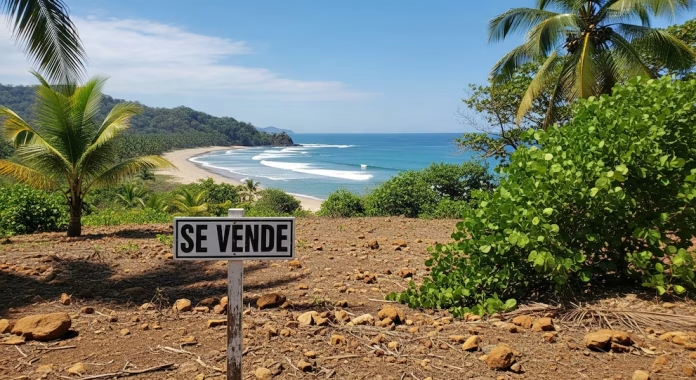


Q COSTA RICA — Vacationing on one of Costa Rica’s beaches no longer just involves considering the cost of fuel, food, or lodging. For a large majority of the population, consuming basic goods, finding accommodation, eating at restaurants, or even buying property in coastal areas is now considerably more expensive than it was years ago.
This is revealed in the report “Perceptions of the population in Costa Rica on tourism and real estate development in coastal communities,” (Percepciones de la población en Costa Rica sobre el desarrollo turístico e inmobiliario en las comunidades costeras) prepared by the Programa Interdisciplinario Costero (PIC) of the Instituto de Estudios Sociales en Población (Idespo) at the Universidad Nacional (UNA).
The results show that the perceived increase in cost affects practically all aspects related to living and daily life near the sea.
In the case of food and basic consumer goods, more than 80% of those interviewed believe that prices have increased. A similar perception exists for recreational activities, cafes and restaurants, hotel accommodations, cabins and Airbnb rentals, as well as public and private transportation, with percentages between 75% and 80%.
However, no sector generates such a high perception of price increases as the real estate market.
85% of those surveyed believe that the sale price of properties has increased in coastal areas.
The report specifically highlights what happened in Guanacaste.
“In the Costa Rican context, the transformations in the Guanacaste real estate market demonstrate excessive land value increases, registering up to 400% in land value between 2020 and 2023, due to financial speculation and land purchases by transnational capital,” the research states.
Construction grows after the pandemic
The changes are not limited to land prices. 63.9% of those surveyed perceive growth in real estate infrastructure in coastal regions, particularly after the COVID-19 pandemic.
When asked about the types of construction that have increased the most, hotels and cabins account for over 50% of mentions, while luxury homes and condominiums account for over 40%.
This expansion contributes to a widespread sense of transformation.
45% of respondents believe that coastal areas have changed “a lot,” compared to 13.9% who believe the changes have been minimal.
The causes attributed to these transformations are diverse.
10.7% identify changes related to the economic impact and employment, 7.8% point to infrastructure development, 7.6% to increased tourism, and 6.5% to rising prices and the cost of living.
Another 10.6% say they perceive no changes, while 9.9% believe that “everything remains the same.”
The expansion of tourism is also reflected in the businesses that, according to the population, have gained ground.
For 66.4%, the main economic activity that has grown on the coasts is hotels. Restaurants come in second place, with a perception of over 50%, while supermarkets and shops remain below 20%.
“Taken together, these responses show that the population associates the recent transformations of coastal areas with changes in economic, tourism, and real estate activities,” the document concludes.
Despite the debate generated in recent years around real estate development on the Costa Rican coast, the concept of gentrification remains unknown to a significant portion of the population.
The study determined that 71.9% of respondents are unfamiliar with the term.
Educational level, however, makes a significant difference.
Among people with university degrees, around 62% report being familiar with the concept, while among those with incomplete secondary education or a lower level of education, the proportion drops to approximately 8%.
Among those who are familiar with the term, 27.8% associate gentrification with the “displacement of the local population by foreigners,” 19.9% with the “purchase of properties by foreigners,” and 13.5% with “economic and social transformation.”
The perception of an increase in the foreign population is even more pronounced: 86.4% believe that the number of foreign residents in coastal areas has increased.
More restrictions on accessing beaches
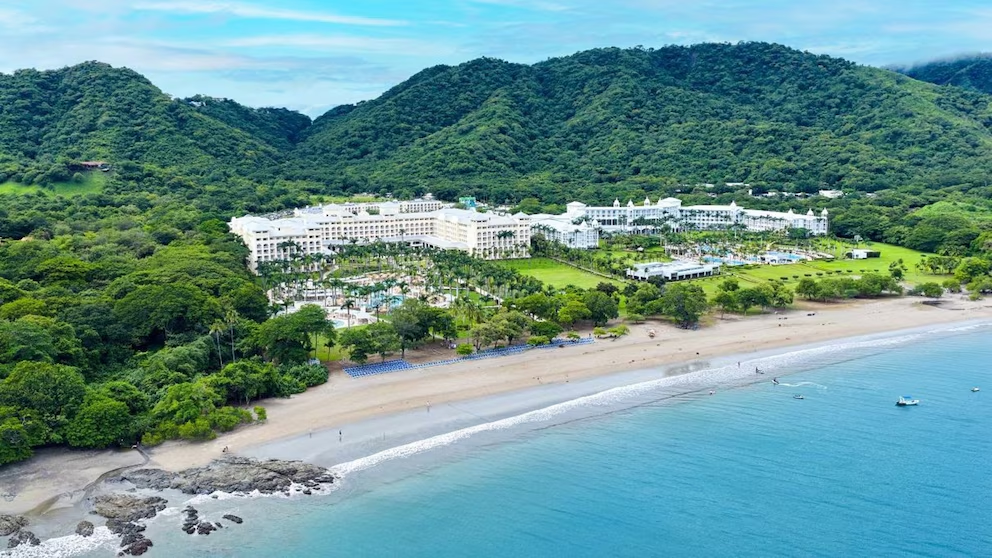
One of the most striking findings is related to access to the coastline.
44.3% of those interviewed believe that there are currently more limitations on accessing beaches, while another 16% assert that there are even places where access is prohibited.
The study also specifically analyzed the responses of those living in coastal communities.
47.9% indicated that they have resided in these areas for three decades, while only 10% stated that they had settled there within the last five years.
Regarding proximity to the sea, 82% live 400 meters or more from the shoreline, while only 7.3% reside less than 200 meters away.
The rising cost of living also appears to be impacting the decision of some families to remain in the area.
32.6% of the residents surveyed reported knowing at least one person or family who had left their home in a coastal area due to the high costs associated with tourism.
ICE and ICT Receive Higher Ratings
The research also inquired about the evaluation of public institutions present in these areas.
The Instituto Costarricense de Electricidad (ICE)—State power and Telecom—received the highest satisfaction rating, exceeding 80%, followed by the Instituto Costarricense de Turismo (ICT)—Tourism Board, which hovered around 70%.
At the opposite end of the spectrum are the Legislative Assembly and local governments, institutions that do not reach 30% approval.
Regarding water supply, approximately seven out of ten people report not facing access problems.
Among those who do report difficulties, 45% blame institutional neglect.
For the researchers, the results show that the Costa Rican coast is undergoing a transformation that cannot be analyzed solely in terms of tourism expansion.
The report defines the phenomenon as “complex, dynamic, and multidimensional,” involving a confluence of economic, tourism, real estate, social, and environmental factors.
Experts also consider it urgent to strengthen public policies that regulate these processes.
The researchers “highlight the urgent need to formulate and implement inclusive land-use planning policies that regulate real estate and tourism development.”
They also consider it necessary to guarantee binding community consultation processes, protect common goods—including public access to beaches—and ensure sustainable coverage of essential public services.
The survey was conducted between November 12 and 20, 2025, through 966 valid interviews. The study reports a maximum margin of error of 3.2 percentage points and a 95% confidence level.