

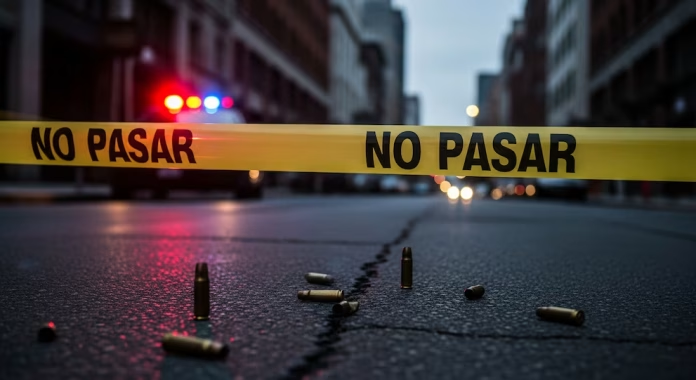


Q COSTARICA — The number of collateral victims of homicides in Costa Rica during the first half of 2026 fell to 20, representing a 57% decrease compared to the same period of the previous year.
This decline, which the Organismo de Investigación Judicial (OIJ) still consider preliminary, is attributed to more targeted attacks and an overall decrease in homicides, although the number could change.
Projections from the OIJ anticipate that the country will end the year with fewer than 800 homicides in a context of a general decrease in lethal violence. This decrease has reduced the exposure of bystanders to criminal disputes, according to specialists cited in El Observador.
The reduction in collateral victims reflects a trend in which assailants seek to attack when the target is alone, thus minimizing the risk to bystanders. However, authorities warn that errors in the execution of homicides still occur and that the category of collateral victim can change after new evidence or testimonies emerge.
The category of collateral victim, explained the acting director of the OIJ, Michael Soto, is usually defined at the crime scene, but it commonly changes during the investigation. Soto emphasized that the figure is provisional and could increase as the investigation progresses: “That number is probably higher,” he said.
The professionalization of hitmen does not explain the decrease
The decrease in homicides and collateral victims does not imply greater professionalization of hitmen (sicarios in Spanish) in Costa Rica. According to Soto, serious flaws persist in the execution of attacks, such as shooting the target’s companion or making mistakes during the escape.
Experts consulted agree that the phenomenon is more a response to changes in the dynamics of the attacks than to a qualitative leap in the training of the perpetrators. Criminologist Erick Villalba explained that a victim’s classification depends on the initial information, but it can change as the investigation progresses and new data emerges, such as criminal connections or cell phone analysis.
Villalba maintained that, sometimes, the investigation can reveal that a person initially considered the primary target was actually a collateral victim, and vice versa. “The classification is based on the information available at that time,” the criminologist said.
Criminologist Esteban Ruiz positively assessed the observed decrease, noting that it means “fewer people unrelated to these drug disputes are losing their lives in Costa Rica.” However, he stated that it is not yet possible to speak of a widespread professionalization of hitmen, although some attacks show greater precision and planning.
Ruiz warned that carrying out homicides in public spaces continues to pose a high risk to bystanders, and that the presence of teenagers and young adults as perpetrators reveals a lack of experience in many cases.
Villalba acknowledged that certain criminal groups have refined their methods, choosing the locations and times of attacks more carefully, as well as surveilling the victims beforehand. Despite these changes, he clarified that this does not necessarily equate to professionalism, but rather to an evolution in the strategy of some groups.
Authorities and specialists insist that the decrease does not imply a qualitative leap in the professionalization of hitmen, but rather specific adjustments in the criminal dynamics.