

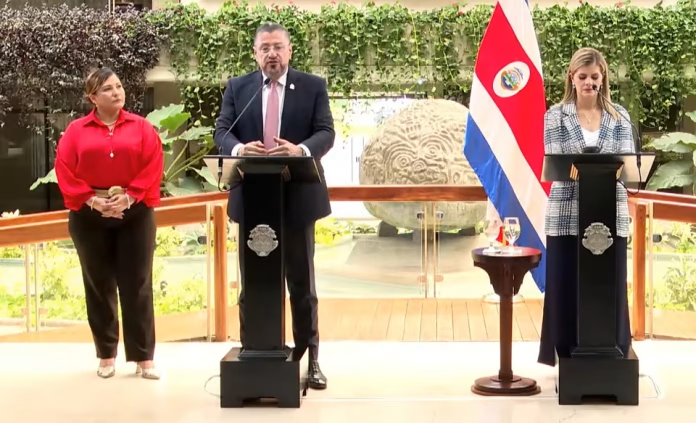


Q COSTA RICA — President Laura Fernández referred to former president and minister Rodrigo Chaves as “president” Wednesday afternoon during the live broadcast of the weekly government news program, later justifying her continued use of the title for the leader of the political movement that brought her to power in the February elections.
After nearly four months demonstrating the considerable power wielded by Chaves, who formally serves as Minister of Finance and Minister of the Presidency, the president addressed him as “president” in what appeared to be a spontaneous remark, preceded by a smile, before attempting to clarify the situation.
You caught that, eh!
“You all noticed that I called Mr. Rodrigo ‘President.’ And to avoid any sensationalism, I will continue to call him ‘President’; I will always respect him as the great president he was, and I am honored that he is part of my team, just as he occasionally calls me ‘Minister’ or ‘Jefa (boss),’” Fernández remarked, recalling that she served as Minister of Planning and Minister of the Presidency between 2022 and 2026.
Immediately afterward, the cabinet was seen applauding, with Chaves in the front row.
Fernández also didn’t shy away from mentioning one of the media outlets she often identifies as an adversary. “Before fueling the sensationalism, I want to clarify this, because when people focus more on egos than results, this could be a headline tomorrow,” she said, finishing with a laugh and trying to end the moment by taking a question from a journalist.
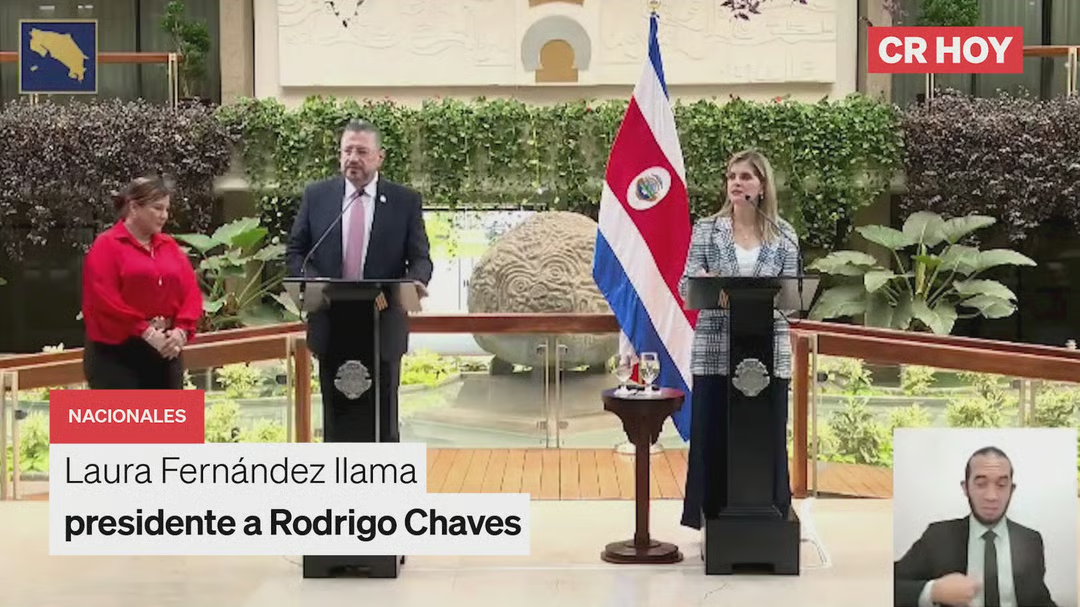
This occurred after a journalist asked Fernández a question about a Constitutional Chamber ruling regarding the appointment of union representatives to the board of directors of the Costa Rican Social Security Fund (CCSS).
The president immediately called Rodrigo Chaves to the microphone for a “political focus,” which allowed for one of the former president’s customary bombastic speeches against the Judiciary and opposition parties.
This is not the first time Fernández has referred to the man who handed over the presidential seat to her as “president” on May 8th. It has also happened with other government figures and in media outlets aligned with the political movement.
Despite this, in interviews Fernández has reaffirmed her role as head of state. “I am the only President. There is no two-headed government here. What I have by my side, thank God, is an extraordinary economist who was president and who is also the founder of this movement,” she said in an interview.
As Minister of the Presidency, Chávez wields the powers of chief of staff, government spokesperson, and liaison with various sectors and the Legislative Assembly. As Minister of Finance, he controls the budget. As leader of the ‘Chavista’ movement, however, he exerts power beyond the formal realm and maintains a frequent presence at Fernández’s activities.
Many of the current ministers and pro-government deputies are under his direct influence, although he often claims to be Fernández’s subordinate and his “humble Minister of Finance.”
A slip of the tongue—also known as a parapraxis or Freudian slip- President Laura may have unintentionally exposed her hidden thoughts or desires. At the very least, it’s giving fuel to the ‘chismes’ (gossip) that Rodrigo is the one pulling the strings.
Not common in Costa Rica to keep calling someone by their highest official title
The practice of continuing to address individuals by their “highest rank in office” for life—even after they have retired, stepped down, or left service—is standard protocol in the United States.
Costa Ricans generally do not use this. Instead, Costa Rican society is profoundly egalitarian and informal when it comes to political authority. Once a politician or public servant leaves office, they return to civilian status and are typically addressed by standard societal honorifics or academic degrees rather than a permanent political rank.
For general respect towards older individuals, superiors, or neighbors, Costa Ricans use the traditional honorifics Don (for men) or Doña (for women) paired exclusively with the person’s first name (e.g., Don Rodrigo, Doña Laura). This signals warmth and respect.
Rather than tracking political or administrative ranks, Costa Ricans place higher daily emphasis on earned academic and professional designations, such as Licenciado / Licenciada for anyone holding a professional university degree, Ingeniero / Ingeniera for engineers, Profesor / Profesora for educators, etc.