

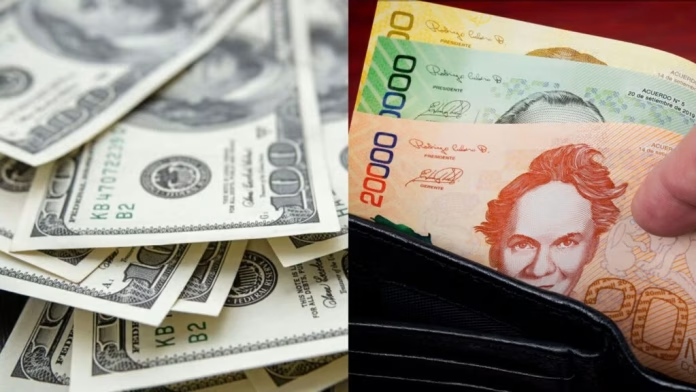


Q COSTA RICA — Seven domestic and international factors could increase pressure on Costa Rica’s colón and drive up the value of the U.S. dollar, according to economist Norberto Zúñiga, a consultant with Ecoanálisis.
The variables include international prices, interest rates, exports, foreign investment, market expectations and the country’s fiscal outlook. Together, they could increase demand for foreign currency while reducing the supply of dollars available in the local market, according to Infobae.com.
One of the main risks comes from geopolitical conflicts and their effect on oil, raw materials, and food prices. Higher international prices make imports more expensive for Costa Rica and require more foreign currency to pay for them.
The country’s oil bill rose by nearly 50% during the first nine months of the year. That increase came as global interest rates remained elevated, adding pressure to the domestic foreign-exchange market.
Higher U.S. interest rates could also affect the colón. Yields on U.S. Treasury bonds reached 5.30% for 10-year securities and 5.60% for 30-year bonds. Those returns may encourage investors to move capital toward the United States, increasing demand for dollars in other markets.
Zúñiga said that the shift could become a catalyst for greater demand for foreign currency, although he noted that the size of any net capital outflows from Costa Rica cannot be predicted with certainty.
The performance of Costa Rica’s exports is another important factor. Zúñiga linked a possible slowdown to higher tariffs imposed on some Costa Rican products by the administration of U.S. President Donald Trump, as well as to the prolonged appreciation of the colón.
Companies operating under the Free Trade Zone Regime could be particularly exposed. Goods exports grew 3.8% during the first eight months of the year, compared with 15.7% during the same period a year earlier. Service exports also fell by more than 3% in the first half of the year.
A weaker export sector could reduce the flow of dollars into the country and make it more difficult to offset demand from importers, businesses and public-sector institutions.
Foreign direct investment is another concern. Announcements involving restructuring, partial closures and layoffs at free-zone companies have raised questions about whether investment inflows could decline. Zúñiga cited the sale of Florida Ice & Farm operations to Heineken as an exception, but suggested that investment could weaken once that transaction is excluded.
Expectations among businesses, investors and other market participants may also influence the exchange rate. If a significant share of the market expects the colón to depreciate, companies and investors may purchase dollars in advance, increasing demand and reducing the amount available for sale.
Costa Rica’s fiscal outlook could reinforce those expectations. Concerns about public finances may affect perceptions of the country’s risk and influence future credit-rating decisions. A deterioration in either area could prompt additional demand for dollars.
The exchange rate had already shown unusual movement before the report. The weighted average rate rose by more than ¢1 per day in eight of the 10 business sessions preceding October 5. The currency’s cumulative decline reached ¢10.89, or 2.43%, bringing the dollar to ¢458.67—its highest level in three months.
Trading activity in the Monex, the official wholesale foreign exchange market, was relatively limited during that period. No daily session exceeded US$40 million, one remained below $20 million, and the average stood at US$31 million.
The Central Bank of Costa Rica sold US$187.9 million to the nonfinancial public sector and purchased US$128.3 million through Monex. The difference required the bank to use US$59.6 million from its international monetary reserves.
Private-sector banking operations remained in surplus, but they were not enough to cover public-sector needs, including those of the Costa Rican Petroleum Refinery.
Zúñiga said the recent behavior of the dollar was unusual and stressed that no model can predict the exchange rate with certainty. Still, he argued that a combination of higher import costs, weaker export and investment flows, stronger U.S. returns and changing market expectations could place additional pressure on the colón.