

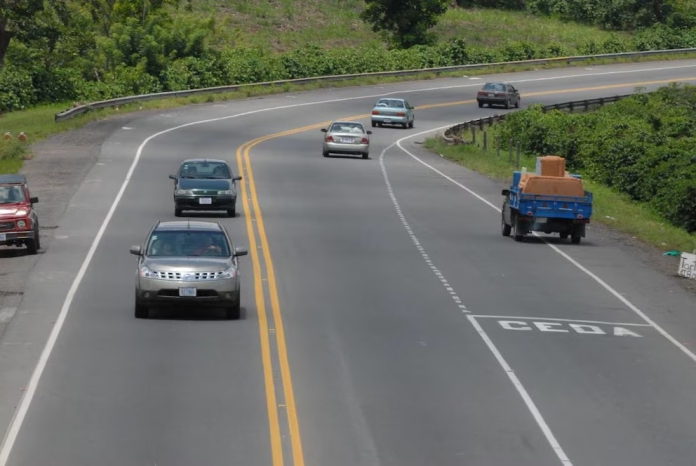


Q COSTA RICA — The planned expansion of Ruta Nacional 1 between San José and San Ramón has been one of Costa Rica’s most debated infrastructure projects for more than two decades. Intended to ease congestion on the country’s main route toward the western Central Valley, the project has moved through several designs, financing plans and legal arrangements—while repeatedly facing delays.
The 60-kilometer corridor (55.6 kilometers between La Sabana and San Ramón in addition to 4.45 kilometers of the Río Segundo radial road) connects the capital with Alajuela, Grecia, Naranjo, Palmares and San Ramón. It is a vital route for commuters, freight companies and travelers heading toward the Pacific coast and the Juan Santamaría (San José) International Airport. It is also one of Costa Rica’s most heavily used and congested highways.
The need for a wider road became increasingly clear as population and economic activity expanded west of San José. The existing highway, much of it built as a two-lane route, struggled to handle rising traffic volumes. Daily backups became routine, especially near Alajuela and along the approaches to the airport and the western suburbs.
An early concession and a public backlash
The first major attempt to modernize the corridor came through a public-works concession awarded to the Spanish company Autopistas del Valle. The concession agreement, signed in the mid-2000s, called for the rehabilitation and widening of the route, along with the construction of new interchanges and other improvements.
The project quickly became controversial. Critics questioned the cost of the tolls, the terms of the concession and the condition of the road after construction began. Drivers complained about congestion and safety problems, while the government and concessionaire clashed over delays, design changes and the financial structure of the contract.
In 2008, after years of public criticism and disputes, the government and Autopistas del Valle reached an agreement ending the concession. The state took back control of the highway, leaving the country with a partially improved corridor but without the comprehensive expansion originally promised.
The episode shaped public opinion about infrastructure concessions for years. It also reinforced a broader concern in Costa Rica: major transportation projects could take many years to move from proposal to construction, with costs and designs changing along the way.

A new concession plan
After the first concession collapsed, the government began exploring another public-private model. In 2015, the administration of President Luis Guillermo Solís selected the consortium Consorcio Ruta 1 to develop the expansion under a new concession arrangement.
The proposal called for widening the route between San José and San Ramón, improving interchanges, adding bridges and upgrading sections of the highway. The plan was presented as a way to transfer much of the financial and construction responsibility to the private sector while speeding up delivery.
The proposal soon drew strong opposition. Community groups and motorists objected to the projected tolls and questioned whether the concession would provide sufficient value. In western Central Valley communities, protests and road blockades reflected broader distrust of the project’s financing and decision-making process.
The government ultimately abandoned the concession initiative in 2016. The decision left Costa Rica without a private partner to carry out the expansion and forced officials to reconsider how the project should be financed and governed.
The birth of Fideicomiso Ruta 1
Following the cancellation, the government turned to a trust-based financing model known as Fideicomiso Ruta 1. The arrangement was designed to allow the state to raise funds through future toll revenue while giving a financial institution responsibility for managing the project.
Banco de Costa Rica was selected to administer the trust. Under the model, the project would be financed through a combination of loans and toll income, with construction divided into separate works packages rather than delivered as one massive concession.
The approach was intended to address some of the concerns that had sunk the previous plans. Instead of granting a private company control of the entire corridor for decades, the trust would focus on financing and delivering specific improvements while keeping the highway under public ownership.
The model also reflected the financial limits facing the Costa Rican government. The country needed a major investment in its road network, but public budgets were under pressure and large infrastructure projects competed with other national priorities.

Breaking the project into stages
The expansion was reorganized into a series of projects covering the corridor from San José to San Ramón. Rather than simply adding lanes along the full route, the program included a mix of highway widening, bridge replacement, interchanges, drainage improvements, pedestrian facilities and upgrades to existing pavement.
One of the most visible components was the expansion of the route between San José and the Juan Santamaría International Airport. That section carries exceptionally heavy traffic and serves as the main western entrance to the metropolitan area.
Additional works were planned farther west, including improvements around San Ramón and the communities along the route. Some sections required complex engineering because the highway passes through densely developed areas, while others involved difficult terrain, property acquisition and the reconstruction of bridges and interchanges.
The staged design was meant to make the project more manageable. It also meant that motorists would see individual improvements arrive at different times rather than experiencing one continuous construction program.
The toll question
Tolls have remained at the center of every version of the Ruta 1 expansion. The road requires substantial investment, but tolls are politically sensitive in a country where many people rely on the corridor every day.
Under the trust model, toll revenue is intended to help repay the financing used for the works. That creates a direct connection between the cost of the project and the amount paid by drivers. It also raises concerns about affordability, traffic diversion and whether tolls will be sufficient to cover long-term maintenance and debt service.
Officials have repeatedly argued that the expanded road will reduce travel times, improve safety and make freight movement more reliable. Opponents have responded that users should not be asked to pay high tolls for a route that has already been financed through public funds and previous toll collections.
The dispute has never been limited to the price of using the highway. It has also involved questions about transparency, contract terms, construction schedules and the state’s ability to protect the public interest.

The 2020s: progress, setbacks and renewed urgency
The project entered the 2020s with several works in development, but progress remained uneven. The COVID-19 pandemic disrupted construction, supply chains and public finances. At the same time, traffic patterns shifted temporarily as offices closed and economic activity slowed.
When traffic began returning, the structural problems on Ruta 1 became visible again. Congestion, crashes and bottlenecks continued to affect commuters and businesses. Heavy rains and damage to bridges and road surfaces added to the pressure on a corridor already operating near capacity.
The government also faced rising construction costs and the need to reassess project financing. Inflation, higher interest rates and changes in engineering estimates made it more difficult to deliver the original plans within earlier budgets.
Some elements of the program moved forward through targeted construction and rehabilitation contracts. Other portions remained subject to design revisions, financing decisions, environmental requirements and land acquisition. As a result, the phrase “expansion of Ruta 1” came to describe a long series of linked projects rather than a single construction job.
Why the project matters
Ruta 1 is more than a commuter highway. It forms part of Costa Rica’s main north-south transportation network and connects the metropolitan area with the country’s agricultural, industrial and tourism economies.
For companies, delays on the route increase shipping times and fuel costs. For residents of Alajuela and the western Central Valley, congestion can turn a short trip into a daily ordeal. For emergency services and airport users, unreliable travel times create additional risks.
The corridor also exposes the limits of Costa Rica’s broader transportation system. The country’s economic growth has outpaced the expansion of key roads, while decisions about public spending, concessions and tolls have often taken years to resolve.
The history of Ruta 1 therefore reflects a recurring national challenge: the need for large infrastructure projects is widely recognized, but reaching agreement on how to pay for them and who should build them is far more difficult.
A project still defined by time
More than 20 years after the first major concession plan, the San José–San Ramón corridor still lacks the complete transformation originally promised. The road has received repairs, widening and new infrastructure, but the full expansion remains a work in progress.
Each administration has inherited the same basic problem: a congested highway that requires billions of colones in investment, a public wary of tolls and concessions, and a financing system that must survive political change.
The long history of the project has made one point clear. Building the road is only part of the challenge. Costa Rica must also maintain a stable financing structure, communicate openly with communities and keep construction moving across multiple administrations.
Until that happens, the expansion of Ruta 1 will remain both a national priority and a symbol of the country’s struggle to turn urgent infrastructure needs into completed roads.