



Q COSTA RICA — The Pegasus software, created by Israeli government intelligence for espionage, has been used in Latin America to monitor journalists, activists, human rights defenders, and politicians. Among the countries where cases have been documented are Mexico, El Salvador, Colombia, and Ecuador.
In Costa Rica, interest in this technology arose after government legislator Kattia Calvo stated in the plenary session that “Operation Pegasus has nothing to do with that,” when legislator Sigrid Segura questioned the government decree that declares all security-related actions, including public procurement, a state secret.
President Laura Fernández denied that the purchase of this software is being processed.
Mexico
Mexico is one of the countries in the region where the most cases related to Pegasus have been documented; at least 15,000 people were affected, according to Forbidden News.
According to an investigation by Citizen Lab and the Mexican digital rights organization Red en Defensa de los Derechos Digitales (R3D), new attacks against journalists, human rights defenders, and politicians were identified between 2019 and 2022.
Among those affected was journalist and writer Ricardo Raphael, who was targeted with Pegasus at least three times: in October and December 2019, and again in December 2020.
A journalist from Animal Político, whose identity was not revealed, was also attacked in June 2021.
Human rights defender Raymundo Ramos was the victim of at least three attacks between August and September 2020. Similarly, Agustín Basave, then an opposition congressman, was attacked between September 5 and 11, 2021.
These cases occurred after then-Mexican President Andrés Manuel López Obrador assured the public that his government would not use Pegasus, given its history.
In 2017, Citizen Lab and other organizations published eight reports on Pegasus attacks in Mexico. Victims included investigative journalists, members of anti-corruption organizations, lawyers, legislators, and researchers. The partner of a journalist murdered in what was believed to be a cartel-related settling of accounts was also targeted.
Although the investigations could not conclusively determine who was behind the attacks, Citizen Lab noted that several of the victims were considered to be of interest to Mexican government agencies and organized crime groups.
El Salvador
In El Salvador, Citizen Lab and Access Now documented 35 cases of journalists and activists affected by Pegasus between July 2020 and November 2021.
Among those affected were journalists from media outlets such as El Faro, Gato Encerrado, La Prensa Gráfica, Revista Digital, Disruptiva, Diario El Mundo, and El Diario de Hoy, as well as freelance journalists. Members of organizations such as Fundación DTJ and Cristosal were also affected.
In one case, a device was reinfected with Pegasus more than 40 times.
Investigations did not determine who was behind the attacks. However, these occurred within a context of questioning regarding allegations of censorship, harassment, and attacks against journalists and civil society organizations during the administration of President Nayib Bukele.
Those affected were investigating and publishing information on matters sensitive to the administration, including an alleged pact between the government and a gang.
The attacks included sending text messages with links that, when opened by the victim, could allow the installation of the software. In some cases, victims were alerted by Apple through notifications directed to iPhone users.
Ecuador
In August of this year, media outlets reported two possible cases related to Pegasus in Ecuador.
One of them involved activist Gabriela Panchana, who reported receiving an alert on her iPhone warning her that she might be the victim of a spyware attack.
Fernando Cornejo, former president of Segura EP, received a similar alert. The former official reported via his X account that Apple notified him he had been targeted by an attack exhibiting characteristics associated with Pegasus.
Furthermore, in 2024, an investigation was launched in Ecuador to determine whether the government of President Daniel Noboa acquired the Israeli software Pegasus to spy on political opponents, journalists, and activists.
Colombia
At the beginning of this year, the then Minister of Justice, Andrés Idágarra, reported that his phone had been tapped with this software and pointed to the Ministry of Defense as responsible for the surveillance.
What is Pegasus?
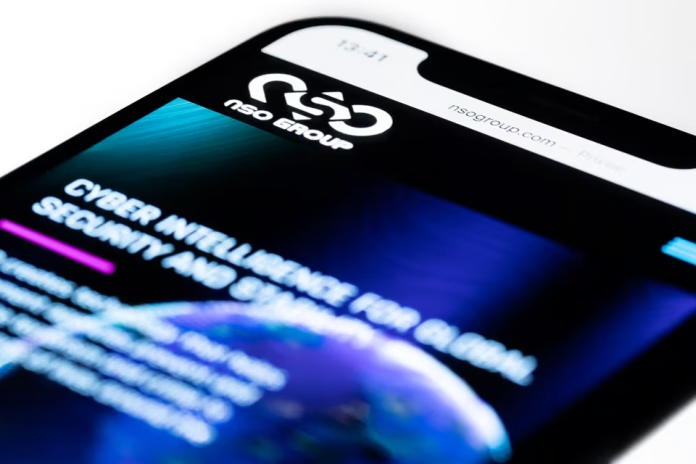
Pegasus is software developed by the Israeli company NSO Group and marketed as a cyber intelligence tool for government agencies.
Pegasus can grant access to messages, photos, and location data, as well as activate a cell phone’s microphone and camera without the affected person having to open a link. The software can exploit security vulnerabilities to infiltrate the device without any user interaction.
In their investigations, these organizations have indicated that the use of Pegasus is part of a recurring pattern of using advanced technologies to obstruct or interfere with the work of journalists, human rights defenders, and civil society organizations.
They also warned that, in some cases, the attacks occur within a broader context of pressure against journalists and organizations investigating matters of public interest.
They point out that the concern lies in the fact that a free and independent press can serve as a counterweight to governments and powerful actors, and therefore the use of surveillance tools against journalists and opposition figures can have consequences for press freedom and the functioning of democratic societies.