

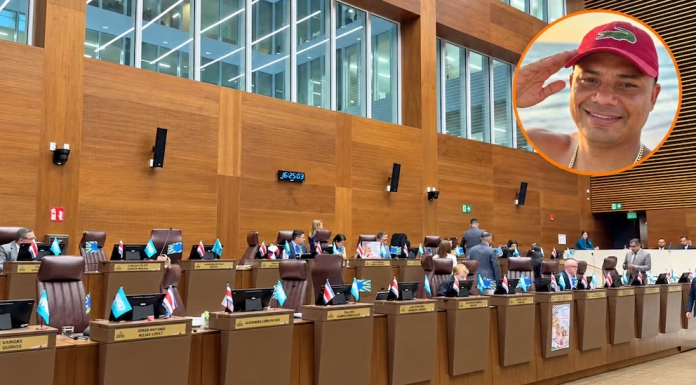


Q COSTA RICA — The death of Costa Rican Carlos Josué Marchena Marchena—who died while in the custody of U.S. immigration authorities—sparked a confrontation on Monday, September 21, among the legislative blocs of Costa Rica’s Legislative Assembly.
The clash occurred after the ruling party—the Partido Pueblo Soberano (PPSO)—faction rejected a motion to observe a minute of silence in his memory.
The proposal sought to have the Legislative Plenary pay tribute to the deceased compatriot and express solidarity with his family. However, the initiative failed to secure the necessary votes for approval due to opposition from the 29 ruling-party lawmakers present for the vote.
The 24 lawmakers who supported the motion belong to opposition factions, including Liberación Nacional, Frente Amplio, Unidad Social Cristiana, and the Coalición Agenda Ciudadana.
The opposition held the tribute during a recess.
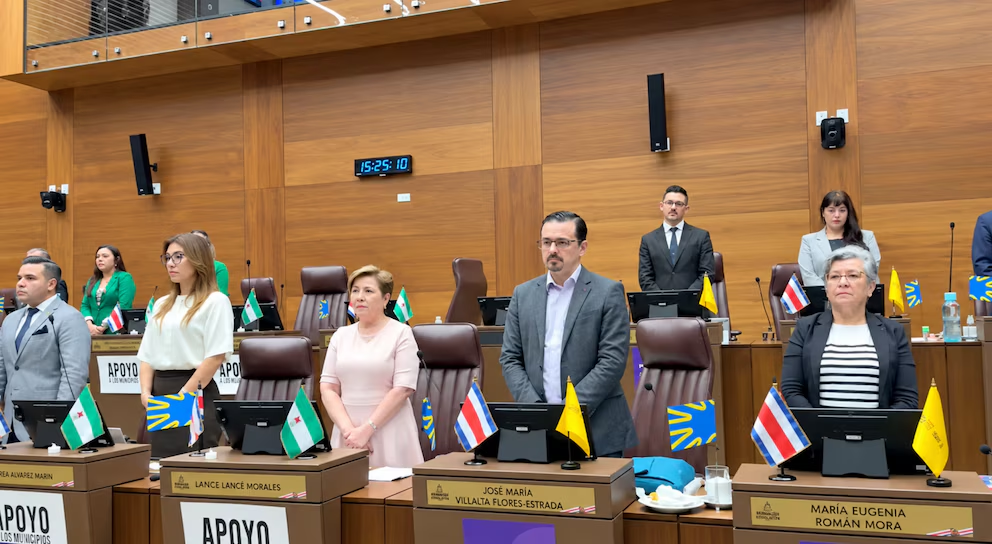
Following the rejection of the proposal, legislator José María Villalta of the Frente Amplio requested a legislative recess so that interested lawmakers could observe the minute of silence, even though it had not been authorized as an official act of the Plenary.
During this time, opposition lawmakers stood at their respective seats to remember Marchena and express their support for the Costa Rican man’s family.
Most members of PPSO left the legislative floor during the tribute. However, some ruling-party figures remained standing and participated in the observance.
Among them were the President of the Legislative Assembly, Yara Jiménez; legislator Reynaldo Arias Mora, a member of the Legislative Directorate; and legislator Robert Barrantes Camacho.
All three had voted against the motion but subsequently participated in the minute of silence called by the opposition legislators.
Why did the ruling party vote against it?
During the debate, ruling-party legislator José Miguel Villalobos justified his position by arguing that the motion had a political intent that went beyond merely expressing solidarity with the deceased’s family.
In his view, the proposal sought to indirectly question the United States government’s immigration policies, even though the text presented to the plenary session contained no explicit rejection of those policies.
Villalobos maintained that the intent should be analyzed not only based on what the motion stated but also on what, in his opinion, its proponents sought to convey.
Opposition legislators rejected this interpretation, arguing that the initiative was intended to express solidarity regarding the death of a Costa Rican citizen abroad.
Legislator Claudia Dobles, of the Citizen Agenda Coalition, stated that the tribute should be understood as a gesture of empathy toward a family facing the loss of one of its members.
Meanwhile, legislators from the Frente Amplio highlighted the importance of the Costa Rican state monitoring the conditions in which its citizens are held while in the custody of foreign immigration authorities.
A subsequent motion for reconsideration also failed to garner the necessary support to alter the initial decision.
Official position of the PPSO
Following the rejection of the motion, the PPSO’s legislative caucus issued a statement expressing condolences to Carlos Josué Marchena’s family and defending its decision to vote against the minute of silence.
“Our vote today against the motion presented in the plenary session does not signify indifference to this family’s pain,” the caucus stated, adding that it awaited clarification regarding the circumstances of the death.
However, legislators from the ruling party argued that the proposal sought to bring the debate over U.S. immigration policy into Congress and accused the opposition of trying to gain political advantage from the tragedy. “Our position stems from the view that such a painful situation should not be turned into a tool for the opposition to engage in political posturing,” they stated.
The group concluded that “a family’s grief deserves respect, prudence, and seriousness” and reiterated that it would not support initiatives that, in its view, turn a personal tragedy into a tool for political confrontation.
The case of the Costa Rican man who died in the United States
Carlos Josué Marchena Marchena had been detained by U.S. immigration authorities since January 2026 while his immigration status was being resolved.
He died in Louisiana, where he was in the custody of U.S. Immigration and Customs Enforcement (ICE).
According to information released about the case, Marchena was found unconscious at the Winn Correctional Center. Facility staff initiated resuscitation efforts, and he was subsequently transported to Winn Parish Medical Center, where he was pronounced dead.
The Costa Rican man’s family has alleged that, during his detention, he faced difficulties regarding food and access to medication, in addition to experiencing health issues in the days leading up to his death.
These circumstances are among the concerns raised by his loved ones as the official cause of death awaits confirmation.
Marchena was scheduled to be deported to Costa Rica approximately two weeks after his death. His family was already preparing for his return after he had spent nearly eight months in ICE custody.