




Q24N — More than 41 million Colombians are eligible to vote in the first round of the presidential elections this Sunday, May 31, 2026, a process that will determine who will occupy the Presidency of the Republic during the 2026-2030 constitutional term.
The event has garnered attention both within and outside the country because it will mark the succession of President Gustavo Petro and will determine the political orientation of the next government in one of Latin America’s five largest economies.
According to the National Civil Registry voting will take place both within Colombia and abroad. For Colombians residing outside the country, the electoral process began several days before the main day and will continue until the polls close on May 31.
In these elections, citizens will vote exclusively for the presidential and vice-presidential candidates. Each candidate appears on the ballot along with their vice-presidential running mate, and voters also have the option to cast a blank ballot (voto en blanco).
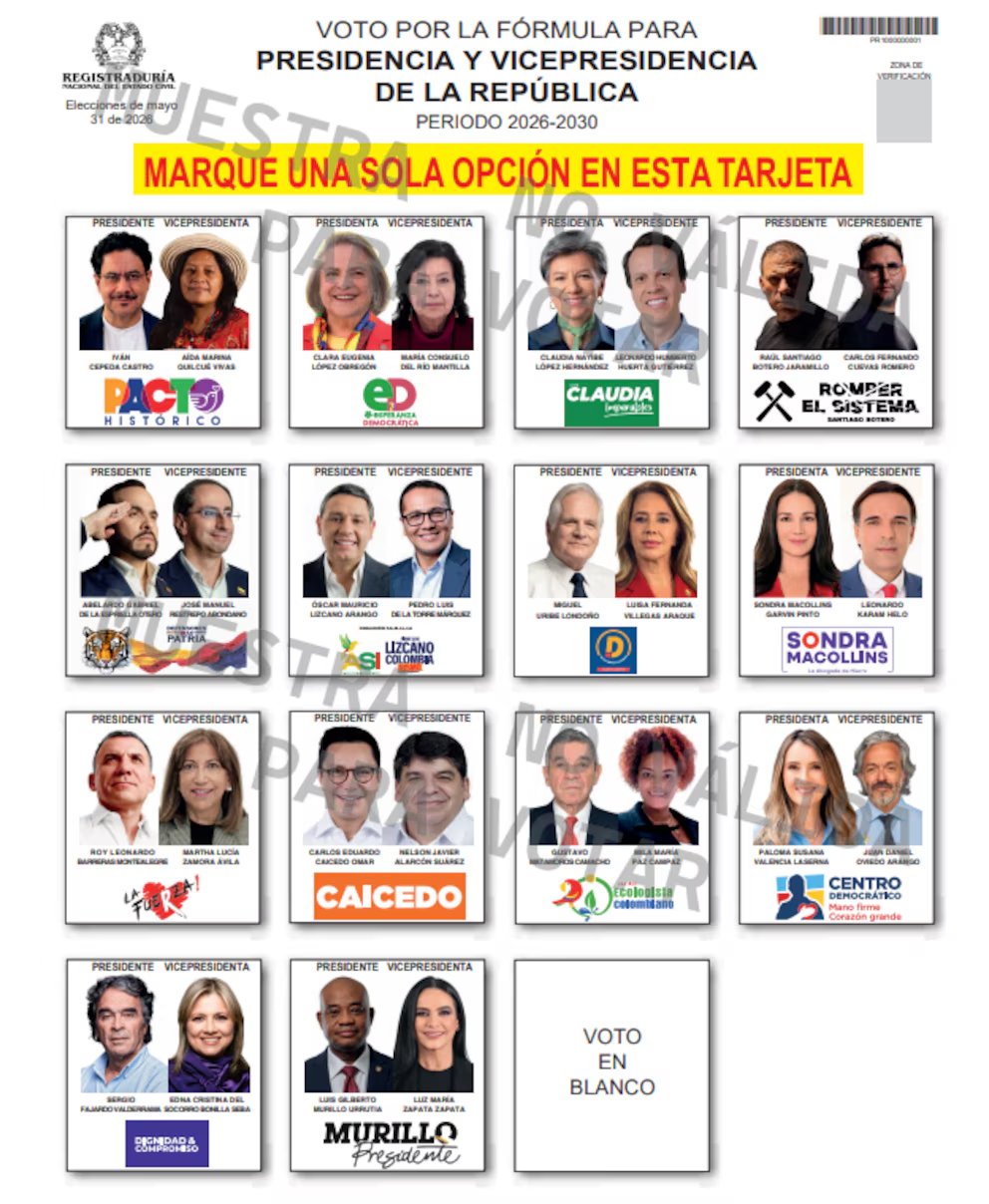
Unlike other electoral processes, this election will not include the election of members of Congress, governors, mayors, representatives, or council members. The legislative elections were already held in March 2026, resulting in the formation of the new Congress that will serve alongside the next head of state for the following four years.
The elected president will assume the presidency from August 7, 2026, to August 7, 2030, during which time they will be responsible for economic policy, security, international relations, and the implementation of key government programs.
The Colombian electoral system stipulates that to be elected president in the first round, a candidate must obtain an absolute majority of the valid votes cast; that is, half plus one of the votes (50% + 1).
When none of the candidates reaches this threshold, the Constitution mandates a second round of voting, also known as a runoff election. This mechanism was incorporated to ensure that the elected president has a majority electoral support and is used in several Latin American countries, such as Argentina, Chile, Costa Rica, Peru, and Brazil, and European countries.
For the 2026 elections, a potential runoff is scheduled for Sunday, June 21. Only the two presidential tickets that received the most votes in the first round participate in this stage.
Colombian law does not establish a fixed number of votes required to win the election, as the result depends on the total number of valid votes cast on election day.
Since the introduction of the presidential runoff in the 1991 Constitution, only Álvaro Uribe has managed to avoid a runoff. He did so twice consecutively: in 2002, when he won the presidency with 53.05% of the vote against Horacio Serpa, and in 2006, when he was re-elected with 62.35% of the vote against Carlos Gaviria. All subsequent elections have required a second round.
The five candidates with the best chances according to the polls
Although several presidential tickets appear on the ballot, the various polls published during May agree in pointing to five figures as those who garner the most voter support.
- Iván Cepeda
The candidate of the Historical Pact is presented as the main hope of the political sector that supports President Gustavo Petro. The senator and leftist leader has led in most of the polls published during the campaign and enters the election as one of the favorites to advance to a potential runoff. His platform focuses on continuing several of the reforms implemented during the current administration, especially in social, institutional, and peacebuilding matters with armed groups. - Abelardo de la Espriella
The lawyer and businessman is running for the Defenders of the Homeland movement and has built his campaign around issues related to security, the fight against corruption, reducing the size of the state, and defending free enterprise. In recent weeks, he has seen sustained growth in various polls and appears to be one of the main contenders for a spot in the runoff. - Paloma Valencia
The senator from the Democratic Center represents one of the parties with the largest presence in the Colombian Congress. Her candidacy is positioned within the right and center-right sectors, and she has focused part of her campaign on proposals related to strengthening the Public Force, reducing taxes, and promoting private investment. Various polls place her in contention for second place. - Sergio Fajardo
The former governor of Antioquia and former mayor of Medellín is participating in a presidential election for the third time. Traditionally identified with centrist positions, he has based his campaign on proposals related to education, transparency, and institutional strengthening. However, polls show him trailing the leading candidates. - Claudia López
The former mayor of Bogotá is also competing from the center-right. Her campaign has focused on issues of public administration, urban security, the fight against corruption, and institutional reforms. Like Fajardo, she appears in the polls behind the three main frontrunners.
Polls published by leading firms agree that the election remains open and that none of the candidates currently have enough votes to win in the first round.
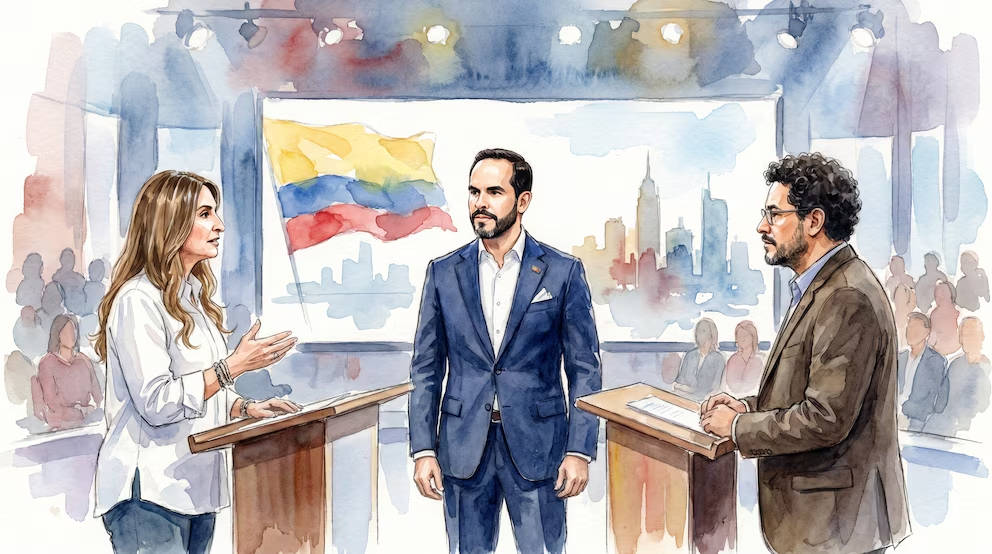
In terms of voting intentions for the first round, Iván Cepeda leads in most of the polls released in May, followed by Abelardo de la Espriella and Paloma Valencia. Sergio Fajardo and Claudia López trail behind.
The runoff scenarios vary significantly depending on the polling firm. While Invamer projects advantages for Cepeda over all his potential rivals, studies conducted by Guarumo & Ecoanalítica, Atlas Intel, and the National Consulting Center show competitive scenarios and even advantages for some opposition candidates in certain matchups.
According to Invamer, Cepeda would obtain 52.4% of the vote compared to 45.3% for De la Espriella and 52.8% compared to 44.3% for Paloma Valencia. Conversely, Guarumo & Ecoanalítica projects a scenario in which De la Espriella would reach 43.6% compared to Cepeda’s 40%, while Valencia would obtain 44.8% compared to the government candidate’s 39.9%.
Atlas Intel presents similar results, showing De la Espriella with 50% of the vote intention compared to Cepeda’s 41.3% in a potential runoff. Meanwhile, the National Consulting Center registers a narrower difference, with De la Espriella obtaining 43.6% compared to Cepeda’s 40.9%.
Although polls differ on the exact percentages, most agree that Iván Cepeda, Abelardo de la Espriella, and Paloma Valencia are the candidates with the best chances of securing the top two spots in the first round of the presidential election.
The projections available so far suggest that Colombia is headed for a runoff election on June 21, as none of the candidates are close to the threshold needed to win the presidency outright in the first round.
The final result will depend on voter turnout and how the vote is distributed among the various candidates in an election that will determine Gustavo Petro’s successor for the 2026-2030 term.