



Q COSTA RICA — The El Niño phenomenon is significantly raising temperatures in Costa Rica, a fact that has alarmed agricultural and food experts.
According to recent reports, the increased heat accelerates food spoilage, posing a greater risk to food security in the country.
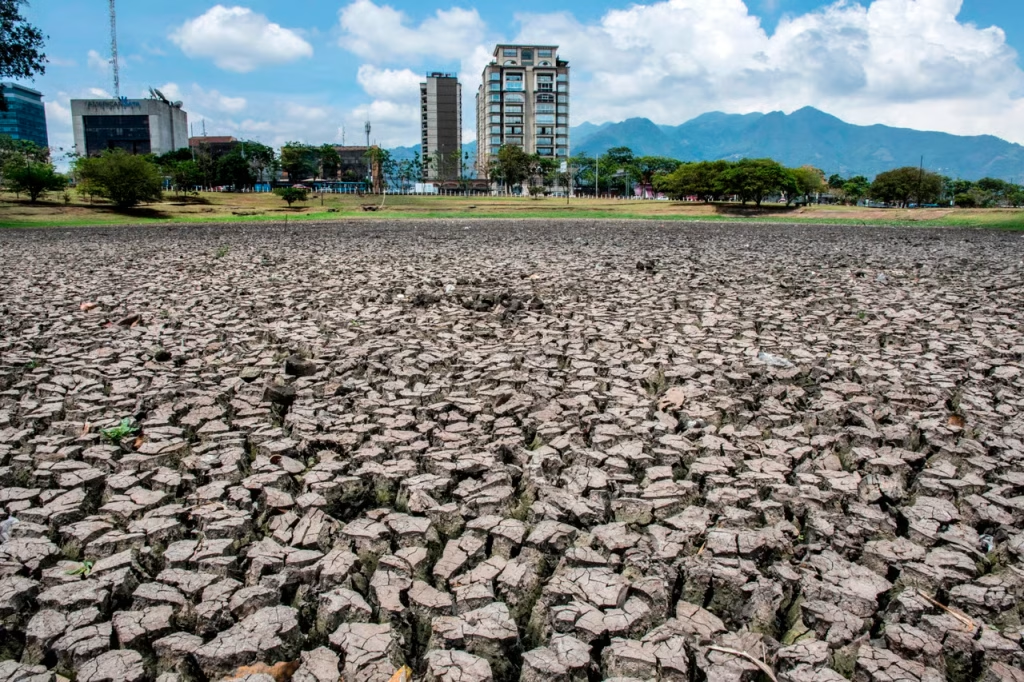
The temperature increase associated with El Niño not only affects environmental conditions but also has a direct impact on agriculture. The high temperatures and prolonged droughts being recorded in Central America, including Costa Rica, are causing significant agricultural losses.
This translates into a reduction in the availability of fresh food and a greater risk of spoilage of stored products, hindering their preservation and increasing economic losses for producers and consumers.
The warning was issued by Edgar Gutiérrez Font, tutor of Food Microbiology at the Universidad Estatal a Distancia (UNED), who pointed out that high temperatures can accelerate both the reproduction of microorganisms and the chemical and natural processes that affect the quality of products.
The call takes on particular importance at a time when Costa Rica is experiencing El Niño-influenced conditions. The national weather service, the Instituto Meteorológico Nacional (IMN), maintains a forecast of low rainfall for September in parts of the Pacific, Central Valley, and Northwest Zone, related to the presence of the El Niño phenomenon and other atmospheric conditions that limit rainfall.
Although Costa Rica is a tropical country accustomed to relatively high temperatures, Gutiérrez explained that an additional increase in heat can significantly alter the length of time food remains safe to eat.
“Hotter conditions can definitely affect food handling and preservation, and increase the risk of exposure to various illnesses caused by food spoilage,” the specialist explained.
According to information released by UNED, climate projections for the second half of 2026 anticipated a reduction in rainfall of between 10% and 30%, accompanied by temperatures between 0.5°C and 1°C above average.
The impact is not limited to food preservation. Reduced rainfall can put pressure on water reserves, affect agricultural productivity, decrease the availability of pasture for livestock, and potentially impact the prices of certain basic goods.
However, once these foods reach supermarkets, stores, and homes, another challenge begins: keeping them at temperatures that inhibit the growth of microorganisms.
The specialist emphasized that precautions shouldn’t focus solely on what’s typically stored in a refrigerator.
Products like eggs (eggs in Costa Rica are not refrigerated), fruits, and vegetables that can be kept at room temperature can also spoil more quickly under intense heat.
For this reason, one of the main recommendations is to avoid buying quantities of fresh food that significantly exceed the household’s immediate needs.
“It’s recommended that when we shop, we buy only what we plan to consume within a certain timeframe. If we buy a large quantity of a fresh food and want to store it, it’s important to portion it out for each use,” Gutiérrez noted.
Thawing on the Countertop Can Increase the Risk
Another common practice that could pose a greater risk during periods of high temperatures is leaving meat or other foods to thaw at room temperature.
Gutiérrez recommended transferring products from the freezer directly to the refrigerator and allowing them to thaw slowly under controlled conditions.
“If we are going to thaw food that we have in the freezer, it is important to do so in the refrigerator, since if we do it at room temperature and with the high temperatures we may experience, the product will be much more susceptible to spoilage,” he explained.
Given the current climate scenario, the UNED summarized the main recommendations into simple actions: plan your shopping trips, properly maintain the cold chain, separate raw and cooked products, store prepared meals correctly, rotate food items, and thaw them in the refrigerator.
The current climate scenario reinforces the importance of these measures. For the week of September 7-13, 2026, the IMN forecasts particularly dry conditions across large areas of the Pacific and rainfall deficits that could extend throughout September, in a context marked by El Niño.
The El Niño phenomenon is strengthening in the region and could also exacerbate food insecurity more broadly, affecting not only Costa Rica but several other Latin American countries.