



Q COSTA RICA — The trial against Ricardo Olivas Valle, former treasurer of the State bank, the Banco Nacional de Costa Rica (BNCR), has entered its final stage with the prosecution requesting a total of 396 years in prison for the alleged embezzlement of ¢3.293 billion colones (US$7.3 million) stolen from the vaults of the bank’s headquarters in San José.
The Deputy Prosecutor’s Office for Probity, Transparency, and Anti-Corruption (FAPTA) began presenting its conclusions to the Criminal Court, where it will explain why it believes the former official is responsible for the alleged acts and formally request a prison sentence.
Olivas faces charges of 33 counts of embezzlement, one for each withdrawal of money over a two-year period that, according to the Public Prosecutor’s Office, he allegedly made between 2021 and 2023, taking advantage of the last minutes of the workday and times of least surveillance within the bank.
Read more: Banco Nacional confirms missing ¢3.3 billion in cash!
According to the investigation, Olivas made withdrawals mainly between 4:16 p.m. and 5:29 p.m., when activity within the facilities decreased. The Prosecutor’s Office maintains that the former treasurer took advantage of alleged lapses in internal controls to remove millions of colones from the vaults.
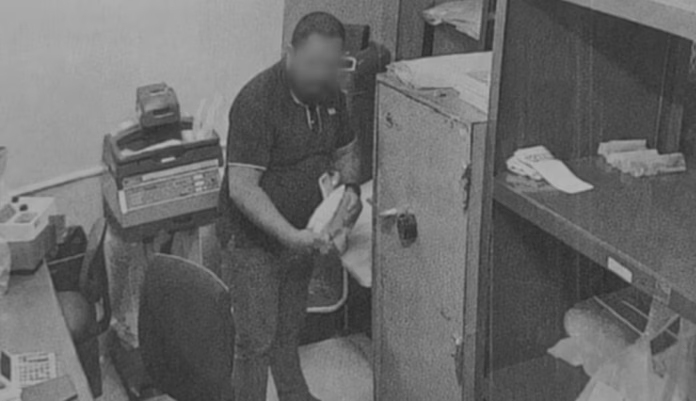
During the trial, dozens of security camera recordings were analyzed, which, according to the prosecution, show the former official placing bundles of bills into yellow manila envelopes before leaving the bank, passing through security checkpoints.
The case was dubbed “Gallo Tapado” (Hidden Rooster) by the Organismo de Investigacióon Judicial (OIJ) and the Prosecutor’s Office due to the alleged mechanism used to conceal the origin of the money.
According to the prosecution, Olivas allegedly used some of the stolen funds to buy large quantities of lottery tickets from the state lottery, the Junta de Protección Social (JPS). When he won, the money was deposited into his bank accounts, allowing him to introduce the funds into the financial system while making them appear to come from a legitimate source.
During the raids carried out at his home, authorities found nearly 3,000 lottery tickets, which were included as evidence in the court file.
Based on the evidence presented during the trial demonstrates the former official’s involvement in the embezzlement for which the Public Prosecutor’s Office requested a cumulative sentence of 396 years.
Read more: How to rob a bank and get away with it
However, although the total sentence far exceeds the national legal limit, the eventual sentence must be adjusted to the maximum limit established by Costa Rican law, which is currently 36 years in prison.
In addition to the Prosecutor’s Office, the Attorney General’s Office and the Banco Nacional, the institution claiming the allegedly embezzled funds, are participating as prosecuting parties in the case.
He admitted to lottery addiction
During his testimony before the Court, Olivas admitted to having problems related to gambling, although he claimed his addiction was limited to buying lottery tickets.

“I was addicted to gambling at one point, only to the lottery,” declared the former official, who asserted that after entering preventive detention (prison) in 2023, his problem was solely related to “the urge to gamble.”
The former treasurer denied that his behavior was linked to other types of betting and stated that he mainly bought lottery tickets.
Failures in Banco Nacional Controls
The investigation also revealed alleged weaknesses in the Banco Nacional’s internal oversight mechanisms.
According to the prosecution, thorough physical audits of the vaults had not been conducted since 2019, a situation that allegedly allowed the thefts to continue undetected for several years.
Read more: Banco Nacional just can’t seem to stop theft from within
In addition to Olivas, other individuals were included in separate investigations for possible omissions, dereliction of duty, or cover-up. These include supervisors, accountants, security personnel, and former legal directors of the institution.
The trial will continue with the closing arguments, after which the Criminal Court will determine the former official’s responsibility and any potential sentence.