Costa Rica is not the biggest of countries, it is not a place that will require long flights to get from one place to another, it is not a country which has train rides that can take almost a day or bus rides that can consume whole weekends.
However, there are still some journeys that can take a little time. It is not as if you can zip from one place to the other without at least some travel and some need to pass the time which often feels like it is seriously dragging when you are stuck on a bus or train.
The journey from San Jose to Tamarindo, for example, can take over four hours by car so if you take public transport it will be even longer. This is the time where you will want something to do, something that can help you to forget that you are going to be on the road for a while. Costa Rica has many beautiful viewing points but some journeys can take you through places that are less than picturesque, meaning many people turn to their phones to keep them entertained.
It is amazing what our phones can do nowadays and it is no surprise that we often see people glued to them. They are like small cinemas, little games consoles and music machines all in one little package, they have everything you need to keep you entertained. The rise of apps has cemented this role for phones and now there are so many apps to choose from that it can be a little overwhelming. You don’t want to find yourself on a seven-hour journey from beautiful Puerto Jimenez to Liberia only to find the apps you have installed are useless.
To help you out, we thought we should explore two of the must-have apps for traveling around Costa Rica.
Wintingo online casino
When you are traveling, often you just wanted to feel you are transported to somewhere else. You want to forget you are on a bus or a train and imagine yourself in a faraway land doing something else. Wintingo online casino makes you feel like you are in Monte Carlo or Las Vegas on a buzzing and elegant casino floor, the fact that they offer a match bonus of up to $500 adds to the illusion that you are a billionaire in Monte Carlo.
Yo Viajo
You are not going to be getting far in Costa Rica without knowing from where and when the buses are going to be coming. Yo Viajo is the most easy to use app for journey planning and gives you all the info you need for your Costa Rican adventure. It can help you get from A to B and you can even use the app to buy and store your tickets.
Viva El Menu
Your bus or train might be stopping off somewhere for you to grab some food, Costa Rica has some magical places to grab a bite but it can be a little hard to find a place. Viva El Menu has a guide to all the perfect places to get something to eat in Costa Rica and best of all, the app is free.
Premier Brian Pallister said he was 'surprised' and 'disappointed' to learn that he might owe a luxury tax on his Costa Rican vacation home. (Warren Kay/CBC)
Manitoba, Canada, Premier Brian Pallister faced questions in the legislature Wednesday about allegations he failed to pay a luxury tax on his Costa Rican vacation home.
Manitoba Premier Brian Pallister said he was ‘surprised’ and ‘disappointed’ to learn that he might owe a luxury tax on his Costa Rican vacation home. (Warren Kay/CBC)
Pallister and his wife own the 7,000-square-foot home — which sits on several acres of land near Tamarindo, Costa Rica — through a holding company.
CBC News has reviewed a list of companies posted by the Costa Rican revenue department that had not paid the tax and the premier’s holding company is on it.
The Costa Rican luxury tax is applied to homes that exceed a certain value.
The Venezuelan state-owned aluminum firm Alunasa has announced its intention to layoff more than 300 workers at its plant in Costa Rica due to lack of raw materials to operate, the Ministry of Labor reported.
Labor confirmed in a statement that Alunasa submitted on March 22 the request to temporarily suspend part of its workforce “citing the lack of essential raw material to keep the factory running.”
According to the statement, about only 40 employees, office staff, would remain at the Alunasa located in Esparza, about one hour west of San Jose.
The ministry said that “the request for temporary suspension of contracts is for a period of three months, but the company is making efforts so that the process resumes as soon as possible.”
Costa Rican labor legislation establishes conditions under which a company can suspend work temporarily – lay off – without termination of employment contracts, and the Ministry of Labor must determine the veracity of the causes raised by the company.
The said it ministry verified that the company paid punctually wages for the second half of March and complied with the labor rights of its employees. Since the workers would have no income as of April, the ministry indicated that it would seek solutions for them during the shutdown of the plant.
The situation pointed to Venezuela’s economic agony as it teeters on the brink of default and as its government scrambles to juggle its shrinking finances. The Venezuelan army general in charge of the factory in Costa Rica, Noel Martinez, told a group of the workers on Tuesday that Alunasa had problems sending needed aluminum from Venezuela for the plant to operate and the company was seeking permission from the Venezuelan government in Caracas to source the metal from other markets.
From January to September 2017, companies in Costa Rica imported $62 million worth of printing machines, and purchases from the United States grew by 9%.
Figures from the information system on the Market for Machines and Devices for Printing in Costa Rica, compiled by the Business Intelligence Unit at CentralAmericaData:
Changes in imports Between the first nine months of 2016 and 2017 the imported value of printing machines in Costa Rica decreased by 5%, falling from $65 million to $62 million.
However, for the months in question, over the last 3 years imports of these items from the US rose from $38 million in 2015 to $42 million in 2017, which represents an average annual rate of increase of 5%.
Origin of imports During the first three quarters of 2017, 67% of the import value came from the USA, 11% from China, 5% from Japan, 4% from the Philippines, 3% from Thailand and 1% from Vietnam.
The Philippines is the market of origin of imports that has grown the most in the last 6 years. In 2012 it represented 0.7% of the total import value, and in the first nine months of last year this figure rose to 4%.
Progressive values won in Costa Rica – for now, at least.
AP Photo/Arnulfo Franco
Carlos Alvarado Quesada has won the Costa Rican presidency with 61 percent of the vote, an overwhelming victory for a progressive candidate who entered election day in a dead heat with his conservative rival.
Alvarado Quesada, a 38-year-old former labor minister under the unpopular outgoing President Luis Guillermo Solis, ran on an “agenda of equality” that included support for same-sex marriage, public education and renewable energy. In Costa Rica, this is a rather classic political platform.
Progressive values won in Costa Rica – for now, at least. AP Photo/Arnulfo Franco
But his opponent, Fabricio Alvarado Munoz – an evangelical senator and former Christian musician who opposes gay marriage, secularism and sex education in schools – won the first round of Costa Rica’s election in February. The April 1 runoff was widely viewed as a referendum on social values in country historically seen as stable and progressive.
In a region where nearly every other nation faces extreme violence and has a history of political unpheaval, peaceable Costa Rica is sometimes called “the Switzerland of Central America.” Many commentators will tout Alvarado Quesada’s triumph as a confirmation of Costa Rican exceptionalism.
I see things differently. In the 15 years I have studied Central American politics, deep fractures have emerged in Costa Rica’s democracy – the same social and religious tensions that were on display in the 2018 election.
Meanwhile, I’ve watched troubled El Salvador and Guatemala become stronger democracies. Costa Rica is still an exception, but it is closer to the Central American average than ever before.
Costa Rican equality
The origins of Costa Rica’s exceptionalism are often attributed to the fact that it has no military. President José Figueres abolished it after the country’s brief 1948 civil war.
As a result, modern Costa Rica has seen neither the military dictatorships nor protracted civil wars that plagued every other Central American Country during the 20th century.
Less defense spending has freed up the national budget, allowing Costa Rica to invest in gold-standard environmental protections and universal public education. Its population is among the world’s most literate.
Costa Rica is also wealthier than the rest of Central America, which is one of the poorest regions on the globe. It scores as well as European nations on many of the United Nations’ human development measures, including gender equality. About a third of seats in Costa Rica’s legislature are held by women, thanks to strong gender parity laws. Costa Rica had a woman president, Laura Chinchilla, from 2010 to 2014.
The country is also Central America’s least corrupt. Just 9 percent of Costa Ricans reporting having experienced corruption, according to Vanderbilt University’s AmericasBarometer survey. By comparison, a quarter of Guatemalans say they’ve been the victim of corruption.
The state of democracy in Costa Rica
In some ways, this year’s election was in keeping with Costa Rican tradition. Turnout was typically high – about 62 percent. The election was free and fair, as Costa Rica’s elections usually are. There were none of the irregularities seen in, say, Honduras’ contested November 2017 presidential election.
But the campaign was still unusual. Nearly 40 percent of Costa Ricans voted for an ardently anti-gay candidate from the upstart Evangelical National Restoration Party. That is consequential in a historically secular country.
It is also significant that neither of the two finalists for president was from a mainstream political party.
The National Liberation Party decided to back Alvarado Quesada after he progressed to the second round of the election, but it was the first time since the party’s founding in 1951 that its own nominee did not compete for Costa Rica’s presidency, indicating widespread voter discontent with politics as usual.
Neither did the official candidate of the Social Christian Unity Party, Costa Rica’s mainstream conservative opposition, which did not back Alvarado Munoz.
The rise in outsider candidates and the unexpected strength of evangelical voters this year demonstrate that Costa Rica is less unified and less progressive than it once appeared.
Guatemala’s outsider candidates
Alvarado Quesada’s victory does not erase these fissures. Watching him lag behind a religiously conservative, tough-on-crime political outsider with pop culture roots during most of the 2018 campaign, I was actually reminded of neighboring Guatemala.
In 2015 comedian Jimmy Morales won a surprise bid for that country’s presidency. Competing against a former first lady, he ran on the slogan “Neither corrupt nor a thief.”
Political parties in Guatemala are traditionally weak, so an outsider candidacy was not surprising there. In fact, many saw the Morales win as a positive sign for Guatemalan democracy.
Morales was elected a month and a half after President Otto Pérez Molina stepped down to face trial on corruption charges. Molina is one of hundreds of Guatemalan officials to be tried for corruption since 2007, when the country invited in a UN-backed anti-corruption commission to clean house.
Today Morales, a conservative, is himself embroiled in a corruption scandal, confirming that public malfeasance remains a major political problem.
But the nonviolent democratic transfer of power after a presidential resignation was a sign that peaceful change was possible in Guatemala. This alone was a significant step forward for a Central American nation with a long history of conflict.
El Salvador on the rise
Democracy is gaining ground in troubled El Salvador, too. There, the leftist Farabundo Martí National Liberation Front (FMLN) and its main conservative opposition, ARENA, have participated together in politics since 1992, when peace accords brought quiet to El Salvador. The two factions once fought each other in bloody civil war.
Under the FMLN former revolutionaries, who have been in power since 2009, El Salvador has followed a moderate political path, seeking to improve access to social services and reduce inequality.
I believe El Salvador has actually replaced Costa Rica as having the strongest party system in Central America. This is an especially impressive achievement just 26 years after the 12-year civil war ended decades of military dictatorships.
In a country battling perhaps the world’s highest homicide rates, El Salvador has also created specialized courts to address violence against women.
More Salvadoran women are getting involved in politics, too. From 2003 to 2012, the number of female mayors in El Salvador increased from 15 to 28, according to United Nations data. There are 262 mayors nationwide.
Toward a Central American average
Guatemala and El Salvador are far from perfect democracies. As I argued in my recent book, both still struggle to build the rule of law. Corruption and crime remain huge challenges.
Along with Uruguay, Costa Rica is still one of just two “full democracies” in all Latin America, according to the Economist Intelligence Unit, which ranks countries worldwide based on civil liberties, transparency and political participation, among other measures.
But its neighbors are making strides. 60 percent of Guatemalans vote regularly – just shy of the Costa Rican average. Turnout is even higher in El Salvador. Central America is changing.
So is Costa Rica. In a region where democracy is improving, the 2018 election showed that it is just a little less of a Central American exception.
Rachel E. Bowen, Associate Professor of Political Science, The Ohio State University.
This article was originally published on The Conversation. Read the original article.
(OPINION) The Washington Post – THE HISTORY of North American attitudes toward Latin America is in part a story of serial infatuations with various revolutions and regimes. The left fell in love with Fidel Castro’s Cuba and Sandinista Nicaragua; many on the right hailed the supposed free-market magic of Chile under Gen. Augusto Pinochet.
Through it all, one country whose political and social systems actually deserved to be held up as a model never quite captured the “yanqui” imagination: Costa Rica has been a peaceful multiparty democracy since 1949, with high levels of literacy, near-universal access to health care and, blessedly, no standing army. Maybe Americans found this oasis of order and progress unexciting compared with its more turbulent Central American neighbors.
In any case, we are happy to report that, in a world where populism of all stripes is on the rise, and liberal democracy seems to be on the defensive, Costa Rica continues to embrace tolerance and civility. On Sunday, voters turned out in larger-than-usual numbers to elect Carlos Alvarado Quesada as president — and to reject the candidacy of right-wing populist Fabricio Alvarado Muñoz (no relation), which was based almost exclusively on opposition to same-sex marriage. Mr. Alvarado Muñoz, sounding a note of Trumpian neo-nationalism, not only promised to ignore a January ruling in favor of marriage equality by the San Jose-based Inter-American Court of Human Rights but also hinted at pulling the country out of the Organization of American States. Contrary to polls that had shown a dead heat going into election day, 60 percent of the electorate rallied to Mr. Alvarado Quesada and his message of inclusion and respect.
A different outcome might have left Costa Rica in the unusual position of lagging behind Latin America in individual freedom, because several other countries, including Argentina and Colombia, have already adopted same-sex marriage. For now, the country still occupies its customary position in the democratic forefront. Nevertheless, seven decades since its inception, Costa Rica’s democratic experiment is showing some of the same signs of wear and tear that better-known counterparts in Europe and North America exhibit: the decay of traditional political parties, corruption scandals, rising income inequality and a surge in violent crime.
Concern over these problems may have fueled Costa Rica’s political volatility as much as the issue of gay rights. Yet in turning to Mr. Alvarado Quesada, the people showed an admirable resistance to demagoguery and single-issue politics. It will be up to the new president to show that they were right to place their trust, once again, in the democratic values and institutions that have served this remarkable country so well.
For the first time in the country’s history, a black woman will be Costa Rica’s vice president. Here’s what you need to know about Epsy Campbell Barr.
Entrepreneur and promoter Don Stockwell, acclaimed for his many followers on Facebook due to a peculiar promise to President-elect Carlos Alvarado, if he won, to bring Pink Floyd to Costa Rica.
Now Ticos are aking the promoter to make good on his promise.
The promise began in a video shared by the president-elect on his Facebook page, where he appears singing a song called “Wish You Here” by Pink Floyd, considered one of the most influential British roack band in history.
Although the promoter did not give details, he did post on Facebook that he was going to press Roger Waters, one of the members of the rock group.
The Government of Honduras will invest US $ 200 million on the road to Nicaragua.
The Government of Honduras will invest 4.760 Billion lempiras (about US$200 million) in the reconstruction of the road that leads from Tegucigalpa to the eastern city of Danlí and Las Manos, border point with Nicaragua, reported the Prensa Libre.
The Government of Honduras will invest US$200 million on the road to Nicaragua. Photo Prensa Libre
The financing of the 130 kilometer route will be financed by external funds, said the head of the Ministry of Infrastructure and Public Services (INSEP), Roberto Pineda, according to a statement from the Presidency of the Republic.
Pineda said the project is supported by the Honduran president, Juan Orlando Hernández, whose government promotes the reconstruction of some of the main roads of that country and the opening of new ones to contribute to agricultural production and the growth of domestic tourism, among other sectors.
The Government of Honduras has also invested some US$210 million in the reconstruction of the so-called southern highway that connects Tegucigalpa with the city of Choluteca, and El Amatillo, on the border with El Salvador, a project currently underway.
Panama has placed Venezuelan President Nicolas Maduro and other top officials on a watch list for money laundering.
The National Commission Against Money Laundering published a resolution naming 55 people and 16 Venezuelan companies “considered high risk for money laundering” and financing terrorism.
The challenge facing the next government led by President-elect Carlos Alvarado, is a Costa Rica economy facing its biggest fiscal deficit in 30 years, when more than one-third of the central government’s debt is due and without many instruments to finance it, with permission to issue bonds abroad, and the pressure of a reduction in the risk rating.
In the next four years, more than one-third of the central government’s debt is due
In addition, it is possible that the next government may not even have an approved tax plan to generates new resources, including the Value Added Tax (VAT) proposal, which has so far not received the political commitment to approve the project.
Another negative outlook is that the economy, although it has recovered since December, is still slow, which means less tax collection and more uncertainty.
Consumption continues to decelerate, and this means that people are not spending, credit is stationary, and unemployment continues as one of the largest the country has, mainly in young people and rural areas. Needless to even mention the actuarial problem facing the regime of Disability, Old Age and Death Fund (IVM), in general.
To find solutions, the President-elect’s economic team will be led by Edna Camacho, who is part of the alliance with Rodolfo Piza, leader of the Partido Unidad Social Cristiana (PUSC), and Alberto Franco, Edgar Robles, Javier Chaves, Pablo Villamichel, Roxana Morales, Sol Echeverría, José Francisco Pacheco, Jorge Guardia, André Garnier, Ottón Solís, among others.
First challenge: Do not enter into defaults (impagos in Spanish)
The first thing that President-elect Alvarado must do is to have a plan so that the country does not go into default. If the Central Bank projection of a deficit of 8% of GDP in 2019 is reached, the red lights of a possible default would be on.
If with a deficit of 6.2% of GDP last year, we are already experiencing interest rate pressures, the uncertainty of consumers and investors, liquidity problems in the Treasury, warnings from risk rating agencies and a squeeze on resources.
What would the panorama look like if there is no fiscal solution?
Experts say the solution must start with lowering expenses. Income must be raised, the VAT is vital instead of the central government relying solely on a general sales tax on goods. With that there is a dire need to modernize the tax authority (Ministerio de Hacienda), to make tax collection more efficient.
Finding measures to lower informality (in labor) and contraband are two good actions that would provide the central government with added resources.
Among the experts pointing out the most critical points that President Alvarado will face are: economist and former President Miguel Angel Rodriguez and Daniel Sucher, financial expert and independent analyst.
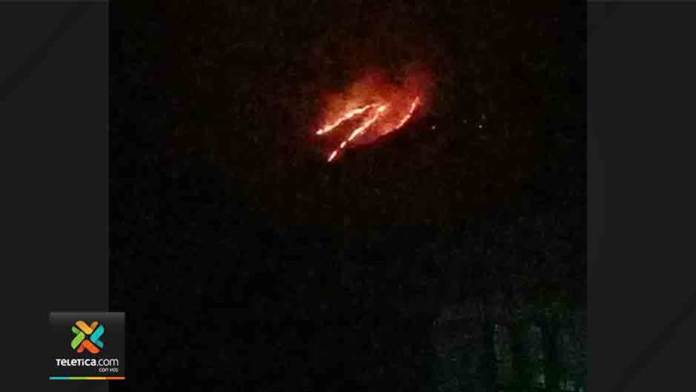
A forest fire continues to several hectares of Cerro Los Cuarteles in La Legua de Aserrí. According to surrounding neighbors, the fire is uncontrollable and destroying the mountain and several paddocks.
The flames can be seen from several points such as Frailes de Desamparados, Santa Cruz de León Cortés, San Antonio de Corralillo, Bustamante and San Cristóbal Sur.
As of late Monday night (11:10 p.m.) the fire had consumer more than 30 hectares.
SpaceX has successfully launched the 15th mission to the International Space Station on Monday, with a payload that included Costa Rica’s – and Central America’s – first satellite.
The satellite, which is part of the Irazú project and is a small cube shape, was designed to collect data on the growth of our country’s forest. According to Julio Calvo, of the Instituto Tecnológico de Costa Rica (TEC) the satellite is expected to transmit data “of environmental variables from remote protected areas of Costa Rica to a data visualization center on the ground”.
Liftoff took place at 20:30 UTC, April 2nd, 2018 from SLC-40 of Cape Canaveral.
Following a long and divisive campaign, president-elect Carlos Alvarado, has called for unity, for all Costa Ricans to become united for the benefit of all.
With 97.47% of the votes counted, Carlos Alvardo obtained 60.66% of the votes, his rival, evangelical minister Fabricio Alvarado, 39.34%
Carlos Alvarado’s win on Sunday was by a surprisingly big margin over his rival, Fabricio Alvarado – no relation.
With 97.47% of the polling stations processed by noon on Monday,, the PAC candidate obtained 1,293,668 votes (60.66%), the PRN 839,092 (39.34%) of the total 2,132.760 ‘valid’ votes.
Following a well deserved rest, the president-elect came out of his Santa Ana condo Monday, calling on other parties to join him in a government of national unity, later in the day fulfilling a promised he made his mother, to visit “La Negrita” – the Virgin of Los Angeles – in Cartago once the election was over.
‘Taking the country forward’
In his victory speech, Sunday night, in San Pedro, in front of supporters, the former minister said that Costa Ricans could now “go to sleep reassured because there is a decision and now we’ll unite to take this country forward”.
He also said that he had already received a “call” Fabricio Alvarado, congratulating him.
On Monday, the President-elect, among the congratulatory calls received were from the U.S. Ambassador to Costa Rica on behalf of her government and Panama president, Juan Carlos Varela.
Don Carlos was quick to point out to Varela of the close ties between Costa Rica and Panama and that his son, Gabriel, was in fact born in Panama. “Es Panamemio (he’s Panamanian),” Carlos told Varela on the phone in front of the cameras. Carlos Alvarado and his wife, Claudia Dobles, who will be the First Lady, had lived in Panama for several years before returning to Costa Rica.
By the end of the day it was evident the president-elect was not sparing the little time he has to form a government by May 8.
For her part, vice-president elect, Epsy Campbell, said Monday they started work contacting all the different factions in the country’s national assembly to forge a government of national unity.
Who Is Carlos?
Carlos Alvarado Quesada (born January 14, 1980, in San Jose) is a writer, journalist, political scientist and politician. He previously served as Minister of Human Development and Social Inclusion and Executive President of the Joint Social Welfare Institute (IMAS) and Minister of Labor after the resignation as minister of Víctor Morales Mora, under the current administration of Luis Guillermo Solis. Alvarado has a Bachelor’s degree in communication and a Master’s degree in political science from the University of Costa Rica, as well as a Master’s degree in development studies from the University of Sussex
Among his work experience, he served as an advisor to the Citizen Action Party’s (PAC) group in the Legislative Assembly (2006-2010), was a consultant to the Institute of Development Studies of the United Kingdom in financing SMEs and Department Manager of Dish Care & Air Care (Procter & Gamble Latin America).
For the 2014 election, Carlos Alvardo was Director of Communication for the presidential campaign of Luis Guillermo Solís, professor in the School of Sciences of Collective Communication of the University of Costa Rica and in the School of Journalism Of the Universidad Latina de Costa Rica.
Carlos Alvarado is also a published author, in 2006 publishing the anthology of stories Transcripciones Infielescon Editorial Perro Azul. That same year he obtained the Young Creation Award of Editorial Costa Rica with the novel La historia de Cornelius Brown. In 2012 he published the historical novel Las Posesiones that portrays the dark historical period in Costa Rica during which the government confiscated the properties of Germans, Japanese and Italians during World War II. His most recent book published is Temporada en Brighton.
The “Momument Los Presentes” (Momument To Those Present), a sculptural set made of bronze composed of nine life-size figures, representing the Costa Rican peasant.
Statues in front of the Central Bank of Costa Rica (BCCR), downtown San Jose
The work personifies the typical inhabitants of the Central Valley, in danger of disappearing due to modernization; Paradoxically, they are represented as firm, immutable, static and in silent rebellion against changes.
The work was developed by the Costa Rican sculptor Fernando Calvo, who received the “Premio del Salón Anual de Escultura en 1980” and the “Premio Nacional Aquileo J. Echeverría en 1982”.
The sculptural group “Los Presentes” is located in the gardens of the Banco Central de Costa Rica (BCCR) – Central Bank – building in downtown San Jose (Avenida Central and Calle 4), since 1989.
Despite the polls, the poll by the ice cream vendor, Los Paleteros, was spot on. The results were based on consumer prefernce of a CHURCHI PAC OR CHURCHI PRN.
Despite the polls, the rhetoric, the support of Evangelical ministers and followers, lots of money thrown at a hard-fought campaign, the people of Costa Rica decided, Presidente Fabricio Alvarado would not be.
Their choice was clear. Carlos Alvarado was their President, the man who would solve the problems facing the country: a fast-growing fiscal deficit, poverty, unemployment, and road infrastructure, etc.
The last cut on election day. The final numbers will be available later this week after a manual count of all votes that begins on Tuesday
So what happened?
In my opinion, the voters in Costa Rica made it clear religion and politics don’t mix. It got people scared, so scared that many did the unthinkable, cut their Semana Santa vacation early to get back to the city to vote, resulting in the lowest absenteeism on record.
Anyone who has lived or visited Costa Rica will know that vacation time is sacred. I happened to be in the CIMA hospital ward (working) early Saturday morning and commented to the nursing staff of only 8 patients in a 36 room third floor. “Just wait to Monday, people don’ get sick during the holidays, but the day after,” nurse Furlana (not to use her real name) told me.
More people voted on Sunday than ever before. In fact, Don Carlos may even surpass his Luis Guillermo Solis’ record votes. The final numbers aren’t in, Don Carlos is close to breaking that record, we won’t know until at least next week when all the votes are counted. And that is a feat in itself since Don Luis Guillermo’s record was without an opponent.
Fabricio Alvarado
Was he, Don Fabricio, overconfident? Perhaps.
Anyone following the politicking this past couple of weeks saw a man overconfident of what was to be, a man who, in my opinion, and that of others, thought he had might on his side and could not lose. He was going to be the next President. He was sure of it. And so were his supporters.
CID-Gallop, Opol Consultores, the University of Costa Rica (UCR) and others all had Don Fabricio ahead of Don Carlos. Not by much, but still ahead enough to give Don Fabricio and his supporters the belief he would be giving his acceptance speech instead of announcing his defeat come Sunday night.
Watching Don Fabricio in public speaking brought my thoughts to the Evangelical ministers on television, arms in the air, overly excited of their message, sweating profusely while looking up in the heavens and so on. A showman. Totally in contrast to the slow speaking Don Carlos and his direct message. One line that stayed with me during the last few days was, “I promised my mother (…)”.
One had it right. A vendor of ice cream, the Los Paleteros, had the results spot on, even to the percentages.
They had created two ‘paletas’ ice cream treats: the CHURCHI PAC and CHURCHI PRN Based on customer preferences, the Los Paleteros predicted the PAC would win with 60% of the vote, and the PRN with 40%.
Could it have been Don Fabricio’s stand on same-sex marriage?
Perhaps.
Some countries in the region — including Argentina, Brazil, Colombia, and Uruguay — have legalized same-sex marriage. The Inter-American Court on Human Rights (based in San Jose, Costa Rica) ruled in January (days before the Feb. 4 election) obligating Costa Rica to same-sex marriages.
Don Fabricio seized on this. His stance against same-sex marriage had him winning the February 4 election with almost 25% of the vote, but it was short of the required 40% to take the presidency.
During the weeks leading up to the run-off election, Don Fabricio backpedaled his stance. The threat to remove Costa Rica from the Inter-American Court’s authority should he be elected. He also softened his stance on “gender ideology”, what he called the “secular state”, and his vow to eliminate sex education in schools.
Election Day
It was interesting to watch the Sunday morning interview on Teletica channel 7, Don Fabricio being interviewed by the weekly noon news anchor, Marcelo Castro, who has said openly that he is gay.
This is where I knew Don Fabricio was done for the day, when to Marcelo’s surprise, he went soft on the last question on the future of gay rights in the country. I swear I could see in Don Marcelo’s face a ready fight. The interview ended quietly.
My Prediction
For days I had been asked of who would win. My answer was Carlos Alvarado, but by a very low margin, maybe even only a few votes.
That conviction was confirmed in my travels around the west side of the San Jose Sunday morning, where cars with flags, horns honking (I even joined in some that of honking, hey I had just installed a new pito (horn) on my classic FJ-40 Landcruiser and people on the side of the road with flags waving, cheering on passersby.
All the flags and honking was for the PAC. Not a single PRN. Maybe I wasn’t looking, as my wife clearly pointed out. Maybe. But, by the afternoon, an hour ahead of the end of voting, on a trip to the local grocery store, the majority of the flags were PRN. But there was no honking.
After the polls closed, at 8:00 p.m, where we got the first glimpse of what was to be, my surprise was not in Don Carlos winning, but by the majority.
Respect, Tolerance, Democracy and just plain common sense won the day.
What’s Next?
But don’t rule out Don Fabricio and his Restauracion Nacional party. The PRN won 14 of the 57 seats in the Legislative Assembly on February 4, the PAC with 10, the PUSC with 9 and the PLN with 17 (their lowest ever). The rest went to various parties. See infograph below.
Infographics by By DrRandomFactor – Own work, CC BY-SA 4.0, https://commons.wikimedia.org/w/index.php?curid=67717034
The PAC has only . This means that Don Carlos, if is to get anything done during the next four years will have to compromise, wheel and deal, negotiate, re-negotiate and them some.
Move the numbers around a bit, but not much different than what we’ve had for the last four years.
It will cost the Cuerpo de Bomberos (Fire Department) more than ¢1 million colones to repair the two units that were stoned Saturday night while putting out the fire of the burning of two effigies during the “quema de Judas” – burning of Judas.
Foto: Melissa Fernández
Héctor Chaves, director of the Bomberos, said that they attend these incidents in the company of police because it is not the first time that the vandals have stoned the units.
But, on Saturday night, they had 16 calls, five of them in Parrita, three in Alajuela, seven in Heredia and one in San Jose. During one of the calls, the crowd started stoning the fire trucks when the firemen tried to put out the flames.
According to Chaves, people try to disguise such vandalism as a religious theme.
“We always have to respond, because many times they hang them (effigies) in the power lines and that produces damages and short circuits that can lead to the burning of a house, so we always have to respond,” he said.
Their intention was to arrive back in San Jose in time to vote after a few days of fun in the sun in Guanacaste. But a problem with the radiator hose of their vehicle prevented the eight members of the Vargas Bolaños family from doing so.
With car problems the 8 members of the Vargas Bolaños never got to vote. Foto: Rafael Pacheco
The family from San Pablo de Heredia left Santa Cruz de Guanacaste at 9 a.m. and was going well until a few hours in their trip that their minivan began to experience problems. They reached the area of Rio Segunda de Alajuela, on the Ruta 27, when it completely broke down.
“The radiator hose burst,” said Ana Lucrecia Vargas. “I thought we would be on time, what happens is that ‘diay’, an unforeseen at any time is given, yes, I was excited to vote, more because I worked in the Court,” the Herediana lamented.
Fluid transit
Although the reversibility on route 27 (San José-Caldera) ended at 3 p.m. on Sunday, traffic on the road back from the coast remains fluid. In fact, there weren’t many cars on the road, the majority returning to the city on Saturday.
The traffic police reported similar conditions on the Ruta 34 (Costanera Sur), with some traffic congestion from Jacó to Pozón (Orotina), but by the afternoon there were few cars.
The same on the Interamericana Norte, Ruta 1.
On all routes, the traffic police maintained their vigilance, focused mainly on controlling speed and ensuring that voters go to vote on time.
The election of Carlos Alvarado to the presidency of Costa Rica will also mark another milestone in the country’s political history: Epsy Alejandra Campbell Barr, one of the founders of the Part ido Accion Cuidadana (PAC), will be the first person of African descent to become the country’s First Vice-President on May 8.
Epsy Alejandra Campbell Barr, Costa Rica’s first vice-president (elect)
“It would not be the first only in Costa Rica, but in Latin America. And eventually, if the president leaves the country, (I would be) the first woman of African descent to assume the presidency in the entire American continent. It’s a big responsibility,” Campbell said Sunday in an interview with CRHoy.com.
Campbell joins a short list of women in places of privilege in Costa Rica politics include Thelma Curling, who was the first Afro-Costa Rican legislator (1982-1986), Victoria Garron, the first vice-president (1986-1990) and Laura Chinchilla (2010-2014) the first president.
“It will be a responsibility not only to represent people of African descent but to represent all women and men in the country, a country that gives us all the same opportunities,” added Epsy.
Campbell is named after her paternal grandmother, who migrated from Jamaica to the Costa Rican Caribbean coast with her husband. Epsy Campbell Barr was born in San José on July 4, 1963 (54) while her parents Shirley Barr Aird and Luis Campbell Patterson were living in San Francisco de Dos Rios. She is the fourth child of a family of five daughters and two sons. She married at a young age and became mother when she was just starting her university studies. She has two daughters, Narda and Tanisha.
Epsy Campbell has been the head of the Center for Women of African Descent, the Alliance of Leaders of African descent in Latin America and the Caribbean, and the Black Parliament of the Americas.
After serving in the legislature for four years (2002–2006) and running for vice president in 2006, Campbell decided to seek the nomination of the PAC. She traveled the country in an RV, taking her anti-corruption and accountability message to PAC voters. Three other candidates vied to represent PAC in the 2014 national elections: Juan Carlos Mendoza, Luis Guillermo Solís, and Ronald Solís Bolaños.
Carlos Alvarado Quesada, 38, will become the 48th president of Costa Rica, on May 8, 2018, winning the second round of elections with 60.79% of the votes against Fabricio Alvarado, who received 39.21%.
Carlos Alvarado accepting the win on Sunday night
That was the officially announced by the president of the Tribunal Supremo de Elecciones (TSE) – Supreme Electoral Tribunal, Luis Antonio Sobrado, at 9 p.m., three hours after the voting closed.
With 95.04% of the tables counted, Carlos Alvarado (the PAC candidate) received 1,275,671 or 60.8%, while Fabricio Alvarado (the Restauración candidate) received 822,997 or 39.2%. Abstention low, 32.97% compared to 43.5% of the second round four years ago.
From the Parque del Lago hotel, Fabricio Alvarado admitted his defeat.
Fabricio Alvarado
“We will continue to work so that the sun shines again in this country, wherever we are, we will continue to defend those principles that have made this country grear. Wherever we are will continue working to defend life. I congratulate Don Carlos Alvarado. I called him by phone immediately and I told him that he can count on to face the things that are stuck in this country, I send my respect to Don Carlos,” said Fabricio Alvarado.
Before giving the results, the president of the TSE said that this had not been an easy campaign, that the date (Easter Sunday) was not the best, but that the country overcame the challenges.
Moving forward
In the words of Otto Solis on Twitter, “This is a second chance for the PAC and we can not fail” in describing the win by Carlos Alvarado.
Otton Solis, a founding member of the of the PAC party and ran as its three-time presidential candidate
By 9 p.m. Sunday night the party was over. Carlos Alvarado will now have to face the crisis in public finances that threatens to raise the fiscal deficit from 6.1% to 8% of the Gross Domestic Product (GDP), in 2019.
At the same time, he will have the task of uniting the country, after three months of a deep polarization around same-sex marriage, abortion, sex education programs and the role of the Inter-American Court of Human Rights.
“The youth have asked that I not fail them, and I will fight not to fail,” said Carlos during his acceptance speech.
The president-elect faces tough times ahead such as the economy, unemployment, poverty, social inequality and the crisis in road infrastructure
To resolve these fractures and combat the fiscal problem, Carlos Alvarado promised to build a “national government” and appoint a multiparty cabinet.
Carlos Alvarado, also promised to solve unemployment, insecurity, poverty, social inequality and the crisis in road infrastructure facing the celebration of the bicentennial of independence in 2021.
Changing Times
At 38 Carlos will become the youngest president of Costa Rica since the foundation of the Second Republic, in 1948.
This will also be the first time that the PAC forms a consecutive government, breaking the two-party paradigm of alternating governments between the Partido Liberacion Nacional (PLN) and the Partido Unidad Social Cristiana (PUSC) that had dominated Costa Rican politics for decades.
In addition, the PAC, under Carlos Alvarado’s leadership is close to reaching the figure of 1,338,321 votes obtained by President Luis Guillermo Solis, the highest vote in history, in 2014. In that second round election Solis ran unopposed, his challenger, Johnny Araya, having quit the presidential race, even though technically he could have been elected.
Epsy Campbell, one of the Founders of the PAC
Also making history is the choice of Carlos Alvarado for his running mate, Epsy Campbell, who will become the first person of African descent to become first vice president of the country.
Carrying a machete and food basket, an Emberá Katío woman levels a penetrating gaze at the photographer. The villagers of La Puria follow traditional subsistence, hunting game and practicing small-scale horticulture. Photograph by Iván Valencia
In Colombia’s mountainous northwest, three hours’ walk from the closest town over paths haunted by guerrillas, lies the village of La Puria. It’s home to around a hundred indigenous Emberá Katío people. In their language, ẽberá can mean human being, indigenous person, or man.
But there are no men here.
Colombia’s decades-long civil war has eroded La Puria. Some men were recruited by the Revolutionary Armed Forces of Colombia (FARC) or the National Liberation Army (ELN), the country’s two largest leftist guerrilla groups. Others were victims of the conflict, as both guerrillas and right-wing paramilitaries made use of violent tactics—including kidnapping, setting land mines, and drug trafficking.
An indigenous teenager leaves the zinc-roofed, wood-walled house she built herself. Photograph by Iván Valencia
Where men once ventured into the rainforest to hunt and gather food, young women now take the lead—wielding machetes with their babies strapped to their backs. The current chief is a 26-year-old mother of four. The peals of playing kids ring through the houses their mothers have built themselves. Many of these children were borne by teenage women who were raped by soldiers belonging to a local guerilla splinter group.
Even now, the kids of La Puria bear the marks of war. Last year, during an art therapy activity in the village’s school, nearly all of the children used their crayons and colored paper to draw pictures of people with guns.
A Peaceful Tongue
For the first time since the 1960s, the conflict is over. Though in 2016 a civil referendum narrowly rejected a peace treaty reached by FARC leaders and the Colombian government, a revised agreement was ratified months later. And while the road to true peace is uncertain, the cease-fire still holds. (Read National Geographic’s exclusive interview with Colombian president Juan Manuel Santos.)
Even after the war, “they’re still totally abandoned by the state,” Valencia says of the inhabitants of La Puria. Without government assistance in healthcare and public works, malnutrition and unsanitary conditions compound the challenges they already face in rural, post-conflict Colombia. “I’m learning that the consequences [of war] continue.” (See photos of Amazonia that blur the past and the present.)
Maria, an adolescent mother, walks with her child, whose father has disappeared. Photograph by Iván Valencia
But a little light remains. Valencia recalls being struck by La Puria’s vivid people: “After walking for so long in the jungle, I remember reaching a place where there’s so much color—many of the indigenous people wore bright colors—color in the middle of such grey and such sadness.”
For the Emberá-speaking villagers and the Spanish-speaking photographer, a visual language was the only one they shared.
“We communicated through the camera,” Valencia says. “We’re strangers in their world. There has to be respect towards a person using their own vocabulary.”
Article by Rachel Brown
Photographs by Iván Valencia
A foreigner visiting Costa Rica with her family was dragged by waves of Playa Jaco. The death of the tourist whose name was not made public was confirmed by Alexander Porras, spokesperson for the Cruz Roja (Red Cross).
Porras said the body was recovered at 9:39 a.m. Saturday morning, after some 15 minutes the woman had been missing in the water. Rescuers tried to resuscitate the woman but lost the battle.
A total of 495 high-tech solar panels will generate about 40% savings in energy consumption in the food area of the upscale mixed-use development Avenida Escazú. The solar panels cover an area of 1,056 square meters.
The project, whose investment amounts to more than US$165,000, is financed by the Promerica bank, as part of its “Green Credits“, a program that will be three years old, according to Federico Chavarría, the entity’s assistant business manager. The solar panels will feed the cooling systems, lights, elevators and power outlets of the food court for monthly savings of more than US$2,400 and more than US$29,000 per year.
View of the first Costa Rican satellite constructed by students and professors of the Technological Institute of Costa Rica (TEC), during its presentation in Alajuela, El Coyol 25 kilometres West of San Jose on October 23, 2017.
The Irazu project -aimed at monitoring carbon levels in Costa Rican forests- is the first Central American space mission developed by TEC students and professors. The satellite will be launched into space in March 2018 from the international space station. / AFP PHOTO / Ezequiel BECERRA
The first Costa Rican satellite is targeted for a launch on Monday, April 2 at 3:30 p.m. EDT, when for the fourteenth Commercial Resupply Services mission (CRS-14) heads to the International Space Station.
The first Costa Rican satellite.
The Irazú satellite project is the first for Costa Rica and Central America.
The satellite, developed by the Asociación Centroamericana de Aeronáutica and the Espacio y el Tecnológico de Costa Rica (Central American Association of Aeronautics and Space and the Technological of Costa Rica) has technology that will allow the monitoring of climate change.
The satellite, that measures 10 centimeters (4 inches) on each side, is a perfect cube and weights one kilogram, will travel on the Falcon 9 rocket by SpaceX, launched from Cape Canaveral, Florida.
A backup launch opportunity is available on Tuesday, April 3 at 4:08 p.m. EDT.
SpaceX’s live launch coverage will begin about 20 minutes before liftoff. You can watch the launch webcast at spacex.com/webcast.
More than 3 million Costa Ricans today will chose their new president: Carlos Alvarado (left) or Fabricio Alvarado (right)
Costa Rica has presidential elections every four years. The election is held in February, with the newly elected president taking office the following May 8.
More than 3 million Costa Ricans today will chose their new president: Carlos Alvarado (left) or Fabricio Alvarado (right)
In February’s election, if no candidate wins more than 40% of the vote, the two best performing candidate go head-to-head in a run-off election to be held weeks from the first round election.
If there should be a tie in the run-off election, the oldest of the two candidates will be declared winner and president.
A sitting president cannot run for consecutive office, he or she has to wait out one election cycle before running again.
The 2018 Election
On February 4, Fabricio Alvarado obtained 24.8% of the vote, while Carlos Alvarado – no relation – got 21.8%. The run-off election, in accordance with the rules, was set by the Tribunal Supremo de Elecciones de Costa Rica (Supreme Electoral Court of Costa Rica) – the tribunal that oversees the election – on April 1.
The favorite leading up to the general elections, the former Legislative Assembly President Antonio Alvarez Desanti, obtained only 18% of the vote.
The Voting
Today, April, a total of 3,322,329 Costa Ricans are registered to vote, of which 31,896 (22,384 in the U.S. alone) are voting outside the country.
Polls open at 6:00 am and close at 6:00 pm. The TSE is expected to provide the first results around 8:00 pm, with periodic updates during the evening as the votes get counted.
Given the closeness of the rate, it most likely won’t be until Monday when a winner expected announced.
Who’s going to win?
The two candidates are neck and neck in the polls. The latest polls have both candidates in a ‘technical tie’.
All we know for certain there will be an Alvarado declared the winner.
Fun Facts
This could be the closest vote in Costa Rica for decades.
One single vote could be the difference between winning and losing.
If there should be a tie, Fabricio Alvarado, who turns 44 on May 30 will have won over the 38-year-old (January 14) Carlos Alvarado.
If Carlos Alvarado wins he will be one the youngest (más güilas in Spanish) president in the history of Costa Rica; the record goes to José María Castro Madriz, who became president at age 29. The others, Rafael Iglesias was 31 and Miguel Mora Porras was 33.
The Constitution now demands a president must be at least 35.
A President must be Costa Rican born.
The oldest president was Santos León Herrera, who assumed the presidency at 74 years, the curious thing about him is that he barely lasted 18 days in power, as he arrived in the middle of the war of 1948, his presidency lasted from April 20 – May 8. The second place for the oldest is for Abel Pacheco (2002 – 2006) who will be voting today in his district of Pavas, who came to power at age 69 and the third was Juan Bautista Quirós Segura (DOB January 18, 1853), who assumed the reins of the country at 66 and then only for two weeks, from August 13 to September 2, 1919.
For those who thought Oscar Arias Sanchez would be tops in that list, you are not alone, not so. Don Oscar became president for the second time on May 8, 2006, when he was only 65 years of age (his birthday September 13, 1940.
Tobacco consumption dropped considerably in the Costa Rica in recent years. According to the authorities, the preference for this drug fell and maintains a “tendency to disappear”.
This was explained by Guillermo Araya, director of the Instituto Costarricense sobre Drogas (ICD) – Costa Rican Institute on Drugs – who believes that in Costa Rica there is a significant growth in the consumption of marijuana that has replaced tobacco.
Although in Costa Rica the second round voting to elect the next President doesn’t occur until Sunday morning, 123 Costa Ricans – 63 men and 60 women – in Sydney, Australia already began casting their votes.
Voting in Australia. Photo Crhoy.com
The Tribunal Supremo de Elecciones (TSE) – elections tribunal – has 31,896 Ticos registered to vote outside the country, at 52 consulates in 42 countries. The largest majority of Tico voters outside the country are in the United States, a total of 22,384 registered voters.
Voting takes place under the watchful eyes of TSE officials arriving at each consulate to monitor that the process is transparent and in accordance with Costa Rica’s election laws.
The second voting station to open its doors was in South Korea and third Japan.
Randall Arce Villalobos, the first to vote outside Costa Rica. Photo from Facebook
The first Costa Rican to vote outside the country was Randal Arce, a visual artist and international tour director, who has lived in Australia for the past 10 years. He was also the first to cast a vote worldwide in the February 4 elections.
Polls in Costa Rica open at 6:00 am Sunday morning and close at 6 pm.
Sydney is 14 hours ahead (GMT+10) of Costa Rica time. Seoul, South Korea, and Tokyo are 13 hours ahead (GMT+9).
With the intervention of rescuers and ambulances of the Red Cross (Cruz Roja) from Puriscal Center, La Gloria de Puriscal, Ciudad Colón and San Jose, they attended the rollover of a vehicle with 7 passengers in Candelarita de Puriscal.
One of the injured required an airlift to the Mexico hospital via a helicopter made available by Air Evac, with the support of the Cruzrojistas (Red Cross paramedics).
In addition, two other patients, a green category, were transferred by ambulances to Puricsal CAIS (Clinic).
The increasing murderous wave that has swept Costa Rica in recent years does not go unnoticed, much less outside the borders of the country.
With 603 murders in 2017, the figure reached the highest point in history. And today, with more than 146 cases, 2018 seems to follow the same path.
Even the Organismo de Investigación Judicial (OIJ) – Judicial Investigation Agency – does not rule out that the record may be exceeded. They have stated this repeatedly.
Panamanian mathematics professor Roberto Moreno Grajales, arrested in Costa Rica, for being the main suspect in the attack of fellow professor Diosita Martinez, may soon be on his way to his native land.
The Panamanian newspaper El Siglo reports documents have been delivered to Costa Rican authorities for the extradition of Grajales back to Panama.
Grajales was apprehended on March 6 in Costa Rica, where he had been hiding out, following an intelligence operation that included Costa Rica’s OIJ and the International Police (Interpol).
Costa Rica’s first and only same-sex married couple are worried about their future in Costa Rica as the nation prepares to go to the polls this Sunday, April 1.
Evangelical preacher Fabricio Alvarado faces former minister Carlos Alvarado in an election dominated by the issue of same-sex marriage.
Laura and Jazmin were able to marry due to an error in the civil registry. Though Jazmin is clearly a woman, the civil registry birth certificate indicates she is male. As Laura explains, Jazmin’s passport and ID (cedula) have her as a man and the couple took advantage of that error and got married as a heterosexual couple.
But Laura and Jazmin are now worried about their future in Costa Rica.
Fabricio Alvarado, who could become Costa Rica’s next president tomorrow, is against same-sex marriage. Days prior to the February 4 presidential elections, on January 20, 2018, the Inter-American Court of Human Rights (based in San Jose) ruled that Costa Rica must enact marriage equality.
One of the two Alvarado will be elected president tomorrow, Sunday, April 1: Fabricio (left) or Carlos (right)
At first, the candidate said he would take Costa Rica out of the Inter-American Court, later in the second round politicking softened his stand, though still opposes same-sex marriage.
His opponent, Carlos Alvarado, on the other hand, supports same-sex marriage.
Laura says the couple has been attacked, harassed. “We are very scared, we are afraid that hatred and harassment continues, that escalates … People hate us, we didn’t know we live in this kind of country. We don’t want to continue to live like this, with fear, and we are thinking of leaving (Costa Rica) and going to Spain,” says Laura.
In the video produced and filmed by Kate Barker and Ly Huong for the BBC World Service’s Newsday program, listen to their story.
For the first time in the history of Costa Rica, the German airline Lufthansa arrived at the Juan Santamaría International Airport (SJO), directly from Frankfurt (FRA), Germany.
The inaugural flight, an Airbus A340-300, with a maximum occupancy of 279 passengers, as received by Mauricio Ventura, Costa Rica’s Minister of Tourism.
The twice-weekly flights (Thursdays and Saturdays) arrives at the San Jose airport at 17:55, the return flight departing at 19:50.



 It is amazing what our phones can do nowadays and it is no surprise that we often see people glued to them. They are like small cinemas, little games consoles and music machines all in one little package, they have everything you need to keep you entertained. The rise of apps has cemented this role for phones and now there are so many apps to choose from that it can be a little overwhelming. You don’t want to find yourself on a seven-hour journey from beautiful Puerto Jimenez to Liberia only to find the apps you have installed are useless.