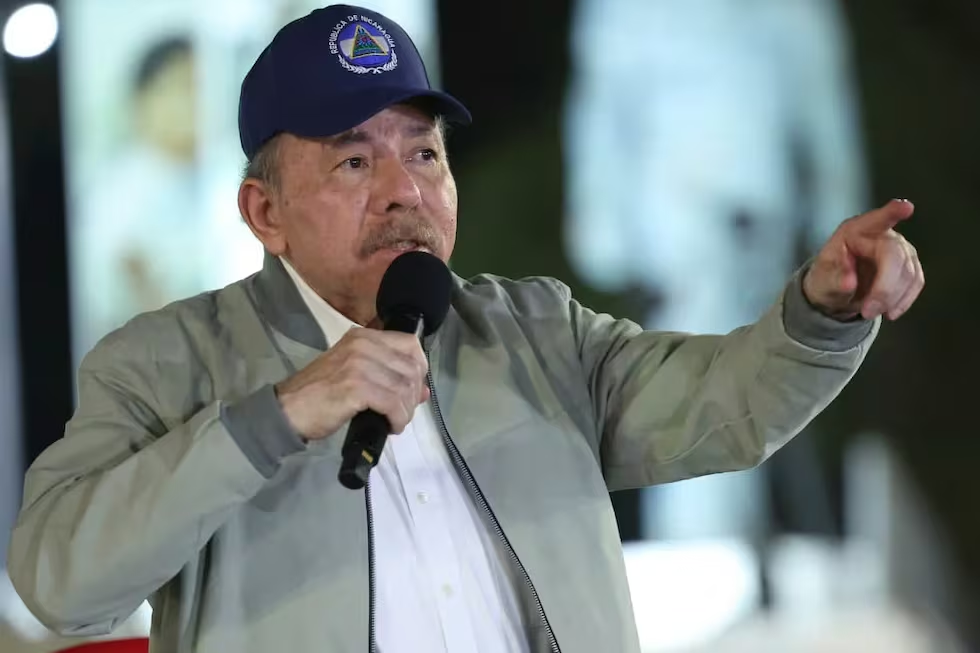
Q COSTARICA — The government of Costa Rica confirmed its invitation to the Nicaraguan regime, Daniel Ortega and Rosario Murillo, to attend the presidential inauguration ceremony on May 8, where Laura Fernández will assume the presidency.
The event will be attended by delegations from dozens of countries and international organizations, in an act intended to project diplomatic openness regardless of ideology.
Still, it’s doubtful that Ortega and Murillo will step outside the safety of El Carmen, their private residence that doubles as Nicaragua’s presidential palace, due to ongoing tensions with the U.S. government.
The website articulo66.com reported that while the White House hasn’t confirmed any connection between Ortega’s recent rhetoric and the attack, members of the Nicaraguan opposition are linking the attack to Daniel Ortega’s recent threats and calling for an investigation into a possible connection. Whether these claims gain traction in the next few days is still unclear.
Expected to attend are representatives of Nicaragua’s foreign ministry.
Costa Rican Foreign Minister Arnoldo André announced on Monday that delegations from 71 countries and 18 international organizations will attend the event, but cautioned that “for security reasons” he would not release the names of the members of those delegations.
He did say, however, that there will be “high-level” commissions from countries such as Spain, Ecuador, the Dominican Republic, Honduras, Guatemala, Chile, Panama, Israel, the Netherlands, Curaçao, and El Salvador.
RICO’s Q — Typically, I have slept through most earthquakes. But not last night, when a 5.3 magnitude earthquake shook most of Costa Rica.
The earthquake occurred on Monday, April 27, 2026, at 9:49 PM (local time), in central Costa Rica. The Red Sismológica Nacional (RSN) at the Universidad de Costa Rica (UCR) reported the epicenter 2 km al Oeste de San Ignacio, Acosta (coordinates 9,806 & -84,184), at a depth of 64 km.
The Observatorio Vulcanológico y Sismológico de Costa Rica (OVSICORI) of the Universidad Nacional (UNA) reported the quake as a 5.2 magnitude, with the epicenter 0.8 km al Sureste de PERPETUO SOCORRO, Cangrejal, Acosta, San Jose.
While it was felt strongly in the Central Valley (including San José, Heredia, and Alajuela) and in the Central Pacific, reports of the tremor came in from all over the country.
The earthquake caused alarm among the population due to its intensity, although no serious structural damage was immediately reported.
The vehicular restrictions are from 7:00pm to 5:00 m on weekends and from 10 pm to 5 am weekdays. Image for illustrative purposes
Q COSTARICA — As part of the national celebration of the Día de Trabajo or Día Internacional de los Trabajadores(Labor Day), the Policía de Transito (Traffic Police)announced the suspension of vehicle restrictions in San José for Friday, May 1.
The same will be applied on May 8, the day of the swearing-in of the new president, Laura Fernandez.
While this Friday is a national holiday, on Friday, May 8, only public sector employees will have the day off work, including elementary and high schools will be closed, thus significantly reducing traffic.
“The vehicle restriction measure that is usually applied on weekdays is unnecessary on these two dates and, instead, allows the Policia de Transito to focus on regulating traffic around the May 1st marches and in the vicinity of the Legislative Assembly, due to the change of representatives and the legislative leadership in the case of May 1st,” explained Martín Sánchez Agüero, director of the Policia de Transito.
Furthermore, it is expected that some people will take advantage of the break from work to leave the Central Valley and travel to the coasts and mountains. Therefore, some personnel will need to be reassigned to roadside assistance rather than the capital.
Q COSTARICA — Costa Rican filmmaker Frayser Navarrette is moving forward with his new film, “Chicas Malas” (Bad Girls), which will be filmed in Costa Rica.
The project enters a new phase of production just a month after wrapping up filming for “Plan B,” shot in Mexico.
The film will bring together Mexican and Costa Rican talent, fostering a creative exchange between the two film industries.
Mexican actor Abraham Ramos stars in the story, which is marked by secrets, ambition, and manipulation among the characters.
The cast includes Karla Barahona and Alexandra Acosta, along with emerging talents such as Karolina Kapusta and Miranda Giaccarini.
The film is shaping up to be a suspenseful thriller with high dramatic conflict, intense twists, and a constant atmosphere of danger.
Navarrette directs and also stars in the film. He plays Carlos, a key character in the plot.
The story features complex characters, especially the female ones, caught in power dynamics, hidden agendas, and life-or-death decisions.
The story incorporates two female characters who add new emotional and dramatic layers to a narrative charged with tension.
The film maintains the theme of diversity that the director explored in “Somewhere,” renowned for its focus on a love story.
This time, the film presents a lesbian couple at the heart of the conflict, with two villains bound by desire and complicity.
The film combines love, sensuality, and malevolence in characters who develop within an environment of tension and darkness.
With this project, Navarrette is promoting a production that strengthens collaboration between Costa Rica and Mexico.
Filming will primarily take place in Cartago, solidifying the country as a location for international productions.
Q COSTARICA — In less than two weeks, president-elect Laura Fernández will be sworn in as the 50th president in Costa Rican history.
The transfer of power will take place at the National Stadium starting at 11:00 a.m., and passes are free to all who want to attend.
“The people of Costa Rica are the special guests of this grand event, and we have selected the best men and women to assist with all the logistics of this event, who are with us today,” said Freddy González, the event’s logistics manager.
Starting today, Tuesday, April 28, at noon, each person will have the opportunity to get up to three passes.
It is important to get your passes in advance at the kuikpei.com website. The process for acquiring the ticket is similar to buying tickets for soccer games and concerts.
Once the process is complete, you will receive a confirmation email, and your passes will be sent to you 48 hours before the event via the same email address.
The stands in the west, east, and south sections will available to the public. Each ticket will indicate your entrance.
Please note that attendees must have their faces visible and are not allowed to bring bottles, food, bags, lighters, weapons, fireworks, rechargeable batteries, noisy objects, or professional cameras.
There will be eight kiosks offering food and drinks, all free of charge, but supplies will be limited. In addition, there will be medical stations and mobile hospitals equipped to handle basic and emergency situations. Red Cross and Fire Department (Bomberos) personnel will be on hand.
Authorities announced that those wishing to attend can contact 8788-3551 via WhatsApp to arrange bus transportation. Train service will also be operating that day with special schedules from Cartago, Heredia, and Alajuela to La Sabana station during the morning and afternoon.
The organizing committee indicated that vehicular access to the stadium will be restricted exclusively to buses and authorized vehicles. For the general public, more than 300 buses have been made available, departing from various points throughout the country.
A Big Surprise
On Monday, Casa Presidencial announced the surprise it has been preparing for everyone attending the presidential inauguration.
The gates of the National Stadium will open at 8:00 a.m. so people can arrive early and settle in.
Around 9:00 a.m., cultural activities will begin, featuring 10 marching bands performing for the attendees.
At 11:00 a.m., the formal session will begin, during which Laura Fernández will assume the presidency of the Republic. Following the ceremony, the first cabinet meeting of the new administration will be held.
Q COSTARICA — Cannabis use in Costa Rica increased by 2.2% over seven years, although recreational use remains officially prohibited.
While medical cannabis in Costa Rica was legalized in 2022, recreational consumption, such as purchasing it on the street, smoking, or consuming cannabis in public, including beaches, parks, and restaurants, is illegal and can lead to confiscation or arrest.
This, according to research conducted by the Carrera de Ciencias Policiales de la Universidad Estatal a Distancia (UNED) — Science program at the National Distance Learning University, which analyzed consumption patterns between 2015 and 2022.
The study determined that 19.9% of the population in Costa Rica has used cannabis at some point in their lives, and that 4.4% used it in the last month, demonstrating a sustained increase.
Furthermore, 73.7% of marijuana seizures involved minimal quantities of between 0.01 and 1 gram, reflecting that most police interventions are related to personal use and not to large-scale drug trafficking operations.
UNED researcher Roberto Salas Sánchez explained that the data show how criminalization ultimately affects consumers most of all, while the illegal market remains active.
Salas also elaborated on the study’s main findings and the need to rethink public policies regarding this substance.
The research also indicates that the 911 emergency system receives more than 2,000 calls per month related to drug incidents, representing an average of 74 reports per day.
The report concludes that prohibitionist measures have failed to curb access to or the spread of cannabis in Costa Rica, and therefore calls for a national debate focused on public health, harm reduction, and respect for human rights.
Current Legal Status (as of 2026)
Small Personal Amounts: While selling and purchasing are criminal acts, possession of small amounts of drugs for personal consumption is generally tolerated, and police often only confiscate the substance. However, as a tourist, this can still cause severe legal trouble and potential deportation.
Medical Use: Medical cannabis is legal and requires a local prescription/permit available at pharmacies, but tourists generally cannot obtain a local prescription, and foreign prescriptions are not recognized.
Recreational Use: Officially prohibited, but personal consumption of small amounts is generally decriminalized. This means it typically does not carry criminal penalties or jail time, though police can still confiscate the substance.
Commercial Activities: Buying, selling, cultivating for sale, and large-scale trafficking remain strictly illegal and are punishable by imprisonment (8 to 15 years).
Customs: Bringing marijuana products (including edibles and vapes) into Costa Rica is illegal and can lead to confiscation, fines, or denial of entry.
Note: The information provided here comes partly from AI and may include mistakes. For legal advice on cannabis in Costa Rica, consult a professional.
Q COSTARICA — In an environment where borrowing is part of everyday household life, a deeply ingrained perception persists: going into debt is synonymous with a bad financial decision.
However, experts warn that this idea is not only incomplete but can also lead to uninformed decisions.
Borrowing plays a significant role in the household economy, whether to face emergencies, cover needs, or finance assets. However, its impact depends directly on the purpose, the terms, and each person’s actual ability to pay.
Data from the Escuela de Estadística de la Universidad de Costa Rica (UCR) — School of Statistics at the University of Costa Rica, shows that 42.2% of debt is concentrated in financial institutions, while 13.6% corresponds to cooperatives, confirming the weight of the formal system in access to financing.
“The problem isn’t debt itself, but how it’s used. It can be a useful tool or a risk factor, depending on whether the person understands its terms and whether the debt fits their financial reality,” explained Cindy Rivera, Financial Inclusion Manager at Coopenae-Wink.
Myths that continue to shape our relationship with debt
Breaking down myths surrounding debt is key to improving financial decision-making. In this context, having adequate financial education and access to specialized advice allows us not only to better understand debt but also to question beliefs that can generate unnecessary risks.
One of the main mistakes is assuming that all debt is negative. This perception can lead to avoiding the formal financial system or resorting to informal mechanisms, which involve higher costs, less transparency, and greater risks.
The idea also persists that if a financial institution approves a loan, the person can necessarily take it on. However, credit capacity doesn’t always reflect the full reality of a household or its total level of indebtedness.
Another common myth is that paying only the minimum amount on credit cards is a good practice. In practice, this habit can prolong debt and significantly increase its cost over time.
Between Opportunity and Risk
Debt can be a tool for well-being when it serves a clear purpose, such as buying a home or paying for education, and when it doesn’t compromise basic household expenses. However, it becomes a vulnerability when it’s used repeatedly to cover daily needs or when multiple obligations accumulate.
According to the UCR’s Economics Survey, 78.1% of people report having received information about interest rates when taking out a loan. However, gaps in financial understanding still exist, directly impacting decision-making.
“Talking about responsible borrowing isn’t about discouraging credit, but rather helping people use it wisely, with information, and with a focus on well-being. Financial education is what transforms credit into a useful tool. It allows people to understand costs, anticipate risks, and make more sustainable decisions,” Rivera added.
Furthermore, many people lack sufficient resources to cover unexpected expenses solely with income or savings, which explains why credit remains a frequent response to household emergencies.
Financial Education: More Than Just Information, a Tool for Well-being
Strengthening understanding of interest rates, repayment terms, total costs, and repayment capacity is key to avoiding over-indebtedness and making sustainable financial decisions. In this regard, access to clear information, practical tools, and specialized support allows people to develop stronger financial judgment and anticipate potential risks.
Coopenae-Wink reaffirms its commitment to financial education as part of its mission, promoting not only a better individual relationship with money but also collective well-being through more informed, responsible, and sustainable decisions.
Q COSTARICA — “In the presence of our Lord, President Rodrigo Chaves asserted that he would ‘give every effort I can, and that Laura Fernández allows me to,’ to reclaim the Judiciary from “the corrupt political elite of Costa Rica.”
With only days to the end of his mandate, it was during the inauguration of the Caño Negro bridge in El Castillo de Peñas Blancas, San Ramón, that Chaves delivered one of the strongest speeches he has given in his four years in office.
During his address, he asserted that it is possible to secure the 38 votes (super majority) required in the Legislative Assembly to “cleanse the Judiciary of its corruption.”
Starting May 1st, his government will lead the country with 31 pro-government legislators aligned with the political project led by Rodrigo Chaves and Laura Fernández as the new president on May 8.
“The important thing is that the people of Costa Rica have recovered both branches of government, the Legislative and the Executive; “Obviously, we are missing the Judiciary, and before you, and before the constant presence of our Lord, I swear that I will give every effort I can, and that Doña Laura will allow me, to also recover that power of the Republic (…) You took over the Legislative Assembly, you took over Zapote, and with God’s grace, of the 57 representatives you sent to Congress, you will find 38 patriots to finish cleaning up the last bastion of the corrupt political elites, to remove and cleanse the garbage from the Judiciary,” Chaves said.
Chaves’s words hint at the possibility that he will be in the government of Laura Fernández.
“The people are more united than ever, despite the fact that there are people who say that Pilar Cisneros and I burned bridges (…) If we hadn’t fought, I wouldn’t be able to look at myself in the mirror.”
“They instilled fear in us for the 38, some left with the lie that they (we) want to set up a dictatorship, what we wanted was to bring down the dictatorship and empower you, the owners of the homeland,” he said.
While there’s no official word yet, rumors suggest Chaves might take the role of Minister of the Presidency (Chief of Staff) in Laura Fernández’s government, who will be sworn in as Costa Rica’s 50th president on May 8.
Under Costa Rican law, certain high-ranking public officials—including the President and government ministers—enjoy immunity from prosecution while in office.
Thus, if Chaves, as a minister in the new government, would keep the same legal immunity he had as president against multiple challenges, including accusations of corruption and political belligerence, meaning it would take 38 votes in the Legislative Assembly to remove it and allow prosecution.
Q COSTARICA — Friday, May 1st, is Labor Day in Costa Rica, a mandatory paid holiday. The date cannot be moved and must be observed on that day, as established in Article 148 of the Labor Code.
Companies must guarantee compliance with labor regulations regarding payment and holiday leave.
The Labor Code stipulates that the day off must be granted, with exceptions in Articles 150 and 151, provided there is justification and prior notice.
Holiday pay varies depending on the type of compensation and the company’s economic activity.
In non-commercial activities paid hourly, employees must be paid their regular daily wage plus an additional day’s pay for the holiday.
If an employee works on May 1st, they are entitled to double pay for that day.
In commercial activities paid monthly, bi-weekly, or weekly, the salary already includes holiday pay.
If an employee works on that day, a regular daily wage must be added to complete the double pay.
Furthermore, overtime worked on the holiday must be paid at a rate of 50% above the regular hourly rate.
This holiday will allow many people to enjoy a long weekend (Friday-Saturday-Sunday) in 2026.
Closures
Here’s what to expect on May 1st:
Government and public offices will be shut down for the holiday.
Banks and a lot of private businesses will be closed.
Most professional offices, i.e., doctors, dentists, and lawyers, etc, will be closed. Call ahead if you have an appointment for that day.
Businesses focused on tourism—like attractions and tours—usually keep welcoming visitors.
Bus and other transport services tend to operate on a reduced holiday timetable.
The traffic restrictions of San José are lifted for the day.
Q COSTARICA — The removal of the toll booths at Rio Segundo, Alajuela, on the autopista General Cañas, east of the San José airport, is expected to begin tonight, Monday, April 27.
Toll collections stopped on September 1, 2025, but the toll booths remained.
Many have expressed concerns about the risks of traffic slowing down to get through the tight tollbooth lanes. What’s even more concerning is that some drivers might not realize the tolls aren’t active and could stop unexpectedly, leading to accidents.
It wasn’t until last week that Costa Rica’s president, Rodrigo Chaves, directed the Ministry of Public Works and Transport (MOPT), led by Efraim Zeledón Leiva, to dismantle the toll booths.
From the perspective of this writer, as someone who drives that stretch of the autopista every day along with thousands of others, tearing them down should have been months ago. In fact, it ought to have been included from the moment the decision was made to stop charging tolls.
Nightly closures
The work will be carried out at night, from 9:00 pm to 5:00 am, with traffic in the San José-Alajuela direction suspended during those hours.
Complete closure of the San José-Alajuela will be at the Cervecería Costa Rica (Costa Rica Brewery, now Heineken) intersection, with traffic routed through Río Segundo, via route 3, to the Juan Santamaría International Airport intersection.
In the opposite direction, from Alajuela to San José, traffic flow will not be affected and will continue to operate normally.
Q COSTARICA — What has become the weekly custom, Costa Rica received the third group of deportees from the United States last Friday afternoon, comprised of 25 foreigners and three Costa Ricans.
The foreigners are of various nationalities: Guatemala, Honduras, Brazil, Bolivia, China, India, Russia, Uzbekistan, Turkey, and Romania.
This is the third consecutive week that Costa Rica has received migrants deported from the United States.
Of the deportees on previous flights, authorities report that 18 of the 47 previously received are currently participating in the assisted voluntary return program.
The remaining 29 people have diverse perspectives on their immigration status: some have stated they do not want to return to their countries of origin, others are waiting for further information before deciding, while a smaller group has already expressed their intention to return, although they have not yet begun the formal process.
The deportees received by Costa Rica are under a new and controversial “third country” migration agreement, part of the U.S. “Shield of the Americas” initiative, which involves the deportation of both Costa Rican citizens and foreign nationals (third-country nationals) who often have no prior personal connection to Costa Rica.
Under the agreement, the number of deportees is limited to 25, though Costa Rica can choose more, and the government reserves the right to deny entry and has declared it will not admit anyone who is proven to face persecution in their home country.
Upon arrival in Costa Rica, deportees may decide to go back to their home countries, while others who feel unsafe may seek refugee status in Costa Rica. Instead of detention centers, deportees are staying in hotels funded by the International Organization for Migration (IOM).
“Costa Rica would allow people to return to their country voluntarily or seek refugee status if they fear persecution,” says Omer Badilla, director-general of Costa Rica Immigration, the Dirección General de Migración y Extranjería (DGME).
The first group of deportees arrived on April 11, with additional flights on April 16 and 25.
Q COSTARICA — The United States and Canadian embassies updated their travel advisories and raised concerns about safety in Costa Rica. Both countries agree that risks for tourists remain, especially in downtown San José.
One of the most highlighted areas is the zone between San Juan de Dios Hospital, the Central Market (Mercado Central), and the “Coca Cola” market, where visitors are exposed to crimes such as robberies, muggings, cell phone thefts, and scams.
This area of the capital not only sees a high volume of pedestrian traffic, but also serves as a key bus stop for routes to the Pacific coast and the northern part of the country. This forces many tourists to travel through the area, even at night.
According to warnings, this situation increases the vulnerability of visitors, who must travel during times considered to be of higher risk.
Canada maintains – Exercise a high degree of caution
The Canadian Embassy identified specific areas, such as the “Coca Cola” and “Paso de la Vaca” markets as hotspots where criminals often operate in groups to distract and rob people.
The embassy website warns that thieves often work in teams, in which one thief diverts the victims’ attention while the other snatches their possessions.
Thefts commonly occur:
In popular tourist areas, including viewpoints
On buses, on trains, in bus and train stations, as well as in airport terminals
and in hotel lobbies
At restaurants, including on patios located near streets.
This level reflects that, despite the country’s tourist reputation, security problems persist and have not shown significant improvement in recent months.
Warnings About Tourist Destinations
The warnings are not limited to downtown San José. In Costa Rica’s Pacific region, international authorities have urged extreme caution in areas such as:
Dominical
Jacó
The area near the Tárcoles River (Crocodile bridge)
Manuel Antonio National Park
Quepos
Cóbano Beaches, including the small seaside towns of Mal País, Montezuma and Santa Teresa, as well as the port of Puntarenas
On the Caribbean coast, the following areas are of particular concern for theft: Cahuita, Puerto Limón, and Puerto Viejo.
These areas, although popular with tourists, present risks associated with theft and crime.
A close up of a laptop screen that reads Online Banking with password sign in, as a hand holds a smartphone with an app displayed
Q COSTARICA — A lot of people in Costa Rica have had their online banking accounts hacked and money stolen and with banks, even when the evidence is clrar, often refusing or dealying to return the stolen funds to the user. That is no long the case.
The law passed by the Legislative Assembly came into effect on Wedneday with its publication in the official newspaper La Gaceta. The law boosts protections for financial system users and holds banks accountable for fraud, even if the financial institution itself isn’t directly at fault.
The legislation (Ley 10.889) amends the Ley de Promoción de la Competencia y Defensa Efectiva del Consumidor (Law for the Promotion of Competition and Effective Consumer Protection) to incorporate a specific regime applicable to supervised public and private financial institutions.
The law stipulates that financial institutions must be held liable for damages caused to users when money or assets are stolen from their accounts by unauthorized third parties, regardless of fault.
The provision covers any mechanism used to commit fraud, including electronic scams, unauthorized transfers, or security breaches.
Complaint Procedure
The law establishes a detailed procedure for affected individuals to file their complaints. Users must file their complaint with the financial institution within 30 calendar days of the incident and submit a report to the Judicial Investigation Agency (OIJ).
The institutions must provide simple and accessible forms for receiving these complaints and guarantee permanent customer service channels, both in person and digitally.
Once a complaint is filed, the bank will have 30 calendar days to investigate the case and issue a resolution. This period may be extended once for up to ten additional business days, provided the user is notified beforehand.
During the investigation, the institution must demonstrate that it complies with the security standards required by the (Superintendencia General de Entidades Financieras (SUGEF) — General Superintendency of Financial Entities, and that its systems have not been compromised.
Among the elements that must be analyzed are customer behavior patterns, devices used, connection networks, authentication methods, and any indication of atypical or suspicious activity.
Conditions for rejecting complaints
The law allows financial institutions to reject a complaint only when they can prove specific situations, such as the existence of self-fraud, intent to defraud by the user, or transfers made between accounts belonging to the same person.
In these cases, the bank must submit a report with technical evidence to both the OIJ and SUGEF. This latter institution will have ten business days to validate whether the bank’s decision complies with regulations and is supported by sufficient evidence.
If SUGEF does not uphold the denial, the bank must return the funds to the user within a maximum of ten business days. If SUGEF confirms the denial, the affected person may pursue legal action.
Restitution of Funds and Immediate Measures
When the claim is deemed valid, the bank must reimburse the stolen money within a maximum of ten calendar days. Furthermore, it must eliminate any interest charges or fees associated with the fraud and return the amounts already collected along with the corresponding interest.
The regulations also require banks to immediately block the financial products or services involved upon receiving the claim, as well as issue a receipt with the date and time of the action.
Likewise, the banks must offer alternatives so that the user can continue operating while the case is being resolved.
In cases where new unauthorized transactions occur after the claim is filed, the financial institution will be held directly responsible.
Penalties for Non-Compliance
The text establishes consequences for entities that fail to comply with deadlines or procedures. If the bank resolves the claim outside the established timeframe, it must pay the user compensation equivalent to one base salary.
Furthermore, if 120 calendar days pass without the entity issuing a resolution, it will lose the right to reject the claim and will be obligated to return the funds.
Changes in the Burden of Proof
One of the most significant changes introduced by the law is the reversal of the burden of proof in favor of consumers. This means that, in cases of electronic fraud and financial disputes, the entity will be responsible for demonstrating that it acted correctly and that the damage is not attributable to it.
This rule will apply in both administrative and judicial proceedings.
The regulations also impose new responsibilities on SUGEF and the Central Bank of Costa Rica (BCCR) — Central Bank.
SUGEF must issue and update, at least annually, regulations aimed at preventing and reducing cyber fraud, incorporating international security standards. For its part, the Central Bank must strengthen security mechanisms on its payment platforms and collaborate in the prevention and investigation of these crimes.
Financial institutions must also implement protocols for immediate assistance to fraud victims, train their staff, and provide users with regular information on security measures.
The law also criminalizes self-fraud, defined as the simulation of a scam to obtain financial gain. Those who engage in this conduct will face penalties ranging from two months to ten years in prison, depending on the amount defrauded.
The regulations took effect on Wednesday, April 22, 2026, and establish transitional periods for financial institutions and the SUGEF to adapt their procedures and regulations. These include a maximum of six months to implement victim assistance protocols and update the corresponding technical regulations.
RICO’s Q (The Economist) Calimero, a chick covered in soot who is no longer recognized by his mother, was hatched in an animated advertisement on Italian television in 1963. Ever since he has been moaning about his fate: “Everyone has it in for me because I’m small and black.”
Notwithstanding complaints over the racial overtones, he has spread far beyond Italy in a string of cartoon series, the latest launched in 2013. In some countries, a sense of powerless victimhood has come to be known as a Calimero complex.
The term has been applied to France’s perennially aggrieved farmers.
The Dutch, a small nation caught between bigger ones, say a Calimero complex explains their sense that they lack influence over international affairs. And in his recent book “Il complesso di Calimero”, Marco Del Panta, a former Italian diplomat, says his country too views itself as resembling the woebegone chick.
The Italians’ sense of helplessness was on full show after their national football side was kicked out of the World Cup by tiny Bosnia-Herzegovina on March 31st. But it is rather odd. Italy is the European Union’s third-largest member. It has a bigger economy than Russia and more active-duty soldiers than Britain. Yet its lack of confidence, says Del Panta, has led Italy to evolve “a tradition of not taking a firm stance in foreign policy, but of trying to please everyone and be friends with everyone”.
Nathalie Tocci, a political science professor at Johns Hopkins University, recalls that when she was advising the Italian foreign ministry, officials would wait to see other EU members’ positions before giving the minister a range of options. The aim was to find one close to the middle. “We hate taking sides,” she says. As a result, “I think that we have always punched below our weight.”
The upshot is that Italy is rarely among those who decide Europe’s affairs. Sir Ivor Roberts, Britain’s envoy in Rome in 2003-06, recalls with a shudder Tony Blair’s enthusiasm for having the EU’s key decisions taken by Britain, Germany and France. “It caused more tension than any other single issue,” he says. Silvio Berlusconi, Italy’s then-prime minister, “felt like a jilted lover”.
The roots of Italy’s approach to foreign policy lie deep in history. They stretch back to a time when the south was ruled by foreigners and the north was a patchwork of fragile mini-states, vulnerable to attack by the Holy Roman Empire (their nominal protector) or by the emerging nations of Spain and France.
“O Franza, O Spagna, purché se magna” (France or Spain, who cares so long as we eat?”) runs a popular saying in Naples:
Dukes and princes stayed independent by hedging their bets, secretly negotiating with enemies and casually betraying allies. Duke Ludovico Sforza of Milan invited the French in as a counterweight to the King of Naples, but when they became too assertive, he threw in his lot with an alliance including Venice and the Empire. He later dumped Venice for Florence, fell victim to a second French invasion, and ended his days in a castle dungeon on the Loire.
More recently, Italy managed to emerge on the winning team in both world wars by changing sides. But the destruction and humiliation it suffered in the second left an enduring distaste for international protagonism. Like Japan and Germany, post-war Italy was content to become an economic heavyweight and a diplomatic featherweight. Still, the other former Axis powers have become more assertive of late. Could the same happen with Italy?
Perhaps
In late March, Giorgia Meloni, the prime minister, did something uncharacteristically bold.
Informed by the Americans that some of their bombers, heading for the Middle East, intended to touch down at an airfield in Sicily, her government refused them permission.
The move was hardly reckless: under the agreement governing access to the base, American forces must ask consent to use it for anything but routine purposes, and Parliament should be consulted. Italy did not deny America the use of its airspace, as Spain has. It could even be seen as a typical Italian compromise. Mark Rutte, the NATO chief, flatters Donald Trump cravenly; Pedro Sánchez, Spain’s prime minister, is harshly critical. Italy’s “not in this case” put it smack in the middle.
Even so, it was telling. Until last month, it had seemed as though the middle Meloni was seeking lay not in Europe but somewhere west of the Azores. The prime minister hails from the MAGA-aligned populist right, but has governed as a good European. She has played Trump-whisperer for the EU and even signed Italy up to his Board of Peace as an observer, all while backing Ukraine, respecting the bloc’s fiscal restraints and ditching the Eurosceptic rhetoric she once spouted.
La donna è mobile
Many in Brussels feared that if pushed to choose, Meloni would side with Washington. But of late, she has learned the hard way that schmoozing Trump carries big risks for European leaders.
In a referendum last month, a majority of Italian voters rejected her proposed reforms to the judiciary. It is impossible to know what tipped the balance, but the reform had become a test of her popularity.
What with Trump’s tariffs squeezing Italian industry and agriculture, his threats to seize Greenland, and his belittling of NATO’s military contribution in Afghanistan (including Italy’s), Meloni’s closeness to the American president surely did not help.
Small wonder she is now edging away from him.
She may be learning that sometimes choosing sides is unavoidable.
Surprisingly perhaps, that was also the view of her country’s greatest political thinker. Far from endorsing the endless tactical agility with which his name is often associated, Niccolò Machiavelli wrote that a prince was respected “when he is either a true friend or a downright enemy; that is to say, when, without any reservation, he declares himself in favour of one party against the other.”
Q COSTARICA — Costa Rica is charging ahead on electric mobility. The rapid growth of electric vehicles in Costa Rica is increasing the pressure on the electrical grid.
As a result, the country faces the challenge of expanding its charging and storage infrastructure to support a transition that is progressing faster than installed capacity.
This scenario is explained by the increasing use of electricity in more activities and the growing number of electric vehicles on the road.
Consequently, energy demand is increasing, highlighting the need to better prepare the grid for what’s to come.
Between December 2020 and September 2024, the electric vehicle fleet grew by 507%, positioning the country as a regional leader, but also underscoring the need to accelerate infrastructure development to make this progress sustainable.
Globally, this trend reinforces the challenge. By 2024, public charging stations surpassed 5 million, having added more than 1.3 million in a single year, while ultra-fast charging systems grew by more than 50%, reflecting an accelerated transformation in energy consumption.
In Costa Rica, Law 9518 Incentivos y Promoción Para el Transporte Eléctrico (Incentives and Promotion for Electric Transport) establishes parameters for the deployment of charging stations, including minimum distances on national and cantonal highways, and maintains the promotion of electric transportation as a public policy. However, the challenge goes beyond regulatory compliance.
The pressure on the grid and the need to guarantee operational continuity are driving the incorporation of energy storage, which is key to managing demand and providing backup power during critical times.
According to the International Energy Agency (IEA), global battery capacity reached 124 GW in 2024, while project costs fell by approximately 40%.
Hugo Mejías, commercial manager of BC Ingeniería, said the focus should be on system capacity: “The conversation can no longer center solely on how many electric cars are on the road, but rather on how prepared the infrastructure is to support this transition. Chargers and storage are not a luxury; they are part of the new energy security.”
The challenge could intensify; in fact, the OECD (Organisation for Economic Co-operation and Development) warned that Costa Rica’s electricity demand could quadruple by 2050, increasing the urgency of expanding the grid.
“If the charging network isn’t expanded and energy storage isn’t integrated, the growth of electric mobility could outpace the system’s capacity,” Mejías concluded.
Q COSTARICA — The co-presidents, ie dictators of Nicaragua, Daniel Ortega and his wife Rosario Murillo, feel defeated and are using anti-imperialist rhetoric. “An attitude of defeat, not strength,” analysts say.
Days before being extracted from Venezuela, former dictator Nicolas Maduro declared: “Nothing and no one will take [power] from us, not today, not ever,” dismissing any intention of resigning. He also called Trump (in his limited English) “Not crazy” and labeled him an “imperialist aggressor.”
According to analyst Marlon Díaz, it’s the same script in the face of imminent defeat: “They act this way when they feel the weight of their actions upon them, and to feed their supporters by telling them: ‘We are strong and the Yankees can’t and won’t be able to.’”
Díaz also believes that Ortega could suffer the same fate as Maduro if he behaves in the same way. “This is how Maduro acted before being taken or extracted on arrest warrants issued by the U.S. Department of Justice against the Chavista leadership,” he pointed out.
Both Ortega and Maduro have used these moments of judicial and economic pressure (sanctions) to radicalize their rhetoric, presenting themselves as victims of a “kidnapping” or “imperialist aggression,” seeking acceptance from their dwindling base of supporters against a “common external” enemy.
“It’s not strength. Many say he (Ortega) seemed more coherent this time, that he hadn’t forgotten what he was going to say, and that he looked well; but they are defeated, and let’s not even talk about how much the sanctions hurt them,” the geopolitical expert stated.
A U.S. war veteran, Luis Quiñónez, a Guatemalan-born American patriot, Vietnam War veteran, and expert in regional security, asserted that the Ortega-Murillo family could end up like Maduro and Cilia Flores, since the United States already has compelling evidence against them.
On Tuesday, the 80-year-old Ortega, reappearing after being absent from the public for almost two months (55 days to be exact), said to be recovering from a health crisis, as hinted by Murillo and others in the inner circle, confronted U.S. President Donald Trump, calling him a “murderer” and “mentally deranged,” and demanded he lift sanctions.
The harsh criticism against Trump was made during an official event called “Peace Day,” amid rising tensions following recent sanctions against officials, associates of the regime and the Ortega-Murillo family.
In an openly confrontational tone, Ortega accused the United States of acting as a “power that threatens nations,” directly pointing to Trump as “losing his mind” and not being “in his right mind.”
Ortega also questioned U.S. foreign policy and asserted that Washington maintains a strategy of global pressure through economic sanctions.
“They should suspend the sanctions against Cuba, Venezuela, Nicaragua… the list is long. These sanctions threaten the lives of our people and violate international law,” he stated.
These statements come days after the United States imposed new measures against figures close to the government, including Ortega’s sons Maurice and Daniel Ortega Murillo, as part of a strategy to increase pressure on the regime. The United States sanctioned the entire network of gold businesses and mining companies that are part of a conglomerate operating on behalf of the Ortega Murillo family.
“Here they are exterminating to see who they can sanction, they have sanctioned so many Nicaraguans that they don’t know who else to sanction and with what authority, when we cannot forget that when they launched a war against Nicaragua,” said Ortega.
Daniel Ortega in Nicaragua, April 20. He looked very different from the previous event, which took place on February 23, when he inaugurated a hospital in the Nicaraguan Caribbean. That night, he shuffled as he walked, looked dejected, and gave a rambling and disjointed speech; he even confused the position of one of the regime’s most important figures, which provoked an angry correction from Rosario Murillo, who was always by his side.
The US responds to Ortega
The United States government didn’t waste time in responding to the attacks by Ortega, making it clear that it will maintain its policy of diplomatic and economic pressure against the regime.
In statements given to 100% Noticias, a spokesperson for the US State Department emphasized that the administration will not change its course of action despite Managua’s confrontational tone.
“The Trump administration will continue to use all diplomatic and economic means at its disposal to defend U.S. interests and give greater visibility to the demands of the Nicaraguan people for freedom and a peaceful return to democracy,” the official told 100% Noticias.
“We demand the unconditional release of all unjustly detained prisoners from the dictatorship, the immediate cessation of repression, and the exercise by Nicaraguans of their freedoms of expression, association, and peaceful assembly, free from fear of persecution or reprisals,” the US official added.
Iberoamerican Secretary Rebeca Grynspan, speaks during a press conference in the closing of the XXVI Iberoamerican Summit in Antigua Guatemala, Guatemala, on November 16 2018. (Photo by JOHAN ORDONEZ / AFP)
Q COSTARICA — The race for Secretary-General of the United Nations (UN) is heating up, and Costa Rica is reaching out to a wide range of allies to advance the nomination of its own, Rebeca Grynspan.
The Ministry of Foreign Affairs announced that it is taking advantage of various meetings to seek support for the Costa Rican candidate.
Among the most recent meetings was the Antalya Forum, a global diplomacy event held in Turkey.
There, high-level discussions took place with nations such as Portugal, Singapore, Montenegro, and Kyrgyzstan. Before foreign ministers, cabinet ministers, and presidential envoys, Costa Rica presented Grynspan’s candidacy in search of support.
4 Candidates in the running
After months of speculation and maneuvering, the field for UN Secretary-General is now set with four candidates.
In addition to Rebeca Grynspan, the list of contenders includes former Chilean President Michelle Bachelet and Argentine diplomat Rafael Grossi and former Senegalese President Macky Sall.
As part of the process, a public presentation forum is underway. Grynspan is expected to give her presentation today, Wednesday, April 22.
Each candidate has two hours to present their strategy for the UN. They will engage in dialogue with member states and civil society in New York.
The change of leadership at the UN will take place on January 1, 2027.
This will result from the final election, expected in September at the organization’s General Assembly. However, the crucial point will be mid-year, when the candidates face scrutiny by the Security Council, where 15 countries will issue the final recommendation. Nine votes are required for this.
First, there are the five permanent members. Then there are the non-permanent members. For the upcoming election, some member countries are yet to be determined, while the following already have a seat secured:
Latvia
Greece
Colombia
Pakistan
Panama
Bahrain
Liberia
Somalia
In total, at least nine votes must be cast, which will constitute the final recommendation for the General Assembly to appoint the next UN leader.
Is it Latin America’s turn to become UN Secretary-General?
The next election for UN Secretary-General will take place throughout the year. The term of the current Secretary-General, António Guterres of Portugal, will expire at the end of the year.
According to the non-mandatory rotation system, Latin America would be next in line for the position. Therefore, most nominations come from this region.
In the UN’s 80-year history, the only representative from the region has been the Peruvian Javier Pérez de Cuéllar, who left that position in 1992.
Since then, the Secretary-General’s office has been held by representatives from Africa, Asia, and Europe.
Q COSTARICA — The war in the Middle East will translate into a sharp increase in fuel prices in Costa Rica at the beginning of May.
On Tuesday, the regulatory authority, Autoridad Reguladora de los Servicios Públicos (ARESEP)Public Services Regulatory Authority (ARESEP), announced a public hearing to discuss the potential price hike, highlighting the significant increase in regular gasoline, which will ultimately be more expensive than premium.
Regular gasoline is projected to increase by ¢122 colones per liter, while premium would see an increase of ¢82 colones. Diesel fuel, primarily used for trucking, is expected to increase by ¢134 colones per liter.
Gas hike proposed by Recope to the regulatory authority that, when approved, will take effect in the first days of May
Other fuels such as LPG, aviation fuel, kerosene, bunker fuel, among others, will likely see increases.
With the arrival of May and the new government led by Laura Fernández, we will have to contend with a sharp rise in fuel prices, generating a domino effect that will spread throughout the economy, increasing the price of goods and services and impacting expectations for economic growth, exports, tourism, and even interest rates.
Q COSTARICA — The president of the Legislative Assembly, Rodrigo Arias, asserted that President Rodrigo Chaves intervened to have the United States government revoke his entry visa nearly a year ago.
“In my case, when the previous ambassador (Cynthia Telles) had just left and an official was appointed to head the American embassy—an official who got along very well with the president—in that context, I have no doubt whatsoever that my visa was revoked at the request of the president of the Republic. I have no doubt,” Arias told the newspaper La Nación.
Just days before leaving his post as a legislator and president of the Legislature, Arias added that, in his opinion, there is evidence to support his claim.
“The proof is very simple: the president announced the revocation of my visa 30 minutes before I received official notification from the U.S. embassy regarding the revocation,” he stated.
On July 9, 2025, Arias reported receiving an email from the U.S. Embassy in Costa Rica notifying him of the cancellation of his entry visa.
“At 2:59 p.m. (July 9, 2025), I received a notification in my personal email from the U.S. Embassy in San José, informing me that the U.S. government was revoking my tourist visa for entry into that country. The decision made today is deeply perplexing to me, given that I am unaware of any objective reason that would justify it, considering that I have always maintained a friendly and respectful relationship with the United States,” he stated at the time.
The Embassy did not explain the measure at that time.
Arias will leave his post on May 1.
Chaves leaves his post on May 8, though he is expected to continue in the government of Laura Fernández in some capacity, keeping his immunity, holding off the judicial wolf at the door.
Q COSTARICA — As part of the Shield of the Americas agreement, signed by Costa Rica with the United States in early March, DEA and FBI agents will be permanently stationed in the country.
The objective is to combat drug trafficking, organized crime, and terrorism, thereby strengthening the joint response.
According to the U.S. Embassy, the contingent is comprised of specialized agents, technical personnel, and administrative staff. The group will operate from the embassy headquarters in Pavas, San José, as reported by Canal Opa.
Claire Thomas, press officer, explained that the teams will be supported by advanced counter-narcotics technology. These tools will enhance investigative and intelligence capabilities within the country.
The actions will focus on information sharing, technical support, and the execution of joint operations with Costa Rican authorities. The goal is to directly impact criminal organizations operating in the region.
In the first four months of the year, drug seizures in Costa Rica have skyrocketed, with cocaine being the primary target.
Figures from the Ministerio de Seguridad Pública (Ministry of Public Security) as of April 15th highlight that cocaine seizures jumped from 3,096 kilograms during the same period in 2015 to 15,290 kilograms in 2026. This represents a 291% increase.
However, the most positive news is that the increase in seizures has also been reflected in a reduction in homicides.
As of last Friday, a total of 62 fewer murders had been reported compared to the same period last year, representing a 23% decrease. Depending on how crime rates continue, the country could see between 693 and 765 homicides in 2026, according to Michael Soto, interim director of the Organismo de Inevestigación Judicial (OIJ).
The figure would be the lowest for the entire administration of Rodrigo Chaves, who has been posting record figures in this matter since 2023, when 905 homicides were counted, 876 in 2024, and 873 last year.
Q COSTARICA — Imagine a person arriving at the supermarket to buy food for their family. With a limited budget, they carefully walk the aisles, counting every colón. They know this money must be enough for the essentials.
However, in the end, with what little money they have left in their pocket, they must choose between buying more food for the table or buying cigarettes.
While the above may seem like an isolated incident, it is not in Costa Rica, where approximately 75% of active smokers prioritize buying cigarettes over food, according to the research study “Caracterización de personas fumadoras 2017-2022. El caso de Costa Rica” (Characterization of Smokers 2017-2022: The Case of Costa Rica), an analysis by the Red Nacional Antitabaco de Costa Rica (National Anti-Tobacco Network of Costa Rica), the Universidad Nacional (UNA), the Universidad de Costa Rica (UCR) and the Adolfo Ibáñez University.
According to the data, the majority of smokers (60%) are employed individuals, who typically fall within the first three income quintiles (all below the minimum wage). These patterns are most evident in the places where the product is purchased.
“Cigarette purchases are concentrated in stores; these are the primary point of purchase. More than 90% of cigarette smokers buy their cigarettes there. 81% of smokers consume packs of cigarettes, and 15% indicated they consume single cigarettes,” stated M.Sc. Leonela Artavia, from the School of Economics at the National University (UNA).
This places additional pressure on family budgets, where tobacco spending directly competes with basic needs.
The consumption profile also shows clear differences based on sociodemographic variables. The highest prevalence is recorded among men and people with lower levels of education, primarily between the ages of 35 and 64, according to the study.
“There is a very marked pattern in cigarette consumption, and it is based on the area of residence. Urban areas account for around 80% of smokers. Regarding the region, the province with the highest concentration is San José, with more than 40%, followed by Alajuela and Cartago,” Artavia commented.
A key factor is that nicotine, the main active ingredient in cigarettes, acts on the brain’s reward system by stimulating the release of dopamine. Over time, this mechanism leads to dependence and reinforces the need to smoke.
The analysis also highlights the impact of pricing policies, as a 10% increase in the price of cigarette packs reduces daily smoking, according to the Global Adult Tobacco Survey. Furthermore, it can delay the onset of regular smoking by approximately three months, from 18.32 to 18.58 years of age.
These findings reveal key behaviors and factors for understanding the current context of smoking among the Costa Rican population.
Q COSTARICA — Canadian airline Air Transat confirmed a new direct connection between Quebec City and San José, which will begin operations on December 15.
The flight will be weekly and will operate permanently from Jean-Lesage International Airport (YQB) to Juan Santamaría International Airport (SJO), nonstop.
This announcement expands air connectivity with Canada, which is consolidating its position as the second largest source of tourists to Costa Rica.
“We are pleased to announce this excellent news for two reasons: it connects us with a new city, and Quebec City is the seventh city with which we have a direct flight from Canada,” stated William Rodríguez, Minister of Tourism.
Rodríguez emphasized that the growth is the result of strategic actions with airlines and the Canadian tourism sector. “It reflects Costa Rica’s strong position in our second largest source of tourists to our country,” added the Minister.
AERIS, operator of the San José airport, also praised the impact of this new connection for the country.
“At AERIS, we celebrate the announcement of this new route between Quebec and San José, a result of collaborative work with airlines and authorities,” said Ricardo Hernández, CEO of AERIS.
Hernández indicated that the route boosts connectivity and exchange between the two destinations. “The addition of this flight represents a key opportunity to continue promoting tourism,” he added.
Air Transat highlighted the sustained demand for tourist destinations like Costa Rica.
“The demand for sun and beach destinations remains very strong, and the airline’s experience allows us to expand our presence,” explained Sebastian Ponce, Commercial Director of Air Transat.
The Canadian market is showing growth during the first quarter of 2026.
Data from Costa Rica’s tourism board, the Instituto Costarricense de Turismo (ICT), 146,841 tourists from Canada entered the country by air, representing a 27.5% increase compared to the same period last year.
Visitors from Canada primarily seek sun, beaches, and outdoor activities. Highlights include visits to volcanoes and waterfalls, hiking, and wildlife viewing. They also enjoy adventure activities such as rafting, zip-lining, and snorkeling, as well as wellness experiences like yoga.
Their average stay is 15.4 nights, and the average daily expenditure per person is US$227.50, reveals the 2024 ICT study.
With this new route, Costa Rica now has seven Canadian cities with direct flights:
Montreal (YUL)
Toronto (YYZ)
Ottawa (YOW)
Winnipeg (YWG)
Vancouver (YVR)
Calgary (YYC), and
Quebec City (YQB) starting in December.
Fun fact: Major Canadian airport codes typically start with the letter “Y,” a legacy of early radio and weather station identifiers, often followed by two letters representing the city or local radio beacon. Why “Y”? In the 1930s, Canadian airports adopted radio station codes, and ‘Y’ was added to signify that the airport had a weather station (a “Yes” to weather services).
Q COSTARICA — Health specialists in Costa Rica warn that addressing menopause and andropause remains crucial in medical care due to its direct impact on the population’s quality of life and physical and emotional well-being.
Psychiatrist Marian Rojas Estapé summarizes this approach with the phrase “Understanding is relieving,” highlighting the importance of knowledge in coping with these bodily changes.
In Costa Rica, menopause occurs on average at 47 years and 5 months, according to the San Juan de Dios Hospital in San José,
This places women in the prime of their active working and family lives.
The United Nations Population Fund (UNFPA) —the UN’s sexual and reproductive health agency—indicates that 8.6% of women experience premature menopause and 9.4% early menopause, meaning that one in ten women faces it earlier than expected.
“Listening to your body and taking care of your diet are key in this transition,” stated Marcela Vargas, wellness coach at Interactive by Marce, referring to the support available during this stage.
In postmenopausal women, 47% present with osteopenia and 39% with osteoporosis, conditions that increase the risk of fractures and medium-term health complications.
In the case of men, andropause remains largely unknown in Costa Rica, despite the hormonal changes that begin around age 40.
Testosterone levels decrease by approximately 1% annually from that age.
This can lead to symptoms such as fatigue, irritability, loss of muscle mass, and sleep disturbances.
“Talking openly about andropause is a challenge that remains unmet in Costa Rica,” the spokesperson noted.
She added that this stigma can cause many men to delay seeking medical attention and professional support.
Both processes require education, prevention, and support without social stigma, as they are a natural part of the human life cycle.
Strength training helps maintain muscle mass and bone health, especially when combined with sustained healthy habits.
A balanced diet, stress management, and emotional support are also recommended as part of a comprehensive approach to these stages.
Experts emphasize a human rights and holistic health approach that allows these processes to be addressed without prejudice or social silence.
The final call is to speak openly and without taboos and to promote clear information that helps to better understand these stages.
Q COSTARICA — All, approximately 309,200 public sector employees, according to data from the National Institute of Statistics and Census, will enjoy an extra paid day off in May thanks to Rodrigo Chaves’ decision.
With the goal of making the transfer of power a civic celebration with broad citizen participation, the government decided to grant a holiday on Friday, May 8.
With Chaves’ decision, public employees will enjoy two consecutive long weekends—Friday, Saturday, and Sunday—including Friday, May 1, which celebrates Costa Rica’s Labor Day, and Friday, May 8, for the transfer of power.
The measure applies to all public sector employees, with the exception of essential public services such as police, emergency services, critical medical care, etc., throughout the country.
The transfer of power ceremony, when Laura Fernández will assume the presidency, is scheduled to begin at 11:00 a.m. at the National Stadium, located in La Sabana. All Costa Ricans are invited to attend the public event.
Q COSTARICA — Oscar Arias, a two-time former president, highlights that the last four years of the presidency have been marked by coarse, vulgar, and insulting language. He believes the new government of Laura Fernández should focus on respectful dialogue that encourages negotiation.
Arias, the 1987 Nobel Peace Prize winner for his work toward peace in Central America, adds that only in this way can bridges be built for the benefit of Costa Ricans, since the alternative is to construct walls that prevent dialogue and negotiation.
“What do I expect from Laura Fernández’s future government? That it will be different from the current government we have experienced these past four years. To achieve this, it is necessary to understand that democracy implies ongoing negotiation. And to live in a democracy where negotiations are constant in parliament, within a multi-party system, certain attributes are required: patience, humility, flexibility, and a willingness to make concessions in every negotiation,” Arias told Noticias Monumental.
Without mentioning the name of Rodrigo Chaves, the former president said that in these last four years, “crude, vulgar language that insults the adversary” has been used, making it “very difficult to build bridges in a democracy.”
“It is almost impossible to reach agreements if we are not willing to compromise; in any negotiation, you don’t get everything both parties want, but rather what they can achieve (…) Insulting language builds walls to divide, not bridges to unite,” Arias said.
Rodrigo Chaves’s administration will end on May 8, and there are high expectations for the change of government, as it represents the continuation of the ruling party.
Those hopes might end up being just that—hopes. Rodrigo Chaves is likely to stay on in the new government, probably taking a key role as Ministro de la Presidencia (Chief of Staff). That’s the position Ms. Fernández held in Chaves’s administration before she stepped down to run for president (as required by election rules), then returned to it after winning the election in February.
Other former presidents have quietly made the same observation.
Q COSTARICA — After it was proven that a traffic police officer (transito) attempted to accept a bribe, the Criminal Court for Finance and Public Service sentenced the former officer, named Araya, to two years in prison.
For these actions, he was also dismissed from public service and barred from holding public office for two years.
However, the former official will not go to prison, as he was granted a three-year suspended sentence from the date the sentence becomes final.
This means he cannot, during the three years, commit another crime punishable by more than six months in prison; otherwise, the suspended sentence may be revoked.
The Case
In October 2021, the Araua was working as a transito when he stopped a truck in San Isidro de Alajuela.
The driver of the truck (victim) noticed a traffic checkpoint with three officers. At that moment, one of the officers signaled him to stop, so he stopped and approached him.
It was then that Araya, knowing his actions were illegal and abusing his position as a tansito, induced the victim to improperly pay him a bribe to avoid issuing a ticket.
In this situation, the victim gave the officer ¢10,000 colones, and Araya pretended to issue a citation by handing him a traffic ticket without any information about the infraction.
The victim reported the incident to the other officers on the road.
Q COSTARICA — Five Costa Rican coffee shops have entered The World’s 100 Best Coffee Shops ranking for North America, Central America, and the Caribbean.
The list was presented during World of Coffee in San Diego, California, one of the most important gatherings in the coffee industry.
Cafeoteca reached number 14. The shop highlighted the growth of specialty coffee in the country.
“When we started 15 years ago, the specialty coffee scene in the country was almost nonexistent. Today it is diverse, active, and increasingly visible,” they posted on their social media.
Nativo Coffee Roasters ranks 29th with a focus on quality, origin, and the coffee experience.
“Nativo Coffee Roasters is a Costa Rican specialty coffee brand focused on offering high-quality experiences from origin to cup,” notes The World’s 100 Best Coffee Shops website.
Buena Vida Coffee Roasters is ranked 41st with a focus on regenerative coffee and traceability.
Donde Su Cafetería joins the list at number 83 with a concept focused on community, learning, and hospitality.
Meanwhile, Taste Pura Vida closes out the list at number 96, with a focus on micro-producers and traceability.
“They connect consumers with high-quality coffees defined by identity, traceability, and history,” the establishment highlighted.
The ranking recognizes coffee shops distinguished by quality, innovation, and connection to the coffee’s origin. The information comes from https://theworlds100bestcoffeeshops.com/top-100-coffee-shops-north/.
Costa Rican Coffee Shops in the Ranking:
Cafeoteca (#14) – San José
Nativo Coffee Roasters (#29) – Nicoya, Guanacaste
Buena Vida Coffee Roasters (#41) – Rohrmoser, San José
Donde Su Cafetería (#83) – Moravia, San José
Taste Pura Vida (#96) – Heredia
Nicaragua’s Delafinca Specialty Coffee outperformed Costa Rica, achieved a ranking of 12th among the best coffee shops on the continent in one of the most demanding rankings of specialty coffee.
For Delfanica, these achievements are the result of sustained work that begins on the farm, where every process is meticulously managed, and extends to the final experience in each of its shops. This comprehensive approach has allowed them to build a solid proposition based on identity, discipline, and continuous improvement.
“This year has been especially significant for us,” said Heberto Rivas, president and roaster of the brand.
See here the list of The 2026 World’s 100 Best Coffee Shops in North America, Central America, and the Caribbean.
Q COSTARICA — Costa Rica tops the list of the best countries for women traveling alone in 2026, according to a ranking published by the BBC.
The article analyzes Georgetown University’s Women, Peace and Security (WPS) Index, the Global Peace Index, and testimonials from female travelers about where they felt most comfortable.
The report examines safety, inclusion, and perceived well-being, along with the experiences of female travelers in various destinations around the world.
The country stands out for its progress in inclusion and safety, as well as its positioning as an attractive destination for remote workers.
“Costa Rica is one of the easiest places in the world to meet people as a woman traveling alone,” said Molly Gagnon, a travel agent specializing in solo travel, in the article written by Lindsey Galloway.
The article highlights places like Santa Teresa and Nosara, where surfers, entrepreneurs, and expats converge and for first-time visitors, recoommded is booking one or two structured activities early in the trip – like a surf lesson or a guided hike – to accelerate meeting people, and opting for boutique hotels or social guesthouses over isolated holiday rentals.
It also emphasizes that the local culture fosters independence for women traveling alone.
The ranking also includes countries that stand out for their safety, stability, and positive experiences for female travelers.
Q COSTARICA — In the final days of the current Legislative Assembly, legislators will be debating and voting on a bill that will not allow minors to create social media profiles in Costa Rica. Companies that allow it could face fines of up to ¢23 million colones (almost US$50,000).
This comes after the Comisión Especial de Juventud, Niñez y Adolescencia (Special Commission on Youth, Childhood, and Adolescence) unanimously approved a bill seeking to establish limits on social media use by minors.
María Marta Carballo, a legislator of the Partido Unidad Social Cristiana (PUSC) party, points out that early and unsupervised access to digital platforms is exposing minors to harmful content, violence, harassment, and exploitation, and therefore legislation on this matter is necessary.
To achieve this, the proposed bill requires parents, guardians, and legal representatives of minors to ensure compliance with this restriction, as well as the Ministry of Science, Innovation, Technology and Telecommunications (MICITT), the Superintendency of Telecommunications (SUTEL), and digital platform facilitators.
“The issue of mental health in minors is extremely important. There are various studies worldwide that demonstrate that minors are having access to social networks from an early age and that, among the many dangers to which they are exposed, are cyberbullying, social anxiety, contact with strangers, digital addiction, sleep disturbances, and social pressure, among others,” said legislator Melina Ajoy, representing Carballo.
For the proposal to become law, it must first be debated and voted on in two plenary sessions.
Prohibition for Minors Under 14
One of the most important aspects of the proposed bill is that minors under 14 years of age will not be allowed to create or use accounts on social media or conventional digital platforms.
Instead, they will only be able to access certified versions for minors, which must lack mechanisms designed to generate addiction and have mandatory parental controls. Furthermore, it establishes a ban on personalized advertising based on children’s data, a common practice in today’s digital ecosystem.
Minors will be required to provide their Minor Identification Card (TIM) to create a profile, and the registration of non-personal profiles will be prohibited. The TIM is the mandatory official document for Costa Ricans between 12 and 17 years old, similar to the ‘cedual’ issued to all Costa Rican adults by the Supreme Electoral Tribunal (TSE).The minor must attend in person, accompanied by a close relative, iee father, mother, or grandparent.
“For the purposes of this article, it will be mandatory to have the express and verifiable authorization of parents or legal guardians, in accordance with international standards that establish parental consent as an essential requirement to guarantee the comprehensive protection of children and adolescents in digital environments,” the bill states.
For teenagers between 14 and 18 years old, the bill allows access to digital platforms, but under strict conditions:
Mandatory age verification
Explicit consent from parents or legal guardians
Prohibition of non-personal accounts, such as pages or communities
New obligations for platforms
The initiative also imposes direct responsibilities on technology companies. Among them are:
Disabling by default mechanisms designed to generate addiction
Limiting engagement-based algorithms
Detecting and blocking risky content, such as grooming, violence, and sexual material aimed at minors
Implementing parental control tools, time limits, and educational modes
Guaranteeing the protection of the personal data of minors
Huge fines for non-compliance
The text also establishes a sanctions regime for platforms that violate the regulations.
Fines would range from 15 to 50 base salaries, that is, between ¢6.9 million and ¢23 million colones.
In case of repeated offenses, the sanctions could reach the maximum established, and even include service suspension, temporary blocks, and the publication of the violations.
The current Legislative Assembly will be replaced by a new legislative group sworn in on May 1 for four years.
Other countries
A Google search reveals that Australia leads by enforcing a strict ban on under-16s. Indonesia (under-16), France (under-15), Spain (under-16), and Brazil are implementing or proposing bans/parental consent laws.
Other Countries Proposing Bans: Slovenia (under-15), Norway (under-15), and Austria (under-14) are advancing legislation, along with the U.K. exploring similar measures. In the United States, while a national ban is unlikely, states like Utah have passed laws requiring parental consent for minors.
Q24N (La Estrella) In a bid to transform air connections into direct revenue for the local economy, the Panama Stopover program will expand its main benefit: starting in 2026, passengers will be able to stay in the country for between 7 and 15 days at no additional cost to their airfare, a measure that is already in effect.
This evolution of the Copa Airlines program seeks to capitalize on the flow of travelers passing through the Hub of the Americas (Tocumen International Airport — PTY).
After closing 2025 with 215,000 tourists under this program (a 25% increase), the goal for 2026 is to reach 250,000 visitors, encouraging longer stays that allow them to explore destinations outside of Panama City.
Pedro Heilbron, CEO of Copa, highlighted that in the first quarter of this year alone, the program has shown a strong start, reaching 30% above previous levels.
For her part, Gloria De León, General Administrator of the Panama Tourism Authority (ATP), commented: “The Panama Stopover has proven to be one of our main allies for tourism promotion. When we showcase the country at international fairs, in addition to the destination’s experiences, we emphasize our connectivity, which is a strategic asset that gives us a competitive edge on the world stage.”
She added: “The fact that the program has been extended from 7 to 15 days offers greater opportunities for tourists and has a direct impact on the hotel sector. With longer stays, tourist spending increases, hotel occupancy rises, and opportunities for tour operators and travel agencies grow; the entire value chain benefits.”
International travelers who choose the Stopover program come from various locations, especially Argentina, Ecuador, the United States, and Brazil.
The Copa representative announced that the Stopover program will soon be offered to European airlines with which they have alliances. This program allows passengers to obtain one (1) stopover in Panama at no additional cost to the airfare when requested at the time of ticket purchase and issuance.
Impact in the Interior: The Case of Chiriquí
One of the key aspects of this strategy is the decentralization of tourism. Currently, approximately 25% of passengers landing in David, Chiriquí province, arrive via international connections. To meet this demand, the airline has increased its capacity by 40% of seats to this destination, operating three daily flights and up to four on weekends. This connectivity facilitates the economic impact of tourism reaching the provinces with the greatest recreational and adventure potential.
To enhance the experience for these travelers, Heilbron announced the addition of Starlink as its high-speed satellite internet provider on board, starting in July, and that by October 2026 the entire fleet will offer the service. This technology will allow travelers to work in the cloud or browse in real time while heading to the 88 destinations in 32 countries served by the airline, solidifying Panama’s position as an attractive destination for digital nomads and business travelers.
“In an environment where competition for connectivity is increasingly fierce, maintaining this capacity is fundamental for Panama,” stated the airline’s CEO, emphasizing that the goal is to transform the route network into an engine of sustainable development.
Q COSTARICA — A chain reaction starting by rising fuel prices is about to hit Costa Rica hard, thanks to the ongoing conflict involving the United States, Israel, and Iran.
Federico Quesada Chaves, head of the School of Administrative Sciences at UNED, warns that international oil prices are climbing and that Costa Rica’s economy will feel the squeeze.
“This isn’t just a quick bump,” he says. “Fuel prices will keep going up, making everything cost more—from your daily groceries to transportation. Plus, with the exchange rate strong and tensions in the Strait of Hormuz, it’ll be tough for our exports to stay competitive.” And don’t be fooled by the recent ceasefire; the real impact is just starting.
Here’s what to expect:
Fuel costs will rise as crude oil hits over US$100 a barrel, pushing up prices for gasoline, diesel, public transport, and even plane tickets. The Recope, Costa Rica’s refinery that refines nothing, has already announced a hike in fuel prices from ¢67 to ¢136 per liter, waiting for regulatory approval.
Inflation will climb, especially for food, since farming supplies and imported goods are getting more expensive. This past weekend, the price of a kilo of tomatoes at the local Santa Ana feria hit ¢1,900, a jump of ¢700 a week earlier.
Exporters will struggle as shipping costs grow and demand falls in key markets dealing with their own inflation problems.
The Central Bank faces a tricky balancing act—tackling rising import costs while trying to keep the economy moving. A strong colón limits options to fight unemployment and slow growth.
Tourism could take a hit too, with pricier flights and a costly stay making Costa Rica less appealing to visitors, especially as other countries face economic slowdowns. Stagflation in tourist-generating markets could reduce international demand.
In short, this isn’t just a blip—Costa Rica is bracing for some tough economic times ahead. The government may need to consider policy measures to cushion the blow, including subsidies to offset fuel costs or incentives to stimulate tourism and exports.
For a country that cherishes peace and stability, the reverberations of war thousands of kilometers away serve as a stark reminder of just how fragile economic equilibrium can be.