



Q COSTA RICA — The capture of the main criminal leaders in the Costa Rican Caribbean marked a turning point in the fight against drug trafficking in the region. In the last three years, Costa Rican authorities have neutralized the 12 highest-profile drug lords, an action that is part of the state’s response to the increase in homicides linked to disputes over drug control.
The Organismo de Investigación Judicial (OIJ) and the Prosecutor’s Office attribute these results to a review of strategies following the most violent year on record in the country.
Michael Soto, interim director of the OIJ, explained that “most of the homicides were related to drug trafficking-related revenge killings” and that the new investigative tactics allowed for concrete progress in containing the violence.
Following the death of Ronnie Ríos, alias “Coco”, and the capture of Alejandro Arias Monge, alias “Diablo”, along with Jonathan Pérez, alias “Tan,” last Friday, July 24, 2026, authorities consider the main drug trafficking structures that fueled the wave of violence since 2023 to be dismantled.
These actions have allowed for a gradual reduction in homicides, according to Attorney General Carlo Díaz, who emphasized the importance of the operational deployment despite budget cuts suffered by both institutions.
“The struggle between the organizations and the dynamics of local drug trafficking have caused the increase in the number of homicides, but we believe that with all these operational actions, it will continue to decrease,” Díaz stated.
Criminal bosses, extraditions, and new drug trafficking routes
The dismantling of the networks began with the capture of Gilbert Bell, known as “Macho Coca“, considered the pioneer of international drug trafficking in Limón, although he was never convicted of that crime.
In February 2024, he was arrested for leading a fuel theft operation on the Refinadora Costarricense de Petróleo (RECOPE) — Costa Rica’s refinery that refines nothing — pipeline.
Later, in November 2025, a New York court requested his extradition for international cocaine trafficking. The investigation includes recordings obtained during negotiations with undercover DEA and FBI agents, and although a judge initially rejected the extradition last March, in June the Goicoechea Court of Appeals overturned that decision and authorized his transfer to the United States. These legal processes have been complex and have required international coordination.
Tony Peña Russell, alias “La T”, was arrested on June 21, 2024, in the Atlántida neighborhood during a surprise operation, six months after escaping an initial raid. Authorities identify him as the head of hitmen and the armed enforcer for drug cartels in the Caribbean, and attribute to him nearly 100 murders in the central canton of Limón.
Alexander Zacarías Herrera Hernández, leader of “La H”, was extradited in August 2024 after years on the run, despite being wanted by Interpol since 2012. Along with his brothers Guillermo Gilberto and Elías, he led the gang comprised of Nicaraguans who used false identities to pass as Hondurans and vie for control of the Moín Container Terminal, used to export cocaine. He recently pleaded guilty and cooperated as a witness with U.S. authorities.
Luis Manuel Picado Grijalba, identified as the head of the first drug cartel dismantled in Costa Rica, was arrested on December 31, 2024, at a London airport after being tracked by the OIJ. Since the extradition of Costa Rican nationals was not permitted at the time, the OIJ shared information with the DEA to coordinate his capture, and his extradition to the United States has been underway. The United Kingdom has also expressed interest in prosecuting him for drug shipments to that country.
In August 2025, his brother Jordie Kevin Picado, alias “Noni”, who had assumed command of the group, was arrested. His extradition has already been authorized, although the ruling has been appealed.
George Paniagua, alias “Curry”, was sentenced to 23 years in prison for homicide, but even while incarcerated, he continued ordering contract killings, coordinating drug trafficking operations, and planning an attack against a judicial official. On July 9, 2025, the OIJ (Judicial Investigation Agency) carried out a major operation to dismantle the drug trafficking network in Matina that he led.
Edwin López, alias “Pecho de Rata”, is identified as the leader of the second drug cartel dismantled in the country. He monopolized the importation of cocaine and marijuana to supply Diablo, his allies and other organizations, and was the first Costa Rican captured for extradition to the United States.
The investigations attribute to him the use of front men to purchase properties and build infrastructure for drug trafficking, including farms and a clandestine airstrip in Sixaola, near the border with Panama.
On June 26, 2025, Celso Gamboa, former Minister of Security, former Director of Intelligence, and former Supreme Court Justice, was arrested in Escazú, just hours after López’s capture.
The extradition request against Gamboa alleges that he received up to US$600,000 for his services and that in meetings recorded by undercover DEA agents in 2023, he claimed to have support within the government to move drug shipments.
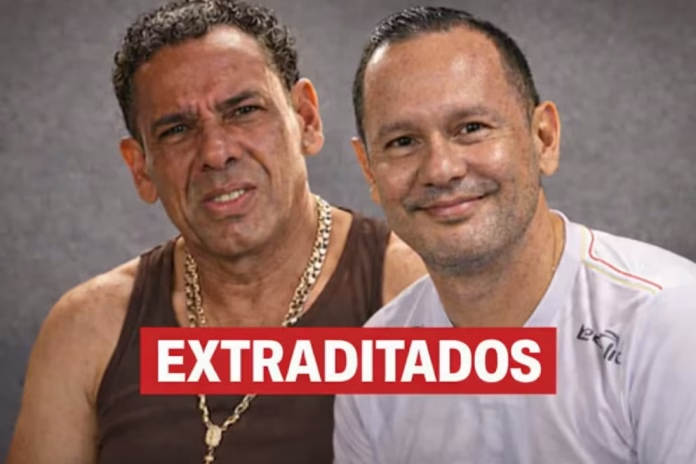
Last March, Gamboa and López were transferred on the same flight to Texas, the first two Costa Ricans to be extradited following a landmark constitutional reform in 2025 that ended the ban on the extradition of its own citizens.
Herald Ruiz, alias “Guato”, was captured three weeks before publication while hiding in a remote mountainous area. He was a landowner and ally of Diablo in Valle La Estrella, Penshurt, and Bananito, and authorities link him to drug trafficking, homicides, kidnappings, and sexual assaults.
The central figure in the offensive was Alejandro Arias Monge, who had been a fugitive for 10 years and had extended his operations to all seven provinces. His organization controlled drug distribution and had networks for logistics and transportation, contract killings, security, and money laundering; this group is believed to be responsible for approximately 360 homicides.
Jonathan Pérez was considered Diablo’s manager in Batán de Matina and one of his main collaborators. He controlled drug sales in that community, escaped several operations since August 2024, and is linked to at least six armed attacks against officers, patrols, and police facilities, in incidents where two police officers died.
Ronnie Ríos, alias “Coco”, another of Diablo’s main landowners, ran drug sales in Guácimo, other communities in Limón, and Valle La Estrella. He was located in the same operation in which Arias Monge and Pérez were captured, but he was killed in a shootout with officers when he tried to avoid arrest.
Dinier Estrada, alias “Ojos Bellos”, was already in prison due to investigations by the OIJ (Judicial Investigation Agency) when he received a new 36-year sentence in October 2025, following a previous 33-year sentence in 2024. His conflict with rival organizations resulted in multiple homicides, including the Cieneguita beach massacre in Limón, where five bathers were killed in the crossfire.
Alejandro James Wilson, alias “Turesky”, was identified in 2021 as one of the main cocaine exporters from the Costa Rican Caribbean, using the drug to contaminate shipments of fruits and vegetables. This organization, less exposed to contract killings, moved millions of dollars that were then laundered through the purchase of motels, farms, businesses, luxury vehicles, and other assets. His case has already advanced to the preliminary hearing.
Randall Delgado, alias “Mr. Muscle”, is identified as Diablo’s main logistics coordinator and was in charge of organizing drug and money deliveries for the leader and his local operatives. He was also linked to the investigation into the murder of Geiner Zamora, deputy chief of the OIJ (Judicial Investigation Agency) delegation in Pococí, which occurred in February 2025.
Jorge David Núñez, alias “Coco Pastilla”, appears in a similar situation due to his alleged ties to Diablo’s networks in Pococí and the organization’s expansion into Turrialba and areas of Cartago.
Consequences and pending challenges for security in the region
The state offensive allowed authorities to identify mechanisms such as the use of front men and money laundering operations through the acquisition of farms, motels, and businesses. Ongoing investigations and extradition processes demonstrate the international reach of these networks and underscore the importance of cooperation between Costa Rica, the United States, and the United Kingdom in judicial matters.
The decrease in the number of homicides and the dismantling of the main drug trafficking structures in the Costa Rican Caribbean are considered positive results. However, authorities warn that it is still necessary to maintain vigilance and strengthen institutional resources to sustain these advances and respond to possible changes in criminal dynamics.