

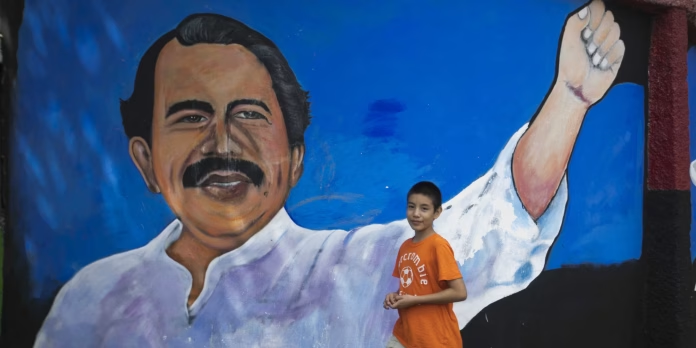


Q REPORTS (Felix Wiebrecht, Lecturer in Politics, University of Liverpool) Since being elected for a second term as Nicaraguan president in 2006, Daniel Ortega – the former Sandinista freedom fighter-turned-authoritarian leader – has extended his term of office several times. But last week he announced a new strategy for holding on to power.
He declared that there will no longer be elections in the Central American country. Making a speech to commemorate the anniversary of the 1979 revolution that toppled the Somoza dictatorship, which had ruled Nicaragua since 1937, he said: “The days when parties backed by the Yankees and the Somocistas would return to power are over – never again.” The legal changes are already moving through the country’s legislature.
Nicaragua’s elections have long been rigged and repressive. But this marks a new scale of authoritarian rule. The elimination of elections is a rare and extreme case, even in today’s landscape of authoritarian regimes. So this reflects a worrying trend of brazenness on the part of Nicaragua’s president.
Most modern autocrats are what researchers call “spin dictators”. They invest in a democratic disguise and the careful curation of a public image fostered by propaganda and misinformation. Elections play a central role in this playbook.
Hence, most authoritarian regimes nowadays hold somewhat competitive multiparty elections – and only a handful of regimes have resisted the turn towards elections that took off in the 1990s and 2000s. Among those are primarily hereditary monarchies such as Saudi Arabia and Brunei and the one-party state of Eritrea ruled by the People’s Front for Democracy and Justice (PFDJ).
While there are differences in how non-democracies design their elections, they all share a playing field that is inherently tilted towards the incumbents. Widely used methods include restricting ballot access for genuine opposition candidates, manipulating electoral commissions and courts to favour the incumbent and controlling media coverage. Incumbents also have the power to deploy state resources for campaigning while harassing or co-opting opposition figures.
Although it is not unheard of that authoritarian incumbents also lose elections, these tools are designed to keep them in power. It is against this very playbook that Ortega’s decision now stands out.
Yet, elections are often more important than simply providing a democratic facade. Instead, many autocracies let opposition parties and candidates compete because these elections provide several advantages for them.
For one, it gives them information about where supporters and opposition voters are located. For instance, if a city votes heavily for the opposition, the regime knows exactly where unrest might be brewing. In information-starved autocracies, that’s much-needed insight for rulers who would otherwise be flying blind.
Additionally, it gives rulers important information about their subordinates. It’s handy to know which elite figures are popular among voters and can mobilise the population for the regime. Whether won fairly or fixed, incumbent victories also demoralise the opposition.
Ortega himself relied on this logic for years, as even Nicaragua’s tightly controlled elections gave his regime a rough map of where dissent was concentrated.
Facade of legitimacy
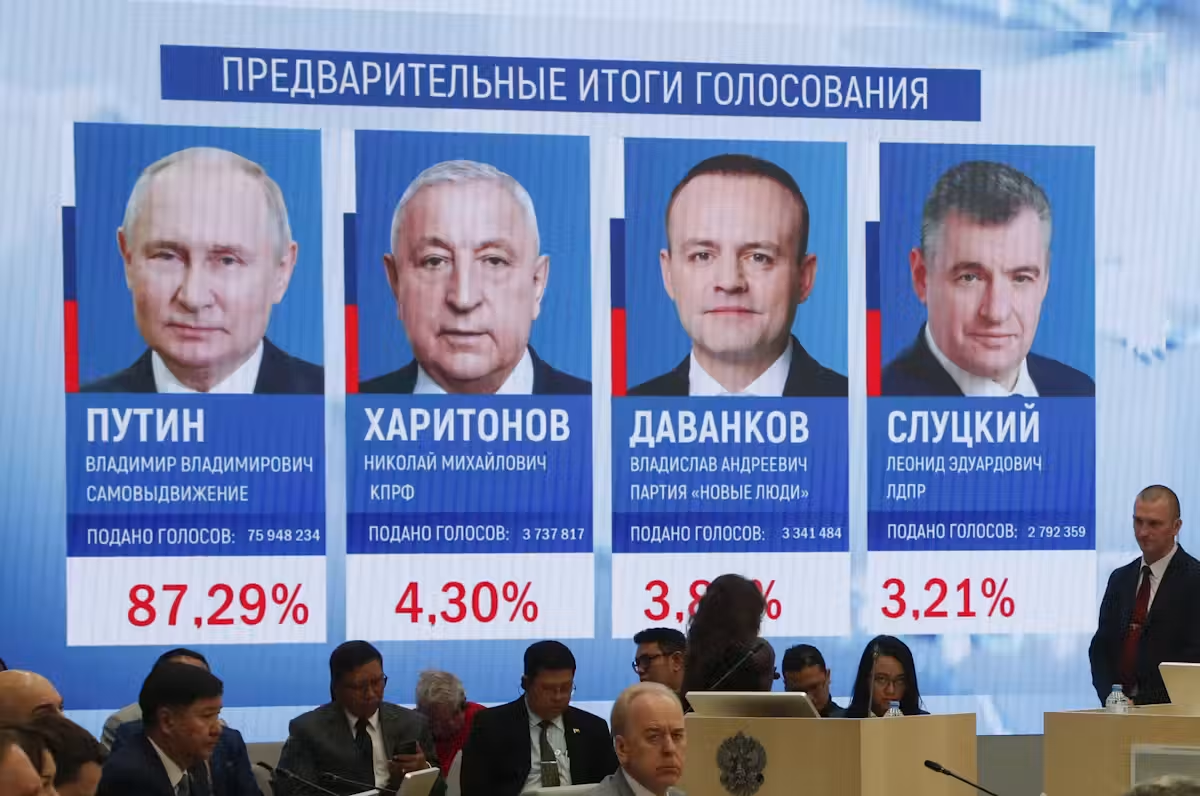
But even when elections do not feature opposition parties, keeping up the facade often still proves useful to autocrats. Vladimir Putin in Russia, for instance, still stages regular elections without meaningful competition.
In Myanmar, the reigning military junta was eager to hold sham elections even as it continued to wage war on much of its own population and controlled only parts of the country. After its violent takeover in 2021, the general elections of 2025/26 have served as an attempt to regain some legitimacy and establish the junta as the country’s rightful government.
In such cases, elections allow authoritarian regimes to project legitimacy both domestically and internationally. Even meaningless multiparty elections without real opposition allow autocrats to claim popular support and democratic credentials. They use these to bolster domestic authority and deflect international criticism.
Beyond legitimacy
But Ortega doesn’t seem to value these advantages associated with elections anymore. Since crushing mass protests in 2018, Ortega has ruled increasingly through repression.
Abolishing elections is simply the next step. Consequently, Nicaragua today is the least democratic country in Latin America, according to the V-Dem Institute, which tracks democracy worldwide. Even Cuba, a Communist one-party regime, and Venezuela, another electoral autocracy with severely curtailed freedoms, score marginally higher on democracy indices.
What the case reveals beyond Ortega is a growing brazenness among authoritarian regimes and a declining concern for international legitimacy. It shows that for many autocrats, even the appearance of democracy is no longer necessary. Abolishing elections entirely remains rare, but the direction of travel is familiar.
Similar examples in recent years include Venezuela’s dissolution of its legislature in 2017 under Maduro and Cambodia’s complete repression of the opposition following the 2013 elections.
Ortega has simply gone a step further. Worryingly, he he is unlikely to be the last autocrat to conclude that elections aren’t worth the trouble in an increasingly authoritarian international environment.
This article is republished from The Conversation under a Creative Commons license. Read the original article.