

Sunday, April 5, 2026
Home Blog Page 382

Daniel Ortega Doesn’t Mind Being Called A “Dictator”

0

“Dictator, terrorist, I am used to be called everything… not just now, but since being a muchacho (young man). During the (Somoza) civil war I was called terrorist…what haven’t they called me…” said Nicaragua President Daniel Ortega to Andres Oppenheimer during the CNN en Español interview recorded last Saturday and broadcast Monday night.

CNN journalist Andres Oppenheimer (left) with Nicaragua President Daniel Ortega (right) following the interview recorded on Saturday in Managua and aired Monday night on CNN en español

“So, that is, it doesn’t bother you,” retorted the journalist, to which Ortega replied, “simply we are all human and we all humans are like that… I learned not to be bothered when I hear the attacks, the lies…”.

In the 45 minute interview Daniel Ortega defended the brutality by his forces against anti-government protesters Monday, as the United States warned he and his wife were “ultimately responsible” for deaths and rights violations.

Ortega also closed the doors to the advance of elections in Nicaragua, as a way out of the sociopolitical crisis facing the country, during his interview with journalist Andrés Oppenheimer for CNN en Español, recorded last Saturday and aired Monday night.

Ortega said that advance elections “do not make any sense” and insisted that new conditions must be created to resume the dialogue and that his government is already working with the Organization of American States (OAS) in a program of “strengthening mechanisms elections” in the face of the elections of 2021.

Under what conditions would you accept early elections? The journalist asked Ortega.

“I have participated in many peace processes, I remember what was the war in Central America, in El Salvador, Guatemala and Nicaragua and at no time was it proposed that (early) elections be held,” Ortega argued.

The president indicated that before April 18, a timetable for reforms in the electoral field had already been established “to give confidence to the opposition forces”.

Oppenheimer asked the president if he would accept a referendum financed by the international community to consult Nicaraguans whether or not they want to hold elections, but Ortega said no.

“It is that here you are facing an opposition that accepts nothing more than the exit of the Government. The most serious of all this is that if we here set the precedent that a government that is opposed in the way that they have done with us in these three months (…), that Government can be evicted and ended here the electoral route and we would go back to past history… would open the doors to anarchy in the country,” he said.

In the interview Ortega also disputed the more almost 450 deaths recorded by human rights organizations in Nicaragua – like the Comisión Interamericana de Derechos Humanos (CIDH) that counts the number of dead between 295 and 448 – saying that count is “not correct, they just add up the complaints but do not verify it.”

Ortega said that the executive secretary of the IACHR, Paulo Abrão, “lies” when he says that 90% of the deaths have been due to the Government’s repression. “He (Abrão) is lying, he lies and he lies every day, he comes to conclusions simply because of what he hears,” Ortega said.

Ortega his own death toll of 195, including two dozen police officers, as well as paramilitaries, supporters of his ruling Sandinista party and other civilians.

Ortega also blames the international media coverage for falsely suggesting most Nicaraguans want him gone. “Not all the people” are against him, he said, only “part of the population.”

“Mr. President you are painting a picture, let’s say, surreal… unusual because 21 countries of Latin America, including those of the left such as Ecuador and Uruguay, have condemned your government for all the repression, brutality, what are they fools, have been misled, are paid by the CIA? 21 members of the OAS… this picture you are painting of the groups of the right does is not believed by any of the 21 governments”, Oppenheimer narrated as Ortega listened with steely eyes.

In response, Ortega blamed the international media for maintaining “a war through social media” against his government, a government under his leadership that has been responsible in the last decade for bringing economic prosperity, stability to the country, that suddenly explodes.

The President says that “groups of the right, led by the US from their bases in Miami, Florida and Costa Rica have been plotting against his government, since his return in 2007, murdering farmers, murdering soldiers, police (…).”

For Ortega, these groups of the right have been “allocating millions so that Nicaragua upholds ‘democracy’… but which are diverted to destabilize the country and encourage armed actions.” He said: “The truth is that we are facing a powerful enemy that has intervened militarily in Nicaragua, which is the United States.”

Oppenheimer asked, “how is that possible when “U.S. President Donald Trump embraces dictators like Putin and that of Korea (sic)… is criticized for fighting with his allies and befriending his adversaries (…), you say he wants to overthrow you… “.

Ortega said, “President Trump no, no”.

On Monday, the United States has stepped up its scrutiny of the violence in Nicaragua and is considering extra sanctions on top of those already applied to top officials. In a statement Monday, the White House said it “strongly condemns the ongoing violence in Nicaragua and human rights abuses committed by the Ortega regime.”

“President Ortega and Vice President Murillo are ultimately responsible for the pro-government parapolice that has brutalized their own people. The United States stands with the people of Nicaragua,” the White House said, demanding democratic reform and an end to the bloodshed.

As to the future, the way out of the crisis, Ortega said he was ready to accept mediation with the United Nations to restart the stalled dialogue with the opposition.

“I don’t believe Nicaragua is on the brink of civil war,” he said. “The people are tired” of the unrest already experienced”.

Article originally appeared on Today Nicaragua and is republished here with permission.

- A word from our sponsors -

Costa Rica announces winners of public Wi-Fi project

0

Costa Rica’s telecommunications regulator, the Superintendencia de Telecomunicaciones ( Sutel ) as awarded contracts to bring Wi-Fi connectivity to 515 public spaces throughout the country to three different bidders.

Photo from Selina.com

In a statement, Sutel said Telecable, Coopeguanacaste and a consortium made up of state operator ICE, Racsa and PC Central had been awarded the contracts worth a total of US$70 million.

The ‘Connected Public Spaces’ initiative will use resources from the National Telecommunications Fund (Fonatel) to connect parks, libraries, train stations, civic centres and public universities in 82 cantons.

The contracts will be signed next month, with operators given two months to deliver the first ten Wi-Fi zones of each region, said Sutel.

Source (in Spanish): Sutel

- A word from our sponsors -

Spider Travels 8,000 Km To Sting Woman Returing From Her Costa Rican Vacation

0

A Hampshire, England woman returning from her vacation in Costa Rica got the shock of her life when she was stung by a scorpion which had traveled back in her suitcase all the way from the land of Pura Vida.

Photo from WaterloovilleFireStn/Solent

The Mirror reports the woman dialed 999 (England’s equivalent of 911) just after 11 am to report she had been stung by a scorpion, received treatment at home and was then taken to Queen Alexandra Hospital in Cosham, Hants, for further assessment.

A spokesman for the ambulance service said: “The advice we have accessed from Toxbase (National Poisons Information Service) is for anyone with a scorpion sting to be assessed and monitored at the hospital.”

Pictures from the fire service show the small eight-legged black and brown scorpion captured under a glass. Waterlooville Fire Station spokesman Marley Cameron said: “Our co-responder has just assisted with an incident which was a bit different than we normally attend. “A female was bitten by a scorpion which had decided to hide in her suitcase on return from her holiday.”

Photo from WaterloovilleFireStn/Solent

“I think that’s the ‘most unusual call out of the year’ in the bag for 2018,” said a South Central Ambulance Service spokesperson.

The scorpion had hidden in her suitcase all the way from Costa Rica, more than 8,000 kilometers (5,000 miles) away.

All scorpions have a venomous sting, but the vast majority of the species do not represent a serious threat to humans. Only about 25 species are known to have venom capable of killing a human.

In Costa Rica, there are 14 different species of scorpion, all of which are not deadly to humans.

- A word from our sponsors -

Hand-Painted Tiles of Barrio Amon

0
An interesting old brick wall and a decorative door protects the home that was built by Mario Gonzalez Feo in the historic Barrio Amon neighborhood. This is one of the fascinating discoveries that await those who seek out the hand-painted tile art that is found throughout this neighborhood

Many times I will tell visitors to Downtown San José, that they should take a walk through a neighborhood that was once the most prestigious in all of Costa Rica. That neighborhood is Barrio Amon.

An interesting old brick wall and a decorative door protects the home that was built by Mario Gonzalez Feo in the historic Barrio Amon neighborhood. This is one of the fascinating discoveries that await those who seek out the hand-painted tile art that is found throughout this neighborhood.  Photo Michael Miller

There are a number of worthwhile things that you will discover on a walk through Barrio Amon: Some beautiful old buildings, a few small inviting hotels, a number of nice restaurants and a couple of fascinating art galleries. However, one of the biggest surprises to visitors is a form of public art that is found throughout the neighborhood: Hand-Painted Tiles.

This badly damaged work of tile art shows the Indian girl who discovered the little black statue of the Virgin Mary in the 1500’s. The magnificent Basilica of Our Lady of the Angels in Cartago was built on this site. This work is now protected by steel bars.  Photo Michael Miller

What I am talking about are ceramic tiles. As stated by the painting contractors Sydney, these ceramic tiles are painted and then glazed over to protect the art. These “sets” of tiles are then mounted on walls, often exterior walls, for the public to enjoy.

Hand-painted ceramic tiles is an art form that has a long history and can be found in many cities around the Mediterranean. This tradition took hold in Spain and Portugal in the 1300’s, and it came to the Americas as those nations settled the New World.

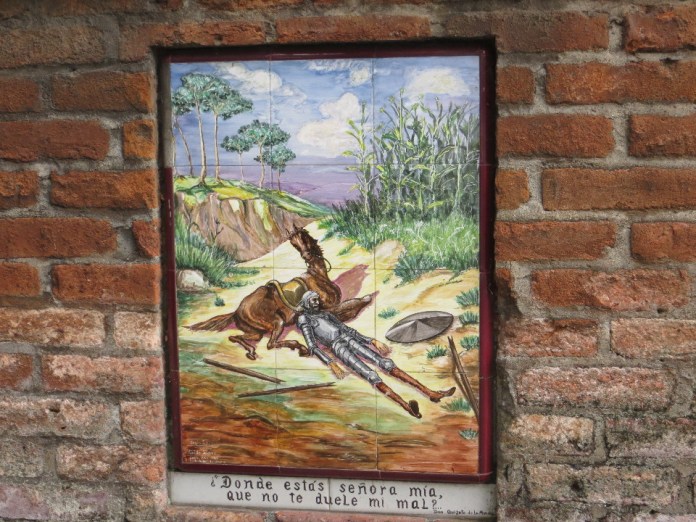
An exhausted Don Quixote and his horse Rocinante, rest by a stream. This collection of tile art was painted by Guido Saenz, Costa Rica’s first Minister of Culture.  Photo Michael Miller

Here in Costa Rica, hand-painted tile art became popular, when landowners from the countryside achieved enough affluence to build townhomes in the capital city of San José. By the second half of the 1800’s, these “coffee barons” started building beautiful houses in Barrio Amon and the adjacent Barrio Otoya.

The exterior wall of the Hotel Don Carlos facing Avenida 9, displays a collection of hand-painted tile images based on the literary classic, Concherias. This book of stories about life in rural Costa Rica in the late 1800’s is depicted in each of the paintings.  Photo Michael Miller

Hand-painted tile art is everywhere in this neighborhood which are easily done by painting contractor phoenix. It is on the exterior walls of private homes, and on the walls of hotels and restaurants. You can find it on the walls of office buildings. Sometimes it is hidden in private alcoves. Some of the art will jump out at you as you walk the neighborhood, and some of it you will have to look for.

This scene depicts a wedding in the Costa Rican countryside, and is one of the collection of “Concherias” tile arts at the Hotel Don Carlos.  Photo Michael Miller

Perhaps the best way to see the hand-painted tile art of Barrio Amon is to start at the Hotel Don Carlos. At this lovely boutique hotel, you will find tile art both inside and out.

A country market scene. This is another scene based on the Costa Rican literary classic, “Concherias.”  Photo Michael Miller

On the exterior wall of the Hotel Don Carlos facing Avenida 9, you will find a collection of eight tile paintings that depict scenes from the Costa Rican countryside from an earlier era. These paintings were inspired by a book of stories about life in rural Costa Rica during the late 1800’s. The book is called Concherias by Aquileo Echeverria, and it is a considered a classic of Costa Rican literature. The book is available in the fine gift shop in the Hotel Don Carlos.

The herb vendor. This hand-painted tile work shows a man, looking a bit lonely, tending his shop at the mercado selling herbal remedies.  Photo Michael Miller

Inside the Hotel Don Carlos, you will find several other examples of tile art. The most significant of these is a huge work that shows all the prominent buildings in the northeast section of Downtown San José. Many of those buildings no longer exist. The work was the creation of artist Mario Arroyabe, who is from Colombia. Lupita Balser de Weiler, the owner of Hotel Don Carlos, told us how she and many local experts aided the artist with old photographs and descriptions of the buildings.

A private home protected by a brick wall displays a collection of hand-painted tile art scenes from the classic Spanish novel Don Quixote de la Mancha.  Photo Michael Miller

Next door to the Hotel Don Carlos is a private home that is protected by an interesting brick wall. On the wall, you will find another collection of hand-painted tiles with a literary theme. These are scenes from the Spanish classic Don Quixote de la Mancha. They were painted by the nation’s first Minister of Culture, Guido Saenz, who is also famous for converting the passenger terminal of the old Sabana Airport into the Costa Rican Museum of Art.

This tile work shows a working class cantina scene. This picture and the one above, can be discovered by walking through the historic Barrio Amon neighborhood. These are next door to the Dunn Inn and across from the Hotel Taormina.  Photo Michael Miller

Part of the fun of walking around Barrio Amon is discovering examples of tile art. Down the hill from the Hotel Don Carlos is another small hotel called the Dunn Inn. Next door you will see a pair of tile art pieces that show scenes of life in Costa Rica; one of them shows a man selling medicinal herbs in the mercado, and the other shows men standing at a bar in a cantina.

The coat of arms of Costa Rica on hand-painted ceramic tiles, one of the many surprises you will find as you walk through historic Barrio Amon.  Photo Michael Miller

Another surprise that you might discover are two examples of tile art on the exterior wall at the rear of the Sportsmen’s Lodge. One is a reproduction of a popular painting with an old ox cart next to a farmhouse, and the other is a religious image showing the Blessed Virgin.

Religion is a popular theme for tile art. If you walk to Avenida 7, across the street from the Casa Amarilla, there is an ornate old guard shack at Parque España. The guard shack is decorated with tile art from top to bottom, and on each side you will see depictions of religious images.

This exquisite alcove is the entry way to a private home next door to the Sportsmen’s Lodge. This image depicts the Blessed Virgin Mary, a popular subject in the Roman Catholic country.  Photo Michael Miller

If you continue walking up Avenida 7, across from the Mexican Embassy, there is a piece of tile art that is somewhat painful to see. It depicts the young Indian girl who discovered a small black statue of the Virgin Mary in, what is now, the city of Cartago. This statue, known as “La Negrita,” is immensely important to the Catholic faithful in Central America, and it was on this spot that the magnificent Basilica of Our Lady of the Angels was built.

The distressing thing about this piece of tile art is that it is mounted on a wall behind some black steel bars. If you look at this picture, you will see several places where it has been badly damaged by vandals. My, how sad. Sad on so many levels. Fortunately, the steel bars keep this piece of art safe from further damage.

Even with some damage, the hand-painted ceramic tile art of Barrio Amon is a good reason to take a walk through this historic neighborhood. As I have said many times before, San José is a city full of surprises. It is all part of “the real San José.”


The old guard shack at Parque España, across from the Casa Amarilla, features hand-painted tile trim and religious images on each side.  Photo Michael Miller

To find Barrio Amon, it is the neighborhood immediately behind high-rise tower of the Holiday Inn in Downtown San José. If you wish to begin your walk at the Hotel Don Carlos, you will find it at the corner of Avenida 9 and Calle 9.


I would like to thank La Señora Lupita Balser de Weiler, the owner of the Hotel Don Carlos. She was most generous with her time and she has a wealth of knowledge of the tile art of Barrio Amon. Her enthusiasm for all forms of Costa Rican art is contagious.

La Señora Lupita Balser de Weiler, right, the owner of the Hotel don Carlos and patron of Costa Rican art, meets with then President-Elect Don Carlos Alvarado and Claudia. Photo from the Internet.

And a very special thank you to tour guide and interpreter Nury Mora-Vargas, who once again has proven to be an invaluable help.


Michael Miller is the author of the first and only guidebook that focuses on Downtown San José, Costa Rica, titled The Real San José. Paperback copies are available for sale in the gift shop of the Hotel Don Carlos. An electronic version of The Real San José is available at Amazon/Kindle. Click Here.

Your questions and comments are always welcomed. You may contact Michael directly by email: therealsanjose@gmail.com. You can see other stories that Michael has written about Downtown San José at his website: TheRealSanJose.com

- A word from our sponsors -

‘The truth is we had to leave’: Fleeing Venezuela for Colombia

0

Cucuta, Colombia – Insecurity, instability and violence have forced more 1.5 million Venezuelans to flee the country since 2014, according to conservative government figures. Over half that population have sought refuge in neighboring Colombia.

More than 35,000 people cross the bridge from Venezuela into Colombia every day. Many return daily, but around 4,000 people stay in the border city, Cucuta, or move further into Colombia or to neighboring countries. People sell and buy items at the market near the bridge so they can take money and goods to their families in Venezuela. Simon Bolivar Bridge, Colombia. Iris V. Ebert/IRC

“Colombia is a lifeline for western Venezuela,” said Rafael Velasquez Garcia, the International Rescue Committee’s (IRC) head of mission in Colombia. “Every day more than 35,000 Venezuelans cross the Simon Bolivar bridge alone to purchase food and receive vital medical assistance, among other services which are not available in Venezuela. Of that number around 4,000 do not return Venezuela – many of whom are without official documentation or status.”

This number does not include those who cross through the “trochas” or trails that are often controlled by Colombian armed groups and/or organized crime groups, which charge migrants and refugees fees and expose them to the risks of recruitment and robbery.

An assessment of Venezuelans in Cucuta and Villa del Rosario conducted by the International Rescue Committee in March 2018 showed that among respondents who spent the last month in Colombia, their self-reported highest priority need was to find a job (89 percent), followed by food (80 percent), and then shelter (58 percent).

The assessment also found evidence of significant family separation, recruitment of children into gangs and armed groups, sexual violence and exploitation, including transactional sex of Venezuelan women, girls and boys, and due to the lack of education opportunities, more children living and working on the streets.

“Venezuelans who remain in Colombia invariably have few possessions, very little or no money, and no immediate, formal and safe opportunities to earn income,” Garcia said.

“As a result, many work in the informal sectors, increasing their exposure to violence, exploitation and other dangers. Women and children are often the most vulnerable during transit and they face significant protection risks when traveling alone to a new location.”

The IRC noted that the sheer number of Venezuelans remaining in Colombia has meant that needs are far outstripping available services.

*Names changed to protect identity

Luis* gives haircuts for 1,000 Colombian pesos, less than $1 USD, next to the Simon Bolivar Bridge near Cucuta, Colombia, bordering Venezuela. His wife, who is pregnant, is in Venezuela. He said he is earning money to buy diapers in Colombia to bring home. Iris V. Ebert/IRC
Maria* is originally from Peru but lived in Venezuela for 25 years. With no work available in Venezuela, she crosses the border almost daily to come to Colombia to sell coffee and baked goods. With two other women, she cooks meals in the kitchen of a small rented room for people living on the streets in the area. Iris V. Ebert/IRC
Tania* was raised in Caracas, Venezuela. Today she is homeless in Cucuta. She spends her days collecting plastic bottles and other recyclable materials to earn money to buy food. She relies on the money she can raise and the kindness of other Venezuelans and Colombians in Cucuta. “The truth is we had to leave,” she says. “We were threatened – people said that they were going to hurt us.” Iris V. Ebert/IRC
Sofia* and Luis* fled Venezuela with their two sons and baby girl. They both used to work in transportation and are now finding odd jobs including cutting hair to earn enough money to feed their family. Luis suffers from a chronic leg injury and can no longer work. Sofia hopes to one day start a hair salon. Iris V. Ebert/IRC
Carla*, 23, fled Venezuela to Cucuta after suffering sexual violence two years ago. She had to leave her children behind with family. Her family has been torn apart by the crisis; she says her children are hungry and have no access to food or medicine. Iris V. Ebert/IRC
Colombians and Venezuelans wait for food distribution at a local soup kitchen. Approximately 35,000 Venezuelans are crossing into Colombia’s Norte de Santander department, where the border city of Cucuta is located. This region of Colombia has the highest number of Venezuelans in transit. Iris V. Ebert/IRC

Article originally appeared on Today Venezuela and is republished here with permission.

- A word from our sponsors -

What if Costa Rica had an army?

0

(OP-ED) Costa Rica is capable of maintaining an army and may be facing the reality of such in the future.

Often when people look back on the Costa Rican army, they think of it as a ragtag militia force that was not capable of much of anything. This isn’t true, and for it’s time, and it’s budget, the Costa Rican army proved itself effective in combat between the 1840s and the 1940s, facing US-backed filibusters in Nicaragua, the Panamanian army in the Coto War, and the Nicaraguan army on several small incursions into Costa Rican territory between the 1850s and the 1950s, although the force that met them in the 50s was the Civil Guard, not the army.

The Costa Rican army looked just as professional as those of major powers in the early 20th century, the only thing Costa Rica lacked was numbers, often the army only had a couple thousand men on hand at any given point in history.

Costa Rica used its own variants of the Mauser rifle (Chambered in 7mm Mauser rather than the 8mm used by Germany), and was the only country outside of Italy to use the Breda PG, the Costa Rican variant possibly being the first gun in the world to feature a burst fire mechanic.

Costa Rica never had a navy or an air force, nor did it have tanks. I’ve heard about there having potentially been armored cars at some point in the 30s, but I have never seen pictures of them. The army did have aircraft in inventory, but these were simple transport planes, not fighters/bombers.

As for what would happen in the modern day, the financial situation would simply not allow for a modernized Western force. Likely, the new Costa Rican troops would be using older rifles (AKs, M16s, etc), surplus uniforms from other countries (Likely the US or Canada), and whatever kit they could cobble together.

The Fuerza Publica (national police) owns helicopters, although these are only utility, but I can imagine if a pickup truck can be made into a fighting vehicle, so can a utility helicopter. It certainly wouldn’t be a first-rate force that would be seeing service overseas, but it would be enough to offer formidable resistance to their only rival Nicaragua.

By Rayburn Halkett, former Warrant Officer 2nd Class at Royal Canadian Army Cadets (2014-2018), posted on Quora.com

- A word from our sponsors -

Ortega opens possibility of referendum

0

President Daniel Ortega said in an interview with journalist Andrés Oppenheimer, for CNN en español, that he is willing to hold a referendum to ask people whether or not they want to hold elections in Nicaragua, as a way out of the sociopolitical crisis facing the country. country.

Would you accept a referendum? Ask people whether or not they want early elections? “, CNN en español journalist asked the president.

“Would you accept a referendum? Ask people whether or not they want early elections?”, the journalist asked the president.

“What is the problem here? Yes, we could ask people, of course. If people say yes, we go to early elections, and if people say no, they’re going to say that we committed fraud.”

Oppenheimer’s interview with Ortega will be aired in full at 7:00 pm on Monday (July 30), Nicaraguan time, by CNN en español, but the network published advances this Sunday highlighting the point of the referendum.

“It is an issue that we have discussed, no agreement has been reached at the level of the alliance, it is there, but it has many problems. Who would organize this referendum or plebiscite? With the current Supreme Electoral Council, there can be no referendum, because it has no credibility,” said Tünnermann, representative of the Civic Alliance in the national dialogue.

In the CNN en español interview, President Daniel Ortega disagreed about the number of deaths that human rights organizations have registered in the country since April 19, are between 295 and 448.

“The official data we have, which is no small thing either, is 195 deaths, as a result of these clashes,” Ortega said, discrediting the figure of the Inter-American Commission on Human Rights (IACHR), which records 295 deaths.

“The data handled by human rights organizations, including the IACHR, have not been refined, have not been verified, they are simply complaints that have been received and are adding them up,” said Ortega.

In a column for Miami’s El Nuevo Herald, journalist Andrés Oppenheimer said that President Ortega seeks to “strengthen” the mediation committee of the national dialogue by incorporating international organizations such as the United Nations and the European Union.

In a column for Miami’s El Nuevo Herald, journalist Andrés writes, “he wants to strengthen the country’s mediation commission by adding international organizations in an effort to end the country’s bloodshed”.

Ortega said he’s talking with the United Nations’ secretary-general and the European Union to expand the current mediation commission, which is chaired by Nicaragua’s Roman Catholic Church Conference of Bishops.

https://platform.twitter.com/widgets.js

“We have been in touch with the Secretary-General of the United Nations and different international organizations, and obviously with Cardinal Brenes,” Ortega said. “We’re are searching for ways to strengthen the dialogue commission.”

Cardinal Leopoldo Brenes, head of the Episcopal Conference of Nicaragua, has strongly criticized the Ortega regime’s repression of anti-government protesters, but said he would still be part of his proposed enlarged mediation effort, he said.

However, many see Ortega’s proposal as a gambit to win time to weaken the opposition. But a stronger role for the U.N., the European Union and the Organization of American States could put added international pressure on Ortega to allow early elections with an independent electoral tribunal and credible international observers.

Oppenheimer said that during the interview, which took place at Ortega’s residence in Managua, “the president seemed eager to convince the world that Nicaragua is recovering its normalcy after months of political violence — even though hotels in the city are virtually empty and many flights in and out of the city are only half full. Thousands of opposition protesters and pro-government counter-demonstrators were marching on the streets Saturday.”

The journalist noted that on Friday night, the InterContinental hotel’s two restaurants and several bars — which in normal times are packed on the weekends — looked like a scene from a ghost town. A taxi driver said he had one passenger after five hours, and said that may be his only ride of the day.

Watch the full interview with President Ortega on Monday at 7 pm (Nicaragua time) on CNN en Espanol. 

Article originally appeared on Today Nicaragua and is republished here with permission.

- A word from our sponsors -

How did this happen in a country once called the “safest in Central America”

0

(OPINION) The sentiments of many Nicaraguans was expressed on Twitter by Gioconda Belli: “Ortega has not given interviews in his country for eleven years, but now he is dedicated to washing his hands of his bad government and repression by giving interviews to journalists who barely know what is happening in the country and which is made to appear as the president victim of his people!”

https://platform.twitter.com/widgets.js
Over the past week, Ortega has given interviews to Fox News, albeit it appears like a canned interview given the and Ortega were not in the same place; TelesurTV that is owned/sponsored by Nicaragua, Venezuela, Cub, Bolivia, and Uruguay; and CNN en español that will be aired Monday night.

For more than 100 days Nicaragua has been gripped by a political crisis that has left more almost 450 dead and thousands injured in clashes with police and paramilitary forces loyal to Ortega.

So how did this happen in a country once called the “safest in Central America”.

What is your opinion? Use the comments section below or post your comments to our official Facebook page.

Article originally appeared on Today Nicaragua and is republished here with permission.

- A word from our sponsors -

Bomberos de Costa Rica Celebrate 153 Years of Service

0

As part of the celebration of the 153 anniversary of the Bomberos de Costa Rica (Fire Department), they showed off five new fire extinguishing units that will benefit and strengthen the service in the communities of Barrio Mexico, Bagaces, La Fortuna, Neily City and Guápiles.

The Bomberos celebrated their anniversary on July 27.

- A word from our sponsors -

Teen Wins Battle Against Cancer and School Regulation Against Long Hair

0

Julián Barquero Campos, who in 2016 was diagnosed with acute lymphoblastic leukemia, and prefers to wear his hair long, won his battle against the Colegio Nuestra Señora del Pilar, in Escazú, who demanded he cut his hair.

Julián Barquero Campos

“It is very difficult to explain the great psychological trauma that means to see how your hair fall out. Every time you take a shower, a fist full of hair falls out. It is almost impossible for me to count with words what you feel when you see how little by little you are going bald, for that reason, my hair means the triumph of life, that is why I wear it long because I want to live a lot. My hair is the happiness of the triumph of health over cancer,” said the 19-year-old.

Faced with being forced to cut his hair to stay in school, Julián decided to appeal (recurso de amparo in Spanish) to the Constitutional Court or Sala IV as it is commonly known in Costa Rica.

The Sala IV sided with Julián, who now wears with pride and just reason his “colochos” (curly hair).

“Hair on the floor means cancer, death; the hair on my head means health, life,” he explains, still with great doubts about why in his school they pay more attention to a cold and hard regulation than to a warrior of life, a fighter against cancer, who last September learned his bone marrow was ‘pura vida’.

- A word from our sponsors -

Otto Guevara: Ministry of Education wants to turn young people into worshipers of the socialist system

0

Former legislator and perennial presidential candidate, Otto Guevara, said that the Ministry of Education (MEP) wants to turn young people into ‘worshipers of the socialist system’.

The former legislator and perennial presidential candidate accuses the Ministry of Education of socialist teachings of the Partido Accion Cuidadana (PAC). File photo from Otto Guevara’s days in the legislative assembly

The libertarian said that “those who have had a position of influence in the MEP use public resources and the entire education system to indoctrinate youth about their (socialist) development model, about the vision they have in various issues.”

“They want to turn young people into statesmen, worshipers of the State, worshipers of the socialist system, turn them into enemies of private enterprise and the capitalist system and this is reinforced at the university level”, added the ex-legislator.

Guevara believes that parties like the Partido Accion Cuidadana (PAC) – in its second consecutive term of having a president in office – and the Frente Amplio (FA) have benefited from these educational programs “that prepare the minds of the people so that the electoral proposals of these groups can find fertile land.”

Guevara recommended a profound revision in education, so that students develop critical thinking.

- A word from our sponsors -

Man Acquitted Of Murder In The Killing of His Best Friend

0
Caleb Villalobos (left) was acquitted for the killing of his friend to stop him from continuing beating on his woman and children

After a year and four months in preventive detention (remand), Caleb Villalobos Aguilar, 30, is a free man, acquitted by the Limon criminal court accused of killing his friend Roberto Menocal, who he shot in the middle of a struggle when he intervened to prevent the now deceased from continuing to beat his live-in girlfriend and her two children.

Caleb Villalobos (left) was acquitted for the killing of his friend in a strulle to stop him from continuing beating on his woman and children

But, far from reproaching the year and four months that he was behind bars, he justified it, because after all he had ended the life of a human being and, even more, his closest friend.

During the trial, the woman gave declarations in defense of Villalobos, whom Jessica Jiménez Cordero considers her “hero”.

Judges José González Ulloa, Carlos Álvarez Arrieta and Marbeli Porras Venegas clarified that they would not call Villalobos a hero, but they did recognize that his action was fundamental to saving the woman and her children 11 and 8 at the time.

The accusation of murder against Villalobos arose from early accounts that he had shot his friend in the back while trying to flee. However, during the trial, witnesses told another story, the three-judge panel was told how Menocal had always been a violent man, was known to have weapons and boasted of, supposedly, that he had killed 15 men and he did not mind doing it again.

The court also learned of the domestic violence of which Jessica Jiménez, 33 years old, lived at the hands of her sentimental partner.

Villalobos faced 12 years in prison if he had been convicted.

- A word from our sponsors -

I Saw The Arenal Explode!

0
One of the eruptions of the Arenal volcano, which was reactivated on July 29, 1968 after a prolonged "siesta"

That morning, on July 29, 1968, the was nothing unusual. At least that’s how it seemed, writes Víctor Hugo Murillo relating his story in La Nacion’s Revista Dominical of the morning that the Volcan Arenal awoke after a prolonged “siesta”.

One of the eruptions of the Arenal volcano, which was reactivated on July 29, 1968 after a prolonged “siesta”

My mom, my dad and I were in the wide corridor of the grocery store talking, I do not remember what. It was a little past 7:30 in the morning.

– How strange, Carlos, you see how suddenly the day is getting very dark, said Mommy.

– Look, it’s true, and the wood trembles and the gate rattles, added Daddy.

– Is it that the Arenal exploded?, she expressed.

– Ah, woman, only you can think of it. The Arenal?

In addition, there was a hoarse, prolonged noise, similar to the turbine of a jet … that did not advance. It came from something that was stopped.

My mom did not stay still. He entered the grocery store that my father and a brother owned and went to the ‘manigueta’ telephone used to send and receive telegrams to and from nearby towns such as Arenal, Tronadora, El Silencio and, a little further on, Tilarán.

The material spewed by the Arenal volcano, in July of 1968, devastated a radius of 15 square kilometers and killed almost 90 people.

We lived in Venado, a small peasant town, owners of farms and laborers, where the main  -and only- economic activity was a milk farm. It was attached to the canton of Grecia; today it is part of San Carlos.

The horse was the “car”. The only way to leave quickly was by plane to Ciudad Quesada, Arenal (now submerged under the homonymous lake) or Cañas. On the back of a beast, it was possible to reach Arenal to take a car to Tilarán.

– Carlos, come, believe it, manifested, challenging and with victorious air, my mother, Maravelí. The Arenal is erupting!

Papi (daddy) had no choice but to surrender to the evidence: messages of help, stories of what was happening, dismay and confusion saturated the phone.

Pueblo Nuevo and Tabacón, the two towns closest to the Arenal volcano, were swept away by the fury of the eruptions.

I, 9 years old, the first thing I thought was my satisfaction that on Monday, July 29, 1968, I would not have to go to classes (school) in the afternoon to the bidocente (two teacher) school in Entre Ríos. But it was not only that day because the rest of the week the Arenal continued to demonstrate, with all its fury, that it was a volcano.

Ah, because although in the school books and on maps it was identified as Arenal volcano, among those who lived in its surroundings it was simply the “cerro” (mountain). Sometimes, when someone called it a volcano, they exposed themselves to mockery.

Angry neighbor

For us, the Arenal was a neighbor. From a window in the kitchen of my house, you could see its perfect cone, sometimes completely when there was no cloud over it.

To me, always with a fever for Social Studies, it was hard to believe that this colossus was now demonstrating strength and destructive power. Just seven months before, in December of 1967, accompanying my mother on a mission from “Niño Dios” to Ciudad Quesada, I had seen it: imposing, beautiful and totally green, from the window of the Cessna that Antonio Toño Espinoza piloted. How to imagine that beneath such beauty was hiding such a powerful volcano!

The Arenal Volcano seen from La Fortuna, San Carlos, in 1966. Brian Castillo

In a matter of minutes, that Monday, the day gave way to the “night”. Everything was disrupted: the work in the field was paralyzed, the chickens looked for the chicken coop and Simbo, my uncle Fabio’s dog, was afraid, like many in Venado.

In my community, where the two teachers were the most educated, understanding what was going on was not easy. Many feared that Venado could be hit by the ashes, sand and fire that we witnessed, helpless, incredulous and ecstatic. Needless to say, it was not holy that they did not come down from heaven.

But no. We were privileged. Because of its position on the colossus, approximately 12 kilometers to the north, in a straight line, we were safe. The Arenal exploded on the west side, opening a crater where it began to spew pyroclastic material and lava. The wind carried the ash and sand to Arenal, Tronadora, Mata de Caña, Tilarán, Cañas and Liberia, and even to the Gulf of Nicoya.

Apart from the surprise of that very different that Monday, I keep another very special memory: on Tuesday, July 30, after one o’clock in the afternoon, another black mushroom from Arenal began to rise again. Again “night”, again fear and expectation.

But what happened that afternoon, according to my childhood memory, was… (caramba, I find it hard to find a suitable adjective) Brutal!, let’s say. As if what was done by the “cerro” the day before had not been enough to boast its power, what I witnessed that day leads me to affirm that I have never seen a demonstration of so much force of nature.

Lava expelled by the Arenal volcano.

The blackish cloud was illuminated by red-hot fire and the sparks of possible collisions between the igneous rocks. The earth trembled and the noise was deafening. The “show” lasted something like six hours.

The next few days, our neighbor continued to sulk, but little by little it’s tantrum moderated.

The Arenal changed the appearance in a radius of 15 square kilometers. Pueblo Nuevo and Tabacón, the two small towns closest, received a full discharge and disappeared from the map, literally.

A few years later, the construction of the Arenal hydroelectric project(that included the creation of the Lake Arenal) finished modifying the landscape.

In a matter of a decade, much of what we had known was no longer the same.

Source: La Nacion

Arenal Volcano (Spanish: Volcán Arenal) is an active andesitic stratovolcano in north-western Costa Rica around 90 km northwest of San José – a 2.5 hours drive, in the province of Alajuela, canton of San Carlos, and district of La Fortuna.

The Arenal volcano measures at least 1,633 metres (5,358 ft) high. It is conically shaped with a crater 140 metres (460 ft) in diameter. Geologically, Arenal is considered a young volcano and it is estimated to be less than 7,500 years old.  It is also known as “Pan de Azúcar”, “Canaste“, “Volcan Costa Rica”, “Volcan Río Frío” or “Guatusos Peak”.

The volcano was dormant for hundreds of years and exhibited a single crater at its summit, with minor fumaroles activity, covered by dense vegetation. In 1968 it erupted unexpectedly. Due to the eruption three more craters were created on the western flanks but only one of them still exists today. Since 2010, Arenal has been dormant

See also List of volcanoes in Central America.

- A word from our sponsors -

1200 Kgs Of Cocaine Aboard Homemade Sub Confiscated In Southern Zone

0

Authorities detained 2 suspects linked to a home made submarine transporting 1,200 kilos of cocaine in the Punta Burica area, a small coastal peninsula−reef in the Pacific Ocean of Costa Rica’s southern zone.

The suspects were guarding the vessel. They were arrested in a joint operation between the Organismo de Investigación Judicial (OIJ) – Judicial Police,Policía de Fronteras (Border Police) and the  Servicio Nacional de Guardacostas (National Coast Guard.

As detailed by the OIJ, a total of 30 packages with drugs were confiscated. The cargo would have a value of more than ¢4,8 billion colones (US$8.5 million dollars) in the illicit market in the country.

The detained subjects are Ecuadorian nationals.

- A word from our sponsors -

The “Trojan Horse” Of The Plan Fiscal!

0

Legislators are waiting the government’s new draft of the Plan Fiscal (Tax Teform), plan that is more like the ‘timex watch‘ (takes a licking and keeps on ticking), turned ‘energizer bunny‘ (beating the bass drum), that may end up the ‘trojan horse‘.

- A word from our sponsors -

Couple Prisoner of Their Marijuana Cultivation Business Inside Their Home

0
Foto: Ministerio Público

A couple was arrested Friday by the Judicial Police (OIJ) and the Prosecutor’s Office (Fiscalía) of La Unión, in Cartago, suspected of growing hydroponic marijuana inside a house.

Foto: Ministerio Público

The arrest was made in a house in Barrio Concepción after the authorities raided the property and discovered 149 plants of different sizes.

The suspect was identified by their surnames Terán Vicente and the girlfriend Pavón Vargas. The investigation began as a result of confidential information received by the Organismo de Investigación Judicial (OIJ).

In addition to the plants, a large amount of equipment was set aside for the production of marijuana.

The property has three rooms that were adapted for the activity, with air conditioners, fans, power regulators, special lights and high power lamps.

Foto: Ministerio Público

Basically, the couple lived among the marijuana jungle they had created inside their home.

Agrochemicals used for cultivation and rapid growth were also located, along with several weigh scales and already processed marijuana.

The couple is being charged with the alleged crimes of drug cultivation and storage.

- A word from our sponsors -

Costa Rica: ripping jungle trails & surviving the emergency room! (Video)

0

Pura Vida- I thought this was just a gringo phrase, to be printed on walls of airports, bar napkins, and cheap t-shirts, but it turns out locals really do say this every day!

And after three days in the country, I can see why!

With an itinerary of a quick three day trip to the small Central American trip, I gave movie maker Logan Nelson a call, as well as photographer Eric Mickelson. We headed down to the tropics right in the middle of the rainy season, and therefore, with zero expectations. And what we discovered was amazing- a truly robust enduro community!

If you liked the video, visit Pinbike.com for the article and (lots of) photos by Jeff Kendall-Weed.

My favorites…

- A word from our sponsors -

Nicaragua: Doctors Fired for treating wounded protesters

0

Providing medical attention to protesters wounded in the city of Leon, is the reason for the dismissal of eleven doctors, nurses and technical staff of the Oscar Danilo Rosales teaching hospital, denounced the fired doctors.

Residents of Leon protested this Friday for the dismissal of dozens of doctors who treated protesters who were injured during the crisis

Among the dismissed are eight medical specialists, two nurses and a laboratory technician.

They were fired because they treated wounded anti-government protesters and were seen backing their cause, medical sources said Friday.

Dr. Jorge Alemán, dean of the Faculty of Medical Sciences of the National Autonomous University of Nicaragua (UNAN-León), said that the dismissals are to the detriment of the population.

“What happened is very regrettable because this will undoubtedly have a direct impact on the population; Negative impact against a director or someone not, but in the population,” he explained.

Dr. Alemán affirmed that the most serious thing is that they dispensed with unique personnel in their specialty throughout León, including an oncologist and a pediatric pulmonologist.

“They are dismissing very valuable doctors who have more than 35 years of studies to reach that level, and that unquestionably affects the population in a tacit and direct way,” said Alemán after urging the Ministry of Health, the government agency that runs the hospital, to “reverse these layoffs that will affect a lot the quality, capacity of attention to the population, capacity of training to the medical specialists that form in the hospital “.

The firing bolsters reports that those perceived to back protesters calling for the ouster of President Daniel Ortega were being persecuted by his government and sympathizers.

According to the the Nicaraguan Association for Human Rights (ANPDH), almost 450 people have been killed and thousands injured during the more than three months of unrest in the country.

Dr. Aaron Delgado

“They did not even let me finish the operation,” said Dr. Aaron Delgado who was told to go to the human resources office in the middle of performing surgery on a woman with breast cancer, and was quickly notified of his termination. “All this because a month ago outside the hospital we treated the wounded from a massacre perpetrated by the government’s paramilitaries.”

A letter given to the dismissed staff reads in part: “This notice hereby notifies you that upon the date listed above, your services are no longer needed at this hospital.”

Dr. Javier Pastora Membreno, who served as head of surgery and endoscopy before being fired, said: “Our crime is having tended to the wounded from the protests or having supported the marches in some way, asking for justice, freedom and a real democracy.”

“We are doctors, not terrorists,” added Pastora who has worked in Nicaragua’s public health system for 33 years.

United States Senator Marco Rubio, who recently said Ortega is an ‘old man’ and labeled his wife, Vice President Rosario Murillo ‘crazy’, denounced the wave of firings in a tweet.

https://platform.twitter.com/widgets.js‘More criminality from the regime in #Nicaragua. Doctors are being fired from their jobs in #Leon Nicaragua because they treated teenagers injured by paramilitary gangs working for #Ortega and Murillo. #SOSNicaragua.’

Article originally appeared on Today Nicaragua and is republished here with permission.

- A word from our sponsors -

4.8 Quake Jolts Costa Rica Friday Morning

0

A strong earthquake shook Costa Rica this Friday morning at 11:50 a.m. In a preliminary. The Red Sismológica Nacional – RSN (National Seismological Network) reported the intensity in 4.8, while the Observatorio Vulcanológico y Sismológico de Costa Rica – OVSICORI (Vulcanological and Seismological Observatory of Costa Rica) reported the magnitude at 4.7.

The epicenter was located 7.0 km southeast of San Ignacio, Acosta, near the epicenter of the 9:33 a.m. tremor that was barely noticed.

The RSN indicates that the earthquake felt strongest in José, Sabana, Santa Ana, Aserrí, some areas of Alajuela, Zapote, Escazú, Rohrmoser, Pavas, San Pedro, Heredia, among others.

Other areas in and out the Great Metropolitan Area (GAM) also reported feeling the tremor.

No damage or injuries were reported.

- A word from our sponsors -

Lie-Flat to Latin America: JetBlue to Fly Popular Mint Service to Costa Rica

0
Kick back (all the way back) and relax–with the longest fully lie-flat seat

JetBlue announced Thursday it is once again answering calls from customers for more Mint flights with the addition of two new routes to feature the airline’s popular premium service with lie-flat seating.

Starting December 2018, JetBlue will offer fully lie-flat seats, artisanal dining options, the most free inflight entertainment, revitalizing amenities and more, on its JFK to Liberia (Costa Rica) route.

Later this year, JetBlue will begin operating seasonal Saturday Mint service between New York ’s John F. Kennedy International Airport (JFK) and Liberia, Costa Rica’s Daniel Oduber Quirós International Airport (LIR), JetBlue’s first Mint city in Latin America.

“Adding Mint between these cities means travelers on these routes can finally enjoy a first-class flying experience,” said Marty St. George, executive vice president commercial and planning, JetBlue. “When Mint first launched more than four years ago, we knew we had created an unmatchable premium experience, but we could have never imagined Mint would be landing in well over a dozen destinations in such a short time.”

Costa Rica’s Liberia becomes JetBlue’s first Mint city in Latin America and JetBlue will be the only airline to operate regularly scheduled flights with a lie-flat premium seat between Costa Rica and the United States.

Saturday Mint Schedule between New York (JFK) and Liberia (LIR): Beginning December 15, 2018,

  • JFK – LIR Flight #1691 – 10:25 a.m. – 2:49 p.m.
  • LIR – JFK Flight #1692 – 4:15 p.m. – 10:14 p.m.

With the addition of Liberia, JetBlue will now serve 12 cities with Mint flights from its New York-JFK focus city. In Boston, where JetBlue is the top airline in both number of flights and number of customers, new St. Lucia Mint service will bring Mint to nine routes from Logan. No other airline in Boston offers a premium lie-flat seat on as many routes.

JetBlue’s Airbus A321 With Mint Offers Every Customer A Better Flight

Kick back (all the way back) and relax–with the longest fully lie-flat seat

Since launching in 2014, Mint has become a favorite way for celebrities, technology executives, creatives, and entrepreneurs to travel. Mint was recognized by Fast Company’s Innovation By Design Awards, which honors innovative and disruptive design that pushes boundaries and seeks to change the world.

All customers will benefit from JetBlue’s new Airbus A321 with Mint aircraft, which features the airline’s new core experience for customers seated throughout the entire aircraft.

Mint offers a completely rethought design and a more personal approach to service, addressing the needs of the modern traveler. Mint features exceptional hospitality from specially trained crewmembers.

Favorite Mint features include lie-flat seating, a signature cocktail, a tapas-style menu by New York City restaurant Saxon + Parole, fresh espresso from the first purpose-built cappuccino machine for a U.S. airline, amenity kits by Hayward and Hopper, and dessert from local artisanal ice cream makers based in Mint cities.

Features of the A321 core interior include 10-inch television screens offering free entertainment, comfortable seats with the most legroom in coach (a) and power outlets accessible to all customers. JetBlue’s popular marketplace, a self-serve station full of free snacks, sodas and water for customers to enjoy at their convenience, is also available throughout the flight. And all A321 aircraft offer JetBlue’s free Fly-Fi high-speed broadband Internet service (b) and access to JetBlue’s Hub content on personal devices and first-run Hollywood movies.

Sources: Businesswire.com; Jetblue Mint

- A word from our sponsors -

ANPDH: Deaths Reach 448 in Nicaragua, 97 In The Last 15 Days

0

Between July 10 and 25, the Nicaraguan Association for Human Rights (ANPDH) recorded 97 deaths nationwide and on Thursday said that 448 people died in the citizen protests that began on April 18, due to the repression and the confrontations that this unleashed.

Repression. The ANPDH on Thursday raised to 448 the number of people killed in the country between April 19 and July 25. The number of injured reaches 2,830, most “without access to medical care.”

The new count is an increase of nearly 100 over the previously released toll.

The victims comprised 383 civilians, 40 members of pro-government paramilitary groups, 24 police officers and one soldier, said Alvaro Leiva at a press conference.

Leiva added that the last 15 days “were particularly bloody.” The 97 deaths in the last two weeks represent 21.6% of the cases recorded in 98 days of protests; that is, on average six deaths per day.

Violence by the numbers. El Neuvo Diaro

We are intensely concerned about the deep crisis of human rights violations, by a government that does not demonstrate the political will to improve the human rights of Nicaraguans,” said Leiva.

The report details that 356 people were killed by gunshots; 20 from stab wounds; two from hand grenades; two from homemade weapons and 68 that are under investigation.

Leiva said Thursday that 399 of the dead have been identified, more than 2,800 people have been injured, 72 of them incurable.

Paramilitary groups have also abducted 718 people, 595 of whom remain missing, according to Leiva, who accuses paramilitary groups of intimidating the population out of “party and ideological fanaticism.”

President Daniel Ortega denies any responsibility for the killings and accuses his opponents, who are demanding his resignation, being coup plotters. Ortega, though he says he has the utmost respect for bishops of the Catholic Church, he accuses them of siding with the coup plotters.

A couple mourns during the funeral of 21-year-old Bryan Picado, who died during clashes with members of Nicaragua’s Special Forces in the Sandino neighborhood in Jinotega on July 24, 2018. (AFP Photo)

Managua’s archbishop, Cardinal Leopoldo Brenes, told AFP that the Church “is not an enemy” of Ortega’s government, and urged the administration to “listen” to the people. He said that, while conditions were not right now to resume dialogue, “without talks there could be more deaths.”

Article originally appeared on Today Nicaragua and is republished here with permission.
- A word from our sponsors -

Cuba celebrates National Rebellion Day

0

Santiago de Cuba, Jul 26 (RHC) Cubans celebrate today the National Rebellion Day, established in honor of the assault on the Moncada and Carlos Manuel de Céspedes barracks in the east of the island, on this date in 1953.

As in every round anniversary, Santiago de Cuba hosts central activities in remembrance of that action undertaken by a group of young people under the leadership of Fidel Castro.

On Wednesday, the First Secretary of the Communist Party of Cuba, Raul Castro, headed in the Segundo Frente municipality of Santiago the provincial rally to commemorate the anniversary.

The celebration of the Day of National Rebellion comes at a special moment for Cuba, marked by a change in the leadership of the State and Government, with the arrival in the presidency last April of Miguel Diaz-Canel, who has sworn allegiance to the legacy of the historical generation of the Revolution.

Article originally appeared on Today Cuba and is republished here with permission.

- A word from our sponsors -

Natalya Nemchinova, Sexiest fan of the World Cup 2018

0

The beauty of Natalya Nemchinova, 28, captivated many fans of the planet for her sexy outfit in the stadiums and a spectacular figure.

See more of Natalya Nemchinova on Costa Rica Confidential.


- A word from our sponsors -

What Nicaragua Should Learn About How to Topple a Tyrant

0

Nicaraguans have been trying to remove Daniel Ortega from power for more than three months. The Sandinista leader, on his third consecutive term, has more than 11 years so far, in the presidency and the economic situation, as well as the repression, is getting worse.

Daniel Ortega has refused calls to step down or hold early elections in Nicaragua.

For anyone who has followed what has happened in recent weeks, it is clear that the people of Nicaragua have given everything; they are brave and willing to take risks. In spite of how long the battle has been and the brutal aggression against the demonstrators, carried out by the Ortega paramilitaries armed with AK-47s, and willing to acts as aberrant as burning churches with refugees inside, the protest has not waned.

However, marches, mobilizations, and confrontations with homemade weapons do not seem to be the way to get a tyrant out of power. Recall that the same thing happened a year ago in Venezuela: for months people went out into the streets and confronted the paramilitaries, and in spite of that, Nicolas Maduro is still in power.

The “state”, is nothing more than a bunch of politicians literally living to extract money from the people.

In Venezuela, certainly, the MUD helped to prop up the tyranny, but it is not the same in Nicaragua, where the dialogue between the opposition and Ortega has been mediated by a strong and dignified Catholic church that has canceled the negotiations when the government has not complied and, unlike in Venezuela, was willing to stare down the Sandinista thugs in order to avoid massacres.

History has shown that there are different ways to topple a tyrant. I personally defend tyrannicide as a matter of self-defense. The murder of a tyrant, as Father Juan de Mariana explained in “On the King and the Royal Institution,” is a natural right of the people. However, both in the case of Nicaragua and in Venezuela, this path does not seem viable. The people are not armed and for some reason the military has not been able to do anything about it.

There may not be enough rebels within the military willing to give their lives to defend their people. They may not have the necessary weapons, and the tyrants appear to have so well infiltrated their own military forces that dissidents therein have thus far been unable to mount a credible threat. Whatever the case may be, the violent overthrow option has not had a real chance in either of the two countries and it does not seem to be working for now.

However, there is another option to topple a tyrant. It is a strategy that is rarely discussed, although for me it is much more valuable, intelligent, and romantic.

What they call the “state”, is nothing more than a bunch of politicians literally living to extract money from the people; the day that it is unable to do so, the state dies.

In Colombia a tyrant has already been toppled in this manner. It is not so difficult, it is not impossible, and it does not necessitate the death of hundreds of innocents.

At the beginning of 1957, Colombia lived through an extremely tense political environment. The government of General Gustavo Rojas Pinilla was in crisis, the leaders of the two traditional parties of Colombia had withdrawn their support, the discontent of Colombians was growing and the country was experiencing a difficult economic situation. As an aggravating circumstance, in those days, Rojas Pinilla began to manage his re-election for the period 1958-1962, with a National Constituent Assembly that had previously legitimized his government.

The press was completely censored. Rojas issued a decree establishing a prison sentence of two to five years for anyone who defamed his government. It closed unfriendly media such as La Unidad, a weekly magazine published in Bogota and directed by Belisario Betancur, a well-known man in Colombia.

The tyrant had also ordered the closure of all civil society he viewed as a threat to his power, much like Cuba in the first years of Fidel Castro. Just as, as we see today in Nicaragua, the Catholic Church was the victim of attacks.

How did they topple Rojas Pinilla? With a great national strike.

As I said before, the state dies if it does not have a means to extract money from its people.

The first ones to strike were the students, since from the first of May the universities were empty. On May 5, by order of the directors, the newspapers stopped circulating. The next day, May 6, the banking sector joined the strike and decided to close its doors. After that, the commercial strike began, as retail stores shut down. On May 7, Medellín and Bogotá, the main cities, declared an industrial strike; the next day all the industries of the country were closed. On May 9, the whole country was stopped and food was scarce in the capital.

At dawn on May 10, after a week of the national strike, Rojas Pinilla resigned. “Liberty. Rojas no! He fell!” was heard in every street in the country.

There was a united opposition: even Conservatives and Liberals agreed. There was also a military junta that would take power while elections were being held. But this was not what toppled the tyrant, these were factors that facilitated the transition after the fall. What made Rojas Pinilla resign was the coordinated action of all Colombians stopping any economic activity.

There are many historians and scholars who describe the fall of the military dictatorship as an incident without precedent in Latin America. Millions of people deliberately and cohesively overthrew, without violence, a military dictatorship.

The reader will now understand why I used the word “romantic” to refer to this nonviolent option of toppling a tyrant. An overthrow of this style implies, first, that people realize what I have mentioned several times: politicians live by stealing money, and if one day we all decide not to pay taxes, the system simply collapses. It is not possible to put everyone in the country in jail.

But, in addition, this type of overthrow involves a second element: the coordinated action that comes from believing in the strength of voluntary cooperation. What happened in Colombia is that everyone agreed and trusted that no one else would open their store, their warehouse, their bank, or their company. The students trusted that their classmates, like them, would stay at home and refuse to go to school. The workers did likewise.

The day that the Nicaraguans, all of them, understand the power of cooperation and decide not to keep the small group of criminals that govern them in power, Ortega will be toppled.

Source: Article by By Vanesa Vallejo for the Panampost.com

Article originally appeared on Today Nicaragua and is republished here with permission.

- A word from our sponsors -

Venezuela: Surviving in the Country with the Worst Hyperinflation in History

0

How do you survive in a country where inflation can reach 1,000,000%? That is the current situation in Venezuela, the country with the largest oil reserves on the planet, but which became one of the poorest in the world thanks to the arrival of socialism.

Venezuela’s hyperinflation has forced millions to seek better opportunities abroad (Twitter).

The International Monetary Fund (IMF) was forced to revise its estimate of the Venezuelan economy. Although at the end of 2017 it indicated that the country governed by Nicolas Maduro would reach an inflation level of 13,000%, this week it warned that inflation will hit 1,000,000%.

In Venezuela, the minimum monthly wage is USD $1; however, one kilo of white cheese costs 6,400,000 bolivares (USD $1.80), that is, more than one minimum monthly salary.

A decade ago, when the economic decline began, many economists argued that Venezuela could experience hyperinflation thanks to its oil wealth. However, thanks to socialism mismanagement, they not only destroyed the economy but the production of crude oil as well.

https://platform.twitter.com/widgets.js

The Venezuelan economist, José Toro Hardy, explained to the PanAm Post that with the new estimate of the IMF, Venezuela is among the highest inflation cases that humanity has known in its entire history.

He noted that the economic crisis in Venezuela is due to “aberrant public policies” full of price controls.

This is the result of a nonsensical public policy and unrestrained populism. The government of Venezuela has incurred an unmanageable fiscal deficit to finance the cash flow of PDVSA, which is the state-controlled oil company.

“The government has resorted to demanding from the Central Bank of Venezuela that they issue vasts quantities of money without necessary backing; that money is incorporated into the country’s money supply and results in a demand for goods. But as in the country, there are no goods because they have destroyed the country’s productive capacity through expropriations, price controls, through all kinds of socialist measures: what they have achieved is that there is a shortage of everything. In Venezuela there are no medicines, there is no food, but the result is that there is this huge money supply, seeking to buy goods that do not exist, thus the key result is that prices go up,” he explained.

Currently, 91% of Venezuelan families live below the poverty line, and 65% of families face extreme poverty.

“It is very difficult to live in these conditions, first because the country has become impoverished, because there is no salary adjustment that can withstand this increase in prices, and that adds to the scarcity of almost any product. People are getting desperate and living in terrible anguish and for that reason, many Venezuelans simply choose to leave the country,” notes Hardy Toro.

Before, the main reason why Venezuelans emigrated was due to the insecurity and the high levels of violence in the South American country; now the main reason is because the Venezuelan economy is unsustainable.

Source: Panampost.com

Article originally appeared on Today Venezuela and is republished here with permission.

- A word from our sponsors -

Mexican Authorities to Create Transnational Anti Gang Center

0

(Prensa Latina) Mexican authorities will create a Transnational Anti-gang Center (CAT) in Chiapas, in the south of the country, it was reported.

The entity aims at identifying the gang members and study their movements, especially towards Tapachula, an area they are trying to control.

According to the authorities, over the past five years, more than 300 leaders of the antagonist gangs Mara 13 and Barrio 18 were detained in Chiapas, some of them detained in the entity’s penal centers and others were taken to their countries of origin.

The CAT will be in charge of the Migrant Assistance Office, within the Regional Security and Crime Prevention Program, implemented by the State Attorney General and the Interinstitutional Group, integrated by the Specialized Police, the State Preventive Police, the Municipal Police and the Federal Police.

In addition, CAT Chiapas will be linked to the Transnational Anti-gang Center of the National Civil Police of Guatemala, Honduras and El Salvador, which will help identify criminals.

- A word from our sponsors -

Legislator Enrique Sánchez: “Uber would pay a 3% tax for each trip”

0

Under the premise that Uber must be legal in Costa Rica, PAC legislator Enrique Sanchez, is promoting a bill that aims to level the playing field with taxi drivers and would incorporate a 3% tax on each trip made by the drivers of Uber.

Questioned if the tax will raise the price to the consumer, the legislator said it all depends on the company, whether it decides to pass on the tax to consumers. The tax on the would be used to strengthen urban mobility and public transport.

The legislator emphasized that the proposal is personal and not an official position of the PAC party, but the party has also discussed the need to regularize Uber, and the government is aware that it must do so.

- A word from our sponsors -

Guanacaste, Costa Rica’s Engine For Economic Development

0
The expansion of the Daniel Oduber airport, the opening of the Liberia-Cañas highway, among other factors, have reactivated the interest to invest in the province. Shutterstock / The Republic

Guanacaste aims to accelerate its pace of development through the diversification of its productive activities and improvement in infrastructure.

The expansion of the Daniel Oduber airport, the opening of the Liberia-Cañas highway, among other factors, have reactivated the interest to invest in the Pacific Coast province of Guanacaste. La Republica

The expansion of the Daniel Oduber Airport (LIR), the opening of the cargo terminal, the inauguration of the Liberia-Cañas highway and the start of roadworks between Cañas and Limonal, as well as other factors, have reactivated the interest to invest in the province.

Proof of this is the beginning of the construction of the new Coca-Cola plant. The building will be located in Liberia and will initially require approximately US$50 million investment.

All this and more has spurred interest in more investment in the Pacific coast province.

“Guanacaste has attractive characteristics for investors, a quarter of national hotel occupancy and 53% of foreigner visits are concentrated there; it is a pioneer region in the use of clean energy, it has a young population with a high degree of educational preparation; it’s an area with a lot of potential that has not been taken advantage of,” said Monica Castillo, director of Colliers real estate.

Although the area still has significant challenges, it is emerging as an outlet to decongest the economic activities of the Greater Metropolitan Area of San Jose while bringing development to the province.

Tourism remains one of the strongest economic activities. The Liberia airport saw 518,000 tourist arrivals in 2017. For 2018, that number is expected to be higher with the addition of Aeromexico, Apple Vacations and Air Canada increasing its number of flights.

There are still deficiencies that must be corrected so that the province continues to attract new businesses, for example, service centers.

President Carlos Alvarado has reiterated on several occasions the importance of Guanacaste for the growth of the country.

Source (in Spanish): La Republica

- A word from our sponsors -

Surf’s Up: Margot Robbie’s The Perfect Wave in Costa Rica

0

Actress Margot Robbie‘s no longer skating on ice, she’s down in Costa Rica taking in some surf … and pretty good at it.

The “I, Tonya” star and her hubby, Tom Ackerley, caught a party wave during a late afternoon surfing session. She looked like a pro on her longboard … then again, she’s Australian so surfing is basically in her blood.

Afterwards they headed into shore for happy hour and the sunset where Margot blended in with the other beach folk, gave a solid “cheers” and did a hang ten onto her man’s arm.

Margot could be taking a quick break before kicking it into high gear again. She’s got a ton of upcoming projects including “Suicide Squad 2,” “Gotham City Sirens” and “Marian.”

Source: TMZ

- A word from our sponsors -

Costa Rica “On Alert” Of A Migratory Crisis Over Violence in Nicaragua

0

The political and social crisis that Nicaragua is experiencing has Costa Rica on the verge of a migratory crisis for which it may not be prepared due to lack of resources.

The entrance of 3,300 refugees only during June and more than 10,000 applications in total, reflect the fear of Nicaraguans of the President Daniel Ortega regime.

The government’s concern is that if the number of refugees reaches 5,000 it would amount to an immigration crisis.

We still can not talk about a crisis, but the country is On alert.
Epsy Campbell, Costa Rica’s Foreign Minister.

Unlike migrants, refugees are people fleeing armed conflict, violence or persecution and are therefore forced to cross the border to seek safety, entering the country without assets or work, so the Costa Rican government has to care for them, providing food & shelter, medical assistance and other services.

This month, the migratory flow of Nicaraguans – between refugees and migrants with a visa – has reached one thousand people a week.

Although the government has a comprehensive action plan to deal with migratory flows, it would not be enough. “Extraordinary resources are required to meet an eventual extraordinary flow of refugees. We still cannot talk about a crisis, but the country is on alert,” said Epsy Campbell, Costa Rica’s Foreign Minister.


Epsy Campbell, Costa Rica’s Foreign Minister.

Last week, the government opened two shelters, one in La Cruz de Guanacaste, in the north and the other in Golfito, in the southern zone, near the Panama border.


The facilities are the same used three years ago, to address the migration crisis faced by the country, due to the massive influx of Cubans and Africans, among others, unable to leave Costa Rica a due to Nicaragua closing its borders to them.

The political turmoil in Nicaragua that has resulted in more than 300 deaths and thousands injured since mid-April is closely followed by the Costa Rican government, not only because of the potential migration crisis but also because of the impact it would generate on trade, acknowledges Costa Rican president, Carlos Alvarado.

Nicaragua is the fourth destination of Costa Rican exports with US$566 million in 2017, including cement, syrups, medicines, and sauces, among others.

- A word from our sponsors -

Fierce Opposition to the Pacific Alliance Continues

0

Entrepreneurs in the agricultural sector in Costa Rica are maintaining their position against an eventual incorporation into the commercial block, the Alianza del Pacífico (AP) – Pacific Alliance  – made up of Mexico, Colombia, Peru and Chile.

The sector affirms that it will not allow any renegotiation of the bilateral agreements in force in the Tratados de Libre Comercio (TLC) -Free Trade Agreements – with each of those nations.

The Pacific Alliance wishes to have 90% of the products from Costa Rica into a free market condition while some agricultural sectors could feel the backlash from exporting along with competitive nations, such as Colombia.

Read more: Costa Rica Yes and No to Pacific Alliance

The matter was more than clear during the debate that followed the paper “Costa Rica should join the Pacific Alliance as soon as possible”, presented in the “Smart Debates” program, promoted by Lead University. The activity was carried out last Thursday (July 19), with the intervention of the panelists Fernando Ocampo, former vice-minister of Foreign Trade (Comex); Juan Rafael Lizano, former Minister of Agriculture and Livestock (MAG), as well as experts in international trade Viviana Santamaría and Renzo Céspedes.

Ocampo and Santamaría represented the side in favor of the statement, while Lizano and Céspedes were the voice of the group against.

Although it is not yet a priority on the agenda, the Ministry of Foreign Trade plans to initiate a consultation process with all the sectors involved, to analyze the positive and negative aspects of an eventual inclusion to the Pacific Alliance and in what way the process should be carried out.

Meanwhile, the agricultural sector has kept its same position ever since discussions began in the country regarding the possibility of being part of the commercial block, which the Costa Rican industrial sector does want to join.

According to those who defend the position of the agriculture sector, ” …Activities such as dairy farming, which today are outside of free trade with members of the PA, would be severely affected by joining the bloc and affirmed that the process to access this group of countries is not a negotiation, but a simple accession, in which all terms are acknowledged and accepted, without prior discussion.”

Nacion.com reports that for Fernando Ocampo, “… negotiation to enter the Alliance must begin, and depending on the conditions that block requests of the country, a decision taken internally. According to the fomrer vice minister, it is possible to carry out an intelligent negotiation and respect the sensitivities that some products have, although he explained that it is only about 50 tariff lines, of the 6,587 that, in general, Costa Rica handles in its foreign trade.”

The current head of the Comex, Dyalá Jiménez, explained that, with respect to the adhesion to the Pacific Alliance, the position of the Government and not only the Comex is that the block goes beyond commercial issues and acknowledged that, therefore, if it involves commitments in sensitive areas.

Jiménez said that starting this past Monday (July 23), for the XIII Cumbre de la Alianza del Pacífico, the Foreign Ministry and the Comex in a meeting of the Alliance, in Puerto Vallarta, Mexico, is not about taking a position and rather to start the inclusion process.

Costa Rica and Panama are Observer Countries who are now candidates to be part of the Pacific Alliance.

Pacific Alliance summit in February 2014.

Costa Rica’s interest of joining the Pacific Alliance was originally disclosed in 2014, with the signing of an agreement by then president Laura Chinchilla under which Costa Rica will enter the alliance by 2015, but the alleged search of the right timing for the inclusion of the country has caused its delay.

Panama and Guatemala have also expressed interest in becoming members.

The Pacific Alliance, founded in June 2012, was created to build a free trade zone and visa-free travel between the countries. It currently represents 50% of the population and 35% of the GDP of Latin America.

- A word from our sponsors -

Guatemala Business React to the Nicaragua Crisis

0
People march in cars and motorcycles from Managua to Ticuantepe, 15km south of Managua, demanding the resignation of President Daniel Ortega and the end of the state repression, on July 15, 2018. More than 280 people have been killed since the start of a popular uprising against Nicaraguan President Daniel Ortega in April 18. / AFP PHOTO / MARVIN RECINOS

One of the decisions taken by Guatemalan businessmen with interests in Nicaragua is to suspend new investments until the situation in the country is normalized.

Due to the social and political situation that the country has been experiencing for more than three months, Guatemalan investors that operate companies in Nicaragua have been analyzing the situation closely, and are already taking measures to minimize the impact of the crisis on businesses. One of the decisions that some companies have taken is to reduce the cost of the operation to the lowest possible level, in order to maintain or reduce product inventories.

Another measure is not to make new any investments or reinvestments until the situation is clarified for the future, or at least as long as there are no signs of stability. The last and the most extreme is to close down operations and sell the business to other entrepreneurs.

Juan Carlos Tefel, president of the Chamber of Industry of Guatemala, told Prensalibre.com that ” … Guatemalan companies are reducing their operations to a minimum, in response to the crisis.”.. ‘In the tourism sector we know that there are firms that have decided to leave, and in the case of industry they are still operating because they are not in the places where the conflicts are occuring.'”

“.. Alejandro Ceballos, president of the Apparel and Textile Committee, explained that the majority of Korean companies decided to change their production centers to Guatemala, El Salvador and Honduras, and they are sending the products that are manufactured in the country for that sector to those factories.”

Source (in Spanish): Prensalibre.com

- A word from our sponsors -
th>

¢461.96 BUY

¢466.89 SELL

/
27 March 2026 - At The Banks - Source: BCCR