The Director of Immigration, Raquel Vargas, said on Tuesday that they are not suffering from an immigration disorder.
“We are not in a situation that forces us to declare a national emergency, or that we already exceed our capabilities.”
Director of Costa Rica immigration Raquel Vargas
During an interview on a radio program, Vargas addressed the issue of Nicaraguan migrants. She explained that during the months of June and July Costa Rica received a total of 21,000 requests, while in this month of August there were only 5,000, which shows a drastic reduction.
“The interesting thing is that in two months we talked about the highest percentage of refugee claimants and in August there is a shocking decrease, which shows that there is evidently a drop in (Nicaraguans) coming to Costa Rica,” she said.
Vargas explained that they have established a plan integrated by working groups, which includes security, health, international cooperation and with which they intend to establish a constant monitoring of the situation of the territory.
“When, for example, we say that we have thousands and thousands of people and there are people sleeping in the parks, the first thing we do as a public institution is to verify, go to the field and verify that we do not have these situations,” explained Vargas.
The news of the decrease of migrants is making bigger headlines in Nicaragua than in Costa Rica.
The death toll continues rising. So far this year, 293 people have lost their lives in traffic accidents. A worrisome figure for transit authorities because up to Monday, August 27, the number of deaths so far this month reached 37 deaths, seven more than those that were counted in the entire month of August last year and four more than those registered in July.
“August has shown a worrying increase in the accident rate with fatal consequences. We are not only talking about the number of deaths but the circumstances in which these accidents have occurred, such as frontal crashes, which could be related to improper passing or people on their cell phone and lose sight of the road. We have the case of vehicles that run off the road, which can infer abuse of speed or alcohol at the wheel. Sometimes, the reason is as simple as lack of skill, people who are not qualified to drive,” said Transit Director Germán Marín.
Driving without a license is a problem. According to the data from the Policia de Transito (traffic police) up to the end of July this year, a total of 24,292 fines were issued to people driving without a license. The fine is ¢105,000 colones.
To combat the use of the cellular phone while driving, the Ministry of Public Works and Transportation (MOPT) announced that it is carrying out a campaign in conjunction with the Road Safety Council (Cosevi) and the cellular operator, Movistar, to provide information on the danger of using a cell phone when driving.
According to data from Movistar, recording an audio with the cell phone while driving at 40 km/h, takes 15 seconds, representing 160 meters (a block and a half) of travel without the person concentrating on driving.
In addition, the authorities highlighted other recurring behaviors such as driving without using a seatbelt or allowing passengers not to use one, as well as riding a motorcycle without a helmet.
“People still do not understand that the Traffic Law does not make distinctions, everyone must wear a seat belt. The case of motorcyclists is also alarming, we have sanctioned a little over 4,000 for not wearing a helmet, while at 31 July 116 motorcyclists had died, that is, for every one of them we have sanctioned 35, which shows that There are even more irresponsible people who do not even wear a helmet. It is difficult to understand how more people do not die, “reflected Marin.a
The United Nations High Commissioner for Refugees (UNHCR) will expand the technical and financial cooperation offered to the immigration service, the Dirección General de Migración y Extranjería (DGME) with the aim of strengthening its services to the public, given the increase in the number of refugee requests of migrants.
This was announced by the director of immigration, Raquel Vargas.
According to Vargas, Migración signed a Letter of Understanding with the UNHCR, which will allow, in a first phase, to rent a building to attend to the current flow of people. In addition, it empowers to hire 20 lawyers and 10 office workers.
“This cooperation will allow us to improve the process of reception and analysis of refugee applications and to recognize that condition to persons who meet the requirements established in the Convention on the Status of Refugees, signed by Costa Rica. This is a first phase, which is equivalent to a total of US$590,000 dollars to improve our services,” said Vargas.
The Deputy Minister of the Interior (Gobernación), Víctor Barrantes, explained that UNHCR assistance is important so that the migratory pressure does not affect the quality of services offered to both nationals and foreigners.
“The resources will be administered by UNHCR and immigration will be able to access them through the Memorandum of Understanding,” said Barrantes.
The document signed on the last Thursday will have a term of 2 years and will be extended automatically.
“With this letter of understanding, the UNHCR reaffirms its commitment to support the Government of Costa Rica in the effective response to the situation of refugees and asylum seekers in the country,” said Marcela Rodríguez-Farelly, official in charge of UNHCR.
National fishermen demonstrated once again on Tuesday, and their reason for the protest is the same: the few job opportunities before the ban on trawling.
On this occasion, they warned that the movement is undefined and that the protest will not be concluded until the government sends its representatives to the province of Puntarenas so that they understand the situation that hundreds of people live in that and other coastal areas.
The spokesman for the fishermen, Cristian Campos, said that since the morning protests began in different parts of the Pacific and the Caribbean, warning that fishermen will only agree to talk with ministers or with the president, Carlos Alvarado.
According to Campos, they are willing to keep the demonstration for the days that are necessary until the government sends a delegation to Puntarenas of hierarchs with decision-making power.
The fishermen set up blockades in several key points on the Ruta 1, the Ruta 27 and the Costanera (coastal road), allowing only emergency vehicles to pass.
Reports indicate that in the Barranca sector of the Interamericana (Ruta 1), traffic backed up for 10 kilometers, however, protestors were accepting of a plea from a Transito (traffic official) to allow a small bus full of elderly Japanese tourists to pass.
By late last night, the fishermen lifted their blockades and end the protests after reaching an agreement with the government. Chief of Staff, Rodolfo Piza, had arrived at the port city to meet with the fishermen, holding talks for most the afternoon and into the evening, until an agreement was reached after 2:00 am this Wednesday.
Campos confirmed that there would be no more protests or blockades today.
“In no street of Puntarenas, nor in Golfito, nor in Quepos, in Dominical, Cahuita or Limón. That is to say, in the points where the fishing sector manifested itself Tuesday, they will not have complications. We apologize to so many people who unfortunately were affected by being many hours in the roadblocks,” said Campos.
The details of the agreement reached were not made last night, Campos saying the details would be made available today.
In Puntarenas, there are 44 boats dedicated to shrimp fishing and each one generates ¢14 million colones, per month, to the formal industry of the province, Campos explained.
Though the protest that was peaceful, one incident of violence did mark event: a Telenoticias – channel 7 news – vehicle was pelted with rocks and other objects when the camera crew began filming the protest in the area of the Ruta 27, south of Caldera.
Around 600 Uber drivers and drivers of other transport apps protested outside Casa Presidencial (Government House) on Tuesday, demanding the government for a law that regulates the ‘irregular’ transport.
Outside Casa Presidencial in Zapote
The drivers also demand the fines levied against some of them be suspended while the government of Carlos Alvarado considers the legality of the service.
Elena Chinchilla, spokeswoman for the “Comisión 14 de agosto” stressed that it is a peaceful demonstration, to call a halt to the police operations against Uber drivers.
The drivers began their protest at 8:00 am from the Zapote Fair Grounds, moving to Casa Presidencial where they remained all day.
By then of the day (5:00 pm), no one from the government – nor President Alvarado, or his Chief of Staff, Rodolfo Piza, who had his hands full with the fishermen’s protest in Puntarenas, nor the minister of Transport, Rodolfo Méndez, had come out to attend their demands, generating ire among some of the drivers.
In the last several months, bowing to pressure from the formal (red) taxi drivers, the Policia de Transito (traffic police), under the authority of the Ministry of Transport (MOPT), has been targeting Uber drivers.
Their action has included fining drivers and even confiscating vehicles, while the government had asked for time to analyze the situation.
“It can not be possible that on the one hand, they say that they have to look for solutions, and on the other, they should continue with the operatives,” said Walter Oses, speaking for the Comisión 14 de agosto.
Andrés Echandi, general manager for Uber in Central America, made it clear that the ride app company did not organize or agree on the holding of demonstrations or road blockades.
“We believe that all people have the right to demonstrate peacefully, however the Uber company does not organize or encourage the holding of demonstrations or roadblocks,” Echandi said in a press release.
Uber arrived in Costa Rica 3 years ago, unleashing a confrontation with the formal taxi drivers who have and continue to demand the government shut down Uber and others.
Since its arrival in 2015, the service has grown from 7,000 drivers at the end of the first of operation to 22,000 today. In addition, the company says it has some 738,000 users in Costa Rica and the highest per capita Latin America.
Keylor Navas, when not in front of the net during La Sele, Costa Rica’s national team play, has been left out of the team for the friendlies against South Korea and Japan as he focuses on his battle to be No. 1 goalkeeper at his real job with the Real Madrid.
Keylor Navas
Navas, 31, faces competition from the Real Madrid’s signing of Thibaut Courtois.
Coach Julen Lopetegui indicated recently that he could opt to rotate his two keepers for Champions League and domestic matches.
“We have spoken with the players that are playing in foreign leagues and after the World Cup — some of them joined their teams 15 or 22 days late,” Costa Rica coach Ronald Gonzalez said.
“In some cases, they are dealing with new coaches or others are about to finish their contracts and because of that we decided not to call them up.”
Navas, who has played 84 times for La Sele, was praised by Costa Rica teammate Giancarlo Gonzalez.
“Keylor is our star player,” the Bologna defender said. “He’s a reference in our country as a player and as a person.”
Rico’s TICO BULL– The current government, as its three predecessors, is intent on introducing sweeping tax reforms that include the introduction of a Value Added Tax (VAT) or Impuesto al Valor Agregado (IVA) in Spanish, that proposes to tax many items not taxed under the simple Impuesto de Ventas (IV) or Sales Tax currently applied to consumer purchases.
Sit bakc, enjoy, mostly like the IVA, if and when it is implemented, won’t apply to your Netflix if you don’t make payment using Costa Rica plastic.
One of the items that would be taxed IF and when the IVA is approved and goes into effect is Netflix.
That is, for the current monthly Netflix of $10.99 (¢6,300 colones), the cost would be US$12.41 with the 13% tax, if payment is processed in Costa Rica.
To collect the tax, the law would require issuers of credit and debit cards to collect the tax when processing the payment.
But what of payments made on cards or other online payments gateways with no connection to Costa Rica payment options such as credit/debit cards issued in the U.S., Canada, Europe, Paypal, Payoneer, Paxum, etc.?
That is, the tax on your Netflix or digital services such as hosting for websites, domain registration, antivirus, etc, would only apply if you made payment using a credit/debit card issued in Costa Rica.
Hopefully, the short arm of the Tico tax man won’t reach far enough to tax us foreigners who call Costa Rica home, outside the borders.
Again, not charged on a Costa Rica card means no IVA.
Maybe. In Costa Rica, everything is a maybe. Even maybe itself.
Use the comment section below or comment on our official Facebook page. I would like to hear your opinion on this.
Hewlett Packard Enterprises (HPE) continues its expansion in Costa Rica. On Friday, the company celebrated the grand opening of its new offices located in America Free Zone, where all its 7 floors were remodeled with a total investment of US$11 million.
The company will also be adding 120 new job positions will bring support to the Supply Chain and Research and Development (R&D) processes
Hewlett Packard, with a 15 year history in the country, is looking for professionals from IT Engineering, Industrial and Electric Engineering and Computer Sciences. English proficiency is a must, and other job positions will require a third language skill.
88% of the HP workers in Costa Rica are between 20 and 40 years old, and 4 out of 10 are women.
The Minister of Foreign Trade, Dyalá Jiménez, said: “The services sector shows us a particular dynamism, registering a record in 2017’s exports of US$9.020 million, which is 3.5% higher than 2016. Hewlett Packard Enterprise is a good example of this sector; betting on Costa Rica and its human talent and opening growth possibilities. Throughout these years, HPE has taught us about excellence, sustainability and innovation. I’m sure that we will continue learning from them and being allies in their projects, allowing us to keep growing as a country.”
Meanwhile, the Minister of Science, Technology and Telecommunications, Luis Adrián Salazar, commented: “We celebrate the opening of HPE’s new offices in Costa Rica. Innovation is part of the company’s DNA and Costa Rica’s human talent is part of that, which allows us to grow in a continuous process of added value co-creation. We believe that the local talent must take advantage of the new digital economy in a very effective way.”
From Costa Rica, HP delivers services in Finances, Supply Chain, R&D, and Point Next. The company has external and internal clients worldwide, such as: USA, Asia, Africa and Europe.
“Costa Rica’s human talent has become a key element for HPE’s strategy. From here, we work in developing new products and services, allowing the company to advance one foot ahead in the sector”, said Antonio Collantes, Site Leader of Hewlett Packard Costa Rica.
Spanish police have seized 67 kilos (148 pounds) of cocaine found inside hollowed-out pineapples discovered at Madrid’s main fruit and vegetable market, Mercamadrid. The drug-stuffed fruits were among a shipment of pineapples that arrived in the Portuguese port of Setubal by ship from Costa Rica.
The fruits are said to have then been transported overland to the Spanish capital.
Authorities in Spain said each pineapple was ‘perfectly hallowed out and stuffed with compact cylinders’ containing 800 to 1,000 grams of cocaine. The operation was described as Premeditate, with an almost surgical preparation and a lot of creativity.
The fruit was coated with wax or yellow paraffin to conceal the ‘odors of the chemical products which the drug contains and avoid its detection’, the statement said.
Police arrested seven people as part of the operation – three in Madrid and four in Barcelona – who are suspected of playing a role in the cocaine smuggling operation.
The Costa Rican pineapple is one of the most sought out in the world market, but – also – cocaine. Combining the two is so attractive for criminal organizations that they prefer to set up companies in Costa Rica to make shipments.
Germany, Holland, Spain, Portugal or Ireland are some of the destinations of shipments from Costa Rica.
Authorities in Costa Rica explain structures, with links in Europe, in farms and houses camouflage the drug fruit or in components that travel in the container (with the fruit).
Apparently, an export company that shipped the load discovered on Sunday, was registered in Costa Rica and used as a front.
“In Europe, a kilo of cocaine can go for 50,000 euros,” explained Michael Soto, Minister of Security, when referring to a Costa Rican cell dedicated to sending cocaine to Germany inside platforms for pineapples, which was disarticulated on August 22.
Thus, with the Madrid find, the value of the shipments could exceed 3,000,000 euros (US$3.5 million dollars), while 2 shipments made to Germany between February and April this year had a value of 1,000,000 euros (US$1.2 million dollars).
Soto assured that this ‘modus operandi’ is not recent. It is even possible that other groups use it to send drugs to other continents. There are shipments detected on pallets, refrigeration equipment or under floorboards.
The minister explained that the export company was registered in 2016, with a legal address in Curridabat (San Jose), though the production farm is located in Pital de San Carlos.
The Ministry of Public Security (MSP) hopes that the use of scanners in ports – in the medium term – will reduce this type of case, which according to the Costa Rica Chamber of Exporters “these events not only negatively impact the image of the country in the main export destinations, they also show the high incidence of organized crime, making this situation a problem that not only affects the export sector , but national security. “
The evolution of modern society, where radio, film, television and, more recently, the Internet have brought people from all over the world in contact with each other, which opened up a huge range of options in onomastics.
The birth of Cost Rican number 5,000,000 is expected on September 1. And shedding away customs and traditions of distant years when Costa Rican parents would give their newborns up to five names, like José Macario de Jesús or Fermina Luisa de la Trinidad, the most likely names today is Angelina, Emma, Ronaldo or Keylor.
The evolution of modern society, where radio, film, television and, more recently, the Internet have brought people from all over the world in contact with each other, which opened up a huge range of options for parents naming their children.
That conclusion is based on an analysis of the evolution of names throughout the history of the country with a historical and cultural perspective and with the information provided by the Civil Registry, an entity attached to the Tribunal Supremo de Elecciones (TSE) – elections tribunal.
In its report, La Nacion explains how parents went from five names to one: the most frequent custom one in Costa Rica.
The most used names in the country
Our name differentiates us from others and identifies us throughout life, chosen by our parents from among those who have been in the family before, from someone much loved and admired, from some famous historical figure or from a current public figure from entertainment and football to politics and science.
However, in families of Hispanic-Christian tradition – like Costa Ricans – just 450 years ago the custom offered limited options: the santoral, those names that the Catholic Church considered eligible, or the Bible, of which it was possible, to take names of the Old and New Testaments, with previous approval of the parish priest.
On other occasions, the name of the parents, grandparents or great-grandparents were the inspiration. A sponsor, an uncle or a close relative of the family could be another option.
Also from those times and still at the end of the 20th century, many Catholic families added a name that corresponded to the invocation; that is, a divinity or saint that would protect or sponsor the baptized.
However, in the last 150 years, the possibilities have been expanded with the inclusion of names of other cultures and languages.
The evolution of modern society, where radio, film, television and, more recently, the Internet has brought people from all over the world in contact with each other, which opened up a huge range of options in onomastics.
Likewise, other religions that diminished the primacy of the saintship and benefited, some of them, the use of Biblical names of the Old Testament, which previously were not allowed.
Also, a famous person could inspire the name that was assigned to the newborn. For example, in colonial times it could be a governor, a priest or a king of Spain. Several centuries later, they would be a singer, an actress, a soccer player or a president of a powerful country.
Today, however, the name Shakira (Colombian singer), Angelina (American actress Angelina Jolie), or Keylor (the goalkeeper Keylor Navas)- could be an option for younger parents.
In the 19th century, four and five names were common, though, the person was known by one or two names first names; only in the close family – not always by all – was the full name known. Subsequently, in the 1930s it evolved to a maximum of three – very rarely four – which was reduced to two from 1964, and it has once again reached a single first name in the 21st century.
Although the oldest records of the Costa Rican Catholic Church were irretrievably lost due to the humid climate of Cartago and the hazards of time – remember that this city was founded in 1561 -, a recount of the names recorded in the first book of baptisms from 1594-1625 is preserved.
In the list of the names of that period that today are not usual among Costa Ricans we have the following: for women Jerónima, Úrsula, Violante, Elvira, Damiana, Sabina, Gertrudis, Josefa, Dominga, Pascuala, Magdalena, Juana, Margarita, Gracia, Petrona (o Petronila), Fabiana, Clara and Micaela. For men, Melchor, Antón, Cristóbal, Salvador, Hernando, Pascual, Jerónimo, Leandro, Jacinto, Lázaro, Lucas, Ambrosio, Baltasar, Domingo, Buenaventura, Cosme, Gaspar, Isidro y Agustín.
There are others that are still valid, such as: Ana, Catalina, María, Francisca, Luisa, Leonor, Inés, Lucía, Beatriz, Andrea, Elena, Isabel, Juan, Diego, Francisco, Andrés, Pedro, Miguel, Sebastián, Santiago, Mateo, Vicente, Bernardo, Alonso, Esteban, Marcos, Rafael, Tomás, Pablo, Simón, Antonio, Matías, Luis, Felipe and José.
Also, between the seventeenth and twentieth centuries, there was a large number of names whose present vitality is practically nil; some of them are Águeda, Antonia, Bartola, Benita, Bernabela, Bernarda, Cesárea, Dorotea, Efigenia, Egipciaca, Estéfana, Felipa, Hermenegilda, Ildefonsa, Práxedes, Rita, Sinforiana, Teodosia, Tomasa, Tomasina, Alejo, Amparo, Anacleto, Basilio, Blas, Bonifacio, Casimiro, Cayetano, Clemente, Cornelio, Dámaso, Dionisio, Hilario, Jacobo, Justo, Narciso, Lázaro, Lorenzo, Nicomedes, Pancracio, Pánfilo, Romualdo, Silvestre, Ulises, Victorino and Zacarías.
In the 21st century, the most frequent names of men are Sebastián, Santiago, Gabriel, Alejandro, Mathías, José Pablo, Matías, Samuel, Isaac and José Daniel; while for women, Valentina, Sofía, María José, María Fernanda, Jimena, Mariángel, Isabella, Valeria, María Paula and Mariana.
Unisex namesUncommon names, according to the Civil Registry
A set of anti-corruption initiatives in Colombia failed to attract the required number of votes Sunday, despite earning nearly 100 percent support of the voters.
Supporters rallying for the nation’s new peace agreement with FARC hold a giant flag during a march in Bogota, Colombia, Nov.15, 2016.
Over 11 million Colombians voted to approve the seven initiatives, which included imposing term limits on lawmakers, drastically reducing their salaries, and ending house arrest as a punishment for corrupt officials. But the measure failed because it did not earn the 12.1 million votes needed to pass.
Newly elected President Ivan Duque supported the initiatives, bucking against lawmakers in his conservative party who openly opposed them. Duque urged congressional action to approve the initiatives in a televised speech shortly after the results were announced.
“We were five cents short,” said Green Party lawmaker Angelica Lozano, an outspoken supporter of the referendum and he told reporters late Tuesday, the vote represented “shaking of the traditional political class.”
Studies have found that corruption in Colombia costs the country at least four percent of its gross national product each year.
In the Mexican city has allowed sex in public places
Making love in public view has traditionally been considered offensive, but as time goes by one long-established taboo is on the way out. At least in one Mexican city.
Guadalajara approved legislation that allows sexual relations to take place in public. Its supporters say the measure will prompt the police to put more attention on combating crime. Photo Jose Esteban Castro/Flickr
Sex in the street is no longer a daring fantasy in the Mexican city of Guadalajara because the local authorities have greenlighted a legal amendment that allows sexual relations in public as long as there is no complaint from a third party.
Guadalajara lawmakers hope change will allow police to focus on fighting serious crimes
“Holding sexual intercourse or acts of sexual exhibitionism on public roads or in public places, vacant lots, entertainment centers, vehicle interiors or in private places with a view to the public will be viewed as a violation only if complained about by citizens,” the local media cited an amendment to the police regulations of the city of Guadalajara.
The move is intended to prevent police in Guadalajara, a city of 1.5 million people, from extorting couples who “give their love” to each other in public, said a councilor who presented the initiative.
The city council last week pushed through the reform, which now states: “Having sexual relations or committing acts of exhibitionism of a sexual nature in public places, vacant lots, inside vehicles or in private locations in public view will be considered administrative offences, as long as a citizen requests police intervention.”
Guadalupe Morfin Otero, the politician who proposed the change, cited a survey among university students in which 90 per cent said they had experienced extortion by officers who accused them of immoral acts or exhibitionism.
“It’s not that the law allows sexual relations on the street, even though this is what may happen in practice. The law aims at eradicating extortion by the police because previously, when a police officer saw a couple in an intimate situation he could extort money from them,” Father Antonio Gutierrez Montano, spokesman for the Archdiocese of Guadalajara, said.
In the Mexican city of Guadalajara has allowed sex in public places
He added that for all its good intentions, the new law is fraught with many risks, as it could encourage prostitution and violence.
“Women could be raped and if nobody says anything, this will continue. Children are also at risk because they may be similarly abused,” the cleric noted.
Moreover, “children and adolescents can begin to see this as something normal,” he added.
The head of the Department of Applied Psychology at the University of Guadalajara, Dr. Baudelio Lara Garcia, disagrees.
Dr. Garcia said that “it is not an invitation to have sexual sex in public. You do not often meet people on the street engaged in sexual intercourse. What we are talking about are couples having a good time making out in parks”.
According to Dr. Garcia, the amendment is aimed at “the formation of a new type of relations between people, as issues of feminism, respect and justice permeate society, as well as a more civilized perception of a topic that historically was viewed as taboo and in many cases gave rise to abuse of power on the part of the authorities.”
Day after day the crowds flock to the Expresos Flamingo bus terminal in Caracas to begin checking out of their crumbling nation.
The UN estimates 2.3 million Venezuelans have left the country since 2015. Photograph: Luis Robayo/AFP/Getty Images
Some carry their earthly possessions in suitcases or backpacks, others plastic bags containing water and snacks for the long journey ahead. All share a dogged determination to escape.
“Food became so expensive that for months we weren’t able to eat three meals a day,” says Harry Flores, 41, who has been queuing for nine days with his family in the hope of boarding a bus to Peru.
Many Venezuelans fleeing abroad are adamant peaceful solution is no longer possible
When he does secure those seats, Flores, an unemployed computer engineer who sold his car to bankroll the trip, will join a historic exodus from what was once one of South America’s wealthiest and most stable societies.
The UN estimates that 2.3 million Venezuelans have fled since 2015 with Colombian authorities predicting 2 million more could follow by 2020. That would mean some 4.3 million people – 14% of Venezuela’s population – had taken flight.
Hundreds more made it into Peru through its northwestern border on Saturday despite new rules preventing Venezuelan migrants from entering without passports, which many lack because of the upheaval in their country. “We must act humanely with this vulnerable population,” said Abel Chiroque, the local ombudsman.
A Venezuelan migrant crossing the border between Ecuador and Peru in Tumbes, Peru. Photograph: Luis Robayo/AFP/Getty Images
Last week the Venezuelan president, Nicolás Maduro, vowed to reverse the country’s slide into hyperinflation and deprivation with what he called a visionary plan for recovery, growth and economic prosperity.
Maduro’s “revolutionary formula” includes lopping five zeros off the old inflation-stricken currency, the bolívar, and introducing a new one, the sovereign bolívar, as well as raising the monthly minimum wage by nearly 6,000% from next month.
“This is my economic recovery programme. It’s mine! And when I say it’s mine, I mean: it’s the people’s,’” Maduro tweeted on Wednesday, a day after his country was rocked by a 7.3-magnitude earthquake that some interpreted as a political metaphor for his teetering regime.
Few experts believe Maduro’s measures will produce the economic miracle he promises.
“There is zero chance it will work,” said Javier Corrales, a professor of political science at Amherst College in the US and the co-author of a book on Venezuela’s political and economic decay called Dragon in the Tropics.
An UNHCR official speaks with Venezuelan migrants upon their arrival in Ecuador. Photograph: Luis Robayo/AFP/Getty Images
“The one big lesson – especially from Brazil, which had many years of four-digit annual inflation – is that just dropping zeros from your currency doesn’t do it. The new measures do nothing to solve the two basic structural problems that are causing inflation: the deficit, which is probably around 15–20%, and, secondly, the expectations on the part of people that the currency has no backing anywhere,” added Corrales.
In Venezuela, the plan has added bewilderment to the growing sense of despair.
Advertisement
“When I went to the market today some prices had almost doubled,” complained Edelia Zambrano, a 31-year-old risk analyst from Caracas.
Sandra Campos, a 32-year-old accountant, suspected she had been overcharged for her breakfast because of the befuddling new system. “The clerk charged me 50 times the price, because she confused the numbers. There’s too much confusion.”
Uncertainty, too, surrounds the fate of Maduro, a 55-year-old former bus driver [£] and foreign minister who became custodian of Hugo Chávez’s Bolivarian revolution after his mentor’s 2013 death but has overseen the country’s economic collapse.
Just this year two plots to bring Maduro down have reportedly been foiled – one in May when a conspiracy involving top military officials codenamed Operation Constitution was thwarted, and another in early August when two explosive-laden drones failed to reach their target during a rally in Caracas.
Many of the Venezuelans fleeing abroad are adamant a peaceful solution is no longer possible. “We’ve got to get him out: to eliminate him,” said Carlos Briceño, a 37-year-old from Maracaibo, as he queued to cross from the Colombian border town of Ipiales into Ecuador last week.
Harold Antanas Trinkunas, a Venezuela specialist at Stanford University, said such scheming would inevitably persist, meaning Venezuelan and Cuban spies would need to be on constant guard against “outlandish” if amateurish attempts to kill Maduro.
Opposition demonstrators are gathered during a protest against the government’s economic measures in Caracas. Photograph: Cristian Hernandez/EPA
If, as seemed likely, Maduro’s economic plan failed to stop the rot an Arab spring-type uprising was also possible which could lead to “a very unpredictable outcome as we saw in the Middle East and North Africa”.
Advertisement
Trinkunas added Maduro might also be purged by his inner circle and replaced with “a more competent strongman” such as longtime rival Diosdado Cabello.
For now, however, Venezuela’s president appears to be in control. “He seems to have put down potential challengers, he has purged the military a little bit after this drone attack and the Constitution [plot], he seems to be keeping Diosdado Cabello at bay and has definitely made himself very much the front and centre of these new economic reforms. So my guess is that his hold on power is better than it was maybe a year ago,” said Trinkunas.
Corrales also saw the most likely challenge coming from within but said Venezuela’s leadership had proved surprisingly resilient.
A child receives a measles vaccination in Rio de Janeiro, Brazil, Aug. 6, 2018.
SAO PAULO — Brazil’s health officials say more than 4 million children still need to be vaccinated against measles.
A child receives a measles vaccination in Rio de Janeiro, Brazil, Aug. 6, 2018.
More than 1,380 people have been infected in an outbreak linked to cases imported from Venezuela.
To stop the disease’s spread, Brazil’s Health Ministry launched a campaign this month to vaccinate all children between 1 and 5 — regardless of their vaccination history. It said Friday that 4.1 million children still had not been vaccinated as the campaign enters its final week.
Among the places with the lowest vaccination rates is Roraima, one of two border states with Venezuela where cases are concentrated.
Health services in the neighboring country have collapsed amid economic and political turmoil, which has caused more than 1 million people to flee.
MANAGUA, NICARAGUA — Jairo Bonilla was inside a Managua seminary last spring during a break in Catholic Church-mediated talks to try to end Nicaragua’s bloody political crisis when two fellow students approached him with a threat.
Jairo Bonilla, wearing a #WeAren’tCriminals T-shirt, gives an interview at a safe house in Nicaragua, July 28, 2018. The 20-year-old, a leader of student protests against President Daniel Ortega’s government, is in hiding, trying to ignore the threats that come regularly on Facebook and in menacing text messages.
“You’re going to pay,” warned one of them, Leonel Morales, the president of the government-backed student union at Nicaragua Polytechnic University, where they both studied. “Your family is going to cry tears of blood.”
“You know where to find me,” Bonilla replied.
That was then. Now the 20-year-old, a leader of student protests against President Daniel Ortega’s government, is in hiding, trying to ignore the threats that come regularly on Facebook and in menacing text messages. He has survived four months of resistance to Ortega’s government, but the student movement he helps lead is now largely underground.
Hundreds of people have been killed in the government’s brutal suppression of the months-long protests that erupted in April. More than 2,000 people have been detained as security forces search for those who took part, including about 320 still in custody. Many say they have been abused at the hands of the authorities, including severe beatings and torture. The common refrain of “We’re not scared!” chanted at the early student marches, is seldom heard any more.
“Ortega achieved his objective,” Bonilla said in a recent interview, held at a secret location. “He made us feel fear.”
In hiding, out of country
Chased off their college campuses, the future is uncertain for the students who have stood up to Ortega. Many have fled the country, others are scattered about in safe houses. Some are recovering from bullet wounds they suffered during the government crackdown or struggling with psychological trauma, while Bonilla and other student leaders try to rally the attention of the international community and strategize how to maintain pressure at home.
Bonilla joined the uprising against Ortega’s government in mid-April, angered like many of his classmates by the violent government response to protests by retirees angry over cuts in social security benefits. After the marches quickly evolved into a general call for Ortega’s ouster and student casualties mounted, Bonilla volunteered to represent his fellow students in the church-mediated talks to try to end the crisis.
Pro-government posters cover the National Palace on Revolution Square in Managua, Nicaragua, Aug. 1, 2018. With control of the country’s universities and other opposition bastions now firmly in government hands, Ortega, who has been in power since 2007,
Talks on hold
That effort was short-lived. In a fiery speech in July, Ortega accused the Roman Catholic bishops organizing the mediation of being “coup mongers” seeking his ouster and said they were unqualified to be mediators. The talks have not restarted.
With control of the country’s universities and other opposition bastions now firmly in government hands, Ortega, who has been in power since 2007, has vowed to remain in office until at least 2021, when his latest term ends. He has dismissed those who participated in the protests as “terrorists” manipulated by outside forces.
These days, Bonilla spends his time holed up in his hideout, trying to prepare for the day when talks with the government might resume. He reads political economy texts, studies negotiation tactics and absorbs as much as he can about Nicaraguan history online. He has changed safe houses twice since June.
Still, Bonilla’s situation is better than some.
He is still in Nicaragua and slips out in the open, his face masked by a bandanna, to participate in the sporadic, smaller protest marches that continue despite the arrests and mounting death toll. Other students were locked up for days in a shed or forced to hide at the bottom of a well while government forces searched for them.
An anti-government university student, who did not want to be identified for fear of government reprisals, shows his scars after surgery to extract a bullet from his shoulder, in Managua, Nicaragua, July 27, 2018. Among those in hiding is this 20-year-old who lost much of the mobility in his right arm and hand after being shot by security forces on June 23 while helping treat wounded students as they came under fire.
‘We want … normal lives’
There is now a tense calm in Managua, following the violent government crackdown. The stone barricades the students and other government opponents erected at the height of the protests on major highways and outside entire neighborhoods have now been removed by government forces. But there is little activity after nightfall; many restaurants are shuttered and people rush home at dusk, fearful of the masked armed civilians working in coordination with the police who patrol the city’s streets.
In the moments when they aren’t worried about being discovered or where their next meal will come from, many of those in hiding grow despondent over an unraveling future.
“We want to go on with our normal lives,” Bonilla said.
One 25-year-old woman, who had been working on a master’s degree at the National Autonomous University of Nicaragua before she joined the student resistance movement, is in her second country of exile. Early this month, she fled to Costa Rica, where she had hoped to establish a network of support for those in hiding in Nicaragua. But rumors of government informants among the Nicaraguan exile community there forced her to move again. Now she is in a third Central American country.
“I don’t see my future,” said the woman, speaking on condition of anonymity because she hopes to return to Nicaragua one day. “I had planned this year to start classes to finish (the degree), but now I’m directionless.”
Among those in hiding in the Nicaraguan capital is a 20-year-old former student at the national university who lost much of the mobility in his right arm and hand after being shot by security forces June 23 while helping to treat wounded students as they came under fire.
The bullet entered his side and lodged behind his shoulder blade, requiring extensive surgery. He was hospitalized for 11 days and suffered nerve damage, but doctors tell him he could recover with a few months of intensive physical therapy.
Instead, he’s in a safe house with his 18-year-old brother, who is also in hiding. Both declined to be identified for fear of arrest.
The younger brother said they struggle to sleep, listening to passing traffic and thinking that at any moment they could be discovered.
“All of us who were there in the struggle, they know us,” he said of the security forces.
“Since the moment that we decided to join the struggle we all knew that a time would come when we would be pursued,” he said. “And in case the struggle isn’t won and the regime stays in place, I believe that will basically be the end of our lives. Because we won’t be able to return to the university, we won’t be able to walk in the street.”
Hugo Torres, a guerrilla commander who once fought with Ortega during Nicaragua’s 1979 revolution, gives an interview in Managua, Nicaragua, July 26, 2018. The retired general broke with Ortega two decades ago and now is vice president of the opposition Sandinista
Struggles ebb, flow
Hugo Torres, a guerrilla commander who once fought with Ortega during Nicaragua’s 1979 revolution and a retired general with the Nicaraguan army, said it’s natural that students who haven’t experienced such a struggle before would see a darker and suddenly more complicated future for themselves.
“These struggles have their flows, like the tide, their ebbs,” said Torres, who broke with Ortega two decades ago and now is vice president of the opposition Sandinista Renovation Movement. There is time to mourn the dead, he said, but that doesn’t mean “your spirit falls or you give up the fight.”
“Nicaragua’s history is one of civil wars with small intervals of peace,” Torres said. “We’re obligated to break this cycle.”
Bonilla agrees.
“We’re scared of being massacred, of being arrested, but if that is the price we have to pay, we’re going to do it for a free Nicaragua.”
Managua: Hector Saballos, a member of the underground student movement, sits at a table in a safe house planning how to deliver rice, beans and medicines to friends who are in hiding. His boots are stained with blood, and his finger is broken from a recent shootout. He is worried about his girlfriend, who is in the hospital recovering from gunshot wounds.
An anti-government university student wearing a spider man mask holds a home made mortar during a protest outside the Jesuit-run Universidad Centroamericana, UCA, demanding the university’s allocation of its share of six per cent of the national budget, in Managua, Nicaragua. Photo: AP
A few months ago, Saballos, 29, was studying mechanical engineering. When the government of President Daniel Ortega announced changes to the social security system, setting off protests throughout the country, Saballos joined the marches. As security forces began to kill protesters, he manned the barricades, fighting with mortars, guns and rocks.
Now he is a wanted man.
“I had no preparation for this,” he said. “I have no military or tactical training. I grew up on a farm, so I do know how to use a gun. But Ortega is destroying human rights in this country. He is ignoring the separation of governmental powers. We can forgive much of what he has done, but we can’t forgive him for killing his own people.”
Students are at the heart of the movement opposing Ortega, who has been in office for 11 years and was last re-elected in 2016. In the past several years, Ortega has grown increasingly authoritarian, punishing those who speak out against him and cracking down on protests. More than 300 people have been killed since the demonstrations started in April, many of them young people, according to human-rights groups.
Students have been prominent in Nicaraguan politics for decades, with university campuses acting as centres of activism during the Sandinista revolution that triumphed in 1979, driving out dictator Anastasio Somoza and bringing Ortega and his comrades to power. Ortega was voted out of office in 1990 and returned to the presidency in 2007.
Until recently, though, students have not taken centre stage in opposition movements, although they at times engaged in issues like the environment.
“I thought they were just millennials who cared mainly about video games and lived their lives online,” said Marie Antonia Bermudez, a literature professor at the University of Central America (UCA). “But I was wrong.”
A protestor holds a photo of one of the victims of the deadly protests during an anti-government march in Managua. Photo: AP
With Nicaragua’s opposition parties weak and divided, students have assumed a leading role in the protests. In the spring, they started taking over the universities, building barricades to fight off police and pro-government militias. Military forces have recently moved in and occupied campuses, but the students have achieved an iconic status among many Nicaraguans. CDs with songs like “Gracias, estudiantes” can be bought in local markets. Graffiti lining the streets of Managua praises the courage of the young protesters.
The demonstrators have demanded Ortega step down and early elections be held.
Ortega has claimed his political opponents and drug cartels are behind the fighting and insisted he will stay in office until the 2021 elections. International and local human-rights groups attribute most of the violence to government security forces and their allies.
For students, the crisis gripping the country has meant a complete disruption of their lives. Most universities have been closed for three months. Many scholarships have not been disbursed. Many students have returned to their families in the countryside because they have no money, and with the economy in a downward spiral, there is little chance to find work. Others have fled the country.
Vinicio Gonzalez, 24, known in the student movement as “Yankee” because of his light skin, was a dance major at UCA before he joined the rock-throwing demonstrators confronting the police. He had planned to perform at a folkloric dance festival in Costa Rica this summer. Instead he is hiding out with Saballos at the church.
Thousands participate in May in a demonstration called the “March of the Flowers” remembering the children killed during the previous two-months’ violence. Photo: AP
“Rocks can’t do anything against guns,” he said through tears.” But I have to take these risks. Our friends have been killed, and our rights taken away.”
Kim Angeles, 23, had a full scholarship to UCA and was studying sociology. She now spends much of her time at a safe house and tells her parents she is going to church when she attends protests.
“My biggest fear is being raped,” she said. “We are just students. We don’t know how to fight.”
In this divided country, Angeles’ situation is complicated by her father’s and uncle’s support of Ortega.
“My father thinks that students in the resistance should be killed,” she said.
Regis Gonzales, 20, is a medical student who helped treat students injured during a protest. He said he was arrested and questioned for 12 hours by the police.
“After they questioned me, they started writing on a piece of paper. I looked down to see what they were writing. They had written ‘terrorist’ by my name. I was shocked,” he said.
He was released and continued to attend protests. Now, he said, police have issued an arrest warrant for him, accusing him of being a terrorist. He has been living in a safe house.
“I will continue to fight against the political oppression,” he said. “We won’t forget a single drop of blood spilled by our friends who were killed.”
Professors also are facing hardship. Many have not been paid for three months since classes have been suspended, and they cannot go to their offices or do research in the library.
“I am living on savings,” said Bermudez, the literature professor. “I am attending the funerals of my students. My entire department has fled to Costa Rica.”
Sergio Ramirez, winner of the 2017 Cervantes Prize, the most prestigious literary prize in the Spanish-speaking world, said pro-Ortega student groups have quashed intellectual inquiry and made voicing opposition opinions dangerous on campuses.
“Somoza never was able to control the universities,” said Ramirez, who served as vice-president under Ortega from 1985 to 1990, but now is openly critical of his administration. “Ortega has been able to control them.”
Saballos said government agencies issue scholarships, which makes many students afraid to speak out.
“They know that if they say anything against Ortega, they won’t get scholarships, ” he said.
Bermudez, the professor, said the students operate differently than her generation did during the Sandinista uprising, which was inspired by leaders of the Cuban revolution like Fidel Castro and Che Guevara.
“They see our generation of Sandinistas as failures. They don’t want to create great leaders like Che or Fidel,” she said. “They operate more as a group. We used to say “Liberty or death.’ But they say ‘Be free … and live.’”
speeding and alcohol at the wheel, add mental situations, such as lack of concern for what may happen or make decisions without meaning. Photo: Andrés Garita
Up to Wednesday, August 22, 32 people lost their lives in traffic accidents, more than one death per day this month. And so far this year, the number of fatalities exceeds 288 people, in on third of the cases, the deceased were between 10 and 40 years old.
Speeding and alcohol at the wheel, and mental situations, such as lack of concern for what may happen are the principal causes of traffic fatalities. Photo: Andrés Garita
These numbers do not include deaths at the scene and not those in transit to or in hospital.
The figures are alarming to Transport authorities, in particular the director of the Policia de Transito (Traffic Polic), German Marin, who considers drivers are taking lightly the responsibility behind the wheel.
According to Marín, the weekend August 18 and 19, in a police operation that took place in different parts of the country, transitos (traffic officials) managed to surprise 256 unlicensed drivers and another 25 driving while intoxicated. All facing criminal charges. Marin detailed that a total of 1,500 ‘partes’ (traffic tickets) were issued in the two days alone.
For Marín, someone behind the wheel, including motorcyclists, without a license is just one of those irresponsible decisions.
“There is a part of this that worries us, it can be due to a phenomenon of the driver, many drive uninhibited, make a decision without any logic (…), they see the license as a procedure and that is already a terrible decision, just as driving without a belt or on a motorcycle without a helmet,” he explained.
The police chief regrets this mentality, seeing the obtaining of a drivers license as a simple procedure, a situation that is on the increase, and many not taking into account the knowledge acquired during the ‘process’, a knowledge that can make a difference when reacting to different situations that occur on the road.
Marin also spoke about the non-sensical decisions made by drivers, too often resulting in fatalities, like overtaking, exceeding speed limits, disrespecting traffic signals without any explanation. “They see a stop sign and instead of slowing down the accelerate, they advance in the opposite lane knowing that another vehicle is coming head-on,” explained Marin.
The director described that mental state as an intangible factor, which adds to the already known causes, such as speeding and driving while intoxicated.
“What is not clear is how a driver knowing is forbidden to overtake on a double line, knows
German Marin, 45, was at the head of the Policia de Transito from 2006 to 2010 (Arias administration) and from 2012 to 2014 (Chinchilla administration) and again from May 14 of this year. Marin has been at the MOPT for the last 24 years
that another car is coming and in spite of everything does not care, as they say to themselves ‘let happen whatever has to happen,’ like the brain connecting responsibility is disconnected and simply make a decision, in many cases involving innocent people,” he added.
Worrisome for transitos is the number of fatalities involving motorcyclists. According to the date, 4 out of 10 victims of fatal accidents are motorcyclists.
So far this year, Transito has seized some 11,500 motorcycles, in many cases not due to the condition of the motorcycle but to the condition of its driver.
According to Marín, three months ago (when he returned to the directorship of the police body) they intensified speed control operations, alcohol abuse and other possible infractions.
Evening operations, something that seldom occurred, returned and in coordination the local municipal traffic police.
For some years, the traffic police was staffed to the minimum at night, basically to respond to accidents and other emergencies.
The morning shift at the Policia de Transito begins at 7:00 am. However, a change is underway, as Marin explains it, “This weekend we implemented a new modality that is to go to work at dawn, with the highest concentration on weekends.
According to Marin, the objective is to intercept the drivers coming out of bars, parties, etc.
Another action they are betting on is re-education of drivers through the programs implemented by the Road Safety Council (Cosevi) for those who, after committing sanctions, lose all points of their license.
Supporting the efforts of the Transito are campaigns by the national insurer, the Instituto Nacional de Seguros (INS) in order to sensitize and promote safe driving.
Marin added that the Traffic Police expects to have 400 officers in the short term, and with the hope for the approval of a bill that channels traffic fines money to reach the Ministry of Public Works and Transportation (MOPT), and thus be able to be used in hiring more officials.
Staff of the Migration and Aliens Office verified the status of foreign workers. Photo courtesy Ministry of Labor.
The first mega inspection carried out by different government institutions, headed by the Ministry of Labor, that was aimed at verifying compliance with labor, tax, immigration, health and social security regulations, resulting in the fining of 14 stores and the closure of one in downtown San Jose.
Immigration officiers verify the status of foreign workers.. Photo courtesy Ministry of Labor.
In the 14 businesses fined were found breaches to issues such as receipts and minimum salary, among others. The shuttered business had inconsistencies with its ‘patente’ (operating permits).
Immigration officials confirmed the verification of 19 workers with residency in the country, of which two were cited for expired immigration status.
For its part, the Costa Rican Social Security Fund (CCSS) verified the information of employers, all but one were up to date with their employee benefit contributions. They also found 10 workers with some situation outside the law and another 45 with the papers a day.
As part of the actions, the Ministry of Health also made some seizures of merchandise.
In total there were 15 businesses reviewed, all located in Chinatown, in downtown San José, which had been reported to one or more of the institutions participating in the inspection.
Steven Núñez, Minister of Labor, explained that this is a first inter-institutional effort. “As well as joining actions in favor of formalization of work and economic activities, likewise, it promotes an improvement in working conditions that, in turn, facilitate an adequate living condition of working people,” said Núñez.
80 officials from seven different institutions or agencies participated in the mega operation in downtown San Jose’s Chinatown. Photo courtesy of the Ministry of Labor.
This operation involved 80 inspectors from the Ministry of Labor, Ministry of Health, General Directorate of Taxation of the Ministry of Finance, the Caja, the Fiscal Control Police, Immigration Police and the Fuerza Publica (national police).
Núñez added that the plan is to continue with this type of actions in other provinces of the country, to guarantee compliance with labor rights and the promotion of the formalization of economic activities.
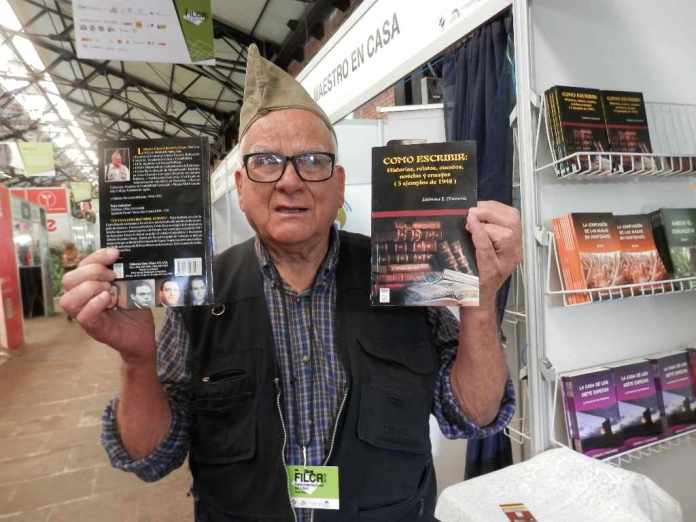
Looking for something to read? Try a visit to the Book Fair (Feria Internacional Del Libro) in the Antigua Aduana (Old Customs) building between now and September 2.
When I read the whole world is mine. Photo Mitzi Stark
Publishers and book dealers from Costa Rica and all of Latin America, more than sixty, have books on display. The fair is free and most sellers offer discounts.
There are books for everyone, even a selection in English from the major bookstores; Lehmann, Universal, Internacional and Max. There are histories and biographies from the university publishers, bibles and bible stories from religious publishers, technical and electronic books, novels and art books. Electronic books too.
: Printing press. La Gaceta. Photo Mitzi Stark
Local authors are there to show their work and to sign their books. Many are easy-to-read Spanish about myths and beliefs, folk tales or life in the country in bygone years and tico food recipes. Several museums are there with books on natural science or history.
Book and toy company all in English. Photo Mitzi Stark
And it’s not just books. There are also programs throughout the days; presentation of new books and authors, storytelling, theater, workshops for writers and educational games and toys for kids, parents and teachers. There are musical programs and sometimes a surprise action, a mini theater or marianettes. And there are blocks of seating for browsing or resting. Most stands have free bookmarks to promote their books and you can build up a collection of bookmarks to last until next year’s fair.
You can sit, read and relaax. Photo Mitzi Stark
UNED, the National University at a Distance, has one of the more popular booths with books by and about Costa Ricans on history, social studies, and the environment, plus studies for working with children and the books are reasonably priced.
Lisimaco Chavarría muestra su libro. Photo Mitzi Stark
There are used books too for real bargains in the annex behind the Aduana building, and a food court for taking a break.
Photo Mitzi Stark
This is the 19th year that the Camara Nacional de Libros has sponsored the Book Fair. “Books are just as popular as ever,” said a spokesperson for the Camara. Even readers who have electronic devices “like to have a book in their hands.” Book sales are as strong as ever. Last year’s fair drew 73,000 book fans.
Photo Mitzi Stark
The Antiqua Aduana building is on Calle 23, Avenidas 7-9. The fair is open from 9 a.m. to 8 p.m.
And it’s free.
Games in english. Photo Mitzi Stark
There is street and parking lot parking. Train service is available from Monday to Friday, public bus service every day. See Facebook page for map and bus routes.
Thousands participated Saturday morning’s march “For solidarity and against xenophobia” in San Jose.
“No one is 100% Tico” reads the banner. From social media
Costa Ricans, Nicaraguans who have been living in that country for years, as well as those who have fled the repression that the government of Daniel Ortega now for more than four months. Foreigners from other nations also participated.
“Ticos and Nicas are brothers! We respond to hatred with joy!” was one of a number of slogans and chants by the participants who, starting from the east and west of the capital, met in the middle, in the Plaza La Democracia.
Flags of Costa Rica and the Blue and White of Nicaragua were carried proudly. The national anthems of both countries and songs of brotherhood could be heard at different points of the march.
Contrary to the xenophobic event of last Saturday (Aug. 18), this morning’s event uneventful.
President Daniel Ortega accused the Nicaraguan opposition of trying to destroy the country’s economy with the protests against his government, which began on April 18 and have been repressed by his government, leaving more than 300 deaths confirmed by national and international organizations.
A man holds a poster with the image of Daniel Ortega during a march of Sandinista sympathizers. Confidencial
“They want to see Nicaragua destroyed because they believe that they will gain power in that way,” the president said Wednesday in a speech to the Sandinistas on the occasion of the 40th anniversary of the assault on the National Palace during the struggle against the Somoza dictatorship, overthrown in July 1979.
“They have taken the road to hell,” he added.
According to Ortega, his detractors promoted a “dark wave of destruction” since last April and are now asking the United States to apply economic sanctions against Nicaragua.
Ortega calls demonstrators “protesters of destruction”
The president called “vende patrias, traidores, peleles, Judas” (selling off their homeland, traitors, wimps, Judas) and “sembradores de destrucción” (sowers of destruction) to those who have requested such sanctions.
He also blamed the “malvados” (evildoers), in allusion to opponents, for the budget cut of US$186.3 million dollars – 1.3% of GDP – which his government had to make due to the fall in tax collection and a lower influx of external resources.
“Now because of the malvados, you can not call them any other way, we have had to cut the budget. Because of the malvados, many have lost their jobs,” said Ortega.
The president called on his followers to “recover peace” to resume productivity, but also to be united and vigilant.
Cuban plain clothes policemen prohibits a citizen from filming. Photo: Internet screenshot.
HAVANA TIMES – Along with “Citizen, your ID Card please,” “Turn off your phone!” might be Cuban police’s second most used phrase today.
Mobile technology gradually entering the island has meant that a considerable number of Cubans now have smartphones and, to a lesser extent, Internet access. And as Cuba becomes less and less isolated from global logic, “communications technology as the people’s new entertainment” has firmly taken root in the mindsets of many people who don’t lose an opportunity to capture what is going on around them in a photo or video.
Cuban plain clothes policemen prohibits a citizen from filming. Photo: Internet screenshot.
Meals, walks, accidents, fights, commotions, jokes, meetings… anything that is out of the ordinary is an excuse for people to pull their mobile phones out and start recording. And because Police and State Security agents are sometimes the protagonists in events that are out of the ordinary, well it’s normal that somebody (often a few) takes out their phone to record what is going on, whether out of curiosity, morbidity, to put pressure on the authority figure, to denounce a possible abuse of power or to get people talking about the wrongdoing.
Once a phone has been raised to eye level and starts recording, a “Turn off your phone!” is shouted out; followed by a threat to seize the phone, break the device or even, arrest the person recording. All of this is aggravated by public-order agents’ lack of training and manners.
Strangely enough, the Cuban Criminal Code only classifies a photo taken, without authorization, of military documents and objectives, relating to State Security, a crime in its section dedicated to espionage (Art. 97.3). Thus, it would be very hard for a recording of a public happening to put national security at risk.
Nevertheless, in a court sentence recently given to biologist Ariel Ruiz Urquiola, judges ruled that the act of recording the argument he had with two Forrest Rangers was an aggravating circumstance. According to the judges, an action that “is frequently reproduced on Cuban streets and this forces judges to take more drastic measures.”
This, of course, sets a bad precedent for citizen defense practices, which is articulated in several countries across the world via “cop-watching” groups. Thanks to this practice, we have been able to find out about US police’s excessively violent actions against Afro-Americans, pictures and videos that Cuba’s official media reproduce over and over again. However, in Cuba, every time a cell phone is turned on, alarm bells start ringing. It seems that those who are playing the role of Big Brother in our society don’t like it when the roles are reversed.
However, it is also striking to see how this no recording practice is also firmly rooted in the mindsets of our highest-ranking public servants.
A few weeks ago, I bore witness to a vice-minister of Transportation’s visit to the Villanueva Bus Station in Havana, during an extremely tense moment.
A combination of insufficient interprovincial transport, night getting on and people needing to sleep as well as fuel checks of private truck-drivers and tickets being sold “on the side”; meant that a large number of people, including women and young children, were on a packed out waiting list for more than four days.
After several unsuccessful attempts to explain the inexplicable to a group of people who didn’t want words but solutions, and after two hours of unproductive phone calls; the vice-minister (a relatively young, polite man, who would have surely liked to have resolved that situation) entered the waiting room to talk to everyone there face-to-face. However, before he started speaking and noticing just how many phones were pointed at him and how many flashes were going off, he warned: “I’m not to going to speak until you turn off your phones.”
The police officers who were accompanying him automatically began to repeat the order and demanded that people stop recording. Some people in the room also did the same. But… seizing one cell phone isn’t the same thing as taking dozens off a sea of people. Faced with the “recorders” stubbornness and the tense atmosphere that was created in the room, the official decided to withdraw to a place without any public access to tell three people what was going on. Then, he left.
I have drawn two conclusions from that episode.
First of all, the fact that many of our officials don’t entirely understand that they are public servants, that the nature of their work is also public and that citizens who they answer to (who pay them their incomes, cars, etc.) have a right to know what they do, so they can assess their actions, criticize or praise them. If the story I just told you was simple “hallway talk”, what would happen when people demand statistics that reveal how public officials spend budget money, just to give you an example.
This is what transparency is, which only appears in the draft Constitution twice, by the way, and is only linked to the Comptroller General and the National Election Commission, as part of their duties.
Nothing appears under the term “accountability” in the draft Constitution either, which ties public servants’ work to direct popular control and not just through the National Assembly or State bodies. The only thing that is recognized is “everyone’s right to receive true, adequate and timely information from the State, according to established regulations” (Art. 56), which makes citizens passive recipients who have to wait to be informed instead of being able to actively demand it.
In this respect, Bolivia’s Constitution seems a lot more progressive in my opinion, as it dedicates a whole section to Social Participation and Control. It would be a good subject to bring up in debates that have just recently started.
Second conclusion. Many of our public servants haven’t realized that we are living in a new era of communications, news and technology and it is becoming harder and harder for them to cover up and retain information, no matter how much they want to.
Still in the dark about the legal and ethical foundations that support this right to produce, circulate and consume public information that is socially relevant, new technologies have practically done away with spatial and temporal limits.
What you have just said here, people are already listening to it there; even in Cuba with all of its technological backwardness. And once mobile data is made available on cell phones, the ability to record events will be joined by the ability to upload and share it instantaneously. As a result, the attempt to stop these things from spreading or being recorded will not only be futile, but the arbitrariness of such an action will also become public knowledge.
Even though political advertising still evokes many of its own ghosts, it’s a thousand times better to deal with them than have to live under a veil of secrecy, a lack of transparency and the excesses committed in the dark. A lot of the time, public opinion is the main defense (the only defense) of the most vulnerable.
I am not trying to defend the irresponsible and abusive behavior of violating people’s intimacy and dignity though. That is something entirely different and our laws should be written up to punish this. I am talking about people’s right to access public information, to actively participate in the assessment of the management of public affairs, to be actively involved in political life, to use public complaints as a mechanism of defense and social control. In short, do not wait for others to fulfill their duties, but to take to the street and demand our rights.
According to ETECSA, there are five million active mobile lines and over two million Nauta accounts, which are mainly used on smartphones. This means that several million people have the means to produce, transmit and consume information (even if they don’t all take advantage of them). And because there are always two sides to every coin, new technologies aren’t just a tool to dominate and turn people’s minds to mush like it is presented to us here a lot of the time. They are also resources to empower civilians, to create networks and encourage participation.
If only the new Constitution and new Communications Law were to stop criminalizing turning on your phone to record something or holding it as a punishable action, instead of making the order to make someone turn off their phone a crime or punishable action. Did you catch that?
Ever since the crisis began in Nicaragua, a new wave of immigrants fleeing to Costa Rica in order to survive has begun. They go not only to look for work, study opportunities or healthcare. They didn’t plan their journey to improve the quality of their lives, but as the only way to remain alive.
These are some Nicaraguans’ stories…
The decision had already been made. Lesly Mayorga would escape from Jinotega across the mountains with all of his family on July 25th, before pro-Ortega paramilitaries managed to break the “barricades” that protected their town. None of them had a passport and none of them wanted to leave their lives behind, but they all wanted to carry on living. Without knowing where they were heading exactly, they reached their final destination seven days later: Costa Rica welcomed them.
Lesly poses with part of his family inside the Detention Center where they are currently living. Photo: Semanario Universidad.
Today, Lesly wakes up on a mattress lying on the dirt floor, alongside his family, in an improvised tent at the Temporary Center for Immigrants (CATEM) in Guanacaste. He says that he quietly cries every day, out of nostalgia and impotence, but he doesn’t hesitate to express his happiness at not being afraid of being killed. “Ah, I’m happy. It’s a lot more comfortable here than sleeping on the ground in the jungle,” he jokes.
Reasons for traveling illegally include a lack of money to apply for a passport and visa, or fear of being detained on the Nicaraguan side of the border.
Days are long at the refugee camp. According to the Nicaraguan immigrants who are staying there, the peace and quiet is surprising and suspicious. After almost four months of bearing witness to extreme repression by government forces in Nicaragua, peace, and quiet has become far-removed from their normal lives.
The Center is located five kilometers before reaching La Cruz and around 20 minutes from the Penas Blancas border crossing point. It’s rough terrain, without paved streets, with 25 green tents, between Nicaraguans and “extra-regionals” (which is the administrative term for African immigrants).
This is where local authorities take immigrants who are seeking asylum in the country. When Lesly reached Penas Blancas with his 8-member family, they took down their information, gave them an immigration appointment at La Uruca in San Jose and put him on a truck with all of his family to go to the center. “We had been walking for over five days. Traveling on the truck gave me an incredible sense of peace,” he says.
The place looks more like a military camp in Iraq than somewhere in Costa Rica because of it being an eye-sore and these tents where refugees sleep are military tents. According to the directors of the center, up to 25 people can stay in each tent and they can even receive up to 300 at their busiest times.
Inside the Center, stories about repression in Nicaragua are told all day long and everyone compares their own experience with that of others there. Even though these immigrants have come from different departments, their stories are all similar.
Lesly Mayorga defended his trench in Jinotega from April 20th until the day before his escape. According to what he tells us, his weapons were mortars, stones and he even took his machete from time to time, which he had used to work on a farm just months before. Ever since he joined the Self-Organized Movement, he and his family began receiving threats.
“One of the most shocking things that happened was when paramilitaries tried to burn my house down when I wasn’t there. As they didn’t manage to do this, they grabbed my 15-year-old daughter. They threw mortars at her body, they attacked her,” he tells us.
Today, Lesly has an arrest warrant against him in Nicaragua, charged with terrorism.
However, he says that his family was the main reason he needed to flee the country. His daughters, all of whom are minors, had been threatened with rape after they would lock him up.
He was left with nothing. In spite of his robust stature, Lesly looks vulnerable, sad. He carries the deeds to his house in his wallet, alongside a yellowish list of the names of all the people who had threatened him ever since he entered the trenches. These two pieces of paper are the only things that remain out of all of the belongings he packed up when he left.
Women in the temporary shelter ‘Centro de Atención Temporal de Refugio’ in La Cruz begin to prepare lunch in artisanal kitchens created by the migrants. Photo: Semanario Universidad.
Inside, there is a tent with games where refugee children can distract themselves, but they have to play in the mud that the rain left behind. It’s time for lunch and the refugees are making their own food on a fire. Nicaraguans are cooking Nicaraguan rice and beans for them all and mumble between themselves. They smile before the cameras and longingly look at the pot of food. Some of them, like Juan Carlos Espinoza, haven’t eaten for more than five days.
Juan Carlos tells us he traveled from Managua to the Penas Blancas border crossing point, fleeing the Sandinista Youth group in his neighborhood. They had recruited him months ago as a paramilitary, but he refused because “he didn’t want to kill civilians.”
“One day, they turned up at my aunt’s house, where I was living, to invite me to join “Operation Clean-Up”. I was offered 500 Cordobas (just over US$16 dollar) per day and an AK-47 rifle so that I could defend the Commander-in-Chief from the “coup mongers”, he explains.
Juan didn’t finish high school, but he was working at a barbers’ shop. He was earning less than US$100 per month and had to support several children. Even so, he says he rejected the offer he was made. That’s when the threats against him and his family started. He says that while walking home one day, hooded men in a Hilux 4×4 got out and beat him, stole his identification, the money he had on him and his cellphone. “After that, my aunt told me that she couldn’t have me there (in her house) anymore. That I would have to go. That’s why I’ve come to Costa Rica,” he says.
Some of the newly arrived refugees, like Juan Carlos Espinoza, hadn’t eaten for more than five days
He spent most of the journey walking through the countryside and without a single bite of food. When he reached Costa Rica, he didn’t seek asylum because he didn’t know he could do this.
“I hadn’t eaten or drank anything in days. When I came to Costa Rica, I looked for work on a pineapple farm and they told me that they didn’t hire illegal immigrants. I turned back, asked for some water at a house near there. I was given some money and was told that there was a shelter. I came by bus and taxi and then I was left with nothing again. But, I am here now, and I could eat something. I’m good now,” he explains.
Juan Carlos’ voice is muffled and sad. He says that he doesn’t have any hope. He wants to go to the appointment to ask for asylum in La Uruca, but he doesn’t know how to get to San Jose. The Government doesn’t cover transport costs and every immigrant has to make their own way to the appointment; the majority don’t have any money of their own, so the only way they can travel the 267 kilometers between these two places is hitching a ride. According to the General Direction of Migration and Aliens, it is working on creating immigration units nearer the refugee centers.
Most of the immigrants who are living at the shelter came into the country illegally. Reasons for coming in this way include a lack of money to apply for a passport and visa, or others for fear of being on a list and being detained by the Nicaragua immigration authorities.
Alvaro Gonzalez came illegally for both these reasons. He is 22 years old, but his exhausted face adds many more. He has been in a wheelchair for two years now after he was attacked by neighborhood gang members with a screwdriver to his back, in one of Managua’s slums. He hasn’t been able to work ever since and so applying for a passport was financially impossible, he says.
The tents where migrants sleep resemble military camps within war zones. Photo: Semanario Universidad.
Ever since civic protests broke out, his brother entrenched himself at a university in Managua. A month ago, he was caught at his home and they also tried to take Alvaro. “(The paramilitaries) stormed the house to take my brother and they wanted to take me out of my wheelchair, saying that I was pretending to be sick so they wouldn’t lock me up,” he tells us. When they realized he really was handicapped, they kicked him and left him sprawled out on the ground. “You can’t live like this in Nicaragua,” he laments.
With help from his family, he began to look for money to cross over with help from smugglers near Penas Blancas. They told him that it was nearly impossible to take him across and so they charged him almost double. The young man doesn’t like to talk about how he managed to get to Costa Rica.
He skips forward and begins to remember how he and his partner were asking about the Refugee Center they had seen before on the news. He found it but it doesn’t have the facilities he needs. Alvaro continues to wait for a response about where he can temporarily live. For now, he admits that he is calm living in a place where he doesn’t hear shots being fired every half an hour. According to him, it’s worth sleeping on the floor if that allows him to survive.
The original article in Spanish by Yamlek Mojica Loáisiga was published at Semanario Universidad.
(WRI) Coffee is core to Costa Rica’s economy and its national identity. Farmers have been growing it there since the 1800s. The beans are so important that the country’s history, as portrayed in the National Museum in San Jose, centers on coffee cultivation and trade.
Coffee farmer Don Luis explains incremental adaptation measures he’s undertaken, like planting new coffee varieties resistant to coffee leaf rust and introducing shade trees. Photo: Rebecca Carter/WRI
But because of climate change, increased competition and shifting demographics, some farmers are giving up coffee in favor of fruits better suited to warmer temperatures. This shift in crops is a trend that may become more common—not just in Costa Rica, but in agricultural communities throughout the world.
Costa Rican Coffee Farmers Face Growing Challenges
Currently, there are more than 43,000 coffee growers in Costa Rica, and, at peak harvesting time, up to 150,000 people are employed by the coffee sector. In 2016, the coffee sector generated more than $308 million in export revenue, according to Costa Rica’s Coffee Institute (ICAFE). In many cases, coffee production has been the most lucrative way for farmers to earn a living from the tiny plots of land they own.
But climate change paired with declining coffee prices globally due to increased competition and production are challenging the future profitability of Costa Rican coffee. The country is already experiencing more frequent and intense droughts, floods and storms, all of which affect coffee production. Farmers are reporting increased incidences of disease, which experts at ICAFE and the Tropical Agricultural Research and Higher Education Center (CATIE), a regional research organization, link to climate change. Coffee farmers in the northern Guanacaste region told WRI researchers that under these conditions, they would need to sell a bushel (or fanega) of coffee for at least $200 for it to be profitable, since production costs are around $140. Coffee is selling at around $110 per bushel today. Even prices for Fair Trade-certified coffee are too low at $160 a bushel.
Farmer points out coffee rust afflicting his plants. Photo: Stefanie Tye/WRI
Crop models linked to climate projections indicate that prime coffee-growing areas will become unsuitable within a few decades. Some areas that are currently too cold for coffee – primarily the mountains – will eventually have more suitable temperatures. However, shifting coffee cultivation to these areas is problematic because many are in protected areas, which are vital to the ecotourism industry – the lifeblood of the Costa Rican economy. Others are located on slopes that are too steep or have soil types or other factors that would make expansion impossible.
Shifting production locations would also require establishing coffee processing plants in new areas, which can be a complex and expensive undertaking. And farmers in these areas would have to learn to grow this alternative crop, which would likely require support from government extension services. Thus, multiple aspects of the production system would need to change to support farmers in growing new crops.
A Shift from Coffee to Oranges
Farmers in upland Guanacaste shared their struggles with WRI researchers during a recent visit. Although some have access to new varieties of coffee and have been trained in incremental ways of adapting to climate change—such as improved cultivation techniques and better soil and water management—few were optimistic about the long-term future of coffee production on their farms.
In response, some farmers in this area have begun shifting from coffee to orange production autonomously – that is, outside of a specific government program or project. Twenty-five years ago, a local coffee cooperative wanted to help local farmers after a particularly disappointing harvest. It distributed orange tree seedlings, and the National Institute for Learning (INA) provided a one-time training course on orange production.
According to farmers we spoke to, coffee harvests have since declined by about half in the Guanacaste region, in part due to climate change impacts, while orange production has blossomed and become an alternative for some former coffee farmers. In fact, one expert from the coffee cooperative estimates that farmers will harvest 80-100 million oranges in two or three years, once trees have matured.
Switching from coffee to oranges is already paying off for farmers near the town of Hojancha. They report higher prices, lower production costs and better disease resistance after shifting all or part of their farms from coffee to citrus production. They are also finding oranges to be more resilient to the droughts, floods, uneven temperatures, erratic rainfall and higher winds that climate change is bringing.
However, it’s unclear how long citrus will be a viable crop in Guanacaste. Farmers shifted from coffee to oranges without support for evaluating climate and other long-term projections. As the climate continues to change, the suitability of oranges for this region may also shift.
Alternative Crops Are One Way Countries Can Transform Their Agricultural Sectors
An orange in Costa Rica. Photo: Stefanie Tye/WRI
Shifting from growing coffee to oranges illustrates a key aspect of transformative adaptation to climate change that will be seen throughout the world one day: switching from crops that are more vulnerable to climate impacts to those that are less so. The term transformative adaptation is used by the Intergovernmental Panel on Climate Change (IPCC) in its Fifth Assessment Report to describe alterations that:
…seek tochangethe fundamental attributes of systems in response to actual or expected climate and its effects, often at a scale and ambition greater than incremental activities.
This contrasts with incremental adaptation, which the same IPCC report defines as:
…actions where the central aim is tomaintainthe essence and integrity of the existing technological, institutional, governance and value systems.
Transformative adaptation requires going beyond swapping crops to include more systemic changes. While these farmers in Guanacaste have been able to change one fundamental attribute of their production system – what they grow – broader support will likely be needed for more farmers to join them.
For example, because this example of transformation occurred outside of a formal planning process, key institutions have not geared up to assist farmers in producing oranges to the same extent as they support coffee farmers. Coffee farmers have access to low-cost credit to produce coffee through cooperatives that is not available to orange producers. Extension services offer advice on coffee production rather than orange production. There is no institution that provides the regulatory and research support to orange growers in the way that ICAFE does for coffee producers. Orange farmers have had to figure out marketing arrangements on their own.
Luckily, these farmers seem to be succeeding – but examples like this must become more widespread, and occur more quickly to keep up with intensifying climate impacts. Governments, adaptation funders, international organizations and agricultural researchers can help ensure these shifts happen strategically and effectively, with long-term thinking in mind. WRI’s forthcoming paper, Transforming Agriculture for Climate Resilience, explores how this can be done. Look for it in October.
Article by Rebecca Carter and Stefanie Tye first appeared at World Resources Institute (WRI) – Wri.org. Read the original.
The men and women of the Fuerza Publica – the national police – the largest of all police forces in the country, are generally charged with the apprehension of criminals and the prevention and detection of crime, protection and assistance of the general public, and the maintenance of public order.
Other police and investigative forces are operated by the Judicial Branch of the government – the OIJ, the Ministry of Transportation – Policia de Transito, and the Immigration service.
Other police forces in the country: Municipal police, DIS (Intelligence), Guardacost (Coastguard), Vigilancia Area (Air Surveillance) and PCD (Drug enforcement), among others.
How do they earn? The salary depends on the police force, the specialty, the years of service and many other factors.
What we can tell you is the starting salary of a new recruit to the Fuerza Publica: ¢451,165 colones monthly.
Recruits have to be Costa Rican nationals, over the age of 18, completed grade 9 and must complete an entrance exam.
For more information on joining the national police force, click here.
A march that will take place in San Jose, today, Saturday, August 25, is to remind Costa Ricans of the importance of living in peace and being a supportive population, as well as reproaching any manifestation of hatred or xenophobia.
The activity will start at 10 a.m. from two different points: From the east, the parapet of the University of Costa Rica (UCR), in San Pedro de Montes de Oca; and from the west, La Merced Park.
The two will come together at the Plaza de la Democracia, located between Central and Second Avenues, in front of the National Museum or the old Bellavista Barracks.
Todays’ event, called the Great National March for Peace and Solidarity in Costa Rica, is organized by the Colectivo Bienestar y Migraciones, a group that brings together 12 organizations that work to support people in migrant or refugee status.
“Saturday’s march is a call for peace and solidarity, and to demonstrate that a sector of the Costa Rican population is against xenophobia. We were very worried about what happened the previous Saturday in La Merced and that is why we reacted with this walk,” said Roy Arias, representative of the Welfare and Migrations Collective.
According to Arias, although the group was formed five years ago, it was during the last presidential campaign when they began to detect xenophobic manifestations in the Costa Rican population.
Other organizations joining the peaceful demonstration are the rectories of the UCR, the National University and the National Technical University (UTN); also the Student Federation of the UCR, the History Students Association, the Arias Foundation for Peace and the Costa Rica Coalition group.
The event will close with a cultural festival in the Plaza de la Democracia. There will be musical groups and circus and artistic activities.
Nicaragua has been going through a political crisis for four months, Nicaraguans suffering repression by the Daniel Ortega administration and violent acts by police and paramilitary groups tied to the government, resulting in more than 300 deaths, more injured and disappeared.
The violence in the neighboring country has forced thousands to flee, more than 20,000 seeking refuge in Costa Rica.
If you are attending the event, the Coalición Costa Rica recommends:
Wear comfortable clothing – white t-shirt preferrable – and footwear
Sunbblock, water and ID
Stay in groups
Do not let yourself be provoked
Have your cellphone fully charged and lots memory for photos
And don’t forget rain gear.
The press office of the Fuerza Publica confirmed it will ensure the safety of those who join the peaceful event.
Oscar Arias arriving at the Fiscalia. Photo Crhoy.com
The Fiscalía General (Prosecutor General’s Office) accused former President Óscar Arias Sánchez (1986-1990 and 2006-2010) of the alleged crime of malfeasance in the so-called ‘Crucitas’ case, a gold mine permitted during his second administration.
Oscar Arias arriving at the Fiscalia. Photo Crhoy.com
Authorities say Arias in 2008 signed a decree that cleared the way for the Crucitas gold mine by the Canadian company Infinito Gold Mining, in Cutris de San Carlos, as of national convenience, in spite of a moratorium on gold mining put in place by the government of his predecessor Abel Pacheco (2002-2006).
The accusation was formally made on Wednesday.
The mine never advanced beyond site clearing, but protected trees were cut. Later a Costa Rican court found that the permits for the mine were illegally granted and recommended an investigation of various officials, including Arias.
Arias, 77, was investigated last year (2017), where he insisted on his innocence.
The reactivation of the case was covered by a legal analysis ordered by the Attorney General Emilia Navas in order to deepen the search for new evidence that was not incorporated into the investigation file at the appropriate time.
Arias’ lawyer, Rodolfo Brenes Vargas, says the accusation is made in haste and without evidence.
“At the end of this process, the innocence of Mr. Óscar Arias Sánchez will be established, as we have been holding from the beginning. We consider that the accusation presented by the Public Prosecutor’s Office is hasty, lacking evidence, that violates elementary criminal law principles and that it does not know the role of a President of the Republic,” explained Brenes.
However, the Fiscalia argues that the former president is the missing piece to complete the sounded Crucitas case.
After years of judicial comings and goings, the criminal file opened in 2012, Navas on Tuesday signed the petition to continue with the case.
This crime is punishable by sentences ranging from 2 to 6 years in prison.
Sara Sampaio, the 27-year-old fashion model and Vogue cover girl likes, spends a lot of time in a bikini. As it turns out, she wears the exact same thing when she’s working and when she’s on vacation.
This week, the Portuguese model shared photos on Instagram from her holiday in Santa Teresa, Costa Rica.
Might stay here forever! #costarica #puravida
Her feet were in the water as she sat on the edge of the swimming pool, the beauty wrote, “Might stay here forever!”
This trip comes after new images of her for the latest Victoria’s Secret campaign was released.
With more than 6.7M followers on Instagram, she recently insisted her incredible looks are merely illusion and not how she appears in real life.
The star candidly told The Edit: ‘People need to realize that models get [professional] hair and make-up, incredible lighting, and we know how to pose. ‘I’ve been doing this job for almost 10 years so I know how my body looks good from different angles. But I don’t look like that in real life.’
The best place in the world for travel experiences has been named by TripAdvisor as La Fortuna de San Carlos (pictured) in Costa Rica
TripAdvisor has named La Fortuna de San Carlos in Costa Rica the best place in the world for travel experiences.
The best place in the world for travel experiences has been named by TripAdvisor as La Fortuna de San Carlos (pictured) in Costa Rica
The travel site has revealed the places – countries, and specific cities, towns and regions, grouped under ‘destinations’ – that are best for local tours, activities and experiences, based on the combined average destination ratings and reviews for bookable experiences.
And the Costa Rican town ranks No.1 in the ‘destination’ list.
The second-best destination is Kauai, Hawaii, while Tromso in Norway comes third and Rotorua in New Zealand is fourth. Ireland and Scotland, meanwhile, come fourth and fifth respectively in the country list – which Costa Rica tops, too.
The top-rated experiences in La Fortuna – at least, that’s according to booking data from TripAdvisor – are whitewater river rafting, guided sloth seeing tours and canyoning in the Lost Canyon.
THE BEST PLACES IN THE WORLD FOR TRAVEL EXPERIENCES ACCORDING TO TRIPADVISOR
Best destinations
La Fortuna de San Carlos, Costa Rica Top-rated experiences include – white-water rafting, sloth seeing tours, canyoning in the Lost Canyon
Kauai, Hawaii, USA History and ecology trek at the Makauwahi Cave Reserve, sightseeing flight and koloa zipline
Tromso, Norway Fjord and Northern Lights tours
Rotorua, New Zealand Jet boat rides
Puerto Vallarta, Mexico Tequila tasting
Sedona, Arizona, USA Off-road tours
Queenstown, New Zealand Bungee jumping
St. Petersburg, Russia Three-day highlights tour
Santorini, Greece First Impressions Private Tour
Key West, Florida, USA Small group kayak and snorkel eco tour