In a mocking post on Twitter, we get this video when a “terrorist” drops the new bombs against the regime. “Hopefully they will soon send the entire parapolice force to destroy them in time and avoid detonations.” writes the Twitter user in mock.
¡ATENCIÓN! En este video se ve cuando un terrorista deja caer las nuevas bombas contra el régimen.
Esperemos que pronto envíen a toda la fuerza parapolicial para destruirlas a tiempo y evitar detonaciones. pic.twitter.com/ONDNO1F1Rt
Bluefields in the southern Caribbean, Chinandega in the west and Jinotega and Matagalpa in the north, in addition to San Marcos, in Carazo, some of the main Nicaraguan cities that this September 14 awoke with their streets full of “chimbombas” with messages against the regime of Daniel Ortega and Rosario Murillo.
The chimbombas were ‘popped’ by police, paramilitaries and municipal workers.
And crossing the barrier of improbability, in Carazo, police arrested three people for carrying the ‘bombas’.
In Jinotega many of the balloons had written inside the names of the young people who have died as a result of the confrontations with the paramilitaries, as well as messages in which they also asked for the resignation of the Sandinista mayor, Leonidas Centeno.
Neighbors of the San Antonio neighborhood in Chichigalpa, and the exit to Chinandega, Los Rieles sector, reported gunshots to destroy the blue and white chimbombas.
“It’s like crazy when they saw the bombas, in seconds they destroyed them,” one resident reported.
The question, “Is living in Costa Rica all it’s made out to be” put to Quora readers recently received (so far) six answers from Quorans with first hand experiences of living as expats in Costa Rica.
Terry LaRue wrote, “It obviously depends on who you are and what you want. My wife and I have lived here almost 4 years and we love it. However, I heard that the average stay is about 2 1/2 years here, and then people move back to the US/Canada. That seems to me about right.”
In Terry’s opinion, “if you come here looking for a cheap place to live, you will be disappointed. Overall costs here are about the same for a comparable lifestyle in the US. Some things cheaper, others more expensive. If you don’t speak Spanish, you can still get along, but you will miss a great deal of the real fun of being here.”
Liz Guegan wrote, “Well that depends on what you think its ‘made out to be;. I have lived here for 12 years, through various ‘inconveniences’ such as water off during the day in some areas, electricity off sometimes all day, satellite tv going out in the rainy season…However, my quality of life is far greater, the pace of life is slower and less manic, people are friendly, food is good and cheap, housing and utilities are mostly very cheap, and the scenery is awesome…”
For Rob Evans, “If you want the ‘American Dream’ of lots of money, many cars, and a huge house, Costa Rica is not the place. If you value the quality of life, health, relationships, beauty, it may be. As a retiree, I value the latter more than the former since each year of quality life gained is priceless.”
Xavier Morera, who has lived in Costa Rica since 1978, said, “It has ups and downs. Depending on where you live now and which part of Costa Rica you will relocate to, it can be better or worse. It depends on your expectations and attitude.”
Mario Chanto, who lived in Costa Rica, said, “Costa Rica is almost the textbook example of the middle of the road… It is an expensive country to live in but in my opinion, this might be the result of market forces.”
Phil Baker, who studied at Chinese Street Fighting and lives here, “Costa Rica is Always an Adventure… Let me tell you there is no other place like this… Now that said, let’s get a few things straight. There is a big difference between traveling here, living here and owning here.”
The decision to live in Costa Rica depends on what you want out of life. Terry says he and his wife have lived here almost 4 years, past the average stay is about 2 1/2 years here, and then people move back to the US/Canada and love it.
“If you want to come here to be a big fish in a small pound, then you can do that too, but people don’t really have Big Fish envy like those do in the US, so you might feel the air being let out of your ego,” writes Phil Baker.
Life is not perfect in Costa Rica, nor is it always easy or cheap. You should be able to live modestly for about US$1,500 to US$2,000 a month for a single person or a retired couple, including the cost of housing, food, transportation, medical care (that can vary greatly), and entertainment. Eating meals out at restaurants, drinking out or other activities and side trips, you’d be in the US$2,500 – US$3,500 range.
Have you ever considered living in Costa Rica? Are you now living in Costa Rica? What has been your experience? Post your opinion in our comments section below or to our official Facebook page. Pura Vida!
Think paganism, and you probably don’t think of a conservative, Catholic-majority country in Central America. But Costa Rica, with its beautiful beaches and tropical charm, is emerging as an unlikely base for a growing pagan movement battling stereotypes and discrimination to assert its distinct identity.
Denied the status of adhering to an official religion, pagans here have long been pushed to the fringes of society. Now, they’re pushing back, and publicly.
Costa Rica’s indigenous communities have long practiced animism, but it was only in 2010 that the first formally organized pagan group, Kindred Irminsul, was formed. At least six more such pagan groups formed in the following three years.
Since 2012, the multiple pagan groups have banded together to form broader partnerships.
There’s the Asociación Ásatrú Yggdrasil de Costa Rica, a group self-described as “dedicated to ancient Nordic and Scandinavian religious practices.” Its membership has grown by 60 percent since 2013, says 31-year-old Esteban Sevilla, the group’s president. There’s also the Pagan Alliance of Costa Rica, which consists of Asatruar, Roman Reconstructionists, Wiccans and Druids.
Sevilla’s Asociación has nearly 2,700 followers on Facebook, while the Pagan Alliance has just short of 1,600. These numbers are small, even in a country of just 4.3 million people. But in a country where, according to the U.S. State Department, animism remains common among traditional communities, these growing numbers and the increase of organization among pagans are giving leaders of pagan communities hope for a future where they’ll be accepted as part of the mainstream.
It’s a religion that doesn’t force you to be anything other than what you are. Esteban Sevilla, president, Asociación Ásatrú Yggdrasil de Costa Rica
For the moment, pagans in Costa Rica remain threatened — some have suffered physical violence, others have had their practices disrupted. Sevilla knows pagan practitioners who have had their employment terminated suspiciously, when their beliefs were revealed at the workplace. But Costa Rica’s pagan groups aren’t retreating.
Since 2013, they’ve organized Pagan Pride Day marches. The alliances of groups are petitioning the government for formal recognition of paganism as a religion. Since 2011, Prolades, a respected survey group that focuses on Latin American religious studies, has included paganism in its list of Costa Rican religions.
For pagan followers, the struggle is also about reclaiming the essence of Costa Rica’s soul — captured in the phrase pura vida, which visitors will find everywhere in the small nation.
“It’s a religion that doesn’t force you to be anything other than what you are,” says Sevilla.
A combination of beliefs, cult religions and sects that don’t fit into the major religious structures, paganism is hard to define. That’s partly why the number of active pagan followers in Costa Rica remains unclear. But the fluidity of what constitutes paganism is also what makes it appealing to many, suggests Sally Gamboa, who heads the Pagan Alliance of Costa Rica. It encourages responsibility for actions “without the need to resort to intermediaries,” she says.
That pagan beliefs are often less judgmental about their followers than mainstream religions are also makes them attractive. “People don’t want to feel oppressed by their faith, they want to feel free,” says Sevilla. “Paganism doesn’t shame you for being imperfect.”
That allure is increasingly driving paganism in places as diverse as Lithuania, where followers of Baltic religions have quadrupled since 2001, and American college campuses. Syracuse University appointed its first pagan chaplain in 2010. Institutions ranging from the University of Texas and University of Baltimore to MIT and Loyola University Chicago have pagan student organizations. The number of Ásatrú worshippers in Iceland has gone up by 50 percent since 2014, according to the country’s national statistics bureau.
In Costa Rica, a country where more than three-fourths of the population identifies as Catholic, paganism also offers a way to push the envelope, to rebel, concedes Gamboa. To 46-year-old pagan practitioner Adrian Esquivel, it’s a way to “live in peace with the gods.”
As with many other new or revived movements, Costa Rican pagans rely on social media to stay connected. Facebook pages like Festividades Paganas/Runas de Costa Rica, Wicca en Costa Rica and Esoterica Costa Rica, which combined have thousands of unique likes, allow followers of one faith to celebrate, interact and learn about other pagan beliefs.
This emerging pagan movement continues to face major challenges. Discrimination against pagans remains rampant. Sevilla recalls a traditional naming ceremony in a public park, during which police were called because the group was alleged to be “performing satanic rites.” The altercation, according to Sevilla, almost got the group removed from the park. He knows pagan practitioners who have suffered serious physical violence after they publicly declared their beliefs.
“There is absolutely discrimination against pagans, as we live in a Catholic country,” says Gamboa, echoing Sevilla. “The discrimination can be all over, it can be in work, social exclusion or in the family.” Discrimination within one’s family usually comes from older, more conservative members. The youth, says Sevilla, are excited by the new pagan movement.
Petitioning the government for a formal religious status is not cheap. There’s the cost of hiring lawyers to read over the paperwork, and the fees of submitting applications. Sevilla notes it could cost his group $1,000. “We’re working on it,” he says, “but it’s expensive.” The review process is long and bureaucratic. Sevilla and his colleagues need to prepare a statement detailing their activity, get a minimum of 50 member signatures — but the more signatories, the greater the likelihood of approval — and then draft and present the religious organization’s statutes. The government can then take its time vetting the request.
Still, the benefits of formal recognition aren’t insignificant. Though non-Catholic religions must meet stricter regulations than Catholics, their bodies don’t have to pay taxes, they have a vote at the annual gathering of religious associations, and they can, in theory, enjoy “legal visibility and representation” in government, says Sevilla. But Costa Rica’s pagan followers have more driving them than the prospect of recognition. Esquivel says he feels “free” now. “I’ve stopped living in fear,” he says. “Most important, I’m not living by a book.”
Aviación Civil (Civil Aviation) on Friday issued a ‘yellow alert’ at all international airports in Costa Rica, as a preventive measure, increasing the security controls in the perimeters of Liberia (LIR) and San Jose (SJO) airports while the national strike continues.
The General Director of Civil Aviation, Guillermo Hoppe Pacheco, on Friday said, “Today the General Directorate of Civil Aviation declared a yellow alert at all International Airports in Costa Rica, as a preventive way, increasing all the security controls in the perimeter areas of the airports, at the access points to the terminals and in the most vital airport facilities”.
The alert is not expected to affect airport operations, to which continued operating as normal, according to a press release from Casa Presidencial.
“We do this to ensure the safety of all passengers and operators,” concluded Hoppe.
In previous days, access to the Juan Santamaría Airport (San Jose) airport terminal was strictly limited to passengers duly identified with their passport and its operating personnel.
As is the tradition in Costa Rica every September 14, the Municipality of Cartago carries out a series of activities to commemorate independence.
The Plaza Mayor in Cartago
One of the main activities is the receiving of the Torch of Independence and a symbolic cabinet meeting by the sitting government.
But this year, the national strike that was in its fifth consecutive day, is being blamed for the lack of people showing up for the independence ceremonies.
I do not see that it was necessary (to take the torch by air), but hey, the government had its reasons to have made that decision.The mayor of San Ramon, Nixon Ureña
First, an alleged blockade, which the unions deny, in Esparza, Puntarenas meant the independence flame was put out while the torch was airlifted to Cartago. The torch arrived early in the ‘old metropolis’ and safeguarded at the local police station until the evening.
The Plaza Mayor in Cartago
The Ministry of Education (MEP) decision to fly the torch to its destination was taken “to safeguard the safety of the students and the people who accompanied them on the overland route, given the blockades that are taking place in several parts of the country.”
For its part, the unions denied that the passage of the torch was blocked or that the safety of the students was put at risk.
An alternative torch was carried from Esparza to different parts of the country without suffering any setbacks.
Even the mayor of San Ramon, Nixon Ureña said, “I do not see that it was necessary (to take the torch by air), but hey, the government had its reasons to have made that decision.”
The second, the government of President Carlos Alvarado decided that the session of the Governing Council – cabinet meeting – was not going to take place in the Plaza Mayor, as is the custom.
This year the cabinet met behind closed doors in the Municipality of Cartago offices, while a small number of attendees celebrated the outside cultural activities, to which rain and the lack of a cover in the square caused the few present to leave their chairs empty.
Protesters to the government’s proposal for the plan fiscal were kept behind police lines
Meanwhile, behind a police line were hundreds of protesters with flags, blankets, and banners protesting against the plan fiscal (tax reform).
Far away from the public, President Carlos was booed while receiving the torch, and screams of “afraid, afraid, afraid” could be heard, noting the president and his staff distance to the people.
September 15, Independence Day is a big deal in Costa Rica. So big in fact the entire month of September is dedicated to independence.
During the “Mes de la Patria”, red and white flags, banners and decorations are everywhere.
Here are things to know about Costa Rica’s Independence Day.
This year is the 197th year of independence from Spain.
Costa Rica shares independence day with Guatemala, El Salvador, Honduras and Nicaragua.
Though September 15 is the agreed upon date of independence for Costa Rica, the news of independence declared in Central America did not arrive in Cartago – the capital of Costa Rica – until October 13 (1821).
There was no war or fight for independence.
September 15 is a statutory holiday and celebrated on the day it falls. No long weekend or “puente” with this holiday.
Every year, the symbolic Torch of Independence makes its way from Guatemala to Costa Rica, arriving in Cartago on the evening of September 14.
On October 13, 1821, when the Act of Independence of Central America documents arrived at Cartago, an emergency meeting was called upon by Governor Juan Manuel de Cañas.
There were many ideas on what to do upon gaining independence, such as joining Mexico, joining Guatemala or Nueva Granada (today Colombia).
A group was declared (Junta de Legados), which created the temporary Junta Superior Gubernativa de Costa Rica.
Independence from Spain was acknowledged and ratified on October 29, 1821, by the colonial authorities. It was then ratified in the cities of San José on November 1, 1821, at Cartago on November 3rd, 1821, at Heredia on November 11, 1821, and Alajuela on November 25th, 1821.
Following full independence in 1838, Costa Rica had no regular trade routes established to export their coffee to European markets. Lack of infrastructure caused problems in transportation (sound familiar?): the coffee-growing areas were mainly in the Central Valley and had access only to the port of Puntarenas on the Pacific coast. Before the Panama Canal opened, ships from Europe had to sail around Cape Horn in order to get to the Pacific Coast. In 1843, the country established a trade route to Europe.
An era of peaceful democracy in Costa Rica began in 1869 with elections. Costa Rica has avoided much of the violence that has plagued Central America. Since the late nineteenth century, only two brief periods of violence have marred its republican development. In 1917–19, Federico Tinoco Granados ruled as a dictator.
In 1948, José Figueres Ferrer led an armed uprising in the wake of a disputed presidential election. “With more than 2,000 dead, the 44-day Costa Rican Civil War resulting from this uprising was the bloodiest event in twentieth-century Costa Rican history.”
The victorious junta drafted a constitution guaranteeing free elections with universal suffrage and the abolition of the military. Figueres became a national hero, winning the first election under the new constitution in 1953. Since then Costa Rica has been one of the few democracies to operate without a standing army. The nation has held 16 successive presidential elections, all peaceful, the latest being in 2018.
Off-duty police have been called to strike by their union, the section of Fuerza Publica in the in the National Association of Public Employees (ANEP).
Mainor Anchía, union leader, explained there is a ‘double discourse’ on the part of President Carlos Alvarado, who blamed the police of the ‘disaster’ in the handling of the confrontation of university students of the Universidad de Costa Rica (UCR) Wednesday night.
Many police officers are upset with the president, who sided with the university community claiming the police officers incurred excessive use of force and in an apparent violation of university autonomy.
However, Michael Soto, the Minister of Public Security, did support the actions of his officers because, according to his words, they were pelted with stones.
Everything started after a blockade of roads in San Pedro. However, the persecution of the alleged protesters continued onto the university campus.
The university claims the campus is an autonomous territory. A Constitutional Court ruling a few years back supports that position, saying police can only enter the campus with a warrant or chasing a suspect in caught in the act of crime.
The university alleges the students being chased by police did not commit any crime, they were retreating from a demonstration, which is not a crime, and the situation did not warrant the incursion and the subsequent use of force.
For his part, Minister Soto, a career law enforcement man, said he was not aware of the ‘autonomous’ status of the university and that his officers were attacked, which is a crime.
A group of 50 people committed acts of vandalism Thursday night in Puntarenas, burning of tires, destruction of store windows and even exchange of bullets with the police, increasing tension in the area.
Rodrigo Alfaro, deputy chief of the National Police in Puntarenas, reported that the group of vandals were out to cause damage.
“They went out into the streets to damage the doors and windows of the Banco Popular ATM, broke glass in the José Paolo store and stole merchandise. They also tried to rob a warehouse but they could not enter,” said the police chief.
The chief also confirmed that his officers were attacked with firearms and stones.
The strike of public workers may affect the president's travel plans to the United States in the coming days
The strike by public employees against the plan fiscal (tax reform) could truncate a trip abroad by President Carlos Alvarado, planning to make his first appearance at the 73rd general assembly of the United Nations (UN) and in search of foreign investments.
The strike of public workers may affect the president’s travel plans to the United States in the coming days
The president’s trip will begin with a visit to Silicon Valley, home to many emerging and global technology companies. Subsequently, he plans to travel to New York to the UN assembly.
If he succeeds to leave the country, it would be his first speech before the international community as president. In the Big Apple, he also plans to hold diplomatic meetings with some of his counterparts, representatives of multilateral and financial organizations.
However, the climate of tension and violence in the country threatens the president’s agenda. Amid the heated demonstrations and the heated discussion in the Legislative Assembly on tax reforms, it may not be advisable for the President to be leaving the country.
According to the Foreign Ministry and the Ministry of Foreign Trade (Comex), the meetings, because they are at a high level, require early confirmations and prior planning, are already considering the possibility that the Minister of Commerce Dyala Jiménez travel with the vice president and chancellor, Epsy Campbell first, with the hope that, the president can join them later.
The UN general assembly meeting opens on Tuesday, September 18.
Not his best moment in his first months of governing, certainly not what he expected, President Carlos Alvarado was booed in receiving his first Independence Torch.
And, unlike in previous years, President Carlos had his cabinet meeting behind closed doors, in the Cartago municipal offices.
In the past, tradition has been to hold the traditional September 14 cabinet session in the open air, the people up and close, an integral part of the event.
The only contact that President Carlos and his cabinet had with the people on this occasion was from a distant platform from the citizens, which caused their annoyance.
“Miedo, miedo, miedo!“ (Fear, fear, fear!) The Cartagineses shouted to the government, while the ‘ruler’ received the torch of Independence. from the Women’s Volleyball Team.
Despite the climate of tension in the country, this Friday the president did not call for peace and focused on defending his tax plan once again, ensuring that the country is on the verge of a financial crisis like the one that was experienced in the 80’s.
For tomorrow, Saturday, starting at 7 am is the celebration of Independence planned in downtown of San José.
For now, it is unknown what will be the participation of President Carlos in the event.
EDITORIAL – Que Vergüenza! What a shame that striking public sector workers would interfere with the tradition of carrying the Torch of Independence, an act involving up to 20,000 students, from Nicaragua border to Cartago.
This is NOT the way the Torch of Independence has made it to Cartago in the last 196 years!
This is the first year in Costa Rica’s history that the Torch could not complete its overland route called “Ruta de Independencia”, from the border post at Peñas Blancas to the ruins of Cartago, because the public sector workers and their supporters could not put aside their whatever, blocking the route in Esparza, Puntarenas.
At 10:35 am this Friday morning, a Fuerza Publica (National Police) helicopter landed in the Plaza Asis, diagonally to the Max Peralta Hospital. Never before had the Cartagineses seen the Independence Torch arrive by air on September 14 and amid such a bittersweet environment.
The only decorative signs were the small flags that the second and third grade students of Escuela Asención Esquivel Ibarra took from their desks when they were told they should race to receive the symbol independence.
Shame. Shame. For the flight from Esparza to Cartago, the flame of Independence, a symbol of independence in Central America, had to be put out.
Once the helicopter rotor stopped, the policemen who brought it tried to light the Torch as subtly as possible and handed it to the Minister of Education, Edgar Mora, who held it up as he walked towards the two students who were waiting for him.
From there, the tradition of students carrying the flame of independence continued, in yet another break in the tradition, the Torch was carried to the Cartago police station, for safekeeping until eventually handed over to the Consejo de Gobierno (cabinet) for the September 14 evening ceremonies.
Estudiantes de quinto año llevaron la antorcha por turnos desde el Hospital de Cartago hasta la delegación de Fuerza Pública de la ciudad. Ahí se queda hasta el Consejo de Gobierno, en la noche. ‘Vamos a dejarla en un lugar seguro’, dijo el comisionado Erick Calderón. @nacionpic.twitter.com/8MdpIQrCNh
Shame on the public sector workers. Shame on the trade unions for not calling on its membership to uphold the almost 200 year old tradition. And shame on you Mr. President. This is on your watch.
What is your opinion? Have your say. Use the comments section below or post to our official Facebook page.
For the first time in the history of Costa Rica – 197 years – the carrying of the Torch of Independence overland was suspended.
Traditionally the Torch of Independence was carried overland by students from the Nicaragua to Cartago. This year, due to the protests of the national strike, and in defense of the safety of the students, the decision was made to airlift the Torch.
The Torch, traditionally carried by students from Peñas Blancas (border with Nicaragua) to Cartago, was carried by air to Cartago, for the Independence Day ceremonies.
The decision to suspend the traditional overland was due to the demonstrations by protesters in the national strike.
In Cartago
On Thursday, the arrival of the Torch in Liberia was delayed for three hours, today blockades in Esparza, Puntarenas and other points, led the Ministerio de Educación Pública (MEP) to not place at risk the young students in charge of carrying the Torch.
In Guanacaste
“Due to the inconveniences that occurred during the night (Thursday) on the route of the Independence Torch, and in defense of the safety of the students and the support staff that accompanies them, it has been determined to stop the route by land in the area of Esparza, the transfer to Cartago will be by air,” said the MEP in a statement.
The Minister of Education, Edgar Mora, took to the task of personally ensuring the Torch reached Cartago Friday afternoon.
A leave without pay granted to Albino Vargas on January 15, 1990, has allowed this public employee to remain in his career as general secretary of the Asociación Nacional de Empleados Públicos (ANEP) – National Association of Public Employees – without the possibility of removing him from the position or fill it with another person.
Albino Vargas
The leave was granted by the Ministerio de Justicia (Ministry of Justice), where Vargas began working as a clerk (Oficinista) in 1981.
At the time he was granted the leave his monthly salary was ¢23,710 colones monthly. The exchange rate in 1983 (the farthest back the Central Bank will go) was ¢45 to one US dollar. The exchange rate today is ¢580.
Currently, the monthly salary of an Oficinista under the Civil Service scales, is ¢322, 000 colones.
This September 15, Vargas will have spent 28 years and 8 months at a government job without performing the tasks for which he was hired for.
The leader of one of the most powerful trade unions in the country is a clerk on leave since January 1990, to dedicate himself full-time to unionism.
But Vargas, as leader of one of the largest public sector unions, earns much, much more than he would at his job in the government.
The last time Vargas spoke openly about his salary was four years ago. Then he confessed that his monthly salary was of ¢1,600,000. A query made by CRHoy.com separately indicates that Vargas earns more than ¢2,200,000 per month. This money does not come from the Ministerio de Justicia, but is paid by the union.
Because they are covered by regulations such as the Labor Code and the International Labor Organization (ILO), any official who is a union member receives special protection that protects him from being fired for his union membership.
This means that although Albino Vargas has 344 months without officially being at to work at his job as a clerk at Justicia, they cannot fire him for that, nor replace him because Vargas could legally reoccupy his position whenever he chooses to.
A neighbor of Alajuelita, in a house, inherited from his parents, this 62-year-old public official with no children or registered marriages has managed to remain at the peak of union representation in Costa Rica.
albino vargas cannot be fired or replaced from his job as a clerk and can go back anytime, though he hasn’t been there for 28 years and 8 months
How has he managed to remain for so many years in union power?
His detractors are harsh and point to alleged “dictatorial practices” in the ANEP elections to prevent another person from taking office.
In 2011 there was a serious attempt. Laura Morúa, representative of the Partido de los Trabajadores (Workers’ Party), two years earlier was elected to the union’s board of directors and quickly proposed the option of a replacement.
“Internally there was an undemocratic struggle, there was no freedom of expression, of disagreeing with the leadership, there was no possibility of accessing the documentation of the union,” Morúa told CRHoy, recalling that again in 2015 there was a second attempt on her part to take over the union leadership. Two years later Vargas was re-elected without opponents.
“They modified the statutes so that the periods of administration increased from two to four years, and eliminated the proportionality representation in the board of directors. Before all of us could obtain positions and now if he wins even by one vote he is the one who governs the union,” added Morúa, who faced a lawsuit for alleged defamation by Vargas when she was a candidate for the union leadership.
Morúa did not achieve her goal and Vargas remains at the head of the union until at least 2021 when there will be a new election; However, she questions the same as some political sectors that think that Albino Vargas is disengaged from the bases and someone else should prepare the strikes because “there is wear”.
In the current conjuncture of fiscal discussion, the Partido Acción Ciudadana (PAC) set out to delegitimize the work of Albino Vargas. This despite the fact that it is the party that took a union representative to the Vice Presidency, Marvin Rodríguez, and in the past – during the Presidency of Laura Chinchilla – even joined ranks with the unions against tax reform.
On Monday, PAC legislator Enrique Sanchez pointed out Vargas being at the forefront of a strike created based on lies and misinformation, calling for a renewal to the trade union leadership.
“Costa Rica is not for this (strike) and the needs of a fiscal reform to clean up the finances and have a Solvent State are not for manipulations, they are not lies, to continue protecting privileges,” said Sanchez.
Is Albino’s time up?
Despite his stronghold on the union leadership, the recent conflict over the tax reform will undoubtedly determine if Albino Vargas wins or loses in image, which is relevant if he wants to continue in office.
Although there are still three years until the next election at the ANEP – the same time Costa Ricans choose a new president – in the eternal union-government pulse every victory or defeat in battles counts.
Rico’s TICO BULL – I find myself more and more taking pubic transportation, the bus. I like it. And I don’t like it.
Getting to San Jose by bus is easy. Just about every bus on a major route is either heading to or away from San Jose. I say most because there are some inter-city or inter-community routes.
The Ruta 09 bus. You have to pay attention to the sign in the left front to know where the bus ends up.
The Intelinea is one of those that connect communities or cities, ie like in Escazu, Santa Ana and Heredia without going to or from San Jose.
What I like about taking the bus to San Jose is the simplicity. I live in Santa Ana. The Ruta 09 bus connects downtown San Jose to Santa Ana. Any bus on this Ruta going east will go to downtown San Jose. It may make some turns here and there, but it will end up in downtown Chepe.
Coming back is another story. There is my dislike. You have to be extremely careful to get on the right bus to get to your destination. Making it worse, all the buses operated by the Tapachula look the same, all blue and all have Santa Ana – Escazu on the header.
The inside sign will tell you where the bus is headed and the route it will take – the ‘pista’ (highway) or ‘calle vieja’ (old road). Interesting that the Piedades (Santa Ana) ‘pista’ will start off on the highway, but then move on the old road to finish.
These buses are super comfortable
The difference, if you take the old road all the way it may take you two hours to get to Piedades. I an not exaggerating. The pista option in about 50 minutes, of which a good 20 is spent doing the in and out of Santa Ana center.
What I like is that if I get on the right bus, I can sit back, do my Facebook thing, check emails, catch up on Twitter and so on.
But, (the dislike) if I take the wrong one – my fault for not checking, and as the driver clearly pointed out, “you didn’t ask” – you end up close, but not close enough.
Case in point. I step on the blue bus to Santa Ana by way of the pista with ‘Forum’ as one of the destinations. What I didn’t pay notice to is the sign said Forum II, which is on the north side of Santa Ana, in Lindora. Opposite where I wanted to go.
For the inter-city or community, this really gets complicated.
Taking the bus allows you meet a lot of interesting people
For the ‘not like’ you really, really, I mean really, have to read the sign and – not or – ask the driver if his (no her yet) bus will go to your destination. If you don’t ask you may be in for a surprise.
Then, more ‘not like’ are the stops, marked or otherwise. The bus on my street, for example, I see the driver making all kinds of stops. None are marked. I see people waiting for the bus, it stops.
Me, I see the bus coming, I flag it and it doesn’t stop. The driver giving me one of those “dumb gringo” looks. The other day, I asked the driver to make a stop, some 100 meters from my house where I was sure was the stop, but no. He did stop in front of my house, where the stop is, but is not marked. Know I know.
The what “I like” about this system is that it forces me to walk. If I have the time and the weather permits, I can walk a kilometer or two or even three. The other day my combination of Ruta 27 Comtrasuli and walk beat the time I would take on the Ruta 09 bus.
If the weather or time does or had walked enough that day, I can and sometimes do, use Uber. Prefer it over a taxi anytime.
To sum up, taking the bus has more good than bad, as long as you give it the time to learn the system and learn to ask.
The glass factory Vidriera Centroamericana S.A. (Vicesa) activated its protocols to stop production this weekend, as it does not have enough gas for its operations.
The situation is due to the strike affecting the dock of the Refinadora Costarricense de Petróleo (Recope) – the Costa Rican refinery that refines nothing – in Limón.
This week, Vicesa was only able to extract two gas tankers, although it requires at least one per day to operate.
This was confirmed by his supply manager, Juan Pablo Mora.
“We managed to load (containers with gas) last weekend, but Monday, Tuesday and Wednesday of this week we could not do it. Up to today (Thursday), we managed to get two cisterns (to Moin), but they have not managed to get out of there for safety. Now, the issue of the strike was mixed with the security problems outside the facilities of Recope, in addition to how slow it is to transport the cargo due to the blockades and that does not allow time for an effective rotation of trucks as is normally done in Moin,” said Mora.
The Vicesa manager said that the gas storage capacity of the plant does not allow them to maintain the operation without receiving replenishment.
According to the Vicesa official, the losses of the only glass factory in the country would be in the millions (of colones) if it is forced to stop production.
The company produces glass containers and exports them to the rest of Central America and the Caribbean. In the isthmus, there is only another factory, in Guatemala, with the same characteristics and dedicated to the same activity.
Vicesa employs 700 people in its Cartago plant, has a production of more than 400 tons of glass per day.
According to Casa Presidencial, on Tuesday night (September 11), amidst the strike of public employees who oppose the tax reform promoted by the Government, a group of people (vandals) presumably employees of Recope, entered the Moín plant’s control room to interrupt the power supply.
The government alleges, the vandals disconnected the main substation and disabled the level control system of the LPG gas storage areas, which caused a slowdown in the distribution of fuel until the Recope managed to reactivate the operations after repairing the damage.
Recope reports the vandals cut the tube that transports the hydraulic oil of the mechanism of control of the in/out valves of the spheres.
“Disabling the hydraulic pumps closes the spheres, a condition that put at high risk the facilities and workers, because at the time of the vandalism LPG was discharging from the ship to the spheres,” said the state refinery in a statement.
The repair was completed by Wednesday night, bringing the plant operations back online.
University students holds up sign during the protests in San Jose where university students have been accused of violence, particularly against the mediaa.
Somos Estudiantes NO Delinquentes
“Somos Estudiantes NO Delinquentes” (We are students NOT delinquents) reads the sign held by a student who does not identify herself with a few or some of the ‘hooligans” that may be or may not be university students.
A group of trade unionists, apparently from the National Association of Educators (ANDE), boycotted on Thursday blocked the passage of the Independence Torch north of Liberia, Guanacaste, as it moved, as is tradition, from the border with Nicaragua, by students who have been prepared for months back for that task.
In the blockade located seven kilometers north of Liberia, protesters surrounded the youths and prevented them, for at least three hours, from moving with the Torch, confirmed the Ministry of Public Education (MEP).
Police had to intervene to protect the students and the Torch, one of the symbols of the national holiday.
However, in the negotiation with the demonstrators that took about two hours, MEP officials in charge of the activity had to light another Torch, a replica of the real one, to use it on the other side of the blockade and continue the run to Cartago.
The real torch arrived in Liberia at 8:38 pm, three hours late, to be guarded by police while the replica continued on its journey.
The Independence Torch, each year on September 13, is received from Nicaragua and carried to the Cartago for the September 15 Indepedence Day ceremonies.
Cartago was the center of government when Costa Rica gained its independence.
Blows, threats, insults, and obstacles are part of the aggression suffered by news teams during the marches against the tax reform that began on Monday.
Attacks were reported by staff of La Nación, CRhoy and television news Repretel and Telenoticias, while covering street demonstrations against the plan fiscal (tax reform)
Included, a journalist of the Semanario Universidad was attacked by the Police on Wednesday night, as students retreated to the Universidad de Costa Rica (UCR) campus in San Pedro.
The ‘Semanario’ journalist was attacked while reporting police aggression against the students. “The situation did not merit violence,” said Javier Córdoba.
The worrying factor in that scenario, reported Córdoba, is that police chased the students onto the campus illegally. Experts argued the UCR campus is an autonomous State institution and the Constitutional Court has ruled, entrance by police is only by a warrant or in witness to a crime in flagrante.
On Thursday, the transmissions of the television channels’ equipment were hindered by a group of protesters during the march that left the parapet of the University of Costa Rica (UCR), in San Pedro, towards the Casa Presidencial, in Zapote.
“It’s a small group of university students who lash out at the press with insults. They are very aggressive,” said Roy Solano, a reporter for Repretel.
According to Solano, the Thursday morning attackers rebuked him and his colleague, cameraman Carlos Cruz.
“We knew that it was not wise to get into the march, so what we did was to get closer to the group as it progressed. We had not finished interviewing a person when they shouted insults at us. Several people surrounded us and covered us with a blanket because they did not want us to record,” Solano said.
Solano affirmed that they did not receive blows but were pushed and insulted and the protesters attempted to turn off the recording equipment.
“They would touch the cameraman’s camera to try to turn it off, they put their hand on the lens while recording. He was really worried that something would happen to the team. They told us ‘do not record’, ‘what we want is for you to leave’, you are this and that,” the Solano continued.
Solano, who is a graduate of the UCR, added that the group is not representative of the place where he studied.
Dudly Lynch, Telenoticias reporter, was also been a victim of verbal aggression and threats during the last three days. The first chapter occurring on Tuesday, while reporting the strike movements from Heredia. The second occasion occurred on Wednesday, during the demonstration that left the statue of León Cortés, in La Sabana, towards the Legislative Assembly.
That day, to capture panoramic images of this protest, the Telenoticias team went up to one of the balconies of the Melico Salazar Theater, on Second Avenue. When the protesters spotted him from the street, they started insulting him. “I’m going to kill you, Linch; You’re one for which, they told me,” the reporter recalled.
On Thursday, again, he and his two fellow cameramen, Marvin Céspedes and Jorge Valverde, experienced a similar situation prior to the departure of the students to Casa Presidencial
“We were doing a live shot for Buen Dia, but they should ‘thieves’, ‘evaders’,” Lynch said.
Silvia Ulloa, director of CR Hoy, also said that several members of her journalistic team have been beaten and verbally assaulted in recent days.
She commented when journalist Josué Alvarado and cameraman Róger Miranda reported the situation of those waiting to be treated in the pharmacy of the Calderón Guardia Hospital, on Wednesday, a security officer at the medical center lunged at them.
“He hit them and the cameraman dropped his cell phone,” said Ulloa.
According to Ulloa, that same day, another of the CRHoy journalists, Jéssica Quesada, also suffered violence on the part of the demonstrators who marched from the statue of León Cortés, in La Sabana, to the Legislative Assembly.
“There, outside the Assembly, they threw coins, stones, sticks, bottles with liquids,” said the Ulloa.
She continued: “When we tried to make a Facebook live video, they interrupted us, they shouted expletives, they stood in front of the cameramen … the police had to protect them,” she added.
The communicator considers it “a movement against the press.”
At the end of the day Thursday, the unions and the government were in a stalemate: the union movement affirms that the protests will be maintained and President Carlos Alvarado is staying firm of not negotiating until the strike ends.
President Carlos Alvarado assures the doors to dialogue are open if the protest movement is called off. For his part, Albino Vargas, the leader of the public sector union movement, is clear, “It is negotiable to stop the strike”.
The President and the union leader are at odds, publicly making calls to the people: one to end the strike, the other to continue, as the national strike continues to day four.
While Alvarado said he is prepared to talk, Vargas insisted the demonstration will not only be maintained, but strengthened with the participation of groups such as university students.
Vargas added that there was never a formal invitation to begin the dialogue with the government.
On its fourth day, the strike will continue with the initial trend, that is, with regional movements.
Day three of the national strike, the single biggest day for striking public sector workers, included provocations, aggressions, sabotages and blockades forcing a criticized police response.
For the most part, until the end of the massive march in which public sector workers from all over the country participated, was peaceful as the major concentration was in San Jose, from La Sabana park to the Legislative Assembly.
However, as the peaceful demonstration drew to a close, bottles, coins, stones, pipes, and even smoke bombs were thrown against police and journalists who were on the boulevard (Avenida Central) that divides the Sion buildings and the Castillo Azul of the Assembly.
The strikers even removed the security barriers that prevented the passage on that boulevard, to confront face-to-face police in riot gear.
A human barrier was formed this time in charge of anti-riot police, who only used their shields to prevent them from pushing through the barriers.
The protesters demanded that union leaders be allowed access to Legislature.
Although the threats of violence began to diminish, the Public Security Ministry sent reinforcements, which included more riot police and even overflights.
However, the instruction appeared to be clear and in line with the statement made by the Minister of Public Security, Michael Soto: violent force would not be used to repel provocations.
In spite of the call of the union leaders for the protesters to stay firm, the afternoon downpour that began shortly after 1 pm, dispersed the crowds and appeased the spirits of those that remained.
According to the Ministry of Security, the disturbances after the march resulted in the detention of six people, including a music teacher. Two of the detainees were transferred face possible charges of threat and resistance to the authority. One of the two was also found in possession of drugs, the other has a history of domestic violence.
The other four detained received only a summons from police.
According to Security, during the riots, two police officers were attacked with pepper spray by some demonstrators.
The doors of the Legislators were closed, some of the legislators were moved to other buildings for their safety and the scheduled appearance for the Minister of the Presidency, Rodolfo Piza, in the Handover Affairs Committee was canceled.
The Interamericana Norte (Ruta 1) was chocked off by protesters for some 15 hours at various points, including the Bernardo Soto section (the airport to San Ramon).
On the east side, the Florencio del Castillo had intermittent interruptions to traffic, mainly to impede access to the RECOPE plant in Ochomogo.
On the Ruta 27 and other major roads, official taxi drivers caused delays due to tortuguismo in various sections of the road. Theirs was to protest against the continuing services of Uber in the country.
President Carlos Alvarado described the actions in front of the Legislative Assembly on Thursday and the violence in Limon Tuesday night as “deplorable”.
“With deep sadness, we have seen the sabotage of public goods to try to prevent gas from reaching the kitchens of homes or hospitals, the retention of a public train affecting its passengers, the aggression of officers of the Fuerza Publica or members of the press. Neither you nor I want that Costa Rica. From the Government of the Republic we are doing everything necessary to punish those responsible for these acts with all the rigor of the law. My government will not tolerate these actions,” Alvarado said in a message released late at night.
The United States on Wednesday approved the return to Nicaragua of non-emergency personnel and diplomats’ family members after they were pulled from the country during weeks of deadly anti-government protests.
U.S. Embassy in Managua
The US Embassy UU in Managua expects to resume routine visa services, although it maintains that conditions in the country “are not normal.”
“The United States Embassy in Managua will resume routine visa services as soon as staff permit. All visa information services will be published on the Embassy’s website and on the Facebook page, ” the State Department informed Today Nicaragua.
“Though Nicaragua is not back to normal, due to President Daniel Ortega’s campaign of violence and intimidation…the Department of State has lifted” the mandatory evacuation order on non-emergency personnel and relatives, it said in the statement.
The Embassy is expected to increase the number and types of visa appointments for nonimmigrants as consular personnel rejoin. The State Department warned that applicants should expect long waits for appointments, over the next two or three months, especially for business visa and tourism interviews.
On the return of the Embassy staff and their families, the delegation in Managua explained in a statement that “although Nicaragua has not yet returned to normal, due to the campaign of violence and intimidation of Daniel Ortega’s government, The State Department – after establishing protocols to address the growing security problems – has lifted the mandatory exit status effective September 12, which allows the return of US personnel to Nicaragua. ”
Despite the return of its personnel, the Embassy explained that a travel warning remains in place for Nicaragua. The State Department maintains a call for its citizens not to travel to Nicaragua.
“Our travel recommendations to Nicaragua remain in effect at level 3. The State Department continues to strongly recommend American travelers to refrain from traveling to Nicaragua due to social turmoil, arbitrary law enforcement, criminality and the limited availability of health services, “the statement added.
The notice refers to statements made by the US vice president, Mike Pence, who says that in Nicaragua “the government of President Daniel Ortega is virtually waging a war against the Catholic Church and against those who demand democracy and national dialogue.”
Finally, the State Department affirmed that the U.S. remains at the side of the Nicaraguan people, “including the members of the Sandinista Front party, who call for the return of peace and democracy by holding free, fair and transparent elections.”
“We support the process of national dialogue led by the Catholic Church and we call, once again, the Ortega government to resume this process,” it concluded.
In recent months, the United States has raised its voice in the Organization of American States (OAS) in favor of respect for the human rights of Nicaraguans and the return of democracy to the country, through the advancement of elections. This position has also been made clear in the Security Council of the United Nations, which last week addressed the country’s socio-political crisis.
Costa Rica’s subequatorial climate is marvelous. Despite that the country’s territory is rather small, it’s characterized by a huge variety of weather conditions. For instance, the highland regions are rather frosty, the forests are foggy, the central part of the country is called “the land of eternal spring,” and on the coasts, the relatively stuffy and hot weather dominates almost all year round.
The best seasons to visit Costa Rica are winter and spring. This time in the country is usually called Verano – summer. The beginning of the high season in Costa Rica doesn’t mean that you can’t get caught in the rain at any time. Accordingly, the low season in Costa Rica begins in May, when the precipitation increases dramatically.
The first months of the rainy season are actually the best time to get a ticket to Costa Rica. At this time, you can avoid tourist hassles and find accommodation at much better prices.
Peculiarities of a winter vacation in Costa Rica
On average, the weather in Costa Rica in winter keeps at around +28°C. Once December kicks in, the dry season begins, and this means that torrential rains won’t spoil your plans for a romantic getaway here. Strong winds and precipitation continue to dominate only on the coast of the Caribbean Sea.
If you want to buy a tour for this period, than it’s better to plan your holiday on Costa Rica in the winter on the Pacific coast. Here, the beach vacation will be a success! What if you don’t have a girlfriend to visit Costa Rica together? Than visit https://godatenow.com/ for all of your dating purposes. According to many tourists who have visited here, we can conclude that winter is the season when riding on Costa Rica is behind the most vivid and diverse emotions.
Peculiarities of a spring vacation in Costa Rica
In the spring, the weather in Costa Rica will continue to please with its excellent climatic conditions. If you still do not know when to have a better vacation in Costa Rica, than choosing the period from March to May, you definitely will not regret it. Depending on the region, the air temperature will rise to + 15-25 ° C.
To have a holiday in Costa Rica in the spring turned out to be very exciting and memorable, do not miss the opportunity here to go surfing or diving and get a uniform bronze tan. Despite the fact that in May the rainy season begins, this time of year is very popular among tourists.
Peculiarities of a summer vacation in Costa Rica
Holiday in Costa Rica in the summer can be overshadowed by the height of the rainy season. The greatest amount of precipitation falls in the highlands. The air temperature is kept within + 25 ° C. Summer is called a green season, when it’s not worth to go to Costa Rica for those who do not tolerate torrential rains. Indeed, the weather in Costa Rica in summer can be called the most changeable and unpredictable. Walking along the street 2 steps, it can go heavy rain, and after 2 more steps look out the sun.
Peculiarities of an autumn vacation in Costa Rica
Due to the fact that vacation in Costa Rica in the autumn is not accompanied by an intense influx of tourists, you can profitably save on tours. As for the weather in Costa Rica in the fall, it can be called quite favorable. Daily precipitation is possible only on the Atlantic coast. As for the opposite coast, it sets a dry season. The air temperature rests at + 29 ° C during the day and + 21 ° C at night. Water warms up to + 26 ° C.
As you can see, every season on Costa Rica has its own thing about, but the common thing is that it’s beautiful throughout all of the year.
From the early hours, this Wednesday access to Paseo Colon and Avenida 2 has been restricted, in advance of the “gran marcha” that will leave La Sabana park headed towards the Legislative Assembly.
Union leaders say more than 160,000 people will participate in today’s protest.
The Government of Carlos Alvarado this morning changes its tone, from talking tough on sanctioning blockades of major roads to ‘Under no circumstances will we allow acts of violence’.
In a statement posted on social media this morning, President Carlos said: “The Government of the Republic is respectful of the constitutional right to the demonstration, however, I am clear to point out that under no circumstances will we allow acts of violence that put at risk the life and safety of Costa Ricans.”
El Gobierno de la República es respetuoso del derecho constitucional a la manifestación, sin embargo soy claro al señalar que bajo ninguna circunstancia permitiremos actos de violencia que pongan en riesgo la vida y seguridad de las y los costarricenses.
Taxi drivers will be participating in today's big march to protest against Uber in the country
The “gran marcha” is on. Labor unions estimate that some 160,000 people will take part in the manifestations in San Jose today (Wednesday), demanding the Government withdraw the Bill for the Strengthening of Public Finances – the Combo Fiscal as it has come to be known – before the Legislative Assembly.
Taxi drivers will be participating in today’s big march to protest against Uber in the country
The big march is scheduled to leave the Leon Cortes statue on the east face of the Sabana park at 10:00 am and move east on Paseo Colon and Avenida Segunda, towards the Legislative Assembly in Cuesta de Moras.
The march is expected to greatly affect downtown San Jose traffic.
Taxi drivers will also be joining today’s manifestations, theirs, however, also add the Government’s (in)action with respect to getting rid of Uber in the country.
Different cooperatives in the country will send their members to the metropolitan area, to join independent taxi drivers in support of the trade unionists.
The taxi drivers and other protesters are expected to interrupt traffic on the Autopista General Cañas, the Rutas 27 and 32 and the Costanera, among others.
In the medical centers, other than ‘essential services’, the unions say all other services will be affected. The same is expected with other state institutions like ICE, RECOPE, AyA and Government offices like the courts, for example.
The Government reiterated it will not permit blockades. But if anything like the last couple of days, they are powerless to take action.
What’s the strike all about? Beats me. As did most of the people I talked to yesterday (Tuesday) as I got in the thick of things in downtown San Jose.
I got right and close to find an answer. Photo by Rico
The majority would respond with fiscal plan, taxes, pensions, combo fiscal, the government wants to tax us more. But none I spoke to, people I chose that would represent typical Costa Ricans, could not be specific.
Others said they were responding to a call by their union. Others believed it was the thing to do, however, without a clear position on the issue.
As I walked through the thick of it all, in front of the Legislative Assembly (Congress) building, a movil (mobile) sound unit with piped music and a barker on the microphone,like the guys in front of downtown San Jose shops, hyping the tone, I thought I would the answer.
Photo by Rico
But no. The barker was doing his job keeping the mood and the tone of the situation, while somber faced police guarded the entrance to the Congress building.
A comment that led me to decide to get the hell out of dodge and not engage was the blaming of the “gringo corporations for not paying their taxes in the last 20 years”.
The drums beating. Photo by Rico
They are the blame for this fiscal mess and government needing to cut salaries, pensions, said the barker. I am not a gringo, though I look like the part, and although I saw no immediate danger, no sign that the crowd could turn to a mob, I wasn’t taking my chances.
My questions to more than a dozen protesters was done several blocks away, a safe distance, as many of the protesters dispersed with the arrival of the early afternoon downpour.
Many did not know details of why they were protesting. Photo by Rico
I could see from the distance the ‘sound movil’ and faintly hear the barker, but few people were now listening, protesting. It was over. Tomorrow (Wednesday) would be better and bigger, as I had heard the barker say earlier.
On the personal side, it was a great opportunity to take care of some personal errands with government institutions, namely the Casa Amarilla (Foreign Ministry office) and the Corte Suprema de Justicia (Supreme Court) secretariat.
At Casa Amarilla, I was able to have my documented ‘apostillado’ (apostilled) from the morning to the afternoon, my last document right in front of me, a process that usually takes up to five days.
How? Was the comment by my friend who had gone through the same process two weeks earlier. His took the full five working days.
At the court secretariat, I was able to obtain a written verification of my court document (the last to be apostilled) within hours instead of the next day, the usual turn around time.
Adriana was very sweet. She was also bored. She was one of the two employees at the office, with no ‘usuarios’ (users). The Supreme Court building was practically empty. The security officer to the Constitutional Court offices (same floor of the Secretariat) was bored out of his mind. When I asked him, he put on a brave face. At the main lobby security and check-in the official had plenty of time to engage in conversation.
I asked Adriana why she didn’t join the march. Her reply was interesting. At first, it was about the need to keep essential services operating, but when pressed, her concern was keeping her job. That is, not risk being fired for protesting.
In comparing her and her office companion to most of the others on the street protesting, I summarized the difference is that she appeared to have a good job and probably a good salary, one she felt she needed to protect.
Though she was a secretary behind a desk, she did have the power to grant me my needed document in a few hours instead of the next day. In fact, she called me by phone 45 minutes before my programmed return time, ending my mingling with the protesters outside.
Traffic in the downtown core was also very light, just as light as the protest, from my point of view. I had been witness to protests in the past, but not with so few people like on this day, at least when I was there.
Traffic in the downtown core was light I was able to travel through downtown San Jose, on Avenida 1 with no problems. Even got most the lights green, not needing to change gears in my old Landcruiser.
In fact, I made it from the INS building to my home in Santa Ana, at 3:30 in the afternoon, in less than 25 minutes.
So, what is the strike all about? Beats me.
Maybe today, day number 3, I may get some answers.
Downtown San Jose's Avenida 2 on Tuesday before the early afternoon downpour. Photo by Rico
Costa Rica’s labor unions said its second day of the national strike is having an effect against a proposed Plan Fiscal (Tax Reform).
Downtown San Jose’s Avenida 2 on Tuesday before the early afternoon downpour. Photo by Rico
On Tuesday, the head of the ANEP, one of the largest public sector unions, Albino Vargas said they were satisfied with the results so far.
Heading into its third consecutive day of the strike, “the regionalized national strike has served its purpose on this second day,” said Vargas.
These past two days have served as preparation and warm up for big march planned for Wednesday in downtown San Jose, according to the union leader.
The “indefinite” national strike led by public sector workers began on Monday, as protesters across the country demonstrated their rejection of the tax reform package currently being discussed in the Legislative Assembly and deemed of major importance that it be passed by the government of Carlos Alvarado.
On Tuesday, the manifestations continued and included several blockades and closed the night with the burning of a tractor trailer in Limon.
The strike has affected health services and schools, primarily in the greater metropolitan area (GAM) of San Jose.
“We believe that the tax combo fosters inequality and the concentration of wealth,” Vargas said, adding that he thinks that it does not deter tax evasion, while it does tax employees to settle a public deficit that the people did not generate.
(AFP) Japan gave Costa Rica’s national team the runaround in a 3-0 home victory Tuesday. Sho Sasaki’s header was turned into his own goal by Bryan Oviedo after 16 minutes before second-half goals from Takumi Minamino and substitute Junya Ito settled a one-sided friendly in Osaka.
This was Japan’s first outing since their surprise run to the last 16 of this summer’s World Cup under Akira Nishino had been scheduled to take place last Friday against Chile in Sapporo, the capital of the mountainous northern Japanese island of Hokkaido, was cancelled after an earthquake struck the northern Japanese island of Hokkaido a day earlier, leaving at least 40 people dead.
A group of unidentified people burned a trailer on Tuesday night that was parked at the entrance to the facilities of the Refinadora Costarricense de Petróleo (RECOPE) – Costa Rican Oil Refinery – in Moin.
Hours before about 30 people, at that same point, burned tires and several garbage cans.
Original reports said the disturbance had caused damage to an LGP gas pipeline, but fire authorities were able to rule that out after an inspection.
The Bomberos Communications Center confirmed that no firefighter, faced with the risk of being attacked, got out of the units until conversing at least 10 minutes with the protesters.
In Barrio Limón 2000, another tractor-trailer was burned, after unknown persons set it on fire.
Security Minister Michael Soto said several criminals threw stones at the driver of the trailer carrying paper reels, so he had to stop. The driver managed to escape from the site to protect his life.
“Unknown people attacked the truck with stones. The cabin was set on fire. Police is on site ensuring the integrity of the cargo and the driver. We are tracking to try to locate those responsible,” Soto explained.
At 9:15 p.m. a group of riot police (antimotines in Spanish) of the Fuerza Publica (national police) arrived by land, with the intention of dispersing the rioters. Another group of police was also transferred to Limon by air from San José.
A group of employees of the Hospital Mexico obstructed the traffic on the General Cañas highway to join the march. Photo: Albert Marín.
The government of Carlos Alvarado declared a win in Monday’s national strike, not for settling or stopping the work stoppage it deems illegal, rather for minimizing the impact the labor unions had intended.
A group of employees of the Hospital Mexico obstructed the traffic on the General Cañas to join the march. Photo: Albert Marín.
The government says with the actions taken on Sunday night and its contingency plans, the Government and its institutions managed to neutralize, to a large extent, the impact of the strike.
The organizers threatened to paralyze public services. However, there was no paralysis.
Two weeks ago, the Bloque Unitario Sindical y Social Costarricense (Bussco), Patria Justa and other trade unions, announced the indefinite strike in opposition to the Plan Fiscal now before the Legislative Assembly.
Since last week, President Carlos Alvarado, called the unions to dialogue, however, there was no positive response. For that reason, on Sunday night the president said on national television, that the strike was inadmissible and that they would ask for the declaration of illegality.
On Monday, public 24 entities had filed n application before the labor courts
The Government reported that 25 institutions had reported zero striking officials; and the rest, low participation, below 6% of the staff, except in the Ministry of Public Education (MEP) and the Costa Rican Social Security Fund (CCSS).
As of 7 p.m. Monday, the MEP registered 7,847 absent teachers without any justification in a sample of 856 schools and colleges of the 4,800 that exist throughout the country.
This figure represents 36.7% of the 21,335 employees.
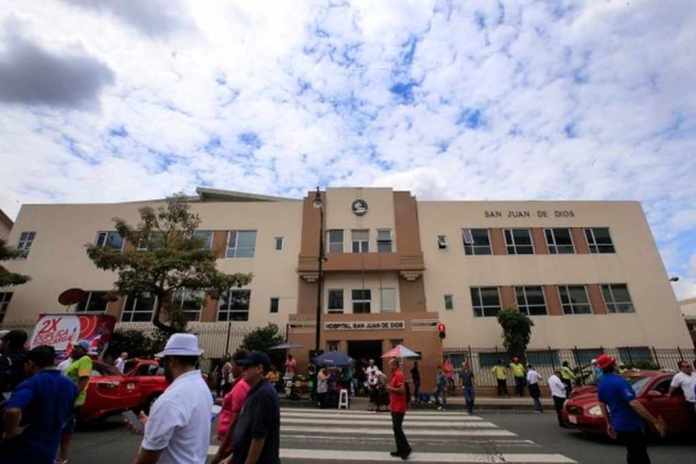
The San Juan de Dios Hospital in downtown San Jose was the one that had the greatest impact, according to Román Macaya, executive president of the CCSS. Photo: Rafael Pacheco
At the CCSS, the executive president, Román Macaya, explained that in order to face the imminent work stoppage, they declared an “institutional emergency”. That measure gives them access to a fund that would allow the institution to contract outside workers and supplies, such as buying food for patients, if necessary, if nutrition services are paralyzed.
The San Juan de Dios Hospital (HSJD) in downtown San Jose was the most affected. Up to 60 scheduled surgeries were suspended, according to the hospital director, Ileana Balmaceda.
Douglas Montero, director of Hospital Mexico, explained that 40% of the staff was absent. In this medical center, all services were provided but at a slower pace. There, 17 of 27 scheduled surgeries were suspended.
At the Guardian Calderón, Taciano Lemos, director of the hospital, assured that the affectation was minimal and they had enabled seven of 26 operating theaters. Medical services and External Consultation worked despite the strike.
In Cartago, the Max Peralta hospital estimated 26% of the services were affected by the work stoppage.
Airports were working. Important for travelers and Costa Rica’s tourism industry, the international airports in San Jose and Liberia were not affected.
In the photo, Taxi drivers took over Paseo Colon, in San José, protesting Uber’s presence in the country. Photo: Rafael Pacheco
Taxi drivers in different parts of the country joined the movement to protest their presence of Uber in the country.
C/onferencia de Prensa_Presidente Carlos Alvarado_Jerarcas_Huelga Nacional_CasaPresidencial_Foto Julieth Mèndez_10/092018
The government says it will not give in, have its arm twistest by the protests and is keeping firm on its plans for tax reforms.
Press conference at Casa Presidencial on Monday.
According to President Carlos Alvarado, the protests will not change his mind and is in the firm belief that the Plan Fiscal (Tax Reform) is the way to avoid a financial crisis in the country.
Up to 24 public institutions that were affected by the strike on Monday have requested the illegality of the strike.
“Seven ministries filed a request before the Attorney General’s Office and 17 institutions of the decentralized public sector before the Labor Courts,” informed the Minister of Labor and Social Security, Steven Núñez Rímola.
The institutions listed by Núñez were:
Caja Costarricense de Seguro Social (CCSS)
Correos de Costa Rica
Sistema Nacional de Radio y Televisión (SINART)
Ministerio de Obras Públicas y Transportes (MOPT)
Instituto Costarricense de Electricidad (ICE)
Ministerio de Justicia y Paz (MJP)
Patronato Nacional de la Infancia (PANI)
Ministerio de Vivienda y Asentamientos Humanos
Radiográfica Costarricense (RACSA)
Junta de Administración Portuaria para el Desarrollo de la Vertiente Atlántica (JAPDEVA)
Compañía Nacional de Fuerza y Luz (CNFL)
Comisión Nacional de Emergencias (CNE)
RECOPE
Instituto de Desarrollo Rural (INDER)
Ministerio de Salud
Junta de Protección Social
Banco Central de Costa Rica
Instituto Nacional de Aprendizaje (INA)
Ministerio de Hacienda
Imprenta Nacional
Seguridad Pública
Ministerio de Educación
INCOPESCA
Ministerio de Cultura y Juventud
As explained by President Carlos, a judge will determine within three days if the strike is declared illegal, if so, the protesters will have 24 hours to return to their jobs.
Those who require medical services, as well as students, are the citizens who suffer most in this national strike that for the most part has been centered in the Greater Metropolitan Area (GAM) of San Jose.
The government reiterated that the dialogue table is open for unions if they end the strike.




 In spite of the call of the union leaders for the protesters to stay firm, the afternoon downpour that began shortly after 1 pm, dispersed the crowds and appeased the spirits of those that remained.


 This was Japan’s first outing since their surprise run to the last 16 of this summer’s World Cup under Akira Nishino had been scheduled to take place last Friday against Chile in Sapporo, the capital of the mountainous northern Japanese island of Hokkaido, was cancelled after an earthquake struck the northern Japanese island of Hokkaido a day earlier, leaving at least 40 people dead.