The Ministerio de Hacienda (Ministry of Finance) seized the machinery of the company Representaciones Artísticas Mayfa S. A., a company dedicated to the manufacture of wooden pallets.
The seizure (embargó in Spanish) was to recover a little more than ¢1.053 million colones in tax arrears in legal collection.
The debt originated from the non-payment of sales tax from 2008 and until 2017; income tax debt between 2009 and 2015; and the education and culture stamp from 2009 to 2016. The seizure was carried out through the administrative channel after the General Tax Office failed to reach an agreement with the company.
This is the second major seizure this week.
On Tuesday, July 3, Hacienda imposed an embargo on the Caribeños bus company for a tax debt of ¢529 million colones. According to Hacienda, the company failed to pay income tax on rent collected in 2009 and 2010, on commercial space it has in bus terminals in Limon and Guapiles.
The objective of the seizures is for the delinquent taxpayer to deposit the corresponding payment in a State account.
The Department of Judicial Collections (Cobros Judiciales in Spanish), issues and executes an administrative lien against assets – mobile or fixed – that are legally seizable from the debtor, as Hacienda seeks to recover the (ax) debt, plus interest and costs.
According to Priscilla Piedra, general director of Hacienda, the focus is movable assets that are legally seizable in the debtor’s domicile, that can be removed from premises, as in the case of Mayfa.
Director Piedra explained that in recent months Hacienda has been able to recover close to ¢1.293 billion colones in debt, this through a legal power granted to them to improve the struggle against tax fraud.
That power allows Hacienda to seize bank accounts, rents, commissions, products, and raw materials at customs, or any credit in favor of the delinquent tax debtor.
An important step in the process, before a seizure occurs, according to Piedra, there is a negotiation phase between Hacienda and the tax debtor. The embargo is a last instance to recover when an agreement cannot be reached with the taxpayer.
The United States on Friday ordered all of its non-emergency personnel to leave Nicaragua and advised travelers to reconsider going to the country amid a wave of anti-government protests and violence.
A State Department travel advisory that was updated Friday said U.S. government personnel in the country must stay in their homes and “avoid unnecessary travel between sundown and sunrise.”
The State Department says heavily armed, government-controlled paramilitary forces operate in areas of the country including in its capital, Managua, where the U.S. Embassy is located. “These groups are attacking blockades, kidnapping and detaining individuals, taking over privately owned land, and committing other crimes,” says the travel advisory.
The advisory also warned that roadblocks may limit food and fuel availability and that hospitals busy treating victims of violence can’t respond to other emergencies.
Protestors are demanding president Daniel Ortega and his wife and vice-president, Rosario Murillo, step down and early elections for March 2019. Ortega’s mandate ends in 2022.
The Civic Alliance (Alianza Cívica), in opposition to the Ortega, has called for a countrywide march, called “Juntos Somos un Volcán” (Together We are a Volcano) for Thursday, July 12, followed by a 24-hour national strike on Friday, July 13.
The march and national strike is to pressure Ortega to reply to the proposal of early elections made last month by the bishops of the Episcopal Conference, as a way out of to the sociopolitical crisis that has left more than 300 dead.
The Civic Alliance for Justice and Democracy called for a national strike, march and caravan to press for a way out of the sociopolitical crisis. Óscar Sánchez / END –
After the 24-hour national strike, the Civic Alliance said it will continue to demonstrate on Saturday, July 14, with a caravan “whose route we will be announced in the coming days”.
Initially, the opposition had planned protests for this weekend. Lesther Alemán, representative of the university students in the Civic Alliance and in the National Dialogue, indicated that they decided to reschedule the march for security reasons, for information that the government party is planning to organize demonstrations on Saturday, July 7, in different parts of Managua.
The full text of the new U.S. Travel Advisory is as follows:
Reconsider travel to Nicaragua due to crime, civil unrest, and limited healthcare availability.
On July 6, 2018, the U.S. government ordered the departure of non-emergency U.S. government personnel. The U.S. Embassy remains open to provide emergency services for U.S. citizens.
Heavily armed, government-controlled parapolice forces in civilian clothing, sometimes numbering in the hundreds, operate in large parts of the country, including Managua. They are often in vehicles that don’t have license plates, and they may be escorted by uniformed police forces. These groups are attacking blockades, kidnapping and detaining individuals, taking over privately owned land, and committing other crimes.
Rallies and demonstrations are widespread and occur daily with little notice. Government-controlled forces have attacked peaceful demonstrators leading to significant numbers of deaths and injuries. Looting, vandalism, and acts of arson often occur during unrest, including in tourist areas. Government authorities detain protesters, and some people have disappeared. Human rights groups have documented credible claims of torture of detainees.
Roadblocks, including in Managua and other major cities, may limit the availability of food and fuel. Roadblocks may also limit access to the Augusto C. Sandino International airport in Managua. Criminals are in charge of some of the roadblocks.
Hospitals around the country are inundated with victims of violence and lack the capacity to respond to other emergencies. Other hospitals have denied treatment to people wounded in protests.
Violent crime, such as sexual assault and armed robbery, is common and has increased as security forces focus on the civil unrest. Police presence and emergency response are extremely limited.
The U.S. Embassy in Managua is limited in the assistance it can provide. U.S. government personnel in Nicaragua must remain in their homes and avoid unnecessary travel between sundown and sunrise. In Managua, they must avoid Rotonda Metrocentro, Rotonda Universitaria, and the vicinity of universities, particularly UNAN.
U.S. government personnel are prohibited from using public buses and mototaxis and from entering the Oriental Market in Managua and gentlemen’s clubs throughout the country due to crime.
Additional restrictions on movements by U.S. government personnel may be put in place at any time, depending on local circumstances and security conditions, which can change suddenly.
Every day an average of 3 people die in traffic accidents, indicates the results of an analysis by the Comité de Medicina de Tránsito del Colegio, using the data of the National Institute of Statistics and Census (INEC) of the last 17 years.
Photo 25kph.com
In the last 7 years the country there was an increase of 3 deaths per year, if this is maintained, within 4 years there will be more than 1,000 deaths per year on the road.
The traffic accidents are the main cause of death in the population economically active, the study reveals.
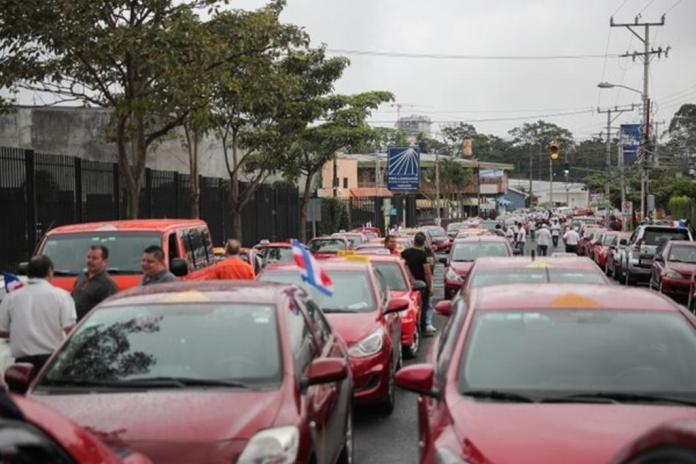
This Wednesday (during the taxi driver’s protest) the creativity of hundreds of Ticos came to light with the birth of a new meme, with focus on a driver of Uber Eats and a group of taxi drivers demonstrating.
The photo by Jeffrey Zamora
Jeffrey Zamora, photographer for La Nacion, said he didn’t think it twice to capture the image of the Uber Eats delivery guy on a bicycle making his way through taxi protesters blocking the roads.
Buscando en el diccionario el significado de la Palabra HUEVOTOTOTES , apareció esta foto! ????????♂️???? pic.twitter.com/4PiQ8UHb3A
— Alex Costa Comedy (@AlexCostaComedy) July 5, 2018
Zamora said the delivery guy did not skip a beat, including insults and shouts aimed at stopping him.
Important here, one of the major contentions of the taxi drivers is the presence of Uber on the streets of Costa Rica.
The memes.
Taxis protest while they (Uber) cover the demandHere we have machillo’s (Oscar Ramirez) replacementWe didn’t know that there was Uber Eggs (Balls)The moment you learn your life is worth shitJust like when a hot woman passes by a construction siteThe balls of a taxista (taxi driver) placing a Uber Eats order
Within three months the “dictamen médico” (medical opinion) that is mandatory obtain a driver’s license and its renewal, will not be issued to persons with certain medical conditions or history.
Signs like in the photo point new drivers and drivers renewing their license to the mandatory medical exam.
This was confirmed by Dr. Andrés Castillo, president of the Colegio de Médicos de Costa Rica (College of Physicians of Costa Rica).
“A morbid obesity, certain spinal injuries, traumas due to accidents, cardiovascular diseases, movement disorders, very old age, deep visual disorders, will not receive the opinion. Of course, each case will be seen separately, but in Costa Rica, not everyone can be given the medical opinion to a drivers license how it is happening today, that must change,” said Dr. Castillo.
The Comisión de Medicina del Colegio de Médicos Ticos (Medical Committee of the College of Costa Rican Doctors) designed a new course that must be completed by all doctors in the country that provide a “dictamen médico” for a driver’s license, that now it will include a review of the mental abilities of the examiner.
The main objective of the changes is to avoid the many traffic accident deaths and injuries. Last year alone the INS- the state insurer – treated 35,843 injured due to traffic accidents, more than half of them motorcyclists.
This change is part a joint effort by the College of Physicians, Ministry of Health, MOPT, Conavi, Policia de Transito (Traffic Police), the Institute on Alcoholism and Drug Dependence (Instituto sobre Alcoholismo y Farmacodependencia – IAFA) – and the national insure, the Instituto Nacional de Seguros (INS).
Currently, getting the “dictamen médico” or medical certificate is ‘as easy as pie’. The hardest part of the dictamen, if you are not near a licensing center, is finding a doctor licensed to issue the document, which is now issued online and linked directly to the MOPT licensing database.
No appointment is necessary, the service is on a first come first served basis. If there is no one in line, you are out of the exam in less than 5 minutes, in which a good part of that time is verifying ID and completing the online form.
A few questions, a cursory eye exam and you are done. If for the first time, confirmation of blood type is required. Pay the ¢20,000 colones (current cost fo the Dictamen Médico), wait for the medical practitioner to complete the online form and you are done.
There is no verifying if the patient (driver) is lying, as in hiding any serious medical condition, there is not follow up.
At the licensing center, the database confirms the medical exam and your renewed or first driver’s license, for multiple years, is issued.
Bananas are facing potential extinction, researchers have cautioned, as a deadly tropical disease sweeps across crops worldwide.
Known as Panama disease, or Fusarium oxysporum f.sp. cubense, the fungal infection has already spread throughout Asia, Africa, the Middle East, Australia and Central America.
Should the infection reach South America, researchers warn the Cavendish banana – the species most commonly sold and consumed worldwide – could face extinction.
Chemical treatment has proved ineffective at halting the spread of the disease, with experts only able to stop the fungus by quarantining vast swathes of farmland.
Cavendish bananas are genetically identical to one another, which allows Panama disease to rapidly decimate entire harvest yields.
Salvation for banana crops could come in the form of a rare Madagascan tree, which grows an unpalatable, wild species of banana that is immune to Panama disease.
Plant biologists are rushing to create a hybrid of the two species of banana in the hope of creating a infection-resistant strain.
Quarantine has showed some effectiveness as a way of limiting the spread of the fungus, but it is not a perfect method.
Whilst a portion of land may be sacrificed to protect an even larger area becoming riddled with the destructive fungus, spores remain dormant in the soil for decades, ready to flare up when the right conditions arise later on.
There are only five of the more hardy Madagascan banana trees in existence.
Richard Allen, senior conservation assessor at the Royal Botanic Gardens at Kew says that the rare disease-resistant species found in Madagascar (Ensete perrieri) has certain traits which make it more durable than the Cavendish banana.
The Government on Wednesday night signed an agreement with the (formal) taxis following a day of protests, roadblocks and tortuguismo.
On Wednesday the taxi drivers blocked streets and applied tortuguismo on major routes before their leaders sat down for more than 5 hours with government representatives to negotiate the deal. Foto Jeffrey Zamora / La Nacion
Following are the ten points -eight by the Government and two of the taxi drivers to avoid further road protests.
1. To intensify controls on transport services that operate “out of regulation” (services such as Uber).
2. To continue the dialogue as long as there are no blockages or tortuguismo that affect traffic on public roads. In case they are given, “the full weight of the law” will be applied to guarantee security and free transit, and the agreement will be suspended.
3. To guarantee the fulfillment of the regulatory law of the remunerated transport of people and to look for a “definitive solution” to the taxi transport problem, so that they give “quality, efficient and safe” service.
4. To mediate so that the General Superintendency of Financial Institutions (Sugef) and the National Council of Supervision of the Financial System (Conassif) cater to taxi drivers to know their concerns.
5. To convene a meeting with the Minister of Finance, Rocío Aguilar, and the taxi drivers to evaluate the tax implications of the operation of digital applications (apps) for the transport service.
5. The Ministry of Science and Technology and the Ministry of Economy (MIcitt) will “discuss” the scope of advertising guidelines for public transport apps.
7. As of this Thursday, the Ministry of Foreign Trade will review whether the decree that allows the Uber app to operate within the free zone regime is fulfilled in scope and restrictions. It will give results no later than August 3.
8. The Minister of Public Works and Transportation, Rodolfo Méndez, and other senior managers of the MOPT will lead the negotiations. The Ministers of Labor and Science and Technology, as well as the vice-ministers of the Presidency, will accompany them.
And the taxi drivers?
1. Recognize the mixed work commissions created by the Ministry of Public Works and Transport (MOPT) to find solutions to their problems.
2. They will formally submit a petition to the Governing Council to rule on the cessation of the Uber operation. The Council will respond in calendar 45 days, during which the talks will continue.
Within a short time, drivers may have to start paying for the Liberia – Cañas, the 50 killometer section of the Interamericana or Ruta 1.
Guana Noticias reports that MOPT minister Rodolfo Méndez Mata confirmed that studies are being carried out to determine the feasibility of the tolls, that woulc could cost between ¢700 and ¢1,400 colones.
A Canadian man died Wednesday afternoon after crashing the vehicle he was driving against a utility pole. The crash occurred at the entrance of Reserva Conchal, in the area of Brasilito, in Santa Cruz, Guanacaste, at 3:36 pm.
According to the Cruz Roja (Red Cross), the fatality is an adult man who drove a Toyota Hilux pick up, declared dead on the site. Apparently, the man was traveling alone.
At the moment, authorities did not release the man’s identity and the possible cause of the crash. Area residents told Telenoticias the man was a Canadian.
Following a day of protests in the streets, tortuguismo in many areas and five hours of ‘intense’ negotiations, the taxi drivers and the government came to an agreement on Wednesday.
After a long day, both parties signed, on Wednesday night, an agreement to end the protest movement of the taxis.
After the meeting, at 10:30 pm, Communications Minister Juan Carlos Mendoza announced 10 points of consensus, among them the Government will intensify controls on transport that operate outside the regulations, such as Uber.
Mendoza was clear that the Government reiterates its willingness to continue the dialogue as long as there is no pressure measures such as blockades, obstruction or tortuguismo of public roads.
“In this sense, the full weight of the law will be applied to ensure the safety and free transit of citizenship through all routes in the country, and the agreements reached today (Wednesday) will be suspended in the event of situations of blockages. We are pleased to have reached this agreement and we hope that these agreements are complied with,” said Mendoza.
With respect to the informal transport, in particular with respect to Uber, the taxi drivers union are to present in the coming days a formal request to the Governing Council (Cabinet) to set its position on the cessation of operations of Uber in the country.
The agreement reached compromises the Alvarado administration to respond within a maximum of 45 calendar days.
There was also a reaffirmation that the Ministerio de Obras Públicas y Transportes (MOPT) will lead an effort to regular transport modes.
The MOPT will have the support of the Ministerio de Trabajo (Labor Ministry) and the Ministerio de Ciencia, Tecnología y Telecomunicaciones (Micitt) – Science, Technology and Telecommunications – to regulate apps such as Uber.
Another point of agreement was that the Executive branch will schedule a meeting with the Minister of Finance and the taxi guild, with the intention of assessing the tax implications of the operation of irregular transport service apps.
The Government undertook to investigate, through the Ministry of Foreign Trade (Comex) whether the decree that empowers Uber to operate within the free zone regime is being fulfilled in its scope and restrictions.
Roadside fruit stands are a delightful culinary experience not to be missed while traveling through Costa Rica. The country’s tropical climate and fertile volcanic soil create excellent conditions for a wide range of fruits to flourish.
Although travelers may be familiar with fruits such as mango, papaya and coconut, Costa Rica offers a wide variety of nutritious and tasty tropical fruits, which stand out for their freshness and exotic flavor.
Below are the top five must-try delicacies no traveler should miss on their next trip:
Nance
Nance Fruit
The Nance is a small yellow berry with delicate skin and a white pulp. It grows in clusters, which acquire a penetrating aroma. They are sweet and slightly bitter. The tree can be found in Costa Rica’s dry forests, savannas and coastal areas, such as Alajuela, Puntarenas, and Guanacaste. Nance fruit is often used to prepare beverages, craft liquors, ice cream and desserts. It is a rich source of vitamin C and fiber.
Guaba
In Costa Rica, Guaba is synonymous with luck. When someone is particularly lucky, they are called “Guabero”. Not to be confused with guava, the Guaba tree can measure up to 50 feet high and produces beautiful flowers. The fruit pods vary in size and shape, but have a woody bark that contains black seeds covered in a white cottony layer of delicate sweet flavor. Due to its flavor and texture, it is also known as the “ice cream bean.” Guabas are usually available during the rainy season and are often used as an ingredient in salads and ice cream. Its seeds are often used to create jewelry, usually necklaces or earrings, which can be found in craft markets throughout Costa Rica. This fruit is rich in vitamin C, fiber and other micronutrients.
Cas
Cas is a small round green fruit that can be found throughout Costa Rica. The skin is thin and the pulp is fleshy and juicy. Cas juice, which is made with ripe Cas, is tart—somewhat similar to lime or lemonade, but has its own unique flavor. It is a Costa Rican staple during mealtime. Cas is available throughout the year, but is most common from November to August. This fruit is rich in vitamin C, vitamin A, fiber and potassium.
Mamón Chino
Mamón Chino (Rambutan) is an exquisite round fruit covered in an intensely bright red skin, which is protected with soft thorns. The trees grow in clusters and can reach up to 65 feet in height. Mamón Chino is typically found in the southern regions of Costa Rica, where small and large producers, especially from the Corredores area, produce high quality fruit. The sweet and juicy pulp is consumed fresh, and is the ideal ingredient for the preparation of desserts, salads and drinks. Mamón Chino is a rich source of vitamin C, potassium, fiber, vitamin A and other beneficial components for health.
Pitahaya
Pitahaya belongs to the cactus family, is native to Mesoamerica and is also known as dragon fruit. The plant grows in dry stony areas, and is resistant to drought. In Costa Rica, it is found in tropical dry forests—mainly north of Puntarenas and Guanacaste. It is also possible to find the plant in some dry areas of the Central Valley. The Pitahaya fruit is oval-shaped with a bright pink and scaly surface. The pulp is soft and translucent, with multiple tiny black seeds—similar to that of grapes. The fresh pulp is a common ingredient in desserts, drinks, salads and ice cream. On the Costa Rican Colón, the Pitahaya appears as a symbol of the country’s natural heritage. This fruit is rich in vitamin C, iron, phosphorus, potassium and fiber; it is also a rich source of antioxidants.
For travelers seeking a culinary adventure that brings all the senses to life, Costa Rica’s road side fruit stands await.
About Costa Rica Set between Nicaragua and Panama, Costa Rica offers visitors an abundance of unique wildlife, landscapes and climates–meaning a trip to this Central American country is anything but run-of-the-mill. The country proudly shelters approximately five percent of the known biodiversity in the world and has become a global leader in sustainable practices. Visitors to Costa Rica enjoy a highly organized tourism infrastructure offering a broad terrain of activities and accommodations.
About Instituto Costarricense de Turismo (ICT)
Established in 1955, the Costa Rica Tourism Board (the ICT), alongside its partners in the private sector, spearheads the vital task of regulating and promoting Costa Rica’s extensive tourism offerings.
Oscar Ramirez’s tenure with Costa Rica comes to an end, he will not be continuing as coach following the team’s performance at the World Cup 2018 in Russia.
Oscar Ramirez during a new conference at the World Cup 2018 in Russia
Ramirez, who has been the national team’s coach since August 2015, revealed after the 2-2 draw with Switzerland on June 27 that he was unsure of his future, and Fedefutbol president Rodolfo Villalobos confirmed on Wednesday that they are not going to renew the contract.
“Oscar’s contract expired after the game against Switzerland and the decision not to renew it was taken by the executive committee,” said Villalobos. “I would like to thank him for his efforts,” , said the Fedefutbol president during a news conference.
He said Ramirez’s replacement would depend on the Fedefutbol’s budget.
The Ticos reached the quarter-finals of the 2014 World Cup in Brazil but were eliminated after only two games in Russia after losing to Serbia and Brazil, before drawing 2-2 with Switzerland in their final game.
“After the game in Switzerland we talked internally in the delegation and we are clear that at that moment our process started towards Qatar 2022. I guarantee that Costa Rica will be in Qatar 2022,” said Villalobos.
The Fedefutbol will now search for a new manager to begin the Qatar 2022 process, with hopes of having a new coach in place before the friendly games against South Korea and Japan in September.
“We’re less than two months away but we’re not going to demand we have someone in place by that time. If we manage to get someone, great, but we’ll take the time to decide who will take control exclusively for the two games in Asia,” Villalobos said.
A headline in one of Spanish language news had this: Fedefútbol busca un técnico “bueno, bonito y barato”, a common phrase used in Costa Rica to mean “good, nice and cheap”.
(AP) — The brother of Nicaraguan President Daniel Ortega, and former chief of the Army until 1994, retired general Humberto Ortega, in a letter released Wednesday urged his brother to move up elections to avoid more bloodshed.
Humberto Ortega published a letter sent to the dialogue table mediated by the Episcopal Conference of Nicaragua in which he urged the government to “deactivate” the paramilitaries (vigilante groups) and that the opposition lift the “tranques” (barricades) on the roads, “no matter how righteous your reasons may be”.
The retired general also proposed to move up the 2021 elections to 2019, to reach “a peaceful solution to the tragic crisis we are suffering.”
Humberto Ortega wrote, “by constitutionally moving up presidential elections to the coming year, he (Daniel Ortega) says yes to peace.”
The 72-year-old president has been silent on a proposal by the Catholic bishops to early elections.
Ortega faces the worst crisis since his return to power in 2007, whose trigger was a reform to social security but then became a demand for his stepping down from the government by repression, which in two and a half months has left more than almost 300 dead and 1,500 injured, according to human rights organizations.
Humberto Ortega was head of the Army between 1980 and 1994 when he was retired by then President Violeta de Chamorro (1990-1997).
After the return to power of his brother, in 2007, he has adopted positions critical of his administration.
Also Wednesday, former President Enrique Bolaños (2002 -2006) reiterated his call for Daniel Ortega to step down. “If you are a true patriot resign and this country will thank you for it,” said Bolaños.
The Ruta 27, a 76 kilometre road was officially opened in January 2010,
During the last two years, the Ministry of Public Works and Transportation (MOPT) shelved the recommendations that a group of experts made for the expansion plan of the road to Caldera – the Ruata 27 -which would allow the decongestion of this important 77 km highway to the Pacific coast.
The Ruta 27 was officially opened in January 2010.
In 2016, a commission composed of the Federated Association of Engineers and Architects, (CFIA), the Costa Rican Chamber of Construction, the National Laboratory of Materials and Structural Models (Lanamme), the National Council of Roads (Conavi) and others studied the preliminary the Globalvia (concessionaire of the route) proposal, to increase the number of lanes.
The analysis was based on a request from the National Concessions Council (CNC), a decentralized body of the MOPT, which must decide on the expansion of this road given in concession.
The 2014 proposal was to enable three lanes in each direction between La Sabana and Ciudad Colón, and four in each direction from Ciudad Colón to Caldera for an approximate cost of US$400 million at that time.
Currently, the road, that starts at the southeast end of La Sabana is four lanes (two in each direction), expanding to six lanes from the Escazu tolls to Multiplaza, returning to four lanes to the Cuidad Colon (Santa Ana) tolls and then two lanes, with intermittent four lanes at a few points along the way to Orotina and Caldera.
The use of this road has reached the maximum. Built for a traffic volume of 25,000 vehicles daily average, it was three times that in less than 12 months in use. At the Escazú toll, Globalvia reports a traffic volume of 116,000 vehicles a day.
One of the major stumbling blocks to the expansion, besides political will and financial constraints, a group of experts recommended to the CNC, before making a decision, to ask Globalvia to present a definitive solution for the collapse at kilometer 44. The experts also want Globalviaa to elaborate on “extensive” geotechnical and structural studies, plans of the future toll stations and traffic projections.
At kilometer 44 of the road between San José and Caldera, a large crack that crosses the road was detected months ago, the problem grows according to Lanamme’s reports and is caused by the instability of the land in that area. Photo of Warren Campos
In addition, they warned that there is a lack of information on the unstable slopes and that it should be defined if the concessionaire will assume the expansion of the five major bridges, since those structures were the responsibility of the State, built by MOPT prior to the concession contract and the road that was finally inaugurated in 2010.
The crack that crosses the via Caldera
The Ruta 27 had been in the development stage for almost three decades. Contracts with several companies to build the road came and went, through which the five bridges, two lanes each, were built based on the traffic projections made in the 1980s. The bridges today are one of the major congestion points between Cuidad Colon and Orotina.
The new minister of Transport, Rodolfo Méndez Mata, said the expert recommendations will be taken into account when the government starts its negotiations with Globalvia slated for next month, on August 16, the 100th day of the government of Carlos Alvarado.
“It does not mean that the negotiation is going to be resolved in a week, but we are going to start before the 100 days (of government) are fulfilled,” said Méndez Mata.
Millionaire tolls. A sore point for most users, in particular truckers, are the “excessive” tolls for a highway that can be best described as a cantonal road.
According to data from the CNC, in March alone Globalvia collected US$6.4 million dollars in the nine toll booths that it has along the 77 km of the road.
The collection stations in Escazú are the ones that generate the most money, US$2.1 million collected in March alone. The tolls at Atenas and San Rafael de Alajuela follow with US$$1.3 million each in that month.
In the first three months of 2018, the tolls paid by users amount to US$18.7 million dollars.
Globalvia has a 25-year concession to operate and maintain the Ruta 27, beginning in 2008. The concession contract is for US$301 million, of which, as of March 2016, US$136.5 million had been paid.
MANAGUA – Marta Uceda, Manuel Mendo, Auxiliadora Cuellar – all Nicaraguans with one thing in common. They are grandparents ready to give their lives in the battle of the people against the government, in exchange for a better future for the youth of Nicaragua and for a country of justice and peace.
Photograph dated June 30, 2018, shows a woman talking with EFE, after participating in the march “Nicaragua does not forget, Nicaragua does not surrender”, in Managua (Nicaragua). EFE
“I’m old, so let them kill me,” mother and grandmother Marta Uceda told EFE, adding that she is ready to do whatever is necessary to defend the people against the government.
It all began last April 18 when Nicaraguan President Daniel Ortega decided unilaterally to reform social security with a series of unpopular measures that stirred up the embers that had been smoldering for some time but suddenly burst into flames, into a huge fire there was no way of putting out.
The call of the grandmas and grandpas goes on, and they seem ready to do anything, to the point of taking a bullet to protect the future of their children, grandchildren, and Nicaragua itself.
“What Daniel (Ortega) wants is to leave Nicaragua destroyed…If I had him before me I’d say, you’re a murderer. He got rid of (former president) Somoza because he was a dictator, and now he’s the dictator,” Marta exclaimed with the pain of a mother and grandmother who sees the future through the eyes of her descendants.
Uceda, almost 70, from the indigenous district of Monimbo, is full of fear, not of dying but of the “combined forces” of the government, made up of police, parapolice and anti-riot squads that continue to persecute the youth of the country and have slain at least 288 young activists.
Marta, who confesses she hardly knows how to read, is nonetheless full of the wisdom she has acquired over the years and through the experiences of a hard life during which she brought up her kids by working in the fields and making handicrafts, which haven’t always made her enough money to put food on the table.
Photograph dated yesterday, July 1, 2018, shows a woman protesting in the caravan “Nicaragua does not forget, Nicaragua does not surrender”, in Managua (Nicaragua). EFE
Manuel Mendo had a message that appears agreed upon by Nicaragua’s elderly: “They have bullets and we have flags. That’s all we need to bring down the tyrant (Ortega). and with that alone and our voices, we will do it.”
The old folks have no doubts. The radical position they have adopted in recent weeks gives young people the strength they need to keep going after more than two months of struggle, of nights of government shootings and bloodshed at dawn.
People of all ages have come together to bring down Ortega and live up to the slogan “A united people will never be defeated.”
The Civic Alliance today called a sit-in for this Wednesday, July 4, and a march on Saturday, July 7, as part of the protests against the government of Daniel Ortega.
In addition, they demanded the release of the people who are in the prison of El Chipote, in the Directorate of Judicial Assistance, in Managua.
The sit-in will be from the Rubén Darío roundabout to the Jean Paul Genie roundabout, at 11 am on Wednesday, organizers explained.
“It will be a national sit-in from the Rubpén Darío roundabout at the Jean Paul Genie roundabout” in Managua, “that all people put aside what they are doing and that they join, that they sit and participate,” said Juan Sebastián Chamorro, of the Alliance Civic
As for the march, it is scheduled for 10 am on July 7 and will be throughout the country.
In this national manifestation a denunciation will be made to the violation of the human rights, indicated the Civic Alliance.
Chamorro, on behalf of the Civic Alliance, said that they have asked the human rights organizations to supervise the sit-in.
Lola He, 27, arrived in Costa Rica a year and three months ago. She studied Spanish in China and lived for a year in Cuba, where a teacher gave her the name she now uses: Lola. Photo Jeffrey Zamora / La Nacion
Two months ago, Rafael Cham was not Rafael Cham; His real name is Ji Jiang and he lived in Yunnan, a province located in southern China, very close to the border with Burma.
The CHEC design department in Costa Rica has about 18 people. Photo: Jeffrey Zamora / La Nacion
Now, Ji Jiang, 27, lives in Cairo of Siquirres, Limón, and was baptized as Rafael because that name is easier to pronounce for Costa Ricans.
He arrived in Costa Rica in April to join the team of the China Harbor Engineering Company (CHEC), in charge of expanding the 107 kilometers of the highway between Rio Frio and the Limon center. He also seeks to perfect his Spanish.
What do you like most about Costa Rica? “Cielo claro,” (clear sky) the young man responds in his best Spanish and admiration for the “green landscapes” that predominates in the Caribbean. Rafael also wants to visit the volcanoes of the country. He is afraid of mosquitoes because he has read about dengue and chikungunya.
When asked about what he does not like about Costa Rica, Rafael takes a few seconds – he probably looks for the right words in his basic Spanish so as not to say something politically incorrect or offensive – and replies: “Costa Ricans work a little slower”.
Rafael’s response coincides with that of others interviewed, last Thursday, in the CHEC camp, the work base for the extension of the roadworks, built in Siquirres.
At the camp, there are 105 Chinese nationals there among engineers, administrators, cooks, and translators. There are also 210 Ticos (Costa Ricans) at the camp, working in the construction of the new road.
In the next few months between 160 and 170 more Chinese workers will arrive, who will be responsible for field work, such as the construction of bridges and intersections.
Azucena, a 23-year-old Chinese woman who arrived in the country in January to assist in the translation of documents, believes the same: “Costa Ricans and their institutions work more slowly.”
The woman – whose real name in China is Guo Xingyu – affirms that she has struggled to adapt to the rhythm (we call it ‘tico time”) to which Costa Ricans and their institutions work because “they take a long time” to reply to a request for documents or to complete a process.
Although she resents that slowness, the young woman tries to be diplomatic: “doing things like that (slow) is good, because they make sure they are well done”.
Zhou Jingxiong, CHEC project manager, acknowledged that they have faced problems to harmonize the Chinese and Costa Rican work culture.
“In Costa Rica, I really like the attitude of people, like when they say ‘pura vida.’ For example, you see a Costa Rican and they say ‘pura vida’ and that attitude is good for me, especially us Chinese over 50, but the attitude of the Chinese is to do everything faster,” said Jingxiong.
He added that “they have tried to put the differences in the pace of work on the table to talk and move forward together.”
“There is a cultural and also a political issue, they live in a condition different from ours, they (the Chinese) do not have to respond to so many institutions. We have had to collaborate a lot with everything that has to do with procedures with Costa Rican institutions,” said Kenneth Solano, the Consejo Nacional de Vialidad (Conavi) engineer in charge of the project.
“Language and culture barriers exist, but that has not been a problem for the development of the project, there are minutes in Spanish of all the meetings, those minutes are then translated into Chinese, but in general there have not been serious problems with regards to the language,” the official added.
Life in the camp
The work schedule in the Chinese camp is from 8 am to 5 pm, but normally work until 10 pm or later to coordinate matters with colleagues in China.
There is a strict schedule for breakfast, lunch and dinner. Two Chinese chefs are responsible
Ma Yang Hong, one of the two cooks, from the camp prepares lunch for his companions. Photo Jeffrey Zamora / La Nacion
for preparing the dishes, all typical of home. Vegetables and very spicy beef and pork predominate the menu. The most common at breakfast is the Youtiao, a kind of churro accompanied with vegetables.
In the dining room there are chopsticks, bowls for the Chinese and forks, and flat dishes for Costa Ricans. In the center of the circular tables there are different types of Asian sauces and dressings to accompany the food.
There are also televisions with Chinese news not to be disconnected from “home”.
In their free time, Chinese workers can play badminton, basketball, go to the small gym they have available or dedicate themselves to personal matters, such as laundry. Most prefer to wash by hand, although there are washing machines available.
Personal items, such as toothbrush, toothpaste, towels, repellent and toilet paper, are supplied by CHEC.
The bedrooms are divided into rooms for men and rooms for women, and in each there are two or three people. They have air conditioning in all the facilities to battle the heat.
“Now we are adapting, when another camp is ready in Guapiles we are going to be living better”, justified Lola, one of the CHEC workers who has more time in the country. She arrived a year and seven months ago. At first she was in the San Jose offices and now he lives in Siquirres. She is responsible for translating commercial contracts for rental of machinery, for example.
Lola He, 27, arrived in Costa Rica a year and seven months ago. She studied Spanish in China and lived for a year in Cuba, where a teacher gave her the name she now uses: Lola. Photo Jeffrey Zamora / La Nacion
Lola adds that they leave the camp very little and when they do it is in groups for security reasons. She has gone to the south Caribbean beaches on weekends, but most of her companions prefer to stay put, to rest up.
The contract
CHEC has 36 months to build the highway, which began in November 2017.
The credit contract for the US$395 million for that project was negotiated in 2013. Since then it has gone through a slow process that includes the approval of the Legislative Assembly, the endorsement of the General Comptroller of the Republic, obtaining environmental permits and dozens of revisions in the National Road Council (Conavi).
Currently, the Conavi still has no certainty of how many expropriations it needs to huild the highway and how much those acquisitions will cost.
Minister of Finance Rocio Aguilar to the deputies to publicize their measures to cut public spending and contain the growth of the fiscal deficit. Photography: José Cordero.
To avoid further pressure on local interest rates, the Ministry of Finance will be considering issuing US$1 billion a year in the international market over the next four years.
Costa Rica’s Minister of Finance Rocio Aguilar
Representatives from the Ministry of Finance confirmed that they are preparing an application to the Legislative Assembly to issue US$4 billion in debt securities in the international market.
Rocio Aguilar, Minister of Finance, explained to Bloomberg that ” … the Government has the objective of selling US$1 billion of Eurobonds annually over a period of four years. This transcended on Thursday afternoon when the aforementioned news agency published it in a note. “What we are thinking about is an umbrella authorization that covers several years. If we continue to use only the local market, we will continue to put pressure on local interest rates.'”
“… For international market analyst Douglas Montero, there is an appetite for emissions from Costa Rica in the foreign market. “In the case of Costa Rica, of course, there will be appetite, Costa Rica’s bonds are still traded, after the downgrades (reductions in ratings), after everyone knows that there is a fiscal deficit, that there are problems, that the reform is not being approved and that it will have to pass through legislative approval’.”
For the union of exporters, the announcement by the Ministry of Finance comes at a bad time. In a statement they said: “… From CADEXCO we were concerned to see the announcement made by the Ministry of Finance on Thursday to make a new issue of $4 billion over the next four years. For the export sector this announcement is surprising and worrying because, with the sole effect of announcing it, expectations of appreciation of the colon have been generated, negatively affecting the competitiveness of our exports.”
“… If this project is approved, we would be faced with an artificial excess supply of dollars that could lead to the colon appreciating, subtracting value from the income of the exporters. We believe that it is not appropriate for a sector that is generating employment and that contributes to Costa Rica’s economic growth, to have its performance negatively affected by this type of action.”
Costa Rica’s economy grew at a rate of 2.8% in April of this year and it moves away from the 3% average that had maintained in the last eight years.
For these reasons, Aguilar explained that it is necessary to go out to international markets to look for fresh resources to finance the obligations of the State after the approval of the fiscal reform, the Ley de Fortalecimiento de las Finanzas Públicas (Law Strengthening Public Finance) in the Legislative Assembly (Costa Rica’s Congress).
The last time the Legislative Assembly approved an indebtedness plan in international markets was in 2012, when it also placed US$4 million in four issues of US$1 billion per year.
The last issuance of these Eurobonds was placed in 2015 and since then the Government opted for internal indebtedness to obtain resources and finance its obligations. However, the growing fiscal deficit and the reduction in the growth rate of the economy make it increasingly difficult to obtain resources in the local market.
Costa Rica’s fiscal deficit will reach 7.1% of the Gross Domestic Product (GDP) at the end of 2018 and 7.9% at the end of next year, according to the projections of the Banco Central de Costa Rica(BCCR) – the Central Bank.
Costa Rica has 28,000 milk producers, with 13,000 specialized farms and 15,000 double-purpose farms (milk and meat), according to the latest agricultural census. Here the estate of the Madriz, in Rancho Redondo. Photo: Melissa Fernández Silva
According to the sector’s union, in 2017 consumption of milk and its derivatives reached 212 liters per capita, 33% above the level recommended by international health agencies.
Costa Rica has 28,000 milk producers, with 13,000 specialized farms and 15,000 double-purpose farms (milk and meat), according to the latest agricultural census. Photo: Melissa Fernández Silva / La Nacion
According to the Cámara Nacional de Productores de Leche (Caprole) – National Chamber of Milk Producers, growth in milk production recorded in the country in recent years, is explained by an increase in domestic demand and a rise in exports to Central America and the Caribbean.
The average consumption in Central America, according to data provided by Caprole, is 108 liters per person per year, which leaves Costa Rica with a remarkable relative position.
Regarding production, Nacion.com reports that ” … In 2010, Costa Rica achieved a production of 953 million metric tons of milk, a figure that was already at 1.015 million tons in 2012 and that last year closed at 1.144 million.”
Regarding the opportunities to continue increasing domestic consumption, Álvaro Coto Keith, president of Caprole, explained that ” … Costa Rica still has room to increase food consumption, especially through the modality of “eating milk”, that is, with the increase in demand for derivatives, such as cheeses, custard, butter, yogurt and others. It is in this way, especially with consumers switching from fresh cheese to mature processed cheese, that Europeans are increasing demand.”
For his part, Bernardo Jaén, vice minister of Agriculture and Livestock (MAG), warned that in the country there are two segments in the dairy sector: One with a high productive performance, excellent genetic quality and very good administration of the productive units; The other, specialized, oriented to elaborate especially artisan cheeses and semi-processed products.
Melania Trump was visibly moved by the tale of a six-year-old Costa Rican boy found abandoned in the desert in Arizona, during her visit in Arizona Thursday to visit border patrol facilities.
Abandoned: This is how U.S. Border Patrol found the six-year-old Costa Rican boy, abandoned in the Arizona desert
US Border Patrol agents came across the boy on Tuesday, June 20, just north of the Mexican border, west of Lukeville, as he sat all alone by the side of the road.
The First Lady was shown pictures of the boy during a visit to a Customs and Border Patrol facility in Tucson, Arizona, on Thursday.
Rodolfo Karisch, Chief Patrol Agent of the Tucson Sector Border Patrol showed Mrs Trump a photo of the unnamed boy, telling her he had been dumped by his uncle with nothing but a bottle of Coke and a note.
Despite the searing heat, the boy can be seen wearing jeans and a long-sleeved top in the photograph. Melania looks at the photo above
‘Oh God,’ local news website AZ Central reported Mrs Trump as saying. ‘It’s incredible, as young as six years old, you know, someone would leave them. Wow, very sad.’
Despite the searing heat, the boy can be seen wearing jeans and a long-sleeved top in the photograph.
Rodolfo Karisch, Chief Patrol Agent of the Tucson Sector Border Patrol shows Mrs Trump a photo of the unnamed boy at a U.S. Customs and border and protection facility in Tucson
The boy reportedly told agents he was on his way to see his mother in the US, and that his uncle had dropped him off without any food or water.
The note in his hand, written in Spanish, read: ‘I am looking for my mother’.
The young boy was carrying this hand-written note saying ‘I am looking for my mother’
The boy, whose name had not been released, had been transported to a Tucson center for further processing, and is reportedly in good condition.
During her visit to the Tucson facility, Mrs Trump held a roundtable discussion with Border Patrol, Immigration and Customs Enforcement, the U.S. Marshals Service and a local rancher.
‘I want to thank you for all your hard work. I know how difficult and dangerous your daily jobs are,’ Melania Trump told agents. ‘I am here to support you and help any way I can.’
The group stage of the World Cup came to an end on Thursday. 122 goals were scored in the 48 games, and 24 penalties were awarded so far in the 2018 edition, the highest ever in a World Cup. The group stage also witnessed nine own goals scored so far, another World Cup record.
Apart from the numbers, the group stage also provided maximum entertainment with some massive upsets. Defending World Cup 2014 champions Germany were out after losing to South Korea. Japan defeated Colombia as they became the first Asian team beat a South American opponent.
The biggest sporting event in the world has also taken over the conversation on the social media.
Most tweeted games on Twitter was the Philippe Coutinho and Neymar goals as Brazil defeated Costa Rica 2-0 to keep their campaign alive tying 1-1 against Switzerland in their first game.
The Costa Rica – Brazil game was also the most-tweeted game on the social media platform. It was followed by Germany vs Korea and Spain vs Portugal, the six-goal thriller.
Two of the top three moments – as measured in number of Tweets per minute – also belong to the Brazil vs Costa Rica game.
Luis Barrantes Quesada slices a pineapple on a Costa Rica farm owned by his company, Del Valle Verde Corp. He says the fruit is organic, but Costa Rican lawmakers found otherwise. They have asked the country’s attorney general to determine whether Barrantes, fruit certifiers and officials committed fraud.
How do you know whether food certified by the U.S. Department of Agriculture is actually organic? You don’t, according to Costa Rican lawmakers who investigated bogus organic pineapple exports to the United States.
Luis Barrantes Quesada slices a pineapple on a Costa Rica farm owned by his company, Del Valle Verde Corp. He says the fruit is organic, but Costa Rican lawmakers found otherwise. They have asked the country’s attorney general to determine whether Barrantes, fruit certifiers and officials committed fraud. Photo by Richard Read, NerdWallet
A Costa Rican congressional committee says American consumers paid premium prices for more than US$6 million in pineapples sold as organic but grown with banned chemicals.
The findings confirmed NerdWallet’s own investigation into the pineapple scheme last year and flaws it revealed in the USDA organics labeling process. NerdWallet reported conflicts of interest and mismanagement in USDA regulation of the US$43 billion organics industry.
How to find organic food if you don’t trust the USDA label?
No system is perfect, but you have ways to find truly organic food, like making sure you buy locally sourced produce and using resources watchdog groups have compiled to help consumers navigate the organics industry.
Stay abreast of the national drive to stop fraud and support the organic farming industry.
A report by the Costa Rican legislators blasted one particular pineapple producer and two companies that certified the exports as organic, accusing one of them of colluding with the producer and lying during sworn public testimony.
The certifiers ‘assumed the role of defense counsel for these companies that committed a large number of irregularities,’ the committee report said. ‘The Ministry of Agriculture seems incapable of sufficient basic coordination with U.S. authorities ” in the case of organic pineapple, and most likely many other products ” to prevent illegal activities affecting producers and consumers.’
Lawmakers forwarded their findings to Costa Rican prosecutors for possible criminal action against a representative of the certification companies and against the country’s former agriculture minister, Luis Felipe Arauz Cavallini.
Concerns about USDA organics program. The legislators’ findings undermine USDA officials’ assertions that they are eradicating fraud, leaving U.S. consumers in doubt about ‘organic’ food often sold at twice regular prices.
Under the USDA system, the agency approves various companies around the world to inspect, monitor and certify whether foods bound for U.S. consumers are produced according to organic standards. The agency announced recently that it would crack down on fraudulent imports by tracing imports electronically and would increase training of certifiers.
USDA managers defend their certification process, even as U.S. farmers disenchanted with the agency roll out an alternate organic seal. An agency spokesman sidestepped NerdWallet’s questions concerning USDA failings and the Costa Rica case, instead saying consumers show confidence in the official seal.
‘The continued double-digit growth in organic sales is a strong indicator of the trust American households have in the USDA organic seal,’ David Glasgow, USDA agricultural marketing service public affairs director, wrote in an email.
Glasgow has declined NerdWallet’s requests for nine months to interview Betsy Rakola, USDA organics enforcement chief, and other National Organic Program officials. Rakola closed the Costa Rica pineapple case last summer.
The two certifiers criticized in the legislators’ report ” PrimusLabs, of California, and Kiwa BCS Oko-Garantie GmbH, of Germany ” approved production of Costa Rican pineapples allegedly grown with chemicals forbidden in organics.
The congressional committee found that Primus violated USDA regulations by certifying farms run by Del Valle Verde Corp. while the company’s processing plant was suspended by Costa Rica for organic production.
Lawmakers concluded that Valle Verde’s pineapple operations did not meet organic standards. The committee’s report noted that Luis Barrantes Quesada, Valle Verde chief executive officer, repeatedly refused to respond to their questions.
The committee asked prosecutors to investigate whether organics certifier Humberto Gonzalez Guerrero, Barrantes and others committed perjury and other offenses.
Gonzalez, speaking for Kiwa, and Barrantes deny the accusations, as does Cavallini, who stepped down as minister of agriculture in May when a new administration took office.
Farmers selling pineapples certified as organic receive about twice the amount they can charge for conventionally grown fruit. Growing fruit with chemicals is cheaper and easier, and reduces risks of crop loss due to disease and insect infestations.
The lawmakers called on Costa Rica’s Ministry of Agriculture to stop allowing Primus and Kiwa to certify organic operations in their country. Executives at Primus AuditingOps’ Santa Maria, California, headquarters have not responded to repeated requests for comment.
The article $6 Million in Bogus Organic Fruit Sold to U.S., Costa Rican Report Finds originally appeared on NerdWallet.
Steve Christopoulos, the CEO of one of the largest charter school operators in the Tampa Bay area, died Wednesday in Costa Rica.
Steve Christopoulos, the CEO of one of the largest charter school operators in the Tampa Bay area, died Wednesday in Costa Rica. while vacationing with his three daughters. [Courtesy of Superior Schools]The 59-year-old was vacationing there with his three daughters, according to the company. Christopoulos was the CEO and president of Superior Schools, which over the past 13 years has opened nine Plato Academy charter schools in Pinellas, Pasco and Hillsborough counties.
Tarpon Springs Mayor Chris Alahouzos said he was told his friend drowned while swimming.
“He was a pillar of our community,” said Alahouzos, who sits on the Plato Academy board. “He was always involved in the Greek community in Tarpon Springs.”
The Tampa Bay Times reported last year that Plato Academy schools had a wait list of over 5,000 and had earned “A” ratings. The schools are known for teaching Greek from pre-kindergarten to eighth grade. Alahouzos said Christopoulos was the engineer behind the schools’ success.
“He’s going to be missed,” the mayor said. “He was a very good friend of mine and also a very good person to work with.”
Superior Schools spokesperson Vasia Kallimahou said the company’s staff is devastated.
“Our priority is to bring him back home to his loved ones and arrange for his funeral,” Kallimahou said in an email to the Times.
Be ready on Monday for slowdowns on the Ruta 27 if truckers made good on their threat to block the highway indefinitely if authorities raise the tolls even by one colon.
Today, July 1, in accordance with the concession contract, Globalvia is in its right to adjust the tolls it charges along the route from San Jose to Puntarenas.
The adjustment would take effect on Monday, July 2.
The new tolls take effect on July 2. The increase is only ¢10 in some categories and toll stations.
The truckers union is against any increase. Marco Murcia, president of the ANEP, told the press that the union and truckers consider the amount of the tolls an injustice.
“The people (truckers) are upset, we are not going to put up with any increase, not even a colon and if it happens, we will block the whole route 27 for an indefinite time, but after a vacation,” said Murcia.
The mid-year school vacation began this weekend and will be for two weeks, when students return to school on July 16.
“The members were going to block immediately, but we will give time to see what happens, we will not allow them to continue taking our money,” added Murcia.
The tolls (one way) for a big rig is ¢13,700 colones.
Recently a group of some 200 truckers from all over the country were able to meet with the deputy minister of the Presidency, Nancy Marin, to voice their concerns and lower the tolls.
We’ve all been witness, big rigs ramming through the toll stations on the Ruta 27 The practice is so common Globalvia, the concessionaire of the Autopista del Sol has erected a secondary drop gate, higher than the first one, automatically activated to drop down on the windshield of a big rig that crashes the first.
In a personal experience, paying the toll in the adjacent booth at Cuidad Colon, the attendant started shouting obscenities – in a really passionate way – at the truck that had just crashed the gate, evading the toll.
When asked, she told me it is a daily occurrence on the exclusive quick pass lane, multiple times a day in fact.
The Orotina tolls are the worst fo gate crashing to avoid paying the toll. There Globalvia has set up the secondary barriers on all toll lanes. Notice the orange boxs in the photo.
But, in some cases like on Friday, the crashing is more than just the barrier. The incident occurred at 1:10 p.m. at the Pozón toll in Orotina. The big rig crashed into the toll booth itself, a man was hit several times.
According to the report of the Cruz Roja, the man was assessed on site, however, he opted not to be transferred to the local clinic.
For latest traffic info on the Ruta 27, click here.
From Angie Vecchio, co-organizer of the event, live on Saturday, June 30, in front of the U.S. Embassy in San Jose, the official count was 80 Ticos (Costa Ricans) and Gringos (Americans) who gathered together to protest the demonizing of immigrants and refugees, and the separation of families at the US Mexico border due to the zero tolerance immigration policies of the United States; and to demand their reunification.
Angie writes the protesters were persistent in transmitting their messages through signs and chants in English and Spanish, and passersby were enthusiastic in their reaction. Horns were sounded in support, waves from car and bus windows were frequent, and pedestrians at times stood with the protesters.
The rally in Pavas was one of hundreds around the world in solidarity with the message Families Belong Together, and denouncing the policies of the Trump administration against migrants and refugees fleeing horrors in their home countries.
It was a madhouse at the San Jose airpot arrivals on Friday afternoon. Much more than normal.
Costa Rica’s national team landed at the San Jose airport on Friday, returning from Russia, at 4 in the afternoon. What drew the attention of many was that Oscar Ramirez, the team’s coach, was nowhere to be seen.
Oscar Ramirez or “machillo” was given special security on his return home on Friday following death threaths
Given the threats against him and his family, airport officials decided not to let the coach leave the terminal building through the normal door, but through a side door, sort of speak.
While the team, amid security, exited through the main terminal doors, “machillo” was taken to Base 2, the special area one kilometer west of the main terminal building, away from the crowds.
The move by airport officials was not one of slight, rather, the Base 2 is a heavily secured area where ‘important’ people, like Keylor Navas for instance and former president Barack Obama on his visit to Costa Rica, are ushered away or to the airport from their plane.
The only sports blog, TicoDeporte.com, earlier this week published reports from reliable sources inside the Costa Rica soccer federation, Federación Costarricense de Fútbol (Fedefútbol), confirmed that Ramirez and his family had received death threats.
The blog also pointed out that Fedefútbol had wanted Ramirez not to participate in the Switzerland game on Thursday, wanting him to return to the country immediately.
The coach himself and Fedefútbol were quick to deny the TicoDeporte.com reports; However, players like Venegas confirmed, this Friday, that the coach was going through a hard time, very hard time.
It was a madhouse at the San Jose airport arrivals on Friday afternoon. Much more than normal. Foto Jeffrey Zamora
At the main terminal, it was a madhouse, between well-wishers and few hecklers, the press and regular afternoon crowds at the airport, the members of the national team, sans Ramirez, made they way out and into waiting cars. No one was willing to talk to the press or the crowds.
Players like Oscar Duarte quickly escorted the building to waiting cars, not talking to the crows or the press. Foto Jeffrey Zamora
A group of women is celebrating the national team’s early departure from the World Cup 2018 in Russia this Saturday, in the hope that it could reduce the violence against women.
With the slogan ¡Gracias Costa Rica por no pasar a octavos! (Thanks Costa Rica for not going to the second round!) a group of women will celebrate in the loss at “Fuente de la Hispanidad” in San Pedro, the possibility that, with the Sele out of competition, cases of domestic violence will decrease.
The activity, a very different type of welcome or the national team, different from the welcome in 2014 when the Ticos advanced to the quarterfinals, will be this Saturday, June 30, at 2 pm.
The Fuente de la Hispanidad is the same location that drew thousands to celebrate Costa Rica’s win in 2014.
The event is organized by the Gutis pharmaceutical, the maker of the Emma brand of birth control pills.
In a symbolic way, these women will celebrate that in the absence of games in many homes they will not live with the fear that provokes the violent reactions of their partners, who often under the effects of alcohol and drugs retaliate the defeats with their spouses.
During the Brazil game, between 6 am and 8 am, the 911 emergency received calls from 15 people reporting domestic assaults. Then, from 8 to 9 in the morning, the calls increased to 18.
According to the data, during the three games the Ticos played in this World Cup, where they lost the first two and tied the third, the 911 reported on average a call every 3 minutes.
“This is a problem that is affecting many women in our country. Futbol (soccer) should unite us all in joy and not turn such a beautiful sport as a reason for violence. That is why we want all the women of Costa Rica to join us in this celebration,” affirmed Yimaina Vega, head of publicity at Gutis.
Vega said that they are not looking to celebrate the defeat but to invite the victims of aggression and the people who are witnesses to raise their voices on violence against women.
The activity is open to all those who want to join to protest and demand that a woman not is attacked again.
No, there was nothing wrong with your television. However, if you did think so, when you noticed that one of the channels was in black and white, not to worry.
The TD Más channel 15, by Teletica specifically, was in black and white is because it is their way of supporting the Marcha de la Diversidad (Pride March) that will take place this Sunday.
On Friday, the channel broadcast all their programs in black and white because the colors are going to be in the LGTBI march (#VamosAlPride) that will take place downtown San José starting at noon.
The colors were turned off Thursday night and will be back today, Saturday. Interesting is that the day of no color coincided with the day of rest of the World Cup in Russia. Given that the channel is a sports channel, it is not sure how World Cup fans would have reacted.
While many supported the decision, others did not and were vocal about it, at least on the social media.
“Who was the genius of that brilliant idea?”, wrote Jaime Torres.
Diego Andrés Artavia also complained posting on TD Más Facebook: “Everyone’s ideology is respected, but I am paying for a channel to watch the World Cup, either live or replay, and now see that it is black and white …. get serious and return things for what is being paid for. ”
The television station manager, René Picado Riba, said that the initiative was a joint effort between the channel and the Jotabequ advertising agency and that they did so in order to draw attention “since the colors will be in the Pride March on Sunday and it is extremely important to continue visualizing this topic “.
As for the negative comments generated, Picado stressed that these are always going to occur and “are normal and even in some cases quite aggressive” and that is precisely why it is that you can not stop “putting these issues on the table”.
The colors were in full at the INS and ICE buildings Friday night.
The ICE building in La Sabana. From TwitterThe INS building in downtown San Jose. From Twitter
(Press Release) This rally is to protest the mass incarceration of asylum-seeking refugee families entering the United States, and the Trump administration’s proposal to incarcerate migrant children separated from their parents and families on military bases.
U.S. Embassy, in San Jose, Costa Rica. File photo.
Protestors will rally in front of the U.S. Embassy (in San Jose, Costa Rica) to denounce the cruel policies of the Trump Administration against migrants fleeing horrors in their home countries.
WHAT: RALLY FOR REFUGEE RIGHTS AND AGAINST FAMILY SEPARATION WHEN: SATURDAY, JUNE 30TH, 2018 AT 11 AM WHERE: IN FRONT OF THE U.S. EMBASSY IN PAVAS, SAN JOSE (Vía 104, Calle 98)
We strongly believe that refugee asylum seeking families should not be separated, children should never be detained, and the use of military bases to hold migrant children and families is a grave violation of human rights.
Since October 1, 2017, at least 2,700 children have been taken from their parents. The vast majority were separated after US Attorney General Jeff Sessions announced a zero tolerance policy to criminally prosecute every adult who enters the US without documentation.
Sending parents to federal prison or to detention centers means separating them from their children — including parents who have proven parentage and are seeking asylum. Photographs of hundreds of children in cages with foil sheets for blankets sparked such a public outcry that President Trump signed an executive order replacing his administration’s policy with a new one.
The new policy, instead of detaining children in separate facilities away from their parents, holds families in detention together — indefinitely. This is punitive, inhumane and unnecessary.
Further, the Trump administration does not appear to have a plan for how to reunite parents and children who have already been separated from each other — or an answer to critics who point out that the Flores settlement agreement prohibits holding migrant children in custody for more than 20 days.
The rally is being organized by the Liga Internacional de Mujeres pro Paz y Libertad – Costa Rica, (LIMPAL) a Non-Governmental Organization (NGO) in San José.
If you are traveling to and from San Jose and Guapiles this Friday morning be aware of the closure of the Ruta 32 in the area of the Zurqui, due to a landslide Thursday night.
Photo for illustrative purposes
MOPT authorities are expecting to clear the debris and re-open the road by noon, depending on weather conditions, as Tropical Wave 11 tapers off.
The Ruta 32, through the Braulio Carrillo national park is prone to landslides and closures, in particular during the rainy season.
Alternate routes include the route through Turrialba and Siquirres reconnecting to the Ruta 32. Also there is the Heredia – Vara Blanca – Sarapiqui to/from Guapiles.




 A State Department