(QBUSINESS) In 2015 Panama led the importation of footwear and related materials in the region, with US$234 million, followed by Costa Rica, which imported US$155 million, and in third place Guatemala, with US$154 million.
Data from the report Foreign Trade Office on Shoes, similar articles and related materials, prepared by Business Intelligence Unit at Centralamericadata.com shows that in 2015 the countries of the region imported $757 million, corresponding to a volume of 84,484 tons.
Of the total tons bought in 2015, 96% corresponded to footwear and 4% to related products.
Exports of the Central American countries together totaled US$94 million, led by El Salvador, from which 3,373 tonnes were exported, equivalent to US$50 million. In the case of El Salvador, there was a decrease of 7% in sales compared to 2014.
The second largest exporter in volume and value was Guatemala, which in 2015 managed to sell abroad 5,360 tons of shoes and related products, generating US$30 million in revenue.
CentralAmericaData.com provides detailed information on the import and export of shoe soles, rubber soled footwear, waterproof footwear, footwear with uppers of rubber, leather and textile, leggings, and shoe parts, among others.
Adolfo Carvajal, a resident of San Gerardo de Irazu, found the cattle that is responsible in poor condition. The cows had their eyes and nostrils with ash. They were hungry because they could not eat the grass and water covered with ash. | RAFAEL PACHECO.
People are not the only affected by the eruptions of the Turrialba volcano, in San Gerardo de Irazu, near the colossus, workers found the cattle, in poor condition. The cows had ash in their eyes and nostrils, and hungry because they could not eat the grass and water was covered with ash. Photo Rafael Pacheco, La Nacion
(QCOSTARICA) The Turrialba volcano continues to rumble on after two days of intense eruptions, spewing ash and gas to heights of some 4,000 metres (4 kilometres or 2.5 miles) above the crater, forcing the shut down of the San Jose airport for almost 24 hours between Monday and Tuesday.
The Juan Santamaria (SJO) – San Jose – airport that reopened before noon on Tuesday, is today playing catch up as passengers try to make their way out or to the country. Despite the return to normal operations, Aeris, the manager of the airport, recommends passengers contact their airline for a status on their flight.
In the latest bulletin by the Observatorio Volcanologico y Simologgico de Costa Rica (OVSICORI) and the Red Sismologica Nacional (RSN), the volcano has been relatively calm with no major eruption, but expect intermittent emissions of gas and has combined with “low and constant seismic activity.”
The OVSICORI reports “…seismic pulses averaged 6 per hour, until 16:00 (4:00pm) when activity significantly decreased, and columns of ash ranged in height between 200 and 400 metres above the summit.”
The Ministerio de Sauld (Health authorities) are urging the public to wear masks to avoid inhaling the ash particles and practice frequent hand-washing and avoid prolonged exposure, in particular to the elderly and those with respiratory problems, such asn asthma sufferers.
The Turrialba this morning. Photo by the RSN that constantly monitors the volcano
The Turrialba this morning. Photo by the RSN that constantly monitors the volcano
(QTRAVEL) This is a great article by Claire Litton-Cohn on Matadornetwork.com, that could apply to many who decide on Costa Rica to live, finding themselves in a totally new place, with no real resources except their ability to cope. And in particular to the spouse who is he addendum, the afterthought, to the trip
Here is what it’s really like to be a trailing spouse – The last time I moved to a different country, I’d won a scholarship to study in Australia. I got rid of almost everything, left my old school papers in my mother’s storage closet, and boarded a Qantas flight with my hiking backpack and a rolling suitcase. I spent some time traveling in Thailand first, so I left both of those in a luggage locker in Hualamphong Railway Station for three weeks. In Australia, I moved in with someone I met on Couchsurfing, started going to classes, and eventually found a job working night shift as the receptionist in a brothel. It was exciting, it was easy to navigate, and it was entirely under my own direction.
Now, things are different.
I’m what they call a “trailing spouse”. This means my partner has been relocated to Sweden for work, and our toddler daughter and I are along for the ride. Although it was a shared decision, this is not my rodeo; my answer to the never-ending question “Why did you move here?” is “My husband has a job.”
We sent a cargo shipment of our furniture, irreplaceable art, and my favorite cast iron frying pan. Every day, my husband drinks coffee, brushes his teeth, and leaves for work…and there I am, at home. In a totally new place, with no real resources except my ability to cope and hope that the local Facebook groups won’t be too petty.
I don’t speak Swedish. I’ve been doing Duolingo for awhile — although I started getting embarrassing “We’ll stop sending you these reminder notices, you failure” messages — and there are free Swedish classes sponsored by the government, assuming I can manage to register for them. Every day so far has been a cascading pyramid of to-do list items: I can’t check on my daughter’s registration for kindergarten without a bank account ID number, which I can’t get until I get my Swedish identity card, which I couldn’t get until I had a social security number, which I couldn’t get until we went to the immigration office and got fingerprinted.
I’d love to find a job, since my residency includes a work permit, but my lack of bilingualism means I can’t even apply for most of them. I don’t know where to buy food; there are supermarkets everywhere, but I’m confused about what they carry. Some days it feels like I live in the grocery store, buying three items at a time and always forgetting something.
Trailing spouses, usually women, end up doing a vast amount of emotional labour, not just for their households and their children, if they have them (helping teenagers adapt to new countries or dealing with toddler jet-lag), but for themselves. In the rest of my life, I’m used to being independent, interesting. I have hobbies. This trip, I’m the addendum, the afterthought. I’m the extra box on the customs form, the “spouse of” instead of the reason for going. Because I’m the one staying home, I end up managing our household, buying replacement toilet paper and trying to figure out our budget with a whole new realm of unanswered questions. I register the toddler for daycare, find activities to take her to so I don’t just sit at home alone all day. I can’t join a gym or even check out library books effectively. Being a trailing spouse is a little bit like having postpartum depression: you’ve done this thing that everyone is so ecstatic about and is supposed to be amazing, and then it’s frustrating and hard and you feel even worse for finding it hard.
Like any move, you eventually settle into a routine. Eventually all the paperwork is sorted out and you don’t have any more hoops to jump through. Eventually, I can stop looking through listings of apartments and worrying about mortgage rates, because we will have our own place and our non-Swedish queen-sized mattress can come out of storage, and I will have a place to put the cargo bike I’d like to buy.
The mornings are starting to get darker, which is the most inexorable reminder that days are passing, and I feel like I have so little to show for it. When we first arrived and our unsettled daughter was waking every morning at 5:30, it was bright and sunny outside…even if it was a crisp, pale sun.
Now, more than a month later, it is a rich blue at the same time, and she wanders through the house turning on our lights. Another month, and it will be pitch black, staying that way through Scandinavian winter, where daylight reportedly only lasts four to six hours in the mid-afternoon (I hope they’re exaggerating).
These daylight hours are ticking away and I am still fighting to feel my balance, getting lost, and running constantly into tiny barriers that throw in my face how different it is. I float, do my best to swim, bravely forge ahead. But I’m still, always, trailing behind.
(QCOSTARICA) San Jose, 7:35pm. Airport operations at the Juan Santamaria (San Jose) airport are returning to normal, eight airlines announced the resumption of “normal operations” Tuesday afternoon.
Another eight airlines said they will be working normally on Wednesday, unless there is a new outpouring of ash from Turrialba volcano.
As reported by Silvia Chaves, spokesperson for Aeris, the airport manager, the airlines operating normally are: Sansa, Nature Air, Avianca, Copa, Iberia, Veca, Jet Blue and Air Canada.
For Wednesday, United, American, Alaska, Southwest, Spirit, Delta, Aeroméxico and Westjet are expected to resume their flights to and from San Jose.
In total, more than 12,000 passengers on 120 flights were affected by the almost 24 hours closing of the country’s major airport.
Aeris recommends to check with your airline for the latest flight information.
The arrivals and departure boards at the San Jose airport Tuesday, Photo Angeola Avalos, La Nacion
The arrivals and departure boards at the San Jose airport Tuesday, Photo Angeola Avalos, La Nacion
(QCOSTARICA) Passengers on Copa and Avianca affected by the closure of operations of the Juan Santamaria (San Jose) airport during Monday and Tuesday have had the option of rescheduling or refund (in the case of Avianca).
Both airlines resumed flights Tuesday afternoon within Central America. However, many flights originating in the U.S and Canada for San Jose, for example, were cancelled ahead of their departure times.
In cases such as the eruption of the volcano, being a force majeure situation, airlines do not have the responsibility to assume the costs of lost connections and other expenses incurred such as additional stay in hotels, meals, etc by customers unable to travel; however, this depends on the policy of each company.
For travellers on the Colombian airline Avianca, the airline provided passengers a change of travel dates without penalty; was well as a refund to passengers who were unable to or unwilling to travel on other dates. The airline said travellers could change dates up to one month in the future without penalty.
In the case of the Panamian airline Copa, the airline announced additional flights, three for Tuesday and five for Wednesdays to get their customers to their destination.
Copa announced that travellers who purchased their tickets prior to September 19 could make changes at no cost or penalty; changes must be made by September 21, with travel not later than September 30.
While these two airlines have resumed flights, not all airlines, in particular the U.S. airlines, have not resumed their flights to and from San Jose, some advising their customers of more delays or cancellations for Wednesday.
(Q24N) A new report sheds light on the phenomenon of human trafficking involving Chinese citizens in Argentina, highlighting some of the factors underlying this illicit business.
An investigation broadcast on September 18 by the television news program Periodismo Para Todos delved into the issue of Chinese victims of human trafficking in Argentina.
According to the report, an estimated 80 percent of the country’s Chinese population entered the country illegally, in many cases as part of human trafficking schemes.
A summary of the report by La Gaceta Salta stated that most Chinese migrants entering Argentina cross into the country through the provinces of Misiones, on the border with Brazil, or through Salta, which borders Bolivia to the north and Chile to the west.
Periodismo Para Todos reported that official statistics in recent years show a doubling of the number of Chinese encountered by Argentine authorities without proper immigation documentation.
The television program’s investigation indicated that the majority of Chinese immigrants to Argentina come from situations of extreme poverty, and reportedly pay smuggling groups up to $6,000 dollars to be brought into the country. Many subsequently fall victim to human traffickers who exploit them for forced labor or sexual slavery.
According to El Diario de Madryn, the typical stories of Chinese trafficking victims in Argentina mirror those of victims from other countries like Paraguay, Bolivia, Brazil and the Dominican Republic. Many victims come from situations of economic hardship, and are seduced by traffickers with promises of well-paid work in the destination country. Once they arrive, however, traffickers often trap and exploit them, most commonly in forced labor and prostitution.
There are several factors that play a role in the apparent increase in human trafficking in Argentina involving Chinese citizens. One factor is China’s slowing economic growth, which could be contributing to increasing unemployment in the Asian nation. Moreover, even those who can find work are often confronted with exploitative conditions that may push them to seek opportunities outside their home country.
For poor Chinese who cannot afford the costs of regular migration, criminal organizations appear to have stepped into the void. Human trafficking is one of the most lucrative illicit industries on the planet, which no doubt adds to its appeal for crime groups. And the “Chinese Mafia” is well-established in South America; InSight Crime reported in 2014 on the involvement of Chinese crime networks in human smuggling activities.
However, the Argentine government does appear to be stepping up efforts to dismantle these criminal strucutres. In June 2016, authorities in Argentina cooperated with Chinese counterparts to arrest 40 suspected members of one such mafia group.
(Q24N) A former president of Guatemala’s Central Bank who admitted involvement in laundering $30 million will avoid serving jail time, a mixed result for an otherwise successful effort by prosecutors to counter corruption at the highest levels of the country’s bureaucratic elite.
Édgar Barquín
Édgar Barquín, the former president of Guatemala’s Central Bank and 2015 vice-presidential candidate, was sentenced on September 16 to 30 months in prison for influence trafficking following a joint investigation by the Attorney General’s Office, know locally as the Public Ministry (Ministerio Publico – PM), and the International Commission Against Impunity in Guatemala (Comisión Internacional Contra la Impunidad en Guatemala – CICIG), reported La Prensa Libre.
Barquín will not, however, serve prison time. The judge suspended his sentence on the attorney general’s recommendation as part of a plea bargain in which Barquín admitted guilt and agreed to cooperate with investigators. The banker is barred for five years from holding public office or exercising his political rights. Should Barquín commit any crime during that period, the suspension of his sentence will be lifted, according to the court’s ruling.
The investigation showed that Barquín and two members of congress, his brother Manuel de Jesús Barquín and Jaime Martínez Lohayza, were part of a criminal structure headed by Francisco Edgar Morales Guerra, alias “Chico Dólar.” The group conspired to launder money used to illegally finance the 2011 presidential campaign of the National Unity of Hope party (Unidad Nacional de la Esperanza).
The scheme consisted in diverting dirty money to the legal financial market through 200 front companies via money transfers involving more than 10 countries, reported Agencia EFE. The investigation revealed evidence of 686 international money wirings, for a total of 225 million Guatemalan Quetzals — the equivalent of $30 million — between 2008 and 2014. But the total amount of money laundered through the scheme reportedly could be up to $120 million.
Barquín’s crime was warning Chico Dólar of an upcoming investigation and later helping the campaign financier evade scrutiny for monetary gain.
This is a mixed result that could provide a preview of things to come as it relates to the corruption cases against public officials that are still in motion.
In other words, the fact that Guatemalan prosecutors supported by the CICIG were able to obtain a conviction against the former central banker is one more sign of progress in law enforcement’s aggressive effort to put an end to the impunity routinely enjoyed by corrupt officials in Guatemala. But the fact that he has escaped with a virtual slap on the wrist waters down that achievement.
The CICIG-supported effort against impunity in Guatemala has definitely made a difference, although the international commission’s progress has suffered ups and downs since it’s creation in 2007, as illustrated by the forced resignation of former President Otto Pérez Molina and the acquittal of one of his predecessors, Alfonso Portillo.
It is yet to be seen what cooperation Barquín is providing beyond his guilty plea, so the jury is still out on whether the leniency extended to this high-level official is a raw deal for Guatemala.
Rebels of the Revolutionary Armed Forces of Colombia, FARC, stand in formation during the group’s 10th conference in the Yari Plains, Colombia, on Saturday, Sept. 17, 2016, where leaders and delegates gathered to vote on the accord reached last month with the Colombian government to end five decades of war. (Ricardo Mazalan/Associated Press)
(Today Colombia) The deal negotiated over four years of talks in Cuba that would see Latin America’s oldest guerrilla group surrender its arms to United Nations monitors in exchange for a series of concessions from the Colombian state is expected to be signed next week, between the government of Colombia and the Revolutionary Armed Forces of Colombia, better known by its Spanish acronym FARC.
For 52 years, the FARC has operated from bases in Colombia’s jungles and mountains, nominally fighting for the redistribution of the nation’s land and wealth, but increasingly resembling an organized crime operation built on cocaine trafficking and kidnapping.
The group reached its peak of power more than a decade ago, when people who wanted to travel between Colombia’s cities often had to sign up for long, slow convoys under military escort.
Rodrigo Londono, centre, also known as Timochenko, top leader of FARC, is embraced by singers of the Southern Rebels guerrilla band during a concert Sunday, Sept. 18, at the group’s conference in the Yari Plains, Colombia. (Ricardo Mazalan/Associated Press)
Today, the situation has changed.
Colombia’s military has delivered a string of heavy blows to the guerrillas, killing their leaders and liberating their most prized hostages. Some Colombians feel the FARC is finally on the run, and have a hard time accepting the terms of the proposed peace accord.
Those terms would give the FARC 28 temporary safe areas where ordinary Colombians would not be allowed to enter.
The clause that rankles most, though, is one that would give the FARC five guaranteed seats in the Colombian Congress and five more in the Senate, for the next 10 years, even if the group fails to secure a single vote.
The FARC has so far respected its side of the deal. It has ceased its attacks, released its remaining hostages and this month began to demobilize its many underage fighters.
A key point of the accord is that the FARC are not surrendering but rather agreeing to peace, and therefore won’t surrender their arms to the Colombian government. The movement is anxious to show its followers that it is bowing out of the armed struggle undefeated.
And so its arms will be melted down and used to build three peace monuments, one in Bogota, one in Cuba and one at the United Nations in New York.
Thousands of demonstrators take part in a protest against FARC and ask for changes to a peace agreement between the guerilla group and President Juan Manuel Santos’ government in Cali, Colombia, April 2, 2016. (Jaime Saldarriaga/Reuters)
However, the deal could be short lived.
First, though, Colombians would have to ratify the peace accord in a referendum on October 2, 2016. Opposition is being led by former president Alvaro Uribe, whose military buildup turned the tide in the war against FARC, and whose own father was killed by the guerrillas.
Until last month, public opinion polls suggested that more Colombians might agree with Uribe than with the current president, Uribe’s former minister of defence and friend-turned-enemy Juan Manuel Santos.
But this month, support for peace began to climb, and the “yes” option now leads in the polls.
Santos will be praying that trend holds, or the historic peace deal Dion will witness next week will be dead just one week later, and Colombia’s long, bloody conflict will resume.
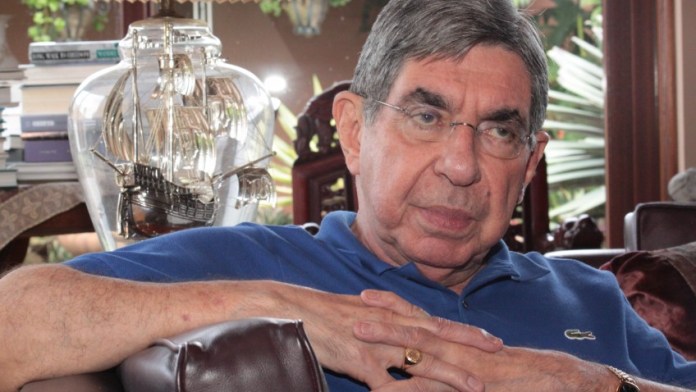
Former President Oscar Arica Sanchez, now 76 years of age, discarded any possibility of running for re-election in 2018
(QCOSTARICA ) Former President Oscar Arias had said definitely he will not be running for a third term as president in 2018, citing the need to make room for new leadership. But he warns he is not withdrawing from politics.
The two-time president (1986 to 1990 and from 2006 to 2010) and 1987 Nobel Peace Prize-winner for his efforts to end the Central American crisis, wrote of his decision in his column titles “No One Is Indispensable in a Democracy” published on the IPS news service.
The decision has opened the Partido Liberation Nacional (PLN) party nomination to a number of high profile PLN politicians, including Antonio Alvaro Desanti.
(IPS) I have put a great deal of thought into whether or not to return to politics. Groups from different political parties, and without party affiliation, have expressed their concern over the current situation in the country and have offered me their support. And the opinion polls indicate that I would have a chance at a third presidential term.
Former Costa Rican president Oscar Arias
The support of so many people fills me with gratitude. There is no greater reward for me than feeling the confidence and trust of the Costa Rican people, because it is based on deeds and actions, on knowing me for over 45 years, and knowing that, with all my defects, I always say what I think and do what I say.
The approval of my first two administrations is a reflection of what we managed to do together. In the 1980s, we brought peace to a region crushed by war, and we thus put Costa Rica on the world map.
Ten years ago, we inserted our small country in the international economy, and we put it on the map again when the United Nations approved the Arms Trade Treaty, Costa Rica’s biggest contribution to humanity in its entire history.
For many months I have weighed the contribution that I can still make, serving Costa Rica once again, against the need to give a boost to the emergence of a new generation of Costa Rican leaders. And I’m not thinking about the next four years. I’m thinking about the next 40. I have enough strength and enough ideas to serve them again. But I also know I’m not indispensable. No one is indispensable in a democracy.
This is something I have said many times: one of the main obligations of a political leader is to foster new leadership. The future of a country depends on the continuous emergence of new cadres willing to take up the baton. Only tyrants cling to power.
Democrats, of whom I am one, understand the importance of stepping aside. I believe the next generations must be given space, and this is the main reason for not running again for president.
The second reason arises from the political ungovernability in Costa Rica. The opposition doesn’t bother me; on the contrary, I have always believed that in a democracy if there is no opposition, it has to be created. I believe a good government requires someone on the other side of the sidewalk, reminding it of its commitments and holding it accountable.
Unfortunately, there is a segment of the opposition in our country which, instead of demanding that the government in office make good on its promises, uses any tool to keep it from doing so. Rather than allowing it to implement the government plan that voters supported at the polls, they spend four years carrying out a continuous election campaign, standing in the way of progress in the direction that the people said they wanted.
On May 8, 2006, when my second government took office, I made the following appeal to Costa Ricans, which continues to apply today:
“I hope that we learn that no party or social segment has a monopoly on honesty, patriotism, good intentions and love for Costa Rica. I hope that we can understand that the responsible use of political power is much more than pointing things out, complaining, and hindering, and consists above all of engaging in dialogue, working together and building.
“I hope we will be able to tell the difference between adversaries and enemies; understand that willingness to compromise is not a sign of weakness, just as intransigence is not a sign of strength. I hope we can do away with the pettiness of our political debate, raise up our heads, look forward and think big.”
The third and last reason that pushes me to make this decision is that I think there are many ways to work for the people of Costa Rica. They say that someone who is only good at being president is not even good at that. That is, if you can only exert influence from the presidential seat, it will not be a strong influence.
I don’t plan to retire. I will continue to express my opinions about the way things are going in the country, and I will continue to support the causes I believe in: I always defended what I consider is best for our people, and above all, for the less fortunate.
I will continue to tirelessly advocate the need for Costa Rica to approve educational reforms that make it possible to boost the quality of education in our primary and secondary schools and our universities, such as dual education, evaluation of teachers and ensuring that our young people receive the skills needed to compete in today’s world.
I will continue to insist on the need for Costa Rica to modernise its economy, invest in infrastructure, insert itself even more in the global markets, significantly bolster its competitiveness and rev up its engines of productivity, the best instrument to reduce inequalities. And I will continue defending democracy, peace and disarmament, because the small size of our country should never be the measure of its moral authority.
I have decided not to run for a third presidential term because I believe that the main problem we are facing is medium- to long-term. If we don’t manage to elevate the quality of politics and increase interest in public service, if we fail to get the most capable, educated and honest people to participate in political life, the sustainability itself of our democratic system is at stake.
To preserve this way of life that we have enjoyed for years, we have to encourage young people to lay their hands on the helm of history.
This is a country of young people. It’s the new generations that have to fight for, and exercise, power. If they don’t like the direction the country is moving in, they should change it. You can do a lot of good outside of politics, but a country where everyone is outside politics is a country adrift.
Arnold Toynbee, the great British historian, said “The greatest punishment for those who are not interested in politics, is that they are governed by people who are.”
Young people must occupy their rightful place in decision-making. They should take the helm of this ship we call fatherland; it will go in the direction of their commitment, or their indifference. I hope the Costa Rica of the future will not be the fruit of their omission, but of the most determined transformative action!
My profound gratitude to everyone who has supported me. Thank you so much for your affection and your trust. Thanks so much for the people of Costa Rica, who continue to move me, to inspire me, and to give me reasons to believe that politics is an instrument for doing good, for achieving peace, for doing justice; that politics is the workshop of dreams where perhaps they can become more realistic, more precise, more concrete, but also the place where dreams can come true.
LIGHTER SIDE – Could this be real? Extraterrestrials (ETs) visiting Costa Rica? This is a screencapture of the live camera by Teletica pointed at the Turrialba volcano on Tuesday afternoon.
We haven’t heard anything yet from the UFO (Unidentified Flying Object) hunters who claim to have been making contact with alien life.
Screencapture of the Teletica camera pointed a the Turrialbca volcano from atop the Irazu
But we wouldn’t be surprised if the social media will soon abuzz over this, just it did last March of the witness reporting watching and photographing a saucer-shaped UFO near the Irazú Volcano National Park, a stone’s throw away (ok a little further than that) of the Turrialba.
Clean up of the runway at the San Jose airport. Photo Alber Marin, La Nacion
CHECK WITH YOUR AIRLINE BEFORE HEADING OFF TO THE AIRPORT FOR YOUR FLIGHT TO OR FROM COSTA RICA!
Clean up of the runway at the San Jose airport. Photo Alber Marin, La Nacion
(QCOSTARICA) The San Jose airport was re-opened shortly after noon today, the airport manager, Aeris, saying operations are back to normal. For now.
Although the airport is supposedly open, the Aeris website continues the “airport closed alert” and according to source close to the Q, they report no flights have taken off since the announcement.
All U.S. carriers cancelled their flights in and out of San Jose for today.
In addition, Avianca, the Colombian airline that operates two daily afternoon flights from Toronto to San Jose cancelled the flights. The morning flights to Toronto from San Jose were also cancelled.
According to a report by La Nacion before noon, some 12,000 passengers were directly affected by the airport closure today, with 52 inbound flights and 68 outbound cancelled.
The question which as been asked repeatedly is why aren’t flights diverted to Costa Rica’s other international airport, the one in Liberia, Gunacaste.
I may have to do in part that the Liberia airport cannot handle the volume of passengers or aircraft. And then there is the cost of moving by land number of people and luggage, a logistics nightmare.
Important here is that if you have a flight to of from San Jose today or tomorrow, check with your airline before heading for the airport. Do not rely on websites or news reports, to be disappointed to find your particular flight cancelled or delayed.
The Pavas San Jose airport with mainly local flights and small planes is also affected by the volcanic activity ongoing since the early hours of Monday morning.
Waiting, waiting, waiting. at the San Jose airport. Photo La Nacion, John Duran
Waiting, waiting, waiting. at the San Jose airport. Photo La Nacion, John Duran
Hundreds of passengers have camped out at the San Jose airport waiting, waiting, waiting for the airport to re-open. Many others have been heading to the airport, not aware of the closure.
A check on the Aeris (airport operator) website, when the website is not down for too much traffic, a number of flights show cancelled, while others continue as normal, but important to call your airline for a status.
Passengers continue to arrive at the San Jose airport not aware of the closure. Photo La Nacion, Jeffrey Zamora
For those flying to San Jose by way of a stop, be aware that your flight might depart as scheduled, but may have the spend the night at the stop point, such as San Salvador or Panama. Flights may also be diverted to Liberia (Costa Rica), 3 to 4 hours by land from San Jose. Check with your airline.
As of 8:00am this morning (Tuesday) more than 100 flights have been cancelled or delayed since Monday morning, when airport operations were suspended due to the two early morning eruptions of the Turrialba volcano. A third eruption at noon and then minutes after 4:00pm maintained the suspension, with only a 30 minute window (from 4:30pm to 5:00pm) that airport operations were resumed.
Aeris has announced the airport would be re-opened at 8:00am, updated to 11:00am and currently “until further notice”.
Two more eruptions this Tuesday morning and winds blowing in a westerly directions (towards Alajuela where the airport is located) are expected to “complicate” clean up operations and the re-opening of the airport.
The closure is for the safety of passengers and the crew.
(QCOSTARICA) SAN JOSE 8:20AM – The San Jose (SJO) airport continues closed. The latest infromation from Aeris, the operator of Costa Rica’s main airport, has since updated 6:00am re-opening of the airport to, first 8:00m and then 11:00am.
Currently, the Fly2sanjose.com website continues with a red notice, advising the airport is closed until further notice.
Hundreds of passengers, many not aware of the airport’s closure, have been continually arrive at the airport only to find that there is no certainty when and if they will be able to fly today.
If you have a schedule flight out of or to San Jose for today, best is to call your airline for an update before setting off for the airport.
(QCOSTARICA) Airport operations at the San Jose international airport were suspended for Monday (Sept. 19) afternoon following the a major eruption of the Turrialba volcano sending a thing cloud of ash into the sky.
The temporary closure was lifted for 30 minutes, but authorities decided to close again at around 4:30pm for safety reasons because the volcanic ash could cause problems for planes and the safety of passengers and flight crew, Civil Aviation authorities explained in a statement.
Ennio Cubillo, Director General of Civil Aviation, said that given the wind conditions, volcanic particles fell again in Alajuela, some 18 kilometres west of San Jose. The volcano is about 35 kilometres from the capital.
“The particles are not only in the airspace but also on the surfaces of taxiing and takeoff,” explained thechief ofCivilAviation.
The closure is in effect until 6:00am Tuesday morning.
The Turrialba volcano had four eruptions on Monday, one at 2:53am, another more intense at 11:30am, one at 2:40pm and the last at 4:06pm.
On each occasion there wasexpulsion ofash, gasesandincandescent rocks, the latter reached 500 meters above the active crater of the colossus in the activity recorded during the morning.
In addition, the column of volcanic material before noon reached 4,000 metres (4 kilometres or 2.5 miles) high, explained Javier Pacheco, of the Volcanologicaland Seismological Observatory of Costa Rica (OVSICORI).
Reventazon hydroelectric dam is the largest infrasctructure project in Central America
Reventazon hydroelectric dam is the secong biggest infrasctructure project in Central America after the Panama Canal and the largest of its kind in the region
(QCOSTARICA) The Hydroelectric Plant located on the Reventazon River near Siquirres inaugurated last Friday as been classified as the second-biggest infrastructure in Central America after the Panama Canal and the largest of its kind in the region.
President Luis Guillermo Solis inaugurated the public work on Friday, in a ceremony that drew a crowd of more than 500 people.
The 305.5 Megawatt (MW) Reventazon dam will provide electrical energy to more than 525,000 homes, producing enough energy to possible even export to other countries in the region.
The cost of the project by the Instituto Costarricense de Electricidad (ICE), the State power company, came at US$1.4 billion dollars and completed three months ahead of schedule. The plant was completely designed and built in-house by ICE and financed by local and international banks.
“It’s a source of pride today to deliver to Costa Rica the largest hydroelectric dam in Central America, managed and created with Costa Rican talent, an impressive work that positions us as a leader in socio-environmental management (…) This is what we as a country are capable of building,” ICE President Carlos Manuel Obregon said at the inauguration ceremony.
The Reventazon permits Costa Rica to maintain independence in electrical power and reach its carbon neutral goals in terms of reducing greenhouse gas emissions.
In 2015, Costa Rica generated up to 99% of its electricity from renewable sources: hydroelectric, geothermal, wind, biomass and solar.
This year, the country has gone more than 150 days with 100% renewable electricity.
Are you ready for a car free day in San Jose? Join the challenge to move around the city by bus, train, bicycle and even walk to and from work or shopping on September 22
Are you ready for a car free day in San Jose? Join the challenge to move around the city by bus, train, bicycle and even walk to and from work or shopping on September 22
(QCOSTARICA) Can you imagine, just for one fleeing moment, a day in San Jose without cars. Not easy, right? But, come Thursday, September 22, it may be a reality as nine civil organizations try that Costa Rica joins for the first time, the World Car Free Day (Dia Mundial Sin Carro in Spanish).
For example, cities like Bogota, Colombia, on that day imposes fines to curb circulation of vehicles.
Andrea San Gil, of the Centre for Urban Sustainability, said the mission is to being people who travel usually by car to use public transport or other methods of non-motorized mobility, such as bicycles.
“We want people will open the mind and say, ‘Geez, is not as difficult ride public transportation,'” said San Gil.
Car free day is September 22 around the world! Do your part.
Circulating on the roads in Costa Rica, the majority in the streets of the Central Valley, are 1.4 million vehicles. According to experts, some 15 days a year are lost in traffic congestion from Alajuela to Cartago.
Teo Mezger, head of “Moverte Por Tu Cuidad” (Moving About Your City) said the goal of a car free day is get one of out five people not to use their cars on that day.
Other groups behind the movement are: Chepecletas, GAM Cultural, Bici Bus, Dame Ride and Costa Rica Limpia, among others.
The challenge is to get public figures out of their cars on September 22, to get to their work by bus, train or bicycle.
Among those accepting the challenge are Carlos Villalta, Minister of Public Works and Transprot (MOPT); the mayor of Alajuela, Roberto Thompson; and Jean-Baptiste, the France Ambassador to Costa Rica.
President Luis Guillermo Solis was also invited to join in the challenge, however, he will be out of the country, left Sunday morning for New York City for his week long visit to the United States.
Among the corporation to accept the challenge are H.Solís, Universidad Véritas and Florex.
Are you up to the challenge? Join as at the Q to take public transportation (bus or train), a bicycle or even walk this Thursday. Send us your photos and we will publish them here or post directly to our official Facebook page.
(Q24N TRAVEL) A report by CNN makes a compelling argument to booking your flight last minute, to get the best fares, making sense of the random seeming fare process, high one week, low the next and cheaper to fly across the world, than next door.
For example, from San Jose, Costa Rica, it can cost almost US$300 to fly to Managua (return) on either Copa or Avianca. A flight to Toronto, for example, on both airlines can be less than the Managua flight.
Or, here is a better one, it can cost cheaper to fly to Cartagena, Colombia via Panama from San Jose, than the flight from San Jose to Panama. Hold on, I get on plan in San Jose, fly to Panama, change planes to Cartagena, right? And that it is cheaper than boarding a flight in San Jose and flying to Panama without going to Cartagena? Right.
The article by CNN says there’s a method behind the madness. It’s called airline revenue management: the science of adjusting fares dynamically and in real time so that airlines can maximize their revenue.
And it’s not just a case of simple supply and demand: airlines relying on sophisticated software that takes into account many factors, including the individual preferences of their passengers.
From CNN, it hasn’t always been like this.
The following is from the CNN article that can be found here.
For most of aviation history, airlines operated in a tightly regulated, uncompetitive environment, where air fares usually cost a small fortune.
Discounted tickets weren’t unheard of, but usually came with lots of strings attached, such as having to spend a certain number of nights at the destination.
International routes were usually operated by the flag carriers of the countries involved, who would take a gentlemanly approach to competition and fare-setting.
Deregulation — a global liberalization trend which began with the US Deregulation Act of 1978 — swept everything before it, from the industry structure to the way we think about air travel and airline fares.
Fiercely competitive
It’s now all about revenue management, says Robert W. Mann, a consultant and former airline planning executive.
And that’s something, he says, has become increasingly complex and fiercely competitive in the past few decades.
“The growth of the network airline and the drop in the cost of computing has brought revenue management to whole new levels of sophistication,” he tells CNN.
“Techniques such as Expected Marginal Seat Revenue (EMSR) look at the best ways to optimize fares in real time, not only on a given route, but taking into account revenue-generating opportunities across the whole airline network”.
This is why, for example, flying from London to Dubai may cost pretty much the same as flying all the way to Manila, also via Dubai.
That’s because the airline may prefer to keep seats on the London-Dubai leg for higher-value passengers that fly longer onward journeys, and will use pricing to discourage those aiming to fly shorter trips.
Customer profiling
But how does the airline know who the higher-value passengers are and how much to charge them?
Stuart Barwood, founder of Travercial, an airline consultancy firm, says airlines can make a number of reasonable assumptions about the profile of traffic on a certain route and then adjust their prices accordingly.
“The London to Majorca route, for example, has a marked leisure profile. This has implications not only for fare levels but also for the way pricing changes over time.
“If the airline assumes that leisure passengers will tend to book relatively early, months before their holidays, it may be tempted to start pricing seats on that route relatively high. It would then adjust them according to the market response.
“Meanwhile on a typical business route — let’s say London to Frankfurt — the airline may start with low prices to fill a minimum of capacity, then raise prices steeply for business travelers that book at the last minute.”
In fact, those last-minute high-value passengers are so precious that some airlines go the extra mile to make room for them.
For example, a service developed by Barcelona-based company Caravelo helps airlines identify those passengers most likely to accept a flight swap in exchange for compensation, such as vouchers or frequent flier miles, and offers to rebook them on a later flight.
With space then cleared, the high-fare passengers are then booked onto the previously full flight.
Towards total customization
You might think of fare classes in terms of economy, business and first class, but the reality is airlines have dozens of subdivisions.
The airline will adjust the number of seats allocated to each fare class. When one class has been sold, the sale price will leap to the next one.
This is how most fares are currently set, but it’s still some way off from the ultimate goal: Airlines want to know their clients so well they’re able to offer fully personalized pricing.
Loyalty programs, registered users and cookie tracking can give airlines some valuable clues, but even when an airline has gathered a lot of data about its passengers they still might not be putting it to profitable use.
Adding up the extras
“In reality, it is quite common for passenger data to be scattered throughout several functional areas within an airline, kept in data silos where it is of little use to the revenue management department,” says Barwood.
Airlines might be lagging behind the likes of Amazon when it comes to personalized marketing, but Barwood says many are getting up to speed with data management and this is already being felt in pricing and marketing.
Revenue management systems will increasingly take into account not only the air fare itself, but the total value a passenger can generate for the airline, including ancillary revenue.
That’s all the extras that can be added to your base fare, and it’s a growing source of profit.
Using seat choice as an example, many airlines now charge for the privilege of picking your seats in advance.
This could, in theory, be managed dynamically. Why not base seat prices on the occupancy of a given flight? Or charge less to members of your loyalty program?
This kind of profiling might be beneficial to the loyalty program customer in this instance, but what about when a frequent business traveler is then consistently shown higher fares when they’re trying to book a family vacation?
It could well prompt a backlash among the sort of high value customers that every airline hopes to retain.
Protecting the brand
And while airlines may have good reasons not to overcharge their best customers, they also have to be careful not to undercharge the other classes of client.
The temptation is to aggressively lower prices when there are still empty seats left before a flight departs — but if this becomes the norm there’s a serious risk of undermining the brand and alienating higher-value passengers.
A number of companies, such as Bidflyer, Plusgrade and SeatFrog, have come up with applications that allow airlines to sell upgrades to the highest bidder through an auction mechanism — an efficient but anonymous way to get passengers to tell the airline how much they’re willing to pay for premium services.
Back to basics
The apparent randomness of airfares makes for an excellent conversation topic with friends and colleagues, but it can also be a source of anxiety for many travelers.
Perceptions that prices are immensely variable can add to the fear that customers may be overcharged for any extras they inadvertently purchase, or the worry that they might not be getting the best deal out there.
Which is why many airlines have opted for a different approach: go back to basics and offer branded fares — a bundle of services for a closed price.
This shouldn’t be confused with the rigid fare system that prevailed when the first low-cost airlines hit the scene.
This is more like an evolution of the low-cost fare system which lets customers choose the extras they want to add to the base fare.
This approach means re-bundling a bunch of services — from checked-in luggage to a wider, more spacious seat — into a number of fare package options of varying complexity, all selling for a set price.
Think of it as like the menu options at a fast food joint.
The airfare arms race
Airlines might have a whole battery of tools to help them extract the most revenue from their passengers, but travelers can also call on their own arsenal of technological countermeasures.
Companies such as Skyscanner and Kayak have introduced fare alerts which allow you to monitor fares for specific flights and get automated alerts the moment they change.
Some companies are also developing fare prediction technology that promises to help travelers book their flights at the optimal moment, when the fare is likely to be lower.
In order to do this they rely on their own algorithms, plus a heap of historical data on air fares.
California-based FLYR uses its own proprietary fare prediction technology to offer fare lock-in insurance in partnership with TripAdvisor.
This service is similar to buying a financial option where you pay a relatively small premium in advance, to make sure you won’t pay more than a certain amount at a later date.
It also works with travel agents and other distribution partners to optimize bookings.
Seizing the moment
FLYR’s founder, Dutch entrepreneur Alexander Mans, says that outside a 30-day window of a flight’s date of departure, there is a 60 to 70% chance that a specific air fare will drop in price at some point.
“It is practically impossible for someone to monitor this manually, but with our computing resources we can predict pretty accurately the chances of a fare coming down and advise on the best course of action.
“If we think a fare is going to be lower in the future, we recommend waiting, before hitting the ‘book’ button.”
Hopper is another company specializing in the field of airfare prediction. Its mobile app, which has been downloaded more than eight million times, uses big data technology to predict fares as much as 12 months in advance.
“Our system looks at six to eight billion air fares every day. Our database has five years of historical fares, that means trillions of prices!” Frederic Lalonde, Hopper’s founder and CEO, declares proudly.
He claims their algorithms are capable of accurately predicting an airfare within $5, up to six months before departure.
“We are confident enough in our system to predict actual figures and to tell our customers whether they are getting a good fare or not.
“We have tracked our accuracy to 95%. Whether people later follow our advice or not is another story…”
With this amount of computing power being thrown into the field of airline pricing and the expectation that artificial intelligence technology will go mainstream, it might ultimately be up to the robots to fight the airfare war.
This isn’t necessarily bad news — it may result in better choices and more efficient booking processes.
With virtually millions of different air fares — as many as the number of passengers airlines carry every year — what seems assured is that airline fares will continue to be a topic of conversation by the office cooler for years to come.
baby sea turtle trying to make it to the sea. Photo from Sea Sheperd website
(QCOSTARICA) The Sea Shepherd and its founder Paul Watson continue with the legal problems in Costa Rica, posting on its website on Friday the Costa Rican Government forcing it to shut down Operation Jairo II, a campaign to protect endangered sea turtles.
The Seashepherd.org website warns that, “Any Sea Shepherd volunteer found patrolling beaches or engaging in sea turtle conservation work will be detained and deported“.
In Costa Rica, in June 2016, Sea Sheperd announced the Operation Jairo II campaign, that will span three countries including the United States (Florida), Honduras and Costa Rica to protect endangered sea turtles.
As part of the campaign, the Sea Sheperd teamed with the Jaco (Jaco Beach) police to protect nesting females and nests from poachers. Nests were being relocated to a hatchery run by the Jaco police force.
On Friday, Sea Shepherd says it was informed that the Jaco police is no longer authorized to work with the non-profit organization. Captain Osvaldo Rodriguez, Chief of Garabito Police Department in Jaco, was ordered not to work with Sea Shepherd because they are “known criminals.”
Presumably the “criminal” reference stems from the Red Notice issued by Interpol on Sea Shepherd Founder Captain Paul Watson back in 2012 for the Costa Rican charge of interfering with a Costa Rican shark fining operation.
“This is a very difficult moment for us volunteers here in Costa Rica,” said Operation Jairo II Ground Leader Cristina Cely. “In less than 2 weeks we have saved almost 2000 eggs from the beaches of Hermosa, Claritas and Jaco that most likely would have been poached, and 63 very disoriented hatchlings that didn’t stand a chance to survive if we weren’t here. Our presence has made a difference for these eggs and hatchlings, but now, thanks to mediocre minds we have to stop and the only ones who have everything to lose are the turtles.
Photo from Sea Sheperd website
Added COO David Hance: “I’m disgusted that the Government of Costa Rica is willing to sacrifice the lives of 1000’s of turtles, simply because they are motivated by international politics.”
“No good conservation deed goes unpunished in Costa Rica,” noted Sea Shepherd President and CEO Paul Watson. “If you stop shark finning or rescue baby turtles you are considered a criminal by the Costa Rican government. Costa Rica is a country where rescuing turtles can literally get you killed. This government can always be dependent upon to side with the poachers.
From the Sea Sheperd website:
The Costa Rican Red Notice: A Fourteen Year Saga
Prior to his return to the U.S. last month, Captain Watson had been living in France under the protection of the French government for two years. He is wanted by Costa Rica where he is accused of intervening to stop a Costa Rican shipping vessel, the Varadero I, that was illegally finning sharks in Guatemalan waters in 2002.
After obtaining permission from Guatemalan authorities to bring the vessel in for breaking the law, Captain Watson attempted to arrest the vessel, but the poachers broke free and fled toward Costa Rica.
Later that month the Costa Rican authorities filed a criminal complaint alleging that Captain Watson and his crew threatened and attempted to murder the seven crew members of the Varadero I, as well as damaging their vessel. This complaint was based on testimony supplied by the Varadero I crew. A local foundation offered Captain Watson counsel, yet neither he nor his appointed counsel were provided timely notification about a preliminary hearing on the matter in December 2002.
Sea Shepherd filmed the entire incident that occurred at sea, while the Varadero did not provide any documentation.
Although the allegations of attempted murder were later dropped when the court viewed Sea Shepherd’s footage, new charges were added. However, Captain Watson was never informed of this development or given a summons to appear.
When Captain Watson did not appear for trial, the Costa Rican court declared him a “rebel” and issued a warrant for his arrest on the charge of “violation of ship traffic.” This charge came a decade after the incident!
The matter escalated on May 13, 2012, when German authorities detained Captain Watson in Frankfurt. Six weeks later, Costa Rica submitted a modified extradition request alleging “shipwreck endangerment and aerial disaster,” a far more serious offense typically associated with terrorism.
In August 2012, Interpol issued a Red Notice on Watson for the Costa Rican charge of “shipwreck endangerment.” Captain Watson fled Germany after some 70 days of house arrest and eventually ended up in France.
Photo from Sea Sheperd website
Operation Jairo History
Operation Jairo II, which began in August of this year, spanned three locations beginning with Florida before moving on to Honduras and Costa Rica. The campaign continues to be active in Honduras.
Sea Shepherd first came to Costa Rica in 2014 for Operation Pacuare, which saved the lives of nearly 3,000 sea turtles. Upon return to the country a year later, the campaign was renamed Operation Jairo, after Jairo Mora Sandoval, a Costa Rican turtle defender who was brutally murdered on May 31, 2013 while attempting to protect leatherback turtle nests.
There are seven species of sea turtles in the world. Four have been identified as “endangered” or “critically endangered,” and two are classed as “vulnerable,” by the IUCN Red List of Endangered species. Sea turtles are some of the oldest living creatures, one of the few who’ve watched dinosaurs evolve and become extinct. They are now facing the same fate as their predecessors.
(QCOSTARICA) Following weeks of moderate calm, the Turrialba volcano returned with a roar Saturday morning.
According to the National Emergency Commission (Comisión Nacional de Emergencias – CNE), the volcanic activity began at 9:57am, spewing out a plume of smoke and ash to about 500 metres from the base of the crater.
The emanation was dispersed by the wind to the northwest, says the Instituto Meteorológico Nacional (IMN), the national weather service.
Reports of ashfall was greatest in the areas surrounding the colossus, La Silvia and La Picada.
Experts say the volcano still has a lot of energy, experts maintain a constant monitoring.
The Turrialba had more than a month of “relative rest”.
(QCOSTARICA) With her seatbelt on and with minutes before the plane was to take off, 7 minutes actually, her name is called over the speakers. The flight to New York was full.
Patricia Carrera. Photo from social media
An immigration officer was waiting at the door of the plane for Patricia Carrera. She could not believe it, she was being told she could not leave the country, a woman she didn’t even know had filed a child support order (pension alimentaria in Spanish) against her.
She couldn’t believe this was happening. In the customs area, with her bags now off the plane, she sat crying. The holiday that she had planned for a half a year, was ruined. All for a mistake.
Patricia didn’t have any children.
It turns out the woman had mistakenly filed for the child support against Patricia, leading to her “impedimento de salida” (ban from leaving the country).
“It is a woman on woman. Only applicable if one is a mother. It was obvious there was an error. I do not know her. I have no children. Everyone believed I was taken off the plane for carrying drugs, it’s a shame especially for my husband who is a correct person,” said Carrera over the error that apparently was on file since February.
The event occurred last Wednesday, on a Copa Airlines flight leaving San Jose at 5:30pm. The flight took off without Patricia and her husband, at 5:37pm.
Given that Thursday was a legal holiday in Costa Rica, Patricia had to wait to Friday, when it took only 10 minutes for a judge to lift the ban. The court was in San Carlos, more than a 2 hour drive from San Jose.
An “Impedimento de Salida” is typically placed on a person involved in a criminal case and child support or alimony.
In years past, travellers at the airport, after checking in at the airline, would pass through an immigration checkpoint. Now, the immigration check is in the background: the airlines are required to submit their passenger list to the immigration service, which then cross checks the names and takes action, if required, that includes physically removing a person from the aircraft.
To avoid erroneous detentions or persons with bans from leaving the country, the immigration police now has an around the clock access to the judicial database. Judicial orders banning the leaving country are now available in real time, instead of what it would take at times days for the judge’s order (resolution) be sent by the court to the immigration service.
In the case of child support or alimony, a person with an impedimento de salida can make the required deposit at the Banco de Costa Rica (BCR), which information is also accessible in real time by the Feurza Publica (police).
TICO BULL by Rico – Often I get asked why I shop at Pricesmart. The answer is simple and complicated at the same time, in that I can get better pricing on many things and items that you cannot find in other stores in Costa Rica.
For example, I go through 1 1/2 50 lbs of dog food a month. I usually purchase Pedigree, my dogs (I have 5) like it and I like the price. If I had to buy this amount of dog food at the local supermarkets, ie automercado, Masxmenos, Walmart, my dogs wouldn’t be very happy.
On the down side, stocking at Pricesmart is hit and miss. Not sure why, but the 55lb bag of Pedigree is not always available, I have to substitute. So it goes for many other items.
Shopping at Pricesmart starts with a membership card. The value of the card, if you shop often, will save you over the course of the membership year. You can even save the amount of the membership fee in one shopping trip.
With the membership, many customers really don’t know this, you can shop not only at the six Pricesmart stores in Costa Rica, but also in Colombia (5), El Salvador (2), Guatemala (3), Honduras (2), Nicaragua (1), Panama (4), Aruba (1), Barbados (1), Dominican Republic (3), Jamaica (1), Trinidad and Tobago (4), U.S. Virgin Islands (1).
Shopping at locations out of Costa Rica with your Costa Rica issued card issued means first going to the customer service counter, tell them where you are from, have them scan the card to see if it will be accepted at the cash register. If it doesn’t, you will be issued a temporary pass.
Taking the step of verifying your card in the country you are in, will save you lots of time and frustration when checking out.
I did this in Cali, Colombia and Managua, Nicaragua/ All went smooth. But not so at Costco in Toronto. Yes, different company. Or is it? Both had their beginnings with Sol Price (hence the Price in the name, and you thought it all had to do with pricing).
At the Toronto Costco, first thing I am told, “that is an old card”, referring to the “Price Club” name before becoming Costco. A scan, the system doesn’t recognize it.
The PriceSmart membership is non-transferable; if you lend your card to another person he/she will not be able to shop with it. Membership does come with two cards, either you them or not. Get a second card for your significant other or friend.
One of the major differences of shopping at “Price” (as it is called in Ticolandia) that is not at non-membership stores, is the carding at the door and then the “check-off” on your way out. Annoying, but it ensures that only members – people like you – are in the store. The price for the elitism is US$35 or equivalent in local currency) per year.
Now, something I didn’t know until writing this post, is that you can bring with you up to three friends into the club each time you shop. OK, that answers the questionwhy you see large packs of Ticos jamming the aisles, just like on the autopistas.
As to the why you are asked to show your receipt on exit, Pricesmart say it is “our most effective method of maintaining accuracy in inventory control“. I think it’s bull. They don’t trust their members. Simple.
A good personal friend works security at one of the Pricesmart stores in San Jose, there is an army of plain clothes security in the store at all times. They are easily spotted by watching them talk into something in their clothing (hidden transceiver). They are different the security guys and gals in the parking lot. These folks keep their eyes on thieving members.
Paying at Pricesmart can be simple and difficult. Cards (credit and debit) are fine, local or international. Colones are fine too. With US dollars, nothing more than a $50. Canadian dollars, forget about it. Euros, Cordobas, Pesos? Leave you items in the buggy (shopping cart).
There is an ATM machine inside the store. Haven’t used one yet, I always try to bring with me the right currency or card for my purchases. And about the cards, why does Pricesmart insist on ID when the membership card that I pay for and they have my info on file has a picture on it.
“It’s not legal ID”, I was once told. Refund me the membership in that case. I still refuse to do the Tico thing of handing over a card (debit or credit) and their cedula. I see my wife doing that every time, she pulls out both pieces to hand over to the cashier before starting the checkout. I, however, want to be asked. A 50/50 record so far. Since I typically shop at the same Pricesmart, I look for familiar faces at the cash. “It’s the point,” I say.
Closing notes.
Pricesmart doesn’t have sales or offer discounts, they say their prices are the lowest all the time.
There are no express lines.
The best times to go on weekends is before noon on Sundays
Avoid one day before, day after and pay days
During the week (too many crowds on Weekends) is between 12 and 2pm, you can literally have a varied lunch for free from the food samplers.
Returns and/or refunds are without hassle
Limited item selection
Imported items not available at other stores
See you soon at Pricesmart. I am the guy with the pony tail keeping an eye on the price of apple pies.
TICO BULL by Rico – Being an avid reader of Quora, there are always interesting questions and sometimes even more interesting answers. This one caught my attention, “What is the financial reasoning behind wealthy folks choosing to live in a hotel?”
I personally know one person who chooses to live in a hotel in San Jose, a preference over an apartment in La Sabana, Rohrmoser or Escazu.
He, a single man in his early 60s and once a frequent visitor to Costa Rica before making his move permanent, is not a “wealthy” person, but is well off financially, the sum of his savings.
Among the Quora answers to the question include, “removing availability of money from the equation, it turns out that living in the middle of hot and cold running personal service and luxury is actually pretty cool.”
Another poster adds, “Living in a hotel is not only for the wealthy. It can make economic sense for the elderly as well, and is often less expensive than living in a typical retirement facility and comes with more services that you’d get Ina typical retirement facility.
In this case, living in a hotel is about the same, or maybe less, as at a good retirement home. Some may believe it to be extravagant, but consider that a hotel can offer you ‘an address’ instead of some random number on a random street, proximity to everything, security, maid and food service and so on. Luxury hotels add pools, spas, gyms and much more.”
Another poster offers this, “A 5 star hotel in NYC is $400 a night * 365 days = $146,000. I’m sure you can negotiate a better rate, but that’s a decent upper bound. The average American spends about 30% of their yearly earnings on housing (rent/mortgage). Ergo, if your earnings meet or exceed $146,000/.3 = $486,667 a year than it makes sense to live in a hotel.”
Living out of a hotel room may not be appealing to all. Grand Hotel Costa Rica
Which bring me back to my friend, a native New Yorker.
His reason for choosing to live in downtown San Jose hotel is basically for all the reasons above, including income, though not to the level of the example, does well from his investment portfolio, with the added bonus of doing no chores, he can come and go when and for how long he pleases, including travel out of Costa Rica without the usual concern for security, and knowing he will find on his return, everything as he left it.
To his reasoning he adds he had to never deal with the local utilities contracting of people to do things for him and (unwelcomed) people just dropping by at his front door.
In New York, as he tells me, his living accommodations was not more than a hotel room and as a frequent traveler (mostly to Costa Rica), is used to the confines of a hotel room. So, no real change as it would be for someone coming from a big home or living in a multi-room environment.
From a financial point of view, his monthly cost for his (fixed) room in a hotel is not much more than he would spend monthly in renting an apartment and having to contract and pay for individual services. If we factor in the losses through theft and breakage (from people you let into your home), his costs of living in a hotel may actually be less than in an apartment.
Is living in a hotel for me? Not.
For my friend? Definitely.
For you? Maybe.
If lifestyle of living in a hotel room is appealing, all around the country you can find the right hotel, in the right location (for you) and make your deal. In downtown San Jose, for example, there are hotels in the heart of the city, in barrios (neighbourhoods) like Amon, Otoya and California with their history and living trends. Hotels in La Sabana, Rohrmoser and Escazu take you away noise and pollution.
On the last point of living in a hotel, as my friend puts it, there is no long term obligation of a lease or rental agreement. He pays for his month and if he so chooses, he can pack his suitcase and move. To another hotel, down the street, across town, another city, even another country.
(QCOSTARICA) At least three United States military helicopters were spotted flying over Costa Rica skies Wednesday morning, surprised many Ticos who shared their photos on social networks.
Enio Cubillo, director of Civil Aviation, said that the aircraft entering Costa Rica airspace, over flying the country on the way to Honduras and confirmed they had permission.
“They were en route from Honduras of Panama, with a refueling stop in Liberia (Guanacaste),” said Cubillo.
According the Aviation chief, the helicopters are operating within the framework of U.S. non-armed aircraft, which has been greatly debated over the year.
Foto from Cariari Informa Facebook page
For an aircraft of this type to fly in Costa Rica, legislators should issue a permit, as established by a circular of the Directorate of Civil Aviation of 2005.
Posts on Facebook, like the one by Cariari Informa and many others claim to have seen helicopters in the area of Guápiles, east of San Jose, on the way to Limon.
From the photos posted, it is clearly visible that the helicopters are no the Black Hawks flying over San Jose during the visit by President Barack Obama in May 2013 .
In the evening prior to the arrival of Obama, the Black Hawks flew “low and slow”, in the cover of night, over the capital city.
The helicopters spotted Wednesday appear to be the CH-47 Chinook, a twin-engine, tandem rotor heavy-lift helicopter. According to Wikipedia, its primary roles are troop movement, artillery placement and battlefield resupply. It has a wide loading ramp at the rear of the fuselage and three external ventral cargo hooks. With a top speed of 170 knots (196 mph, 315 km/h) the helicopter was faster than contemporary 1960s utility helicopters and attack helicopters, and is still one of the fastest helicopters in the US inventory. The CH-47 is among the heaviest lifting Western helicopters. Its name is from the Native American Chinook people.
Give to Colombia founder Angela Maria “Nai” Tafur at her home in Key Biscayne.. Tim Padgett / WLRN.org
(Today Colombia) WRLN.org – Colombia’s protracted peace talks have put a serious dent in President Juan Manuel Santos’ approval rating at home – and across the Caribbean.
Santos is probably most unpopular in South Florida, home to the U.S.’s largest Colombian community, which is strongly opposed to peace with Colombia’s Marxist guerrillas, known as the FARC.
In a 2014 interview with WLRN, Santos – who has staked his presidential legacy on ending his South American nation’s 52-year-old civil war – took a dig at Colombian expats here.
“Many people in South Florida have bought this black propaganda that I am giving the country away to the communists,” Santos said. “This is nonsense.”
Last Wednesday, after four years of negotiations in Havana, Santos’s government and the FARC finally announced a peace accord. It could end the longest – and last – armed conflict in the Americas, one that’s killed more than 200,000 people and turned 6 million into refugees.
“This is the end of the tragedy of war for Colombia,” Santos said.
But Santos still has to get the agreement through a referendum of Colombian voters, including expats here, on October 2.
And even if he does, peace implementation– administering epic land reform, turning the FARC into a legit political party – promises to be harder than peace negotiation.
“The most challenging part starts now,” says Angela Maria Tafur, a Colombian-American in Key Biscayne. “There has to be a true attitude of reconciliation.”
(Today Venezuela) Margarita Island – The meeting of foreign ministers of the XVII Summit of Non-Aligned Movement (NAM) began here today after discussion of the technical commissions and developed proposals on common issues.
Discussions are focused on various issues such as peace and security of the block, the right to self-determination and independence, solidarity for the development and establishment of international relations based on principles of non-interference, according to the organizers.
These issues complete the agenda of the Foreign Ministers event, which will end tomorrow in Margarita Island, locality of the state of Nueva Esparta.
According to the Venezuelan Foreign Minister Delcy Rodriguez, in this great meeting member countries are working to strengthen the NAM as part of the construction of a new international order that includes not only the economic and social area, but also the field of information.
The massive presence of delegations since Tuesday in Margarita Island, was the key to defeating the media smear campaign waged by partisan interests corporations the right, he said.
Rodriguez will head the foreign ministers event and then submit a document with a summary of the discussions President Nicolas Maduro, who will be leading sessions on Saturday and Sunday at the hotel Venetur Margarita.
Among other topics, the agenda also includes those relating to environmental and global warming issues, the fight against terrorism, disarmament, development of peoples and the recognition of Palestine as an independent and Free State.
The NAM was born 55 years ago based on 10 key principles, including highlights the peaceful coexistence and non-interference in the internal affairs of other countries.
A number of assumptions defines this group of States as to preserve national independence, and not join any military bloc, rejecting the establishment of foreign military bases and go for a complete and general disarmament.
Since its inception, the Organization defends the emancipation of the peoples of Africa, Asia, Latin America and other regions of the world, according to its official website.
Now also they prioritize the integration and cooperation among nations, social inclusion and the fight for equality in a world of peace. This is precisely one of the main objectives set Venezuela to take pro tempore presidency.
For the first time, the South American country assumes command of the organization. Among the range states, only Cuba and Colombia had chaired the NAM.
Fabio Lobo, son of former Honduran president, Porfirio Lobo Sosa, is alleged to be a "socio" of Mexico's Joaquin 'El Chapo' Guzman. Photo Prensa Honduras
Fabio Lobo, son of former Honduran president, Porfirio Lobo Sosa, in media reports in July is said to be one of the partners of Joaquin ‘Chapo’ Guzman in Honduras.
(Q24N via Prensa Latina) A U.S. Court will today sentence Fabio Lobo, the son of Honduran former president, Porfirio Lobo (2010-14), who pleaded guilty to drug trafficking in the country, according to local media reports.
U.S. authorities captured the former Honduran leader’s son in May 2015, as part of a ‘trap operation’ in Haiti, after a New York Attorney charged him with ‘conspiracy to import and distribute various kilos of cocaine in United States’.
According to the case files, in 2014 Lobo agreed to help – by transporting several tons of cocaine through Honduras – two Mexican drug traffickers who actually turned out to be undercover agents from the Drug Enforcement Administration (DEA) .
Leading to Mexican media reports in July that Fabio Lobo was one of the partners of Joaquin ‘Chapo’ Guzman in Honduras.
A year after being captured when he traveled to Haiti to receive his payment which corresponded to the profits made from the transaction of cocaine, the son of former president pleaded guilty to the crimes before Judge Lorna Schofield, who fixed the date of his sentencing for Thursday.
(QCOSTARICA) A bill proposes banning for 25 years the development of hydroelectric projects and concessions for extraction of mineral materials in the course of the Naranjo River in Puntarenas.
Legislators who proposed the bill argue that it is necessary to establish this prohibition due to the damage and contamination observed in the Manuel Antonio National Park due to the “… indiscriminate exploitation of the Naranjo River.”
Elmundo.cr reports that “…The bill envisages the creation of a tourist circuit in the basin of the Naranjo River, ranging from Tarrazu, in the canton of Dota and going up to the canton of Quepos, for which the State will prioritize the development of infrastructure, utilities and roads in the area. ”
The bill, submitted “is based on an indiscriminate exploitation of the Rio Naranjo has an unfortunate impact on wetlands, mangroves, flora, fauna, marine corals National Park, with the arrival of large amounts of sediment to the lower part of the basin, ” said the Partido Unidad Social Cristiana (PUSC) party in a press release.
“It is our duty to protect the Manuel Antonio National Park and we must integrate the communities of the upper part of the basin, both in terms of responsibilities to protect, as well as in terms of the benefits of tourism,” said legislator Gerardo Vargas Rojas.
It is estimated that more than 40,000 people curently depend on the influx of tourists to Manuel Antonio park (in the province of Puntarenas).
The bill seeks to create a tourist circuit in the basin of the Naranjo River, ranging from Tarrazu, the canton of Dotaandto thecanton of Quepos, for which the State will prioritize the development of infrastructure, utilities and roads in the area.
Flight time direct out of Houston to SAN JOSE, Costa Rica is about 3 hours, 45 minutes.
(QTRAVEL) Southwest Airlines is offering US$157 nonstop flights (one-way) from Houston to San Jose, Costa Rica, one of 50 destinations the airline is offering on sale for bookings by Monday, September 19 for travel from September 20, 2016 to March 2, 2017.
Black out dates are from December 9, 2016 to January 9, 2017. Travel in the U.S. September 20, 2016 through March 18, 2017. Travel to/from San Juan, Puerto Rico valid September 20, 2016 through December 8, 2016, and January 17, 2017 through March 2, 2017.
Click here for the Southwest airlines promotions page. 14-day advance purchase required; travel to/from Liberia, Costa Rica (LIR) and San Jose, Costa Rica (SJO) is valid daily. Other destinations have restrictions, be sure to read the really, really small print on the promotions page.
In addition to Costa Rica, some of the top international destinations on the discounted fare include a one-way flight to Montego Bay, Jamaica, starting at $170 and a one-way trip to Belize City, Belize starts at $107.
Flights into Mexico are also available on the sale list. A one-way trip to Cabo San Lucas/Los Cabos starts at $148, to Puerto Vallarta starts at $148 one-way and to Cancun starts at $148 one-way.
Flight time direct out of Houston to SAN JOSE, Costa Rica is about 3 hours, 45 minutes.
Flags of the 193 UN Member States outside the Palais des NationsCredit: UN Photo /
Flags of the 193 UN Member States outside the Palace of Nations, Geneva. UN Photo.
(Q24N) The UN Committee on Economic, Social and Cultural Rights is due to review Costa Rica on Monday 19 and Tuesday 20 September.
Costa Rica is one of the 164 States that have ratified the International Covenant on Economic, Social and Cultural Rights (ICESCR) and so is required to undergo regular review by the Committee.
Composed of 18 independent human rights experts, the Committee will discuss a range of issues relating to Costa Rica’s implementation of the ICESCR with a Costa Rican delegation. The Committee’s meetings with the delegation are public and will take place on 19 September from 15:00 to 18:00 (07.00 to 10:00 in San José) and on 20 September from 10:00 to 13:00 (02:00 to 05:00) in Room XVI at Palais des Nations in Geneva.
The meetings are public and will be webcast LIVE at http://webtv.un.org/, the UN’s live and on demand service.
Any information submitted by civil society organisations can be accessed through the same link.
The Committee will issue its findings on Costa Rica and the other States being reviewed – Cyprus, Poland, Tunisia, Lebanon, Dominican Republic, Philippines – on 10 October and publish them at the above link.
Vacancy rate in office space is above the 10% threshold for defining market saturation
(QCOSTARICA) With a 10% plus vacancy rate, the threshold for defining market saturation, experts are expressing concern, as real estate funds are finding greater opportunities in commercial and industrial projects, while the office market is undergoing “a period of caution”.
In report by La Nacion, Randall Fernández, manager of Colliers International, said “… because of this, real estate office development in Costa Rica is becoming segmented, both geographically and functionally, where there are a lot of projects, but supply is more strategic.”
According to the Colliers report, office space on the west side of San Jose (Escazu, Santa Ana, etc) is being used by the corporate sector, while Heredia, for services and downtown San Jose, the institutional sector.
The data submitted by Colliers shows that the office market in Costa Rica is saturating with under construction projects in the first quarter of the year of 62,286 square metres (670,000 square feet), some 8.7% below the same period last year.
Antonio Perez, manager of Multifondos, said important is diversification, with investments in health, commerce, industry and various sectors; and not just focus on offices.
Unlike the office space market, the vacancy rate in commercial space is only 5.7%. “Investing in commercial development is something intelligent and can continue to do,” Fernandez said.
On the industrial side, the total inventory is also growing and currently stands at more than two million square metres, with a growth of 6.81%.
The Colliers report indicates that growth in the commercial niche is up 24% in the first quarter of 2016, over the same period last year.
In 2015 Central American countries imported $447 million worth of auto parts, and 60% of them came from the USA, Japan and China.
In 2015, 60% of imported auto parts came from the US, Japan and China.
(QCOSTARICA) In 2015 Central American countries imported US$447 million worth of auto parts, and 60% of them came from the USA, Japan and China.
Costa Rica was the third largest importer of vehicle parts in 2015 in Central America, with US$85.1 million, according to data from a report entitled “Vehicle Parts Market in Central America”, prepared by the Business Intelligence Unit at CentralAmericaData.com.
The data shows that Guatemala is the main buyer of these goods in the region. In 2015 alone the country imported US$121.6 million and 37% of it came from the United States, 12.6% from Japan, another 12.6% from China, 9% from Mexico and the rest from other countries such as South Korea and Germany.
Unlike Guatemala, the Japanese market has a greater preponderance in imports in Costa Rica, as 25% of the total came from there, followed by the US with 23%, 14.6% came from China, and the rest was imported from other markets such as China Taiwan, Germany and Mexico.
In addition, US$97 million worth of vehicle parts were imported from Panama, and nearly 30% came directly from the United States, followed by the Panamanian Free Trade Zone regime, with 15%. 12% of imports came from other countries, and almost 11% were purchased in China.
Costa Rica Will Host the Largest Latin American Forum in the Life Sciences Industry
(QCOSTARICA) — For the third time, Costa Rica will host the largest Latin American forum in the Life Sciences field: the Life Sciences Forum 2016, an event organized by the Costa Rican Investment Promotion Agency (CINDE).
The forum will gather some 350 international and national participants who will analyze the main trends in the life sciences industry, and explore Costa Rica’s potential in one of the sectors with the greatest strategic positioning in recent years.
Costa Rica vice-president, Ana Helena Chacon
Among the speakers at the event are: Ana Helena Chacón Echeverría, Vice President of Costa Rica;Alexander Mora, Minister of Foreign Trade; Jorge Perera, Operations VP & General Manager Boston Scientific, Costa Rica; and Kristin Pothier, Partner and Managing Director, Global Head Parthenon-EY Life Sciences.
It will have exposition space for 53 companies and key providers in the industry.
The event will be held on October 9 and 10 at Real InterContinental Hotel in Escazu, across from Multiplaza, with presentations in areas such as: device innovation, 3D printing and the future of medical manufacturing, innovative materials in medical devices, opportunities for clinical investigations in Latin America and the future of the life sciences sector, among other topics, to be presented by international conference speakers and prestigious specialists from universities in Europe, the United States, and representatives from the main companies in the life sciences sector worldwide.
For Jorge Sequeira, Managing Director at CINDE, the Life Sciences Forum 2016 is a platform from which the country can position itself even more prominently as a reference in the life sciences industry on a global scale.
“For the third time, Costa Rica will put on the most important event in Latin America in the Life Sciences field. This shows us the importance and recognition that the country has acquired in recent years in one of the most buoyant international industries. For this edition we will have foreign and domestic panelists who will thoroughly analyze what will be happening in the coming years, from manufacturing to matters related to investigation and development.”
According to CINDE data, over the last five years the country attracted 47 investment projects in this sector, coming in seventh place in a global ranking in terms of number of projects initiated in the sector, according to Oxford Intelligence.
Costa Rica is currently the second-largest exporter of medical devices in the Latin American region, housing more than 60 companies in the sector, including five of the ten largest companies in the global cardiovascular industry.