The other day my husband went shopping and bought platanos (plantain in English), or cooking bananas. If you are in the habit of checking all the displays in your produce section, you have seen them. They look like oversize bananas with skin that is streaked with brown, or green skin, or sometimes totally-brown skin. These guys are not intended for Bananas Foster or a sundae. They are, as we would say in Guam, cooking bananas.
One of my family’s humorous stories is that back in the Sixties, sometime after we had moved to Guam, my mother asked a friend what was the difference between cooking bananas and “eating bananas.” The answer was that you cook with cooking bananas, and the eating bananas are for eating. Well, that wasn’t much help.
It’s ironic that I learned how to handle platanos from the great and all-knowing Chef Alton Brown of the Food Network. He featured bananas on one episode of Good Eats, emphasizing Southern Banana Pudding and platanos, which we also know as Plantains.
So, taking my cue from Brown, I followed his method, and here it is. Go ahead and buy a platano at your local Tucson supermarket–I have seen them at Fry’s as well as Whole Foods and Sprouts.
The platano will be large and hard. Cut off the two ends (at an angle if you wish) and then run the knife blade vertically down the whole length of the fruit. After that you can peel the whole skin off like a jacket. Now you have a whole, peeled platano.
Cut the platano into rounds, either at an angle or straight across. You might want to dredge them in cornstarch or flour–I think Brown did that–but I didn’t have them, so I went ahead without it.
Set the platano slices aside on a plate and put your large skillet over medium heat. Add some oil and/or butter and let it heat up for a few minutes. Then place your platano slices in a single layer in the skillet (one platano will provide the number of slices that you can work with) and let them get browned on one side.
Turn the slices over when they have browned to an appetizing degree, but watch them because there is a quantity of sugar in all bananas that can burn. Once the slices are turned over, let them brown again and then you are almost ready to serve.
Just before you remove the slices to a serving plate, take a large spoon or other sturdy tool and flatten the platenos so that their edges open up. This final touch proves to you that they are cooked through, because if they don’t want to flatten out, then the starchy body of the fruit is not yet broken down.
Once the slices are absolutely ready, you can sprinkle them with brown sugar, as I did, or drizzle them with maple or caramel syrup, or salt them, or whatever sounds good. This is a very versatile breakfast food–treat it as a starch, according to the original hard texture of the plateno.
I had a sauteed egg for breakfast this morning, with platano slices on the side. Along with Costa Rican Cafe Moderno, I don’t think you can beat this little piece of paradise. We must keep platanos around from now on, both here for the short term and then when we get back to Tucson.
The Panamanian teachers’ conflict continues despite the repeal of a decree, described as privatizing by teachers, whose leaders endorsed the strike and announced that on Friday they will hold a march through the centric 50 Street. Today at 2:00 p.m. groups from the nine teachers unions who are striking for 16 days, will march to demand that the Minister of Education, Lucy Molinar, signs an agreement to end the strike, said the union leader Luis Lopez.
He explained that they will gather at the Carmen Church, Via España, and then march down 50 Street to the Office of the Ombudsman with the objective that the President of the Republic, Ricardo Martinelli, is convinced that it is necessary to reach an understanding between the parties.
The official admitted that significant steps have been taken in this period of strike, as the repeal of Decree No. 920 and the installation of the negotiating committee, with the mediation of the Ombudsman manager, Javier Mitil.
However, he said, there is one more point to sign the agreement to end the strike, which is the non-retaliation of any kind against teachers or penalties, including dismissals.
He said they continue striking only for that point, because Molinar insists on punishing educators and students.
The fifth International Banana Congress takes place on in Costa Rica. A conference which brings together large numbers of producers, businessmen, academics and researchers from around the world, directly related to the banana industry.
Program highlights will include scientific research, policy and regulations, environmental management, logistics, marketing, the role of the retailer, developments and innovations in the global banana industry.
The cost of attending is US$550 International delegates, while local participants qualify for the US$450 rate. Corporate packages are also available.
The resort joins the Royal Hideaway Playacar in Mexico’s Riviera Maya as the second adults-only property in Occidental’s portfolio.
“The changeover is part of our strategy to adapt within a competitive, evolving market and a way to meet the needs of our loyal repeat customers,” said Jaime Buxo, Occidental’s managing director.
ZANDT, GERMANY – Zollner Elektronik AG, one of the world’s Top 15 leading Electronic Manufacturing & Engineering Services (EMS) Companies, announced the formation of Zollner Electronic Costa Rica, Limitada and plans to open Manufacturing & Technical Support Services facilities to expand services in Latin America.
The facilities are designed to better serve existing customers and to introduce Zollner’s broad portfolio of services & capabilities to Original Equipment Manufacturers (OEM) based throughout the Americas and Canada.
Zollner will begin opening & staffing the Services facility in early to mid-2014 which is planned to be located in the San José Greater Metropolitan Area, to provide Engineering, R&D and Procurement support to US-based Milpitas, CA operations during the construction phase of the Manufacturing facility being located in Cartago.
The Manufacturing facility is planned to be operational in mid to late 2014 with staffing to begin later this year for key management positions.
“We are excited about the potential Costa Rica has to offer” stated Markus Aschenbrenner, CEO of Zollner Electronics, Inc. “There were competitive options for Zollner to expand in Latin America however we chose Costa Rica for its stability, educational system, manufacturing resources, and strategic location.”
“Many new job opportunities will become available as we plan to staff a Costa Rican based management team, including a local General Manager and Human Resource Manager, in addition to the needed technical and manufacturing personnel” commented Gene Lindberg, General Manager of Zollner CR Ltda.
“We have established an email address for those individuals interested in a career with one of the world’s leading global electronics manufacturing companies. CV’s, in English, including a detail of work experience & salary history can be emailed to jobs@zollner.cr including their desired position followed by last name, first name included in the email comment line” continued Lindberg.
Once in awhile there comes along a drink recipe that is so abstract and unique, you ask yourself why in the world am I drinking this? This is definitely one of those times.
Everyone has heard of Cacique Guaro, Costa Rica’s most well known hard liquor. But fewer have heard or tried the following drink recipe. We must warn you that these shots go down very smooth and you can drink them quickly due to the ingredient mixture so make sure to drink them with friends and family you trust.
Ask the locals around your area of Costa Rica about Chili-Guaro, it is very well known and famous.
What you need:
1 bottle of Cacique Guaro (we recommend the superior black bottle version for the smoothest flavours)
20 rip mandarina limes, not the little green ones, but the bigger ones that look like oranges
1 bottle of very hot sauce (small bottle), you can use your creativity here and utilize Tabasco or another local source
1 large bowl for mixing the beverage properly, with a lip that allows pouring into glasses
Directions:
Get a bowl and add the entire bottle of Cacique Guaro to it
Then massage and squeeze the limes to get maximum juice from them, add all of the lime juice to the bowl with the Cacique Guaro
Dump in the bottle of hot sauce, all of it
Now gently stir the bowl until all of the ingredients go together and it looks bloody red color (yum!)
*Now you can enjoy them in shot format, using normal or large sized shot glasses. Pour them from the bowl into the shot glasses. This drink recipe sounds insane, and it does take some getting used too, but after awhile it may very well become your favorite drink recipe from Costa Rica.
*You can use salt on your shot glass rim or hand before taking the shot as well.
Give it a try and tell your friends that you heard about this from The Costa Rica Star.
Please drink responsibly and obviously 18 years plus only.
By a confusion of terms some believe that the Costa Rican province of Guanacaste belonged to Nicaragua at sometime, but the truth is that the so-called Partido de Nicoya was always an independent territory.
Once again the neighbouring country has placed the issue of Guanacaste at the centre of conflict that Nicaragua and Costa Rica live.
Thus, Nicaraguan president Daniel Ortega, tries to put on the world map a new border conflict, coinciding with the warming of other old conflicts.
One of them is the Gibraltar Conflict, as tensions between Britain and Spain flared up this month after Spain complained that an artificial reef being built by Gibraltar would block its fishing vessels. Britain said earlier this week it may take legal action against Spain over tighter border controls at its contested overseas territory Gibraltar, the rocky outpost at the mouth of the Mediterranean to which Spain lays claim.
Gibraltar is a British Overseas Territory, captured in 1704, during the War of the Spanish Succession (1701–1714). The Kingdom of Castile formally ceded the territory in perpetuity to the British Crown in 1713, under Article X of the Treaty of Utrecht. This was confirmed in later treaties signed in Paris and Seville. Spain later attempted to recapture the territory by force during the thirteenth siege (1727) and the Great siege (1779-1783), and reclamation of the territory by peaceful means remains its government’s policy.
But the issue of Guanacaste is very different.
First, Guanacaste have been part of Nicaragua. For certain, all of the territory of Costa Rica and Nicaragua were one province prior to independence.
On or before 1821, Central America was made up of four areas: Guatemala, including Chiapas and part of El Salvador, San Salvador, Comayagua, the original name for the area of Honduras and Nicaragua-Costa Rica.
With independence, the territories were rearranged roughly to the current form. Left undefined was the area of Nicoya, ie the territories of Guanacaste, an area that did not belong to Nicaragua and decided to annex by its own volition, when the people of the region voted, three years after independence, to join Costa Rica.
They did by their own will and not by foreign military invasion.
In 1826, Nicaragua filed a claim against the Federación Centroamericana (Central American Federation), that belonged to everyone, but recognized that Guanacaste legally belonged to our country.
It was William Walker, the self named president of Nicaragua, who, wanting to keep the troops of Juanito Mora (Juan Rafael Mora Porras) distant, drew up a map showing Guanacaste and the entire northern zone belonging to Nicaragua.
By 1824, with the annexation of Guanacaste, Costa Rican territory reached the San Juan river and Lake Nicaragua.
According to the Nicaraguan government, the border line between the two countries lies from the mouth of the Tempisque river to Matina, thence north all belongs to them.
It takes little imagination and a lot of demagoguery to pretend something like that, almost two centuries of independence.
Nicaragua’s economic adviser, Bayardo Arce, says that President Daniel Ortega never threatened to recover Costa Rica’s province of Guanacaste, but, rather spoke hypothetically about the continuing allegations of “expansionism” by San José.
“Daniel said in the context of: as if we did such a thing (claim Nicoya and Guanacaste), because they are people (Costa Rica) that does not stop inventing something”, Arce told reporters.
On Tuesday, during a ceremony to honour the anniversary of the Nicaraguan Navy, Ortega announced that his country would make claim to the province of Guanacaste before the International Court of Justice in The Hague (ICJ), to “reclaim territory”. His comments were made after criticizing the lack of dialogue with Costa Rica over maritime boundaries.
Nicoya and Guanacaste, according to Managua, were Nicaraguan territories annexed to Costa Rica in 1824.
“What she (Chinchilla) is looking for is oxygen, living making up everything against Nicaragua and very delicate things, with80% of the people against her, accusing of corruption…”, said Arce.
Presidenta Laura Chinchilla has sent a protest letter to Nicaragua’s represenntative in San José, Harold Rivas.
“I do not know what the Foreign Ministry will do with this, while we have a very serious process with Colombia, they are like clowns to be distracting”, said the presidential adviser.
Costa Rica and Nicaragua maintain strained relations over the border dispute that began in 2010.
I don’t get what all the fuss is about Ortega’s comments to reclaim Guanacaste. This is NOT the first time commander Daniel has made such a claim. And it probably won’t be the last.
A couple of years back, in April 2011 if I am not mistaken, Ortega threatened to take legal action to recover the Costa Rican province of Guancaste.
The comment in 2011 came months after Nicaragua allegedgly invated the territory of Isla Calero, a wetland that both Nicaragua and Costa Rica claim theirs.
At the time, Ortega said he was ready to meet his counterpart at Peñas Blancas (Costa Rica – Nicaragua border) and in the presene of Mexican and Guatemalan diplomats, to begin talks to recover what belongs to his country.
There is a lot of confusion about Guanacaste belonging to Nicaragua or even if the Nicas have a claim to it. Before the Spanish arrived, this territory was inhabited by Chorotega Indians from the town of Zapati, Nacaome, Paro, Cangel, Nicopasaya, Pocosí, Diriá, Papagayo, Namiapí and Orosi. The Corobicies lived on the eastern shore of the Gulf of Nicoya and the Nahuas or Aztecan in the zone of Bagaces.
The first church was built out of grass in Nicoya in the 17th Century.
In the 18th Century some neighbors of Rivers established their houses and cattle farms in the northern part of the Nicoya Peninsula at crossroads that connected the towns of Bagaces, Nicoya and Rivers. The place was baptized after a famous Guanacaste tree that grows in the neighborhood.
Part of the Nicaraguan territory prior to independence from Spain, but in 1824-25 the territory of Guanacaste was annexed to Costa Rica. The inhabitants decided by their own will to be part of Costa Rica. The 25th of July 1824 the town people of Nicoya and Santa Cruz decided to join Costa Rica. In 1836 the town of Guanacaste was declared capital of Guanacaste province. In 1854 the town of Guanacaste was renamed Liberia.
Nicaragua wants to build a canal. And Ortega wants to be remembered in history as the builder of the Canal, rather than a Sandinista militant.
The canal, if and when it is build, will run along the southern part of Nicaragua.
And with the area of Guanacaste being part of Nicaragua, it locks in an already prosperous commercial area into the Nicaraguan econnomy.
What is next for Ortegae to claim, the province of Alajuela? It is possible? It certainly would give Nicaragua total control of the canal!
Well, of course the culture is different here, I mean, I’m in a foreign country, right? And as some people would remind me… I’m in a 3rd world country (thanks, Mom). But it’s true. Well, technically, “3rd world country” is a bit of an outdated term, I guess these days Costa Rica would be more classified as an “underdeveloped country”, but even that is hard to fathom when you think of the world class hospitals throughout the country and cities like Escazu (American-style shopping & restaurants).
I like to think of Costa Rica as more of a “developing country”. In any case, one of the reasons we picked Grecia as the town to start out in, is because it is a small, local town – I haven’t seen any tourism here, and it just seems to be more real and authentic to the local customs and way of living. I really have not even been here a full month yet, but here’s my observations of Grecia thus far…
The people here are amazing. When we see someone while walking by on the street in the morning, we say “Buenos Dias” (good morning) or “Buenos” (short for “buenos dias”), and they always respond in kind and with a smile. It is known, that if we do not do this, we may appear as “frightened/leery/anxious American tourists”. Also we learned to not say “Hola” (Hi) as a greeting,
unless we’re prepared to sit down and have a nice long chat. “Buenos” (or “Buenas” in afternoon/evening) is more of a greeting to say in passing, or we can also say “Adios” – which to us Americans means “good bye” – but here it is used in passing, like “hello & good bye” (I don’t want to sit and chat, but wanted to acknowledge you). It’s little nuances like this that we have learned already, and I’m sure there are TONS more…
After meeting someone for the first time, the next time we meet, they greet me with a kiss on the cheek (just one kiss, on the right cheek). This is the custom here, and seems so endearing to me. It’s just more personal than a hug, you know? Even teenagers and little kids do it – it’s so sweet. I truly love that I’ve been greeted like this already, and I have greeted (or said goodbye) to people with a kiss already. Here I am with a model I hired, demonstrating the kiss on the right cheek (said model – my hubby – would not keep his hands off my hips, I do NOT think that’s part of the local custom here…).
The babies and children here – are very well behaved. NEVER have I heard a screaming tantrum in a store, or in public. In the park, kids play together well and run around, like normal, and have fun, but it never gets out of control (amazingly enough). I’m not sure what the differences are exactly – but somehow the Costa Rican people raise their kids to be more respectful, from a very early age. One friend told me he thinks one reason is because they hold their babies facing out (to see the world), instead of facing inwards… Food for thought.
There are dogs everywhere here – roaming freely (some are owned, and some are not, but they all seem to roam freely). At first it is hard to get used to, and I felt so bad for all them… but now am coming to realize that it is a good life for them – simple and free and they are happy. And they all seem to get fed, trust me. They know to get off the road when a car is coming. As our pal Richard says “the only dead dogs you see on the side of the road are dumb ones” (NOTE: we haven’t seen ANY). And we have not seen any aggressive dogs either. On our hikes we encounter many dogs, but they just usually come up to within 10 feet of us, maybe do a little “soft barking”, and then let us walk by… I’ve never felt fearful of a dog at all here.
I haven’t seen any homeless people here in Grecia. I’m sure they are here?? But I, at least, haven’t seen any thus far (San Jose is a different story).
It’s rare to see trash anywhere. It’s so clean here! And I never really see people picking trash up, either (although I’m sure they must). I think people here are just more clean and respectful of their environment.
If someone comes up to you trying to sell you something (happens sometimes in the park) – it’s better to not give an affirmative “no” or “no, thanks” but instead say “otro dia” (maybe another day)… For some reason saying a point blank “NO” is almost rude or offensive AND it is hard for them to accept, so they don’t go away, they keep asking you again. It’s like they can’t take “no” for an answer. We have learned to say “otro dia” from our friend (thanks, Lair!), and it works well.
Pedestrians do NOT have the right of way here. You really need to watch out for yourself while walking around in town and crossing roads, etc. Sometimes, we do find a car driver will slow down and wave us through, but this is definitely the exception here. As long as you know this, it’s not a problem.
Costa Ricans appear to be very hard working. I have not met anyone who is lazy here. While walking around, we always see people working in their yards or gardens; sweeping or mopping their tiled patio’s; doing laundry and hanging it out to dry (dryers are rare here, most people hang their wash on lines or even bushes(!) to dry).
There is barbed wire and fences and gates everywhere here. That, along with the dogs, does seem to deter petty theft, but I also think it’s “just how it is” here. Like in Dallas, Texas – everyone seems to have a fenced in backyard. I thought that was weird when I moved there from Wisconsin – in Wisconsin no one has a fenced in backyard. So, again, once you get used to it, it’s no big deal.
barbed wire…
Fences and gates surround most houses here.
The local people (called “ticos”) are really and truly genuinely NICE people. We run into people all the time – on the bus, in the stores, at soda’s (café’s) and at the pharmacy (when I tripped and fell and scraped my knee). Our first time coming home from town on the bus, we were nervous about knowing when to get off, and this sweet lady just seemed to sense our nervousness and started talking to us. She knew English (pretty darn well!) and she tried to help us, asking where we lived, etc. So nice! Most of the time if you ask the locals if they know any English – they will say “oh no… just a little English”, etc. – but it’s not true! They start talking and they carry on the whole conversation with us in English! They are very modest. When we go in soda’s (always good, by the way) – we always start by greeting in Spanish, and trying to say what we want in Spanish, and it seems like as soon as they know we are making an EFFORT to talk in Spanish, they are so helpful and sweet, and help us with the words and then they start saying stuff in English, which is even more helpful! It really amazes me – because here we are – foreign people (“gringos”) – living in their land – and they are totally kind and gracious to us! Not sure the same can be said about some people in the U.S….
When one of my aunt’s first found out I was moving to Costa Rica, she was worried about me standing out with my fair features and said “well I hope she’s getting contacts and dying her hair!”… which I found funny and sweet, but of course had not even considered. Well, we found her fear to be totally unfounded. The people here are really so courteous and nice, and it appears that they truly LIKE gringos (or at least they like us… or maybe they’re just scared of my hubby.). Here’s a picture from the bus we were on the other day… you can see Costa Ricans look mainly just like us (at least from the back). Although I guess Greg & I do kind of stand out (Greg being tall and me getting blonder by the day). Ah, well…
That’s all for now folks!
Peace! — JenJen
About the author Jen Beck Seymour is the Costa Rica Chica. In June, 2013 she broke free of the rat race of North America where bigger was better, and moved here with her husband from Dallas, Texas. She quit her artificially lit cubicle job and left all sense of stable income behind. She believes in taking time now, while she is still young and healthy, to just ENJOY – life, her husband, day to day simplicity. When she’s not blogging, she is either hiking, baking, sipping coffee or enjoying a glass of wine. You can find her at: www.costaricachica.com/wordpress
In celebration of Mother’s Day, President Laura Chinchilla spoke to Amelia Rueda of her role as a mother and a woman. Doña Laura said she would have liked a larger family, giving her only son, José María Rico Chinchilla, a sister.
The Presidenda recognizes that the decision to become a mother came late for her, at age 37, when at the same time she began her career in public service, first as Deputy Minister and then Minsiter of Security.
Doña Laura describes herself a mom “chineadora” and “apapachadora” (very loving and affectionate), but recognizes the time she shares with her son, at times, is less that she would like it to be.
She admits that many of the “traditional” roles of mother, in the case of care and housework, have been assumed by her husband José María Rico Cueto. She laments having missed her son’s 15 year celebration (a big deal in Costa Rica) in 2011, coinciding with “Black May”, when the Presidenta lost the reins of the Legislative Directory to the opposition alliance.
One of her proud moments as mother, she tells, is her son’s graduating with honours this year.
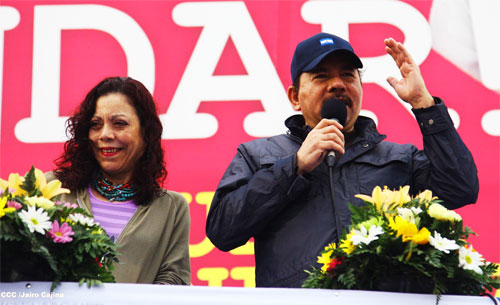
All the world knows Daniel Ortega, Nicaragua’s president (1979 to 1990 and 2005 – present) and a leader in the socialist Sandinista National Liberation Front (Frente Sandinista de Liberación Nacional, FSLN). But few know the other half of what can be described as Nicaragua’s “real couple”, Rosario Murillo.
The Colombian newspaper, El Tiempo, recently described Murillo as “the mystical shadow of president Daniel Ortega”.
Murillo was born in Managua, Nicaragua on June 22, 1951, is a poet and revolutionary who fought in the Sandinista revolution in 1979. She married Daniel Ortega and had 8 children. According to Nicaraguan historian Roberto Sánchez, Murillo is maternally related to Nicaragua’s national hero, Augusto Sandino.
According to the Wikepedia bio, Murillo attended high school at the Greenway Convent Collegiate School in Tiverton in Great Britain and studied Art at the Institut Anglo-Suisse Le Manoir at La Neuveville in Switzerland. Murillo possesses certificates in the English and French language, granted respectively by the University of Cambridge in Great Britain, and University of Neuchâtel in Switzerland. She also attended the National Autonomous University of Nicaragua in her hometown, where she later became a language professor at the Instituto de Ciencias Comerciales and the Colegio Teresiano during 1967-1969.
Murillo joined the Sandinista National Liberation Front in 1969. She provided shelter in her house, which was located in the Barrio San José Oriental in Managua, to Sandinista guerrillas, among them Tomás Borge, one of the founders of the FSLN.
During the early 1970s Murillo worked for La Prensa as an assistant to two of Nicaragua’s leading political and literary figures, Pedro Joaquin Chamorro and Pablo Antonio Cuadra. Murillo was arrested in Estelí for her activities in politics. Soon after, she fled and lived a couple months in Panama and later in Venezuela. She later fetched up in Costa Rica where she dedicated herself completely to her political work with the FSLN. It wasn’t until 1978 that she met her husband, with whom she returned to Nicaragua in 1979. From 1988 – 1990 she served as the Director of the Institute of Culture.
Today, Murillo is by Ortega’s side every step of the way. It is almost impossible to obtain a recent image of Nicaragua’s president without Murillo. This, because besides being Ortega’s wife, she is also the head of the Cabinet and official spokesperson for the government of Nicaragua.
In Nicaragua, it is said that the day-to-day decisions of the government are made by Murillo: it is she who decides what ministers should say, when they say something, given her order not to give statements to the independent press. It is also Murillo who appoints and dismisses government officials.
It is Murillo who leads the nation in place of President Ortega, as happened initially after Nicaragua learning of the International Court of Justice (ICJ) ruling with Colombia, according to El Tiempo.
Ortega’s wife is who receives presidents and official guests to Nicaragua instead of Foreign Minister Samuel Santos and possiblymost important, controls the feared and controversial Consejos del Poder Ciudadano (CPC) – Citizen Power Councils – the political wing of the FSLN that is present in barrios and communities around the country, which are said to be the eyes and ears of the government.
Murillo demands she be called ‘compañera Rosario’.
“La compañera” can be described as “super minister”, a character ubiquitous in the Ortega, who is always present: is personal assistant, translator and spokesperson.
Those who have known her define her as educated and a lover of poetry, but also as mystical, spiteful and vindictive.
Murillo has made mysticism an element of the Nicaraguan government. She herself decorates the official floorboards with flowers and religious and mystical symbols, as the “Mano de Fátima”, to ensure good luck in all official acts.
“Murillo lives and professes the world of spirituality and the supernatural. Her trademark are very thin tights on tabby legs, 30 rings on her hands, a dozen necklaces, a dozen bracelets, and round glasses, in a John Lennon style, far from the traditional figure of first ladies,” wrote journalist Octavio Enriquez in a profile of Rosario.
Sources who for obvious reasons prefer anonymity say that her alleged ambitions of power can unleash strong divisions between the circles close to Ortega, who apparently do not trust the first lady and dear she wants to success her husband.
Feminists criticize Murillo for her staunch defence Ortega when her daughter, Zoilamérica Narváez, accused him of sexual abuse as a child.
With files From El Tiempo, Wikipedia, La Prensa and 19 Digital
The social media, in particular Facebook, has been abuzz with the reaction of Costa Ricans to Nicargua’s president claim to Guanacaste.
¡Diay! Map of Central America circa 16th century clearly showing that Nicaragua’s coastline belongs to Costa Rica!
…waiting for Daniel Ortega
…weather forecast, sunny mornings, with possible rain in the afternoon and problems with Nicaragua in the evening…
If Daniel Ortega claims Guanacaste, it claims the Parque de la Merced! (The Merced park in San José is dubbed “Nica” park, as it is a place of encounter for many Nicaraguans living and working in Costa Rica.
Ortega (top): “I am going to claim Guanacaste!”
Chinchilla (bottom): “Best I give it to you on concession.”
“It would be extremely serious to interpret this as a game or joke”, said Presidenta Laura Chinchilla, at a press conference when addressing the comments made by Nicaraguan president Daniel Ortega.
“With Costa Rica you do not play with”, said Chinchilla.
The presidenta was adamant that the statements made by her Nicaraguan counterpart are “absurd and disrepectful” and that “Nicaragua has not right to Guanacaste”.
On Tuesday, in Managua, during the anniversary of the Nicaraguan Navy, Ortega said his government will make a claim for Guancaste before the International Court of Justice in The Hague. “We are not talking about a 2.8km strip of land, but thousands of square kilometres”, Ortega told his audience.
“We Costa Ricans are a peaceful people, but ready to respond to such insolence by the forces of our convictions of historical truth and international law…enough of the insults, of infamy and bravado”, said Presienta Chinchilla.
In a sense, Sara Ortiz Esquivel is a typical mother and grandmother in Costa Rica. She is sweet and kind to her six children, who have given her 15 grandchildren. She has experienced some hard moments in her life, but yesterday was particularly challenging.
Over the last 22 years, Mrs. Ortiz has dedicated her life to protecting life and property in Costa Rica. She is a member of Fuerza Publica, Costa Rica’s national police force. She was on the beat yesterday when she responded to a citizen’s report of a truck being suspiciously pursued by a sports utility vehicle. Officer Ortiz arrived on scene and was met by insults and a hail of gunfire.
The shooter was a man in his mid-20s, who was accompanied by his brother and a semiautomatic pistol with two magazines (weapon pictured in this article). Despite the shots, Officer Ortiz rushed to the assistance of the truck driver and called for backup. In the meantime, she was able to detain the suspects as they reloaded.
According to an official press release by Fuerza Publica, up to eleven shots were counted –many were stuck in the walls of the homes in the community where the events unfolded, Calle Fallas in Desamparados, which is near the southern suburbs of Costa Rica’s capital city.
Interviewed by Fuerza Publica’s public affairs personnel, Officer Ortiz was still under the spell of adrenaline when she explained:
“I thank God for the opportunity to celebrate Mother’s Day tomorrow! I salute all police women and moms and I hope they keep proving that we can make Costa Rica a better place!”
Officer Ortiz is also the coordinator of Pinta Seguro, a Fuerza Publica outreach program that focuses on getting children interested in drawing and painting. The suspects were taken to the in flagrante delicto prosecutorial division, which means they will be subject to speedy trial proceedings.
It was four years ago on August 11 when Chicago grad student David Gimelfarb disappeared in the Rincón de la Vieja national park.
David’s parents, Roma y Luda Gilmerfarb, have once again making their annual return to Costa Rica, to ensure that thier son is not to be forgotten. On this trip they bring with them the idea of creating a foundation to prevent tourists from disappearing in Costa Rica.
Among their proposals is to make available to tourists visiting national parks, a bracelet that can be tracked via satellite in the event they get lost.
The Rincón de la Vieja National Park is a vast wonderland filled with ancient trees, postcard-perfect waterfalls, and bubbling geothermal mud pits that can reach a skin-scorching temperatures.
Visitors flock here for the opportunity to hike near an active volcano, which is often obscured by cloud cover, lending the park a mysterious aura. Listed as a “not to miss” site in The Rough Guide to Costa Rica, Rincón is exactly the kind of lush, tropical destination that has helped establish Costa Rica as the ecotourism capital of the world.
But despite the park’s wide appeal, locals will tell you that it is unquestionably wild. Pumas, jaguars, and at least four varieties of poisonous snakes lurk deep in the jungle. Some of the labyrinthine trails aren’t particularly well marked, and drug traffickers have been known to use them to smuggle narcotics into Nicaragua, just 25 miles to the north. And a section of the park was quietly closed for several days in 2009 and again in 2012 after hikers were robbed at machete point.
On August 11, 2009, David Gimelfarb was among some 300 people in the park. It was the day the 28-year-old graduate student from Chicago walked into the visitors’ information hut just before 10 a.m. and scribbled his name—David Gimelfarb—into the guest book. He told the ranger in Spanish that he intended to take an easy three-kilometre loop called Las Pailas (the Cauldrons), after the steaming pots that pepper the path. Then the young man walked out of the hut, up and over a rickety footbridge spanning the cool waters of the Colorado River, and vanished.
David’s father and mother have made at least a dozen trips to Costa Rica in the past four years. They have been frustrated by what they say is the lack of help by the U.S. government.
“We send soldiers around the world to fight for somebody. And here, we don’t do anything for people we know where they might be’, the couple told recently CBS Chicago, so they’re starting the David Gimelfarb International Rescue Resources Foundation to help other families find their loved ones who have gone abroad–and gone missing.
“David is our son. To us, he’s the best person in the world” , say David’s parents, reconfirming their commitment to pay a reward of US$100.000 for help in finding out what happened to their child.
If you have any information on the whereabouts of David Gimelfarb, you can contact the OIJ confidential number at 8000 645 OIJ.
Costa Rica’s team are seen underwater as they perform in the synchronized swimming team free preliminaries during the World Swimming Championships at the Sant Jordi arena in Barcelona last month.
From its origins as a breakaway faction of the battered La Familia Michoacana, the quirky Knights Templar of the Pacific coast state of Michoacan have emerged as the third most prominent of Mexico’s criminal syndicates.
At least, that’s according to press reports supposedly based on intelligence documents of the federal police.
The report ranks the Knights behind the Sinaloa Cartel, nominally led by Joaquin “El Chapo” Guzman, and the Zetas gang whose leader Miguel Angel Treviño, alias “Z40,” was arrested by Mexican marines on July 15.
Knights Templar in Costa Rica: According to the Costa Rica’s Judicial authorities, Knights Templar, bring in the drug from Colombia to Costa Rica and then send it to Mexico. The organization, which controls the drug trade on the Pacific coast of Mexico is known for its violence and engage in criminal activities such as kidnapping, extortion and theft.
The Knights now operate in 10 of Mexico’s 32 states, according to the report, compared with only four several years ago. In comparison, the Zetas’ are active in 21 states, and the Sinaloa Cartel in 19. Lagging much further behind is the Gulf Cartel, with presence in five states, and the Arellano Felix Organization — also known as the Tijuana Cartel –, which is now basically confined to Baja California and a small part of Sonora.
The Knights Templar, or Caballeros Templarios, gang was formed by lieutenants of La Familia founder and spiritual guide Nazario “Craziest One” Moreno following his reported killing at the hands of federal police in December 2010.
Guided by a code of ethics that punishes gang deserters with death, the Knights have largely pushed other La Familia factions out of Michoacan and expanded into neighboring Guanajuato and Mexico states, including the teeming working class suburbs of Mexico City.
The federal police report also has the gang operating in the states of Jalisco, Colima, Nayarit, Guerrero and Guanajuato — all close to Michoacan — as well as Baja California in the far northwest, Tamaulipas in the northeast and southernmost Chiapas.
Of course, size matters when it comes to criminal organizations but these measurements are subjective at best.
Tallying a gang’s zones of operation seems a less accurate yardstick than the number of gunmen it can mobilize or the actual control it wields in communities where it is present.
A security analyst in Michoacan, who has tracked the fortunes of the local gangs for years, told InSight Crime that the Knights have about 600 armed members, with thousands more civilian supporters sprinkled across most of the state. A growing number of communities in the state’s Tierra Caliente, or Hot Land, have formed militias to drive the gang out.
Knights Templar cells have also battled with those of the Zetas, La Familia and other gangs in the adjoining areas of Guanajuato, Guerrero and Mexico state, notably in the Mexican capital’s suburbs. But the gang’s level of penetration elsewhere is uncertain.
As one of the principal producers of Mexican methamphetamine exported to the United States, the Knights need to operate in border states like Baja California and Tamaulipas. And they might be in Chiapas to handle the trafficking of precursor chemicals brought in from Asia through Central America.
In comparison, the tentacles of both the Sinaloa Cartel and the Zetas’ have burrowed deep into many communities across Mexico. El Chapo Guzman’s minions have a truly international reach, while the Zetas dominate along much of the Gulf Coast, in western Zacatecas and into Central America.
San Jose, June 28. – Police in Costa Rica captured two suspected Mexican cartel members Knights Templar and seven Costa Ricans who were his accomplices in the country. The murder of a Guatemalan and Costa Rican model last November by a reckoning was the event that triggered the investigation against Mexicans and his group in the Central American country.
Still, the Knight’s creed, loosely based on that of the medieval Christian crusaders they are named after, has transformed them from mobsters into a social movement, at least in their own eyes.
“We do a lot of illegal things but there are things you can do and things you can’t do,” said former school teacher and Knights leader Servando “La Tuta” Gomez in a wide ranging interview posted on YouTube over the weekend (see below). “We can’t bother the public or the working people. We believe, and we have the concept clear, that we are servants. We want there to be work, education and health.”
In comparison with the other large gangs, whose factions frequently fragment into bloody feuding, the Knights so far seem to be holding together. That’s likely due in part to the death penalties for disloyalty and disobedience spelled out in the gang’s 50-point Code of Ethics.
The code opens with the warning that any who join the Knights do so for life, no exceptions.
Regardless of their true national reach this summer the Knights have become one of President Enrique Peña Nieto’s biggest headaches as he struggles to reign in Mexico’s security crisis.
However, the Knights now face serious challenges, and not just from the authorities. In the latest YouTube video La Tuta accuses the federal police of collaborating with the militias that have formed in a number of Michoacan communities to confront his gang. Warning of violence to come, the Knights boss says the militias are linked to the Zetas and the Jalisco Cartel – New Generation, the Knights’ principal enemies.
“The fundamental problem here is that which is happening with the comunitarios,” La Tuta said, referring to the militias. “I assure you that the majority, 80 percent, of the comunitarios are criminals. This is a criminal group against criminals.”
The Knights so far have proved resilient in the face of the government’s campaign against them and have showed themselves willing to take the fight to the vigilante militias. But with Peña Nieto’s public security reputation now pegged to destroying them, and the Michoacan self-defense groups continuing to grow, in the coming months the Knights may well be whittled to a sliver of what they are now.
Officials of Grupo Roble, the owners of Multiplaza Escazú, announced today that outdoor parking it will cost ¢500 colones per hour, with the first 60 minutes free, starting September 1.
Manger of Parking for Grupo Roble, Mario Gonzalez, said the charge for parking is to discourage visitors that are not customers of the commercial centre and allow a more secure environment for patrons.
The mall has 2.600 parkig spaces that will be overseen by 1.000 cameras that have been already installed, with the ability for plate recognition.
Gonzalez added that the mall will provide two hours of free parking after 8pm and for patrons of the cinemas they will have three hours of free parking.
Payments for parking can be made at any of the 24 points in the mall and at ATMs. The malls payment collector machines accept notes and coins, as well as credit and debit cards. There will also be staff in attendance to help customers make the payment.
Dia de la Madre or Mother’s day in Costa Rica is the holiday of all holidays, a major national holiday when mothers are showered with gifts and flowers, many are taken out to their favourite restaurant for a special meal, reinforcing the cornerstone of Costa Rica society that revolves around tradition and family ties.
In Costa Rica, Mother’s Day is a big deal, as government offices, banks, schools and most businesses close for the day, for about the only commercial activity is retail stores and malls open to cash in on the gift buying and restaurants.
Those required to work on this day receive double pay. Mother’s Day is also one of the few holidays where workers are not obligated to work, that is, if asked they can say no and without any recourse. Workers can also refuse to have another day off in lieu of working on Mother’s Day.
To celebrate Dia de la Madre, the Instituto Costarricense de Turismo (ICT) – Costa Rica Tourism Board – is promoting national travel, with deals and discounts all over the country. According ICT assistant marketing director, Ireth Rodriguez, the idea is to give Costa Rican families the opportunity to travel and sightsee on this special day.
Hotels and tour operators are also offering discounts ranging from 10% to 50% off normal rates.
The national lottery is also holding a special Dia de la Madre draw with a first prize of more than ¢250 million colones, that will take place on Sunday, August 18.
The Teatro Nacional (National Theatre) in San José is holding a special program for Mother’s Day, with a special noon presentation that includes dance and music.
All in all, Costa Ricans take this day very seriously.
Wish your Tica friends and neighbours a “feliz dia de la madre!”
A United States Navy guided missile frigate involved in drug interdiction patrols off the Pacific Coast of Costa Rica is undergoing some operational difficulties. The USS Rentz (FFG-46) recently got underway from her home port at the San Diego Naval Base on a seven-month cruise in support of the multinational Operation Martillo, which is part of the protracted, U.S.-led War on Drugs.
This past weekend, the USS Rentz was patrolling off the South Pacific coast of Costa Rica when she intercepted a fishing vessel near the Galapagos archipelago. The FV Capitan Erson, which bears Costa Rica registration PP-271, is a repeat offender with regard to drug smuggling. A U.S. Coast Guard boarding party assigned to the USS Rentz found nearly a ton of cocaine aboard the Erson.
According to an official press release from the Ministry of Public Safety (MSP in Spanish), 963 kilograms of cocaine hydrochloride powder were concealed in a fish hold below deck. The crew of the FV Capitan Erson was taken into custody by U.S. forces. Three of the four fishermen arrested are citizens of Costa Rica; one is from Nicaragua. All suspects are residents of Puntarenas.
A Couple of Snafus
A separate MSP press release indicates that the USS Rentz communicated her intention of delivering the suspects to law enforcement authorities and prosecutors in Costa Rica and then proceeded to take the fishing vessel in tow. Apparently, the towing operation was unsuccessful and the FV Capitan Erson sunk. The MSP press release did not specify whether the 963 kilos of flake were still aboard the fishing boat as she submerged.
Aside from losing the FV Capitan Erson, the USS Rentz ran into another snafu. She lacks legislative permit to dock in Costa Rica, and the four suspects are still aboard. As previously explained by the Costa Rica, foreign military vessels are required to be issued a legislative permit allowing them to dock or to disembark their crews. Earlier this year, the US Coast Guard Cutter Sherman planned to dock in Costa Rica, but her permit had expired and she was snubbed. A few weeks later, legislators at the National Assembly extended a few permits, but only for USCG vessels.
According to legislators who recently issued the permits, they don’t recall seeing a request for the USS Rentz. They do remember, however, her previous participation in the Joint Patrol Agreement -she even docked in Puntarenas back in 2011. The MSP assures that the permit for the USS Rentz was formally requested on June 10th, but legislators in Costa Rica are positive that the frigate was not part of the docket of requests.
The MSP is now rushing to get a permit for the USS Rentz. In the meantime, the four suspects are still aboard. Should the MSP be unsuccessful in obtaining the permit in a timely manner, the suspects might end up being prosecuted by the U.S.
Legislative permits for foreign military forces to enter Costa Rica have recently been hot-button political issues. A few weeks ago, the Constitutional Chamber found that the U.S. Blackhawk helicopters that formed part of the massive security operation prior to President Barack Obama’s historic visit were here illegally. When a C-17 Globemaster from the U.S. Air Force recently landed in Costa Rica to transport nearly 40 tons of cocaine to be destroyed in Miami, it also lacked legislative permit.
In response to Nicaragua’s president, Daniel Ortega, that his country will be claiming the province of Guanacaste, Presidenta, Laura Chinchilla, has summoned her Foreign Minister, Enrique Castillo, who is at the moment out of the country, to a meeting later today to assess the situation.
Carlo Roverssi, the minister of Communications, added that Chinchilla ordered a protest letter be sent to Managua and called in for a consultation Nicaragua’s Ambassador to Costa Rica, Javier Sancho.
“It is contempt and difficult to understand given that Costa Rica has done nothing to caus this type of reaction (by Nicaragua. Our obligation as a government is to pay attention, give it the importance it deserves and an important part of our country is threatened”, said Presidenta Chinchilla, who is tour of Sarapiqui and Pococí.
The Ministro de Seguridad Pública (Security Minister), Mario Zamora, in a live television interview today said Costa Rica is bogged down in “tramitologia” – Spanish for bureaucracy, that is hindering the country’s fight against drug trafficking.
The minister’s comments are founded on the fact that, at this very moment, two Costa Ricans caught with nearly a ton of cocaine near the Galapagos Islands by a U.S. patrol boat cannot be brought to Costa Rica to face justice, this because the country’s lawmakers have not yet voted on authorization for U.S. warships to dock in Costa Rica.
Among the minister’s main complaints is that every six months the Ministerio de Seguridad Pública (MSP) has to submit to the Legislative Assembly a list of ships that are conducting patrols, and to be given berthing authorization.
Zamora says that, despite the agreement to joint patrols between the United States and Costa Rica, delays constantly occur because legislators do not provide timely authorization. A proposal has been made to legislators approving the list on a yearly basis, instead of every six months, but that has gone unanswered, according to Zamora.
“If during the time (in between authorizations) new ships are added to the patrols they are not permitted in Costa Rican waters. We have fallen into the mistake of giving a police technical issue in the hands of politicians and their ideological level”, said Zamora.
Zamora stressed that Costa Rica does not have the operational capacity as the United States and as such is lagging behind in the anti-drug fight, giving drug traffickers the upper hand.
Costa Rican authorities say that the Americans have begun to question whether Costa Rica is serious about the fight against drug trafficking and the purpose of the treaty, for rather than facilitate the paperwork, they complicate things.
The security minister was adamant that the Costa Ricans now in the hand of the Unisted States Coast Guard have the right to be tried in their own country and not, because of the beaurocracy, be sent to a foreign country.
The “pulmón urbano” (urban lung) by the Universidad Nacional captures some of the air pollution in San José in the Antigua Aduana.
The pollution in Costa Rica’s capital city, San José, is a threat to Costa Ricans health, a study by the Laboratorio de Análisis de Calidad de la Universidad Nacional (UNA) – National University´s Quality Analysis Laboratory.
Harmful particles in the air here were recorded at 37 micrograms per cubic metre (ug/m3), according to the research. The figure is almost double the maximum contaminant levels established by the World Health Organization (WHO).
In San José, people are breathing harmful elements such as sulfates, chlorides, nitrates, nickel, copper, vanadium and aluminum.
Also large amounts of manganese which is responsible for the reduction in lung capacity, said Rosario Alfaro, an expert from the university.
This kind of pollution affects human airways, the digestive system and the eyes, as well as the skin with consequent acceleration of aging, she said.
It is urgently necessary to eliminate lead from fuels, mainly because emissions generated by cars, often for lack of maintenance, Alfaro said.
In this regard, Costa Rica’s Minister of Environment and Energy, René Castro, highlighted the progress in the elimination of lead and mercury in fuels.
However, he acknowledged that the challenge for the country is to lower emission levels in San José – Heredia and San José – Cartago routes.
Wireless data and communications providers in Costa Rica spent almost two years in a relative state of post-monopoly peace. That changed a few days ago, however, with an announcement by former communications monopoly ICE with regard to its prepaid wireless rates.
The cost of using ICE’s extremely popular Short Message Service (SMS) went up by almost 100 percent, which means it now costs three colones (not even a U.S. penny) to send a text message to another cell phone in Costa Rica.
Many smartphone users in Costa Rica initially shrugged off the rate increase; they thought they could always use mobile apps such as WhatsApp, Skype or online social networks to communicate via wireless broadband without having to send text messages or even use airtime minutes. Doing this, however, will probably consume their prepaid amounts even faster since they found out that, from now on, they will be charged for every kilobyte used.
Spanish mobile carrier Movistar was quick to follow in ICE’s footsteps insofar as text messaging, but it drew the line at raising its wireless Internet fees. Claro had already beat both ICE and Movistar in this regard, as it had tacitly raised its prepaid rates weeks before. As it stands, Movistar’s wireless Internet data rates for prepaid customers are looking better than ICE, and very similar to Claro. There is no doubt that the three major wireless players in Costa Rica are waiting on each other to make the next move.
A Confusing, Yet Regulated, War
There is a referee setting the rules of engagement for this mobile communications combat. The Superintendency of Telecommunications (SUTEL in Spanish) is the government entity in charge of setting limits. For example, the three colones rate for each text message sent by wireless prepaid customer is the maximum allowed by SUTEL, and Claro was the first to take advantage of it. ICE eventually caved in with its big announcement, quickly followed by Movistar.
Although the SUTEL sets the pace for the combatants to engage in business battles, there is one more regulatory entity that can trump the wireless carriers and even the SUTEL: The Regulatory Authority of Public Services (ARESEP in Spanish). This agency is not in step with the SUTEL and has already warned ICE about raising its fees again. The ARESEP sees wireless services as either telecommunication or information services, and it vows to keep communication fees down while allowing mobile service providers to charge as they please with regard to information services. SUTEL, on the other hand, wants to make SMS a communications-only service, which will allow them to prevent further increases.
ICE has thus far shown greater interest in being aggressive with regard to pricing. Claro tends to test the waters and stay just under the limits promulgated by the SUTEL. Movistar follows ICE’s cue. The casualties of this war are the consumers since the wireless landscape is becoming confusing. ICE would like to convert many prepaid customers into monthly subscribers, and they are trying to do so by pressuring them with their prized wireless Internet service. Claro and Movistar are not quite ready to handle many subscribers, and for the time being they may realize greater profits with prepaid accounts.
The Wireless Internet Elephant in the Room
ARESEP has the power to undo rate increases and can even influence the market with certain measures. For the time being, however, regulators are waiting to see how the three wireless service providers handle upgrades such as mobile telephone number portability and 4G technology. The most significant aspect to watch will be how SUTEL and ARESEP react to the double-digit growth of mobile Internet use in Costa Rica. According to a July article in business weekly El Financiero, Movistar estimates that 83 percent of all its customers are Internet users, and 50 percent access online services via smartphones.
Many of these wireless Internet customers, however, use their mobile devices as modems. They take advantage of unlimited wireless data plans to download films, play video games, stream audio, and make video conferencing calls. For these users the status quo is ideal: They can take up as much bandwidth as they want for one low, prepaid rate.
The problem with this situation is that these data-hungry users are saturating the network and moving providers to raise their fees and meter their networks. Again, the wireless carriers would like to convert these prepaid Internet junkies to subscriber models where they will pay a little more to download all they want; but, the regulators are concerned that ICE, Claro and Movistar may just want to entice prepaid customers to subscribe now just so they can downgrade their services and increase their fees in the future.
Traffic through the toll station on the autopista General Cañas, east of the airport, is now worse than ever with the closure of one of the toll booths, after it was rammed by a trucks three weeks ago.
Traffic backlog at this point on the country’s busiest road has been legendary, as thousands of vehicles each hour stop to pay the ¢75 colones toll (¢100 for the voluntary).
Now, with only three toll booths, traffic backs up even more than ever, despite the policy of opening the toll stations (free pass) if traffic backs up more than 300 metres or three blocks, in the Costa Rican way of measuring distance.
The worst backlogs are during morning and afternoon rush hours. If you need to travel through the toll stations during rush hours, best be armed with lots and lots of patience.