Of the 66,000 high school students who recently underwent the first language proficiency test, only 4% could be hired by a multinational for their level of English.
That small percentage is the B2 level, according to the Common European Framework of Reference for Languages (CEFR), based on the research by the University of Costa Rica (UCR).
This level is considered as an intermediate level and is suitable for a manufacturing or customer service position at a multinational.
According to the results, 70% of the graduates have an A2 basic level that does not make them attractive for this type of contracting; 1% of the graduates had an A1; 25% a B1; and only 0.8% a C1 level.
The exchange rate is expected to maintain the behaviors of the season
During the last week, there have been important movements in the exchange operations of the Non-Banking Public Sector (SPNB), which has raised the concerns of Costa Ricans about the possible effects that this could have on the exchange rate.
The exchange rate is expected to maintain the behaviors of the season
Experts agree that the purchases made by the Central Bank (Banco Central de Costa Rica) on November 28 and 29 for US$137 million and on December 2 for US$375 million, do not have a direct impact on the exchange rate, as they are not traded in the Foreign Currency Market (Monex).
But who are the SPNB companies and why were they taken out of the Monex?
The decision was made by the Central Bank in mid-2014 in order to make purchases and sales of foreign exchange by various entities – such as the Refinadora Costarricense de Petróleo (Recope), Compañía Nacional de Fuerza y Luz (CNFL), and the Instituto Costarricense de Electricidad (ICE) among others, will be carried out directly through the Central Bank to avoid affecting the exchange rate.
“As purchases are made outside of Monex, it is expected that there will be no distortion in the market and that there is no such strong rebound effect in the exchange rate,” economist Daniel Suchar told La Republca.
At the moment, given there is already a high amount of dollars in the market associated with the payment of taxes, and aguinaldos (bonuses), the sales by the SPNB obeys to liquidating operations but not expected to continue in December, according to experts.
“In general, the oversupply of dollars seen in recent weeks should come to an end at some point; however, this will not happen until the currency settlement needs, characteristic of the season ends,” said Melvin Garita, general manager of BN Stock Exchange.
Monday’s purchase by the Central Bank corresponds to the largest recorded in the last five years, that is, since the SPNB was out of the Monex.
The dollar exchange rate saw a rebound of ¢4.36 this morning, going from ó567.65 yesterday to ¢572.01 for sell and ¢3.31 for the buy, going from ¢560.22 to ¢563.53 for the buy.
Betting on extending the cruise season annually and investing in infrastructure should be the next steps of the tourist cruise industry in Costa Rica, several experts agree.
Costa Rica has the potential to expand its cruise industry, even to receive ships year-round, but lacks the infrastructure.
This would allow the country to improve its tourism revenues and not be left behind by its competitors in the Caribbean, or its Central American neighbors, who have been investing significantly in attracting tourists by sea.
Costa Rica has the advantage of being currently the best destination for isthmus cruises, according to Porthole Cruise Magazine and The Florida-Caribbean Cruise Association.
According to date from the Instituto Costarricense de Turismo (ICT) – Costa Rican Tourism Board – the cruise tourist has high purchasing power, so is wanted by several destinations in the Central American and Caribbean region.
This is the profile of the cruise ship that visits Costa Rica, according to ICT: American, with an average age of 55, spends between US$37 and US$70 per day, and contributes US$8.4 million to the national economy.
Source: ICT / La República
“The strategic location, being outside the area of influence of hurricanes and good international tourist image are the advantages of the country as a destination,” explained Rubén Acón, president of the Cámara de Comercio, Industria y Turismo de Limón (Limon Chamber of Commerce, Industry and Tourism).
However, neighboring countries competing are investing aggressively.
An example, Panama has approved the investment of US$18 million between 2021 and 2023 for the Norwegian Cruise Line company to use its ports as a point of embarkation and disembarkation.
More than 140 cruise ships arrive per season, according to figures from the Panama Tourism Authority.
Tourist arrivals
Last cruise season (2017-2018) 326,000 tourists arrived in Costa Rica by way of cruise ship, contributing US$8.4 million in the local economy of US$37 dollars per cruise ship passenger.
Source: ICT / La República
Meanwhile, Royal Caribbean Cruises, the largest in the world, will invest US$27.2 million in the paradisiacal island of Roatan, Honduras, which annually receives 1 million visitors by sea.
The competitive advantage of these destinations is that they receive cruises all year round; while Costa Rica welcomes cruise ship visitors only from September to May.
In the Pacific, an investment of US$4.5 million is projected for several tourism projects. The most expensive is the US$2 million Parque El Muellero, in Puntarenas, which will connect the cruise ship dock with the Parque Marino del Pacífico (Pacific Marine Park), and includes benches, green areas, and a skating rink, among other elements.
To these investments is added the inclusion of a strategy related to the cruise industry within the Investment Attraction Department of the Costa Rican Tourism Institute (ICT).
For the 2019-2020 season, the arrival of 289 cruise ships is projected. Of the total, 173 cruise ships will be in the Pacific ports and 116 in the Caribbean.
During the last cruise season (September 2018 and April 2019), 326,000 cruise passengers entered Costa Rica, according to data from the immigration service and port authorities.
Rubén Acón, President of the Cámara de Comercio, Industria y Turismo de Limón, told La Republica, “We must improve the conditions offered to tourists once they get off the cruise; Offer optimal security and clean conditions, entertainment venues, restaurants, Wi-Fi Internet and duty-free shops. I am sure that at least Limón has the potential to receive cruise ships and tourists all year round, as do Honduras and Panama.”
Gustavo Alvarado, Tourism Management Director at the ICT, “The routes and itineraries of the cruises are outlined taking into account the tastes that the market demands, in the case of Costa Rica, we are positioned in the cruise ship’s taste for the international image that our country has as a sustainable and wide-ranging destination natural wealth The strategic location of the destination is another important factor that attracts cruise lines, according to planned routes.”
For Godfrey Tang, Commercial Director of Royal Caribbean Costa Rica, “If Costa Rica increases its capacity and promotion of the cruise industry, they could see revenues of up US$500,000 per ship. The renovation of the docks could be one of those advances in infrastructure to improve the industry. Another is the extension of Route 32, which would boost easier access to the capital and tempt cruise passengers to visit San José and stay longer.”
Experts agree that Costa Rica has the potential to expand its cruise industry, even to receive ships year-round, but lacks the infrastructure.
Due to delays caused by “situations beyond control”, the China Engineering Company (CHEC) and the Costa Rican authorities agreed to postpone by the delivery of the Ruta 32 expansion by 174 days.
Initially the CHEC, asked the Conavi, the national road council arm of the Ministry of Transport and Public Works (MOP) for an extension of 400 days to deliver the 107 kilometers road expansion, connecting the Rio Frio crossing with the center of Limon, however, the authorities only agreed to a delay of no later than March 2021.
CHEC argued that the expropriation process, which is beyond their control, for the delays in the construction and request for the extension.
However, Mario Rodriguez, director of Conavi, told Nacion.com that “… with the acceptance of the deadline, the company was required to present, at the latest next week, a plan detailing the actions to guarantee that within two months the first 20 kilometers of this road will be delivered.”
Rodriguez added that “… Even in the last meeting they promised that they would give priority to achieving that (the first kilometers); we are waiting for them to fulfill what they offered. In the next meeting, they must show us how they are going to achieve what they are promising us, we hope to see in that meeting that strategy to increase production in the area.”
The work that began two years ago, on November 20, 2017, that was to have been delivered by October 2020 barely reports a 15% progress.
The flagship store is located in Avenida Central, in downtown San Jose, in the old Lehmann bookstore
ETAfashion, dedicated to the sale of clothing, shoes, and accessories, opened its second store in Costa Rica, in the Avenida Central, in the heart of San Jose, in the old building Lehmann bookstore.
The flagship store is located in Avenida Central, in downtown San Jose, in the old Lehmann bookstore
Camila Camacho, head of Marketing at ETAfashion, told Elfinancierocr.com that with “… the opening of this flagship store, the company began its expansion plan in Costa Rica.”
“Since opening our first store in Quito, Ecuador, we decided to grow with our clients, which is why today we take an important step to approach the Costa Rican family through high quality fashion and for all stages of family members, ” said Camacho.
With the opening of this flagship store, the company, which has 22 stores in Ecuador and one in Lincoln Plaza, San José, begins its expansion plan in Costa Rica, which will be developed in stages, generating more employment options in the country.
(Bogota, Colombia) While we tend to think of the so-called sharing economy as a new concept — a product of the fourth industrial revolution — its origins are far older, as old as the economy itself.
What’s happening now, rather, is that due to the rise of e-trading and disruptive models that are ending certain logistical chains, the concept is developing and permeating popular speech.
For Latin America, there are both benefits and challenges involved with these economic shifts. But they also offer a real possibility to redevelop our battered economies. In Colombia’s case, like with most Latin American economies, dependence on the sale of primary goods has caused considerable instability. Dependence on a good, especially commodities or natural resources, destabilizes economic growth in the two other types of goods: secondary and tertiary.
With primary goods (raw materials or renewable and non-renewable resources), prices are usually free-floating and depend on international rates set in this case in U.S. dollars. The greater our dependence on these goods, the less chance we have of pursuing real economic development, of diversifying, in other words, into industrial production (secondary goods) and providing world-class services (tertiary goods).
Dependence on the sale of primary goods has caused considerable instability.
The dollar’s current price volatility makes diversification even more urgent — so as to avoid its negative effects on an already shaken economy. This is why Latin American economies should do all they can to seek alternatives. In our case, as I’ve written before, the state needs structural reform. That reform must envisage changes in education, justice, security, infrastructure, and cargo and passenger mobility inside the country.
Colombia also needs to root out corruption and do away with inefficient bureaucracy in both the private and public sectors. And on the financial side, we need to overhaul the system of taxation. If this overhaul were fully implemented, the country’s risk ratings would improve substantially, and that, in turn, would help make the country more competitive.
In Bogota, Colombia — Photo: Random Institute
What we need to drive this scale of economic transformation are more and better jobs. This could be done by promoting private and public initiatives that involve the sharing economy concept. Its essence is fairly simple and based on the integration of producers and consumers in a community. Both sides have a common objective, so creating a collaborative framework between them facilitates their connection and, ultimately, the exchange of products and services.
The task of institutions should be to pave the way for revolutionary ideas like these.
Creating collaborative eco-systems to aid the mechanization of farming, say, may help yield a high-tech, industrialized farming sector. This industrialization would allow us to move on from the production of primary goods, with benefits for both producers and consumers, locally and abroad.
Exploiting the fourth industrial revolution and using its enablers (digital elements, the internet of things) will be fundamental for creating collaborative eco-systems. The task of institutions should be to pave the way for revolutionary ideas like these.
That they’re still focused, for the most part, on traditional businesses rather than the collaborative model isn’t surprising. But that’s all the more reason why deep structural reforms are now a matter of urgency.
(Q COSTA RICA) Enisha Robertson, the 38-year-old American and her six-year-old son died in a crash in the early hours of Monday morning, on her way to the Liberia airport in Guanacaste. Enisha’s husband, Anthony, 54, was taken to hospital with injuries.
Allan Gerardo Pereira Leiva, 39, a Costa Rican and driver of the minivan the Robertson family was traveling in also died in the head-on crash in Curubandé de Liberia when the driver of a pick-up truck, who was confirmed by the Organismo de Investigacion Judicial (OIJ) to be impaired, crossed the median at high speed.
The driver of the pickup, who suffered only minor injuries, was identified by his last name Dávila, 20 years of age. He is currently in custody of the Ministerio Publico (Prosecutor’s Office).
Monday’s fatal accident marks the second in recent months involving r U.S. citizens. In October, three U.S. tourists and a Costa Rican died when the minibus in which they were traveling collided head-on with a truck being driven a Salvadoran. That crash occurred in La Paz, Guanacaste, on the Interamerican highway north of Liberia.
According to information from Dr. Enrique Baltodano Briceño Hospital in Liberia, Guanacaste, Anthony remained on Monday under observation and in stable condition, leaving the hospital early this Tuesday morning, accompanied by relatives.
The Ministerio de Hacienda (Ministry of Finance) proposes to charge the 13% Value Added Tax (VAT) on purchases of 191 cross-border online services and websites available consumers in Costa Rica.
The list includes famous streaming services such as Netflix, HBO and Amazon Prime; video games such as Epic Games (creator of Fortnite), Playstation and Nintendo; advertising services on social networks (Facebook Ads, Instagram Ads and Twitter Ads); online music like Spotify and iTunes; and even antivirus purchases and website hosting, among others.
Cross-border digital services are all purchases that a consumer makes within Costa Rica through online platforms that are based outside the country.
The list of services was published on Monday, December 2, by the Dirección General de Tributación (DGT) – Tax Department – in a draft resolution that establishes the mechanisms to collect the tax on cross-border digital services.
This is the third draft of this resolution published by the Treasury. However, this latest version is the first one that includes the list of 191 platforms to which the tax would apply.
The public has up to December 16 to receive comments on the proposed tax, after which the Tax Administration will evaluate the comments to determine if it is necessary to make important adjustments to the text.
In a nutshell, the tax would be applied to purchases made in Costa Rica using a debit or credit card issued in Costa Rica. Purchases made with a card issued outside the country, though the service is being consumed in Costa Rica, would not apply. For now.
According to the proposal, the service provided would be required to register for the collection of the value added tax, charge the consumer and remit to the tax department.
The DGT is also looking at a process where the card issuer if to withhold the VAT when a consumer makes a purchase of a cross-border service.
Banks and financial institutions issuing debit and credit cards would withhold on purchases based on the published list.
The DGT can modify, from time to time, the services on the list, based on consumer demand.
The process would include the ability of the consumer to obtain a refund if they experienced an improper charge, in which case would have to submit a form to Taxation for approval and can then make a request to the issuing bank for a refund of the charge.
Following is the list from the of cross-border services the Ministry of Finance proposes to tax.
NETFLIX
SPOTIFY
DEEZER
TIDAL MUSIC
ITUNES.COM
WWW.SKY.COM
PRIME VIDEO
G2A.COM
G2A
GAMEFORCE GAMES
ANKAMA GAMES
BLIZZARD ENTERTAINMENT
BLIZZARD ENT
OASIS GAMES
LEVEL UP INTERACTIVE
INSTANT GAMING
SKR*UNITED GAMES GMBH
PLAYSTATION NETWORK
XSOLLAS
RIOTGAM
RIOTGAMES
RIOT GAMES
STEAMGAMES.COM
VALVE
VALCE CORPORATION
FACEIT
XSOLLA
SEGA
SEGA II
GOOGLE*SEGA
GOOGLE*SEGA
AXESOS
GLAUD GAMES
CLOUD GAMES
WWW.STEAMPOWERED.COM
STEAMPOWERED.COM
EPICGAMES
SITEGROUND
INMOTIIONHOSTING.COM
GITHUB
VENDOSTORE
BEFLICK
MEGA CLOUD SERVICES
ONE DRIVE
MEDIAFIRECHARGECOM
SUGARSYNC
ICLOUD
PCLOUD
JIMDO
WORDPRESS
WEEBLY
YOLA INC
YOLA
YOLA.COM
FREEHOSTING
FREEHOSTING.COM
BLUEHOST
WIX.COM
WIX
MASSIVE MEDIA
FACEBK ADS
INSTAGRAM
TWITTER
TWITTER ONLINE ADS
TWITTER ADVERSTISING
TINDER
TINDER
GOOGLE TINDER
LINKEDIN
TUMBLR INC
SNAPCHAT
HAPPN
BADOO
BADOO
BADOO.COM
MEETIC.COM
FACEBOOK ADVERTISING
THE FINANCIAL TIMES
FINANCIAL TIME LT
FINANCIAL TIME LTD
NEW YORK TIMES
DROPBOX
GODADDY
THE SURFER’S JOURNAL
AIKIDO JOURNALS
COLUMBIA JOURNAL
COLUMBIA JOURNALISM
JOHNS HOPKINS UNIVERSITY PRESS
LIVEJOURNAL
WOOD WORKERS JOURNAL
UNIVERSITY OF CHICAGO PRESS JOURNALS
HIKARI LTD
HIKARI
JHUP JOURNALS
KLETT SPRACHEN
KYLA ITSINES
LEARNING SANOMA
MITBLADDK
MONOCLE MONOCLE
MONOCLE
MYSS.COM
OAKTREE SOFTWARE
PARADISE PUBLISHER
SAGE PUBLICATIONS UK
SAGE PUBLICATIONS
NYT*NYT TIME SYNDICATE
TIME NEWSPAPERS LTD
TRAINING SOLUTIONS
TRAINING SOLUTIONS LTD
WONDERBLE¡Y PERSONLIZED
WONDERBLY
NORTON
NORTON
AVAST SOFT
AVG STORE
AVG ECOMMERCE
AVAST NEXWAY
PANDA SECURITY
AVIRA ANTIVIR
WWW.AVIRA.COM
ESET LLC
BITDEFENDER
SKYPE.COM
SKYPE
SKYPE SUBSCRIPTION SKYPE
WWW.SKYPE.COM
WEBEX.COM
MICROSOFT
GOOGLE PLAY
GOOGLE STORAGE
YAHOO SMALL BUSINESS
HABITISSIMO
WWW.GETTYIMAGES.COM
GETTY IMAGES
MICROSOFT
MICROSOFT
MICROSOFT
DGNET LTD.
OPENENGLISH.COM
BLOMBERG
ENVATOMARKET
HASHFLARE
HBO DIG
HBOSTORE
KASPERSKY
LEIDEN TECHNOLOGY DO B
LEIDEN TECHNOLOGY DO B
RACKSPACE CLOUD
TEAMVIEWER.COM
TELEFONICA GLOBAL SERV
VIBER
VIBER
SECURITY SHIELD
QUICK HEAL
ZOOM.US
ANYMEETING
INTERMEDIA ANYMEETING
WISH.COM
COINBASE
SMILES FIDELIDADE SA
AMAZON VIDEO
AMAZON PRIME
AMAZON WEB SERVICES
AMAZON DIGITAL
MAILCHIMP *MONTHLY
ZOHO CORP
ZOHO CORPORATION
JRPASS.COM
JRPASS LTD
FXCLUB.ORG
AVANGATE
DIGITALRIVER
DIGITAL RIVER
ONEPLUS
ONEPLUS
AIRBNB
HOTELES.COM
BOOKING
B&H PHOTO
BEST BUY
WWW.ALIEXPRESS.COM
MOUSER ELECTRONICS INC
DKC*DIGI KEY CORP
OLX
APPLE
ATLASSIAN
WWW.ALIBABA.COM
NINTENDO
SONY
PLASTATION
SHOPIFY
For the draft published by the Ministerio de Hacienda, click here and scroll down to page 18.
The Festival de la Luz (Festival of Lights) this year will be “dry” (alcohol-free). The Municipality of San José announced Monday the prohibition for the December 14 event.
That restriction applies to the parade route and surrounding areas, said Jorge Villalobos, general coordinator of the festival, explaining that the festival is a family event, with a lot of children.
The prohibition applies from noon to midnight on December 14, from noon to midnight, on the parade route that starts at the Gimnasio Nacional in La Sabana, moves along Paseo Colon and Avenida Segunda, ending at the Plaza de la Democracia.
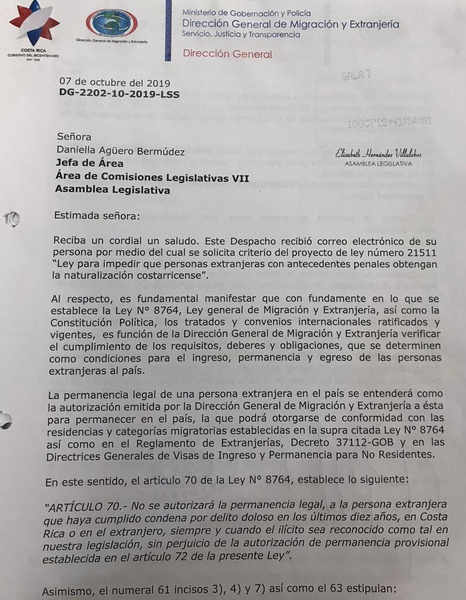
The Dirección General de Migración y Extranjería (DGME) – Costa Rica’s immigration service – supports the bill that seeks that foreigners convicted of crimes in the country do not obtain Costa Rican citizenship.
Immigration Director, Raquel Vargas, in a written statement, told the Legislative Committee on Security and Drug Trafficking, “For the Directorate General (…) foreigners should not have a criminal record, or have committed a criminal offense in Costa Rica or abroad, which is why a positive criterion is issued regarding the bill.”
Under current regulations, foreigners who have been convicted in Costa Rica for crimes such as homicide, trafficking of persons, child pornography or terrorism, can without problems obtain naturalization.
This has been criticized by national security specialists, such as the director of the Organismo de Investigacion Judicial (OIJ), Walter Espinoza, who pointed out that there are many foreigners in the country who have a criminal background, but there is a legal vacuum that forces authorities to issue them nationality.
“We are giving away cheaply Costa Rican nationality. Nationality is not to be given away or raffled. Costa Rica is the country with the softest legislation, the least demanding,” said Espinoza
German Rojas, of the Supreme Court of Elections (TSE), confirmed that under the current regulations nationality has been given to foreigners with convictions in the country for homicide, trafficking and rape of minors.
“It affects us in the future for extradition purposes. It’s a problem. It has been a refuge for big criminals,” Rojas argued.
Shameful example
An example is the infamous case of Arthur Budovsy, at the head of Liberty Reserve, arrested money laundering of more than US$6 billion dollars.
Budovsy became a naturalized Costa Rican after marrying a Tica (Costa Rican woman) who worked selling snacks in front of the immigration offices in La Uruca. Apparently he paid her ¢300,000 colones (US$535 dollars) for the marriage and thus obtained naturalization.
This is one of the cases that hit Costa Rican security authorities the most. Even for many, it is like a mockery of how fragile the system is.
José María Figueres, Ferrer, on December 1, 1948, when with a hammer blow at the Bellavista Barracks, now the National Museum, he abolished the Army.
Legislators on Monday, one day after the celebration of the 71st anniversary of the abolition of the army, passed the bill declaring December 1 “Día de la Abolición del Ejército”, a non-compulsory pay holiday.
This bill, receiving 47 (of 55) votes, promoted by Deputy Wagner Jiménez, of the National Liberation Party (PLN), consists of a reform to article 148 of the Labor Code to include December 1 as a holiday, commemorating the abolition of the army in 1948.
The reforms maintains the compulsory pay holidays of:
January 1 – New YearDay
April 11 – Juan Santamaria Day
Thursday and Holy Friday of Semana Santa (varies each year)
May 1 – Labor Day
July 25 – Anexión del Partido de Nicoya or Guanacaste Day
August 15 – Mother’s Day
September 15 – Independence Day
December 25 – Christmas Day
August 2 will continue to be a non-compulsory pay holiday, while the October 12 – Encuentro de Culturas, also a non-mandatory payment holiday, will only be in the central canton of Limón.
The bill was approved in first debate. To become law it requires passing in second debate and the signature of the president.
Last month, the Interior Minister of Cyprus, Constantinos Petrides, announced the revocation of 26 “citizenships-by-investment” that had been granted before stricter criteria of this program was introduced in 2018.
Though Petrides refused to name those who had lost their so-called “golden passports”, some of the names on the list, according to Kommersant, included Russian oligarchs Oleg Deripaska, Vladimir Stolyarenko, Alexander Bondarenko, along with their respective wives and children. These oligarchs are under criminal investigations in their homeland.
The news is a reminder that this particular relationship is not an exclusive privilege of Cyprus, and Russians are hardly the only ones seeking out golden passports.
Citizenship By Investment (CBI), also known as economic citizenship, is the legal process where a country allows individuals to essentially buy their citizenship, where the passport is given in exchange for a monetary contribution — usually referred to as an “investment” in the host country.
The program was introduced in 1984 by the Caribbean island nation of Saint Kitts and Nevis, which still offers the option. Today, there are currently eight countries in the world with CBI programs: in the EU there is Austria, Cyprus, and Malta, whilst in the Caribbean, there are Antigua and Barbuda, Dominica, Grenada, Saint Lucia and St. Kitts and Nevis.
The investment requirements (i.e., price) differ from country to country, often rising well above US$100,000, and are subject to constant changes and numerous regulations.
The Caribbean remains the most attractive and least expensive. While CBI is the preferred choice for a high net worth individual, granting them a second citizenship and a more powerful passport in a rather short time (months), it can be extremely expensive, certainly in Europe, with pricing starting at more than one million euros.
Many things can be hidden behind the stacks of money.
Every August, the Professional Wealth Management magazine by Financial Times publishes an annual ranking, the CBI Index report, analyzing key features of CBI countries like freedom of movement, the standard of living, minimum investment outlay, mandatory travel or residence, citizenship timeline, ease of processing, and due diligence.
Costa Rica’s Residency by Investment
Costa Rica often called “the Friendliest Country in the World” does not have a CBI, but it does but does offer a form of residency by investment.
The “Residency by Investment” or “Investor Visa” program, which is far more economical and of which almost every nation operates a version of.
In keeping with their nature, Costa Rica´s residency by investment program is a far more laid-back, relaxed process (Pura Vida) than many programs on the market.
Investment Requirement
Applicants for the Costa Rica Residency by Investment program are free to invest in any type of business or real estate purchase, so long as they invest a minimum of US$200,000 dollars into the project. An investment can even be broken down into a house and two cars or a house, a bar and a car for example. As long as all purchases are made within Costa Rica they are valid and go towards the required investment.
Residency Requirement
Foreign investors who become Costa Rican residents by virtue of the Residency by Investment program can maintain their residency permits by spending as little as one day per year in Costa Rica. Initially, investors will be classed as Temporary Residents, and after three years they can apply for Permanent Residency. After one year as a permanent resident, an investor is free to apply for Costa Rican citizenship and will be the proud owners of one of the most sought-after passports in Latin America.
The Costa Rican passport has a mobility score of 140 – visa-free access to 94 countries and visa-on-arrival to 46 countries – including all of South and Central America, Western Europe, plus areas of Africa and Asia and the Far East including Japan and South Korea.
It is important to note here that, in Costa Rica, nothing happens that fast. The Residency by Investment program is under the jurisdiction of the Dirección General de. Migración y Extranjería (DGME) – Costa Rica’s immigration service.
COP25 climate summit, which kicked off in Madrid on Monday
Leaders from over 200 countries pledged a “green revolution” as they gathered for the first day of the COP25 climate summit, which kicked off in Madrid on Monday.
Costa Rica president Carlos Alvarado (third from the left, sitting front row) took part in the COP25 climate summit which kicked off in Madrid on Monday
United Nations Secretary-General Antonio Guterres said he is “disappointed” with efforts to cut greenhouse gas emissions, speaking on the first day of the two-week summit.
“Do we really want to be remembered as the generation that buried its head in the sand?” said Guterres in his opening address. He urged country delegates not to take “the path of surrender” in dealing with climate change.
The main goal of the conference, which was relocated from Santiago to Madrid amid political turmoil in Chile, is to clarify the rules which will help reach the agreed goal of limiting global warming to below 2 degrees Celsius, as laid out in the Paris Agreement.
The markets-based concept of emissions trading will also take center stage as the conference goes on.
Who said what?
Many world leaders and representatives took to the stage on the first day of the major climate conference.
Spain’s interim Prime Minister Pedro Sanchez slammed climate change deniers, saying “only a handful of fanatics deny the evidence.” US House Speaker Nancy Pelosi told reporters later that she agreed with the sentiments, and that leaders should “stick with the science” when it comes to climate change.
In her speech, Pelosi denied suggestions that this may be the last time that the US sends representatives to the annual climate conference. US President Donald Trump formally removed the US from the Paris climate accord last month, but Pelosi said that the US remains committed to its goals.
“We’re here to say to all of you, on behalf of the House of Representatives and the Congress of the United States, we’re still in it, we’re still in it,” she told delegates during her speech.
Europe to lead the way
The new climate minister of Poland, one of Europe’s largest coal producers, said his goal is to redouble efforts to cut carbon gas emissions and develop new clean energy sources. Poland depends on fossil fuels for 80% of its energy.
Guterres criticized countries for their reliance on coal production in his remarks.
“Our strong recommendation is for countries to think seriously before building new coal power plants and for those that can do it to start phasing out the old ones,” he said.
He was, however, optimistic that Europe can lead the way for climate reform, days after the European Union declared a “climate emergency.”
“I’m convinced that Europe will be in a position to negotiate with China, with India, with the United States, with Russia in a way that will allow all to understand that this must be a collective effort and that they all will have to correct their policies in order to be able to drastically reduce the emissions,” he said.
New President of the European Commission Ursula von der Leyen also attended, on her second day in the role. The commission plans to unveil its new European Green Deal to tackle climate change later in December. The deal will constitute a billion euro investment in tackling climate change.
The conference will run for 12 days. Swedish teen climate activist Greta Thunberg is expected to arrive back in Europe on Tuesday after crossing the Atlantic for the second time in a catamaran. She may visit and address the conference, as she did at the UN general assembly in New York in September.
(Expat Focus – QCostarica) In this age of competing hate crimes, I’d like to reflect on the notion of tolerance. Even tepid aggravations seem to be too much for our watery sense of forbearance, like a neighbor’s barking dog, kids playing noisily in the park or a baby crying on an airplane.
Sure, no one likes any of it, but what are you going to do? Slip the baby an Ambien? Scream at a bunch of six-year-olds to stop that incessant playing already and get on their iPhones?
How about threatening to poison the dog, as a neighbor of mine did? (The dog indeed died two days later, but police refused to get involved because Scruffy had been seen on numerous occasions eating his own poop, thus rendering our case flimsy. To my mind, this only strengthened our case: if the dog would eat even his own shit, the neighbor could be certain he’d eat the poisoned meat.)
Take air travel. We’ve been hearing a lot about fracases on airplanes, from that doctor getting knocked out cold for refusing to change his seat, to the woman removed from a plane for complaining about the infant seated within her sonic field. I wonder if it’s just that social media alerts us to these episodes, rather than their being a new development. Were we previously such docile passengers? Were flight attendants more laid back than they are now? Yes, and no.
On a long-distance flight, for instance, an older Orthodox Jewish man absolutely refused to take his seat because it was between two women. He claimed it was against his religion to sit next to a female not of his immediate family—there was always the hairy possibility that their elbows might bump or that their knees might rub.
How would he get up to go to the restrooms without twerking one of the ladies? We were on the ground for almost an hour, unable to take off, because the guy was both unwilling to sit yet refused to exit the plane.
Imagine if that were today? He’d have been removed by an ambulance after the flight crew got through with him (or in a body bag if they had let us passengers have our way). Finally a younger Hasidic Jew took pity on him, and on all of us, and agreed to switch seats. The entire plane applauded him.
I still wonder if the old guy only put up a fuss because he just didn’t want to be trapped in a middle seat for 11 hours, and I also wonder if the young guy was so magnanimous in switching seats because here was his chance to finally rub ankles and elbows with women who were not his sisters.
On another trip, a very large woman sat next to me, spilling onto my seat so I was unable to even lower the armrest. I was shriveled into half a seat for 8 hours, but did I complain? No. I could see she was embarrassed enough and didn’t want to add to her grief, so I stifled mine.
Adding to my woes, my seat wouldn’t recline. Every time I eased it back, it shot forth, giving me whiplash. On the third try, the woman behind me started shrieking that I was crushing her knees, and had better stop!
That solved the mystery of the defective seat back, but not the one about how I would survive the flight without spontaneously combusting. But did she and I roll into the aisle, flailing fists? No. One of us had to be the bigger woman (no pun intended), so again it was I.
Yet where was that patience when I needed it? On a flight to Italy, Alitalia split me and my three Visigoths–aka children–into two and two, one row behind the other, despite my having booked attached seats all in one row. Within minutes, the man in front of my eldest turned around and berated him for kicking the back of his seat. I apologized and explained seat etiquette to my child.
A half hour later, the guy complained again. I apologized again and talked to my boy again. Soon I observed he wasn’t actually kicking the man’s chair; he was drawing a picture, and thus rattling the fold-down table attached to it. But how much shaking could we be talking about? He’s not Jackson Pollock.
Then the woman behind me tapped me on the shoulder. Hard.
“Yes?”
“You kid!”
“My kid? Which kid?” She pointed to the 4-year-old next to me. Him? I thought, bewildered. He hadn’t moved an inch, hadn’t whined a bit, had been the perfect little boy, merely chatting with me.
“He talk and talk! I no can sleep!” she brayed.
I stared at her.
“Are you kidding me, lady? What should I do, put a muzzle on him?” What was she griping about? I’m the one who had had to listen to his incessant prattle for hours. Didn’t she think I wanted to sleep too?
At that moment, my daughter chose to stand up and upend her dinner tray all over the floor, whereupon the woman in front began shrieking. Apparently the applesauce–or was it coconut custard?–had ejaculated onto her Manolo Blahniks. Who wears stilettos on a transatlantic flight? Italian women. Italian women traveling blissfully alone.
As if this concert needed more trumpets, the guy who had been complaining about my son stood up.
“Kid, if you kick my seat one more time, I’m coming back there and slapping you!”
Finally, I snapped. No one threatens my precious progeny but me!
“The hell you say?!” I barked, my New Jersey roots coming to the surface. “You lay one finger on my kid, I’m coming over and beating the living crap out of you! You hear me?”
“Mommy said crap!” one of my kids exclaimed.
Suddenly rows 23-26 exploded (not literally), with the two of us screaming expletives, the woman behind me shouting that no one lets her sleep on this infernal flight, the woman in front yelling about her shoes, and my daughter wailing about the food and drink coating her from the waist down. The one bright spot was that all this excitement shut my youngest up. He was enthralled.
And the flight attendants? Conspicuously absent, they only arrived when projectiles began to be hurled. They told us all to simmer down. But did they admonish the old guy for threatening a child? Did they explain to the passenger behind me that speech was actually permitted by the TSA? No. They just brought two towels, one for my daughter and one for the poor shoes. Had it been today, they would have hauled us all off in handcuffs once we got to Rome.
Then again, today you see videos of people spitting out racist remarks to their fellow passengers or slapping attendants for having run out of white wine. White wine!
What happened to the nice guys, like the young Hasid who gave up his seat? What happened to letting things go? We’re all stuck in the same aircraft, or neighborhood, or planet. So next time, never mind; take the red wine instead.
Property renovation can be a lucrative investment that offers a fantastic return. However, renovations can be challenging and it’s easy to end up losing valuable time and money by investing in a bad project.
To make a profit from home renovations, you must do careful planning and plenty of research. Therefore, it is vital to know some useful tips on how to make money from property renovation.
Research the neighborhood
The location you choose will play a crucial role in how profitable your renovation project is. For that reason, you must conduct thorough market research on any neighborhoods you’re interested in. You should aim to purchase property in a desirable neighborhood with plenty of sought-after amenities like good local schools, doctor’s surgeries, and shopping centers. Keep in mind that you can’t change a street or area, but you can completely transform a house with repairs and improvements.
You also need to determine the average sale price of homes in the local area. This will help you get an idea of the profit you’re likely to turn over from your investment. You can easily obtain this information by asking a real estate agent to obtain a Multiple Listing Service (MLS) report for you.
This will give you details of any properties that have been listed and sold in the local area. It is also a good idea to try and find out what house prices are likely to be like in a few years. For instance, house prices are likely to go up if a brand new state-of-the-art hospital is due to be built in the area in a couple of years. You can find valuable information on upcoming market trends by reading local newspapers, speaking with real estate experts, or researching online.
Find the right property
Once you’ve decided on the neighborhood you want to invest in, you will need to find the right property to purchase in that area. You need to consider how much time and money you have available to put into the renovation project.
Some properties only require minor improvements to get them ready for resale. However, these properties typically turn over a small profit. Whereas, derelict buildings while may require years of renovation works could give investors a substantial return on investment. If you’re new to property renovations, then professionals recommend choosing a smaller project that is fairly low-risk.
You should start by calculating your After Repair Value (APV). Experts at fitsmallbusiness.com explain how the APV provides an estimate of the future value of a property once improvements have been completed. You can calculate the APV of a property by adding the value of renovations to the purchase price of the property.
Make sure you bring your contractor to any viewings, so you can work together to identify what work will give you the best return on investment. Some popular renovation projects include kitchen remodels, replacement windows, and bathroom upgrades.
Hire your renovation team
It is essential that you hire a team of contractors with the skills and knowledge needed to carry out the property renovations safely and to a high standard. Make sure you consider your options carefully and ask friends, family, and neighbors for recommendations of good contractors in the area.
Once you have a team in place, check in on them regularly to get updates on the progress and expected completion dates.
You also need to consider the cost of any additional equipment that may be needed during the renovations such as scaffolding. Several home improvement projects require scaffolding to be completed safely. This includes extension projects, loft conversions, and painting the exterior of the property.
Keep in mind that scaffolding is essential for any renovations that require working at height because of health and safety laws. If you do require scaffolding for a renovation project, then Global Scaffold offers an extensive range of scaffolding available on their website, so be sure to check out what Global Scaffolding sales you can get.
Set a realistic budget
You must be realistic with your budget and be aware that renovations typically cost more and take longer than you expect. According to Finder, property experts recommend that you should aim to spend a maximum of 10% of the property value on renovations. Make sure you remember to factor additional costs such as the deposit, stamp duty, and mortgage repayments when calculating your budget.
You must allocate your budget towards different aspects of your renovation project. Monitor your expenses carefully and refer to your budget regularly.
Remember that overspending on your budget will eat into your profit margin, so it should be avoided whenever possible.
VOA reporters around the world focused on the worth of a girl to reveal how a young bride is valued by two families: the one she leaves behind and the one she joins. And what is the cost to the girl herself of marrying before age 18?
‘When you are part of a couple, you have more responsibility’ In Honduras, an unmarried teen lives with her partner, their daughter – and economic pressures.
This is the story of story Olga Emelina Vásquez Pena, from El Granadillo, Honduras, where living together outside of marriage is common among young Honduran women like her, she says.
‘When you are part of a couple, you have more responsibility’
The 19-year-old says she moved in with her boyfriend when she was 17. Now, the couple share their home in the La Paz region with their daughter.
Economics play a big role in normalizing such informal unions, according to Vásquez and her mother. “Divorcing here is very difficult and expensive,” the elder woman says. “Here, people are poor.”
Transcript:
OLGA: My name is Olga Emelina Vasquez Pena. My daughter’s name is Estefany Elizabeth Omansor.
INTERVIEWER: What’s your main reason for moving in with your boyfriend? OLGA: The main reason is I became pregnant. You cannot take care of a child alone.
We don’t have jobs, and if the children get sick, you need money. And there is no work here — only cleaning on the farms.
Here, kids get together with partners around 17 to 21 years old. Few people get married.
It is difficult. There is only work on the farms. There isn’t any other work here.
When you don’t have kids, you go out. But when you do have kids, you worry about them if you go out.
When you are part of a couple, you have more responsibility. You have to do things, even if you don’t want to.
When you have a partner, he can help you get things.
I’m more at ease now because he is working, earning money to buy food and other things.
OLGA’S MOTHER: It is better for them to be together, get to know each other before getting married, because divorcing here is very difficult and expensive! Here, people are poor and can’t get divorced.
Yes, I wanted her to study and get a career, but she decided to get together with her boyfriend.
I only studied for two years, until second grade.
INTERVIEWER: If you could go back in time, would you do anything different?
OLGA: Yes. I wish I had continued studying to get my degree. I didn’t finish high school.
This Jan. 18, 2019, photoFILE captured by a Mobile Phone Detection Camera and released by Transport for NSW shows a driver using a mobile phone while driving in Australia. Australian state New South Wales is attempting to persuade the public to put down…
Australia’s most populous state, South Wales, on Sunday rolled out “high definition detection cameras” that can detect a driver using a mobile phone.
This Jan. 18, 2019, photoFILE captured by a Mobile Phone Detection Camera and released by Transport for NSW shows a driver using a mobile phone while driving in Australia. Australian state New South Wales is attempting to persuade the public to put down…
Andrew Constance, New South Wales’ Minister for Roads said the “world-first” technology would target illegal cell phone use through “fixed and mobile trailer-mounted cameras.”
According to Transport for NSW 45 cameras, using artificial intelligence to review images and detect illegal use of cell phones, will be installed across the state over the next three years, and will operate round the clock and in all weather conditions.
For the first three months, drivers caught out by the technology will receive a warning letter, Transport for New South Wales said in a statement, after which offenders will face a fine of up to $344, or $457 in a school zone, and penalty points on their drivers license.
“The NSW Government is serious about reducing our state’s road toll and rolling out mobile phone detection cameras is another way we will do this,” Constance said in a statement.
Officials said that a trial of the technology earlier in the year had caught more than 100,000 drivers illegally using a phone at the wheel.
Some 329 people have died this year on New South Wales’ roads, Reuters news agency reports. NSW officials hope to cut the number of road fatalities by 30% by 2021, the report said.
The United States has bought more steel from Brazil than any other country besides Canada during the first nine months of this year
(From CNN) U.S. President Donald Trump announced Monday that the US will “restore” steel and aluminum tariffs on Brazil and Argentina, citing a “massive devaluation of their currencies.”
The United States has bought more steel from Brazil than any other country besides Canada during the first nine months of this year
“Brazil and Argentina have been presiding over a massive devaluation of their currencies. which is not good for our farmers. Therefore, effective immediately, I will restore the Tariffs on all Steel & Aluminum that is shipped into the U.S. from those countries,” Trump tweeted early Monday morning from Washington.
Both Brazil and Argentina were exempted from 25% steel and 10% aluminum tariffs last year when Trump was attempting to avoid a trade war with those countries.
Both Argentina and Brazil have benefited from warmer trade relations with the US under Trump as a result of the US-China trade war, but the two countries have recently seen the values of their currencies drop.
The Brazilian real is down more than 8% against the dollar this year, and the Argentine peso is down 37%.
The United States has bought more steel from Brazil than any other country besides Canada during the first nine months of this year, making up nearly 11% of all steel imports, according to Census Bureau data. It relies on Argentina much less for steel, which made up for less than 1% of imports.
The Grijalba Sandí family faces unemployment and extreme poverty with the support of Puente al Desarrollo. Jorge Castillo / La Nacion
The Grijalba Sandí family is one of the thousands of households in Costa Rica facing unemployment and extreme poverty. In this home, they survive on ¢75,000 (US$135) monthly.
The Grijalba Sandí family faces unemployment and extreme poverty with the support of Puente al Desarrollo. Jorge Castillo / La Nacion
They do so with money from the Instituto Mixto de Ayuda Social (IMAS) – the government agency that operates the duty-free shops at the country’s airports.
With that money, besides groceries, they must also pay water and electricity. As well as buy their 18-month-old baby’s diapers and formula.
The economic situations of Celia Sandí’s family, in the Bella Vista barrio (neighborhood) Jericho, in Desamparados, worsened when her husband, William Grijalba, 57, was fired as a supermarket driver.
Since then, the family depends entirely on the State for their needs. They are also committed to caring for Celia’s father, a senior who has no pension.
“We buy the basics: rice and beans. A bag of rice is worth ¢1,135 and for five people nothing lasts. A soup is worth ¢300, so they are little things that you buy as you can, because there are many things that you cannot … we can hardly buy meat,” said the 37-year-old woman.
Despite the harsh reality of this household, located on the high mountain of Desamparados, Celia does not lose faith in being able to move forward.
For almost two years they have been in the Puente al Desarrollo program and from there, their family began to change their mentality and now struggle to change their situation.
Her children, Wilhelm, 17, and Yalenchka, 14, study at the San Juan del Sur Technical College, both with on the ‘Avancemos’ scholarships that give them ¢30,000 per month to pay for transport, books, and educational materials.
William Grijalba (left), Celia Sandí (center), Yajaira Tames of IMAS (gray), Ezequiel (child) and Yalenchka (blue) participate in a follow-up of the IMAS social Woker. Jorge Castillo / La Nacion
“I go to high school to be able to enter the Organismo de Investigación Judicial (OIJ), that is my goal, to study and be a criminologist to be able to help my family at some point,” says Celia.
She also studies Computing at the National Learning Institute (INA), while her baby, Ezequiel, stays in the Care Network.
The 37-year-old woman affirms that the great economic difficulties that her family is experiencing do not erase the plans and dreams they have to get out of poverty.
“I have big goals, some long term, but I have them. I have not given up, ( … there are still options … I have a mission and a vision of life to get ahead,” said Celia.
The IMAS social worker Yajaira Tames, explained she expects the family to stop receiving money transfers by March, but they would keep the other aid (school, child care) so that their economic situation will not worsen.
“Once they conclude with the Puente al Desarrollo process, they can continue with other benefits as long as they stay in a line of extreme or basic poverty,” said Tames.
That moment does not torment this family. They hope to be prepared to face their future.
“I am not afraid because I have the ability … I have the tools to face the world. Let’s say, I know that I can continue with the support of the Red de Cuido (child care), I will not have the money, but the ability to find a good job to get ahead, then no … I’m not afraid, I feel very sure of what we have done in recent years,” said Celia Sandí.
Criminal organizations in Costa Rica sell their services as “outsourcing” to South American groups that move drugs to North America.
During November, the Organismo de Investigación Judicial (OIJ) (OIJ) and the Public Ministry (MSP) arrested 2 local groups that provided logistics services and support to international organizations, primarily Colombian cartels.
As revealed by the director of the OIJ, Walter Espinoza, the fact that so much drug passes through the region causes international criminal organizations to seek help and find it in local groups that offer services, such as fuel refueling, food, facilitation and clandestine airstrips. Of course, there is no exclusivity
“These groups require collaboration, support, support, logistics, fuel, food, and storage of the illegal products they trade. Faced with this market requirement, groups have emerged in our country that offer the service and charge for that activity,” said Espinoza.
The local groups operate up and down the Pacific coast, from Drake Bay to Guanacaste.
The week before last, in the southern zone, a man, identified as Rojas Mendiola, alias ” Cangreja”, owner of a hotel in Drake Bay, and the liaison for most foreign organizations engaged in drug trafficking during his time in Costa Rica, was arrested by the judicial police.
Cangreja had the attention of the OIJ. He had been a lead suspect in several investigations, but there never had been enough evidence against him for an arrest, explained Espinoza.
“He is known to police as the link to Colombian organizations that do cocaine hauling work in the Pacific of our country. The subject is responsible for people who provide logistical support to organizations,” said the police chief.
According to authorities, Cangreja, provided services to drug traffickers, working with a group led by a man known as “El ingeniero” (the engineer), describing him as a “key piece of criminal organizations”.
In Guanacaste last week, seventeen people were arrested, including the leader of the group known as Uncle Tony and linked to at least 3 drug-related events.
This group provided services to drug traffickers, including the renting of clandestine airstrips for up to ¢80 million colones (US$142,000 dollars). However, the group was diversified and apparently brought marijuana and cocaine from Colombia.
In addition, it was established that this group worked with a former police chief named Pizarro who was sentenced to 10 years in prison for drug trafficking.
Get your sweater (or coat), scarf, hat, and gloves ready for kids in your home, because, come tomorrow, Tuesday, December 3, they can enjoy a little piece of the North Pole in the heart of San José.
On Tuesday, December 3, the traditional igloo open in Chepe.
The inauguration will be after 5 pm, in the Plaza de la Democracia, with a storytelling show, ahead of the official holiday lighting of downtown San José to take place at 7 m.
Admission to the igloo is free and will be open for children until Sunday, December 29, from 11 am to 7 pm daily; except for December 25 when it will be closed and on December 14, 24, 26 and 27, the hours will be from 11 am to 3 pm.
“For us every year we do the igloo is another opportunity to bring joy and entertainment to children, it is a social project that identifies us,” said Federico Hong, general manager of Beirute, the refrigeration and air conditioning company that for the last 33 years has brought he activity to Costa Rica’s capital city.
Children may be in the igloo for 15-20 minutes, depending on the number of children waiting. For safety reasons, only children taller than 90 centimeters will be allowed; children with casts, crutches or wheelchairs, and adults (except for companions with children of disabilities, but not pregnant women) are not allowed to enter.pregnant women or those with recent operations, because they could slip and have an accident, will not be permitted entrance.
Children must dress for the cold, and parents should have a change of clothing for them, just in case.
The igloo has been a staple in San Jose from 1986 and until 2017 it was located in the Don Bosco, at the Beirute facility.
The idea of creating an igloo was by Carlos Beirute, the founder of the company, who built it for his granddaughter, María Alejandra, so that she could know snow, but the success was such that every December it was opened to the public.
Last year, the company allied with the Municipality of San José and the Compañía Nacional de Fuerza y Luz (CNFL) to relocate the igloo and thus offer a bigger area – about 80 square meters (900 square feet)..
Medellin, Colombia – When 6 pm struck in Colombia, the sound of banging pots and pans – the “cacerolazo” – echoed across the country like they have since the mass anti-government protest kicked off more than a week ago.
People bang pans and pots during the ‘Cacerolazo Latinoamericano’ in Medellin
But on Sunday, the thousands of Colombians gathered on the streets of the country’s biggest cities were not alone.
Colombia joined at least nine other countries in the region in what was dubbed a “Latin American Cacerolazo”.
The united demonstration comes after a wave of anti-government protests swept across Latin America, against everything from endemic economic inequality to violence against indigenous populations.
People bang pans and pots during the ‘Cacerolazo Latinoamericano’ at a concert in support of the strike against the government of Colombian President Ivan Duque, in Medellin, Colombia
In Colombia, this most recent “cacerolazo” seemed to take on another significance as well, as leaders work to keep protest momentum going amid strained talks with the government of President Ivan Duque.
“It’s symbolic of that general dissatisfaction with the status quo,” said Sergio Guzman, director of Colombia Risk Analysis. “With politicians, with the way governments interpret popular will, with the way that communities are not taken into account on major decisions that affect them, with inequality.”
Ana Maria Grajales was among thousands of protesters in Colombia and banged a tin can with a dented spoon from her kitchen in the center of Medellin, the country’s second-biggest city. The 27-year-old university student said the regional outcry was a sign that “we Latinos are tired of being walked all over.”
“It’s been a long time with the same story, of everything just continuing to be the same, with the same politicians,” Grajales said. “Now, young people like us don’t have any opportunities.”
#CacerolazoLatinoamericano luce impresionante en el Parkway.
La concentración de personas al son de cacerolas cantando y bailando “¡El pueblo no se rinde CARAJO!”.
Esto parece más un día de fiesta, con las familias enteras en la calle. pic.twitter.com/ZDrE2EEtEe
Protests had stretched on for 11 days in Colombia, spurred on by a variety of issues including rumoured economic reforms, killings of indigenous and social leaders, corruption and the country’s flailing peace accords. In Chile, protesters have been out on the streets for nearly two months, rallying against inequality and the government crackdown on protesters. In Argentina, protests have taken place in recent months over the country’s economic crisis. Protests have also recently occurred in Mexico, Ecuador, Peru and Bolivia, among other countries.
‘Not just an instrument’
The “cacerolazo” protest tradition dates back to centuries. It first began in medieval times when villages would use charivari, or “rough music”, noisy parades to shame men who married young women.
Since, it’s been adopted by French revolutionaries, Algerian paramilitaries, and in recent decades, by a swath of Latin American countries.
“It’s not just an instrument, it’s not just the noises it makes,” said Grajales, tapping the bottom of her can. “It’s why we’re doing it. It’s to tell them – the president and leaders – that things are bad and that we’re not going to stand for it any more.”
In Colombia, Sunday’s turnout was smaller than the mass-marches that had defined the South American country the week before, but thousands gathered in Medellin, Bogota and other cities across the country.
It’s not just an instrument, it’s not just the noises it makes. It’s why we’re doing it. It’s to tell them – the president and leaders – that things are bad and that we’re not going to stand for it any more.
Maria Grajales, protester in Medellin
Colombian analysts say the protest was about keeping the momentum as negotiations between protest leaders and Duque have hit a snag. Although Duque has offered minor concessions like including provisions for poorer Colombians in a recent tax bill and calling for a “national conversation”, negotiations proposed largely on the government’s own terms, it has done little but frustrate protesters who say the government still hasn’t heard them. The enduring marches acted as key leverage for protest organizers in their demands.
People bang pans and pots in Medellin, Colombia, during the ‘Cacerolazo Latinoamericano’
“They’re trying to keep momentum, now, it’s about keeping the upper hand,” Guzman said.
Kitchenware clanged in a steady rhythm as chanters yelled out “Down with Duque” in Medellin and the controversy-riddled ex-president Alvaro Uribe a “terrorist”.
Giovanni Romana, a 39-year-old social leader gathered among throngs of protesters in Medellin, said that Duque’s response has only further pushed him to continue protesting.
“Up until this moment, Ivan Duque has been practically mocking us Colombians,” Romana said. “He’s working against our people, against what we’ve built over so much time. He hasn’t really responded to us, it seems like he’s just mocking us. And what’s the response? This many people in the streets.”
That simmering discontent left Guzman and other experts predicting the civil unrest would only continue in the coming year.
And for Romana, the regional cacerolazo did not just represent the continuance of the protests, but the unifying of Latin Americans against a “common enemy” – systems of government that don’t work for their people.
“This is going to continue,” Romana said, “until he shows us that he’s willing to work with us.”
Andres Manuel Lopez Obrador has spoken out in support of his Bolivian "brother" who he believes was unfairly ousted from the presidency last month. Evo Morales has been living in exile in Mexico since November 12.
Mexican President Andres Manuel Lopez Obrador said Sunday that former Bolivian leader Evo Morales was the “victim of a coup d’etat” and described him as “our brother.”
Andres Manuel Lopez Obrador has spoken out in support of his Bolivian “brother” who he believes was unfairly ousted from the presidency last month. Evo Morales has been living in exile in Mexico since November 12.
Lopez Obrador made the declaration as he celebrated his first year in office with a speech to crowds of supporters in the center of Mexico City.
“In accordance with our exemplary tradition of offering refuge to persecuted politicians around the world, we decided to grant humanitarian and political asylum to the president of Bolivia, Evo Morales, and his vice president, Álvaro García Linera,” the Mexican leader said during the rally in Plaza del Zocalo.
Brothers in arms
“Evo is not only our brother who represents with dignity the majority indigenous people of Bolivia. Evo was the victim of a coup d’etat! And from Mexico, we tell the world, ‘Yes to democracy, no to militarism,'” Lopez Obrador said.
It is the first time that Lopez Obrador spoke directly about the circumstances that led to Morales’s departure from Bolivia. Bolivia’s first ever indigenous president has yet to meet publicly with Lopez Obrador.
Morales resigned on November 10 amid protests over what political opponents claimed was his rigging of October 20 elections.
He fled to Mexico a day later after losing the support of the military and police, claiming to be the victim of a coup.
While echoing the Bolivian exiled leader’s claim, Mexico’s president described Morales as “our brother, who represents with dignity the majority of indigenous people of Bolivia.”
Aerial view of supporters of Mexican President Andres Manuel Lopez Obrador during a rally marking his first year in office in the capital’s Zocalo square
Morales speaks out on ‘government massacres’
Meanwhile, on Saturday, Morales expressed support for the proposal of the Inter-American Commission on Human Rights (IACHR) to create a group to investigate the deaths of citizens that have occurred since the Andean nation became engulfed in political turmoil.
“We support the IACHR’s proposal to form an external group that investigates the de facto government massacres,” Morales tweeted.
Apoyamos propuesta de @CIDH para conformar un grupo externo que investigue las masacres del gobierno de facto. Urge este apoyo porque en #Bolivia no hay Estado de derecho que brinde garantías para organizaciones de DDHH nacionales, que son asediadas por grupos de choque fascistas
The world reacted with a variety of perspectives on the ousting of Morales last month.
Mexico, Uruguay, Cuba, Venezuela and Argentina President-elect Alberto Fernandez have also said Morales was unfairly deposed.
The Trump administration had a different take on proceedings, however. Senior US State Department officials said the situation in Bolivia was not a coup, and President Donald Trump said the events in Bolivia sent a strong signal to other Latin American countries, such as Venezuela and Nicaragua, and “that democracy and the will of the people will always prevail.”
A military court in Suriname on Friday convicted President Desi Bouterse of murder for the execution of 15 opponents in 1982, plunging the South American country into political uncertainty.
Suriname’s President Desi Bouterse has been sentenced to 20 years in prison for the 1982 murder of 15 political opponents.
Opposition parties called on Bouterse, who is on a state visit to China, to step down. He was expected to return home on Saturday or Sunday.
The 74-year-old leader was sentenced to 20 years in prison, but the military court did not issue an arrest warrant. Under Surinamese law, he cannot be arrested until all appeals have been exhausted.
After the court decision, the government asked Suriname’s 560,000 people to remain calm.
Who is Bouterse?
As a junior military officer, Bouterse seized power in a coup in 1980, five years after Suriname gained independence from the Netherlands. He stepped down in 1987 under international pressure in a move that led to a democratic election, only to briefly seize power again in 1990.
He later left the army and took office again in 2010, following democratic elections won by his National Democratic Party (NDP). He secured a second term in 2015.
What did the court find?
The court ruled that Bouterse had overseen what is known as the “December killings,” in which soldiers abducted 16 opponents, among them prominent journalists, academics and military officers.
All but one of the detainees was killed at a colonial fortress in the capital Paramaribo. The sole survivor — a union later — testified against Bouterse.
What led up to the decision?
The court decision marks a turning point in a trial that began in 2007 when Bouterse accepted “political responsibility” for the killings but insisted he was not present.
Bouterse and the NDP have repeatedly sought to obstruct the trial. Shortly after taking office in 2010, the NDP-controlled National Assembly granted him amnesty that was overturned by the constitutional court.
Then in 2016, the president asked the attorney general to halt the legal proceedings against him, but the court ruled against the move because the trial had already started.
Calls to implement law
Angelic del Castillo, head of the opposition Democratic Alternative ’91 party, said Bouterse had “disqualified himself” and demanded he immediately resign.
In a joint statement, the diplomatic missions of France, Germany, the Netherlands, Spain, the United Kingdom, and the United States called on the final verdict in the killings to be “implemented and upheld in accordance with the rule of law.”
“The integrity and independence of the Judiciary is a pillar in Suriname society,” they said.
Drug trafficking
In 2009, a Dutch court sentenced Bouterse to 11 years in prison in absentia for drug trafficking. However, his 2010 election victory protected him from being extradited under an Interpol warrant.
In 2015, his son, Dino Bouterse, was sentenced to more than 16 years in prison in the United States after being convicted of drug smuggling and trying to help the Lebanese militant group Hezbollah establish a base in Suriname. He had previously been picked to run Suriname’s counter-terrorism unit.
A Suriname judge in 2005 convicted Dino of trafficking arms, drugs and running a gang.
Glad to be back on Tico soil. Photo from Costa Rica's immigration service
It was at 9:08 am Thursday when the second group of Costa Rica repatriated from Venezuelan were back on Tico soil.
The group, made up of five adults and three minors, had been in a situation of vulnerability in the South American country. Photo from Costa Rica’s immigration service.
“The return to Costa Rica of the group was achieved through a joint work planned from months ago by the Directorate of Integration and Human Development of the General Directorate of Migration and Foreigners and the Consular Department of the General Directorate of the Foreign Service of the Ministry of Foreign Affairs,” says Costa Rica’s immigration service, the Dirección General de Migración y Extranjería Costa Rica (DGME) in a statement.
Also, Migración said: “there was the assistance and accompaniment of the Consulate General in Panama City during the transit of Costa Ricans through that country.”
The arrival of the Costa Ricans takes place given the socio-political and economic situation that Venezuela is going through.
The repatriation process of this second group began to take shape since last July, following the repatriation of the first group. In the case of minors, an exit permit from Venezuela had to be requested, since they hold Venezuelan nationality in addition to Costa Rican.
The repatriation came at a cost of some ¢5 million colones, according to the DGME, with resources coming from the Fondo Social Migratorio.
Glad to be back on Tico soil. Photo from Costa Rica’s immigration service
Marcos Castillo, 53, has practically lived a life residing in Venezuela, his father took him to that country while still a child, said: “They took me to study. Happy to get back to Costa Rican soil. I consider and feel that only in a democracy can one live well, a stable life, a proper life,” he said.
Armando Giralt, 64, also recalls being taken to Venezuela at a young age with his family. To make the flight that brought him to Costa Rica he traveled 18 hours by land from San Antonio del Táchira, near the border with Colombia, to get to Caracas. “I am happy to arrive in Costa Rica. I feel they have given me great support. We plan to make a new life. Sad because I could not bring my wife, for lack of documents. It has been impossible,” said Giralt.
The Directorate of Integration and Human Development of the DGME reported that in 2018 it carried out 20 repatriations due to a situation of vulnerability and 2 bodies of Costa Ricans who died abroad. Meanwhile, so far in 2019, there have been 18 repatriations due to vulnerability, including the one on Thursday.
Friday's revolutionized the times In Costa Rica in the 1980s will soon be demolished to make way for progress
Another one of the big ones gone. In 1980, Friday’s a concept bar-restaurant that revolutionized the times in Costa Rica …. served its last customers on Thursday. And will now be bulldozed to make way for progress.
Friday’s revolutionized the times In Costa Rica in the 1980s will soon be demolished to make way for progress
Located in San Pedro de Montes de Oca for the past 34 years was purchased (expropriated) by Ministerio de Obras Públicas y Transportes (MOPT), the land necessary for road works on the Circunvalación.
Carlos Huezo, owner of the establishment, alleges that the decision of the MOPT took him by surprise, on Thursday four government officials arrived to inform him that he has until Friday at 9 am to leave the property.
For Huezo, it is a violation of his rights because 24 hours would not be enough. To discuss the issue, he requested an appointment with the head of the department responsible, Vinicio Barboza.
“I will request at least 12 or 15 days to be able to responsibly dismantle the equipment and furniture, it is a lot. Tomorrow (Friday) they come to take (possession of) the facilities, I will request the extension of 15 days. I am going to prepare a letter requesting the deadline they had given me before, I intend to start tomorrow (Friday) to dismantle everything,” Huezo said as he waited for the departure of his last six clients.
The sign put up by Friday’s now-former owner to protest the MOPT’s actions
Vinicio Barboza, the MOPT department head, says he has not received any claims from the property owner, who, according to the official, was notified in August 2018. At that time, however, Huezo filed an appeal for revocation.
“Here is the bottom line, on November 15, the last payment of ¢266 million was made. From that moment, I had the right to vacate property that is now registered in the name of the State and we all Costa Ricans. Here, there is no 24-hour period but a cordial communication, telling you that we are going to occupy the good that is now of the State, which is for road infrastructure work. There is no surprise,” said Barboza, in an audio sent by the MOPT press office.
The land where Friday sits will be part of the viaduct in the transformation of the Rotonda La Bandera, north of the Universidad de Costa Rica (UCR).
What the Rotonda La Bandera will look like when the work is complete
The MOPT is currently completing the transformation of the Circunvalacion south, east and west, using viaducts and overpasses for through traffic, while local traffic continues with rotondas, in anticipation of the completion of the north part of the ring road, that once completed will be a ring around San Jose center.
Last week, the MOPT announced the traffic lights in the area of the Hatillos will be removed, with work expected to be completed by the second half of 2020.
"If it's yours, we want to return it. Tell us the story!"
Did you drop a 20MIL in the area of the Mercado la Coca Cola earlier this month? Yes. Good news, the Policial Municipal de San Jose has it and wants to give it back to you.
“If it’s yours, we want to return it. Tell us the story!”
No joke. Not even a social experiment. Really true stuff.
According to a post on Facebook, the press office of the San Jose Municipal police said they are looking for the owner of the 20MIL that a few days ago (November 6), a municipal police officer found it on the ground in the area of the Coca Cola market in the center of San Jose.
The officer, on routine patrol, thinking he was being set up or a joke being played on him, turned it in at the police desk and reported exactly the place it was found.
So far some 500 people have called in to claim the 20MIL (¢20,000 colones) after the notice was posted on Facebook.
“( …) The goal was not to conduct a social experiment … more than 500 people have expressed interest in the bill … here have the best and worst of Costa Rican,” said Marcelo Solano, the chief of the San Jose police department.
The cash was bundled and wrapped in plastic. Photo: PCD
Two Americans tried to enter Costa Rica, through the San Jose international airport (SJO), with US$644,344 dollars in their carryons.
The cash was bundled and wrapped in plastic. Photo: PCD
According to a press release from the Ministerio de Seguridad Pública (MSP) – Ministry of Public Security – the men were identified by their last names Skees, 25, and Howze, 41.
The Policía de Control de Drogas (PCD) – Drug Control Police – report indicates that the men, arrested on Wednesday, arrived from Los Angeles and had intended to leave that same day for Atlanta.
Ley 8204 sobre Estupefacientes, Sustancias Psicotrópicas, Drogas de Uso No Autorizado, Actividades Conexas, Legitimación de Capitales y Financiamiento al Terrorismo (Law 8204 on Narcotic Drugs, Psychotropic Substances, Drugs of Unauthorized Use, Related Activities, Legitimization of Capitals and Financing of Terrorism) defines the amount of money that each person can enter the country.
Article 35 of Ley 8204 establishes that “upon entering or leaving the country, every person, national or foreign, will be required to declare the cash or securities that he/she carries if the amount is equal to or greater than US$10,000 or its equivalent in another currency”.
The law establishes penalties of 8 to 20 years in prison for money laundering or Legitimación de Capitales in Spanish.
Central Banks admits to a disperfection in the ¢1,000 bills, but assured they are not fake
The Central Bank of Costa Rica (BCCR) denied that ¢1,000 colones noted with a partial detachment of inks are false.
Central Banks admits to a imperfection in the ¢1,000 bills but assured they are not fake
“The ¢1,000 banknotes analyzed were authentic. They correspond to bills that were put into circulation for three years,” confirmed the Central Bank, in a press release, on Thursday (November 28).
In a press release, the BCCR debunked a series of videos and publications on social networks claiming the banknotes are fake.
To determine the authenticity of a ¢1,000 bill, the Central Bank says to use the touch, look and tilt method:
Touch the relief on the image of the character and the denomination, as well as the mark for the visually impaired, located in the upper right of the front of the bill
Look at the transparent window with the image of the character and the register that forms the number «1».
Tilt the bill to see that the coffee leaf and the map of Costa Rica change color from pink to gold.
The Central Bank recommends, in order to prolong the useful life of the banknotes, not to scratch or wrinkle or tear them.
The Central Bank said it is coordinating with the manufacturer to determine the cause.
A woman crosses the flooded street in Limoncito neighborhood. Photo: Raúl Cascante, GN correspondent.
The rainy season is on its way out, but, before it goes it made itself felt on Thursday, with rains starting early in the morning and continuing throughout the day, with a respite for sunny skies in the afternoon.
A woman crosses the flooded street in Limoncito (Limon). Photo: Raúl Cascante
The Instituto Meteorológico Nacional (IMN) – national weather service – reported that a tropical wave and cold front caused the precipitations felt in the entire country, strongest in the Caribbean and northern area, but also surprised residents of the Central Valley.
Besides the flash floods in some areas of the greater metropolitan area, traffic congestion was worse than ever at peak times in the morning and afternoon. The General Cañas, Florencio del Castillo, Ruta 27 (San José-Caldera) and other major roads, were heavily congested.
Rainfall is not expected for this Friday in the Central Valley, save for showers during the morning in the higher areas such as Coronado, Moravia, and San Isidro de Heredia.
Intermittent showers can be expected in the southern, central and north Pacific areas; heavy rainfall, however, will prevail in Limón and the northern zone during the morning and early hours of the afternoon, then gradually fade away.
The National Emergency Commission (CNE) issued a green information alert for Limón and the northern zone, where some streets were flooded on Thursday.
In Pococí, authorities reported swollen rivers. A refuge was set up in the El Ágape Evangelical Church, in Puerto Viejo, for the eventual mobilization of families from Los Lirios and Los Angeles de Nogal, due to the flood of the Rio Sucio and several canals.
Thursday’s tropical wave is number 53 and one of the last of the hurricane season, which began on June 1 and ends tomorrow (Saturday), according to the IMN.
“Though the rains are expected to end by today (Friday), the cold thrust will persist with moderate gusts of winds most of this Friday,” said Eladio Solano, a meteorologist at the IMN.
Currently, 6.5% of Costa Ricans say that the Government is doing a good job, 21.0% say that what is necessary and 71.0% that poor work is being done.
Consumer confidence improved significantly between September and November, but despite this, a significant degree of uncertainty remains.
2019 has been a particularly pessimistic year.
The Índice de Confianza del Consumidor (ICC) – Consumer Confidence Index – Confianza del Consumidor – was 32.3 points in November, 3.7 points more than in August. Improvement remains insufficient to eliminate pessimism.
For every optimistic consumer, there are 3.7 pessimists. Three months ago there were 6.1 pessimists, according to the ICC, calculated by the School of Statistics of the University of Costa Rica (UCR).
The ICC survey also incorporates questions about the current economic conditions and the economic future of the country.
The portion of consumers who perceive a worse economic condition than a year ago did not change in recent months. However, the number of buyers that considers it to be a bad time to buy household items decreased from 73.7% to 66.8%.
Where there is no significant improvement, it is still in the population that values the option of buying a house or a car.
72.7% consider that it is not a good time to buy a house, and 79.8% think the same in the case of the vehicle.
What did change is that pessimistic figures stopped growing.
Regarding the future, 38.3% of respondents believe that their family member’s economic situation will be worse within a year (44.2% three months ago).
The expectation of rising interest rates went from 80.3% to 59.4% in the last year. “This fact coincides with the decrease in interest rates that banks are promoting as part of the strategies to revive the economy,” says the ICC report.
Another of the perspectives that improved is that of family income and the expectation that it will grow more than prices.
Expectations about the personal economic situation are now more positive in terms of interest rates, family income and purchasing capacity, the report explained.
What will prevent the building more confidence?
One of them is the negating rating of economic and social policy. 71.0% say that in the field of economic policy, poor work is being done by the government of Carlos Alvarado and around 70% expect increases in unemployment and poverty.
An additional element is the assessment of the moment to buy durable goods, ie a car or a house. Although the pessimists stopped growing, they are still by far the majority.
Also, 66.1% expect unemployment to increase in the next 12 months.