Presidenta Laura Chinchilla on Tuesday lambasted the government of Nicaragua, after denouncing claims that the northern neighbour is offering Costa Rican waters on concession for oil and gas exploration.
Chinchilla was clear in her message that, Nicaragua can do as it wishes with its country, but to respect Costa Rican sovereignty.
Chinchilla said “it is very clear that Nicaragua is practically selling their country and if they want to do so let them with their country, not with ours, and to respect the boundaries and national sovereignty”.
The presidenta’s words were made in Nicoya where Doña Laura arrived to participate in the opening a child day care centre in the Guancaste community and take part in Annexation celebration on Thursday.
On Monday, Costa Rica’s Foreing Minister, Enrique Castillo, sent a protest note to the Nicaragua’s Foreign Ministry denouncing the inclusion of Costa Rican territory in that country’s offer for oil exploration and production concession.
By Henry Morales, VozdeGuanacaste – Offenders caught redhanded who are arrested by the police of the Canton of Nicoya will be processed in less than 15 days, thanks to an initiative that will send and process them in the Flagrancy Court of Santa Cruz.
According to Omar Chavarria, Police Chief for the Canton of Nicoya, they have sent several cases to the Santa Cruz court since the beginning of May when it became possible to do so.
For the Nosara Security Association, this is very good news, especially after the case on February 19, when a thief caught in the act in a house in Playa Pelada by neighbors was released by a judge within 24 hours, with orders to stay away from Nosara and appear in court every 15 days while awaiting trial.
According to Andres Gonzalez, attorney and vice president of the Nosara Security Association, this procedure has important advantages in the country’s prison system: “If the police catch the criminal in the act, he is referred to the flagrancy court and in less than three days there is a judgment, avoiding the long and tedious process of the ordinary channel, which can take years.” Another advantage is that it reduces impunity.
For Chavarria, this model offers multiple benefits, both for the work of the various police forces, like OIJ, the tourist police and municipal police forces, as well as for the citizens who will be more motivated to report crimes to the authorities. Although he also mentioned some limitations such as restricted hours, as the court is open Monday through Friday from 8 a.m. to 4 p.m. and should handle cases of Hojancha, Nandayure, Santa Cruz and Nicoya respectively.
Chavarria indicated that the need for a flagrancy court in the canton is latent: “In the case of Nicoya, we have seen the need for a flagrancy court. However that requires a physical and administrative platform, the appointment of prosecutors and judges, which is not feasable in our budget.”
The Flagrancy Court of Santa Cruz opened in October 2011, and at the initiative of the deputy attorney of Nicoya, Ines Caravaca, an agreement was reached with the prison authorities of Santa Cruz to allow the cases of persons detained when caught in the act to be prosecuted in the court.
The format of flagrancy courts began to be implemented in Costa Rica in 2008, mainly in the central area, and has been extending to distinct points in the country. Basically a flagrancy court makes it possible to obtain a conviction (or acquittal) of a defendant who is caught in the criminal act in a flexible process in less than 15 days.
By: Arianna Mckinney, VozdeGuanacaste – A little after 9 am Tuesday, July 23, President Laura Chinchilla’s helicopter touched down in the plaza of Maquenco in the Canton of Nicoya, thus avoiding possible barricades from protestors who have threatened that they would prevent her from entering the province of Guanacaste.
The president arrived to inaugurate the new EBAIS clinic in Maquenco, which belongs tio the district of Belen and services the communities of Maquenco, Chinampas, Terciopelo, San Francisco, Platanillo, Naranjalito, San Josecito and Cuesta Grande.
According to Guillermo Cardenas Sanchez, president of the Maquenco Health Committee, they received word two weeks ago that the president might attend but didn’t get confirmation until last Wednesday. Then the time of her arrival, originally scheduled for 2 p.m., was changed to 9 a.m.
The president stayed for about 45 minutes, enjoying the presentation of typical dances, posing for photos with the kids and offering words of congratulation.
Afterward she left in helicopter for her next engagement while community members continued celebrating with a lunch of chicken, pork and arroz con pollo.
Cardenas said he is very content and excited about the inauguration and “grateful to God because he let us achieve this with the effort of many people.”
Muy contento, muy emocionado, agradecido con Dios porque nos ha permitido lograr eso con el esfuerzo de mucha gente
Neighbors have struggled for about right years to build a new clinic since the former clinic was in poor condition. The community donated the 1530-square-meter property and the Costa Rican Social Security funded the construction with 235 million colones ($470,000), according to Cardenas. The clinic will begin operating on Monday, July 29. It is open for consultations Mondays and Thursdays, attending 25 to 30 patients per day.
The mayor of Cartago, Ronaldo Rodríguez, announced on Monday that the use of tents outside the Basilica de los Angeles is prohibited during the “romeria”.
“Not enough space” was the reason given by Rodríguez who expects almost two million (depending on who is counting) people to descend onto his town between July 31 and August 2, to pay homage to the Virgen de los Angeles, an annual tradition in Costa Rica.
In addition, the mayor was clear that sale sale of alcoholic bevarages is stricly prohibited in Cartago’s Central District between 12:01am on August 1 and noon on August 2.
A division of ArthroCare Corp. has an agreement with Zona Franca Coyol (minutes west of the San Jose airport) to acquire property in Costa Rica for a new manufacturing facility.
ArthroCare Costa Rica will pay US$4.9 million for the property and US$19.9 million for construction of the facility. ACR also plans to enter into a separate contract for design, architecture, engineering and construction management services, according to a Monday filing with the U.S. Securities and Exchange Commission.
Austin-based ArthroCare, which was founded in 1993, develops surgical products designed to enable minimally invasive procedures. The company employs 1,700 workers.
In May, it posted a first-quarter profit of US$13.5 million on US$92.3 million in revenue, versus a US$12.9 million profit on US$92.8 million in revenue during the same period in 2012.
Last week, ArthroCare’s former CEO and former chief financial officer were charged by federal officials with allegedly leading a US$400 million fraud to inflate company earnings from 2005 to 2008. They surrendered, authorities said.
Good fences make good neighbours. It is easier to be friendly with your neighbor if neither of you trespasses upon the other’s property or privacy. For decades that hasn’t been the case between Costa Rica and Nicaragua, who at one time or another have been in a squabble over territory.
The latest is a claim by Costa Rica’s Foreign Minister, Enrique Castillo, who on Monday accused Nicaragua of offering oil concessions in Costa Rican territory.
Castillo, in his letter to his Nicaraguan counterpart, demands that “Nicaragua not grant concessions for the oil exploration of blocs of land or maritime areas in the Pacific Ocean nor the Caribbean that cross into Costa Rican waters”.
Costa Rica demands the “immediate withdrawl” of all promotional materials relating to concessions listed in the folder “Petroleum Promotional Folder of Nicaragua“, produced by the Nicaraguan Ministry of Energy and Mines.
According to Castillo, a total of 18 blocks in the Pacific and 55 in the Caribbean offered by Managua violate Costa Rica’s borders.
Costa Rica again describes the act one of arrogance and typical of “an expansion policy” by the Ortega government.
“This is another manifestation of the expansionist policy of Nicaragua, of arrogance in its relations with Costa Rica. A further act of hostility, and we are responding today (yesterday) with a note of protest”, Castillo said.
Costa Rica’s ambassador to Nicaragua, Harold Rivas, declined to offer his point of view, simply noting that he received the letter from his boss and was passing it on to Nicaragua’s Foreign Minister, Samuel Santos. Rivas added that his role is one of a “bridge” between San José and Managua.
In 2011,Costa Rica declared a three-year moratorium on oil exploration.
The two neighbours are still locked into battle over Nicaragua’s 2010 alleged invasion of the Isla Calero, an area on the Caribbean coast that both countries claim to be “in their” territory.
That case is before the International Court in The Hague. Both countries have agreed to honour the decision of the court when it is handed down.
For our report on the Costa Rica’s decision to do away with its zoos go here
For more on Costa Rica’s soon to be extinct zoos go to http://fundazoo.org/web/
The two zoos in Costa Rica will be preparing to undergo a transformation to being just a park, says the Ministerio de Ambiente y Energía (MINAE) in its announcing on Monday that it will ot extend funding to the Fundación Prozoológicos (FUNDAZOO).
FUNDAZOO has been operating for the last 20 years the Parque Zoológico y Jardín Botánico Simón Bolívar in San José and the Centro de Conservación de Santa Ana.
The FUNDAZOO contract expires in May 2014, when the two properties owned by the MINAE, will be transformed into parks and botanical gardens.
Environment minister, Rene Castro, said the animals will be relocated to animal rescue centre, shelters or similar authorized sites, that will be required to meet the conditions necesayr to ensure adequate physical space, care, health, welfare and safety of the animals.
As to the Simon Bolivar, the MINAE will partner with the ministry of Culture, the University of Costa Rica and Barrio Amon and Santa Ana entrepreneurs to operate the two parks.
More than 24 hours are the voting, the Partido Accion Cuidadana (PAC) still has not a presidential candidate. The voting is so close that political scientist Luis Guillermo Solís only has 72 vote lead, forcing a manual count before a winner is declared.
The Sunday voting was light. The electronic results has Solís earning 35.53% of the vote, with Juan Carlos Mendosa behind him at 35.22%.
Although the PAC party is looking to Solís to lead them into the 2014 presidential elections, the Tribunal Electoral Interno (TEI) – Electoral Tribunal – will not declare any candidate as winner of the national convention vote until all the votes have been counted manually.
Solís told the media he was pleased with the results, but being cautious that the results are still provisional.
In the internal party elections, Epsy Campbel placed third with 24.9% and Ronald Solís fourth, with 4.28%. In total 23.247 votes were cast, according to TEI records.
Matt Damon is photographed with a group of children in a Costa Rican Pacific restaurant. Photo: Telenoticias
Matt Damon is photographed with a group of children in a Costa Rican Pacific restaurant. Photo: Telenoticias
Hollywood stars, Matt Damon and Terrence Howard, left the grind of celebrity life to visit Costa Rica and enjoy a holiday.
According to the Dirección General de Migración y Extranjería (immigration service), Damon entered Costa Rica on July 15 at 3:59pm. He has not left the country. Rumours has it that the movie star is in the North Pacific (Guanacaste). Nature Air confirmed the actor as one of their passengers.
According to some witnesses, both Damon and Howard have been spotted in Mailpais.
While Damon is soaking in the Costa Rican sun, Howard, who arrived with his family, is rumoured to be seriously interest in or has already purchased a house in the country.
As if doctors in Costa Rica did not have enough to worry about with a rising tide of dengue victims checked into the hospitals, the ninth victim of the AH1N1 flu virus has died. So far, there have been 258 persons have been treated with Type A flu virus, 156 of them with the AH1N1 type.
With the rainy season getting more intense medics are bracing for more cases. The count only covers those hospitalized for the illness.
According the Costa Rica’s Ministry of Health, the ninth victim is a woman who also suffered from diabetes and hypertension. All told, the rainy season has seen 20 deaths from the flu.
This flu has proven even more deadly than dengue fever. As of mid-July, 17,000 cases had been reported but only three deaths. In both dengue and AH1N1, the very young and older persons are especially at risk. Of the total of 20 deaths from respiratory flu, two were younger than two and 10 over 50.
So far, reported La Nacion, doctors have not issued an alert for the AH1N1 virus. They are more worried about the increase of dengue fever, the paper said.
“Nicoya Deserves to Be News More Than Once a Year”, the Voz de Guanacaste
Foto por Daniel Peraza / Photo by Daniel Peraza
VozdeGuanacaster – Once a year, on July 25th, the whole country turns its attention to Guanacaste and mainly to Nicoya. It is during this single day that the media devote complete reports to the historic annexation to Costa Rica by the Party of Nicoya.
But the pretty face of the annexation has another side to it with deeper dimensions that is always obscured by the splendor of the formal events and the presence of the executive power in Guanacaste. Since 2008 this newspaper, previously named The Voice of Nosara, has covered the repeated celebrations of the Annexation and the presidential visits to the colonial city.
And they are all the same: full of half-fulfilled promises and speeches full of demagoguery that leave an aftertaste of betrayal of the hopes of an entire province.
We can cite two specific examples: one is the construction project of the medical tower for the Nicoya hospital, promised since 2010 by Laura Chinchilla with construction supposedly to start in 2011, but the bidding process for this work just opened in March 2013.
Another is the promise to pave Route 160 that joins Nosara and Samara, where dust has been causing many respiratory problems in children and the elderly, as well as several traffic accidents.
According to statistics from the EBAIS in Nosara, in the month of January 2012 this clinic attended 186 patients, mostly children, with some type of respiratory problem, which equates to a monthly average of six people daily.
In 2009, with former President Oscar Arias in power, he promised that the funds were ready and that they would come from a loan from the Inter American Development Bank. Arias’ government also clarified that they were only waiting for the plans, but this year in April the coastal inhabitants were doused with a bucket of cold water when, during a meeting in the Presidential House, Luis Antonio Aiza, PLN legislator, announced that the money never existed or at least no longer does.
These are just two of a long list of broken promises that are repeated each July 25th by presidents, ministers and legislators.
So it is not surprising that in recent years, protests have increased throughout the country, and Guanacaste has not been the exception.
One example was the statement made by Marcos Jimenez, mayor of Nicoya, tired of the neglect of national routes in the canton, when he decided to create “scandal” by not officially receiving President Laura Chinchilla and taking to the streets in protest during the annexation celebrations of 2012.
His stance, praised by some and criticized by others, at least managed to put Nicoya in national headlines so that the country talked about Nicoya for more than a day.
So what can be expected on July 25th this year? On behalf of the government, not much as Chinchilla ends her term as president in May 2014, so she could argue lack of time to carry out work.
However, on behalf of Guanacaste, as the years pass and things stay the same the accumulated frustrations have reached their limit. Therefore the coastal communities are threatening to hold an unprecedented protest for the upcoming July 25th, in which Chinchilla and her entourage will not even be allowed to enter Guanacaste.
With this editorial we want to make clear that we understand the feelings of the Guanacastecans.
Peaceful protest, with respect and good sense, is a means by which to draw the attention of the government actors to the problems and begin to engage in dialogue and concrete actions to remedy the situation.
Neither Nicoya nor Guanacaste deserve to be national news only on July 25th.
The province voluntarily annexed to Costa Rica with its cultural, economic, historical and social legacy. It is an unpaid historical debt. The people of Guanacaste deserve more.
So remember the old song, “Guanacaste, your history and your determination, Costa Rica should not forget when you raised the Briceño banner, “Of the homeland by our will.”
A reminder that Thursday July 25 is a national holiday in Costa Rica, commemorating the 189th anniversary of the Anexión del Partido de Nicoya a Costa Rica.
The Annexation of Guanacaste Day commemorates the annexation of the province of Guanacaste to Costa Rica, which occurred in 1824 – prior to this year, Guanacaste was part of Nicaragua. Due to the fact that Nicaragua was active in many civil wars at the time, Guanacaste’s inhabitants requested to be annexed to Costa Rica. The Central American Federation approved the annexation; hence Guanacaste became a part of Costa Rica.
‘Guanacastecos’ have always been well identified with Costa Rica and take pride in being a part of this country. Proof of this is their famous slogan ‘de la patria por nuestra voluntad’, which means ‘part of this country by our own choice’. This annexation by choice celebrates Costa Rica’s core values of democracy.
The Guanacaste Day is celebrated with a nationwide public holiday and bustling celebratory activities and events, especially in the province of Guanacaste. On public holidays, all banks, government offices, post offices and other commercial centers close, thus evidencing the great importance of the Guanacaste Day.
This is a list of national holidays in Costa Rica.
The Big Mac Index is published by The Economist as an informal way of measuring the purchasing power parity (PPP) between two currencies and provides a test of the extent to which market exchange rates result in goods costing the same in different countries. It “seeks to make exchange-rate theory a bit more digestible”.
The index takes its name from the Big Mac, a hamburger sold at McDonald’s restaurants.
According to the Big Mac the five most expensive countries to live in latin America are: Venezuela, Brazil, Uruguay, Costa Rica and Chile.
According to the blog Yahoo! Finanza en Español “Tu Seguro” that specializes in insurance and finance, it explains the main features of each of these countries.
In the first place is Venezuela is the country with the consumer price index (CPI) highest in Latin America with 103.49. This country also has the highest inflation rate in Latin America. Only in 2011 reached 28% and as you know, inflation further reduces the real value of money.
On the other hand Brazil has a CPI of 83.71, Rio nation stands in second place of the most expensive countries to live in Latin America. Brazil is a very expensive place to live. Proof of this is that 2 of its major cities, such as Sao Paulo and Rio de Janeiro, are among the top 20 most expensive cities in the world.
In third place is Uruguay, which ranks third as the most expensive country in Latin America, with a CPI of 82.95. Some argue that because of the high cost of living in Uruguay is due to a state too big, expensive and inefficient.
In fourth, Costa Rica is known for its nature, excellent tourism, stable democracy and neutral status which some call “the Switzerland of Central America”. Living in Costa Rica may seem ideal until you analyze the costs. With a CPI of 68.43, ranks fourth on the list.
Chile, according to many economists have the best economy in Latin America, but at the same time is a very expensive country where you have to live with a CPI of 67.39.
Besides having high housing costs, rent and food, Chile has the most expensive education in the region.
However, the author claims that although these countries are expensive, some have high wages, low levels of corruption, stable democracies, which makes them ideal places to live.
The Corte Plena rejected the idea that prisoners be required to work while serving out their sentence, as proposed by a bill promoted by the Movimiento Libertario.
The judges, in their ruling, felt that the condition could be interpreted as “forced labour” and noted that the system could not provide work for all prisoners.
“Costa Rica cannot risk being seen as a state that imposes forced labour: inmates must be given the chance to work, as an option, but should never be confused with forced labour”, stressed judge José Manuel Arroyo.
Currently, prisoners can work voluntarily within the penal system, in return they receive one day off their sentence for every two worked.
Legislator Carlos Gutiérrez Gómez proposed the legislation back in 2009. However, the legislative path for this proposal has been slow, encountering road blocks along the way, like that of the Comisión de Seguridad y Narcotráfico (Narcotics Safety Commission) that gave a negative opinion in 2011.
Currently the bill sits at number 160 on the legislative agenda.
In the study received by the Court, the judges also found that the proposal to change from two to five days of work for one off sentence would not motivate workers to join the voluntary work program.
It’s amazing, when you think about it, to eat a banana that traveled thousands of miles from a plantation in Costa Rica.
By Kelsey Timmerman, CSmonitor.com – Your morning coffee is a miracle of globalization. Someone somewhere in the world, possibly Costa Rica and Colombia, had the faith to plant a seedling that years later would produce small cherries harvested by nimble fingers. And then the coffee bean would be transported down bumpy roads cut into active volcanoes, and across oceans. It would be processed and roasted, and ultimately it would find its way to you.
But the miracles don’t end at the bottom of your cup of coffee. The bluejeans you slip into before rushing off to work were crafted from swaths of denim in a factory in a country you probably can’t find on a map.
In a 1967 speech, Martin Luther King Jr. said, “[B]efore you finish eating breakfast in the morning, you’ve depended on more than half of the world.”
His words were never truer than today. Almost 98 percent of clothes sold in the United States in 2011 were imported, reports the American Apparel and Footwear Association. And while many Americans are attempting to get closer to their food by purchasing locally, the amount of imported food has doubled since 2000, according to a 2011 US International Trade Commission report.
It’s amazing, when you think about it, to eat a banana that traveled thousands of miles from a plantation in Costa Rica. But perhaps more amazing is that so many staples of the American diet – coffee, apple juice, chocolate, to name a few – come from so far away that most of us can’t imagine the plants they grow on, let alone the people responsible for producing them.
Food and clothing labels become red flags, though, when a tragedy occurs like the April collapse of the Rana Plaza garment factory in Bangladesh, which killed 1,129 workers. We realize that our shirt was made in Bangladesh, and maybe we bought it at a price that was guilt-free for our budget, but when we see reports on the catastrophe, that shirt might not feel guilt-free any longer.
How can we not wonder: Should we stop buying clothes made in Bangladesh? Should we do the same for the food we eat from places that may have similar questionable labor practices?
But the global economy is not so simple. I’ve picked coffee on an unimaginably steep mountainside in Colombia, hauled 80 pounds of bananas on my back alongside Costa Rican workers, and walked rows of sewing machines in a Bangladeshi factory, and I’ve witnessed how the line between exploitation and opportunity blurs quickly.
Our needs create opportunity for factory workers and farmers abroad, which is good. But are their lives improving because of our demand?
The global economy may provide farmers with incentives. But to get a grip on the next rung of the global economic development ladder, farmers see higher wages at urban factories as the answer. And that opportunity can be shortlived in a global market that rapidly shifts to find cheaper wages elsewhere, or if middlemen take their cuts and consumers demand still-lower prices.
Ai, one of 85 garment workers involved in sewing together a single pair of Levi’s on a Cambodian production line, left the fields for the factories. When she was told that some Americans don’t want to buy the jeans she makes because they think she should earn more than $55 per month, she quickly replied: “If people don’t buy, I’m unhappy because I wouldn’t have a job.”
In his book “The End of Poverty,” economist Jeffrey Sachs points out that Bangladesh – home to the world’s lowest minimum wage ($38 per month) – has a firm grasp on the first rung of the ladder in part because of the success of its garment industry, which has capitalized on the flood of cheap labor into the cities. As a result, Mr. Sachs explains, over the past four decades per capita income has doubled, life expectancy has increased by 26 years, and the infant mortality rate has dropped by two-thirds. Many economists, like Sachs, say the climb up the economic ladder for Americans was similar – involving urbanization. But not everyone is so optimistic that this climb continues today elsewhere when business is more global, and a single brand, such as Nike, may source from more than 50 countries.
“A garment industry job can help keep a family from starving,” says Liana Foxvog, the director of organizing and communications for the International Labor Rights Forum, “but the vast majority of these jobs are not a path out of poverty. The fact that so many workers returned to work at Rana Plaza the day after the cracks appeared in the building is an indicator of the level of poverty these workers live in.”
Their working conditions may be poor, but workers fear losing their jobs all the same. Karla Licona earns $1.31 an hour working at a garment factory in Honduras and worries about the garment industry: “I’ve heard the rumors that the jobs are moving to El Salvador and Nicaragua because our wages in Honduras are the highest…. Even if Honduras has the highest salary, I only make [$65] weekly, [and] I have to pay utilities, telephone, rent, and send my daughter to school.”
Farm-to-factory pressure
So can we just shop for our basic needs and take comfort in knowing that the people who make our stuff in faraway factories and grow our food in exotic locales have no better options?
Over the past six years I’ve met garment workers in Bangladesh, Cambodia, China, Honduras, and Ethiopia, and almost every one was a former farmer. So in 2012, I went to work alongside farmers on four continents whose work provides Americans with bananas, apple juice, coffee, chocolate, and lobster. Many of the farmers hoped their children would get an education and move to the city. This is happening around the world. Farmers are leaving the fields for the factories, hoping that a job in the city sewing Levi’s or assembling iPhones will improve their lives.
Farmers aren’t just pulled from the fields by opportunities in factories, they are also pushed by dwindling farming opportunities. Many get paid less despite the increased appetites of developed nations for the fruits of their labor.
Coffee is a prime example. Antony Wild, author of “Coffee: A Dark History,” writes that in 1991 the value of the global coffee market was $30 billion, of which producing countries received 40 percent. In 2005, the coffee market was worth $70 billion, and producing countries received 10 percent.
Raj Patel describes the food chain in his book, “Stuffed and Starved: The Hidden Battle for the World Food System,” as an hourglass: lots of producers at the bottom, a lot of consumers at the top, and a small group of companies in between that move and sell the food and have “market power both over the people who grow the food and the people who eat it.”
Gabriel Silva, a former president of the Colombian Coffee Federation, estimates that of the $3 Americans spend on a fancy mocha latte at Starbucks, a farmer gets about 1 cent.
For each milk chocolate bar sold, farmers in Ivory Coast earn only one-third of a cent, a calculation based on what farmers told me they were paid and factoring in the weight and cocoa content of a typical chocolate bar. So some farmers economize on labor by using methods that amount to slavery, as documented by Tulane University’s Payson Center for International Development in a report commissioned by the US government.
Workers in Costa Rica at a Dole banana plantation were paid $28 per day a decade ago, but were down to $20 per day when I visited. One evening I asked one of the veteran workers, who had seen co-workers die from snakebites and had lopped off one of his own fingers with a machete while working, if he had advice for the younger worker sitting next to him. He did: “Find a different career.”
From his perspective, he saw no opportunities in the fields. Similarly, Bangladeshi seamstress Reshma Begum saw no opportunities in the city factories.
After being pulled from the rubble of the Rana Plaza factory where she was buried for 17 days, she ended a press conference with a simple statement: “I will not work in a garment factory again.”
So what can you do?
While the workers of the world may struggle to find opportunities in the fields or factories, concerned consumers can have their own struggle finding ways to support them. Looking at a country-of-origin label is important but, by itself, can’t ensure a consumer that the product was made in a way that treated people and planet fairly.
There are 72 ethical labels for food alone in the US. Certification agencies may work to educate consumers, empower producers, and ensure that certain social and environmental standards are upheld. They affix their labels to approved products, but many consumers do not know what the labels, such as those of the Rainforest Alliance, Fairtrade International, Fair Trade USA, and Fair for Life, actually mean. To make matters more confusing, these groups heatedly debate what “fair trade” means. Fairtrade International says coffee plantations can’t be certified, but Fair Trade USA believes the laborers on the plantations can benefit from fair trade standards. And there is constant debate on how much of a product’s components have to be from fair trade sources for it to receive certification.
Fair Trade USA’s motto is “Every purchase matters.” And, says Paul Rice, president of the group, “If we can get people to understand that something as simple as a banana or cup of coffee or a chocolate bar can change people’s lives, then we’re really onto something.”
Good World Solutions, a partner of Fair Trade USA, has an initiative designed to give farmers and factory workers a voice and connect them with consumers: Labor Link. Workers report on factory conditions and job satisfaction through a survey on their mobile phones. The thought is that workers are the best auditors, and some brands make the survey data available to consumers along with information about the workers so consumers can “meet” them.
Ethiopia-based soleRebels, a shoe company certified by the World Fair Trade Organization, exports to 30 countries, employs 140 people, and pays them three times the wage at other factories. Wubuyau Legasse, a mother of two, had worked at the factory for four years when I met her in 2010. “Before, [my children] didn’t go to school…. Now they [do]. Life is really better now,” she said.
Fair Trade USA is the leading certifier of fair trade products in the US, but only 38 percent of Americans have even heard of Fair Trade USA, according to a poll conducted by the Natural Marketing Institute in 2012. And only one-third of Europeans and North Americans, according to a 2012 Nielsen report, are willing to pay more for products from companies that give back to society, compared with half of consumers willing to do so in other regions of the world.
Awareness of where and under what conditions your food and clothing come from starts with checking the tag of your jeans and the label on your bag of coffee beans and realizing that every grocery store is a farmers’ market and every department store is filled with the work of artisans.
Americans are sacrificing a smaller portion of their budgets for food and clothing than ever before; others sacrifice much more.
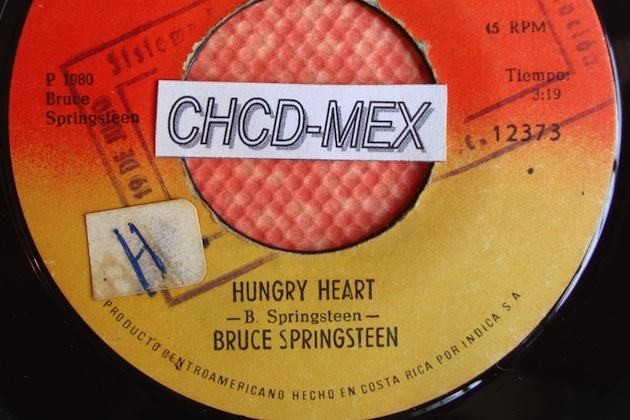
An unusual Costa Rican version of Bruce Springsteen’s 1980 single ‘Hungry Heart’ has sold for $1,310 after 25 bids on eBay. The sleeve even boasts an ink stamp from a local radio station.
Springsteen originally wrote ‘Hungry Heart’ for the Ramones, who were at work their Phil Spector-produced ‘End of the Century’ project, but was ultimately convinced to keep the song for himself at the behest of his manager and producer Jon Landau.
That would prove to be a fortuitous decision: The track would shoot to No. 5 on the Billboard charts, remaining Springsteen’s biggest single until ‘Dancing in the Dark’ reached No. 2 four years later.
Dave Marsh, in his 1996 book ‘Glory Days: Bruce Springsteen in the 1980s,’ called ‘Hungry Heart’ the No. 1 song of 1980.
This ‘Hungry Heart’ single is backed by Springsteen’s ‘Held Up Without A Gun,’ a previously unreleased song from his sessions for ‘The River.’ The A-side remains a regular part of Springsteen’s concert setlists. Springsteen’s current tour is in Ireland for the remainder of July.
Honduras vs. Costa Rica, 2013 Gold Cup quarterfinals: Final score 1-0
Costa Rica had numerous chances to net a late equalizer, but Honduras sealed a semifinal date with the United States, somehow holding on to a clean sheet
Costa Rica had most of the ball and laid siege to the Honduras goal in the dying minutes of their Copa de Oro (Gold Cup) quarterfinal, but the Catrachos were the only ones who were able to make anything of their chances. Some very effective, albeit frantic defending from Honduras in the closing minutes allowed them to make the most of their one goal and hold on for a 1-0 win, advancing Honduras to the Gold Cup semifinals.
The first 30 minutes of the match was slow, as both teams tried to find their footing and struggled to create clear chances. Around the half-hour mark, things picked up considerably. Jorge Claros went close with a shot in the 31st minute and Costa Rica had a shot blocked on the other end just a second later. Honduras turned right around and attacked quickly, with Alexander Lopez forcing a save out of Patrick Pemberton.
Andy Najar was one of the Hondurans’ most lively and dangerous players at the end of the first half. Early in the second, his aggressive and persistent runs off the ball paid off with the winning goal. Lopez set it up with a brilliant cross from the right flank and Najar made the perfect run, cutting inside from the left to get his head on the ball and nod past Pemberton, giving Honduras a 1-0 lead.
That goal sparked Costa Rica — and more specifically, Alvaro Saborio — to life. Saborio was brilliant from then until the end of the match and came close to scoring on three occasions shortly after Najar’s goal. He had a shot blocked in the 56th minute, headed just wide in the 60th minute and had a shot saved two minutes after that.
Costa Rica had all of the possession in the final 30 minutes as Honduras started to play more defensively, only committing men forward on the counter. While the Ticos had all of the possession, they struggled to do much with it between Saborio’s dangerous spell and the dying minutes of the match, when they got desperate.
In stoppage time, Costa Rica absolutely laid siege to the Honduras goal, but the Catrachos were able to hold on to their clean sheet. A Costa Rica free kick in the 90th minute was barely cleared away, and that was only the beginning of the eventual losers’ late push. Yendrick Ruiz had a header barely saved by Donis Escober in the 93rd minute, with the Honduran keeper fumbling before he recovered on the line. With his team’s final effort of the game, Mauricio Castillo ripped a shot wide from 12 yards in the 94th minute as his teammates put their heads on their hands.
Street Racing or “Picones” are common in many areas of San José, mostly due to the lack of enforcement by the Policia de Tránsito (traffic police) during night hours.
Street racers can easily find straightaways and other sites that naturally lend to street racing and without fear of traffic cops showing up and cutting their dangerous fun short.
However, an “anti-picones” unit made its debut Thursday night, with the objective to curtail street racing.
According to the Policia de Transito in their first action they issued 39 “boletas” (traffic tickets) for drivers with fake license plates, for not carrying a drivers license, for reckless driving and driving altered vehicles.
In addition to Tránsitos (traffic officials), the anti-picones unit includes officials of the Organismo de Investigacion Judicial (OIJ) and Fuerza Publica (police).
Areas that are common for street reacing including Pavas, San Francisco de Dos Rios and Desamparados.
In less than two weeks hundreds of thousands will be making their way to Cartago, as Catholic faithfuls embark in the annual pilgrimage to celebrate the apparition of the Virgen de los Angeles.
Although the masses will head to the Basilica de los Angeles on August 1 and 2, it was evident that some took the good weather this weekend to make their journey early.
“Romeros” could be spotted on Saturday and this morning Sunday in the area of Tres Rios, Ochomogo (all east of San José) and at the Basilica de los Angeles itself.
The Fuerza Pública and the Cruz Roja (police and Red Cross) have begun to set up checkpoints between Curridabat and Cartago.
For now, romeros are being asked to be extremely careful as they will have to share the roads with cars and trucks until such time as the Policia de Transito (traffic police) apply road closures, which will depend on the number of romeros ahead of the anticipated August 1 date.
The existing corruption and the lack of judicial safety in Panama’s financial sector are the main reasons that prevent Panama from consolidating as a regional financial center, according to the Association of Business Executives (APEDA).
Regarding the institution, some sectors of the market note that Panama has have not enough willingness to become a financial center, according to the results of a forum on this issue organized by APEDA, where the limitations to project regionally were analyzed.
According to the results of the forum, so that the country becomes a regional financial center, it requires the joint willingness of the regulator, the judicial body and private enterprises, reaffirmed Ana Lucrecia Tovar, representative of the Superintendency of Stock Market.
Roberto Brenes, who is with Panama’s Stock Market, considers there are obstacles for being a regional financial center and notes that in other financial centers, the banks can liquidate other banks, something that does not occur in Panama.
In Costa Rica it is an offence to seduce a child by electronic means.
Grooming is another extremely serious Internet threat that is causing great concern. This type of threat is aimed mainly at young people. Typically, an older person will use the Internet and its services to communicate with younger people. The groomer will not give accurate information about themselves and in many cases will pretend to be a younger person.
Grooming is defined as “actions deliberately undertaken with the aim of befriending and establishing an emotional connection with a child, in order to lower the child’s inhibitions in preparation for sexual activity with the child”. To “groom” a child a paedophile must have a way of communicating with a child effectively in private. To do this they are exploiting the popularity with children of chat rooms and social networking websites.
Once the groomer has made on-line contact with their victim they will spend time becoming their friend and trying to get as much personal information as they can. This process could go on for weeks or even months. The eventual aim of the groomer is to arrange to meet the victim in person in order to carry out some type of illegal activity, usually of a sexual nature.
Some abusers will pose as children online and make arrangements to meet with them in person. Facebook has been involved in controversy as to whether or not it takes enough precautions.
Sexual grooming of children over the internet is most prevalent (99% of cases) amongst the 13-17 age group, particularly the 13-14 years old children (48%). The majority of them are girls. The majority of the victimization occurs over the mobile phone support. Children and teenagers with behavioral issues such as higher attention seekers have a much higher risk than others.
In Costa Rica, since April 2013, the Criminal Code section 167bis, makes it an offence to seduce a child by electronic means. With penalties from one to 3 years of imprisonment for a person that, by any means attempt to establish an erotic or sexual communication with a child under 15 years old.
According to ESET-Latinamerica, a global IT security software solutions throughout Latin America, 26.3% of those consulted said to know a child who has been the victim of grooming and 68% said they feel that these situations are very often online.
The UK based Child Exploitation and Online Protection (CEOP) Centre says there were 1,145 public reports in 2012 relating to incidents of online grooming. 7% of these reports related to attempting to meet a child offline, a drop from 12% in 2011. A cluster of grooming reports from the public in 2010 led to a CEOP-led international investigation called Operation Hattie, spanning 20 months and 12 countries. This led to the arrest and conviction in December 2012 of two brothers in Kuwait who had targeted 110 children worldwide, including 78 in the UK, and forced them into performing sexual acts online. There was no evidence of an offline meeting with victims ever being a motivation.
Risk-taking by young people is the key factor in their vulnerability to grooming and potential contact with child sex offender.
Adolescents who take risks online by having sexualized chats or exchanging sexual images are particularly prone to the increasingly sophisticated, coercive and sinister tactics of online predators.
Smart phone ownership has increased by 21% among 12-15 year olds in just a year and six out of ten (62%) now have one*2. With built-in cameras, these devices and a new generation of apps are giving children the ability to easily communicate with strangers online and share images on the move. The Centre also knows that instant messaging on smart phones and other devices is a popular method of communicating and is used by groomers to approach potential victims. Instant messaging was used by offenders to make contact with children in around third of public reports of grooming in 2012/13.
The leader and founder of the Partido Acción Ciudadana (PAC), Ottón Solís, said that he probably would cast a”en blanco” (blank vote) at his group’s convention to choose a presidential candidate on Sunday.
But he said he would got to the polls and participate in the internal party process.
Solís has led the PAC party in the last three presidential elections.
After the 2010 defeat he said he would sit out the 2014 presidential elections. And despite his firm stand that he would not run, stepping aside for new leadership possibilities, rumours persisted of him leading the party into one more election. The rumours were quieted as the party convention date neared.
On Sunday, the PAC party will choose between Epsy Campbell, Juan Carlos Mendoza, Luis Guillermo Solis and Ronald Solis as the presidential candidate for the February 2014 elections.
As to Ottón he has publicly stated will maintain a position of neutrality and will assert his right to vote, but “will not choose” any of the candidates.
Churches throughout Costa Rica are expecting 30,000 people to join in on a march in defense of traditional marriage slated for August. The gathering is meant to counter attack recent legislations allowing same-sex civil unions, abortion, in vitro fertilization and challenges to the ban on the morning-after pill.
Organizers are calling for Evangelicals and Catholics to unite against what they say is a “combination of death” and hope that Costa Rican families can be restored according to “God’s design.”
“We are in favor of the traditional family of father, mother, siblings and grandparent’s and against civil unions and all that goes against what the Bible says,” said Justo Orozco, a Costa Rican evangelical legislator, according to the Hispanic news site, Mundo Cristiano.
“We want to demonstrate that we should not go against the Constitution, family and God’s word. We are a democratic country without discrimination, but majority rules,” he added.
The announcement of the march comes weeks after Cost Rica “accidently” voted to approve gay marriage, which caused an uproar among Costa Ricans and conservative lawmakers. The issue was brought to light when Orozco demanded President Laura Chinchilla veto the legislation, but she decided to sign it into law.
In addition to gay marriage, people are demonstrating against the Costa Rican abortion law, which is only permissible if a women’s life is at risk. Meanwhile, the Catholic Church is leading the charge against the overruling of Costa Rica’s IVF ban, arguing that embryos created in the process of IVF are oftentimes discarded or left frozen. And while it is currently illegal to sell the morning-after pill in Costa Rica, the law banning its sales has been challenged in previous years.
Planned Parenthood has pointed a finger at the Catholic Church for being a major reason for restrictions on abortion and the use of contraceptives in Costa Rica.
“…The strong presence of the Roman Catholic Church, as well as the continued use of abstinence-only-until-marriage curricula in schools, make abortion under any circumstance highly stigmatized and may hinder the likelihood of contraceptive use among unmarried adolescents,” the organization wrote on their website.
In spite of several controversial issues within the country, the upcoming demonstration aims to take place without causing social upheaval. “It’s a peaceful march with music and prayer for the country,” said Juan de Dios Calderon, general coordinator and president of the Network of Evangelists and Prophets in Costa Rica, Mundo Cristiano reports.
Calderon also said organizers will gather signatures to send a declaration in defense of families to President Chinchilla and the President of the legislative assembly, Luis Fernando Mendoza.
In this photo taken April 11, 2007, Egyptian cleric Hassan Osama Nasr, also known as Abu Omar, walks down a Cairo street after a news conference. (Amr Nabil / Associated Press)
Interpol advised Costa Rica Seldon Lady should be detained in Panama
Fugitive former CIA Base Chief in Italy , detained in Panama this week, was denied entry into Costa Rica Thursday, when an immigration check triggered an interpol alert.
In this photo taken April 11, 2007, Egyptian cleric Hassan Osama Nasr, also known as Abu Omar, walks down a Cairo street after a news conference. (Amr Nabil / Associated Press)
Immigration spokeswoman, Andrea Quesada, confirmed that Seldon Lady, tried to cross from Panama to Costa Rica at Paso Canoas around 10:30am, when a Costa Rican border official called Interpol, which advised that Lady shouldn’t be detained in Costa rica, which has limited extradition powers, but could be held in Panama.
Costa Rica sent Seldon Lady back across the border, where his passport didn’t trigger any alert when checked by Panamanian authorities, Quesada said. The former CIA officer tried to cross back into Costa Rica again, where he was sent back for a second time. On his return to Panama, an Interpol alert was triggered and police detained him.
Costa Rican records show Seldon Lady had entered Costa Rica in December 2012, but stayed in the country less than 24 hours.
In Panama, after barely a day in detention, he was put on a plane to the U.S. by the Panamanian government, a close U.S. ally, instead of Italy, which wanted him to serve prison time in the 2003 abduction of a terror suspect, the Obama administration said Friday.
“It’s my understanding that he is in fact either en route or back in the United States,” State Department spokeswoman Marie Harf told reporters. She declined to disclose other details about his case.
Italy’s deputy foreign minister, Lap Pistelli, said in a statement that Italy “acknowledges” Panama’s decision, adding nothing more about the case. Italy and Panama have no extradition treaty, Italian diplomats said, but Panama would have been free to send Seldon Lady to Italy if it wanted.
Panamanian Public Safety Minister Jose Mulino said later in the day that Seldon Lady was sent to the United States because Italy didn’t formally request his extradition within the allotted time.
“The man was detained for 48 to be extradited but the extradition request was never made formally in that span of time and he had to be released,” Mulino said.
Lady, the former Milan base chief, was sentenced in absentia last year by an Italian appeals court to nine years in prison in the kidnapping of cleric Hassan Osama Nasr. Lady was one of 23 Americans tried for their alleged roles in the operation, all but one of them CIA officers or contractors. Three other Americans indicted in the case, including Jeffrey Castelli, the former CIA station chief in Rome, were given diplomatic immunity and acquitted in 2009. But this year, a Milan court vacated the acquittals and convicted them in absentia. Castelli, who works for a Los Angeles firm, PhaseOne Communications, was sentenced to seven years in prison, and the other two received six years.
Nasr, also known as Abu Omar, was seized under a procedure known as extraordinary rendition, in which the CIA secretly detained terrorism suspects abroad and transferred them to third countries for interrogation. He was flown by the CIA to Egypt, where, he says, he was tortured, and was released in 2004.
In December, Italy’s then-justice minister, Paola Severino, authorized an international warrant for the arrest of Lady, according to the Corriere della Sera newspaper. But warrants were not issued for other CIA operatives convicted in the case because their prison sentences did not meet the minimum for an extradition request.
In April, Italy’s president, Giorgio Napolitano, pardoned U.S. Air Force Col. Joseph L. Romano, who had been convicted of involvement in the kidnapping.
Italy’s secret services were complicit in the operation, Italian courts found, and a former intelligence chief, Nicolo Pollari, was sentenced to 10 years in prison in February. His former deputy got nine years, and three other officials got six years each. Under Italian law, the men remain free while the verdicts and sentences are appealed.
Nasr was suspected of recruiting militants to fight in Iraq and was under surveillance by Italian authorities when he was thrown into a CIA van and driven to Aviano, the U.S. Air Force base in Italy.
An independent Italian prosecutor, Armando Spataro, uncovered the CIA’s involvement in the kidnapping through a detailed analysis of cellphone records and other trails that former CIA officers attributed to sloppy tradecraft.
July 18, not a date where too much happened except the usual world fight for freedom, the killing of kids, etc. (Nothing terribly important for Costa Rica) but perhaps not a total surprise but certainly of deep international consequence, Detroit, Michigan in the United States has declared Chapter 9 bankruptcy. The largest ever in the history of that country followed by vilified Stockton, California.
What does this have to do with Costa Rica?
Maybe not much in the total scope of things, but it does demonstrate, clearly demonstrate, that we are on the same road to hell…The road to debt to default.
For years, Detroit has been living on borrowed time and money. Pretty much the same strategy and amount per capita as US, albeit perhaps more so for Costa Rica.
Associated Press : “The City of Detroit has paid its bills for years with borrowed money.”
Does this sound familiar, sort of like being at home in Pura Vida?
We borrow money to pay for roads, we borrow money to pay for health care, we borrow money to support massive government bureaucracy, we borrow money to modernize our ports of entry and we even borrow money to develop tourism which is not developing at all according to CANATOUR…
In short, much like Detroit, the largest bankruptcy ever in the United States, Costa Rica is living in a Pollyanna world of the same order.
We do not raise revenues except by a multitude of goofy and annoying taxes on income generated from telephones bills , television, water, gasoline/diesel and those other essential costs of life that then, in turn, deprive us of more gross salaries to pay out in “income” taxes. (Personal net revenue)
In the case of Detroit, Mich. there are limited sources of revenue. In the case of Costa Rica the required income has always been here, but not really and seriously never collected. Ergo, a limited source of revenue.
Exit to politics and soccer; avoiding taxes is the national sport and practiced by most Ticos in that order.
Being paid in cash, Costa Rica seems always short on recorded purchase receipts as in medical facilities, to gas stations, and especially to condos who rent out to international tourists as well as national vacationers.
While the U.S. Congress argues the merit of having a massive, but really massive Internal Revenue Service (Taxes), Costa Rica is trying to figuring out how to create an inefficient and complicated tax income service. They call it the “Fiscal Plan.”
Now, why would you create another Frankenstein’s monster
In the most simplistic of terms, much like a having more than multi – credit cards, we cannot continue much longer to borrow on one side in order to payback on the other absent of generating tangible revenue. But as with the IMF, our new best friend the Chinese, along with a variety of development banks…that is exactly what we are doing: Ala Detroit.
We are Detroit Part II but far more south and with better weather.
One of the less visited National Parks of Costa Rica: Marino Ballena. Here you can find the famous ‘Whales Tale’ and you can see why it’s named so. When the tide goes down this amazing scenery appears!