The “hooligans” in Costa Rica that go to soccer games just don’t get it, you cannot behave in the Estadio Nacional (National Stadium) like you the Saprissa or Liga stadiums, for example. No, at the National, you need to show some culture, restraint, whatever.
[quote]Club Alajuelense announces barring of “barras” at Sunday’s “clasico” game in Alajuela.[/quote]
That as not the case yesterday, when violence broke out mid-game, in a match between Alajuelense and Cartaginés.
[/one_fourth]Photos and video clips show the mob of “barra brava” (Alajuelense fanatics known primarily as “La 12” and “Ultra”) attacking Cartaginés fans. Images show women and children fleeing the stands, taking to the soccer field, when hooligans began beating a man dressed in a white and blue t-shirt (Cartaginés colours).
The deputy minister of Security, Celso Gamboa, by way of Twitter wrote, “there was an unjustified aggression against women and children. The problem is that public resources are guarding public shows. And (soccer) clubs allow these groups”.
At least 15 people were detained in yesterday’s disturbance that led to the suspension of the game.
Paul Pinto, president of the Alajueal club, said there was a lack of security., while Claudio Ciccia, manager of the Cartago team, said the event is part of a “social issue”.
The game will be played again today, at the National Stadium, at 3pm behind closed doors.
Sources: Telenoticias Deportes, La Nacion, Al Dia, Facebook
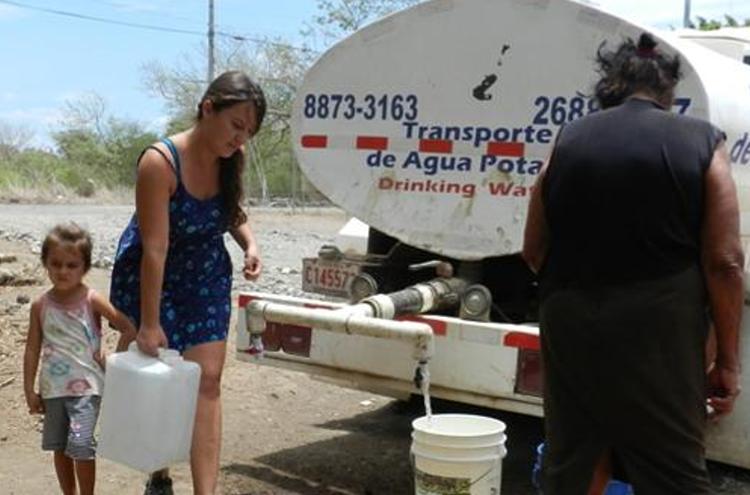
Water, water everywhere (during the rains) but not a drop to drink (during the dry season…) That’s the situation with Costa Rica where the assistant manager of A y A, the water and sewer service, Sergio Nunez, announced rationing in late February.
A supply of bottled water is one solution to the water rationing.
The rationing will hit residents and businesses in the highest altitudes of Alajuelita, Santa Ana, Escazu and Ciudad Colon in the Central Valley. Nunez said the shutoff of water will be from 9 p.m. to 5 a.m. and 11 a.m. to 4 p.m.
Nunez admits that the water levels in public tanks is normal now, but is measured every day and it has been predicted that rationing will be necessary in the above areas.
He added that the cutbacks in the vital liquid would affect only 4% of the populations and the hours in which the water lines are full will allow refilling home tanks. He urged the rest of the population to use water sparingly.
Comment: The measure was inevitable and could be foreseen for years — in fact this blog has done so. Until elected officials stop wasting public funds through corruption and incompetence such as in the public works and highways, the government will not have the funds to provide necessities.
The last serious effort to ensure potable water for the population was the first administration of ex-President Oscar Arias (1986-90) when he put forth a program to guarantee water availability through the rest of the century.
The plan not only worked, but has lasted longer than promised — which government programs
rarely do — with A y A adding little to the effort other than fixing broken lines and collecting water bills.
Of course, politics being an ego-run enterprise, subsequent Presidents have wanted to put their nameplates on new projects (including Arias in his second term) instead of making things run economically and smoothly.
Nothing gets done.
Military police officers watch over the Calabar favela in Salvador, the state capital of Bahia. In 2011, the city installed its first community security base in the favela. (Courtesy of Alberto Maraux/Public Safety Secretariat of the State of Bahia)
TODAY BRAZIL – Famous for its party atmosphere, Bahia’s capital city of Salvador suffers from violence, drug trafficking and social inequality – against all of which the government has bolstered its fights.
Military police officers watch over the Calabar favela in Salvador, the state capital of Bahia. In 2011, the city installed its first community security base in the favela. (Courtesy of Alberto Maraux/Public Safety Secretariat of the State of Bahia)
Military police officers watch over the Calabar favela in Salvador, the state capital of Bahia. In 2011, the city installed its first community security base in the favela. (Courtesy of Alberto Maraux/Public Safety Secretariat of the State of Bahia)
From 2000 to 2010, the number of deaths from firearms increased 158% in Salvador, jumping from 619 in 2000 to 1,596 in 2010, according to the 2013 Violence Map by sociologist Julio Jacobo Waiselfisz.
Research showed the increase in the number of violent deaths during the past decade was seen not just in Salvador, but in almost all of the state capitals of the Brazilian Northeast.
One factor that might be causing the increase in violence is the growth of the market for narcotics in the city, according to Luiz Claudio Lourenço, a researcher from the Federal University of Bahia’s Laboratory for the Study of Public Safety, Civics and Society.
“Nowadays, drugs are consumed by the masses – they’re no longer limited to Brazil’s upper classes. Consumption is widespread,” Lourenço said. “But since drugs aren’t legal, consumers wind up getting caught in the crossfire of the drug trade, along with drug traffickers and police officers.”
About 70% of the murders in the metropolitan region of Salvador are related to the drug trade, said Mauricio Teles Barbosa, the secretary of the Public Safety Secretariat of the State of Bahia (SSP-BA).
“The murders are the result of confrontations, territorial disputes, debt collections … which all are drug-related issues,” Barbosa said. “Crack is the primary product in this market. Crack is now the biggest national issue in terms of health care and public safety.”
Barbosa took over the SSP-BA in 2011, when Bahia launched its Pact for Life program, aimed at bringing together the work of the legislative and judicial branches, the Public Ministry and the Public Defender’s Office in their violence prevention efforts.
The secretary’s duties include combating drug trafficking with a policy that features goals and oversight of police activity; an increase in the number of police officers and operations targeting drug traffickers; and the installation of community security bases.
There are currently 12 community bases in Salvador, all of which adhere to the community outreach policy of the Pacifying Police Units of Rio de Janeiro.
This collection of SSP-BA initiatives has led to a reduction in the number of deaths, according to Barbosa.
A statement released in January by the SSP-BA showed that, in comparison with the previous year, 2013 showed a 14.7% decrease in the number of intentional lethal violent crimes, such as homicides and thefts involving murder, in the metropolitan region of Salvador.
“The city had 126 fewer deaths due to violent causes than it did in 2012,” Barbosa said.
Barbosa added 52 drug kingpins in Bahia have been arrested since 2007.
“But they have already been replaced by others. The work of combating drug trafficking is always ongoing and there’s no endpoint,” he said. “That’s why our policy has been to occupy the most critical areas with community security bases.”
The feeling they are rowing upstream also is shared by Lourenço.
“Drugs won’t cease to exist – that’s why we need to learn how to deal with drugs, through a health care policy, taking care of users and carrying out preventive work,” he said.
Social inequality also may have contributed to the violence in Salvador during the period covered by the Violence Map, despite the increase in family income among the poorest economic classes and the expansion of formal employment in the region.
According to the Brazilian Institute of Geography and Statistics (IBGE), the per capita income of the poorest 20% increased about 70% from 2004 to 2012 in Brazil, while the richest 40% had an increase of 22% in the same period. The IBGE also revealed that the formal employment rate grew by 45% in Salvador between 2002 and 2012.
“The data relating to employment and income are positive, but social inequality is still present in Salvador and in other cities in the Brazilian Northeast,” Lourenço said. “This inequality is one of the hypotheses that can explain the increase in violence.”
Lourenço’s observations are echoed by Tania Cordeiro, a member of the Community Forum to Combat Violence in Salvador, an organization created in Salvador in 1996 to propose public-private initiatives against violence.
“The values related to consumption have grown to a point where human existence has become confused with the ability to consume,” Cordeiro said. “If we compare the ‘brand values’ needed to ‘be someone’ with the economic gains of the poorest in society, there is a large disparity that is unfavorable to these classes.”
Broadening the debate beyond the issue of drug trafficking, Cordeiro pointed out the word “violence” can refer to a variety of events, from least harmful to lethal. However, she noted an increase in the banality of violence.
“In the face of violent deaths, there’s a tendency to disregard the small incidents. Therefore, we consider practices to be ‘nonviolent’ that might actually be contributing to an increase in violence,” Cordeiro said. “Cutting lines, cutting someone off in traffic and cursing people out are some examples of this.”
A rally in Holguín, Cuba. Credit: Jorge Luis Baños/IPS
A rally in Holguín, Cuba. Credit: Jorge Luis Baños/IPS
Inter Press Service (IPS) – If President Barack Obama wants to move more quickly to normalize ties with Cuba, it appears he has gained the political space to do so, according to analyses of a major new bipartisan public-opinion poll released here Tuesday by the Atlantic Council. The survey, which was conducted last month, found that 56 percent of U.S. adults nationwide now support normalizing ties or engaging more directly with Havana, while just over a third (35 percent) are opposed. Perhaps more important politically, an even greater majority – 63 percent – of respondents from Florida, home to the greatest concentration of Cuban Americans, including several of the fiercest foes of the Castro government in the U.S. Congress, support normalisation and greater engagement. Only 30 percent of Floridians said they were opposed. Similarly, 62 percent Latino respondents nationwide favoured normalization, compared to 30 percent who opposed it. “Profound changes to U.S.-Cuba policy would be well received by the American people, and even more so, by Floridians and Latinos,” according to an analysis of the poll results by Peter Schechter and Jason Marczak, director and deputy director, respectively, of the Atlantic Council’s Adrienne Arsht Latin America Center. “For decades, Florida’s politics trumped national policy. This is no longer true. While those opposing change have much emotion and determination on their side, it is clear that demography and immigration have changed the equation in Florida politics.” The survey, which was conducted by experienced pollsters from both major parties, comes as a number of high-profile Floridians have called publicly for changes in U.S. policy toward Cuba, noted Marc Hanson, a Cuba specialist at the Washington Office on Latin America (WOLA), a think tank that has long supported normalization. Two Democratic candidates for governor, including one, Charlie Crist, who served as the state’s Republican governor as recently as 2011, have recently come out against the nearly 54-year-old trade embargo. And just last week Alfonso Fanjul, one of two Cuban-American billionaire brothers who control most of the state’s sugar industry, spoke publicly about his recent visits to Cuba and his interest in doing business on the island. In addition, another prominent Cuban-American business leader, Jorge Perez, called for stepped-up bilateral exchanges between the two nations and voiced hopes to soon feature Cuban artists – even those with ties to the government – at his new art museum in Miami. “Not too long ago, voicing opposition to the embargo would have been political suicide in Florida,” according to Hanson. “But the [recent] public announcements show that the political calculus has changed and that supporting normalisation of relations is not longer a political liability.” Indeed, Obama, who took a somewhat more liberal position on Cuba than his Republican foe, Sen. John McCain, nonetheless won Florida – perhaps the most infamous of “swing” states as a result of the 2000 election – in 2008. After repealing several measures decreed by President George W. Bush restricting the ability of Cuban Americans to travel to the island and send money to their families there early in his first term, Obama won the state again in 2012, in important part by increasing his percentage of the Cuban-American vote there by 10 points. Since those early steps were taken, however, Obama has been much more cautious, due primarily to the continued detention of a U.S. Agency for International Development (USAID) contractor, Alan Gross, who was arrested in late 2009 and subsequently sentenced to 15 years for distributing communications and computer equipment to members of Cuba’s Jewish community without a permit. Most analysts believe that Havana hopes to exchange Gross for the so-called “Cuban Five” – Cuban intelligence agents convicted of spying and other offences in the late 1990’s – one of whom was released in 2011 and another expected to be released this month. Nonetheless, Obama has taken some small steps over the last several years, including making travel to Cuba by U.S. citizens for educational, cultural and similar programs easier and authorizing low-level bilateral talks on a range of issues, such as migration, that had been suspended under Bush. “They’re doing things on the margin of the policy but nothing fundamental,” noted Michael Shifter, president of the Inter-American Dialogue, a hemispheric think tank here which has urged the administration to take a more forthcoming position on Cuba, in part because normalization would improve relations with Latin America as a whole. The survey itself interviewed some 2,000 respondents. In addition to a sample of over 1,000 randomly selected adults, it included additional oversamples from 617 Florida residents and 525 Latinos. Among other conclusions, the survey found that men were significantly more likely (61-51 percent) to favour engagement with Cuba than women; that more-educated respondents were significantly more likely to support normalization; and that a 52-percent majority of self-identified Republicans – the party that has historically been most resistant to lifting the embargo – now favour change. Nationwide, 62 percent favour allowing U.S. companies to do business in Cuba, and 61 percent favour lifting all travel restrictions on U.S. citizens who want to visit the island. For Floridians, the comparable percentages were 63 percent and 67 percent, respectively. Given the partisan polarisation in the U.S. Congress, few analysts believe that legislation easing the embargo is likely during this election year. But some insisted that the survey results should encourage Obama – whose handshake with Cuban President Raul Castro at Nelson Mandela’s memorial service in December evoked little criticism here – to take additional steps through his executive authority. These include removing Cuba from the State Department’s list of state sponsors of terrorism and making it easier bureaucratically for Cuban-Americans and other eligible citizens to travel to Cuba. “The importance of the poll is that it will hopefully feed into the policy discussion over the next year,” Jake Colvin, vice president of the National Foreign Trade Council (NFTC), a heavyweight business lobby group that opposes the embargo, told IPS. “It was really surprising to me that Floridians were more in favour of changing policy than the rest of the country.” A particular surprise for some were the results in Miami-DadeCounty, long considered a stronghold of pro-embargo sentiment and represented in Congress by perhaps its two most outspoken foes of the Castros’ rule – Republicans Reps. Ileana Ros-Lehtinen and Mario Diaz-Balart. Sixty-four percent of respondents in the country said they supported normalizing ties or engaging Cuba more directly. In response, Ros-Lehtinen denounced the poll, charging that it had been “conducted with a political agenda to help justify the disastrous policies toward Cuba by President Obama,” and denouncing the participation in the survey’s release of Arizona Republican Sen. Jeff Flake, “Castro’s cheerleader in the Senate who obsessively lobbies to lift sanctions on the dictatorship.” Flake, who appeared alongside Democratic Sen. Patrick Leahy at the survey’s release, noted that on Monday he had attended a reception marking the 20th anniversary of the lifting of the U.S. trade embargo against Vietnam and noted that it was now one of the nations with which Washington hoped to conclude the Trans-Pacific Partnership (TPP) trade accord. “Why can’t we move forward with Cuba?” he asked. For his part, Leahy, a senior Democrat who has visited Gross twice in Havana, called the poll a “major, major step forward” and urged Obama to remove Cuba from the terrorism list. He said Gross’ continued detention was a “stumbling block, but let us go forward.”
Expats do not seem to much care, few have any idea who are the candidates, their political positions and those same accusations go for the Ticos who will or will not vote for a new president in the upcoming elections.
I find it appalling that expats have not followed the candidates and their party politics since the newly elected president will indeed decide our fate for the next four years. In the mean time, direct foreign investors have backed off from Costa Rica and if one uses the Internet, excluding paid announcements, we come off as being expensive, corrupt, the home of violent crimes and incompetency. All descriptions have some, perhaps a lot, of element of truth to them.
“Yes,” to follow and understand thirteen candidates from thirteen political parties is the job of a news junkie. But, now we are down to two parties and which are easily understandable and identifiable. It is just that most expats are not willing to study reality.
In general terms, Latin America has elected and has moved to either the left of center or far left depending on the nation. Personally, I hope the United States, does not do an “Allende” and kill who ever becomes president in whatever country in the world.
Both Candidates, Araya and Solis, are left of center. Make no mistake about that. Many view Solis as further left than Araya, but that is not the case. Regardless who wins, Costa Rica will see a continued appreciation of the USD, a correspondent increased cost of living and more taxes. It is illogical to think otherwise.
If our exports grow from a weak colon, then import costs must increase as a cost balance; also from a weakened colon. In some cases, that can already be felt at the food stores. Remember, we export tomatoes, and then import same when canned.
Will either candidate resolve the critical inequality of economic classes? Hardly at all. Despite quivering lower lips and tear filled eyes, the lower income earners are far less important than the wealthy which is not at all unique to this country.
And that can become a fatal flaw!
However, as Dr. Peter F. Drucker said, “Business is an organ of society and if business does not promote and sustain society to buy its products and services, enterprise will parish.”
Just look at Venezuela and let Costa Rica learn a lesson to ask the hard questions of the candidates, of the parties and receive measurable answers that meet our needs! Moreover, let expats and foreign investors continue to vote with their wallets.
Latin America – Guatemala’s Attorney General Claudia Paz y Paz is being prematurely pushed out of office, an illustration of the ability of the country’s elites to manipulate the judicial system.
On February 5, the Guatemalan Constitutional Court ruled Paz y Paz must step down from her post in May, seven months before her term is scheduled to end in December, reported Reuters. The decision was based on a technicality. Since she assumed the position early to complete the term of her predecessor, who was removed from office, the court ruled her four years were up in May 2014.
The decision followed a constitutional challenge brought by a wealthy businessman, Ricardo Sagastume, reported The New York Times. In an interview with El Periodico, Paz y Paz, who is appealing the court’s decision, said, “Those who have been affected by the advance of justice are in a hurry to see me leave office.”
Amnesty International has expressed concern over the decision, saying Paz y Paz helped the justice system make advances in uncovering both past and current human rights abuses.
The efforts of Paz y Paz to combat crime and corruption in Guatemala have been praised by international bodies, and she was nominated for a Nobel Peace Prize in 2013. According to Attorney General’s Office figures cited by El Periodico, during her administration the country’s impunity rate has fallen from 95 percent to 70 percent.
Her work combating the Mexican criminal group, the Zetas, as well as battles against corruption and human rights abusers in Guatemala have resulted in the convictions of high level organized crime figures, police, politicians, and military officers. She also successfully brought former dictator General Efrain Rios Montt to trial for genocide — though the Constitutional Court later reversed the landmark sentence in that case.
While the attorney general’s tactics for tackling organized crime have been credited with improving the effectiveness of Guatemala’s justice system, they have also earned her powerful enemies. The country’s entrenched elites now appear to be pulling strings in the country’s highest court to engineer her departure.
Her exit raises concerns that ongoing investigations will come to a halt, along with progress against corruption and impunity. The International Commission Against Impunity in Guatemala (CICIG) has similarly seen its mandate challenged as it has uncovered judicial corruption and spoken out against impunity.
If there is a line to gain admittance to Heaven, Costa Ricans will be the only persons not surprised. Thursday, the leading newspaper La Nacion reported that 20,000 Ticos call each day to find out if they can get a driver’s exam.
The practical driver’s exam is, of course, a requisite to getting a license but the highway security agency, Cosevi, is in no hurry, it seems, to turn a new crop of drivers loose on the road.
Of the thousands of callers,only 500 succeed in getting on the list and Cosevi admits that it has had to transfer five employees from other duties just to handle calls. That means Cosevi can test only 2,500 would-be drivers per week.
Carlos Rivas, Cosevi legal counsel, blames part of the problem on a primitive call center, but did not answer the main question — why not hire more examiners to clear out the backlog?
Traffic Police says that the most common ticket given out is lack of a driver’s license, a ¢99,000 colones (US$200) fine. German Marin, chief of the Traffic Police, says that more than a thousand drivers are caught per month, mostly drivers far from the capital.
Veronica Sacaray recounted to La Nacion how she called all day, week after week. “After much begging and including nearly crying recounting my odyssey,” she told Facebook readers, “I finally got an appointment for my brother. Granted, he has to go all the way to Liberia, but when I got the appointment, I accepted.”
Cosevi’s Carlos Rivas admits the real problem — his agency simply doesn’t have the number
of instructors it needs. There are only 30 of them, 10 to 12 in San Jose and the rest scattered in a dozen centers throughout the country.
Each test takes 25 or 30 minutes. Rivas, in a demonstration of bureaucratic helplessness, pleaded with driver to be patient.
On the road to Monteverde: milk truck wedged into a narrow mountain road. No one has any idea how this could have possibly happened. Photo from C-Monster on Costa Rica commuting disasters 2011.
Partido Accion Cuidadana (PAC)candidate for President, Luis Guillermo Solis, accused his runoff election adversary, Partido Liberacion Nacional’s Johnny Araya, of mounting a smear campaign.
He directly accused Araya of planting fear among voters by painting PAC as an extreme left wing party. Solis made the accusation Thursday morning on a broadcast of radio station ADN-FM.
“The principal spokesman for this fear campaign is don Johnny (Araya), accusing PAC of being a radical left political party,” said Solis, “returning to place the subject of abortion center stage and generating the feeling of government by inexpert and inept people.”
Solis beat Araya in the general election by a bare 1.36% and failed to achieve the 40% of the vote that would have made him the outright winner.
Araya had made the usual politician’s prediction of attaining 40% of the vote before the election.
The PAC candidate vowed to take the high road but did not absolutely guarantee it if Araya did not desist. “The people don’t care for attacks,” Solis said, “but (want) proposals.”
But, he said sternly, if people begin to make false accusations, that damage PAC’s credibility or a future government, “I plan to solve that.”
PAC has never won an election but has many intellectuals and deserters from other parties who have flocked to the standard through the three decades of the party’s existence.
Solis refused to specify exactly who he would name to his cabinet but emphasized that members would have leadership, decency, problem solving capacity and representative of all sectors of the country.
Commentary: PAC is left of center but, then so is Liberation thanks to Araya returning the party to its tradition. Whether Araya is trying to restore the campaign waged against the Broad Front Party, labeling it as extreme left is unknown.
But PAC, although left of center, is in no way extreme. Broad Front was much farther left. As for being pro-choice on the abortion topic, some of its legislators are — but so are some of the voters.
Araya has been cozying up to the Catholic Church recently so this may be a ploy to tap the religious issue. On the other hand, Solis may be making a big thing of the attacks in order to woo the sympathies of the Broad Front voters who were stung by the extremist slur during the regular campaign.
But that is the trap of political reporting. One begins to doubt that politicians say what they mean and mean what they say…
Public employee sector unions are calling for a strike on February 25 against the 0.43% salary increase.
Public employee sector unions are calling for a strike on February 25 against the 0.43% salary increase.
The aspiration of many in Costa Rica is to work in the public sector, higher wages being the motivating factor, as employees of the central government and autonomous institutions earn up to 50% more than in the private sector.
Unlike workers on the “other side”, public employees receive in addition to the salaries, benefits like incentives based on years of employment and occupational hazards pay.
An example of the difference is person with a professional degree can expect to earn a monthly minimum wage of ¢486.344 colones (US$950 dollars) in the private sector, while in the public sector, with all the benefits, the minimum wage is ¢819.994 colones (US$1,605 dollars).
The benefits can add up. For example, the salary increase for the first half of this year decreed for public sector employees is 0.43%. But if you add in all the benefits, the salary hike is really between 5% and 9.17%.
“One of the most serious problems facing this country is the cost of public employment. It is creating a privileged sector…”, according to the Minsitro de Hacienda (Finance Minister), Edgar Ayales.
The payment of the wage increase to some 250.000 public sector employees, for the first semester of 2014 will cost ¢14 billion colones.
Despite the benefits, public employee sector unions are still calling a strike on February 25 against the 0.43% increase.
“I understand that the benefits increase wages, but they are right we have been gaining slowly. We want increases and not adjustments. The minister now says he wants to negotiate a reform when there a only a few months before leaving office”, said Gilberto Cascante, head of the Asociación Nacional de Educadores (ANDE), the largest of teachers union.
Albino Vargas, head of possibly the largest workers union (both private and public), the Asociación Nacional de Empleados Públicos y Privados (ANEP), says his union is fighting not for those with “dignified” wages, but for others like the medical profession, that does not.
For his part, Olman Segura, the ministro de Trabajo (Minister of Labour, who is set to leave office on May 8 to make way for a new government) blames the situation on the unions who, according to the minister, have not honoured “signed agreements”.
Using a photocopier as a source of their new found wealth, two men decided to on a shopping spree thinking they could fool merchants with their phoney US$20 dollar bills and ¢10.000 colones notes.
Police were alerted by a merchant in Guayabo de Bagaces, Guanacaste, Sunday morning when they tried to purchase a ¢1.000 colones minutes card for their cell phone with one of the phone notes.
Detained were two men identified by their last names Fuentes Vásquez, 24, and Torres Jiménez, 26.
The Urban Dictionary defines a Gringas as: A female native speaker of English, unrelated to race. Gringa is often defined as disparaging slang for a foreign female in Latin America.
But that’s no longer true in Costa Rica, if it ever was. We are gringos, the locals are ticos.
However, there is another kind of Gringa to be found in Costa Rica and throughout Latin America: A variety of tacos which uses as a base a quesadilla, consisting of a flour tortilla filled with cheese and “al pastor” meat, topped with cheese. This is then grilled in the same manner as a quesadilla.
Some say the name appears to come from the dark spots that appear on the white surface of flour tortillas when heated, that resemble of freckles in white skin, a “gringa” skin. In general, the name was established from the idea that (wheat) flour tortillas are preferred north of the border. Las pochas is the name given to another variation of tacos made in the same manner, but instead of wheat flour tortillas, corn tortillas are used and instead of “al pastor” meat, grilled meat, pork or less frequently beef is used.
By Simone Shapiro for Triblive.com– Like the United States, Costa Rica is a constitutional republic and has been since 1949. Like the United States, Costa Rica holds presidential elections every four years. Costa Rica held its presidential election on Feb. 2. What is different from the United States is that Costa Rica had 13 candidates running for president, four of them top contenders.
I was in Costa Rica for the three weeks during the run-up to the election and everywhere I went I saw people driving by with their favorite party’s flags flying — green and white for the National Liberation Party (PLN), red and yellow for the Citizen’s Action Party (PAC), yellow for the Broad Front (FA) and red and white for the Libertarian Movement (ML).
In the streets, people wore shirts of their party’s colors and enthusiastically waved flags. Trucks drove through neighborhoods playing music, blasting slogans and encouraging people to vote. Newspapers ran articles extolling their favorites and interviewing candidates and supporters.
The day of the election, folding tables were set up outdoors at election sites and people came out with their children and families. Music was playing, refreshments were being sold and cars clogged the narrow streets. It was a festive, partylike atmosphere. This went on until the close of election at 6 p.m., when everybody went home to wait for the results on TV.
The next day, the results showed that none of the four top contenders had garnered the requisite 40 percent of the vote to be elected president. Now there will be a runoff in April between the top two candidates, Johnny Araya of the PLN, the party currently in power, and Luis Solis, the dark horse candidate of the PAC. (Neither of these contenders is a politician of the far left.)
What is so interesting about this picture? This is Central America! Before the election, there were no government employees taking photos of opposing candidates, no phony demonstrations for candidates who are surreptitiously hated and no violence between military and guerrillas.
During the election, there was no intimidation at the polls, no troops coercing voters, no rigged results and no lone candidate being the only choice.
After the election there were no angry demonstrations, no bloodshed in the streets and no animosity between supporters of contesting candidates.
It was business as usual in Costa Rica. Just compare this to Costa Rica’s neighbors in Central America — Nicaragua, Venezuela, Cuba or El Salvador.
What a wonderful example of the strength of Costa Rica’s democratic tradition. What a role model for the rest of Central America! As they say in Costa Rica, “!Pura Vida!”
Arias welcomed Venezuelan youth in Costa Rica in his home in Rohrmoser.
Former president and Nobel prize winner, Oscar Arias Sanchez, has come down hard on Venezuela’s government. In an interview with CNN Airas condemned the violence against students and speaking out in support of Venezuelans in Costa Rica who gathered at his home in Rohrmoser Thursday night.
In an interview with Patricia Janoit, Arias said there is no threat of a coup and the Nicolas Maduro government should be more flexible to criticism.
Arias told his interviewer that he has met with Venezuelan youth in Costa Rica, who have expressed their concerns what is happening in their home country. The former president said, “criticism should be sponsored and not repressed”.
The 1987 Nobel Peace Prize is asking the Maduro government should “moderate language: the truth is that those who are protesting are not Fascists.”
“Calling any one who criticizes the ruling party Fascists I think is an over exaggeration”, said Arias.
Blasting the actions of Venezuela’s security forces, Arias told Maduro he has no right to call his government a democracy.
The following video is the CNN interview (in Spanish)
Arias posted the following on his Facebook page:
[quote]NOTHING IS WORSE THAN BEING AFRAID TO TELL THE TRUTH
I want to add my voice to a chorus of worry that has swept through our America. Thousands of students and opponents of the administration of President Nicolás Maduro of Venezuela were brutally attacked with firearms by security officials. Three people died and at least 26 have been injured during the conclusion of a series of protests in Caracas and other Venezuelan cities.
In no country that is truly democratic can a person go to prison or be murdered for holding opposing views, or for wishing to express opposition to government policies. Venezuela can employ all the oratorical flourishes it likes to sell the idea that it is a true democracy, but with every violation of human rights committed by the government, they show the untruth of their position, because criticism and dissent are being repressed. Every government that respects human rights must respect the right of its people to peaceful protest. The use of violence is unacceptable. Let us remember Gandhi’s warning: “An eye for an eye leaves the whole world blind.”
I have always defended democracy and I am convinced that in a democracy, if one has no opposition, one must create it, not repress it or condemn it to a hellish persecution, which is what President Maduro’s administration appears to be doing. The government of Venezuela must respect human rights – above all, the rights of its opponents, because there is no merit in respecting the rights only of one’s supporters.
Martin Luther King Jr. once said that “the hottest place in hell is reserved for those who remain neutral in times of great moral conflict. The time comes when silence is betrayal.” That is why I am aware that, upon making these statements, I am risking all kinds of accusations from the Venezuelan government. They will accuse me of meddling in internal matters, of failing to respect their sovereignty, and, almost certainly, of being a lackey of the U.S. Empire. Without any doubt, I am a lackey of the empire: the empire of reason, of prudence, of compassion and of liberty. I will not remain silent when human rights are in danger. I will not remain silent when the mere existence of a government like that of Venezuela’s stands as an affront to democracy. I will not remain silent when the lives of human beings are put in the balance simply because they have defended their rights as citizens. I have lived long enough to know that nothing is worse than being afraid to tell the truth.[/quote]
Costa Rica News – There always seems to be the untouchables in a society be it people with a lot of fame and fortune, those with power, elected officials, or someone else that seems to get away with whatever they want to do and have no consequences. Perhaps this is a step in the right direction in Costa Rica, or it may just be a law that was passed that will never be enforced.
For the first time ever, the work of judges in Costa Rica will be judged. The “Corte Plena” approved this regulation on Monday as an accountability measure. Not only will the 1,300 judges be assessed, but also the prosecutors, defense attorneys, police, and administrative personnel.
Some of the considerations will include the timing resolution and amount of judgements made. This regulation has been 5 years in the making, because there were many indicators to develop. In fact, there are a total of 95 matrices for measuring the effectiveness of the various positions of power.
Judge Rolando Vega explained that “You have to evaluate to see if people are doing what they need to do and how they are doing it. If we do not know how they do things, we can not identify failures. That’s the reason why public institutions do many things, but do not have an impact.”
President of the Costa Rican Association of Judicature, Adriana Orocu, said that the judges have always had to submit reports annually, but that it just wasn’t enough to accurately measure their performance. She also pointed out that this new regulation will in no way impair judicial independence and that if they fall short in their rating, more training will be given to improve the situation, but no penalty will be given.
The annual Miss Costa Rica pageant opened registration on Friday, looking for participants for the 2014 edition.
The requirements to participate in the contest are:
Costa Rican national
minimum height of 1.68 metres
aged between 18 and 27 as of December this year
single (never married) and without children
be a student or university graduate
have a basic knowledge of English
Participation in past contests is permitted, The deadline for registration is March 14
Televisora Costa Rica, operator of local television channel 7, Teletica, owns the franchise in Costa Rica for participation in the Miss Universe contest.
Miss Costa Rica 2013, Fabiana Granados, a native of Guanacaste, placed 16 of 89 candidates in the Miss Universe contest in Moscow.
The Government of Laura Chinchilla on Friday deplored the acts of violence that occurred on February 12, which caused grief and pain among Venezuelans. An official statement released by the Foreign Ministry notes that in relation to these events, it is pertinent that the Venezuelan authorities investigate and establish responsibilities for the victims and injured.
[one_third]
[/one_third]It adds that Costa Rica, respectful of the internal affairs of the fraternal countries, expressed concern that it may exacerbate a climate of confrontation that disturbs the peace and stability of Venezuela.
The text also expresses hope that Venezuelans can find ways to solve it the by path of dialogue and understanding and calls for sanity and respect to avoid a worsening of the situation.
On February 12, fascist groups attacked government institutions, burned vehicles and caused at least three deaths and dozens injured in Caracas and other cities.
These actions were defined by President Nicolas Maduro as part of a right-wing coup against the constitutional development of the Government of the Bolivarian Republic of Venezuela.
Luis Antonio Sobrado (right) overlooks the final act of the vote count. Photo TSE
Luis Antonio Sobrado (right) overlooks the final act of the vote count. Photo TSE
The Tribunal Supremo de Elecciones (TSE) confirmed the conclusion of the manual vote count of the Feb 2. presidential elections. The TSE said that there will not be a manual count of legislator ballots, save for in races were there were disputes in the results.
The last two polling stations to be counted manual was number 6455 in Germany and 6515 in Australia.
Luis Antonio Sobrado, president of the TSE, reminded that an elections ban on public institutions begins Monday, Feb 17.
The elections tribunal is now readying for the April 6 run-off vote, with the voting ballots going to the print this week.
The ballot will have just two names, that of Luis Guillermo Solís of the PAC, which will occupy the left box and that of Johnny Araya of the PAC, on the right.
Solís won the Feb. 2 elections by less than a 1% over Araya, but short of the 40% required for a candidate to become president.
This is the second time Costa Ricans will go to the polls in a run-off election, the first time was in 2002 in a race between the PUSC’s candidate, Abel Pacheco and the PLN’s Rolando Araya, brother of Johnny Araya. Pacheco won the second round, governing from 2002-2006.
0hat amount represents more than 70 percent of the polling stations from the 81 municipalities of Costa Rica’s seven provinces, the citizens of which should attend a second round on April 6th to decide who will be the president for the 2014-2018 period.
On Monday, the TSE will announce the final results of the manual tally of ballots, something that was carried out because the difference between candidates with highest number of votes, Luis Guillermo Solis (Accion Ciudadana party, PAC) and Jonhnny Araya (National Liberation Party, PLN), was fewer than two percent.
Neither could manage the 40 percent of votes needed to win the first round.
The infamous polar vortex has taken hold in North America, and Punxsutawney Phil agrees that Americans are in for a long winter. For visitors in search of a warm escape, travel expert Christopher P. Baker- author of Moon Costa Rica– shares the top ten best beaches in Costa Rica by region, from the Caribbean to the Central Pacific.
THE CARIBBEAN Tortuguero: This silvery beach backed by lush rainforest is the most important green turtle nesting site in the Caribbean.
Playa Blanca, Parque Nacional Cahuita: With several beautiful golden-sand beaches broken by rocky headlands, Cahuita is a great place to sunbathe or snorkel amid the offshore coral reef.
THE NICOYA PENINSULA: Playa Conchal: This sometimes crowded beach of tiny seashells changes from bleached white to gray, depending on tidal and weather conditions. The calm turquoise waters host a beautiful coral reef.
Playa Flamingo: Perhaps the most splendid white-sand beach in the nation, this gently curving scimitar is cusped by rugged headlands.
Playa Santa Teresa: Rugged headlands and isles, tropical forest, and fearsome surf make this one of the nation’s most dramatic beaches.
Playa Naranjo: Surrounded on two sides by swampy estuaries, this golden-sand beach provides access to Parque Nacional Santa Rosa. See big cats, crocodiles, tamanduas, and scarlet macaws.
GOLFO DULCE AND THE OSA PENINSULA: Playa Platanares: East of Puerto Jiménez, Platanares abuts both rainforest and mangrove, is an important nesting site for marine turtles, and offers whale and dolphin viewing.
Playa Zancudo: Washed by surf and littered with tree trunks, this beach has stupendous views across the Golfo Dulce.
CENTRAL PACIFIC: Playa Manuel Antonio: Curling around a sheltered bay like a shepherd’s crook, this beach has it all: calm turquoise waters, rocky headlands, rainforest, and views toward distant mountains.
Playas Esterillos: Palm-fringed with gray sands, four beaches in one run along some 12 miles of shoreline.
The Ministerio de Obras Públicas y Transportes (MOPT) has announced a plan to “cleanse San José” of the growing problem of vehicular congestion in the downtown area.
Silvia Bolaños, the deputy minister of Transport, explained on Friday that the project includes the demaracation of some 48 roads in the area between Avenida 11 (north) to Avenida 18 (south) and Calle 21 (east) and the Called 42, Sabana park (west).
The plan includes additional traffic officials and camera system with a traffic official at the controls to notify fellow officials of traffic conditions and problems.
The plan, named the “Plan de Reordenamiento Vial del Casco Central de San José” will include defining loading and unloading area of trucks, restrictions for heavy trucks during peak times and new road signs. Bolaños said the creation of “exclusive lanes” is also under consideration.
The plan aslo includes establishing controls at intersections to avoid the grid lock and better traffic flow through the timing of the change of lights. (Some years back the MOPT installed “intelligent” traffic lights to better traffic conditions in San José. That project fell to the way side when the trasport ministry ran into problems with the operating control centre.)
The area in gray in the following illustration is the area included in the plan.
The presidential candidates are taking a different approach to the April 6 run-off election, looking to forge political alliances prior to taking the campaign back to the voters.
Former president Abel Pacheco (2002-2006) who beat of Rolando Araya, brother of PLN candidate Johnny Araya) in the first ever run off election in the country.
Today the PAC candidate, Luis Guillermo Solís, is expected to have a private meeting with former president, Abel Pacheco of the Partido Unidad Social Cristiana (PUSC). The former has publicly expressed his support for the PAC candidate.
The meeting will take place at the Pacheco home in Rohrmoser, an informal setting since the two men know each other. Pacheco said publicly on Friday that he would probably vote for Solís on April 6.
On Friday, Solís met with the secretary of the Episcopal Conference, Ángel San Casimiro.
The highest representative of the Catholic Church in Costa Rica, said “there is no need to make trouble where there is none”, regarding Solís’ position on abortion, in vitro fertilization (IVF) and gay marriages. San Casimiro said that the position of the candidate are “not our of this world”, but sait that hopefully all will identity with the fundamental right to life.
Following the meeting that lasted a little over an hour, Solis told
Solís (left) with Catholic Church Bishop, Angel San Casamiro
the press that he will respect the present law on abortion, if elected president on April 6. On the subject of IVF, the candidate said it is necessary to comply with the order of the Inter-American Court of Human Rights that ordered Costa Rica to legalize IVF. On gay marriage, the candidate said he was in favour of coexistence of societies and reiterate to promote marriage equality.
One subject both Solís and the Church are in full agreement is the need to fight to eradicate extreme poverty in the country.
San Casimiro and the other Bishops of the Episcopal Conference met on Tuesday with Partido Liberación Nacional (PLN) candidate, Johnny Araya.
Valentine’s Day, which is celebrated around the world on February 14, is the busiest time of the year for Colombia’s flower industry.
With a total population of about 10,000 people, the Savanna of Bogotá, composed of small villages , is the main area for growing and gathering flowers for export in Colombia. The area produces 76% of the flowers grown for export.
According to the Colombian Association of Flower Exporters (ASOCOLFLORES), the majority o is shipped throughout the world for the celebration of Valentine’s Day, ninety percent is shipped to the United States. In 2013, about 500 million flowers were exported to celebrate Valentine’s Day, totaling US$936.8 million in sales. The United States imported US$837.9 million of Colombian flowers.
ASOCOLFLORES says that sales for Valentine’s Day generate more than 10,000 jobs to complement the workforce of 130,000 in the 108 Colombian municipalities where flowers are grown.
PS. Valentine’s Day is NOT celebrated in Colombia on February 14. The Colombian version, the Día del amor y la amistad and the Amigo secreto (“Secret friend”) is celebrated together on the third Saturday in September.
The strategy was simple enough, host or participate in parties, meet more people, increase drug sales. Using the social networks, primarily Facebook, two couples and two men would publicize their illicit business that maintained their lifestyle.
The group would create and host events, parties, etc. on the social networks or browse for an invitation. The events were used to distribute drugs to the end users.
But the business didn’t work out so well. Investigators of the Organismo de Investigación Judicial (OIJ) – Alajuela office – were able to infiltrate the events and track the movements of the group, that led them to the discovery of a hydroponic marijuana lab.
In a series of simultaneous raids, authorities were able to bust the drug ring, arresting all six people. In El Rey (Alajuela), a 21 year old man, identified as Badilla and his 25 year old girlfriend, Rivera, were detained. Two others, with surnames Sanchez and Morena, both 25, were detained in Canoas and Guadalupe, also in Alajuela.
In total, five raids in four houses and a pud, led to the detainment of six for trafficking in synthetic drugs.
Besides the sale marijuana, investigators also learned that the group was distributing cocaine, LSD and crystal meth, from their homes, bars and local parks in Alajuela.
From Zapote (San José) to Palmares and now Puntarenas, the season of “Carnavales” (Festivals) continues. The “Carnavales de Puntarenas” – which kicks off today – is perhaps hottest, both in temperature and emotion, as the ten 10 street party means great food, dancing, a beauty pageant and concerts.
Puntarenenses are so proud of their event that many will tell you that, ” the Festivals of Costa Rica are the Festivals of Puntarenas!”
Asoplaya, organizers of the festivities, offer a great combo of partying that includes the bands “Los Ajenos” and “Inner Circle” on Saturday, Feb. 22.
At about 13 ft. above sea level, parades, concerts on the beach, and many other recreational activities create the perfect environment to join in and share the culture of the people from Puntarenas.
Click here for more info on the Puntarenas Festival.
Vote counters stand by while presidential candidate Johnny Araya casts his vote.
Vote counters stand by while presidential candidate Johnny Araya casts his vote.
This report is a satire, a parody. Nothing in this report is true. It is all made up. Read at your own risk!
QMENTIRAS — Costa Rica’s unemployment rate shot up an entire percentage this week after Presidential candidate Johnny Araya fired hundreds of TSE workers he’d employed to rig the Feb. 2 elections.
Araya, who finished a surprise second in the presidential voting to Luis Guillermo Solis, said he was stunned to learn of the outcome and that he had to improvise a “happy with the result” speech and flash a fake runner-up smile at his campaign headquarters.
“I really don’t know what to say,” Araya said to a crowd of his disappointed supporters on election night. “I thought the result had been arranged and was all taken care of. By the voters, I mean. By the voters.”
Araya, who hired more than 900 part-time employees of the Supreme Elections Tribune to help him fix the vote, sent a mass e-mail to 757 of them this week to inform them they’d been let go. Coincidentally, those who kept their jobs were single women under the age of 28.
Employees fired by Araya have since come forward to out the attempted voter fraud and inform the Costa Rican public of the heinous corruption efforts by the PLN on election day. Many claim that, as the race tightened late in the day, the pressure from Araya drove them to lose composure.
“Araya would come by every hour or so and whisper in my ear ‘remember, corruption always wins,’ and slip a rojo into my pocket,” said Samuel Morelos, hired and fired Araya vote-fixer. “When I started to feel the pressure, I got so nervous, I just started eating all the vote slips.”
Others hired by Araya forgot what party he represented, claiming the excess acronyms beginning with P all sounded the same.
“I mean, PLN, PUSC, PAC, PASE. What’s the maldito difference?” Said Carlos Cienfuegos, who confessed to not giving a shit at all. “In the end I just put all the votes in PAC box because it reminded me of that cool arcade game.”
Though disappointed he did not win outright, Araya said he will stay the course of his plan and shamelessly attempt to rig the second round run-off vote on April 6. Araya has placed ads for potential vote manipulators in local newspapers and put up several billboards in the central valley that say “Voting for Johnny Pays Off,” with a photo of him putting money labeled PLN into a ballot box.
“Second chance to get this right! #GraciasaDios,” Araya tweeted this morning. “When You Won’t Accept Defeat…Cheat! #imnotacrook”
Araya said he will also continue to pay local newspaper La Nación and journalist Amelia Rueda to run disgraceful Pro-Araya stories on a daily basis.
By: Arianna McKinney, Vozdeguanacaste – Today (February 14), the Municipality of Nicoya will celebrate Valentine’s Day with the theme “Nicoya enamorada” (Nicoya In Love) in Ricaredo Briceño Park in the heart of the colonial city.
During the day, you can purchase flowers, chocolates, balloons and other trinkets in the park.
Several Nicoyan merchants will have stands set up there, including face painting and typical food as well.
At 6 p.m., the 25 de Julio symphonic orchestra and the Municipal Symphonic Band of Nicoya will give a concert.
By: Arianna McKinney, Vozdeguanacaste – Costa Rica’s arks and protected areas are on alert for forest fires. The alert went into effect on January 15, but even before then one major fire had already broken out in the Nicoya area.
On Saturday, December 28, 9 hectares (22 acres) were burned in Corral de Piedra, according to Gabino Carrillo Arias, MINAE park ranger in charge of control. It is believed that the fire was caused by vandalism, although they were unable to find the culprit.
The Corral de Piedra Wetland, located in the district of Corralillo in Nicoya Canton, was decreed a protected area February 23, 1994. Carrillo Arias explained that the 2486-hectare (6143-acre) protected wetland area is composed of 36 private properties, and they also oversee the 740 hectares (1828 acres) of Sonzapote Lagoon.
Both the lagoon and the wetland areas are decreed Ramsar sites, wetlands considered of international importance for conservation due to their ecological and biological importance, especially for migratory birds. In 2013, Corral de Piedra experienced four other fires, all caused by humans and generally not by accident.
The worst of the four burned 7 hectares, others affected 2 or 3 hectares, and one only damaged half a hectare because people arrived in time to put the fire out effectively, Carrillo noted. A group of volunteers from the community volunteer to fight fires, and they also receive support from the fire commission of the Tempisque Conservation Area (ACT- Area de Conservacion Tempisque), but Carrillo said its very hard to control when the cattails catch fire.
They conducted a campaign of meetings with the community about preventing fires, but vandalism is hard to prevent. When wetlands catch fire, the damage to animal life is of great concern, including birds, turtles, small crocodiles, snakes and more. In addition, Carrillo said invasive plants come back stronger in burned areas.
Another area of Nicoya that is on alert is Barra Honda National Park, a 2300-hectare (5683-acre) forested park with underground caverns. An association of local guides from the nearby communities of Barra Honda, Santa Ana and El Flor also serve as forest firefighters for the park.
According to the park’s administrator, Dorian Mendez Guevara, since the alert went into effect on January 15, the brigade and equipment is prepared and they have been conducting rounds of the park. “It appears that the season, for its characteristics, is going to be very strong,” Mendez Guevara estimated. Aside from the fire in Corral de Piedra and fires in other areas of the country, which isn’t common this early, he also noted that the strong winds dry the land, increasing fuel for fires and accelerating the process.
It has also been very hot earlier than normal, which also increases fuel for fires. The worst months for fires are March and April, the height of dry season.
Valentine’s day is more than just about love and romance, it is also about friendship. And as such the day is called the “El dia Del Amor y la Amistad” (love and friendship day)
The celebration goes beyond couples and lovers exchange gifts, chocolates, cards and flower bouquets, friends and family exchanging messages with is common in Costa Rica.
As with many traditions there are varying stories on why and when Valentines Day began to be celebrated.
Celebrations in bars and discos are also common. A romantic sunset can be the perfect setting for couples visiting the beaches and resorts around the country.
For some, however, this year celebrating the day is tough economically, given the rising costs of getting children back to school – uniforms, school supplies, notebooks, etc. as money just doesn’t go that far anymore.
Costa Rica can also be the backdrop for the greatest proposal. Click here of how a couple whose love story began in Miami, Florida, continued with a trip of a lifetime to Costa Rica.
TODAY COLOMBIA – Valentine’s Day, which is celebrated around the world on February 14, is the busiest time of the year for Colombia’s flower industry.
With a total population of about 10,000 people, the Savanna of Bogotá, composed of small villages , is the main area for growing and gathering flowers for export in Colombia. The area produces 76% of the flowers grown for export.
According to the Colombian Association of Flower Exporters (ASOCOLFLORES), the majority o is shipped throughout the world for the celebration of Valentine’s Day, ninety percent is shipped to the United States. In 2013, about 500 million flowers were exported to celebrate Valentine’s Day, totaling US$936.8 million in sales. The United States imported US$837.9 million of Colombian flowers.
ASOCOLFLORES says that sales for Valentine’s Day generate more than 10,000 jobs to complement the workforce of 130,000 in the 108 Colombian municipalities where flowers are grown.
Costa Rica dropped three places to 35th in the February FIFA world ranking, according to local sports authority Thursday.
Costa Rica’s scoring was affected by the two defeats in friendly matches played in January against Chile (4-0) and South Korea (1-0), as part of the training towards Brazil 2014 World Cup.
With this fall, Costa Rica also drops from the third place in the Confederation of North, Central American and Caribbean Association Football (Concacaf) ranking.
The February edition of the FIFA world ranking is led by world champion Spain, followed by Germany, Argentina, Portugal and Colombia.
Costa Rica’s next game will be on March 5 in San Jose against Paraguay. This will be the last match before the Costa Rican fans before Brazil 2014 World Cup.