



- A word from our sponsors -


National Liberation Party Presidential candidate Johnny Araya floated a controversial plan to eliminate the much hated “bachillerato” test requirement for those who do not intend to go on to higher education.
Those who opt out of the test would receive certificates showing they had completed high school.
The first big educational reform in a quarter century is bound to create a firestorm of discussion. Araya’s reform would likely change hiring requirements for hundreds of jobs in both private and public organizations.
 Analysis: The test has long been a stumbling block for those intending to obtain a college diploma. Hundreds take the tests each year and some have to take certain sections, most often math and science, over again to obtain the coveted bachillerato.
Many public institutions and private businesses require the title to even talk with applicants about entry level employment. The tests were instituted in 1988 by then-Education Minister Francisco Antonio Pacheco. Since instituted, 574,888 student have graduated from high school with the title while another 101,464 received a lesser technical title.
Pressure on the students in the tests is as fierce as with U.S. students taking the P-SAT. Undoubtedly, those who cannot take the pressure and “freeze up” are penalized. On the other hand, the test result offer the Education Ministry with a measure of where their process is weakest.
The Araya plan has yet to be examined by the ministry’s own technical departments and the powerful teacher’s unions have not weighed in on it but already it is a political hot potato, especially with current Education Minister Leonardo Garnier who belongs to Araya’s party.
Garnier refused to comment on the proposal. Ex-minister Pacheco understandably was critical of the Araya plan but cautiously so. But there is no doubt that Araya’s proposal is politically risky and opens himself up to the fury of educational traditionalists.
Already he has received a blast from Beatrix Ferreto, president of the high school teachers association who said, “The enormous majority of educators has ceased to believe in the promises of National Liberation any more…If the bachillerato is eliminated we don’t look badly on it but it should be total.”
Only 69.8% of those taking the test in 2012 passed all parts of it. Although Isabel Roman, director of the State of Education Program said, if the Araya program were adopted it should be after exhaustive study. But Araya said he would put the program in action during his fist year in office, if elected.
It is difficult to understand the political advantage Araya sees in making such a proposal. It certainly shows that he is not afraid to break new ground but whether this would be a step backward or forward is not easy for the average citizen to decide.
Article by iNews.co.cr

The number of complaints filed against police, accusing officers of abuse, has risen drastically during the last few years, although Security Minister Mario Zamora says that the situation looks worse then it is.
 In 2012 alone, the 15 judicial jurisdictions received 2,061 complaints compared with the 1,196 filed in 2008, the 865 increase being an average of six per day in 2012. But Zamora points out that many more arrests were made last year than seven years ago, so the situation is not nearly as dire as it might seem.
If the rise seems serious, it is not for lack of laws protecting citizens from police brutality. In fact, even private guards and bouncers in bars are under scrutiny of the law, although they are covered by civil liability, not the criminal abuse of authority statues that curb public officials.
The cases that do make to the light of day warrant headline in this country, as in the case of Mayron Joel Cabrera, 20, who was beaten by a guard at the OIJ holding cells in Goicoichea, a case in which there is little doubt because the beating was filmed by security cameras.
OIJ agents, the elite investigation agency of this country, had to arrest 10 of their own for participation in the aggression. The fight started, Cabrera says, simply because he rubbed the OIJ guard the wrong way. The prisoner, accused of robbery, requested and received a transfer to another prison to avoid vengeance.
Despite the increased frequency of complaints for abuse of authority, only 16 public officials were convicted and charged in 2012. But this is not the only avenue of appeal open to citizens–a recent Sala IV decision says the state is liable for both actual and punitive damages in cases where it is proven.
In Cabrera’s case, the security cameras back up his story but in many abuse cases the proof is lacking because police brutality is more apt to occur in areas isolated from prying eyes. Also, most accusations are likely an example of the criminal mentality in which the criminal considers himself at war with society and its authority.
Article by Costa Rica Star

Simonopetra Monastery, Greece – Photograph by stedef


If you’re out and about this weekend don’t forget the umbrella. The Instituto Meteorológico Nacional (IMN) – national weather service – is calling for a weekend full of rain, though not as heavy as the rain that fell on the Central Valley Friday afternoon.
The wet weather is extended to the Central Pacific and Northern Zone, while Guanacaste will be relatively dry, according to meteorologist, Gabriela Chinchill.
So far, the Comisión Nacional de Emergencias (CNE) – National Emergency Commission – repots only the overflow of the river in he San Rafael de Cerros, in Quepos. The Cruz Roja (Red Cross) has evacuated several homes as a precuation for possible flooding.
In San José, sewer problems have been reported in the downtown area, Tibás and Rohrmoser.
Athough the IMN does not expect thunderstorms and heavy rains, Chinchilla said it is not ruled out the possibility and people should maintain a strong alert in places prone to flooding.

The inauguration of train service to Cartago recently has resulted in a 10% reduction in the number of passengers carried in Lumaca company buses but manager Roberto Rivera says he is not worried. But the La 400 bus company in Heredia is not in such a good position, having lost 35%.
 But the government’s plan to expand train service in order to reduce traffic glut in the capital has had its effect — a University of Costa Rica study in late 2012 shows that four out of every 10 train passengers are drivers who leave their cars at home.
Luminaca prepared for the train to cut into its 33,000 passenger per day service by buying 20 new buses to bring their fleet to 138 units. They did lose 3,000 passengers per day to the train, but says the rest are stable customers. The gap between the train fare, 550 colones, as opposed to the 495 charged by Lumaca, helps.
La 400 company is rather more vulnerable, fielding only 35 buses, some of which are nearing the end of their useful lives. The fare difference is minimal — La 400 charges 400 colones and the train only 20 colones more. It is little wonder that they feel the 35% passenger loss deeply.
Both bus companies have advantages. Many still take the bus even though it takes longer because their jobs in the city are further from the train station, Also, the buses run with more departure and arrival times. More than 70% of passengers use both to get to work, leaving their cars at home for weekend excursions only.
Conclusion: Any change is bound to hurt someone but there is no doubt that the interurban mass transit scheme initiated during the Arias Administration is a success. It will not kill off bus traffic completely but it will reduce it drastically.
For example, the Heredia bus will get you to San Jose in an hour and a half due to the same reason the government started the trains — traffic glut. The train takes only 40 minutes. We always hate to see the government in competition with private enterprise but there is little bus companies can do to overcome their disadvantage.
Source: iNews.co.cr

Robert Johnson, an ethicist and philosopher of science from the University of Aberdeen, says Costa Rica’s controversial plan to close its national zoos offers a lesson that the UK and other developed nations can learn from.
 The author of “Rational Morality – a science of right and wrong” (which is published by Dangerous Little Books) acknowledges that the increased strain on sanctuaries needs to be managed carefully.
Costa Rica’s controversial plan to go ahead with the closure of its national zoos has been making waves around the world. The plan of releasing the zoo animals into sanctuaries, with others going straight into the wild if they are capable of surviving, is said to be the solution to increasingly poor conditions in the countries zoos. The Costa Rican government also noted that they did not want their country’s image to be harmed by having a poor attitude toward nature.
Johnson applauds Costa Rica’s decision as a matter of common decency. “With all honesty we cannot claim to despise unnecessary suffering but then justify it whenever we want to see a large species of wildlife up close.”
“Often when it comes to matters of non-human animals, we have seen that the argument is split between two irrational sides: the current status quo, which believes we should value our own pleasure over the immense suffering of other animals, and the opposition whom want the immediate release of animals with no practical plan in place. But what we have seen with Costa Rica is quite a middle ground on the issue; one that the UK and other developed nations can learn from.”
“They have gone so far as to not only suggest that only the capable animals will be released into the wild, but also provisionally asked sanctuaries to take in the weaker or less prepared animals and allowed those people in guardianship of wild animals to stay so until their peaceful deaths.”
Not everyone agrees with Johnson.
There is a genuine fear that zoo closures may lead to sanctuaries becoming overcrowded. But Johnson doesn’t see this as a terminal problem for Costa Rica’s new policy.
“An over-reliance on shelters does not mean they made the wrong decision: these animals were taken from the wild at no fault of their own, and so as neutral human beings it is on us to change that decision based on us noting the immoral logic we once used. We should thus close the zoos and look after those with no way to survive independently, until their natural deaths in sanctuaries. Costa Rica simply has to go further and either provide public funding for the over-stretched sanctuaries, or find a solution to the problem it now faces.”
Source: SFGate.com
Bloomberg – Costa Rica’s central bank is buying dollars at the fastest pace in three months after foreign companies brought in cash to pay workers, not because of a return of speculative capital to the country, according to brokerage Aldesa Puesto de Bolsa.
Costa Rica’s central bank bought US$41.5 million this week through yesterday, the most since May 17. Dollar purchases have exceeded US$750 million this year as policy makers try to rein in the colon, which has led Latin American and Caribbean currencies with a 2 percent gain against the dollar this year.
Presidenta Laura Chinchilla, who called speculative capital a “weapon of mass destruction,” backed legislation the Legislative Assembly has yet to take up that would raise reserve requirements on foreign investors and boost taxes on interest paid to them to dissuade some inflows. This week’s rise in dollar purchases is probably not related to speculative capital but wage payments, said Adriana Rodriguez, head of investment strategy at Aldesa.
“The national interest rates remain very low, so it doesn’t make much sense that this is a return of speculative capital when there are larger returns available in other emerging market countries,” Rodriguez said in an interview.
Costa Rica’s basic interest rate fell to 6.55 percent this month from 9.2 percent at the start of the year.

 Women tell us they us guys, but these things are making them crazy. Face it, no matter how much we love them, there are things that we do that just irritates the hell of them. New research shows annoying behavior can actually slow down brain activity. So listen up, guys, you’ve got the mind of you special lady to protect.
Here are 10 things you must put the kibosh on.
1. Planning Spontaneous Trips
This might be a shocker, but women hate surprises. British Airways conducted a survey and found that not only 60% of women hate surprises, nearly a third felt unexpected trips are on their list of “don’ts.” The problem with unplanned getaways is they don’t have enough time to prepare. Turns out, women need about 7 days and 11 hours notice in order to fully enjoy a romantic vacation.
2. Falling Asleep After Sex
Want to feel insecure and attention-starved? Tell your lady that once sex is done you should skip the pillow talk, roll over and get some shuteye. Psychologists at the University of Michigan who conducted the study say chatting and cuddling are just as important as what happens before sex — or even the act itself. A man falling asleep before his partner is thought to be a non-conscious act that lets him avoid any conversations about commitment.
3. Not Listening
 This one should come as no surprise (to either sex). According to a survey done by the British laundry detergent company Ariel, more than one third of women said not listening was their partner’s worst habit and is only made worse when men repeat the last few words back to you like a parrot. Rude! But can you be blamed for not paying attention? Not always. A LiveScience study finds that men and women focus differently — and that men are likely to be distracted by what’s going on in the background.
4. Leaving The Toilet Seat Up
It may sound like a cliché, but according to Ariel, this is the second most annoying male habit. Sure, when he leaves the seat up it takes only a second for a woman to put it back down, but it still feels disrespectful — as though your not listening to her.
5. Leaving Toenail Clippings And Beard Shavings Around
Ariel found that leaving clippings and shavings around the house was a big (not to mention gross) annoyance — 18% of women cited it as their top male idiosyncrasy. Single ladies take note of cleanliness too. CouponCabin found poor hygiene to be the biggest dating deal-breaker. That being said, guys, keep shaving because women hate beards.
6. Having Friends You Don’t Like
She don’t care for your buds? This was the fifth most annoying male trait, according to Ariel. This one’s a toughie — and there’s not a lot you can do about it ifs he doesn’t see you friends the way you do. Of course we want our women to be around a crew of pals that like and support our relationship, but your lady might have to realize this one on her own time.
7. Displaying A Poor Sense of Style
 In a recent survey, Ariel found that 60% of single women consider clothing to be a top dating deal-breaker. From your haircut to her shoes, they’re taking note. Plus, if you’re wearing the right colour, they’re taking numbers too. The survey found that men who wear purple, followed by black, have a better chance of scoring a date. What hue should the guys ditch? Pink.
8. Treating The Server Poorly
How you treat strangers says a lot about you– and when you lose your cool over something small, it’s a turnoff. According to CouponCabin, 80% of women find a partner’s negative exchange with servers, hosts or hostesses to be a dating deal-breaker.
9. Using Your Cell Phone On A Date
 Addictions and dependency to mobile devices are on the rise, and yes, we’re totally attached to ours too – but using your iPhone throughout a date? No way. Whether you’re checking the score or texting your pals, it irks them at any stage of the relationship. CouponCabin revealed 82% of women consider this a deal-breaker.
10. Trying To Go Through The Back Door
Men’s Health surveyed women on their least favorite sex positions and much to the dismay of guys, doggy style was at the top of the list. Women felt it was too painful and not intimate enough. Guys, there’s plenty of positions out there, let’s back off (no pun intended) this one.
Article by QMaxine

Manifest Station – a transparent utility box painted by Mona Caron @ San Francisco, US


The Chinchilla government and the private sector are joining efforts to reverse the sharp decrease in cruise ship arrivals in Costa Rica, that has halved between the 2011-2012 season and the current.
The Instituto Costarricense de Turismo (ICT) – Costa Rican Tourism Institute – and entrepreneurs are seeking to streamline procedures and improve safety at the Pacific and Caribbean ports.
For the 2013-2014 season, which begins on September 1, a total of 130 cruise ships are expected to port at Puntarenas and Caldera on the Pacific side and 59 at Limón, according to preliminary data provided by the Instituto Costarricense de Puertos del Pacífico (Incop) and the Junta de Administración Portuaria y de Desarrollo Económico de la Vertiente Atlántica (Japveda).
For the 2011-2012 season, a total of 345 cruise ships docked at Costa Rica’s ports.
Loria Wagner, secretary of the Asociación Costarricense de la Industria de Cruceros, the 50% drop in cruise ship arrivals is due to the lack of progress in improving services for the ships and tourists and strong competition from nearby countries, such as Colombia, Panama, Guatemala and Nicaragua.
External factors that affect each season, varying the arrival of cruise ships and the number of passengers, are weather, fuel costs and creation, elimination and modification of routes by operators, explains Juan Carlos Borbón, ICT general manager.
Costa Rican officials attribute competition and safety reasons to decisions by cruise ship operators like Carnival and Royal Caribbean to curtail docking at Limón.
ICT officials say that the trend by cruise ship customers who want to cover the widest possible set of locations in short travel periods of three to seven days is another reason for the drop.

The number of murders in Costa Rica this year to date is 227, the majority from “sicariato” or “murder for hire” in English. The concern of authorities is not only the increase in sicariatos, but also the increased used of motorcycles by attackers, complicating the process of solving the homicides.
 The method most applied by sicarios (hitmen) are of two men on a motorcycle, one in the back opening fire on the target, the other making the quick get-away offered by a motorcycle.
Francisco Segura, head of the Organismo de Investigación Judicial (OIJ) says that in most cases witnesses are able to provide a description of the motorcycle and the passengers, but not enough to lead to identity and arrests.
According to OIJ statistics, the months with the highest murders this year are February with 34, May with 33 and January with 32. The OIJ says that the cantones with the highest incidents of murder are, San José, Limón, Guápiles, Goicoechea and Tibás (the latter two suburbs of San José).
Segura said that authorities are looking into measures to curb the murder rate and in particular the use of motorcycles. The director cites places like Colombia that require motorcyclists to wear vests and helmets with the license plate of the motorcycle.

The Puente La Amistad de Taiwán (English: “Taiwan Friendship Bridge”) in Guanacaste could soon be a toll bridge, if a proposal by legislator Ernesto Chavarria is approved by the Legislative Assembly.
The plan is to charge ¢500 colones for passenger vehicles, ¢150 for motorcycles and more for heavy vehicles.
The legislator says the proposal is to raise fund to maintain the bridge, a bridge that is showing signs of serious deterioration for lack of maintenance, damage by the September 5, 2012 earthquake and vandalism.
According to Chavarria, the proposal is expected to go before the Comisión de Asuntos Hacendarios en la Asamblea Legislativa (Financial Affairs Legislative Committee), responsible for analyzing the bill, within a month.
Although the proposal is entering the legislative process, area residents and users of the bridge flatly reject having to pay a toll to cross the bridge.
 The Puente La Amistad de Taiwán spans the Tempisque River, in Guanacaste, northern Costa Rica. Although generally known as a cable-stayed bridge, it is really a hybrid bridge composed of a cable-stayed span and a pillar-supported bridge.
The bridge was financed and designed by Taiwan and built primarily by the Taiwanese company MAA, with participation of Costa Rican engineers and workers. It has a particular importance for the province of Guanacaste for it facilitates transit from the capital city of San José. Prior to the construction of the bridge, this route required the use ferries to cross the Tempisque River, or long alternate land routes.
Recent Costa Rican studies have found some problems in the structure that have required increased maintenance.
The bridge has been known colloquially as Puente de la Apuñalada (Back stab Bridge) since former Costa Rican President Óscar Arias cut off relations with Taiwan in favour of China.


By Emiliana Garcia, Vozdeguanacaste – The President of Costa Rica, Laura Chinchilla, ruled out any possibility of dialogue with Nicaragua after the President of Nicaragua, Daniel Ortega, said he aims to “recover” the Costa Rican province of Guanacaste.
Nicoya Mayor Asks Ortega to Respect the Annexation
“We do not accept talking to Nicaragua about Guanacaste. Costa Rica does not accept that they challenge its absolute rights over the province of Guanacaste,” affirmed the president in an official statement after a meeting with Foreign Minister Enrique Castillo, the Costa Rican Ambassador in Managua, Javier Sancho, and several ministers.
The Presidential House announced that the first step taken after Ortega’s statements was to send a formal note of protest delivered Thursday to the Nicaraguan Ambassador to Costa Rica, Harold Rivas.
In addition, she called her representative in Managua to consultations and will keep him in Costa Rica “indefinitely, to see how the situation evolves,” explained Castillo.
The Costa Rican Government also will report what happened to the Secretary General of the Organization of American States (OAS), the Secretary-General of the United Nations and the UN Security Council. “It is a case of Nicaragua wanting to move from words to deeds,” explained Chinchilla.
The President denominated Ortega’s Government an “adversary government of Costa Rica” and said that the claims of the Nicaraguan leader are “absurd.”
“The commander leading the regime of Managua tramples on the historical and legal reality to offend us and seeks to deceive its own people… They won’t enter Guanacaste,” she declared.
For his part, on Wednesday, August 14, the mayor of Nicoya, Marcos Jimenez, decided to send a letter to Ortega, where, on behalf of Nicoyanos, he requested “respect, prudence, coherence with the sentiment of the Guanacaste people who feel a deep pride in being Costa Rican” and ended with “our unscathed position, from the pride of being residents of the Republic of Costa Rica by our own free will.”
The boundaries between Costa Rica and Nicaragua were established in the Treaty of Cañas–Jerez, signed in 1858, but both nations have faced off for years over border disputes.
This territory was annexed to Costa Rica in 1824, after holding town councils in the main towns, and according to local historians before that date it did not belong to any country.


By Henry Morales Navarro, VozDeGuanacaste – Guanacaste coffee producers could suffer losses of at least 30% of their crops, according to the Costa Rican Coffee Institute (ICAFE) and, although there are no effects yet on the price of coffee, it could increase at the beginning of 2014.
The worst impact would happen in the next harvest (2013-2014), since, according to Wilberth Roman, Manager of Coopepilangosta, Hojancha, a plague of blight is obligating producers to replant, resulting in a drop in short- and medium-term production.
The blight is a fungus that attacks a variety of crops, causing diseases to the plants and economic losses to producers.
The future harvest losses have not yet influenced international product prices, Roman indicated, but these effects could be perceived at the beginning of next year, in the 2013-2014 harvest, when production would decrease due to replanting.
At the moment, local consumers have not been affected either. Rodolfo Campos Cardenas, who owns a restaurant, indicated that prices remain the same but a possible variation in the future cannot be ruled out.
“We buy from producers in Naranjo, and despite the blight, prices have not risen. We’ll have to see what happens when price adjustments come,” said Campos Cardenas.
Help for Farmers
On June 25, the legislators approved the “law for the creation of a Trust to support coffee producers affected by the blight” in the second debate with 43 votes in favor, and on July 17 the president of the republic, Laura Chinchilla, signed the law. However, it is up to the executive branch to regulate the execution of this law, and it is estimated that it will be regulated in two months.
Guanacaste coffee growers will benefit from the trust of 20 billion colones ($40 million), approved by the Legislative Assembly.
Roman explained that Guanacaste has an advantage: “In our area fortunately we have a variety that is quite tolerant to the blight… It is called Costa Rica 95… It is a variety produced in Costa Rica, but it is an Arabic species of good quality, high productivity and very rich in yield… It was introduced in the area about ten years ago,” he mentioned.
In Guanacaste, the coffee producing areas are basically Cerro Azul in Los Angeles of Nandayure, Hojancha and the communities in high elevations in the cantons of Santa Cruz and Nicoya, which mostly deliver what they produce to the Coopepilangosta cooperative.


The other day my husband went shopping and bought platanos (plantain in English), or cooking bananas. If you are in the habit of checking all the displays in your produce section, you have seen them. They look like oversize bananas with skin that is streaked with brown, or green skin, or sometimes totally-brown skin. These guys are not intended for Bananas Foster or a sundae. They are, as we would say in Guam, cooking bananas.
One of my family’s humorous stories is that back in the Sixties, sometime after we had moved to Guam, my mother asked a friend what was the difference between cooking bananas and “eating bananas.” The answer was that you cook with cooking bananas, and the eating bananas are for eating. Well, that wasn’t much help.
It’s ironic that I learned how to handle platanos from the great and all-knowing Chef Alton Brown of the Food Network. He featured bananas on one episode of Good Eats, emphasizing Southern Banana Pudding and platanos, which we also know as Plantains.
So, taking my cue from Brown, I followed his method, and here it is. Go ahead and buy a platano at your local Tucson supermarket–I have seen them at Fry’s as well as Whole Foods and Sprouts.
The platano will be large and hard. Cut off the two ends (at an angle if you wish) and then run the knife blade vertically down the whole length of the fruit. After that you can peel the whole skin off like a jacket. Now you have a whole, peeled platano.
Cut the platano into rounds, either at an angle or straight across. You might want to dredge them in cornstarch or flour–I think Brown did that–but I didn’t have them, so I went ahead without it.
Set the platano slices aside on a plate and put your large skillet over medium heat. Add some oil and/or butter and let it heat up for a few minutes. Then place your platano slices in a single layer in the skillet (one platano will provide the number of slices that you can work with) and let them get browned on one side.
Turn the slices over when they have browned to an appetizing degree, but watch them because there is a quantity of sugar in all bananas that can burn. Once the slices are turned over, let them brown again and then you are almost ready to serve.
Just before you remove the slices to a serving plate, take a large spoon or other sturdy tool and flatten the platenos so that their edges open up. This final touch proves to you that they are cooked through, because if they don’t want to flatten out, then the starchy body of the fruit is not yet broken down.
Once the slices are absolutely ready, you can sprinkle them with brown sugar, as I did, or drizzle them with maple or caramel syrup, or salt them, or whatever sounds good. This is a very versatile breakfast food–treat it as a starch, according to the original hard texture of the plateno.
I had a sauteed egg for breakfast this morning, with platano slices on the side. Along with Costa Rican Cafe Moderno, I don’t think you can beat this little piece of paradise. We must keep platanos around from now on, both here for the short term and then when we get back to Tucson.
Buen provecho!
Article by Margot Fernandez, Examiner.com
The Panamanian teachers’ conflict continues despite the repeal of a decree, described as privatizing by teachers, whose leaders endorsed the strike and announced that on Friday they will hold a march through the centric 50 Street. Today at 2:00 p.m. groups from the nine teachers unions who are striking for 16 days, will march to demand that the Minister of Education, Lucy Molinar, signs an agreement to end the strike, said the union leader Luis Lopez.
He explained that they will gather at the Carmen Church, Via España, and then march down 50 Street to the Office of the Ombudsman with the objective that the President of the Republic, Ricardo Martinelli, is convinced that it is necessary to reach an understanding between the parties.
The official admitted that significant steps have been taken in this period of strike, as the repeal of Decree No. 920 and the installation of the negotiating committee, with the mediation of the Ombudsman manager, Javier Mitil.
However, he said, there is one more point to sign the agreement to end the strike, which is the non-retaliation of any kind against teachers or penalties, including dismissals.
He said they continue striking only for that point, because Molinar insists on punishing educators and students.
The fifth International Banana Congress takes place on in Costa Rica. A conference which brings together large numbers of producers, businessmen, academics and researchers from around the world, directly related to the banana industry.
Program highlights will include scientific research, policy and regulations, environmental management, logistics, marketing, the role of the retailer, developments and innovations in the global banana industry.
The cost of attending is US$550 International delegates, while local participants qualify for the US$450 rate. Corporate packages are also available.
For more information go to: http://congresointernacionaldebanano.com/?lang=en

 Occidental Hotels & Resorts will convert the all-inclusive Occidental Grand Papagayo in Guanacaste, Costa Rica, to an adults-only resort, effective Nov. 1.
The resort joins the Royal Hideaway Playacar in Mexico’s Riviera Maya as the second adults-only property in Occidental’s portfolio.
“The changeover is part of our strategy to adapt within a competitive, evolving market and a way to meet the needs of our loyal repeat customers,” said Jaime Buxo, Occidental’s managing director.


ZANDT, GERMANY – Zollner Elektronik AG, one of the world’s Top 15 leading Electronic Manufacturing & Engineering Services (EMS) Companies, announced the formation of Zollner Electronic Costa Rica, Limitada and plans to open Manufacturing & Technical Support Services facilities to expand services in Latin America.
The facilities are designed to better serve existing customers and to introduce Zollner’s broad portfolio of services & capabilities to Original Equipment Manufacturers (OEM) based throughout the Americas and Canada.
Zollner will begin opening & staffing the Services facility in early to mid-2014 which is planned to be located in the San José Greater Metropolitan Area, to provide Engineering, R&D and Procurement support to US-based Milpitas, CA operations during the construction phase of the Manufacturing facility being located in Cartago.
The Manufacturing facility is planned to be operational in mid to late 2014 with staffing to begin later this year for key management positions.
“We are excited about the potential Costa Rica has to offer” stated Markus Aschenbrenner, CEO of Zollner Electronics, Inc. “There were competitive options for Zollner to expand in Latin America however we chose Costa Rica for its stability, educational system, manufacturing resources, and strategic location.”
“Many new job opportunities will become available as we plan to staff a Costa Rican based management team, including a local General Manager and Human Resource Manager, in addition to the needed technical and manufacturing personnel” commented Gene Lindberg, General Manager of Zollner CR Ltda.
“We have established an email address for those individuals interested in a career with one of the world’s leading global electronics manufacturing companies. CV’s, in English, including a detail of work experience & salary history can be emailed to jobs@zollner.cr including their desired position followed by last name, first name included in the email comment line” continued Lindberg.

Once in awhile there comes along a drink recipe that is so abstract and unique, you ask yourself why in the world am I drinking this? This is definitely one of those times.
 Everyone has heard of Cacique Guaro, Costa Rica’s most well known hard liquor. But fewer have heard or tried the following drink recipe. We must warn you that these shots go down very smooth and you can drink them quickly due to the ingredient mixture so make sure to drink them with friends and family you trust.
Ask the locals around your area of Costa Rica about Chili-Guaro, it is very well known and famous.
What you need:
Directions:
*Now you can enjoy them in shot format, using normal or large sized shot glasses. Pour them from the bowl into the shot glasses. This drink recipe sounds insane, and it does take some getting used too, but after awhile it may very well become your favorite drink recipe from Costa Rica.
*You can use salt on your shot glass rim or hand before taking the shot as well.
Give it a try and tell your friends that you heard about this from The Costa Rica Star.
Please drink responsibly and obviously 18 years plus only.
Article by The Costa Rica Star

By a confusion of terms some believe that the Costa Rican province of Guanacaste belonged to Nicaragua at sometime, but the truth is that the so-called Partido de Nicoya was always an independent territory.
Once again the neighbouring country has placed the issue of Guanacaste at the centre of conflict that Nicaragua and Costa Rica live.
Thus, Nicaraguan president Daniel Ortega, tries to put on the world map a new border conflict, coinciding with the warming of other old conflicts.
One of them is the Gibraltar Conflict, as tensions between Britain and Spain flared up this month after Spain complained that an artificial reef being built by Gibraltar would block its fishing vessels. Britain said earlier this week it may take legal action against Spain over tighter border controls at its contested overseas territory Gibraltar, the rocky outpost at the mouth of the Mediterranean to which Spain lays claim.
Gibraltar is a British Overseas Territory, captured in 1704, during the War of the Spanish Succession (1701–1714). The Kingdom of Castile formally ceded the territory in perpetuity to the British Crown in 1713, under Article X of the Treaty of Utrecht. This was confirmed in later treaties signed in Paris and Seville. Spain later attempted to recapture the territory by force during the thirteenth siege (1727) and the Great siege (1779-1783), and reclamation of the territory by peaceful means remains its government’s policy.
But the issue of Guanacaste is very different.

First, Guanacaste have been part of Nicaragua. For certain, all of the territory of Costa Rica and Nicaragua were one province prior to independence.
On or before 1821, Central America was made up of four areas: Guatemala, including Chiapas and part of El Salvador, San Salvador, Comayagua, the original name for the area of Honduras and Nicaragua-Costa Rica.
With independence, the territories were rearranged roughly to the current form. Left undefined was the area of Nicoya, ie the territories of Guanacaste, an area that did not belong to Nicaragua and decided to annex by its own volition, when the people of the region voted, three years after independence, to join Costa Rica.
They did by their own will and not by foreign military invasion.
In 1826, Nicaragua filed a claim against the Federación Centroamericana (Central American Federation), that belonged to everyone, but recognized that Guanacaste legally belonged to our country.
It was William Walker, the self named president of Nicaragua, who, wanting to keep the troops of Juanito Mora (Juan Rafael Mora Porras) distant, drew up a map showing Guanacaste and the entire northern zone belonging to Nicaragua.
By 1824, with the annexation of Guanacaste, Costa Rican territory reached the San Juan river and Lake Nicaragua.
According to the Nicaraguan government, the border line between the two countries lies from the mouth of the Tempisque river to Matina, thence north all belongs to them.
It takes little imagination and a lot of demagoguery to pretend something like that, almost two centuries of independence.
With notes from Teletica.com

Part of the “Glowing Day To Night Series by Stephen Wilkes”

Nicaragua’s economic adviser, Bayardo Arce, says that President Daniel Ortega never threatened to recover Costa Rica’s province of Guanacaste, but, rather spoke hypothetically about the continuing allegations of “expansionism” by San José.
“Daniel said in the context of: as if we did such a thing (claim Nicoya and Guanacaste), because they are people (Costa Rica) that does not stop inventing something”, Arce told reporters.
On Tuesday, during a ceremony to honour the anniversary of the Nicaraguan Navy, Ortega announced that his country would make claim to the province of Guanacaste before the International Court of Justice in The Hague (ICJ), to “reclaim territory”. His comments were made after criticizing the lack of dialogue with Costa Rica over maritime boundaries.
Nicoya and Guanacaste, according to Managua, were Nicaraguan territories annexed to Costa Rica in 1824.
“What she (Chinchilla) is looking for is oxygen, living making up everything against Nicaragua and very delicate things, with80% of the people against her, accusing of corruption…”, said Arce.
Presidenta Laura Chinchilla has sent a protest letter to Nicaragua’s represenntative in San José, Harold Rivas.
“I do not know what the Foreign Ministry will do with this, while we have a very serious process with Colombia, they are like clowns to be distracting”, said the presidential adviser.
Costa Rica and Nicaragua maintain strained relations over the border dispute that began in 2010.
I don’t get what all the fuss is about Ortega’s comments to reclaim Guanacaste. This is NOT the first time commander Daniel has made such a claim. And it probably won’t be the last.
A couple of years back, in April 2011 if I am not mistaken, Ortega threatened to take legal action to recover the Costa Rican province of Guancaste.
The comment in 2011 came months after Nicaragua allegedgly invated the territory of Isla Calero, a wetland that both Nicaragua and Costa Rica claim theirs.
At the time, Ortega said he was ready to meet his counterpart at Peñas Blancas (Costa Rica – Nicaragua border) and in the presene of Mexican and Guatemalan diplomats, to begin talks to recover what belongs to his country.
There is a lot of confusion about Guanacaste belonging to Nicaragua or even if the Nicas have a claim to it. Before the Spanish arrived, this territory was inhabited by Chorotega Indians from the town of Zapati, Nacaome, Paro, Cangel, Nicopasaya, Pocosí, Diriá, Papagayo, Namiapí and Orosi. The Corobicies lived on the eastern shore of the Gulf of Nicoya and the Nahuas or Aztecan in the zone of Bagaces.
The first church was built out of grass in Nicoya in the 17th Century.
In the 18th Century some neighbors of Rivers established their houses and cattle farms in the northern part of the Nicoya Peninsula at crossroads that connected the towns of Bagaces, Nicoya and Rivers. The place was baptized after a famous Guanacaste tree that grows in the neighborhood.
Part of the Nicaraguan territory prior to independence from Spain, but in 1824-25 the territory of Guanacaste was annexed to Costa Rica. The inhabitants decided by their own will to be part of Costa Rica. The 25th of July 1824 the town people of Nicoya and Santa Cruz decided to join Costa Rica. In 1836 the town of Guanacaste was declared capital of Guanacaste province. In 1854 the town of Guanacaste was renamed Liberia.
Nicaragua wants to build a canal. And Ortega wants to be remembered in history as the builder of the Canal, rather than a Sandinista militant.
The canal, if and when it is build, will run along the southern part of Nicaragua.
And with the area of Guanacaste being part of Nicaragua, it locks in an already prosperous commercial area into the Nicaraguan econnomy.
What is next for Ortegae to claim, the province of Alajuela? It is possible? It certainly would give Nicaragua total control of the canal!
Well, of course the culture is different here, I mean, I’m in a foreign country, right? And as some people would remind me… I’m in a 3rd world country (thanks, Mom). But it’s true. Well, technically, “3rd world country” is a bit of an outdated term, I guess these days Costa Rica would be more classified as an “underdeveloped country”, but even that is hard to fathom when you think of the world class hospitals throughout the country and cities like Escazu (American-style shopping & restaurants).
I like to think of Costa Rica as more of a “developing country”. In any case, one of the reasons we picked Grecia as the town to start out in, is because it is a small, local town – I haven’t seen any tourism here, and it just seems to be more real and authentic to the local customs and way of living. I really have not even been here a full month yet, but here’s my observations of Grecia thus far…

The people here are amazing. When we see someone while walking by on the street in the morning, we say “Buenos Dias” (good morning) or “Buenos” (short for “buenos dias”), and they always respond in kind and with a smile. It is known, that if we do not do this, we may appear as “frightened/leery/anxious American tourists”. Also we learned to not say “Hola” (Hi) as a greeting,
unless we’re prepared to sit down and have a nice long chat. “Buenos” (or “Buenas” in afternoon/evening) is more of a greeting to say in passing, or we can also say “Adios” – which to us Americans means “good bye” – but here it is used in passing, like “hello & good bye” (I don’t want to sit and chat, but wanted to acknowledge you). It’s little nuances like this that we have learned already, and I’m sure there are TONS more…
After meeting someone for the first time, the next time we meet, they greet me with a kiss on the cheek (just one kiss, on the right cheek). This is the custom here, and seems so endearing to me. It’s just more personal than a hug, you know? Even teenagers and little kids do it – it’s so sweet. I truly love that I’ve been greeted like this already, and I have greeted (or said goodbye) to people with a kiss already. Here I am with a model I hired, demonstrating the kiss on the right cheek (said model – my hubby – would not keep his hands off my hips, I do NOT think that’s part of the local custom here…).
The babies and children here – are very well behaved. NEVER have I heard a screaming tantrum in a store, or in public. In the park, kids play together well and run around, like normal, and have fun, but it never gets out of control (amazingly enough). I’m not sure what the differences are exactly – but somehow the Costa Rican people raise their kids to be more respectful, from a very early age. One friend told me he thinks one reason is because they hold their babies facing out (to see the world), instead of facing inwards… Food for thought.


There are dogs everywhere here – roaming freely (some are owned, and some are not, but they all seem to roam freely). At first it is hard to get used to, and I felt so bad for all them… but now am coming to realize that it is a good life for them – simple and free and they are happy. And they all seem to get fed, trust me. They know to get off the road when a car is coming. As our pal Richard says “the only dead dogs you see on the side of the road are dumb ones” (NOTE: we haven’t seen ANY). And we have not seen any aggressive dogs either. On our hikes we encounter many dogs, but they just usually come up to within 10 feet of us, maybe do a little “soft barking”, and then let us walk by… I’ve never felt fearful of a dog at all here.

I haven’t seen any homeless people here in Grecia. I’m sure they are here?? But I, at least, haven’t seen any thus far (San Jose is a different story).
It’s rare to see trash anywhere. It’s so clean here! And I never really see people picking trash up, either (although I’m sure they must). I think people here are just more clean and respectful of their environment.
If someone comes up to you trying to sell you something (happens sometimes in the park) – it’s better to not give an affirmative “no” or “no, thanks” but instead say “otro dia” (maybe another day)… For some reason saying a point blank “NO” is almost rude or offensive AND it is hard for them to accept, so they don’t go away, they keep asking you again. It’s like they can’t take “no” for an answer. We have learned to say “otro dia” from our friend (thanks, Lair!), and it works well.
Pedestrians do NOT have the right of way here. You really need to watch out for yourself while walking around in town and crossing roads, etc. Sometimes, we do find a car driver will slow down and wave us through, but this is definitely the exception here. As long as you know this, it’s not a problem.
Costa Ricans appear to be very hard working. I have not met anyone who is lazy here. While walking around, we always see people working in their yards or gardens; sweeping or mopping their tiled patio’s; doing laundry and hanging it out to dry (dryers are rare here, most people hang their wash on lines or even bushes(!) to dry).
There is barbed wire and fences and gates everywhere here. That, along with the dogs, does seem to deter petty theft, but I also think it’s “just how it is” here. Like in Dallas, Texas – everyone seems to have a fenced in backyard. I thought that was weird when I moved there from Wisconsin – in Wisconsin no one has a fenced in backyard. So, again, once you get used to it, it’s no big deal.


The local people (called “ticos”) are really and truly genuinely NICE people. We run into people all the time – on the bus, in the stores, at soda’s (café’s) and at the pharmacy (when I tripped and fell and scraped my knee). Our first time coming home from town on the bus, we were nervous about knowing when to get off, and this sweet lady just seemed to sense our nervousness and started talking to us. She knew English (pretty darn well!) and she tried to help us, asking where we lived, etc. So nice! Most of the time if you ask the locals if they know any English – they will say “oh no… just a little English”, etc. – but it’s not true! They start talking and they carry on the whole conversation with us in English! They are very modest. When we go in soda’s (always good, by the way) – we always start by greeting in Spanish, and trying to say what we want in Spanish, and it seems like as soon as they know we are making an EFFORT to talk in Spanish, they are so helpful and sweet, and help us with the words and then they start saying stuff in English, which is even more helpful! It really amazes me – because here we are – foreign people (“gringos”) – living in their land – and they are totally kind and gracious to us! Not sure the same can be said about some people in the U.S….
When one of my aunt’s first found out I was moving to Costa Rica, she was worried about me standing out with my fair features and said “well I hope she’s getting contacts and dying her hair!”… which I found funny and sweet, but of course had not even considered. Well, we found her fear to be totally unfounded. The people here are really so courteous and nice, and it appears that they truly LIKE gringos (or at least they like us… or maybe they’re just scared of my hubby.). Here’s a picture from the bus we were on the other day… you can see Costa Ricans look mainly just like us (at least from the back). Although I guess Greg & I do kind of stand out (Greg being tall and me getting blonder by the day). Ah, well…

That’s all for now folks!
Peace! — JenJen
About the author
 Jen Beck Seymour is the Costa Rica Chica. In June, 2013 she broke free of the rat race of North America where bigger was better, and moved here with her husband from Dallas, Texas. She quit her artificially lit cubicle job and left all sense of stable income behind. She believes in taking time now, while she is still young and healthy, to just ENJOY – life, her husband, day to day simplicity. When she’s not blogging, she is either hiking, baking, sipping coffee or enjoying a glass of wine. You can find her at: www.costaricachica.com/wordpress


In celebration of Mother’s Day, President Laura Chinchilla spoke to Amelia Rueda of her role as a mother and a woman. Doña Laura said she would have liked a larger family, giving her only son, José María Rico Chinchilla, a sister.
The Presidenda recognizes that the decision to become a mother came late for her, at age 37, when at the same time she began her career in public service, first as Deputy Minister and then Minsiter of Security.
Doña Laura describes herself a mom “chineadora” and “apapachadora” (very loving and affectionate), but recognizes the time she shares with her son, at times, is less that she would like it to be.
She admits that many of the “traditional” roles of mother, in the case of care and housework, have been assumed by her husband José María Rico Cueto. She laments having missed her son’s 15 year celebration (a big deal in Costa Rica) in 2011, coinciding with “Black May”, when the Presidenta lost the reins of the Legislative Directory to the opposition alliance.
One of her proud moments as mother, she tells, is her son’s graduating with honours this year.

All the world knows Daniel Ortega, Nicaragua’s president (1979 to 1990 and 2005 – present) and a leader in the socialist Sandinista National Liberation Front (Frente Sandinista de Liberación Nacional, FSLN). But few know the other half of what can be described as Nicaragua’s “real couple”, Rosario Murillo.
 The Colombian newspaper, El Tiempo, recently described Murillo as “the mystical shadow of president Daniel Ortega”.
Murillo was born in Managua, Nicaragua on June 22, 1951, is a poet and revolutionary who fought in the Sandinista revolution in 1979. She married Daniel Ortega and had 8 children. According to Nicaraguan historian Roberto Sánchez, Murillo is maternally related to Nicaragua’s national hero, Augusto Sandino.
According to the Wikepedia bio, Murillo attended high school at the Greenway Convent Collegiate School in Tiverton in Great Britain and studied Art at the Institut Anglo-Suisse Le Manoir at La Neuveville in Switzerland. Murillo possesses certificates in the English and French language, granted respectively by the University of Cambridge in Great Britain, and University of Neuchâtel in Switzerland. She also attended the National Autonomous University of Nicaragua in her hometown, where she later became a language professor at the Instituto de Ciencias Comerciales and the Colegio Teresiano during 1967-1969.
Murillo joined the Sandinista National Liberation Front in 1969. She provided shelter in her house, which was located in the Barrio San José Oriental in Managua, to Sandinista guerrillas, among them Tomás Borge, one of the founders of the FSLN.
During the early 1970s Murillo worked for La Prensa as an assistant to two of Nicaragua’s leading political and literary figures, Pedro Joaquin Chamorro and Pablo Antonio Cuadra. Murillo was arrested in Estelí for her activities in politics. Soon after, she fled and lived a couple months in Panama and later in Venezuela. She later fetched up in Costa Rica where she dedicated herself completely to her political work with the FSLN. It wasn’t until 1978 that she met her husband, with whom she returned to Nicaragua in 1979. From 1988 – 1990 she served as the Director of the Institute of Culture.
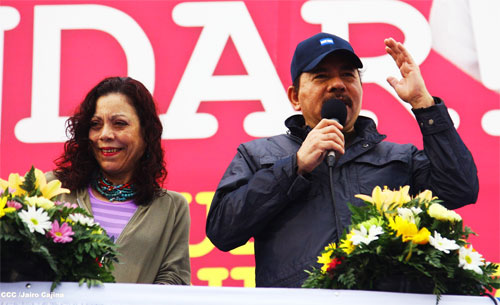
Today, Murillo is by Ortega’s side every step of the way. It is almost impossible to obtain a recent image of Nicaragua’s president without Murillo. This, because besides being Ortega’s wife, she is also the head of the Cabinet and official spokesperson for the government of Nicaragua.
In Nicaragua, it is said that the day-to-day decisions of the government are made by Murillo: it is she who decides what ministers should say, when they say something, given her order not to give statements to the independent press. It is also Murillo who appoints and dismisses government officials.
It is Murillo who leads the nation in place of President Ortega, as happened initially after Nicaragua learning of the International Court of Justice (ICJ) ruling with Colombia, according to El Tiempo.
Ortega’s wife is who receives presidents and official guests to Nicaragua instead of Foreign Minister Samuel Santos and possiblymost important, controls the feared and controversial Consejos del Poder Ciudadano (CPC) – Citizen Power Councils – the political wing of the FSLN that is present in barrios and communities around the country, which are said to be the eyes and ears of the government.
Murillo demands she be called ‘compañera Rosario’.
“La compañera” can be described as “super minister”, a character ubiquitous in the Ortega, who is always present: is personal assistant, translator and spokesperson.
Those who have known her define her as educated and a lover of poetry, but also as mystical, spiteful and vindictive.
Murillo has made mysticism an element of the Nicaraguan government. She herself decorates the official floorboards with flowers and religious and mystical symbols, as the “Mano de Fátima”, to ensure good luck in all official acts.

“Murillo lives and professes the world of spirituality and the supernatural. Her trademark are very thin tights on tabby legs, 30 rings on her hands, a dozen necklaces, a dozen bracelets, and round glasses, in a John Lennon style, far from the traditional figure of first ladies,” wrote journalist Octavio Enriquez in a profile of Rosario.
Sources who for obvious reasons prefer anonymity say that her alleged ambitions of power can unleash strong divisions between the circles close to Ortega, who apparently do not trust the first lady and dear she wants to success her husband.
Feminists criticize Murillo for her staunch defence Ortega when her daughter, Zoilamérica Narváez, accused him of sexual abuse as a child.
With files From El Tiempo, Wikipedia, La Prensa and 19 Digital

The social media, in particular Facebook, has been abuzz with the reaction of Costa Ricans to Nicargua’s president claim to Guanacaste.

¡Diay! Map of Central America circa 16th century clearly showing that Nicaragua’s coastline belongs to Costa Rica!

…waiting for Daniel Ortega

…weather forecast, sunny mornings, with possible rain in the afternoon and problems with Nicaragua in the evening…

If Daniel Ortega claims Guanacaste, it claims the Parque de la Merced! (The Merced park in San José is dubbed “Nica” park, as it is a place of encounter for many Nicaraguans living and working in Costa Rica.

Ortega (top): “I am going to claim Guanacaste!”
Chinchilla (bottom): “Best I give it to you on concession.”

“It would be extremely serious to interpret this as a game or joke”, said Presidenta Laura Chinchilla, at a press conference when addressing the comments made by Nicaraguan president Daniel Ortega.
“With Costa Rica you do not play with”, said Chinchilla.
The presidenta was adamant that the statements made by her Nicaraguan counterpart are “absurd and disrepectful” and that “Nicaragua has not right to Guanacaste”.
On Tuesday, in Managua, during the anniversary of the Nicaraguan Navy, Ortega said his government will make a claim for Guancaste before the International Court of Justice in The Hague. “We are not talking about a 2.8km strip of land, but thousands of square kilometres”, Ortega told his audience.
“We Costa Ricans are a peaceful people, but ready to respond to such insolence by the forces of our convictions of historical truth and international law…enough of the insults, of infamy and bravado”, said Presienta Chinchilla.
© QCostarica.com


