Costa Rica's Vice-President and Chancellor, Epsy Campbell
Chancellor Epsy Campbell said that Costa Rica will maintain its “humanitarian attitude of welcome” to Venezuelans, understanding that the political situation in that country is “complex”.
Costa Rica’s Vice-President and Chancellor, Epsy Campbell
The announcement came a day after the government of Carlos Alvarado said it does not recognize the legitimacy of the presidential elections that took place last Sunday in Venezuela, in which President Nicolás Maduro was re-elected for six more years in power.
Campbell said that Costa Rica has had a welcoming position for Venezuelans, although it still does not have information indicating if there is a strong increase in migratory flows.
“(…) Our attitude will be maintained, it is an open one …” said the chancellor.
Venezuelans usually enter Costa Rica with tourist visas and, when they are here, a good number request refuge. Not being a border country, they must travel by through other countries.
Venezuelans typically seek refuge in Costa Rica for lack of medicines in their home country. During 2016, more than 1,200 Venezuelans sought refuge in Costa Rica, citing lack of medication and not just political persecution, at a time when Venezuela suffered a severe shortage of food and medicine, apart from a deep-seated insecurity.
However, many faced problems in the process because refugee status is granted to whoever proves that their life is in danger in the country of origin and that the State does nothing to protect it.
As for Sunday’s elections, the Ministry of Foreign Affairs considers that the electoral process, in which 46% the population participated, “has been flawed since the beginning and did not meet the international standards of a pluralistic, democratic, transparent and free process”.
In addition to not recognizing the results, Epsy Campbell said that, in agreement with the Group of Lima, Costa Rica has joined a group of countries to analyze the crisis in Venezuela.
In that sense, the Alvarado government does not rule out the adoption of measures such as the blocking of funds for the Maduro regime, similar to the decision taken by the U.S. on Monday, but Campbell said that they want to be cautious about it until there are firm decisions.
“Costa Rica expresses its deep concern that election day did not have the participation of all political parties, or independent international observers, which weakens democracy,” the Foreign Ministry said in a statement on Sunday.
According to the consular registry, updated to January of this year, there are 902 Costa Ricans residing in Venezuela.
The two women suspected of killing the Italian businessman, Stefano Calandrelli, had kidnapped and tortured another man to rob him. The events occurred on April 17, said on Tuesday afternoon the Operational Unit of the Prosecutor’s Office.
Currently, the young women, with last names Smith Smith (24 years old) and Vega Bonilla (19), were ordered to six months of preventive detention, after being arrested on Friday May 18 in then missing case of Calandrelli.
According to the Organismo de Investigación Judicial (OIJ), after the disappearance of Calandrelli, the April case involving Smith came to light. The difference in the cases is that in April the man survived.
Although authorities have not yet said how Smith and Calandrelli met, it is presumed that it was through the Badoo social network and that they set an appointment for Monday, May 14, in the house that the women rented, in San Joaquín de Flores , Heredia. In the house investigators found traces of blood, so it is presumed that Calandrelli, 51 years old, was killed on there.
Calandrelli was last seen alive on May 14 in Escazu. His body was found on Sunday, May 20, in the area of Rio Sucio, on the road to Limon. He had been dead several days.
A report from the Office of the United States Trade Representative (USTR) keeps Costa Rica among the countries in the world that must be monitored for piracy.
Counterfeit shirts of the national soccer team, for example, are openly sold in public.
The report identifies business partners in the United States where the protection and enforcement of intellectual property have deteriorated or have remained at inadequate levels in accordance with international legislation in this area.
Intellectual property is the regime of private property rights that protects creations and inventions in order to grant the creator or inventor the exclusive right of exploitation and to prohibit unauthorized use by third parties.
According to the Report, although Costa Rica has made efforts in this area, they have been insufficient.
“Costa Rica remains on the Watch List in 2018. Despite a number of important unresolved concerns, the United States welcomes positive steps taken by Costa Rica, including the 2016 release of an online patent database, an increase in patent registrations, participation in a Patent Prosecution Highway pilot program with the U.S. Patent and Trademark Office, as well as other ongoing engagement with the United States,” says the report.
In terms of unresolved concerns, the report says Costa Rica has made less progress on ensuring that government entities use only licensed software. In addition, the United States urges that effective action be taken against online markets that specialize in offering unlicensed works, as well as providing greater transparency and clarity in the scope of protections for geographical indications, in order to relieve the uncertainty in access to markets.
“To improve border enforcement, Costa Rica should create a formal customs recordation system for trademarks to allow customs officers to make full use of their ex officio authority to inspect and detain goods,” says the report. “The United States continues to call upon Costa Rica to provide greater transparency and clarity as to the scope of protections for GIs to alleviate market access uncertainty.”
The fight against piracy and counterfeiting is part of the work of the Observatorio del Comercio Ilícito (OBCI) – Observatory of Illicit Trade of the Chamber of Commerce of Costa Rica. According to OECD statistics, in 2013 international trade in counterfeit and pirated products represented 2.5% of world trade and is closely related to other organized crimes such as money laundering, corruption and trafficking in persons.
“The fact that Costa Rica remains on this list reminds us each year that our country is a paradise for piracy and counterfeiting. This not only generates millionaire losses for the holders or representatives of the brands that invest a lot of money in innovation, but it also generates multiple social consequences and impacts the finances of the State when evading taxes,” said Jason Chaves, executive director of the OBCI.
From the OBCI we make a respectful call to the new authorities to address this problem in a decisive way and we make ourselves available to coordinate joint actions in order to generate concrete solutions and reduce the levels of illicit trade in the country.
The world has been consumed by royal wedding fever, as is customary when the British royals do, well, anything. Prince Harry, sixth in line to the throne, married American actress Meghan Markle on Saturday last in a lavish ceremony at Windsor Castle.
Britain’s monarch is best-known.
With so much attention on them, one could be forgiven for not realizing there are actually many other royal families around the world. They’re in charge of 28 monarchies overseeing 29 countries, from absolute monarchies, such as Vatican City and Brunei, to constitutional democracies like those in most of Europe.
Of course, most of the world’s kings and queens are no more, and the majority of surviving monarchies have mostly given up their political functions, explains Boston University’s Arianne Chernock, a professor of modern British history. Particularly in Europe — which is home to 12 sovereign monarchies — royals hold ceremonial roles and work in the arena of soft power, having ceding most day-to-day control to modern, democratic political systems.
“They have a role to play in state functions, but it’s largely performative as opposed to substantive,” says Chernock, who studies women, politics and the British monarchy.
Still, Britain’s royals are the best-known.
Queen Elizabeth II’s reign extends to 16 countries including Canada and Australia.
So why are we so obsessed with them?
“There are so many reasons why people are following this wedding, and they range from escapism to really fascinating gender politics to colonial histories and post-colonial histories,” Chernock says. “The fact that America was once British, that this once was our royal family, is significant in this story. … For Americans especially, we’ve grown up with Disney films. We are captivated by the fairy tale elements that are on display.”
She adds: “I think in our moment that we’re in, who doesn’t love a feel-good narrative that turns on romance and love, and where everyone looks beautiful?
Despite the photo leaves the impression that Carlos Alvarado and his wife are king and queen of Costa Rica, the country is not a kingdom. Photo taken on inauguration day, May 8, as the newly sworn in President waits to receive invited international guests after his coronation, sorry, swearing in ceremony.
Other royals
1. Andorra
The Catholic Bishop of Urgell, Joan Enric, and the president of France, Emmanuel Macron, are technically co-princes of Andorra, a microstate between France and Spain, because of a 1278 treaty that set up joint rule. The position doesn’t add much to the French president’s duties, but in 2009, then-President Nicolas Sarkozy threatened to abdicate over Andorra’s secretive banking laws.
2. Kingdom of Bahrain
Hamad bin Isa al-Khalifa is the island nation’s first king, having changed his title from emir in 2002. The al-Khalifa family, which is Sunni, has ruled the Shiite-majority country since 1783. In 2011, during the Arab Spring and the surfacing of pro-democracy protests, King Hamad brought in troops to halt demonstrations. The violent clashes between troops and police left 30 civilians dead. It’s been reported that dozens of protesters have been killed at demonstrations since then.
3. Kingdom of Belgium
King Philippe took the throne of Belgium on July 21, 2013 after his father abdicated. He is the seventh king since 1830 and his daughter, Elisabeth, is expected to eventually become the country’s first female monarch.
4. Kingdom of Bhutan
King Jigme Khesar Namgyel Wangchuck is the very popular leader of this democratic constitutional monarchy known for its “gross national happiness,” a term coined by his father. He is also known as the Druk Gyalpo, or Dragon King, and holds little actual power after his father oversaw widespread democratic reforms.
5. Brunei
Sultan Hassanal Bolkiah, who also serves as prime minister of this absolute monarchy, took the throne in 1967 and is the longest-reigning monarch after Queen Elizabeth II. He is among the richest men in the world, and he lives in the world’s largest residential palace, the Istana Nurul Iman, with nearly 1,800 rooms.
6. Cambodia
King Norodom Sihamoni was chosen in 2004 by a nine-member council after King Norodom Sihanouk abdicated the throne. He grew up in Prague but returned to Cambodia in 1977, where the Khmer Rouge put the royal family under house arrest until the 1979 invasion by Vietnam. Earlier this year, Cambodia made it illegal to insult the monarchy.
7. Denmark
Queen Margrethe II heads the royal house in Denmark, which also includes Greenland. She is the first female ruler since Margrethe I, who ruled from 1375-1412, because of a constitutional amendment in 1953 that finally allowed women to assume the throne.
8. Japan
Emperor Akihito, 84, recently announced he would abdicate on April 30, 2019, due to declining health. Akihito, who became emperor of Japan in 1989, is the first to step down in 200 years. His son, Naruhito, will replace him.
9. Hashemite Kingdom of Jordan
Abdullah II’s royal wedding in 1993 ranks on lists of some of the most elaborate weddings. The wedding cake was so large, Queen Rania al-Yassin cut it with a military sword. Abdullah, a constitutional monarchy, became king in 1999 and has introduced some reforms during his reign, prompting the Freedom House to upgrade the country to “partly free” from “not free” in its 2017 report.
10. Kuwait
Sheikh Sabah Al-Ahmad Al-Jaber Al-Sabah, 88, was named the new Emir in 2006 after Sheikh Saad, then crown prince, was unable to speak due to illness and could not take the full oath to assume his office. He abdicated and Sabah took over. Sabah served as prime minister of Kuwait from 1963 to 2003, one of the longest-reigning prime ministers in the world.
11. Lesotho
Letsie III succeeded his father in 1990 when Moshoeshoe II was forced into exile. His father regained the throne briefly in 1995 before dying in a car accident. Lesotho is a constitutional monarchy, but Letsie says he is interested in responsibilities that are more than ceremonial. A connection to the upcoming royal wedding: Teen Vogue lists Queen Masenate Mohato Seeiso of Lesotho as another stylish royal of black descent.
12. Principality of Liechtenstein
Prince Hans-Adam became head of state in this tiny nation of 32,000 residents following the 1989 death of his father, Prince Franz Josef. Voters granted him new powers over government in a 2003 referendum, after which he handed over the day-to-day governance to his son, Crown Prince Alois.
13. Grand Duchy of Luxembourg
Grand Duke Henri has reigned since 2000, after his father, Grand Duke Jean abdicated the throne. A 2008 amendment to the Luxembourg constitution removed the requirement that royal assent was needed for laws passed by the Chamber of Deputies.
14. Malaysia
Malaysia is in turmoil after an opposition party won the most recent election in May. The current king, Sultan Muhammad V of Keletan, took the throne in 2016. But Malaysian kings serve a five-year term and are chosen through the Conference of Rulers, making them one of the few elected monarchs in the world. The position tends to rotate among the leaders of the nine Malay states by order of seniority.
15. Principality of Monaco
Prince Albert II of Monaco is the son of American actress Grace Kelly and Rainier III. Monaco, a microstate home to only 38,000-some people, is a constitutional monarchy, but the head of state wields executive, legislative and judicial power. He is the only incumbent head of state to have visited both the north and south poles, trips which he took as part of his efforts to emphasize environmental issues. He also recently purchased Kelly’s Philadelphia home and restored it.
16. Morocco
Mohammed VI assumed the throne in 1999, and shortly after promised to tackle poverty and his country’s human rights record. In February 2004, he enacted a new family code that gave women more power. In 2010, Wikileaks published cables alleging that a holding company owned by the king was soliciting bribes from the country’s real estate sector. We’ve reported that he’s enormously popular and the the king of selfies.
17. Kingdom of the Netherlands
Willem-Alexander is the king of the Netherlands: He is currently Europe’s second youngest monarch, after Felipe VI of Spain. He is also the first male monarch of the Netherlands since the death of William III in 1890. Willem-Alexander has a democratic bent; in 2013 he told his subjects not to call him “your majesty” — unless they really want to.
18. Kingdom of Norway
Harald V is the King of Norway. As a child, his family went into exile during the German occupation of World War II. His marriage to Sonja Haraldsen in 1968 was controversial, because she was a commoner. Earlier this month, the Norwegian Parliament stripped from the Constitution the assertion that the king is “holy.” He must still belong to the Evangelical Lutheran church, however.
19. Sultanate of Oman
Oman, the oldest independent state in the Arab world, is ruled by Qaboos Bin Said Al Said who acts as Oman’s sultan, prime minister and foreign minister. He is the region’s longest-serving monarch and his country has largely avoided the troubles of its neighbors: Saudi Arabia and Yemen.
20. State of Qatar
Qatar is an absolute monarchy under the reign of the Al Thani family. Technically, under the constitution the country is meant to be a constitutional monarchy, however the family does not allow political opposition and banned the existence of political parties. In recent news, it has been found that US President Donald Trump’s personal attorney, Michael Cohen, solicited $1 million from the oil-rich company.
21. Kingdom of Saudi Arabia
Saudi Arabia is an absolute monarchy with King Salman bin Abdulaziz al-Saud as the head. His dynasty holds a monopoly on political power. Most notably, after the death of the former king, al-Saud’s half-brother, the new king implemented a number of liberal reforms, including s decree that will allow women to drive.
22. Kingdom of Spain
King Felipe IV (full name, Felipe Juan Pablo y Alfonso de Todos los Santos) and his wife Queen Letizia are largely ceremonial figureheads. They took the throne of Spain in 2014 and to our knowledge, King Felipe IV does not wear “boots of Spanish leather.”
23. Kingdom of Swaziland
King Mswati III of Swaziland rules over one of the world’s only absolute monarchies. Most recently, he renamed the country “the Kingdom of eSwatini” which means “land of the Swazis.”
24. Kingdom of Sweden
Carl XVI Gustaf is the king of Sweden — a constitutional monarchy. Sweden was the first monarchy to change its succession rights so that the first-born child is the heir to the throne, regardless of gender.
25. Kingdom of Thailand
Thailand is a constitutional monarchy that was previously run by Bhumibol Adulyadej. Born in Cambridge, Massachusetts, King Bhumibol Adulyadej was the longest-reigning monarch before he died in 2016. Maha Vajiralongkorn is Thailand’s current king. His names translates to “adorned with jewels or thunderbolts.”
26. Kingdom of Tonga
The current king of the Pacific island nation, Tupou VI, was coronated in 2015 after his brother, the previous king, died. Tonga is the only sovereign monarchy in Oceania.
27. United Arab Emirates
The UAE is a bit more complicated than other monarchies. It has a presidential, federal and despotic monarchy and is actually made up of seven constituent monarchies: Emirates of Abu Dhabi, Ajman, Dubai, Fujairah, Ras al-Khaimah, Sharjah and Umm al-Quwain. In 2004, Sheikh Khalifa bin Zayed Al Nahyan, Ruler of Abu Dhabi, was elected as President of the UAE.
28. Vatican City
Often overlooked, Vatican City is an absolute monarchy with the pope at its head. The sovereign existence of Vatican City was established by Benito Mussolini in 1929 when Mussolini signed the Lateran Pacts. Vatican City is considered the smallest country in the world and covers just over 100 acres.
Vincenzo Bruno, 44, is an LGBTQ rights activist in San José, Costa Rica. Here, he sits in his childhood home.
Photo:Carmen Graterol/PRI
When an anti-LGBTQ candidate won the first round of presidential elections in Costa Rica, Vincenzo Bruno took to Facebook to denounce him.
Vincenzo Bruno, 44, is an LGBTQ rights activist in San José, Costa Rica. Here, he sits in his childhood home. Photo: Carmen Graterol/PRI
“We are completely against Fabricio Alvarado, He doesn’t represent us, he doesn’t represent anyone in the LGBTQ community,” Bruno told his followers in Spanish. “No! No more abuse, no more hate, we reject him!”
Bruno, 44, is an LGBTQ rights activist in San José, Costa Rica. While historically Catholic and conservative, in recent years Costa Rica had been expanding rights to the LGBTQ community and was becoming known for its progressive politics. But in January, when the Inter-American Court of Human Rights ruled that Costa Rica should allow same-sex marriage during an election year, presidential candidate Fabricio Alvarado rode a wave of anti-LGBTQ sentiment to the top of the polls. Costa Rica was thrown into a runoff election between an establishment candidate, Carlos Alvarado, who said he would follow the court’s opinion and Fabricio Alvarado (no relation), an evangelical singer who campaigned against same-sex marriage and sexual education.
The political fight was heated and Bruno was ready. The battle for LGBTQ rights has been the battle of his life. Bruno is transgender and he remembers that as a kid, when he was living as a girl, he had five locks on his bedroom door.
“When I came home from school I’d lock myself in my room and take out my makeup pencil. I’d draw on a beard and mustache and make my eyebrows thicker. I’d put on one of my brother’s shirts and I learned every knot that I could learn and I’d sit and watch TV, feeling happy with the way I looked,” Bruno said. “But when my parents called to me, I’d run to the bathroom to wash off my face and put on a blouse.”
As Bruno grew up he began to identify as a lesbian. He fell in love and had a kid with his girlfriend. And when he realized his family didn’t have the same rights as heterosexual ones he became an activist.
“I met a trans woman when I became the vice president of the LGBTQ movement,” said Bruno. “Every time we went out she would ask me, ‘Do you think you might be trans?’”
Vincenzo Bruno relaxes in his childhood home where he used to paint on a beard and mustache, happy that he no longer needs a makeup pencil to grow facial hair. Photo: Carmen Graterol/PRI
Bruno equated being transgender to a life of misery. He saw all the looks and insults that his friend had to endure and refused to consider that possibility for himself.
“No, I’m not trans. No, I’m not trans. No, I’m not trans,” Bruno remembered telling her over and over.
One day, he was out shopping with his partner. He had a communion coming up and he had to buy an outfit for the event. Formal wear adheres to strict gendered extremes and he had a choice to make: a suit or a dress.
His partner brought him to a men’s clothing store.
“We bought brown pants and a polo shirt and my body went into shock. I left the store and sat on a bench and began to cry,” Bruno said.
He said he looked at his partner and said he wanted to be a man and she looked back at him and told him that they would look for a doctor and get hormone treatments for him.
“It was a moment when everything was illuminated. Have you seen the movie ‘Pleasantville,’ where everything is black and white and then all of a sudden things come into color? That’s how it was for me — I’d been living for 30-odd years in black and white and suddenly they tell me I can grow facial hair and transition and my life came into color,” said Bruno.
He started taking testosterone and he said every day he’d get up and run to the mirror, anxious to see the changes in his body. His son, Luca, was a little less excited about the changes.
“I told my son that, ‘From now on, I want you to call me Papa instead of Mama,’ and he got scared. He was worried that I would change and not be sweet and caring anymore,” Bruno said
That was five years ago — Costa Rica was still a hostile place for transgender people. The first doctor he went to refused to treat him. Bruno kept fighting for his rights.
He went to the courts to change his name on his government-issued identification. The judge told him he had planned to rule against his request but changed his mind when Bruno’s partner gave her testimony about the humiliation they faced every time they went to the grocery store. She explained that clerks would ask for ID when Bruno paid with his credit card and would reject it because it still showed a female name and sex while he had a beard and mustache.
As Bruno’s life evolved, so did Costa Rica’s political climate. In 2017, after years of advocacy, the government started offering publicly funded hormone therapy for transgender people. Then the Inter-American Court of Human rights published its opinion that Costa Rica should allow same sex marriage.
That’s when Fabricio Alvarado took the national stage. He made headlines when he said that, if elected, he’d pull Costa Rica out of the Court rather than follow their ruling on same sex marriage. He also promised to get rid of non-discrimination protections that had been signed into law and stoked fears that recognizing transgender people would lead to men pretending to be women in order to assault other women.
With the runoff election looming, Bruno threw himself into his activism and getting out the vote. He was also working on a nationwide program to make sure transgender people could make it to the polls without being harassed. He was worried about the outcome.
“We’re in a really sad position,” Bruno said. “We’re in the hands of a completely homophobic and diverse-phobic person. We’re all just waiting to see what happens on April 1,” which was Costa Rica’s runoff election.
In a strange confluence of events voting day landed on Easter Sunday. The whole country had been on vacation and the highways were bumper-to-bumper as people tried to make it back in time to their polling stations.
People lined the streets waving their party’s flags, cars honked their horns and the air felt electric with anticipation.
At the end of the day Bruno turned his camera back on to deliver a new message to his Facebook followers.
“Democracy won! Equality won! Human rights won! Everybody won! Costa Rica won today!” Bruno screamed as car horns blared and people cheer in the background.
On April 1, his candidate, Carlos Alvarado, won by a large margin and Bruno was relieved. Since the election, the government is set to follow the Inter-American Court of Human Rights ruling and they are now allowing transgender people to change their names and plan to eliminate sex from government-issued identification.
But even with this win, Bruno says he’s not done yet. He wants Costa Rica to be even more progressive.
“There are three things I want: First, that transgender people aren’t reliant on a psychologist’s approval [for hormone treatment]; second, that people under 18 can get access to hormones; and third, that it’s a complete package — [publicly funded] hormones and gender-affirming surgery,” he said.
Government officials say they’re open to the changes Bruno wants to see. Doctor Gloria Terwes worked on the legislation for publicly funded hormone therapy. She underscored that as a public institution they have a mandate to ensure they aren’t putting people at risk.
Doctor Gloria Terwes works at the Department of Social Development where she helped draft the legislation offering publicly funded hormone therapy for transgender people. Photo: Carmen Graterol/PRI
“We’re in the first stage right now. We have to keep analyzing the process,” Dr. Terwes said. “We’re still rolling out the program, but in the future we may consider expanding to people under 18.”
She also acknowledged that gender-affirming surgery may be a possibility too. At the moment there are fewer than 30 transgender people enrolled in the program.
While Bruno continues to fight for his community, things have gotten easier at home with his son Luca.
He recounted a day when he was shaving and noticed his son staring at him, confused.
“We had never talked about how men shave, so I told him I was shaving, and he asked, ‘Will I have to do that one day, too?’” Bruno said. “I remembered that when I was little I thought shaving was the coolest thing in the world. I went and got a plastic shaver and covered his face in foam.”
The two took photos to remember one of their first father-son rituals.
Sarah Barrett reported from Costa Rica on a fellowship from the International Reporting Project (IRP)
Italian businessman Stefano Calandrelli, 51, was tortured before being stabbed to death inside a house in San Joaquín de Flores, Heredia, where the two women lived and then his body dumped.
That was the word by the Fiscalia (Prosecutor’s Office), explaining that the two women, identified by their last names Smith Smith (24 years old) and Vega Bonilla (19), are being investigated for the crimes of kidnapping, torture, aggravated robbery and homicide.
The two women are currently in preventive detention for the next six months, following their arrest last Friday.
As to the three men also arrested on Friday, named Sanchez Cerdas, Mckenzie Banton and Rivas Suazo, the must sign in at the courthouse every 15 days and maintain a fixed address.
The men are alleged to have helped the two women. According to article 329 of the Penal Code, someone who impedes an investigation or evades authority or omits to denounce a crime when obliged to do so faces a punishment of between six months to four years in prison.
Although the OIJ is waiting on a full forensic examination to officially confirm the body found on Sunday is in fact Calandrelli, Espinoza said physical evidence at the crime scene indicates that is most likely Calandrelli.
In addition, Rafa Castro, the person believed closest to Calandrelli, posted on social media that his friend had been found dead. Adriana Duran, a noted journalist and Calandrelli’s ex-wife posted on Facebook, he son “had an exceptional father, loving, special and always present”.
For now, authorities presume the motive for the murder is robbery, although the case remains under investigation, explained the director of the Organismo de Investigación Judicial (OIJ), Wálter Espinoza.
The OIJ said there was no request for ransom.
The infograph prepared by La Nacion on what is known in the case so far
Calandrelli disappeared on May 14, the day he was last seen alive for the last time by a partner of his, during a business meeting in Escazú. The next day, Stefano did not answer calls or messages, so his partners filed the complaint with the police.
Espinoza explained that during the investigation they were able to determine that the deceased, had had “a personal meeting” with Smith, who was renting a house together with Vega in San Joaquin de Flores, in Heredia.
“The nature of the meeting, how it was established or how it was contracted is still part of the investigation,” said the head of the OIJ.
The house where the two women suspects lived was raided on Friday and the luminol tests were done by crime scene investigators were positive to the presence of blood. It is believed that Calandrelli was killed in the house. In addition, police were able to recover a bag of bloody clothes, near the Juan Santamaría airport, in Alajuela, thrown by one of the suspects on the day of the arrest.
In the house, investigators found a garbage bag with the pair of glasses worn by Calandrelli on the day he was last seen alive.
Espinoza ruled out news reports circulating in the social media that Calandrelli had been shot or decapitated. The OIJ chief said that, although the body found on Sunday was in an advanced state of decomposition, leg wounds, blows and puncture wound on the back and the neck were still visible. The crime lab estimates Calandrelli had been dead for five or six days, a timeline that coincides with the time of his disappearance.
“There is a similar case that has not yet been resolved, but which is related to the temporary disappearance of persons, with the common link that apparently involves Smith,” said Espinoza.
HAVANA TIMES — Lieutenant Colonel Roberto Rodriguez, Head of the National Traffic Board, announced that 750 people died in accidents last year.
He then went on to announce that “The human factor stands out in all of these cases. That’s why, we are sure that this is the decisive factor in accidents, in spite of the country having an aged vehicle pool, a road network in average condition and a poor level of road signs. Hence the importance of road users acting with the utmost responsibility.”
That’s to say, drivers are the ones to blame, according to the police, and let me repeat the above: “in spite of the country having an aged vehicle pool, a road network in average condition and poor level of road signs,” and yet the government, who holds an absolute monopoly over everything to do with this, isn’t to be blamed at all.
Let’s see, shall we.
According to official figures, 85% of Cuba’s roads are in average or poor condition!!! As a result, braking systems, steering wheels, transmissions and tires are constantly being worn out. Many of these are repaired with inventions or home-fixes as the Government doesn’t allow mechanics to import the parts they need and they don’t import them themselves.
In its eagerness to centralize everything, the State isn’t able to coordinate repairs of electricity, gas, water or phone companies and so roads are constantly being dug up, but they don’t close them afterwards because that’s another company’s job, which doesn’t do this or does it very badly.
Side roads look like they belong in a place subject to area bombing after so many years of not being repaired, forcing drivers to concentrate on main avenues.
Intersections in many neighborhoods are crowded with garbage which block the road and the state-led garbage collection company operates like the Council of State, without haste but without stopping, but without haste.
Urban transport, which is always overcrowded, subjects roads to significant stress.
Road signals are extremely faulty and scarce. There are very few traffic lights and they are broken a lot of the time. Vertical and horizontal signs are worn out by the harsh tropical climate we have and a lack of maintenance, when they exist at all.
If the road signs for cars is highly deficient, it basically doesn’t exist for pedestrians, if you omit one pedestrian traffic light here and there.
Many sidewalks are broken up so pedestrians end up walking in the streets. They also invade the road to try and get onto a bus, which almost NEVER stop at the bus stop but 50 meters before or after it so as to better control the enraged and desperate human herd’s access to the bus.
“It’s cheaper to get drunk in Cuba than it is to eat”
Cuba’s vehicle pool is a scrapyard on wheels with a 32-year average life according to MITRANS, but then what can you expect if a 20-year-old (or more) LADA costs 20,000 CUC or a rundown ‘53 Ford costs you 12,000? The government continues to refuse to import modern cars.
The assistant Head of the National Office of State Transport Inspection, added that in the Americas, road accidents take approximately 154,000 lives per year (15.9 per 100,000 inhabitants), rates varying from a low 6.0 in Canada to a high 29.3 in the Dominican Republic.
“At the end of 2017, Cuba recorded a rate of 6.67 deaths per 100,000 inhabitants with 750 people dying,” he stressed proudly.
I thought that we should give ourselves a pat on the back for being on the same level as Canada but then I thought that the number of vehicles among inhabitants is more important for this calculation than the number of inhabitants in itself.
I was surprised that MININT officials, who are always so efficient in their work, had overlooked this small detail.
Because I don’t know how many vehicles there are registered here in Cuba, I called the National Traffic Board and they asked me why I wanted to know. When I told them that it was to compare against figures given by their boss, they told me that this was a figure they couldn’t just give to anyone. In revolutionary Cuba, I’m not a citizen, I’m anyone.
I found the following online:
In 2010, Cuba came in 95th place out of 120 countries listed by the World Bank when it came to the number of vehicles there were per 1000 inhabitants: 38. Latin American countries have an average of 186, the European Union has an average of 541, high-earning OECD countries had 629 and the United States had 825.
Canada has 563 vehicles per 1000 inhabitants, if we divide 563/38 = 14.8, that is to say, there are 15 more cars per capita in Canada. Therefore, if they had compared these figures in a more appropriate way, we would have seen that there a lot more chances of dying in a road accident in Cuba than in Canada.
I don’t feel like giving them a pat on the back anymore, not unless it’s for their demagogic use of statistics.
If we add to this the fact that it’s cheaper to get drunk in Cuba than it is to eat, and that it’s just as easy to bribe a policeman, it seems that the Revolutionary Government holds some responsibility in this, and let’s thank God that we don’t have as many cars as Canada does.
The University Coalition on Monday proposed the adoption of a “law to set the framework for transition and democracy”, with its first step the immediate destitution of Nicaraguan President, Daniel Ortega.
(Ortega and Murillo) are going, they are going. End the repression, peace! Photo: Bienvenido Velasco EFE /Cinfidencial
The students feel this is the only way to move past the crisis that has cost the lives of 76 people since last April 18, according to information provided by the Interamerican Human Rights Commission.
The proposal was launched by university student Lesther Aleman during Monday’s session of the national dialogue in Nicaragua, a dialogue that began last Wednesday, May 16. Aleman’s proposal was summarily rejected by the government representative present.
The student leader criticized the current constitutional framework, because “the system has been corrupted” and proposed discussing a framework law that would include the destitution of Ortega and his wife, Vice President Rosario Murillo, prior to reforming the Constitution.
University coalition proposes “Law to set the framework for a democratic transition”. Government opposes this, alleging that it implies “breaking with the Constitution”.
“No restructuring can be done within the same system,” he warned in the forum, which was transmitted live by a television channel in the country belonging to the Catholic Church.
Victor Cuadras, another of the student leaders, underlined the fact that they were at the table to demand the “surrender of Daniel Ortega, Rosario Murillo and their minions” and that this demand isn’t negotiable.
Foreign Minister Moncada appeals for “caution”
Speaking for the government [in the absence of Ortega and Murillo] Denis Moncada, the Nicaraguan foreign minister, warned the members of the Episcopal Conference who are witnessing and mediating the process that “we must view with great caution anything that implies a break with the constitution.”
Students in Managua participating in a protest against the government of Daniel Ortega. Photo: EFE / Bienvenido Velasco / Confidencial
In the same way, he claimed that “it’s incongruent to speak of political reforms if we don’t agree to guarantee the country’s stability.”
In that sense, he noted that blocking the highways “seriously” affects the population, and that it’s necessary to reestablish peace.
In addition, Moncada asked that four representatives of the Organization of American States be invited to the next session of the dialogue in Nicaragua, planned for Wednesday. The OAS currently maintains negotiations with the government to reform the country’s electoral system.
Agro business rep criticizes the lack of transparency in the negotiations with the OAS
Michael Healy, a representative of the private sector, criticized the lack of transparency in the negotiations between the government and the OAS on themes regarding the country’s institutions.
“It’s a mockery to the Nicaraguans that behind the curtains they’re cooking up things that we don’t know about,” noted Healy, president of the Nicaraguan Agricultural Producers’ Union (Upanic), at the same time that he gave his support to the students’ proposal and in addition demanded the resignation of National Assembly president Gustavo Porras, who presides over the public health sector of the country.
Healy criticized Porras for the hospitals refusing to receive the students during the protests and for their negligence. He based his comments on the denunciations that have been made public.
Medardo Mairena, a rural leader of the movement against the plan for a canal, also demanded Ortega’s resignation. because “that’s what the people are asking for.”
For his part, Juan Sebastian Chamorro of the private sector suggested that the entire bench of magistrates for the Supreme Electoral Council should also resign, and invited Luis Almagro, secretary of the Organization of American States to visit Nicaragua.
Government cites the economic instability and the risk to jobs
The government, in the words of Ovidio Reyes, president of the Central Bank, insisted that first and foremost the country must recover its stability. He warned that Nicaragua has lost 258.9 million dollars during the protests, with those most affected being the “hotels, restaurants, commercial sector and service industries.”
Reyes, who put the losses from the tourist sector at 185 million dollars, also warned that more than 50,000 jobs could be lost this year when the economy will now grow at a rate between 3 and 3.5%, less than [up to 5%] as had been foreseen.
“It seems that [the government] puts more value on money than on the lives lost,” replied Jose Ramon, one of the university student representatives. He also denounced the fact that the government had broken the 48-hour truce that they had agreed upon last Friday to halt the violence.
“In terms of the truce, we’ve done the best we could,” stated chancellor Moncada.
Later in the afternoon, those participating in the round table met in work groups to continue discussing the proposals for an agenda.
The downpours Monday afternoon generated a series of damages in various communities around the country, including the Greater Metropolitan Area (GAM). The Comisión Nacional de Emergencias (CNE) reported more than 60 incidents in San Carlos, Pococí, Sarapiquí, Cartago, Escazú, Curridabat, Desamparados, San José and San Vito.
In this last, there are currently seven families in the sector of Barrio Canada who had to evacuate their homes, because a landslide generated significant damage, as shown by images of neighbors and Henry de Jesús Díaz, de San Vito Television.
The CNE keeps its emergency committees active in the event that more landslides are recorded, as showers with thunderstorms are forecast for this entire week.
Authorities call the population to be alert to any eventuality.
Director del Organismo de Investigación Judicial (OIJ), Wálter Espinoza, said on Monday that the women identified as Katherina Tatiana Smith, a resident of Limon, and is currently in preventive detention, was the person who rented the house that had held the Italian businessman, Stefano Calandrelli. Prior to the Stefano case, the woman was already under investigation by OIJ agents, a suspect in three other ‘temporary’ disappearances.
According to investigators, the suspect contacted her victims through the Badoo social network, invited the men to the San Joaquín de Flores house, where they would be held until there was a payment.
Investigators explained it wasn’t a case of kidnapping or extortion, rather the victim would be robbed of cash and belongings.
Luring their victims through social media for robbery, sexual assault, extortion, and kidnapping has been reported in Mexico and several countries in South America.
The OIJ is asking anyone who has been a victim to report it 800-800-645.
(Insightcrime.org) Colombia’s presidential election, scheduled for May 27, comes at a critical time in the country’s history. The peace process with the FARC is underway, but new criminal dynamics are presenting challenges that the next president will have to face. Although every candidate has proposals to fight organized crime, the viability of some of their ideas is uncertain.
InSight Crime analyzed the proposals of the five main presidential candidates on drug trafficking, criminal groups, security, justice and the peace process with the Revolutionary Armed Forces of Colombia (Fuerzas Armadas Revolucionarias de Colombia – FARC) and the National Liberation Army (Ejército de Liberación Nacional – ELN), as well as their positions on illegal mining.
Drug trafficking was the most controversial topic, with candidates offering proposals from opposite ends of the spectrum. They also had different opinions on how to deal with guerrilla groups. Some say they would walk away from the negotiating table with the ELN, and all but one would support the current FARC peace process, which has taken historic steps towards ending the armed conflict. A number of the candidates’ proposals are risky, and could backfire if not well implemented. Others could see long-term success if done correctly.
Drugs
With Colombia producing more cocaine than ever, the drug trade will be a major security issue for the incoming president.
Past anti-narcotics policies have run into numerous challenges. Forced eradication has not reduced overall coca levels as eradicated areas are often re-sown by farmers shortly thereafter. There have been health concerns associated with the chemicals used to kill the plants, and recent operations to uproot farmers’ cash crops have spurred protests and massacres of civilians.
As part of a 2016 peace agreement with the Revolutionary Armed Forces of Colombia (Fuerzas Armadas Revolucionarias de Colombia – FARC), the government has launched a new crop substitution program aimed at incentivizing farmers to replace illicit coca with legal crops. While promising, the program has been undermined by powerful armed groups seeking to move in on criminal economies left behind by the FARC.
Despite the lack of success associated with forced eradication in the past, two candidates, Germán Vargas Lleras and Iván Duque, both strongly support the practice.
Both Vargas Lleras and Duque have pledged to reinstate the aerial fumigation of drug crops, a controversial practice banned in 2015 on health grounds.
Duque has proposed making farmers uprooting coca crops mandatory — not voluntary, as the peace agreement with the FARC stipulates.
Vargas Lleras has called voluntary crop substitution “a failure,” although he has advocated a coca eradication goal for 2022 that mainly focuses on substitution.
Other candidates, like Sergio Fajardo and Humberto de la Calle, prioritize substitution, but would also maintain forced eradication as an alternative.
Gustavo Petro, on the other hand, would eliminate forced eradication, due to the social unrest it creates, and focus fully on providing legal opportunities to vulnerable populations.
While some favor more heavy-handed approaches, all candidates have spoken on some level about the importance of rural development and the creation of legal business alternatives so farmers might stay away from the drug trade. Fajardo, for instance, has mentioned the importance of the Territory-Focused Development Programs (Programas de Desarrollo con Enfoque Territorial – PDET), a long-term rural development project for specific municipalities created by the FARC peace deal.
Illicit crop control has yielded less-than-ideal results, but effectively targeting later rungs of the drug trade, like the processing and trafficking of cocaine, could do a lot to disrupt the powerful groups behind the industry.
Some candidates directly address these stages. Vargas Lleras has proposed a reasonably comprehensive strategy that includes securing Colombia’s seas against maritime trafficking — one of the main ways of moving narcotics out of the country. Duque has proposed improving intelligence to detect cocaine laboratories, many of which have now been made mobile.
Criminal Groups, Security and Justice
Colombia’s next president will have to oversee a recalibration of the country’s overall security strategy in the post-FARC era.
The police is the preferred institution to take the lead in fighting organized crime: soldiers are trained to eliminate enemies, not to prevent and solve crimes. Nevertheless, many of Colombia’s crime groups wield serious firepower, meaning the military may need to continue to support the police in operations.
Securing territories formerly under FARC control has proven difficult for the government, as other crime groups have moved in to fill the power vacuum. Huge deployments of security forces have done little to address underlying problems, at times simply displacing violence to other areas.
Improved intelligence gathering, social and economic initiatives for vulnerable communities, efficient justice and steady rural development will be key to achieving long-term results. But these goals come with a hefty price tag, meaning Colombia’s next head of state may have to make tough choices when it comes to how to distribute limited security resources. And the solution isn’t simply to hire more security forces; a poorly planned hiring surge could diminish the quality of recruits and make them more vulnerable to corruption.
Duque and Vargas Lleras have both emphasized the importance of the armed forces in their proposed security strategies.
Vargas Lleras has advocated using military force to establish a presence in areas not currently under state control as a way of allowing other state institutions to enter rural areas. Under his plan, both the military and the police would see an increase in staffing levels, and the police would take the lead in the fight against organized crime with support from the military.
Duque wants to strengthen and modernize the security forces, and improve technology both in rural and urban settings.
De la Calle, on the other hand, has argued that the government’s main enemy, the FARC, has demobilized, and that security forces therefore should shift from an offensive to a defensive posture, securing territories against the incursion of criminal groups. At the same time the state should emphasize crime prevention and improving rural quality of life.
De la Calle has also proposed transferring military officials into the police to refocus efforts on citizen security. While sourcing from the military means that recruits may be better prepared in some ways, adequately retraining the soldiers in areas like human rights and investigative tactics will be crucial to their success as law enforcement officers.
Fajardo’s security strategy centers on the justice system. Instead of rounding up large numbers of suspected criminals in ultimately unproductive arrests, the former mayor would focus on taking down groups’ leaders and financial structures. He also wants to facilitate the collective surrender of members of criminal organization with a law much like the one currently making its way through Congress as part of the FARC peace accords.
In terms of the security forces, Fajardo would put the police at the head of the fight against crime, with military support when necessary. And he would change the military’s broader role to focus on border security, constructing rural infrastructure, and removing landmines.
Petro’s main strategy is socioeconomic development as a way of steering poor populations away from criminal economies. As this weakens illegal groups, Petro argues, they will be easier to defeat militarily. Petro has said he would eliminate obligatory military service and focus the military on defending territorial sovereignty, though it is unclear exactly what this would entail.
Although there is significant divergence in the candidates’ general approach to security issues, most agree that targeting the finances of crime groups should be an important objective and have suggested specific tactics.
Fajardo and de la Calle have both promised to strengthen financial intelligence gathering and improve criminal asset seizure procedures. Duque has also talked about improving anti-money laundering efforts, specifically in reference to assets that the FARC did not declare as it was required to do under the peace deal. However, his proposals are thin on concrete details.
ELN Peace Talks
With the FARC now defunct as a rebel group, the ELN has become the most important guerrilla group that Colombia’s next president will have to deal with. But the issue is a thorny one.
The ELN has been the biggest winner in terms of finances, territory and military might from the FARC’s demobilization. Without a timely response from the government, the danger the group poses will only continue to escalate. Moreover, part of the ELN’s leadership and fighters are believed to be hiding out in neighboring Venezuela, complicating efforts to achieve military gains against the group.
The ELN and the government have been engaged in rocky peace talks for a year. But a final deal with the FARC took four years to hammer out, and the ELN’s fractious nature makes it likely that its talks will take at least as long to bear fruit. Setting tight deadlines and taking important bargaining chips like ceasefires and judicial benefits off the table will likely alienate many ELN members and perhaps even high-ranking commanders. And even if the talks are successful, many factions are likely to continue involvement in illegal activities.
All the candidates have kept the military option on the table in their proposals for dealing with the ELN. But their stances on the peace negotiations vary widely.
Vargas Lleras and Duque are opposed to the current ELN talks. Vargas Lleras has affirmed he will end the talks altogether if he is elected. Duque has given the ELN an ultimatum: if fighters want to demobilize and receive reduced sentences — complete amnesty is not an option — they must give up all criminal activities, and concentrate in designated zones with international supervision within a certain period of time. If this does not occur, they will be attacked by state forces.
Fajardo would also give the ELN a time constraint: the peace talks would have to be finalized a year after he takes office. He has refused to offer a bilateral ceasefire and would continue the military offensive against the group during talks.
De la Calle has expressed a desire to make the ELN talks work, often using the word “hopefully.” Should the talks not work, however, he would continue to combat the ELN militarily.
Petro, a former guerrilla of the April 19th Movement (Movimiento 19 de abril – M-19), which demobilized three decades ago, supports the ELN peace talks. But he stresses that the insurgents must decide which path to follow — the ideological one, or the world of drug trafficking. Should they choose drugs, Petro says, they would be “no longer a guerrilla group … these are criminal organizations” and should be fought militarily.
Both Duque and Vargas Lleras have addressed the problem of the ELN’s safe haven in Venezuela, with Duque promising to denounce the Venezuelan regime’s “support” towards the ELN at the UN Security Council.
FARC Peace Process
More than a year and a half since the FARC and the government signed a peace deal, many aspects of the agreement — the group’s participation in politics, promises not to extradite former fighters, and other issues — still hang in the balance. The next presidential administration could work to build trust in the deal, or it could push for changes that put the already shaky implementation further at risk, driving more FARC members back into the underworld.
With the exception of Duque, all candidates have stated that they would maintain the current peace deal.
Duque would make “structural changes” to the accords, stating that FARC politicians should not be allowed to enter Congress without first making reparations to their victims. (The FARC party has been assigned 10 unelected seats as part of the deal, to be occupied in mid-2018.) The reparations process is part of the transitional justice mechanism (Jurisdicción Especial para la Paz – JEP), which future FARC congressmen have signed onto but not yet completed.
Duque has also promised to stop drug trafficking from being treated as a political crime, in effect removing the amnesty the peace deal offered to former FARC members who had engaged in the drug trade.
While the other candidates have expressed support for the peace deal, they have also made it clear that they will treat FARC members who break the conditions of the accord like any other criminal.
Illegal Mining
Although drug trafficking typically receives much more attention, illegal mining is a huge economy in Colombia, in some cases more profitable to criminal groups than the drug trade. Illegal mining has funded powerful, violent crime groups and has brought devastating environmental consequences.
While destroying mining infrastructure has seen some results, mining communities must be provided with legal alternatives in order to stop them from turning to other criminal economies like the drug trade.
Most of the candidates — de la Calle, Fajardo, Vargas Lleras and Duque — have proposed the formalization of informal miners as one potential solution. But de la Calle, Fajardo and Vargas Lleras would also continue security force operations against illegal mining activities.
Duque’s main proposal would be to make the National Bank the sole authorized buyer of gold in the country (as was the case in the past). This would restrict illegal gold sales, which are often made via legal trading establishments, or make these more visible.
Petro’s main proposal takes a different approach, as he believes that to steer people away from illegal mining, alternative rural economies must be nurtured. He would also reform mining regulations to reflect that artisanal mining should not be considered illegal.
* The proposals listed in this article represent the most prominent proposals on subjects relating to organized crime gathered via a thorough revision of each candidate’s campaign proposals and a revision of debates and public commentary.
MANAGUA – The Inter-American Commission on Human Rights (IACHR) on Monday condemned Nicaragua’s response to weeks of protests against President Daniel Ortega, criticising a crackdown that resulted in rights abuses including torture and possibly even murder.
The IACHR charged on Monday that the material it obtained during its recent fieldwork in Nicaragua shows evidence of “grave violations of human rights” and 76 deaths during the past month of protests.
In a preliminary report of its findings, the IACHR said that since April 18, it had documented at least 76 people killed, and 868 injured, after protests broke out over discontent with a new law that raised worker and employer social security contributions while cutting benefits.
Commissioner Antonia Urrejola, Rapporteur for Nicaragua of the Inter-American Commission on Human Rights (IACHR), speaks during a press conference in Managua, Nicaragua May 21, 2018. REUTERS/Oswaldo Rivas
“The IACHR gathered documentary and audiovisual evidence, and heard hundreds of testimonies that reveal grave violations of human rights during a month of protests, characterized by the excessive use of force by state security forces and armed third parties,” commissioner Antonia Urrejola said regarding Nicaragua.
Urrejola said that the result of the use of force. “This resulted in dozens of deaths and hundreds of people injured, illegal and arbitrary detentions, torture, cruel inhuman and degrading treatment, censure and attacks against the press, and other forms of intimidation.”
The report also said that “there could have been extrajudicial executions.”
Students carry candles during a protest demanding that Nicaraguan President Daniel Ortega and his wife,
Nicaragua “must urgently adopt measures to guarantee the free and full rights of freedom of expression, peaceful gathering and political participation,” the IACHR said, and it urged Managua to adopt 15 recommendations, including investigating human rights abuses and prosecuting those responsible for them.
The IACHR also asked that information on people treated for injuries at hospitals be systematized and all international instruments on human rights and openness to international monitoring be implemented.
Commissioner Antonia Urrejola, Rapporteur for Nicaragua of the Inter-American Commission on Human Rights (IACHR), speaks with executive secretary Paulo Abrao during a press conference in Managua, Nicaragua May 21, 2018.REUTERS/Oswaldo Rivas
The protests mark the most sustained crisis of Ortega’s 11-years in power, and the IACHR’s findings heighten international pressure on the former leftist guerrilla, who has delivered steady growth, despite criticism he has turned the poor Central American nation into a family dictatorship.
Nicaraguan officials are currently in talks with students and business leaders to resolve weeks of tension with the increasingly unpopular Ortega.
At the talks last week, the president was berated by students, who accused him of destroying the country.
Famed economist Lawrence Summers used the rental car as an analogy for the need to promote private property (Util para Todos).
“In the history of the world, no one has ever washed a rented car.” That saying, attributed to the economist Lawrence Summers, former President of Harvard, is a delightful metaphor for the relevancy of a culture of private property ownership in human affairs. A renter has little incentive to wash a car that he or she does not own, is returning to the rental agency, and will never drive again. On the other hand, a car owner has a much greater incentive to take good care of his car. Owners care about and plan for the future.
Private property has a distinguished and polemical intellectual pedigree. John Locke, the 17th century British political philosopher and father of classical liberalism, conceived private property as a “natural right” independent of government. “Every man has Property in his own Person…The Labour of his Body, and the Work of his Hands, we may say are properly his.”
In the 18th century, the moral philosopher and economist Adam Smith argued that property and civil government were dependent on each other, and that the main function of government was to safeguard private property ownership. Yet, in the 19th century, Karl Marx rejected private property outright stating in his Communist Manifesto that “the theory of Communists may be summed up in a single phrase: Abolition of private property.”
Today, private property is a legal concept prescribed by a country’s political system for the ownership of property by individuals and non-governmental entities. As it turns out, property rights and national prosperity are intimately connected. Contrary to Marx’s theory, nations prosper when private property rights are clearly defined and enforced in favor of the right of individuals to own resources and use them as they see fit. In the 19th century, Marx did not have the benefit of the rental car metaphor and unfortunately, the Marxist view of property rights captivated much of the world over the course of the 20th century.
But even more important than the now clear positive correlation between property ownership and economic development, is how private property serves to protect our freedoms. In his political treatise The Road to Serfdom, Austrian-British economist and philosopher Friedrich von Hayek, warns of the tyranny that inevitably results from government control of economic decision-making through central planning:
“The system of private property is the most important guaranty of freedom, not only for those who own property, but scarcely less for those who do not. It is only because the control of the means of production is divided among many people acting independently that nobody has complete power over us.”
Economists now realize that the broader and sounder the laws protecting property rights, the clearer the incentives to work, save, and invest. Thus, the stronger the protections granted to property rights, the more efficient the operation of the economy, and the greater the creation of wealth. It is no longer economic orthodoxy that national development is subject to the presence or absence of natural resources. Development has occurred in countries with a scarcity of resources, and development has been dismal in countries rich in natural resources.
Studies show that a handful of institutional variables explain over eighty percent of the international variation in per-capita gross national income with property rights having the highest level of significance. (e.g., Richard Roll and John Talbott, “Why Many Developing Countries Just Aren’t”)
And yet, even “free market” governments are consistently weakening property rights with an onslaught of regulations affecting the use of private property. Regulations negatively impact economic activity because regulations interfere with private property rights and undermine the most effective allocation of resources. On average, GDP per capita is twice as high in nations with the stronger protection of property than in those providing only fairly good protection. (Lee Hoskins and Ana I. Eiras, “Property Rights: The Key to Economic Growth”)
But for most of us these economic studies are unnecessary to fully understand how a culture of private property ownership affects our decision-making. We just need to remember when we last washed a rented car before returning it to the car rental company.
Article by José Azel was originally published on Panmpost.com. Read the original article. QCostarica.com was not involved in the creation of the content. The opinion(s) expressed here are solely of the writer.
In its third session on Monday, the national dialogue only succeeded in approving the adoption of the recommendations of the IACHR to the State of Nicaragua.
The private sector, university students during the dialogue on Monday
The parties to the dialogue agreed to “scheduling a specific calendar of new visits by the IACHR,” in such a way that a follow-up commission is formed from the national dialogue.
The suggestions of the IACHR, which the Government accepted, include, among other aspects, “the immediate cessation of repression, the dismantling of ‘vigilante groups’ and the adoption of measures to prevent them from continuing to operate.”
After the approval of this agreement, the Government proposed to vote on its proposal: “Advocate for nonviolence wherever it comes from and guarantee the free movement and the right to work of all the people”, in reference to the barricades or ‘tranques’ in Spanish that remain in various parts of the country, but there was no consensus.
The representatives of the university coalition. Óscar Sánchez / END
Students, civil society, the private sector and farmers voted against. The discussion on this will continue on Wednesday when the working sessions of the national dialogue will resume.
Michael Healy, president of the Union of Agricultural Producers of Nicaragua (Upanic) and one of the representatives of the private sector in the dialogue, said that the tranques also affect the producers, “but that is a cost that we Nicaraguans are going to pay for that once and for all we do not have to be sitting in a dialogue looking for solutions to people who want to become dictators in this country. ”
Monsignor Silvio José Báez, auxiliary bishop of Managua, armed crossed, is leading the Catholic Church sponsored national dialogue
Juan Sebastián Chamorro, executive director of the Nicaraguan Foundation for Economic and Social Development (Funides), said that it is “an act of cynicism” on the part of the Government to speak of violence and effects on free mobilization, “when the IACHR has taken out a very tough resolution on what happened in the country.”
José Adán Aguerri, president of the Higher Council of Private Enterprise (Cosep), said that the private sector has worked from 1990 until April 18 (this year) to rebuild the country after a fratricidal war. “About the good and the bad that happened in that period, this private sector is responsible and has been a participant,” said Aguerri.
The president of the American Chamber of Commerce of Nicaragua (AmCham), María Nelly Rivas, stressed at the dialogue table that as a private sector “we are not going to resume the model of dialogue and consensus that we had (with the Government) until before the 18th of April”.
“We have to think about a model that allows broad participation, we have to propose changes that make people here feel safe, calm and that does not happen again that of a month ago,” argued Rivas in reference to police repression that caused dozens of deaths.
Foreign Minister Denis Moncada, representative of the Government, argued that Nicaragua has a memorandum of understanding with the Organization of American States (OAS) regarding institutionality, and said that they would invite four representatives of that organization to explain the agreements at the dialogue table, before accusations of a lack of transparency in the negotiations.
“It is incongruous to talk about political reforms if we do not agree to guarantee the stability of the country,” said Moncada.
Monday was the third session of the national dialogue, involving government, private sector, civil society, students and academics. Óscar Sánchez / END
However, Campesinos (peasants), businessmen, university students and civil society agreed that the barricades cannot be eliminated “because this is the only form of pressure left for us for the government to give up, so that President Daniel Ortega resigns or elections are held, as the people are demanding,” explained Medardo Mairena, of the Campesino movement.
He assured that the barricades of the peasantry will continue in a staggered manner, allowing the passage every three hours and respecting the free movement of ambulances and emergency personnel; but he warned that “there are other barricades that are self-convened and have their own autonomy.”
Víctor Cuadras, of the University Coalition, said that the barricades serve to protect the protesters from attacks by government anti-riot groups, which he accused of not “showing political will” to end the attacks.
Venezuelan President Nicolás Maduro has just claimed victory in a historic election that will vastly expand his power and potentially lead to a new era of authoritarianism in what had once been a vibrant democracy.
Allies of Nicolas Maduro’s party made a clean sweep of the Sunday election after the opposition boycotted. Getty Images
The outcome wasn’t a surprise. Opposition voters boycotted the election, so it was clear that Maduro would dominate the results long before the first ballot was cast. Instead, Maduro’s supporters and critics are clashing over something else entirely: how many Venezuelans even bothered to vote, and whether turnout was high enough that Maduro can genuinely claim a popular mandate or low enough that the opposition can legitimately say he doesn’t have support for his policies.
At issue is Maduro’s push to create a new and massively-powerful politically body known as a “constituent assembly” with carte blanche to rewrite the country’s constitution and begin taking away the power the opposition-controlled parliament still holds. Allies of Maduro’s socialist party won all 545 seats — but the real fight is over how many people actually turned out to endorse it.
While Maduro’s government claimed that nearly 8.1 million Venezuelans participated in the vote — around 42 percent of the registered electorate — members of the opposition movement said the real figure was somewhere between 2 and 3 million, or roughly 15 percentage of the country’s eligible voters.
An independent estimate by Venezuelan pollster Innovarium and New York investment bank Torino Capital, based on exit polls at more than 100 locations, largely bolstered the opposition’s claims. It found that around 3.6 million had voted, according to the Financial Times.
If true, that would be a strikingly low number that indicates millions of Venezuelans did indeed shun Maduro’s election. And it’s much lower than what the opposition was able to turn out when it held a non-binding referendum of their own earlier in July: Nearly 7.2 million Venezuelans voted to reject Maduro’s proposal for rewriting the constitution.
Either way, the results mean that Maduro’s government now has the power to dissolve the country’s parliament — the only part of the national government that the opposition still controls. Earlier this spring, the Supreme Court, which is stacked with Maduro supporters, attempted to dissolve the parliament — although it reversed the move just a few days later after massive protests broke out.
Beyond the political controversy over the constituent assembly, the election was tainted by deadly violence. At least 10 people, including 2 teenagers, were killed in protests with government authorities, and at least one National Guard member is reported dead. One of the candidates for the constituent assembly was also shot dead in his home on Saturday.
The opposition movement didn’t run any candidates for the constituent assembly because they rejected the legitimacy of Maduro’s call for rewriting the constitution altogether. They decried the unilateral maneuver he used to call for the assembly, arguing that he needed to hold a referendum on whether the public was even interested in rewriting the constitution before holding an election on it. That’s what Hugo Chavez, his predecessor, did in 1999 — and won widespread support for it.
The opposition also rejected the self-serving electoral system that Maduro devised for electing the assembly, which gives extra weight to areas of the country that favor him and doesn’t reflect the popular vote.
Ultimately, the opposition views the constituent assembly as a blatant power grab, so they both refused to participate as candidates and called for their supporters to stay at home on Sunday.
That makes the turnout figures vital for both sides. In the run up to the election, Alejandro Vasquez, a historian of Latin America and a Venezuela specialist at New York University, originally predicted that Maduro might garner 5 to 5.2 million voters — a number that he believed would’ve made Maduro vulnerable to criticism. But Maduro appears to have fallen far short of even that — despite using strong-arm tactics to get people out to vote on Sunday, like threatening to fire public sector workers if they failed to show up at the polls.
The opposition can point out that millions more voted in their earlier referendum than the government’s more heavily funded, threat-backed vote in favor of the assembly.
That strongly suggests that Maduro doesn’t have a strong mandate, and the raucous opposition protests that have been rocking Venezuela aren’t going away any time soon.
Maduro’s controversial reign is about to become even more controversial
Anti-government activists who set fire to a National Traffic Police station on election day. Getty Images
The new assembly, which will be convened within 72 hours, has the power to reshape the constitution in any manner it pleases, dismiss old political institutions, and scrap elections.
The actual fate of that plan to remake the constitution is up in the air. Maduro has promised to hold a referendum on the new constitution that the assembly writes up at some point. For some, that pledge suggests that this new assembly won’t really be the authoritarian power grab critics anticipate, since it has to get the sign-off from most of society in that vote.
“This has to be approved by a majority — it therefore can’t be a radical document,” George Ciccariello-Maher, a scholar of Venezuela at Drexel University, told me in the run up to Sunday’s vote.
But others are skeptical that Maduro will follow through on that promise. “Maduro will postpone any election that the government can’t win,” Velasco, the NYU historian, said in the run up to the vote.
After all, Maduro has continued to postpone gubernatorial elections originally slated for last December for that exact reason.
The opposition’s goal now is to continue to undermine the Maduro regime by pushing for more protests — something they’ve vowed will begin again on Monday. They’ve been leading street protests for months that have resulted in more than 100 deaths and thousands of arrests in the past few months.
While there are plenty of factors driving the protests — Maduro is extremely unpopular and the economy is effectively collapsing — there’s been an especially intense campaign in response to the pro-Maduro Supreme Court’s failed attempt in late March to dissolve the opposition-controlled legislative branch.
Now the opposition fears the newly elected constituent assembly will succeed in doing what the court failed to accomplish.
A key part of the opposition’s strategy is to garner international support that will place more pressure on Maduro. Last week the Trump administration slapped sanctions on 13 senior Venezuelan officials for their role in “undermining democracy” in the country and warned that anyone elected to the constituent assembly could be targeted by future sanctions. On Monday, the White House announced direct sanctions on Maduro himself and deemed him a “dictator.”
And in addition to this, the Trump administration is reportedly considering much harder-hitting sanctions that would target Venezuela’s oil industry — the country’s chief source of income.
Over a dozen countries including the US, Mexico, and Argentina are refusing to acknowledge the results of the election.
This sort of international stigma is helpful for the opposition in its quest to destabilize Maduro. And it gives it a stronger hand in secret ongoing negotiations between the opposition and Maduro with international mediators that could possibly produce a resolution to the country’s political crisis.
That means Maduro’s bold attempt at consolidating power could end up hurting him more than helping him.
(Reuters) – Critics at home and abroad on Monday denounced the re-election of Venezuela’s President Nicolas Maduro as a farce cementing autocracy, while the U.S. government imposed new sanctions on the crisis-stricken oil-producing country.
Maduro, the 55-year-old successor to late Hugo Chavez, hailed his win in Sunday’s election as a victory against “imperialism.” But his main challengers alleged irregularities and refused to recognize the result.
In response to the vote, U.S. President Donald Trump issued an executive order restricting Venezuela’s ability to liquidate state assets and debt in the United States, the latest in a series of sanctions that seeks to choke off financing for the already cash-strapped government.
Venezuela’s mainstream opposition had boycotted the election, given that two of its most popular leaders were barred, authorities had banned several political parties, and the election board is run by Maduro loyalists.
Maduro won 68% of votes – more than three times as many as his main rival Henri Falcon. Turnout was a low 46%, significantly down from 80% in 2013’s presidential vote.
“The revolution is here to stay!” Maduro told cheering supporters outside the presidential palace in Caracas. He has not outlined firm policies but has promised to prioritize economic recovery after five years of crippling recession that has seen many struggle with chronic shortages of food, medicines and other basic necessities.
Maduro’s dwindling but often still fervent supporters, many of whom remember the generous welfare policies of the Chavez years, want to give him another shot.
(Reuters) The United States on Friday accused Venezuelan President Nicolas Maduro and the No. 2 official in the country’s ruling party of profiting from illegal narcotics shipments, the first time that Washington has publicly linked Maduro to the drug trade.
The United States has already imposed sanctions against Maduro for human rights abuses and blamed him for Venezuela’s current economic and political crises, as reported by Reuters.
But the narcotics trade charge, leveled in a U.S. Treasury statement justifying sanctions on Socialist Party official Diosdado Cabello, sharpened Washington’s accusations against Maduro as he prepares for Venezuela’s controversial presidential elections on Sunday.
“As of March 2017, Cabello seized drug loads from small-scale drug traffickers, and combined and exported them through a Venezuelan government-owned airport,” the U.S. Treasury said in a statement. “Cabello, along with President Maduro and others, divided proceeds from these narcotics shipments,” the Treasury said.
Venezuela’s Information Ministry, which handles media requests for the government, did not respond to a request for comment. The U.S. Treasury on Friday imposed sanctions against Cabello, his wife, Marleny Josefina Contreras, who heads the country’s tourism institute, and his brother, Jose David, accusing him of “extorting money for personal gains.”
It also blacklisted businessman Rafael Alfredo Sarria Diaz, who it said was Cabello’s front man, and blocked his three Florida-based companies – 11420 Corp, Noor Plantation Investments LLC and SAI Advisors Inc. The latest sanctions come as Washington ramps up pressure on senior Venezuelan figures for their role in the country’s severe economic and social crisis, with millions suffering food and medicine shortages, hyperinflation and growing insecurity.
It came ahead of Sunday’s presidential elections, which Maduro won amid a boycott by opposition parties.
The Treasury Department said Cabello, who has served in senior positions in Venezuela’s government and was formerly president of the National Assembly, had used his sphere of influence to “personally profit from extortion, money laundering and embezzlement.” It said he had laundered money through Costa Rica and Russia, and organized drug shipments from Venezuela through the Dominican Republic into Europe.
“The Venezuelan people suffer under corrupt politicians who tighten their grip on power while lining their own pockets,” U.S. Treasury Secretary Steven Mnuchin said in a statement. “We are imposing costs on figures like Diosdado Cabello who exploit their official positions to engage in narcotics trafficking, money laundering, embezzlement of state funds, and other corrupt activities,” he added.
Republican Marco Rubio and Democrat Robert Menendez in January called on the Justice Department to investigate allegations of drug trafficking by senior officials in Maduro’s government. Washington has used sanctions to pressure Maduro’s government, cutting off its access to the financial system and restricting travel by senior officials.
Maduro has blamed U.S. President Donald Trump for the deep recession and hyperinflation that has caused food shortages in Venezuela and sent an exodus of migrants into neighboring countries.
Volaris Costa Rica, the low cost airline, introduced Washington Dulles (IAD) to its network on May 16, with it beginning a twice-weekly service (Mondays and Wednesdays) service to the US capital from San Jose (SJO) in Costa Rica.
The route operates via San Salvador (SAL).
“We are proud to celebrate the launch of a new direct international flight to Virginia and our nation’s capital region – these direct flights will take tourism, trade and economic development between the Commonwealth and Central America to new heights,” said Virginia Governor Ralph Northam of the launch. “We look forward to the opportunity for countries on both sides to increase connections and strengthen our important relationships.”
No other carrier presently offering direct services between the two cities.
Along with Dulles, Volaris Costa Rica also serves Los Angeles and New York JFK in the US.
Dr Mar Encinas-Puente, Professor John London, His Excellency the Ambassador José Castillo Barrantes, Vice Principle Colin Grant
The Ambassador of Costa Rica, José Enrique Castillo Barrantes, visited Queen Mary University of London on Thursday 17 May to deliver a speech on the importance of languages in diplomatic professions.
Dr Mar Encinas-Puente, Professor John London, Ambassador José Castillo Barrantes, Vice Principle Colin Grant
The event, which was hosted by Queen Mary’s School of Languages Linguistics and Film, was attended by language students at Queen Mary and secondary school students from four partner schools.
“Language is accessing another world”
Professor Colin Grant, Vice-Principal (International) at Queen Mary, introduced the afternoon with a talk that focused on why language has proved “fundamental” for his career. He said: “Language is accessing another world, another reality, another society, another culture and another set of beliefs and being able to translate across different beliefs and values is an incredible asset to any career.”
He encouraged listeners to: “Keep that open spirit, do learn languages, it will translate in a metaphorical and literal sense across cultures and set you in a very good stance to be citizens and leaders of the world.”
Mr Barrantes’ speech highlighted the importance of languages in culture, business and politics, and he urged the secondary school pupils to continue with their language learning. He also spoke about his background and outlined possible career paths for the Queen Mary languages students. He explained: “Wherever you go, language is the key to understanding that country and its culture; it is the tool to express that culture”. He warned that if you don’t understand a language or culture you may feel blocked.
Venezuelan Instagram star Maria Gabriela Lobaton has accumulated over 700,000 followers on her Instagram account. She first started posting to Instagram in November 2014. Her YouTube channel has been viewed over 20,000 total times.
A free telephone information service for Venezuelan migrants currently living in Costa Rica, 800-Venezuela, was launched this week by the International Organization For Migration (IOM), the UN Migration Agency, with the support of the Costa Rica’s immigration service, the General Directorate of Migration (DGME) and the National Migration Council.
According to data from the DGME, 8,892 Venezuelans live in Costa Rica under a regular migration status. However, this figure does not include migrants who are in the country irregularly – which IOM estimates to be much higher.
To support decision making with accurate information and data analysis, IOM is adapting its Displacement Tracking Matrix (DTM) to determine the points of entry, exit and residence of Venezuelan migrants, and identify their vulnerabilities and required services.
#800Venezuela: En colaboración con agencias gubernamentales nacionales, se está vinculando a los migrantes venezolanos con instituciones públicas para facilitar su acceso a atención médica y otros servicios básicos: https://t.co/1aiLj3j5rUpic.twitter.com/kYQsjY1Z8b
“The 800-Venezuela toll-free service provides direct assistance to highly vulnerable Venezuelan migrants,” explained Francisco Furlani, project coordinator at IOM Costa Rica. “In collaboration with national government agencies, Venezuelan migrants are being linked with public institutions to facilitate their access to healthcare and other basic services. They also receive orientation on how to acquire microcredits and thus give them better opportunities for integration and development within the Costa Rican society.”
The toll-free number is one of the first actions in Costa Rica of the IOM Regional Action Plan to Strengthen Response to Venezuelan Outflows, which requires USD 32.3 million in funding to implement, and focuses on activities such as data collection and dissemination, capacity building and coordination, direct support and socio-economic integration.
IOM in Costa Rica
Costa Rica joined IOM as a Member State in December 1952, just a year after the founding of the organization. In 1954, IOM established its presence in the country. Since then, IOM Costa Rica has worked closely with the government of Costa Rica as well as with Costa Rican organizations and institutions to address the challenges posed by immigration in the country and more recently by the emigration of Costa Ricans.
For more information, visit the website of the IOM Regional Office for Central and North America and the Caribbean.
Today’s travelers want to bring home more than tan lines and souvenirs. They aspire to achieve personal enrichment through life-changing experiences that create a shift in perspectives–of the world and the self. Enter transformational travel, the key to meaningful interactions, immersive encounters and genuine communion with nature and culture.
According to the Transformational Travel Council, “we need travel to do what travel has always done: Build bridges, foster understanding, enlighten humanity, and bury fear, insecurity, and intolerance.”
Travelers searching for the exhilarating payoff of transformative adventures should consider rural tourism in Costa Rica–an authentic experience impossible to imitate.
Rural tourism activities in Costa Rica offer travelers an intimate glimpse into the country’s cultural heritage and communities. Itineraries include visits to local farms, tasting traditional dishes in the warm company of Costa Rican families, hiking into the unspoiled natural landscapes and more. The benefits of rural tourism reach far beyond strengthening the economy; they help develop local communities, create unforgettable memories and enhance the Costa Rican identity–for both visitors and Ticos, alike.
Sustainability efforts regenerate and rejuvenate. Various hotels and inns offer visitors the opportunity to experience ecological tourism in a breathtaking natural environment. Many lodging options have undertaken ecological strategies with the ultimate intention of regenerating the land.
Throughout the country, guests can participate in activities such as hiking, bird watching, historical and cultural tours.
Yoga in Aerial Silks in Costa Rica. Photo courtesy of Rancho Delicioso.
Additionally, many of the local organizations offer culinary tours, which provide a 360 view of sustainable farming and food production–the essence of organic farm-to-table. These activities provide visitors the perfect opportunity to taste a variety of fresh locally produced ingredients, which are the bedrock of Costa Rican cuisine.
Agriculture tours preserve and cultivate. Various eco-lodges blend agriculture, education and tourism by offering adventure and ranch tours, hiking trails and botanical gardens. Community farms and resorts are self-sustaining and have been reforesting the formerly barren land into an area rich in biodiversity, while preserving the essence of the Costa Rican rural heritage.
There are also educational centers and models for sustainable farmers and gardeners. Objectives include motivating visitors from around the world to cultivate and harvest organically and sustainably.
Conservation expeditions educate and illuminate. Travelers can experience guided nature, conservation and cultural expeditions. Outdoor activities such as swimming beneath a waterfall and organic fishing, all the while enjoying appearances by local wildlife help visitors forget all about cosmopolitan living. Cultural touches include tours of an authentic sugarcane mill and learning about coffee and citrus production, two crucial commodities that form the backbone of the Costa Rican economy.
Travelers who choose rural tourism positively impact the quality of life for Ticos. In economic terms, travelers help create new employment opportunities for women and youth, by diversifying income-generation sources. Culturally, visitors who participate in rural tourism aid in the ongoing preservation of the local Costa Rican identity and culture. In regards to the environment, rural tourism participation helps to increase awareness for sustainable use of natural resources.
Gone are the days where sipping exotic cocktails while lounging by the hotel pool were the only activities on a traveler’s agenda. Today’s explorers often want to be physically and spiritually changed when vacationing and there’s no place like Costa Rica to achieve this personal enrichment. For travelers who want to reap the many benefits that transformational travel can reward, the rich coast awaits.
Set between Nicaragua and Panama, Costa Rica offers visitors an abundance of unique wildlife, landscapes and climates — meaning a trip to this Central American country is anything but run-of-the-mill.
The country proudly shelters approximately five percent of the known biodiversity in the world and has become a global leader in sustainable practices. Visitors to Costa Rica enjoy a highly organized tourism infrastructure offering a broad terrain of activities and accommodations.
English singer, songwriter, rapper and record producer Craig David popped into a remote, ramshackle convenience store to grab supplies in Costa Rica – and found the owner playing his debut CD.
The multi-platinum-selling and award-winning artist, 37, was walking along a trail on the way to film an acoustic set in a rainforest when he spotted the tiny shop.
Eager to grab some water for the last leg of the trip the team wandered in only to discover the owner was a Craig David fan.
David revealed the bizarre moment as he was interviewed ahead of a surprise one-off gig for staff on a cruise ship.
He said: “It was madness, the guy recognized me when I walked in. He was going ‘Noooooo – I can’t believe it’. He only had three CDs – and mine was one of them. It was a crazy moment. We were on our way to a rainforest. It was the last place on the planet I expected to hear my songs being played.”
David, whose new single “Magic” is receiving critical acclaim, is enjoying a huge renaissance and has amassed an army of younger fans since he returned home from Miami two years ago.
In March, the singer surprised London commuters when he performed an acoustic version of his hit song “7 Days” along with the new single from top 10 album The Time Is Now.
He was filmed performing for passengers on a double-decker bus as it drove through London.
In the footage he can be seen waiting at a bus stop with his guitarist where he says to the camera: “What we’re going to do is we’re going to jump on the bus and give the passengers a little private performance -low-key – we’re just going to freestyle it.”
The Organismo de Investigación Judicial (OIJ) confirmed the body found in Rio Sucio, in Guapiles, on the Ruta 32, is Stefano Calandrelli, the Italian businessman gone missing since May 14
The OIJ said the body was found by a motorcyclist who alerted police when he noticed buzzards flying over that area.
The OIJ, Cruz Roja (Red Cross) and the Fuerza Publica (national police), who together took part in the recovery, said the body was naked and was in an advanced state of decomposition, leading investigators to theorize the body was dumped where found.
The body was transferred to the Forensics Medicine laboratory in San Joaquin de Flores, in Heredia.
Journalist Adriana Durán confirmed in social networks the death of her ex-husband Stefano Calandrelli. Adriana said that despite the hard time that her family is living, she trusts God.
“I’m just going to say that my son had an exceptional father, loving, special, and always present. The best of him is in this little great miracle of life,” Durán wrote on her Facebook profile. The journalist also thanked all the people who have shown her love and support in these difficult days.
Stefano was last seen alive Monday, May 14 when he was meeting with several people at the Escazú Village commercial center, and then called an Uber.
Last Thursday the OIJ sent a statement asking for help to locate it. On Friday night the OIJ arrested five people for the disappearance of the Italian, three men and two women with surnames Vargas Cerdas (38), Rivas Suazo (22) and Mckenzi Bantón (20), Smith Smith (24) and Vega Badilla (19).
All that is known about the case. Authorities have confirmed that Uber is cooperating with the investigation, providing all the details of the trip taken by Stefano.
Confidential information took the OIJ to a search of the house in Heredia, leading to the arrest of the five people with alleged link to the disappearance of Stefano.
The same confidential information told authorities the body may be in the Zurquí, an area on the Ruta 32 that is infamous for “dumping bodies”. The location of the find was on the other side of the Zurqui, on the east side of the Braurlio Carillo national park.
Ahmed Al Salan, again became an example athlete for many this Sunday, when he completed the 21-kilometer San Jose Marathon. He is 92 and every day he runs 15 kilometers, therefore not a big problem for him on Sunday.
Ahmed Al Salan, who at 92 runs 15 km daily, participatedin the 21 km San Jose marathon on Sunday
Al Salan, who is of Jordanian origin has resided in Costa Rica since 1936.
He entered the race on Sunday quietly, accompanied by some five athletes who applauded him, as well as the public. As soon as he crossed the finish line, a paramedic from a medical services company asked him if he needed anything, but Al Salan said no, he was fine.
Days ago, Al Salan told La Nación that he does not care about his (rate) time, he enjoys every kilometer he devours because “I’m already old”.
“I feel good, but now I have to be more careful,” said this resident Calle Morenos, in La Sabana, when he was introduced by the organization as a symbol athlete.
Al Salan has been active in baseball, soccer, judo and weightlifting, the latter discipline with the hope of increasing size, but laughingly assured that it did not help. He is also has a love for roller skating and until October he still put on his skates and went to La Sabana; However, he has not been back because he says that some young people knocked him around for defending a girl and ended up in the hospital.
“When I participate in athletics I feel like I am in a family, everybody greets you, I enjoy it a lot and at the start, as everyone is taller than me, I’m warm, the problem is when the wind hits me,” he said on the day of the marathon.
The results of the San Jose marathon on Sunday, May 20, 2018:
Kenyan Stephen Kibet Tanui took the title in the 42 km San Jose marathon
In the 42 kilometer race, the men’s title was taken Stephen Kibet Tanui, a time of 2:30’24″; the women’s by Genoveva Kigen, with a time of 3:00’56”. Both runners are from Kenia.
In the 21 kilometer race, foreigners also reigned, for the first place for men went to Noah Droddy 1:07’17”; for the women’s Ema Kertez (Estados Unidos) 1:20’56”. Both athletes from the United States.
In the 10 kilometer race, men’s winner was José Asturias (Guatemala) 33’38”; women’s Yolimar Pineda (Venezuela) 41’01”.
In the 5 kilometers, Julio César Aviles (Costa Rica) 14’50” took first place for the men; Julay Gamboa (Costa Rica) for the women with a time of 17’35”.
Kenyan Stephen Kibet Tanui took the title in the 42 km San Jose marathon
Lorena Bobbitt who cut off her husband's penis in 1993.
It’s almost 25 years since Lorena Bobbitt was tried and acquitted for mutilating her husband. On June 23, 1993, the 22-year-old Ecuadorian (née Gallo, born October 31, 1970 in Bucay, Ecuador) Lorena Bobbitt crept into the bedroom she shared with her husband, John Wayne Bobbitt and she proceeded to mutilate his genitals with a knife.
The scene was so morbid and so titillating that the news media couldn’t get enough. From the time Lorena cut off her husband’s penis to her acquittal seven months later, the story of the Virginia (USA) couple and a marriage so broken ran almost around the clock.
At the time word penis had never been printed or spoken aloud with any regularity in American news coverage. They tried euphemisms, i.e. male member, appendage. The New York Times finally acquiesced and began using “penis” in their coverage of the criminal trial.
A quarter of a century later, Jordan Peele is going to tell their story. Peele is producing a docuseries called Lorena to reexamine the events “from her perspective.”
If you somehow do not remember the details besides Lorena cutting off her husband’s penis, at trial, the defense argued that she did so in a fit of blind rage after John raping her triggered a psychotic break, bolstered by suffering years of physical abuse at his hands. The jury agreed Lorena could not be held responsible, which kept her out of 20 years in jail. This excerpt from a New York Times article about the verdict gives you a look back at the gory details.
Lorena and John Bobbitt
In trial testimony, Lorena said she had not realized what she had done until later, in her car after fleeing the family home. She said she then discovered the knife in one hand and per husband’s penis in the other, throwing out what she called his “body part”, which it was retrieved, and, after nine hours of surgery, reattached.
While the Bobbitt case raised issues over domestic violence, female empowerment, and even the threshold for celebrity, the story always boiled down to that one lurid moment. John’s reattached, mostly functional penis was—and perhaps still is—the most famous sexual organ in America.
John and Lorena first met in 1988, he a burly 21-year-old Marine, she a 19-year-old, who was born in Ecuador and raised in Venezuela. They married just months later and settled in Manassas, Virginia, where Lorena worked in the beauty industry and John worked as a cab driver and a bar bouncer.
John was temperamental and physical with Lorena. Divorce was on the table when John came home the night of June 23, 1993, and when, Lorena alleged, he raped her. (In a separate trial, a jury found John) After falling asleep, he awoke to a mutilated penis, his wife having excised an inch or more of its lower third portion.
Lorena fielded book, movie, and interview offers but largely stayed out of the spotlight, reverting to her maiden name and trying to disappear. It was John who perpetuated his own celebrity, turning what was a gruesome assault into a story worth monetizing.
Lorena Bobbitt, now Lorena Gallo, during a recent appearance on Katie Couric’s talk show. She now runs an organization for abused women. (ABC)
First, there was the requisite appearance on The Howard Stern Show in December 1993—one of many—in which Stern attempted to fundraise for Bobbitt’s $250,000 in medical and legal expenses.
Bobbitt’s opportunities to cash in on his notoriety were almost inevitably in the red light district of the entertainment industry. In 1994, he signed a deal for $1 million to appear in an adult video distributed by Leisure Time Communications titled John Wayne Bobbitt: Uncut. A kind of pornographic biopic, Bobbitt played himself, reenacting the attack and then proving his restored sexual abilities by engaging in sexual acts with a succession of actresses. In what must be one of the few adult movie reviews published by Entertainment Weekly, critic Owen Gleiberman observed that Bobbitt’s reconstructed penis had “no real stitch marks” but looked as though it “may have lost an inch or two.”
Having exhausted his potential in pornography, Bobbitt and his penis sought other venues. First, he tried his hand at stand-up comedy. When that failed to pan out, Dennis Hof, owner of the Bunny Ranch brothel, paid him $50,000 a year to be a bartender/chauffeur/handyman. At the Ranch, Bobbitt introduced himself to men waiting for prostitutes and sometimes indulged their request to have him drop his pants for a look.
Bobbitt later found a brief home in a carnival, alongside a professional insect eater and a man with a split tongue. His boorish behavior landed him had him squander his opportunities and got him in trouble all the time. In 1999, he was jailed for pushing a girlfriend into a wall. In 2005, he was arrested and charged with battery in relation to an incident involving his new wife, Joanna Ferrell, the third such allegation during their now-defunct marriage. (He was later acquitted.) The accusations cost him a gig facing off against Joey Buttafuoco on Fox’s Celebrity Boxing.
Today, Bobbitt has settled in Niagara Falls (USA) and works as a limo driver and carpenter. Lorena has founded Lorena’s Red Wagon, an organization offering assistance to women victimized by domestic violence. Lorena’s actions in 1993 were largely unmatched until 2011 when a California woman named Catherine Kieu took a knife and severed her husband’s penis following an argument.
John Bobbitt in 2013. http://www.nydailynews.com
The man would not have an opportunity for a Bobbitt-esque reattachment and subsequent victory lap. Perhaps learning from Lorena’s mistake, Kieu didn’t merely toss the severed flesh away. She pulverized the penis in their garbage disposal.
Back to Peele. The four-part series, produced through Peele’s Monkeypaw studio and directed by documentarian Joshua Rofé will attempt to move past the tabloid sensation that colored the story when it first unfolded and instead unpack the effects of domestic abuse and the way media coverage of Lorena Bobbitt shaped her public identity.
Saprissa endured and suffered … call it what you want, title 34 didn’t come easy for the ‘purple monster’, playing 120 minutes scoreless, winning against Herediano, in the end, 4-3 in penalties.
This despite playing shorthanded with the expulsion of Heiner Mora at minute 28 of the game.
The regular 90 minutes time ended in a 0-0 tie. The tie continued at the end of the 30 minute overtime play, the final decision in penalties.
The final whistle in “La Cueva” (the Cave as the Saprissa stadium is referred to) in Tibas marked the beginning of the all-night celebrations.
Missing the goal, going high over the net, Omar Arellano gave Herediano the loss. Photo Jose Cordero
Deportivo Saprissa, founded in 1935, has the most titles in the national sport, Alajuelenese following behind with 29 and El Team with 26.
Solidarity and investigations after the accident. Cuban authorities are investigating the air crash, with 113 people on board, occurred Friday at noon in Havana, the Cuban capital. The domestic flight was going from Havana to Holguin, on the eastern side of the island, some 700 km distance.
Flags are flying at half-mast in Cuba as the island grieves the disaster
The Boeing 737-200 hired by Cubana de Aviacion went down moments after taking off in a farming area close to the Jose Marti International Airport. Cuban Transport Minister Adel Izquierdo stated to national and foreign reporters Sunday that the specialists are investigating the possible cause of the crash.
Izquierdo added that Boeing company representatives will be arriving on the island, in addition to international experts and insurers. “We will give them all the needed things to do their work, in line with the protocols and international standards,” he said.
For his part, Deputy Health Minister Alfredo Gonzalez reported that up to Saturday afternoon 15 of the 110 fatal victims of the disaster (five minors and 10 adults) had been identified.
Cuban President Miguel Diaz-Canel visite the crash site on Friday, as well as the hospital where survivors are being treated. Díaz-Canel reiterated the condolences of the Cuban government and people to those affected by the tragedy.
The Boeing-737 and its crew were leased by Cuba’s airline, Cubana de Aviacion, from the Mexican-based charter company, Damojh, that has allegations of previous safety complaints.
The head of Guyana’s civil aviation body, Cpt. Egbert Field, told the Associated Press news agency the same plane – which was nearly 40 years old – had been barred from Guyanese airspace last year after authorities found its crew was overloading luggage on flights in Cuba. In one instance, the news agency reports, Guyanese authorities had discovered suitcases stored in the plane’s toilets.
Meanwhile, a retired pilot for Cubana wrote on Facebook that another plane rented by his airline from the same company had briefly dropped off the radar for unspecified reasons while over the central Cuban city of Santa Clara in 2010 or 2011. The captain and co-pilot of that flight were later suspended for “problems and serious lack of technical knowledge,” said Ovidio Martinez Lopez, who worked for Cubana for more than 40 years.
Another pilot who used to work for Damojh told Mexican newspaper Milenio he had complained about a lack of adequate maintenance of planes.
“I experienced several incidents at this company, like engine failure or the electrical system went when we took off from Mexico on one occasion”, Marco Aurelio Hernandez was quoted as saying.
The company has yet to comment on the allegations.
Izquierdo on Sunday updated the official death toll to 110 and listed the nationalities of the victims: 99 Cubans, 6 Mexican crew members, 1 Mexican tourist, 2 Argentinians (a couple), and 2 passengers from Western Sahara (a disputed territory annexed by Morocco after Spain withdrew in 1975).
Meanwhile, the three survivors remain in critical condition with serious burns. “My daughter is a fighter, she’s strong, she’ll save herself,” the mother of a 23-year-old survivor, Amparo Font, told Reuters news agency.
Cuban investigators said that they have recovered one of two “black boxes” and is said to be in good condition.
Among the things most loved by travelers to Central America is the volcanos. Ok, the beaches are great. The rivers, the forests, the lakes, all nice. But a volcano trumps them all.
The isthmus is located along the Ring of Fire and that has meant a ton of volcanic activity. This has been going on for thousands of years and more. And continues to this day. Though most of those volcanos are dormant, there are still a number of active that dazzle, all from a safe distance.
Volcanos are not just for nature lovers. Each volcano is unique, offering amazing views from high above.
Following is a list of all of the active and extinct volcanos Central America.
1Volcanos in Guatemala
Guatemala has the highest amount of volcanos in the region with twenty-nine spread along its territory.
Acatenango
Agua
Almolonga
Atitlán
Cerro Santiago
Cerro de Oro
Chicabal
Chingo
Chiquimula Volcanic Field
Coxom
Cuilapa-Barbarena
Flores
Fuego
Ipala
Ixtepeque
Jumaytepeque
Moyuta
Pacaya
Quetzaltepeque
San Pedro
Santa María
Santo Tomás
Siete Orejas
Suchitán
Tacaná
Tahual
Tajumulco – The highest in Central America at an elevation 4,220 meters
Tecuamburro
Tolimán
2Volcanos in El Salvador
El Salvador might be one of the tiniest countries in the region but it is home to twenty-two volcanos.
Apaneca Range
Apastepeque Volcanic Field
Chingo
Cerro Cinotepeque
Cerro Singüil
Chinameca
Coatepeque Caldera
Chonchagua
Conchaguita
El Tigre
Guazapa
Ilopango
Izalco
Laguna Aramuaca
San Diego
San Miguel
San Salvador
San Vicente, the tallest at an elevation of 2,182 meters
Santa Ana
Taburete
Tecapa
Usulutan
3Volcanos in Nicaragua
You will find nineteen volcanos scattered along Nicaragua.
Apoyeque
Ciguatepe
Cerro Negro
Concepcion
Cosiguina
Esteli
Granada
Lajas
Las PIlas
Maderas
Masaya
Mombacho
Momotombo
Nejapa-Miraflores
Rota
San Cristobal
Telica
Azul
Zapatera
4Volcanos in Costa Rica
There are thirteen volcanos spread all over Costa Rica for you to explore.
Arenal – Active
Barva
Cerro Anunciación
Cerro Tilarán
Irazú – Active, the highest at an elevation of 3,432 meters
Laguna Poco Sol
Miravalles
Orosí
Platanar
Poás – Active
Rincón de la Vieja
Tenorio
Turrialba
5Volcanos in Honduras
There are only four volcanos in Honduras.
Lake Yojoa, the tallest at an elevation of 1,090 meters
Isla El Tigre
Isla Zacate
Utila Ilsland
6Volcanos in Panama
There are three volcanos in Panama.
Baru, the tallest at an elevation of 3,474 meters
El Valle
La Yeguada
7Volcanos in Belize
The tiny and tropical country of Belize doesn’t have any volcanos within its territory.
Some 410,000 people visited the Poas Volcano, the closest to the Greater Metropolitan Area (GAM). An eruption in April 2017 closed the park to visitors. One year later, the Poas volcano park is still closed, despite the relative calm of the Colossus.
In the year since the closure, a number of businesses shut their doors, others struggle to stay open with the few tourists that visit the area.
Some 2,000 people directly depend on the area tourism. On Sunday (May 20) the affected have organized a walk from the “Quieres” restaurant to the park entrance. Their hope is to see the park open as soon as possible.
The Sistema Nacional de Áreas de Conservación (SINAC) says it is in the process of obtaining permits for the construction of some shelters and as soon as they are approved, they will begin construction.
Authorities say to reopen the park, trails have to be reconstructed, safety signs placed and park officials trained, a process that guarantees the safety of visitors (tourists) and inhabitants of the surrounding communities.
Along with the SINAC, the Ministry of Environment and Energy of Costa Rica (MINAE) and the National Emergency Commission (CNE) are participating in an inter-institutional effort.
The head of Research and Risk Analysis of the CNE, Lidier Esquivel Valverde, explained that after the sustained decrease in seismic-volcanic activity since the beginning of the year, the Technical Advisory Committee on Volcanology and Seismology (OVSICORI) established on February 12 five requirements that should be implemented for the reopening of the Park.
To date, signs have been installed indicating that visitors are in a high-risk area and they must take the necessary precautions. The trails have new railings and other safety features. There has been progress in the training of staff, still to come is the training for tourist guides and area residents.
Another requirement by the Technical Advisory is a real-time gas meter, to which is in the process of being acquired.
Deputy Minister of Environment, Pamela Castillo Barahona, assures they are working to reopen the park as soon as possible and “ensuring the safety of visitors and park employees”.
To attract tourists to the area, the Municipalities of Alajuela, Heredia, Valverde Vega and Poas, along with the Costa Rican Institute of Tourism (ICT), the National Radio and Television System (SINART), the Poás, Poasito, Fraijanes, Sarchí and Bajos del Toro Chamber of Tourism, have all come together promote the “Montaña Viva” (Live Mountain) fair through a publicity campaign to visit the natural, cultural, gastronomic and artistic that the Poas area has to offer.
But will it be enough to sustain the commercial activity and lives of residents until such a time the Poas volcano re-opens.
Last week, access to the Irazu volcano, a alternative for visitors who want to experience a volcano, was complicated. The line of cars to enter the park on a Sunday was almost a half-kilometer (500 meters) long. Park officials were allowing a small number of cars to the enter the park at a time.
The Organismo de Investigación Judicial (OIJ) reported the arrest of five people on Friday, suspects of kidnapping the 51-year-old Italian businessman, Stefano Calandrelli. The arrest of the four men and a woman took place in San Joaquín de Flores, Heredia.
Authorities also raided an apartment where the Italian was presumed to have been held.
Although the whereabouts of Stefano is still unknown, the OIJ said it made a significant advance in the case with the arrests. It is expected that as the hours go by, the OIJ can locate Stefano, who has been reported missing since Monday.




 In its eagerness to centralize everything, the State isn’t able to coordinate repairs of electricity, gas, water or phone companies and so roads are constantly being dug up, but they don’t close them afterwards because that’s another company’s job, which doesn’t do this or does it very badly.


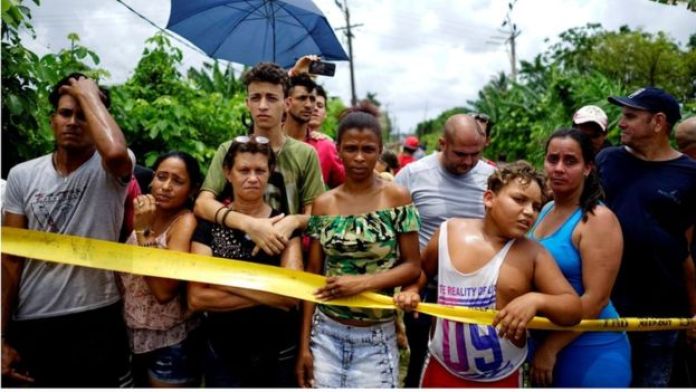 For his part, Deputy Health Minister Alfredo Gonzalez reported that up to Saturday afternoon 15 of the 110 fatal victims of the disaster (five minors and 10 adults) had been identified.


