7:55pm Thursday. Making landfall early this morning as a Category 2, Hurricane Otto weakened rapidly as it moved across southern Nicaragua and currently making its way through northern Costa Rica.
At 7:45pm, Otto is battering the largest of the populated area in its path, the border town of Upala and moving west at 19 km/h. Many areas of Upala, and neighbouring Los Chiles and Guatuso are without electricity.
In La Cruz, residents in the mainly tourist area of Bahia Salinas are bracing for strong winds and heavy rains. The eye of the storm is expected to reach the Pacific coast within a few hours, by midnight Otto should be in the Pacific.
Originally expected to take 36 hours to move from the Caribbean coast to the Pacific, Otto will have completed its trek in less than 18 hours.
So far there have been no reports of casualties. On Tuesday, heavy rains from the storm were blamed for three deaths in Panama.
The Central Valley and south Limon were the only areas spared by Otto, where light to moderate rain in some areas was about the worst of the day.
In its path, that started south of Bluefields in Nicaragua, the intense rain and damaging winds have caused flooding and mud slides, raising roofs in many areas and about two dozen communities isolated. A number of important roads were closed, testing the resolve of crews to re-open them as soon as possible.
Both the Nicaragua and Costa Rica governments, as a preventive measure, declared their respective state of emergency, with evacuations of areas in immediate risk of flooding.
The several thousands in shelters tonight are expected to go home Friday morning as calm returns to the affected areas.
Otto is the hurricane that has touched down the furthest south of Central America since there are records.
Thursday, 10:30pm – Hurricane Otto is within minutes of making landfall, bearing down on the Caribbean coast of Nicaragua a few km/h shy of a Category 3 hurricane.
The National Hurricane Center in Miami reports the Category 2 Hurricane Otto with sustained wind speeds of 175 km/h (178 to make it a category 3).
Boaco, Chontales, Rivas and Granada are on maximum alert
The government has ordered evacuations along parts of their Caribbean coasts, most notably the Caribbean coastal city of Bluefields, a city of 45,000 inhabitants, closed schools and mobilised emergency crews.
Otto was projected to slowly pass along the Nicaragua-Costa Rica border, a mostly rural path that would miss the two countries’ populated areas, but at the last-minute it turned slightly north, south of Bluefields who was hit by category 2 Joan in 1988.
Some Nicaraguans near the southern border were crossing into Costa Rica, hoping it would be safer there, according to locals.
Otto has already proved deadly in Panama, where its outer band of rains and wind caused a mudslide that killed four people on Tuesday. This morning the rains are still affecting the “canalero” (canal) country.
Otto is a rare, late-appearing hurricane in the Atlantic storm season, which runs from June to the end of November.
It is also on an unusually southern trajectory.
A previous, far-stronger hurricane, Matthew, devastated parts of southern Haiti early last month, killing 546 people and leaving nearly 175,000 homeless.
BREAKING NEWS, Costa Rica 1:37pm – President Luis Guillermo Solis just announced the extension of the RED ALERT to include the province of Guanacaste.
The national weather service (IMN) confirmed that Otto, on its way to the Pacific, will be passing some 30 to 50 km north of Liberia, much further south that its passing through La Cruz near the Peñas Blancas border with Nicaragua.
President Solis reiterated that the alert does not mean a massive evacuation of Guanacaste, a major tourist area.
Many roads have been converted into rivers in the northern zone
SAN JOSE 1:21PM – It was at 12:07pm that Hurricane Otto made landfall, hitting Caribbean coast of Nicaragua, some 110 km south of Bluefields or 140 km north of the Costa Rica port city of Limon, according to the Instituto Meteorológico Nacional (IMN) – national weather service, and confirmed by the National Hurricane Center in Miami.
By 1:00pm Otto had been downgraded to a Tropical Storm. It is expected leave by way of La Cruz, Guanacaste, Costa Rica Friday morning, making its way through the lowlands in southern Nicaragua.
Currently the southern portion of Nicaragua and northern Costa Rica are being hit by strong winds and torrential rains.
Costa Rica has expanded its RED ALERT area to include areas such as San Ramon, Naranjo and Zarcero. This is in addition to the Central and South Pacific coast line, the entire province of Puntarenas and the area of La Cruz, 40 minutes north of Liberia.
Starting at noon today, all public bus service in the RED ALERT area has been cancelled. Buses will continue to operate in Central Valley and Guanacaste, both areas under a YELLOW ALERT.
BREAKING NEWS: A 7.2 magnitude earthquake at 12:43pm November 24 (18:43:53 UTC) hit El Salvador, in the Pacific ocean, the epicentre 153 kilometres from Puerto El Triunfo, Usulutan at a depth of 33.0 km, reports the USGS.
The tremor also shook shook various Central American countries, includewestern Nicaragua and northen Costa Rica, two areas currently being it Hurricane Otto that was minutes ago downgraded to a Tropical Storm.
The curious in Limon Thursday (November 24) morning. Photo Albert Marín / La Nacion
9:00am SAN JOSE – Hurricane Otto continues to gain strength, very close to being classed a Category 3 hurricane as it nears the Caribbean coast between Nicaragua’s Bluefields and Costa Rica’s Isla Calero.
The winds at 9:00am is 175 km/h, 3 km short of a category 3.
In the latest report by the National Hurricane Center in Miami, Otto is being called a “highly dangerous hurricane”.
“Otto is a dangerous hurricane with maximum sustained winds near 175 km/h. Some strengthening is expected. It is possible that during the next few hours before it hits the ground, Otto is expected to become a tropical storm tonight,” the report quoted at 9:00am Thursday.
In Costa Rica, experts at the National Weather Institute (IMN), who have been tracking closely the hurricane, Otto is expected to make landfall by 6:00pm and leave at La Cruz, on the Pacific coast, by 6:00am Friday.
Experts are predicting that when Otto makes landfall the wind speed should decrease greatly, and downgraded to a Tropical Storm when it makes the Pacific Ocean.
The live television camera images from the port city of Limon are eerie, we can almost see rays of sunshine breaking through the clouds.
Other images from places like Cuidad Quesada (San Carlos) we see downpours. It is also raining hard in the southern zone of Costa Rica, in places like San Vito de Coto Brus, near the Panama border.
A RED ALERT was issued last and still stands this morning, for the entire province of Puntarenas, from the city of Puntarenas to Golfito.
IMPORTANT to stay off the roads if possible. The Policia de Transito reports the Ruta 32 (San Jose – Limon) and San Carlos – Zarcero are closed due to landslides.
Although the San Jose (SJO) and Liberia (LIR) airports report normal operations, best is to check with your airline before heading to the airport if you are travelling today.
A reminder that all central government offices and autonomous agencies are closed today and tomorrow. Public schools are closed. Many banks are closed. President Luis Guillermo Solis called on private businesses to join the central government’s move to put their most valuable resource first, that is to keep people home, with their families.
UPDATE 9:25am Thursday: Here in Piedades all still calm. It’s been raining on an off, a very light rain. I continue to watch the images on television, local channels 6 and 7 have suspended all regular programming to broadcast live from various parts of the country.
Nothing of what I see in places like Cuidad Quesada (San Carlos) or San Vito is happening here, in San Jose.
TICO BULL by Rico – It’s been a strange day. As I watch the television news of people in the Caribbean coast being evacuated, communities isolated due to landslides and rivers overflowing their banks, roads closed.
I see the photos of people grasping to the little they can take with them, to get out of harm’s way; the houses under water. The story of the elderly man who lost everything but refuses to leave without his dog. The headline in La Nacion reads, “I will die with my dogs, I won’t leave them alone”.
79 year-old Antonio Nunez, who lost everything refuses to leave this dogs, saying he will die with them, but won’t leave them. From La Nacion
I can relate to that, I have five dogs that allow me to live with them in my little place in the world, in Piedades de Santa Ana,west of San Jose, that was eerily quiet today. Quieter than Sunday morning.
The noise from the street was almost none. Other than the constant wailing of sirens from emergency vehicles, there wasn’t the continuous buzzing of vehicles on the Ruta 27, a few blocks from my house.
The morning (Wednesday) started off cloudy. By noon there was some brightness, but no sunshine. Life at rancho Rico was pretty much the same as other days. Other than the looming of Hurricane Otto at our door, it was like any other Wednesday.
But something was noticeably different. Couldn’t put my finger on it until I say the squirrels, in the middle of the day, munching on tree bark. They cut off the tine branches, eat the bark and let the branch fall. I never see them doing this, just the branches on the roof, that blow onto the ground.
Yet today, in the middle of the afternoon, in between the scattered rain, several of them were munching away
And this is when I noticed there was absolutely no wind.The leaves on the trees seemed as if they were painted on. I have a large property with lots of trees and there is always a breeze. None today.
Even stranger was the quietness coming from the two creeks that surround my property. If it rains up the mountains of Santa Ana i get the water, as it runs off to the Virilla river, that connects to the Tarcoles to the ocean.
The water level as low, almost as low during the dry season. I pay particular attention to the level during the rainy season as raging water from up the mountain overflows the bridge that connected my property to the street, but more it doesn’t damage the water pipes to my house.
All day it would be rain, a light rain, for a few minutes then stop. Start again an hour or so later and then stop. It’s now 1:25am and I can hear the drops from my roof from the last rainy episode.
I have never lived through a hurricane before. Is this what it feels like? Is this the calm before the storm?
I am ready. I hope. Will let you know in a few hours.
Q COSTA RICA NEWS – Hurricane Otto is steadily advancing toward the Caribbean coast between Costa Rica and Nicaragua, with wind speeds of up to 140 km/h.
Wednesday evening President Luis Guillermo Solis made a passionate call, for everyone in the country to take the situation seriously, to be prepared.
During the press conference that began shortly after 7:00pm, the President declared a state of emergency and updated the RED ALERT areas to now include 18 cantones (counties) that include Montes de Oro, Esparza, San Mateo, Orotina, Puntarenas, Garabito, Parrita, Quepos, Pérez Zeledón, Buenos Aires, Osa, Golfito, Corredores and Coto Brus in the province of Puntarenas; Zarcero, Valverde Vega, Naranjo, San Ramón and the entire northern zone of Alajuela, that includes Arenal, La Fortuna and San Carlos; La Cruz Guancaste; Sarapiqui de Heredia, and the north Limon.
The update downgraded the port city of Limon and the southern part of the province to a Yellow Alert. The Central Valley and Guanacaste (save La Cruz) are all on Yellow Alert.
Government offices and agencies and public schools to be closed Thursday and Friday
The government also announced that all civil servants, that includes central government employees and autonomous state agencies will have Thursday and Friday off. The Ministry of Education announced the closing of all public schools, the state colleges and universities will also be closed. The government is urging that private schools also close.
Banks Will Be Closed
The state bank, Banco Nacional (BN) announced it will on Thursday keep closed all its branches. The bank says online services and ATMS will be functioning.
At the Banco de Costa Rica (BCR) it will close 20 branches in the most affected areas: Turrialba, Pococí, Sarapiquí, Batán, Cahuita, Cariari de Pococí, Guácimo, Guápiles, Guápiles Urbana, Limón centro, Pocora, Puerto Viejo de Talamanca, Siquirres, Venecia de Carrandi, Municipalidad de Limón, Municipalidad de Pococí, Río Jiménez, Subasta Ganadera Gasol, Subasta Ganadera Guápiles and Subasta Ganadera Palermo.
Banco Popular said it will be closed Thursday and Friday. Bancredito will only close the Limón, Guápiles and San Carlos branches.
Of the private banks, at the time of the post only Davidienda announced the closure of its Guapiles and Cuidad Quesada (San Carlos) branch for Thursday.
The Central Valley
In the Greater Metropolitan Area (GAM) the most populate area in the country life will be pretty much normal, with heavy rain and strong winds expected. The national weather service cautions for winds of between 40 km/h and 60 km/h.
Nonetheless, people must be prepared. In Pavas, as in many other communities around San Jose, a number of retail stores reported selling out of candles, propane gas and bottled water. Yolanda Fernández, manager of corporate affairs at Walmart, say the big demand Wednesday was for batteries, canned foods and bottled water.
Otto is expected to make landfall Thursday morning, the forecast is around 4:00am, with the centre of the hurricane by 8:00am.
“For the next few days we must be more united than ever, and embrace each other more than ever. Because all lives count,” said Solis in his address to the nation Wednesday night.
Photos from a number of sources, including La Nacion, Casa Presidencial, CNE and Facebook.
ENtrevista Alvaro Garita-Bombero de Batan Se realizo un rescate de varias personas en el sector de finca Banasol de Estrada, la zona esta afectada por el dique que se rompio
Many retailers have announced the postponement of Black Friday to Friday December 2
Q COSTA RICA NEWS – Due to the severe climate affecting the country, a number of local businesses announced that they will suspend the Black Friday promotions.
Large retailers like Walmart, La Curacao and Gollo announced they are reprogramming their Black Friday to Friday December 2.
However, some retailers are maintaining their Black Friday promotions for thsi coming Friday, with some of them extending to the end of the month.
For consumers heading to Golfito, the “discount haven of Costa Rica”, be advised that the dutyy free zone is closed on Thursday and Friday. Golfito is in the southern zone, an area greatly affected by the heavy rains of this past few days.
Pococí, Guácimo, San Carlos, Siquirres, Upala, Los Chiles, Guatuso, La Cruz de Guanacaste, Sarapiquí, Río Cuarto de Grecia, Pacuare, Parismina, Barra del Colorado, Barra del Tortuguero, Puerto Lindo y Delta Costa Rica.
A RED ALERT is being maintianed in the communities of Pococí, Guácimo, San Carlos, Siquirres, Upala, Los Chiles, Guatuso, La Cruz de Guanacaste, Sarapiquí, Río Cuarto de Grecia, Pacuare, Parismina, Barra del Colorado, Barra del Tortuguero, Puerto Lindo and Delta Costa Rica.
Q COSTA RICA NEWS – “This is not a rainfall,” were the words of Costa Rica President Luis Guillermo Solis this morning following hours of early morning meetings with a group of legislators and heads of various national relief and emergency support committees.
The meeting at Casa Presidencial began before 7:00am.
Shortly after 9:00am, President Solis in a press conference took the opportunity to remind the population to not let the guard down given the downgrade of Otto back to a Tropical Storm and that what is coming our way is not the typical rains Costa Ricans are accustomed to.
In the coastal area of the provinces of Limon and Heredia, water is knee-deep and more in many communities, all affected from “heavy” to “torrential” downpours and sustained winds. Evacuations and relief efforts are underway.
Authorities this morning updated that Otto will hit by late Wednesday night or in the early hours of Thursday morning, which is currently (at the time of this post) some 100 kilometres off Costa Rica’s Caribbean coast.
Landfall had been expected by 1:00pm Wednesday.
Officials at the Instituto Meteorológico Nacional (IMN) – national weather service – say that Otto will probably hit Costa Rica as a Category 1 hurricane. If the landfall does occur, this will be first time direct impact for the country.
According to the director of the IMN, Juan Carlos Fallas, the downgrade accelerated the effect on the country. “With the information we have at this time the storm would reach Central America as a Category 1 hurricane,” Fallas said.
The RED Alert is maintained in 18 cantones (counties) in the Caribbean, Northern Zone of Alajuela, La Cruz in the northern part of Guanacaste, and Sarapiqui de Heredia: Pococí, Guácimo, San Carlos, Siquirres, Upala, Los Chiles, Guatuso, La Cruz de Guanacaste, Sarapiquí, Río Cuarto de Grecia, Pacuare, Parismina, Barra del Colorado, Barra del Tortuguero, Puerto Lindo and Delta Costa Rica.
A YELLOW ALERT is maintained for all other areas of the country.
So far 161 communities have been affected, 46 of which have been cut off due to flooding and 3,000 people evacuated from their homes.
Ivan Brenes, head of the Comisión Nacional de Emergencias (CNE) – National Emergency Commission – said that 1,183 homes so far have been affected by the rains and water levels, explaining “climate has not helped us to take care of these communities, because the rain has complicated the work of air rescue”.
According to the CNE, some 1,040 people are now in 13 ‘active’ shelters in the Caribbean and Southern Zone.
In Nicaragua, the community is Bluefields is getting ready for a stong impact, a stark contrast to the unpreparedness of 28 years ago when it faced Hurricane Joan.
In Panama, four people lost their lives on Tuesday from the heavy rain.
TODAY NICARAGUA NEWS – The city of Bluefields since Tuesday began prepapring for the arrival of Hurricane Otto.
Twenty-eight years ago, Hurricane Juana caused the evacuation of 321,372 people, 121 dead and 19 missing. “But now the conditions are better,” said Johnny Hodgson, government delegate for the South Caribbean coast.
Photo from END
“In Bluefields we are not afraid. The people have confidence in the authorities and we have already done drills. We are prepared and executing the plans, ” Hodgson told El Nuevo Diario.
Photo from END
Bluefields Catholic Church bishop Oliver Hodgson said he had seen “a lot” of people buying water, plastics, rope, food and other things. “The sky looks very different than on previous occasions,” he said. According to retialers prices of plastic doubled.
Photo from END
JOAN
Official reports indicate that Joan, probably the most destructive hurricane that has passed through Nicaragua, entered the country on the morning of October 22, 1988, becoming a category four hurricane.
At Corn Island, winds of up to 250 kilometers per hour began to be felt on the afternoon of the 21st. In Bluefields they say it was at 7:00 pm at 1:30 pm on the 22nd, Corn Island, Kukra Hill and Orinoco were completely Destroyed. Bluefields, at that hour, was left in ruins.
This hurricane caused losses of US $1.658 billion.
According to the reports of the time, the Blufileños did not believe that the cyclone was going to impact the city and many refused to evacuate or to protect their houses.
TODAY NICARAGUA NEWS – Hurricane season officially ends on November 30, and while the month of November can have named storms, the season is generally winding down. Impactful storms are infrequent occurrences, especially this late in November.
Otto formed in the southern Caribbean early this week as the National Hurricane Center closely monitored the area.
The Sistema Nacional de Prevención, Mitigación y Atención de Desastres (Sinapred), Guillermo González, said most likely the country will issue a mandatory evacuation of the Caribbean coastal areas and two islands, Corn Island and Little Corn Island.
On Tuesday the government issued a “RED ALERT” for the areas of Caribe Sur de Nicaragua, Río San Juan, Chontales and Zelaya Central. A “Yellow Alert” is for the areas of Boaco, Rivas, Carazo, Granada, León and Managua.
If you are traveling to or from Costa Rica in the coming days, best is to check the status of your flight before heading off to the airport
Traveling to and from Costa Rica’s San Jose airport can be affected by Hurricane Otto. At the Q we’ve compiled a list of airlines with regular service to and from the San Jose (SJO) airport, Costa Rica’s main international airport.
If we’ve missed an airline, please add it in the comments section or send us an email. Airline contact numbers in Costa Rica in parenthesis.
Travelers should inquire about the weather, if they traveling to or from Costa Rica. If you are abroad, this point is of special consideration because not necessarily the airline will wait at the closing of the airport to take the precaution of not taking off, that is to say an airline may cancel or postpone a flight even though the Costa Rica airport is operational (not closed).
Important to note, when the operation of the flight is suspended towards Costa Rica, it is possible that the return (outbound) flights that departing from Costa Rica will be affected. Contact your airline.
In some cases, the airlines operate a turn-around flight, so if the flight does not land during the scheduled time, the departure will also be cancelled or delayed. For example, flights coming in late at night, ie American, Delta, United will depart early the next morning. If the evening flight does not come in, there is no morning flight.
At the time of this post Aeris, the airport manager reports normal operations at San Jose.
Q COSTA RICA NEWS – Stationed some 530 km southeast of the Nicaraguan port of Bluefields on Tuesday, and with sustained winds of 95 km/h Hurricane Otto, will be the first phenomenon of this magnitude and nature that directly crosses Costa Rica, according to available information.
According to Juan Carlos Fallas, director of Costa Rican National Meteorological Institute (IMN), Hurricane Joan (Juana in Spanish), that grazed the coast in 1988, officially left 28 dead, 75 injured and 18 missing.
Hurricane Otto is expected to make landfall in Costa Rica’s Caribbean coast by Wednesday night.
Graphic by La Nacion from information by the National Hurricane Center and the Instituto Meteorologico Nacional (IMN)
Q COSTA RICA – All visitors and foreigners living in Costa Rica should take precautions against the possibility of heavy rains, strong winds, flooding, and mudslides throughout Costa Rica as a result of Hurricane Otto.
Otto is currently located east of Puerto Limon in the Caribbean Sea and is approaching Costa Rica and Nicaragua. It is expected to make landfall by Wednesday night (November 23).
Costa Rica has a three-level warning system (Green, Yellow, and Red), and the Costa Rica National Emergency Commission (Comision Nacional de Emergencias, or CNE) reports that a Red alert (the highest) is in place in Costa Rica’s Caribbean region and northern zone. A Yellow alert is in effect for the rest of the country.
Tuesday morning (November 22) the government ordered the mandatory evacuation of the northern Caribbean region. These areas include Tortuguero, Barra de Parismina, Boca Tapada, Boca Pacuare, Barra del Colorado, and Calero. Visitors are advised to avoid these areas. Caution should be exercised in all other areas, as the hurricane may affect the entire county for several days as roads and river condition may worsen.
Travel should be limited to the Central Valley area as of today (Wednesday) and through the weekend.
Be advised to monitor local media for updates or possible changes to weather conditions and to follow any instructions and/or warnings.
Preparations to protect life and property in any storm or weather-related event should be considered.
Foreigners visiting the country should carry their travel documents (i.e. passport) with them at all times or secure them by placing them in a safe, waterproof location. If you must travel during this time, please take reasonable precautions such as avoiding entering swiftly moving water.
Drivers should remain vigilant for possible landslides, flooding, and reduced visibility, particularly in mountainous areas.
Due to the potential severity of the storm, power outages are a possibility, and communications systems, including cell phones, may be affected in certain areas.
The Costa Rica National Meteorological Institute (Instituto Meteorologico Nacional, or IMN) provided specific information is also available on the Twitter feed https://twitter.com/imncr?lang=en.
Although the following roads are open, things can change quickly, and are roads of most concern at the time of this post:
Paso Real – Palmar Norte
Caldera – Puntarenas (ruta 27)
Chacarita – Puerto Jiménez
Paso Real – San Vito
San Ignacio – Parrita
Monterrey – San Antonio (San Carlos)
Naranjo – San Carlos
Ruta 32
La Suiza – Tres Equis – San Vicente de Pacayitas
Río Claro – Depósito Libre
Ciudad Neily – San Vito
La Virgen – Sarapiquí (puenete falseado
Ruta 2 – El Guarco
Las Brisas de Turrialba
Turrialba – Volcán Irazú
FOR U.S. CITIZENS VISITING OR LIVING IN COSTA RICA
The U.S. Embassy in Costa Rica warns U.S. citizens traveling to or residing in Costa Rica enroll in the Department of State’s Smart Traveler Enrollment Program (STEP). STEP enrollment gives you the latest security updates, and makes it easier for the nearest U.S. Embassy or Consulate to contact you in an emergency. If you don’t have Internet access, enroll directly with the nearest U.S. Embassy or Consulate. In addition to information on the Internet, travelers may obtain up-to-date information on security conditions by calling 1-888-407-4747 toll-free in the United States and Canada, or outside the United States and Canada on a regular toll line at 1-202-501-4444. These numbers are available from 8:00 a.m. to 8:00 p.m. Eastern Time, Monday through Friday (except U.S. federal holidays). The U.S. Embassy in San Jose (telephone number: 2519-2590) will be closed for regular business on Thursday, November 25 in celebration of the Thanksgiving holiday. If you are a U.S. citizen in need of urgent assistance outside of business hours, the emergency after-hours number for the U.S. Embassy is 2519-2000.
FOR CANADIAN CITIZENS VISITING OR LIVING IN COSTA RICA
The Canadian Embassy in Costa Rica through Global Affairs Canada advises against non-essential travel to the east coast of Costa Rica due to Hurricane Otto. See Natural disasters & climate for more information. Canadians seeking emergency consular assistance in the area should contact the Embassy of Canada in San José or the Emergency Watch and Response Centre in Ottawa. The Canadian Embassy in Costa Rica is located in La Sabana, behind the “Contraloría” in the Oficentro Ejecutivo La Sabana Building 5, Third floor.
This is the first time Costa Rica is facing a hurricane to landfall. Juan Carlos Fallas, director of the IMN, said “Costa Ricans (Ticos) have no experience in handling the wind force expected for Wednesday night and early Thursday”.
TODAY PANAMA NEWS – Tropical Storm Otto, how a full blown Hurricane, has caused four deaths in Panama and widespread damage from floods landslides and falling trees brought on by heavy rains and high winds.
Two victims died in a mudslide, a girl drowned in a river and a boy died when a tree fell on the car taking him to school. His mother, driving, survived.
Panamanian officials said about 50 homes were destroyed by mudslides. Flights have been delayed.
Also in Panama, one Colombian man is missing after having been dragged away by a river swollen by heavy rainfall.
A further day of heavy rain is forecast in Panama with gusts of up to 50 mph (80km/h).
The Panamanian education minister has suspended classes until Thursday and the government ordered the closure of public offices in Panama and Colon provinces from midday on November 22.
Meteorologists have warned of life-threatening flash floods and mudslides.
There is also a likelihood of dangerous surf and rip current conditions over the next several days along the coasts of Panama, Costa Rica and Nicaragua, the NHC says.
Children urinating in the newly installed fountain at the Plaza de la Cultura has forced its temporary closure as authorities change the water and check operations
Children urinating in the newly installed fountain at the Plaza de la Cultura has forced its temporary closure as authorities change the water and filters
Q COSTA RICA NEW – Children urinating and the ashfall from the Turrialba volcano has caused authorities on Monday to shut down the new fountain of the Plaza de la Cultura, to change the water and filters.
Rafael Marin, architect at the Central Bank explained that the sediment accumulated by Monday forced it necessary to close the fountain to review its operation.
“The number of children at the fountain is very high, they are children than spend two, three and up to four hours there (…) there is urine entering the system (…),” explained Marin.
The stepping on the nozzles has also caused a misalignment, added the architect.
The fountain should be back in operation by tonight, but that all depends on Otto, the Tropical Storm that is now a Hurricane. Marin said the impact of the storm would not damage the fountain, but cause an imbalance in the chemical composition of the water.
The fountain, that is illuminated at night and began operating on November 14, has quickly become a downtown attraction. It was incorporated in the restoration of the Plaza de la Cultura surface to prevent water leakage to the gold museum located below the plaza.
Central Bank authorities warned that the security officers will be keeping an eye on things around the close to ensure the proper use of the fountain and recommended:
Children should not drink the water from the fountain, even though it is filtered and recirculated
Parents are asked to not let their children urinate in the fountain
Parents are also asked not let children in diapers play in the fountain
WATCH IN REAL TIME THE POSITION OF HURRICANE OTTO AND THE WINDS ASSOCIATED WITH THE PHENOMENON
Q COSTA RICA NEWS – Otto is a hurricane and is whipping winds of more than 120 km/h, according to the National Hurricane Center (NHC). Forecasters estimate it could hit northern Costa Rica on Thursday around 1:00pm.
But, many in the areas to be affected the most are not taking it seriously enough.
La Nacion reports that residents of Barra de Matina are refusing evacuate for fear of looting. Besides the potential looting, many are refusing to abandon their livestock.
Batan is under water
The National Emergency Comission (CNE) reports that at 1:10pm it had evacuated only three people – two women and a child – from the Cuatro Millas de Matina pier.
It’s hard leave because we have cattle and we have to take care of it and if we go out people will steal them, people are shameless(…),” said Emilia Pérez Pérez, who lives in Barra de Matina for the last seven years.
Cristian Rodriguez, a police officer in Batan, said the woman finally agreed to evacuate after she was told her four-year-old son would be evacuated if didn’t leave.
Earlier this morning the government issued a “RED ALERT”.
Two nephews of Venezuela’s first lady have been found guilty of drug crimes in a US federal court
TODAY VENEZUELA NEWS – Insightcrime.org – Two nephews of Venezuela’s first lady have been found guilty of drug crimes in a US federal court, with several pieces of evidence presented during the trial pointing to complicity in the drug trade by high-level figures in the Venezuelan government.
A federal jury in New York City on November 18 returned a guilty verdict in the case against Efrain Antonio Campo Flores and Francisco Flores de Freitas, the nephews of Venezuelan first lady Cilia Flores who were accused of plotting to ship 800 kilograms of cocaine to the United States. According to journalist Maibort Petit, who has closely followed the Campo Flores and Flores de Freitas case, the nephews’ sentencing hearing has been scheduled for March 7, 2017.
The nephews were arrested in November 2015 in Haiti and immediately extradited to the United States, where they were charged with conspiring to import drugs into the country.
Court documents filed by prosecutors alleged that the nephews planned to obtain the cocaine from the Revolutionary Armed Forces of Colombia (Fuerzas Armadas Revolucionarias de Colombia – FARC), and that they intended to ship the drugs from the presidential hangar at Caracas’ Simón Bolívar International Airport to the Honduran island of Roatán. From there, the defendants planned to traffic the drugs through Mexico and into the United States.
An individual named Roberto de Jesús Soto García has been charged in the United States for his purported role in the scheme, which allegedly involved agreeing to facilitate the arrival of drug shipments in Honduras as well as setting up a meeting at which the nephews discussed the cocaine trafficking plot.
Press reports citing sources close to the investigation suggest that Soto García served as the contact person in Honduras for networks within the Venezuelan military involved in drug trafficking, known as the Cartel of the Suns.
Soto García was arrested by Honduran authorities in late October. The United States is reportedly seeking his extradition.
Opposition politicians in Venezuela have criticized President Nicolás Maduro for his administration’s lack of a public response to the verdict.
Several pieces of evidence presented during the trial of the so-called “narco nephews” suggest high-level figures with ties to the Venezuelan government may be complicit in the drug trade.
For instance, in a secretly recorded discussion between Campo Flores and confidential sources working for the Drug Enforcement Administration (DEA), the first lady’s nephew appears to confirm that the Cartel of the Suns works with government officials when trafficking drugs.
In the conversation reported by El Nuevo Herald, Campo Flores says that “government executives” and the Cartel of the Suns “were the only ones who worked” in drug trafficking in Venezuela, and that they were “in charge of fumigating [eliminating] anyone who tried to enter to work in the country.”
In a separate conversation reported by Honduran news outlet La Prensa, the other nephew, Flores de Freitas, was asked by an informant if former Venezuelan National Assembly President Diosdado Cabello was the head of the Cartel of the Suns.
“They say he is the boss,” Flores de Freitas replied. “I don’t know the truth.”
Former government figures have previously accused Cabello of leading the Cartel of the Suns, and US authorities have reportedly investigated these claims.
Another indication of high-level complicity in the drug trade came in the form of testimony by a DEA agent that Cilia Flores’ brother Bladimir helped arrange a meeting between the nephews and an alleged Honduran drug trafficker referred to as “El Sentado,” who was killed less than a month after the nephews’ arrest. Bladimir Flores reportedly serves as a high-level police official in Venezuela.
Furthermore, the Wall Street Journal reported that the nephews’ legal costs were being paid by “a wealthy, politically well-connected Venezuelan businessman” named Wilmer Ruperti. According to the newspaper, Ruperti “recently won a multimillion-dollar contract from the state-owned oil company, Petróleos de Venezuela SA,” though he dismissed the notion that the awarding of the contract was linked to his funding of the legal defense for the president’s relatives.
The Venezuelan government has in the past moved to protect high-ranking officials accused by the US government of involvement in the drug trade. In August, for example, President Maduro appointed the former general director of Venezuela’s anti-drugs agency, Nestor Luis Reverol Torres, as Interior minister just one day after a US court unsealed an indictment charging Reverol with drug crimes. While the “narco nephews” have long since been outside Maduro’s sphere of influence, he may yet attempt to provide some form of legal protection to any individuals linked to the case.
TICO BULL by Rico – This has certainly to be shameful for the bosses, a group of Transitos (traffic police officials) taking matters in their own hands, filling a pothole on a road to Puntarenas.
The group of officials, working as if they were a MOPT (Ministry of Transport) crew, equipped with shovels and bags of cement, filled the pothole on some 150 metres from the Chacarita cemetery.
This was on Friday.
Apparently the pothole had been the cause of an accident hours earlier, thus the officials took to the task of filling the pothole instead of waiting around for their bosses at the MOPT to issue a work order. (The Policia de Transito is authorized under the Ministerio de Obras Publicas y Transportes – MOPT).
Area residents and posts on the social media applauded the action of the Transitos and commented on the inaction of MOPT authorities.
According to the head of the Policia de Transito, Mario Calderon, it is common for his officers to take leave of their usual duties not only to fill potholes, but to remove debris, such as fallen tree branches and rocks, from the roads.
But then this is Costa Rica, I doubt very much the higher ups at the MOPT see this as shamefull, rather probably see it as just another duty of understaffed police department, while it focuses on repairing the “platina” bridge, a project that has been ongoing since 2009.
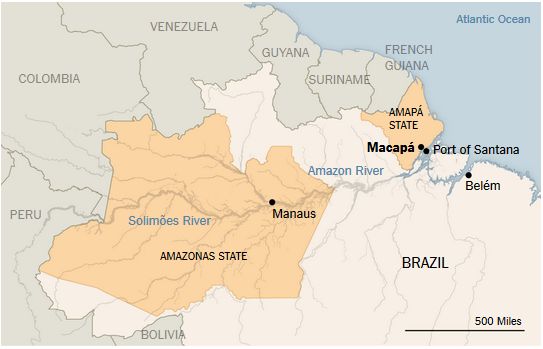
Boys selling staples in Santana, near the city of Macapá. The local government lacks the means to fight the growing threat of piracy. Credit Dado Galdieri for The New York Times
Boys selling staples in Santana, near the city of Macapá. The local government lacks the means to fight the growing threat of piracy. Credit Dado Galdieri for The New York Times
Q24N BRAZIL (Insightcrime.org) Marauding pirates represent a growing threat along the Amazon river in Brazil, the New York Times reports, but this remote outpost is not the only place in Latin America where piracy is becoming a greater security concern.
Police forces in Brazil are struggling to curtail river piracy in the Amazon river basin, as a series of recent attacks have terrorized riverboat crews and their passengers, reported the New York Times. This September, nearly a dozen men raided a ship near the port city of Belém, robbing some 260
By The New York Times
passengers. The following month, armed pirates commandeered a fuel ship, stealing more than 2,600 gallons of diesel fuel, along with the crew’s personal items.
The pirates of the Amazon River relish striking after nightfall.
“Every riverboat captain knows they’re at the mercy of these bastards,” said Merinaldo Paiva, whose passengers were held up at gunpoint by pirates in April.
While piracy is a longstanding issue in the Amazon, boat operators told the Times they fear the groups are becoming more savvy in choosing their victims. Galdino Alencar, the president of a boater’s union in the state of Amazonas, said that pirates are now focused on going after large cargo ships, especially those carrying fuel.
Due to the expansive and remote terrain that the Amazon encompasses, as well as the sparse police presence, combating river piracy has proven elusive for authorities.
“There’s no law on the Amazon River,” one local fisherwoman told the newspaper.
Many of the factors fueling piracy on Brazil’s Amazon are also contributing to robberies on rivers, lakes and the high seas in other parts of the region. In the last few years, there have been multiple reports of armed pirates boarding ships and looting passengers in the near-by Peruvian Amazon region.
Meanwhile, Venezuelan pirates involved in a host of criminal activities have attacked fishermen and stolen machinery from petroleum platforms on Lake Maracaibo, causing delays in oil production. And off Ecuador’s Pacific coast, pirates strapped with AK-47s have reportedly taken to hijacking fishing boats, using the vessels to transport drugs or other contraband items. Fishermen say the pirates offer large sums of money in exchange for their complicity. Those that refuse the offer are rarely heard from again.
coyotes "using the results of United States presidential election as a ruse to lure Hondurans into giving them money to travel illegally to the United States."
Coyotes (traffickers) using the results of United States presidential election as a ruse to lure Hondurans into giving them money to travel illegally to the United States. Photo for illustrative purposes.
Q24N (Insightcrime.org) The United States’ Embassy in Honduras has warned of an increase in the demand for Honduran “coyotes” to smuggle people into the United States, a sign that President-elect Donald Trump’s electoral victory is already influencing the region’s criminal dynamics.
In a November 17 press release, the embassy cited “recent reports” of coyotes “using the results of United States presidential election as a ruse to lure Hondurans into giving them money to travel illegally to the United States.”
While the embassy did not specify which media reports it was referring to, La Prensa has reported an increase in the demand for smuggling services as a direct impact of Trump’s election on November 8.
The embassy warned of the dangers associated with the services provided by human smugglers, stating that “these criminals will lie to take your money and will abandon you at the first hint of danger.” The press release illustrated this by mentioning the 11 Honduran nationals who died last week while crossing through Mexico.
It also underlined that illegal immigration and deportation of undocumented immigrants has been a priority on the US agenda since 2014, perhaps an implicit way of arguing that Trump’s election may not constitute such a radical change for an undocumented migrant’s journey northwards.
The news of an increased demand for smuggling services from Honduras to the United States suggests Trump’s victory, less than two weeks old, is already beginning to influence organized crime and migration patterns in Central America.
As InSight Crime has previously explained, Trump’s campaign promise to build a wall along the US-Mexico border is likely to drive more Central American migrants into the clutches of human smugglers. As a recent study by the International Crisis Group found, migrant crackdowns at the US southern border and in Mexico have actually strengthened these smuggling groups, and that pattern will only accelerate if further border security measures are put in place.
But it appears this process has already started, which may be due to migrants hoping to cross into the United States before a Trump administration takes over in January.
Editorial by the staff at Vozdeguanacaste.com– Could it really be that we still haven’t learned the importance of speaking English in a province like Guanacaste, where tourism plays such a vital role, in order to land well paying jobs?
Business owners continue to complain about the poor level of language on résumés young people bring to job fairs. Although they’re offered free opportunities by state agencies like the National Training Institute (INA), few students manage to take advantage of those programs.
Two stories in this month’s edition highlight the province’s enormous challenges in helping young people out of unemployment by training them in English. One story demonstrates that while nine out of 10 public high school students receive English classes, coverage decreases as students advance through academic levels.
Combined with this reduced coverage, a report by the association Horizonte Positivo for the office of the Second Vice President of the Republic – part of a project called “Fighting Poverty in Guanacaste with Employment” – shows that 95 percent of senior citizens in the province don’t speak a second language.
The statistics the association shared with The Voice of Guanacaste show that the majority of companies having difficulties filling vacant job posts require an advanced level of English.
So who’s responsible? On one side, young people are. On the other, the institutions are. In 2016, for example, INA offered a total of 130 English courses, but those classes weren’t distributed across all cantons, the report stated.
The situation becomes urgent when you consider that employment is the most effective tool to reduce poverty, as shown incessantly by national statistics.
So what can we do?
At universities, professors could deliver more lectures in English and create conversational programs to take advantage of the large number of foreigners who live in the region. Institutions like INA could improve program coverage and offer night classes so people already working can better their chances of finding a job in the formal labor sector.
By Mary Serphos, Vozdeguanacaste.com – These days it seems like everyone wants to detox, but why do it? Toxins, pesticides, chemicals in household cleaning products, plastics, Teflon pans and Guanacaste’s incessant dust all accumulate in tissues, organs and the blood.
While the job of your liver and kidneys is to clean the body, these organs frequently are overloaded and exceed their capacity. Symptoms of a body that’s been abused or “intoxicated” include energy loss, weight gain, fatigue and confusion, to name a few.
Following are six of the best cleansing foods for your daily detox:
1. Fresh Organic Green Vegetables – Raw or cooked, greens like spinach, bok choy, arugula and fresh green herbs such as basil and cilantro have fiber, antioxidants, vitamins and chlorophyll, which flush the liver and boost energy.
2. Garlic (Ajo in Spanish) – Antibacterials in garlic help clear out the digestive tract while sulfur compounds – especially one called allicin – strengthen the immune system.
3. Whole Grains and Ground Flaxseed (Granos enteros y semillas de linaza molida in Spanish) – Quinoa, brown rice, ground flaxseed and other unprocessed grains are excellent sources of soluble fiber and are packed with nutrients.
4. Cabbage (Repollo in Spanish)– Effective at reducing inflammation in the body, cabbage can be prepared raw, lightly cooked or made into “kim chee” (aka raw sauerkraut). The probiotics in kim chee are great for boosting the “second brain,” or digestive system.
5. Fresh Fruit – Whole fruit, or occasionally 100 percent pure fruit juices, have vitamin C and are loaded with antioxidants. However, it’s important not to overdo it with fruits and fruit juices, as they are high in simple sugars. Also, people with candida or yeast overgrowth in the body should avoid most fruits and entirely eliminate fruit juices while cleansing.
6. Lemons (Limones in Spanish) – Lemons boost enzymatic activity in the body and are packed with phytonutrients that help cleanse almost every organ in the body.
While cleansing, remember to drink lots of water and eat or drink water-based vegetable juice, such as cucumber and celery. For an extra boost to your “daily detox” repertoire, add a bit of spice such as ginger, cayenne pepper, hot peppers or fresh hot sauce. If you’re not used to spicy or hot condiments, start by adding them to food in small amounts.
Q COSTA RICA NEWS – The US National Hurricane Center, based in Miami, changed its forecast and said that Tropical Storm Otto will become a Hurricane “this Tuesday,” and not Wednesday, as announced on Monday.
The call continues for a voluntary evacuation and the people in the affected areas to be ready in the case a general evacuation becomes necessary.
Last night the National Emergency Commission issued a “yellow” alert for the storm. Authorities also confirm the closing of 107 schools in the affected areas of the Caribbean and northern zone.
There is no record of a landfalling hurricane in Costa Rica, according to the NOAA best tracks database. Otto could be a historical first, there.
Many areas in the province of Limon have been affected by the heavy rainfall. Photo La Nacion
Many areas in the province of Limon have been affected by the heavy rainfall. Photo La Nacion
Q COSTA RICA NEWS – The Tropical Storm, that turned to a Tropical Depression and later today to become a Hurricane that promises more rain in Costa Rica, brought a drop in temperatures, mainly in the lower parts of the Central Valley.
The national weather service, the Instituto Meteorológico Nacional (IMN) reports temperatures from 4°C a 18°C (40°F a 65°F). That is under the blanket weather in Costa Rica.
For example, the temperature this morning in Montes de Oca (San Pedro) was 15°C and Pavas 17°C. However, in higher places like the weather station at Chitarria (Escazu) the temperature dipped to 9°C and 4°C at the Irazú volcano. Normal early morning temperatures some 4°C higher.
The Tropical Depression Otto is this morning some 440 kilometres northeast of the Caribbean coast of Limon and 440 km 525 km de Bluefields, Nicaragua. The storm is expected to reach land by tonight, a day ahead of the forecast.
A “yellow” alert has been called for the Caribbean and Northern Zone. The Southern Zone is also expected to continue with intermittent rains of variable intensity.
For the Central Valley and the North Pacific, partial cloudiness and intermittent rain is expected.
Aerial picture taken on September 6, 2007, in the village of Sandy Bay, Nicaragua, after the passage of Hurricane Felix. The southernmost Category 5 Atlantic hurricane on record, Felix caused 133 deaths, nearly all in Nicaragua, and destroyed thousands of homes in the city of Bilwi. Image credit: Oscar Navarrette/AFP/Getty Images.
TODAY NICARAGUA NEWS – Tropical storms and hurricanes move into Nicaragua from the east every few years, but one as far south as Tropical Depressin Sixteen (TD 16) is a more uncommon event.
If a Hurricane Otto develops and strikes as currently predicted, it could be the southernmost hurricane landfall on record in Central America.
There are no recorded Atlantic hurricane landfalls in Costa Rica or Panama.
A weak tropical storm made landfall in Costa Rica in December 1887, and Panama: Hurricane Martha, which struck as a strong tropical storm in Veraguas Province, Panama, on November 24, 1969.
“Undoubtedly, there have been other tropical cyclones that moved into Panama, but this was the first one that was definitely tracked,” said Robert Simpson and NHC colleagues in their roundup of the 1969 Atlantic hurricane season.
Noteworthy landfalls in Nicaragua, shown here in rough order from north to south, include:
Felix (September 4, 2007): Cat 5, landfall just south of the Nicaragua-Honduras border
Ida (November 5, 2009): Cat 1, landfall near La Barra del Rio Grande
Beta (October 30, 2005): Cat 2, landfall near La Barra del Rio Grande
1906 Florida Keys Hurricane (October 10, 1906): Cat 3, landfall on central Nicaragua coast
Cesar (July 28, 1996): Cat 1, landfall north of Bluefields
Gert (September 15, 1993): tropical storm, landfall near Bluefields
Joan (October 22, 1988): Cat 4, landfall south of Bluefields
Irene (September 19, 1971); Cat 1, landfall south of Bluefields
Hurricane Martha (1969) on November 21, 1969. The system was a strong tropical storm at this time. It attained hurricane intensity around 00Z on November 22.
Hurricane Martha (1969) on November 21, 1969. The system was a strong tropical storm at this time. It attained hurricane intensity around 00Z on November 22.
Tropical Depression Sixteen (TD 16) is likely to bring torrential rains, landslides, and flooding to parts of Costa Rica and Central America.
The region’s complex, rugged topography may lead to several widely dispersed areas of extremely heavy rain.
The most confident outlook is for several inches of rain over nearly all of Nicaragua, with a core of 25 cm to 40 cm (10 in. – 15 in.) amounts very possible within TD 16’s circulation as it makes landfall and moves inland.
The westerly flow south of TD 16 will impinge into parts of Costa Rica and Panama, leading to very heavy rain already under way on some of the region’s south- and west-facing slopes. Another core of torrential rain is projected by models to develop later this week as TD 16’s outer circulation moves along the north coast of Honduras, perhaps extending into southern Belize and eastern Guatemala.
How rare is a hurricane landfall in Costa Rica?
If a Hurricane Otto develops and strikes as currently predicted on Wednesday in Costa Rica’s northeast coast it could be the southernmost hurricane landfall on record in Central America.
There are no recorded Atlantic hurricane landfalls in Costa Rica or Panama.
A weak tropical storm made landfall in Costa Rica in December 1887, and Panama: Hurricane Martha, which struck as a strong tropical storm in Veraguas Province, Panama, on November 24, 1969.
The storm also brought significant rains to Costa Rica. Flooding and mudslides isolated most of the capital city of San José. Numerous streets were inundated in Golfito. Damage in Costa Rica reached $30 million (1969 USD) and 5 deaths were reported.
“Undoubtedly, there have been other tropical cyclones that moved into Panama, but this was the first one that was definitely tracked,” said Robert Simpson and NHC colleagues in their roundup of the 1969 Atlantic hurricane season.
Mnay parts of the southern zone and Caribbean coast are already under water from the weekend’s Tropical Storm
Q COSTA RICA NEWS – Tropical Depression Sixteen will become a Hurricane Otto on Wednesday heading into the northeastern part of Costa Rica and southeastern Nicaragua, says the U.S. based National Hurricane Centre (NHC).
The almost-stationary storm is about 282 kilometres (175 miles) east-southeast of the San Andres island, with maximum sustained winds of 80 km/h (50 mp/h), according to the NHC.
Tracking map as of 10 AM EST Monday, November 21, 2016 by Weather Undergound
Monday afternoon the government called the population located in the Caribbean slope affected by heavy rains of the last couple days, to a voluntary evacuation as the Tropical Storm that became a tropical Depression converts to Hurricane.
“Those who have the possibility of evacuating voluntarily would be well to do so,” said President Luis Guillermo Solis in a press conference of the Comisión Nacional de Emergencias (CNE) – national emergency commission.
Porjected path by Otto from the NHC, graphic by La Nacion
The call is for communities in the area of Barra del Colorado to Moín, which includes Tortuguero, Parismina, Doce Millas, Playa Bonita and Limón.
According to Solis, authorities are making provisions so that the empty propertieis in the evacuated areas will not fall to vandalism.
President Solis sits next to his Minister of Security, Gusta Mata (sitting, far left in black jacket) at a breifing at the National Emergency Commission (CNE) headquarters in San Jose.
Currently, the rivers are at their limits, transit by road has been affected and the weather does not permit the use of helicopters.
Originally the NHC predicted the cyclone’s evolution would take place on Thursday. However, an update Monday afternoon predicted the hurricane would form by 1:00pm Wednesday.
According to Werner Stolz, head of forecasts at the Instituto Meteorológico Nacional (IMN) – Costa Rica’s National Meteorological Institute, “there is a high probability that Otto will become a hurricane”. The expert explained that the cold front that has been dumping rain on many parts of the country since Saturday will end by Tuesday and Otto will being its journey hitting the Caribbean coast of Costa Rica and Nicaragua.
The good news is that once its touches land Otto should lose strength and become a tropical depression that will last until Saturday.
The CNE and the Ministry of Transport are working to rehabilitate roads to communities that were isolated in the southern zone, such as Puerto Jimenez.
Possible Impact According to IMN meteorologist Gabriela Chinchilla, when Otto converts to a hurricane it is expected to dump some 100 litres per square meter of rainfall in the Caribbean and northern zone.
The southern zone will also feel the impact, where the accumulated rainfall could be between 60 and 120 litres per square metre.
Meanwhile, for the Central Valley, the forecast is cloudiness and intermittent rains with accumulations of between 25 and 50 litres per square metre.
As for wind speeds, it estimated they could reach 70 km/h or more.
Photo from La Prensa in Nicaragua of Tico legislators, supposedly on a working trip to Managua, were seen shopping and drinking in Masaya
TICO BULL – A group of Costa Rica’s legislator were in Nicaragua this weekend, to meet with their counterparts in Managua, to urge publicly the government of Daniel Ortega for an open border between the two countries.
That was the news. That is what happened on Friday.
But, according to the Nicaraguan press, the Tico legislators headed by the vice-president of the Legislative Assembly, Jose Alberto Alfaro, decided to take in some tourism and shopping at our expense.
The Nicaraguan publications La Presna and Nicaragua Hoy both featured photos of Tico legislators shopping in Masaya.
“When the arrived at the Masaya shopping centre, they are around the place to appreciate and buy Nicaraguan handicrafts, while Nicaraguan National Assembly workers carried a cooler with ice and whiskey,” the La Prensa reported.
Nicaragua Hoy highlighted that the agenda of the Tico legislators included only Friday as the day of work, while Saturday and Sunda was dedicated to tourism, visiting the departments of Leon, Masaya and Granada – Nicaragua’s three top tourism areas.
In total, 12 Tico legislators from across party lines, took advatange of the trip: For the Partido Liberacion Nacional (PLN): Jose Alberto Alfaro, Olivier Jiménez, Aracelly Segura, Danny Hayling and Michael Arce; for the Frente Amplio: Jorge Arguedas and José Ramírez; for the Partido Acción Ciudadana (PAC) Laura Garro, Emilia Molina, Marvin Atencio and Javier Cambronero; and independent, Carmen Quesada.
Costa Rica’s Foriegn Minister, Manuel Gonzalez, shared on his official Facebook page with the headling, “Turismo parlamentario” (Parliamentary tourism).
For his part, President Luis Guillermo Solis, a president that has barely kept his presidential chair warm a home, criticized the trip saying the visit caused unease due to the cold relations between the neighbouring countries.
Solis said this type of visit to Nicaragua could generate “confusion” among Costa Rica’s international partners. What say you Mr. President? Confusion of what?
However, Solis did accept that the country’s legislators don’t need his approval, sorry, the government’s permission to visit Nicaragua, hold meetings with Nicaraguans, even if to warm relations or spend the taxpayer’s money.
Italians in Italy take their time eating their food and enjoy, and less likely to gobble down their food and ask for seconds as across the Americas and around the world.
(From the MACARONI JOURNAL) How is it that Italian people in Italy have a lot to eat but still stay skinny?
A lot of true Italian people or hardcore Italians truly believe that Italians in Italy simply do not gain weight. Across the Americas and around the world, the number of people that are overweight is skyrocketing. More and more people are desperate to lose weight, while Italians (in Italy) eat pasta, pizza, and a number of other rather hearty meals and simply do not gain record weight at the numbers those in other countries do.
The Homeland
Perhaps, it has a lot to do with the way that Italians eat in Italy compared to the way that other Italians might eat in Europe or the Americas.
Americans (north, south and everything in between) of Italian descent are known to load their plates with Italian meals that are high in calories and fat. The meals served are also larger.
However, Italians in Italy are rarely overweight compared to American obesity levels.
Why?
Well, health experts suggest that the difference is due to the fact that in Italy, they are basically on a Mediterranean Diet. Supposedly, this type of diet is very nutritious and good for you.
The Italian Way
Another reason that Italians in Italy are less likely to gain weight is due to the way they treat food. They don’t gobble down their food and ask for seconds. Instead, they take their time eating the food and enjoy every bit.
Food is a time to get close with family and talk about the day. They also eat a much more nutritional meal consisting of more fresh fruits and vegetables. After dinner, many Italians like to get together and go for a pleasant walk, instead of jumping in their car.
Italians in Italy are also more likely to walk to a destination, instead of taking the car or some other form of transportation. Thus, they get much more exercise and are more apt to walk off a heavy meal.
Costa Rica soccer player Gabriel Badilla dead at 32 after suffering a heart attack Sunday morning in Santa Ana, almost at the finish line of the Lindora Run
Costa Rica soccer player Gabriel Badilla dead at 32 after suffering a heart attack Sunday morning in Santa Ana, almost at the finish line of the Lindora Run
Q COSTA RICA NEWS – Within 100 metres of crossing the finish line in the 10 kilometre Lindora Run, in Santa Ana Sunday morning, Saprissa and national team soccer player Grabriel Badilla died after suffering a cardiac arrest.
Paramedics declared the 32-year-old athlete dead at 7:15am.
Also taking part in the run was journalist Marienela Cordero who said on her Facebook page that just before arriving at the finish line she complained of her performance and the lousy weather. However, before reaching the finish line she realized what had just happened. “How! Who? Why? I put my hands on
Maureen was at Gabriel’s side in Badilla’s last minutes of life
my head. The deceased could be one of my many friends running…my heart shuddered even more when I learned it was Gabriel Badilla,” said Cordero.
Maureen Sandí, also participating in the run, was at Badilla’s side in the last minutes of his life. On the social media Sandí expressed her paid and wrote about the actions she and others performed on the fallen athlete. “Regardless of his name I did not hesitate to stop and help him, to see him as he changed the colour of his face and body, to take his hand, to speak to him, to remind him that he was a champion, to fight…to see with others as we managed to get him back…we still lost him!” wrote the woman.
In the television media this morning big is that it took the Cruz Roja (Red Cross) paramedics more than 20 minutes to reach Badilla, meanwhile Sandí, a traffic official and third man held the Badilla.
The following video by Luis López Rueda shows the anger displayed that those Badilla’s side.
Described as “Pura Sangre”, Badilla began his professional soccer career at 17.
The last photo of Gabriel Badilla minutes before collapsing withinn 100 metres of the finish line
For his respect of this great athlete, the “Clasico” soccer game between the Liga and Saprissa that was to have been played Sunday night, was postponed to December 7.
The sorrow on display at the Estadio Ricardo Saprissa on Sunday night. Foto: Rafael Pacheco