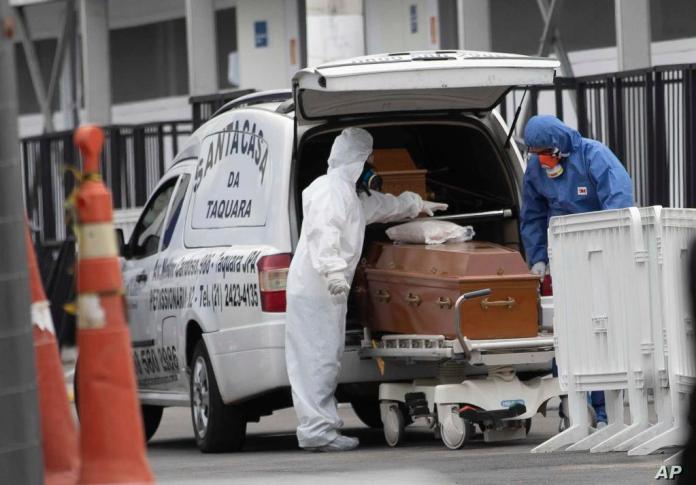
Members of the independent medical associations that, given the inaction of the Nicaraguan Ministry of Health (Minsa), proposed a voluntary quarantine to slow the spread of COVID-19 in Nicaragua, now complain of “a campaign” being waged against them. They assert that the campaign is an attempt to “discredit them” and “throw over the cliff” the work that they’ve been doing for the last few months. This work that has made them a national point of reference.
Independent Medical Associations denounce the smear campaign against them after they called for a voluntary quarantine to slow the contagion from COVID
The “campaign” began this past weekend with a pair of videos in which two doctors accuse the associations of having included their names in a list of those who died from COVID-19 and threatening to sue them. In both videos, which have been disseminated over social media and through the government propaganda outlets, the doctors limit themselves to complaining about the affront against them. They never even mention the disease that the Ministry of Health claims has caused only 55 deaths and 1,354 confirmed cases up until June 9.
In the same vein, people linked with the Sandinista Party have spread the rumor on social media that the independent medical associations “want to destabilize the government”. Despite the lack of resources in the public hospitals of the country, they call on the population not to accept any of the medical supplies the Association is distributing, because they are infected by COVID-19.
A doctor belonging to these associations and who also is on the front lines of the battle against COVID-19, regretted the fact that some health professionals are trying to “undercut the real information” about the death of some of their colleagues. These people “filter erroneous information”, to cause the associations to look bad. According to the last report of the independent monitoring group “COVID-19 Citizen’s Observatory”, forty-eight health workers had died from the COVID-19 virus.
A politicized system
On the other hand, the source warned that refusing medical supplies can have “a boomerang effect”, because as the infection rate rises, the public employees themselves will be “the ones to demand those materials, that can make a difference between life and death.”
In Nicaragua, the health system is “impoverished”, “vulnerable”, and “politicized”, emphasizes the doctor. That’s why some doctors have anonymously denounced the seriousness of the pandemic, while the government tries to minimize it. However, COVID-19 could also leave behind “a wave of firings” in Minsa, as occurred in 2018 during the April rebellion.
“Unfortunately, in Nicaragua, there’s no Physician’s Law. Health care has been politicized, and those directing the hospitals are people loyal to the [governing] party,” the doctor explained. The firings and threats to the health workers who dare to make denunciations “are a reflection of the fact that in this country political interests prevail over science,” the doctor continued.
Reprisals against the doctors
Dr. Javier Nunez, vice president of the Nicaraguan Medical Association, said the campaign against the Medical Associations forms part of a “reprisal” against them for taking on a role that corresponds to the Ministry of Health in the fight against the pandemic.
“Let’s recall that this government relies on lies, conspiracy, in trying to discredit people. This is a campaign that has been expected since Dr. Carlos Quant was fired, simply because he, as an infectious disease specialist, was offering precise information about the pandemic,” highlighted Nunez.
Despite the hostile atmosphere, teams from the Medical Association have distributed medical supplies over a large part of the national territory, according to Nunez. The supplies they’re distributing have been made possible by donations from private companies and non-governmental organizations. Up until now, no health worker has refused their aid.
The Nicolás Maduro regime infiltrated Chavista agents into the U.S. protests to encourage violence in that country. It happened in Chile, Ecuador, Peru, Colombia, Argentina, Bolivia, and now it is also happening in the United States. The Maduro regime and leftist groups are present in the chaos of the American country to destabilize the government of President Donald Trump in an election year.
The fact that members of the left decide to come out with symbols of Chavismo and join the protests is not random. (PanAm Post)
Videos and photographs on social media showed that agents of the Venezuelan regime are in the United States and participating in the protests. In fact, one of the “protesters” who claims to be “Chavista” recently met with the dictator Nicolás Maduro at the Venezuelan presidential palace.
A video shows a young woman during a demonstration in Miami, Florida. The young woman is carrying a backpack with the colors of the Venezuelan flag that was provided by the Maduro regime. She says she is Dominican, claims to be a “Chavista” and that she “supports the Bolivarian revolution. She also says that she recently visited the Caribbean country “on behalf of an internationalist brigade.”
President @realDonaldTrump Maduro is infiltrating the protests to generate violence and chaos in the United States, his permanence in power is a danger to the security of the United States. pic.twitter.com/6vAUin0QkD
In other pictures, you can also see a blond man in a “Chávez eyes” shirt who went out to protest in the United States, and who recently also met with Maduro. He is Max Blumenthal, editor of the Grayzone website and a contributor to the Russian state media Sputnik and RT.
What is happening on North American soil is not accidental. The fact that members of the left decide to come out with symbols of Chavismo and join the protests is not random. It is just another example of how Nicolás Maduro has become a threat to the region.
It is not surprising that the Venezuelan tyranny is behind the violent acts since this is not the first time that it has participated in some way in attacking the peace and security of countries in the region, such as Colombia, which now faces the FARC and ELN guerrillas, financed and supported from Venezuelan territory.
Joseph Humire, an expert in global security, has said that there are criminal groups in the U.S. protests that have found an excuse to commit crimes. There are also shock groups that have been formed to coordinate violent actions against the U.S. government.
Humire believes that the shock troops are operating with alleged support from abroad as the scenes in the US have also been seen in protests in Latin America, Europe, and the Middle East.
“Now we have the flag of the Sandinista FSLN of Nicaragua at the #GeorgeFloyd protests in Miami. Ironically, Sandinista leader Daniel Ortega and his vice president Rosario Murillo, are responsible for the illegal killing of hundreds of protesters in Nicaragua from 2018″, Humire said on Twitter.
“One of the flags repeatedly seen in the ongoing protests throughout the country is that of the Mapuche people of Chile. It was a symbol used in the violent Chilean protests last October, which killed 29 people and injured nearly 2,500. The Mapuches are in the Bolivarian network,” he recalled.
The death of George Floyd, a 47-year-old African-American, brought thousands of people onto the streets to express their anger, sometimes with violence. President Donald Trump sees them as violent radical leftists, especially from the far-left Antifa movement, which he said he will include on the list of terrorist organizations.
FBI on track
Multiple protesters arrested in Miami and other U.S. cities testified before the FBI that they had received money from activists in Cuba and Venezuela
Detainees including citizens of Haiti, Venezuela, Honduras, and the United States who were interrogated by FBI domestic counterterrorism agents.
In Bolivia, on November 13, when four Cubans were arrested with cash financing the protests against the government of Jeanine Añez. By mid-November, Chile had already expelled 50 foreigners “for engaging in looting, being involved in disorder, attempting to undermine authority, and setting up barricades.” This included 30 Cubans, nine Venezuelans, and one Bolivian.
In October, the president of Ecuador himself, Lenín Moreno, said that members of the FARC guerrilla group and Chavista Venezuelans had infiltrated his protests in his country.
In an interview with the PanAm Post, Humire emphasized he believes that Cuba and Venezuela are tools that are being used in a much larger geopolitical puzzle. He added that he believes a matrix of opinion is being built on the São Paulo Forum with the very intention of disguising the real culprits of political and social destabilization in the region.
“I think Cuba and Venezuela are tools that are being used in a much larger geopolitical puzzle. The other pieces are in Europe, Asia, and the Middle East,” he said.
“Recent events have taught us that we cannot focus only on Venezuela. I have always said, for victories inside Venezuela, we have to take action outside the country,” Humire said.
Humire says that to tackle the situation, democratic governments need to take action and impose sanctions on Maduro’s allies and that they should also strengthen their counter-intelligence services in migration to prevent the entry of people who could become a threat.
While Nicolas Maduro’s regime admits that it needs money to deal with the coronavirus pandemic, it sends fuel to Cuba at no cost. Meanwhile, there is an unprecedented shortage of gasoline in Venezuela.
Maduro announced the hike in fuel prices, claiming that Venezuela had paid for the gasoline in dollars to Iran and that Venezuelans should pay for it. However, he does not demand that Cuba pay for regular shipments to the island (EFE).
The ship Carlota C, which is anchored in Venezuela with a Cuban flag, will carry fuel to Cuba. However, in the South American country, people are still waiting in long queues of cars to fill their tanks.
“This boat, the Carlota C anchored at El Palito, is coming to refuel Cuba. This boat has been operating for several years from Cuba to Paraguaná looting our gasoline. Now it is closer, it is the turn of the Palito,” said Congressman Luis Stefanelli on Twitter.
According to MarineTraffic, the ship is in Venezuela after a four-day, three-hour journey from the port of Moa, Cuba.
It is not surprising that the ship Carlota C is transporting gasoline that was paid for by Venezuela. Earlier in March, when the world was already amid the coronavirus quarantine, and there was no fuel at the service stations in Venezuela, Maduro sent loaded tankers to Cuba.
According to journalist Casto Ocando, the PDVSA report indicates that “the shipments of fuel given by Maduro to Cuba amidst the Venezuelan mega-crisis, arrived at the following ports: Cienfuegos, Havana, and Santiago de Cuba.”
Cuba is one of the main allies of Venezuela. The island used to receive about 100,000 barrels of oil from Venezuela every day through various cooperation agreements. Cuba, in turn, sent doctors, military, and intelligence officials in exchange for Maduro’s oil.
A fleet of five ships, the first of which has already arrived in Venezuela, is transporting 1.5 million barrels of gasoline from Iran to supposedly alleviate the shortage in the oil-rich country. The gasoline has not yet been distributed in Venezuelan territory, and the Venezuelan people have not accessed it, but it will also end up in Cuba.
The 200 million liters of gasoline, brought by the Iranian freighters, was paid for in advance with nine tons of gold equivalent to 500 million dollars in the market. This gold was plundered from the vaults of the Central Bank of Venezuela.
Maduro announced the hike in fuel prices, claiming that Venezuela had paid for the gasoline in dollars to Iran and that Venezuelans should pay for it. However, he does not demand that Cuba pay for regular shipments to the island. Meanwhile, Maduro rations how many liters of gasoline Venezuelans can buy.
Venezuelans will need ten months’ salaries refuel their cars
Just to fill a tank of gasoline, Venezuelans will need up to ten minimum monthly wages. This is due to the new increase in prices announced by the Nicolás Maduro dictatorship, which will also have to be paid in dollars, or, at the official exchange rate.
On Saturday, May 30th, Maduro announced a variation in gasoline prices for the first time after more than 30 years with subsidized prices. Fuel went from being the cheapest in the world to the most expensive relative to the wages of Venezuelans, who now have to choose between buying food to eat or filling up their tanks.
Consumers will have to pay at least 20 USD for a 40-liter tank and 30 USD for a 60-liter tank at any of the 200 service stations in the country. Currently, the minimum wage in Venezuela is 800,000 bolivars, which is equivalent to approximately four American dollars.
If you fill a 40-liter tank of an average vehicle, it will cost you 3,962,211 bolivars. You will need ten months of the minimum wage to fill this tank with gasoline.
“It is necessary to have a revaluation of this important product,” said Maduro about gasoline. “The time has come to move toward a new (pricing) policy,” he said.
On May, 12-year-old Joao Pedro became the latest public face of police violence in Brazil. He was playing in his uncle’s house when he was suddenly riddled with bullets: 72 rounds from police guns.
The sign says: “Racism is a virus”
Although Brazil’s Supreme Federal Court ordered a halt to raids in favelas during the coronavirus pandemic, police operations in the country’s poorest neighborhoods have continued unabated. So it is no surprise that Brazilians have added their voices to the demonstrations taking place across the United States and worldwide following the killing of George Floyd by a white police officer. Brazil, the largest country in South America, has a long history of police violence.
“The biggest lie in the history of the world is that slavery ended,” said Monica Cunha, whose son Rafael was killed by police in 2006. “The pandemic is showing us.”
Cunha took part in one of Brazil’s mass anti-racism demonstrations over the weekend. “Enough,” the placard she carried through the center of Rio de Janeiro read. “Black mothers don’t want to cry anymore.”
Deadly police brutality
Some of Brazil’s most violent policing takes place under the shadow of Rio’s Sugarloaf Mountain. In 2018, a quarter of police-related deaths nationwide were registered in the state of Rio de Janeiro. The death toll in the first six months of 2019 alone was 1,075 — 80% of the victims were black. And the death toll for April 2020 was up 43% over 2019.
According to statistics compiled by Violence Monitor, a collaboration between journalists and researchers that tracks homicides in Brazil, 5,804 people were killed by police in 2019 — up from 5,716 in 2018. By comparison, the Washington Post newspaper put the number of police-related deaths in the US at 1,039 for 2019. Statistically, the state of Rio, with an average of 10.5 deaths per 100,000 residents, is second only to the Amazon state of Amapa, which averages 15.1 per 100,000, in a nationwide ranking of police-related deaths.
The Military Police (PM) are most feared law enforcement agents in Brazil. “Their roots stretch back to colonial times,” explains historian Luiz Antonio Simas. The force was founded in 1809, as a royal guard protecting John(Joao) VI of Portugal, who had fled to the colonies to escape Napoleon.
“The elites at the time were terribly plagued by what was known as Hatianism,” Simas said. The 1791-1804 revolution in Haiti — in which formerly enslaved people expelled French plantation owners, abolished slavery and declared independence — had scared Brazil’s land-owning class. “Hatianism persists as a historic fear,” says Simas. “The idea of suppressing blacks while protecting the property of a small group of elites is part of the PM origin myth.” The logo of the PMERJ, Rio’s PM force, still features a crown above crossed colonial pistols flanked by sugar cane.
Racial whitening
Racism is not only common in Brazil’s police: It is deeply rooted in society. After slavery was formally abolished in 1888, the country did not impose official policies of segregation, as US states did, but the guiding principle became “racial whitening.”
When the First Universal Races Congress was held in London in 1911, Brazilian representative Joao Batista Lacerda spelled out the concept of strong “white blood” eventually supplanting weaker “black blood.” Lacerda predicted that if Brazil stopped all African immigration and increased white European immigration, the country’s black and multiracial populations would naturally disappear within 100 years.
“They were spreading the idea of a nation in which blacks were unwanted and expendable,” said Ynae Lopes dos Santos, a historian at the Fluminense Federal University in Rio. The “whitening” of the race would occur through the offspring of white men who were encouraged to wed black or indigenous women. Dos Santos said the myth that Brazilian democracy was founded on the principle of racial harmony ignored the violence committed against women of color.
No land for black men
Though women of color had roles to play as wives or servants, dos Santos said, black men were left out: “19th-century racial ideologies claimed they were genetically predestined to become criminals.” She said that prejudice persisted in contemporary police violence.
The sign says: “Black mothers don’t want to cry anymore”
Police forces were expanded into a sprawling apparatus of state repression against left-wing dissidents during Brazil’s 1964-1985 military dictatorship. And police found a new category of internal enemy when Brazil joined the international “war on drugs” declared by US President Richard Nixon in the early 1970s.
“The bloodbaths of the 1990s are our democracy’s calling card,” the historian Lucas Pedretti said. “Marginalized black men have never gotten out of the crosshairs. Deep-seated state terrorism has indelibly marked our democracy.”
In 1993, the news of four massacres in Rio shocked the nation. In them, PM officers were said to have killed 53 people — including homeless children. Investigations into many of the deaths remained inconclusive.
Colonel Ibis Pereira, who was commander of Rio’s PM at the time, acknowledges the structural racism: “We have a police force that operates like an independent death squad, not a crime investigation unit — at least not in poor areas, where the constitution still hasn’t arrived.” Pereira said that was evidence of the racism, “because mostly blacks live those places.”
Legislators of National Restoration, National Liberation, Christian Social Unity and the Christian Social Republican
(QCOSTARICA) A group of 12 legislators submitted to constitutional consultation the bill to sanction street harassment, which was approved in the first debate on Tuesday.
Legislators of PRN, PLN, PUSC and PRSC parties filed a constitutional consult request, suspended the second and final vote on the legislation that criminalizes exhibitionism and masturbation in public spaces or on means of public transportation
With ‘constitutional consult’ to the Constitutional Court or Sala IV, debate and second vote that was to be before Congress this Thursday is suspended.
The signatories of the consulta are legislators Carlos Avendaño, Melvin Núñez, Geovanny Gómez, Floria Segreda, Mileidy Alvarado and Xiomara Rodríguez, of the National Restoration Party (PRN); David Gourzong, Jorge Fonseca, Paola Valladares and Luis Antonio Aiza, from the National Liberation Party (PLN); Oscar Cascante, from the Partido Unidad Social Cristiana (PUSC); and Otto Roberto Vargas, from the Republican Social Christian Party (PRSC).
The bill, Ley Contra el Acoso Sexual Callejero (file number 20.299) was approved on Tuesday unanimous by all 49 of the 57 legislators present for the vote.
The bill criminalizes the most severe forms of street sexual harassment: exhibitionism and masturbation in public spaces or on means of transport, as well as persecution or cornering and the production of audiovisual material.
The presiding judges for each case would determine to apply a prison term or fines, as follows:
From ten months to one and a half years in prison: to those who photograph or record with a sexual connotation, and without their consent, people in places of public access and in services for the paid transportation of people. The penalty could go up to two years in prison if the material is shown or transmitted to another person.
From six months to one year in prison: whoever masturbates or exhibits their genitals with sexual intention in public.
From eight months to one year in prison: whoever chases or corners a person for sexual purposes.
The number of days fine will be at the discretion of the judges, depending on “the limits indicated for each crime and offenses, according to the seriousness of the fact, the circumstances of the mode, time and place, as well as the characteristics of the author, directly related to the criminal or contravening conduct.
The penalty fine may not exceed 360 days. Each of these days will be calculated according to the offender’s financial situation, taking into account their standard of living, daily income and expenses to meet their needs and those of their family.
The penalties would be increased by a third if the offender is a repeat offender, if the offenses are committed by more than one person or if the victim is a minor, senior or has a disability.
In the image, a graffiti located in front of the south side of the Cathedral of Cartago. Photo: Rafael Pacheco.
In addition, the new law will classify as a “contravenciones” (infractions), within the Penal Code, some conduct classified by the National Institute for Women (Inamu) as “less harmful”.
Currently, the Code establishes “obscene words or acts”, “disrespectful propositions” and “exhibitionism” as contraventions. However, the new law adds, “words, noises, whistles, gasps, moans, gestures or gestures with sexual connotation towards another person without their consent”.
The initiative will also increase penalties for infractions, from the current fine of between 5 and 30 days to between 15 and 30 days fine.
Amanda Segura Salazar, Inamu law firm adviser and criminal lawyer, explained that the concept of contravention introduced by the new law will better protect women’s rights.
The law also provides that, in addition to imprisonment or fines for those who commit crimes or contraventions, judges apply accessory penalties, which would consist of addiction treatments and specialized programs for the control of violent behavior.
These initiatives aim to re-educate and raise awareness on issues such as toxic masculinities, gender equality, and respect for women’s human rights.
The expenses incurred for these treatments will be borne by the State, except if the convicted person has sufficient resources to cover them.
Amanda Segura Salazar, Inamu law firm adviser and criminal lawyer, explained that the concept of contravention introduced by the new law will better protect women’s rights.
“The current violation is intended to protect ‘good customs.’ It does not have a gender perspective or from the victims, but is thought from how other people observe these actions,” said the expert.
The Minister for the Status of Women and President of the Inamu, Patricia Mora, considers that the bill approved by the deputies “is essential for a cultural change.”
“We women have the right to walk without fear through the city. They are acts that invade our bodies and that, in some way, disrespect life in society,” she said.
There was no word from the Constitutional Court on the time it will take to resolve the constitutional challenge filed on Wednesday.
(QCOSTARICA) 86 new cases of COVID-19 in the country, the Minister of Health, Daniel Salas, reported today, Wednesday, June 10, at the daily press conference.
The figure is the highest recorded since March, when the coronavirus was detected and is part of the increasing curve of recent days. The highest before today was on Sunday, June 7, with 55 new cases in a single day.
Extensive work in the field is being carried out in the northern zone to contain contagion mainly in agricultural production and packing plants. Mobile teams more to areas to rest laborers
With this increase, the total number of infections since March reaches 1,461, of which 1,112 are Costa Rican, and 349 are foreigners.
These data were the prologue to new announcements by the Health Minister, Daniel Salas, who reported on the intervention plan in production and packing companies in the northern zone. Failure for companies to implement measures to reduce contagion so could result in firms put out of business (as in closed).
The measure was decided after 49 cases had been detected in two of these plants from on June 1 to date. According to the Minister, the contagion came from relatives of company officials then they moved to the workers.
“On the 49 cases, I add, the immigration status is investigated,” added Dr. Salas.
“We are going to integrate them (to the companies) in a more absolute way in a joint health intervention plan in the affected agricultural sector.
“We are going to apply this plan in a very rigorous way, the idea is that the company that does not align itself will not be able to operate, we are defending and categorically protecting the health of the population and taking into account that increased risk in that sector.
“We have already indicated, the businessman who fails to align himself and meet these requirements will not be able to operate in the country, he is part of that social and health responsibility with the rest,” warned Minister Salas.
To that warning, the Minister of Agriculture, Renato Alvarado, assured that from the beginning of the pandemic, the agricultural sector developed protocols to work permanently and that food production chains did not stop. The problem is that there was relaxation in the application of the measures.
“In the cassava (yucca) harvesting, we have had problems in some of the plants. New cases have started to emerge, as a result of contamination that we are having in the communities and the plants.
“For this, we are going to develop this joint plan, where Health, Ministry of Agriculture (MAG), the Ministry of Public Security, and all the others will be going to the plants directly and carry out the relevant inspections.
“We have already talked with the businessmen of the area so that they actively and forcefully join this containment of contamination (…) we will be very emphatic with those who do not comply with the requirements and health protocols, we will act in a manner joint and very severe,” he said.
Production paused
For the time being, the intervention involved stopping the production process for three days to disinfect and sample all workers, which would determine if they can return to work.
“We know that nobody does it intentionally, they are highly regulated plants with workers enrolled in the Caja (Costa Rican Social Security), and they complied with their protocols, but it was also due to contamination by family members,” said the MAG minister.
However, he acknowledged that there are “unscrupulous” who hire migrants who come from neighboring countries illegally.
The important thing, he declared, is that businessmen and citizens work together to achieve containment and guarantee that the people who are hired have roots and permits to work in the country.
According to Salas, when talking about intervention, it is about verifying compliance with measures such as the use of protective equipment, where to wash hands, alcohol gel available, adequate ventilation conditions.
“Now we are going to make a type of productive bubble, where we are going to minimize the contacts they may have outside the company, if that is not achieved, they will not be able to operate,” he reiterated.
We need to do better
“Costa Rica has been doing things very well and right now we have to do even better. We can economically close everything, but if the health care is unbalanced, there is no way to get out of this from an economic point of view,” said Health Minister Daniel Salas.
The new record in infections was preceded this Wednesday with the confirmation of death number 12 related to this disease, caused by the new respiratory virus SARS-CoV-2.
It was a 58-year-old woman who died in Hospital México, where she remained for 70 days. The patient had risk factors and at the time of death she had already tested negative for covid-19.
Alexánder Solís, president of the National Emergency Commision (Comisión Nacional de Emergencias – CNE), explained that “extended preventive” measures are expanded to cover areas of high contagion, the measures are similar to those applied during Semana Santa, with vehicular restrictions from 5:00 pm to 5:00 am – no vehicles, except for the known exemptions can be on the road and limited hours of operation of stores.
Back to school
Daniel Salas said this Wednesday that the possible return to classes after July 13 (when half-year vacations end), “is not a broad return”, a subject on which he has already discussed with the Ministry of Public Education.
In fact, he announced that there will be no return to classes in areas that remain on orange alert, precisely, because there is a greater circulation of the virus.
“We are still analyzing, next week I have a meeting, ”he said.
By the numbers
As mentioned earlier, the total number of cases since the first case of the COVID-19 in March is now 1461, of which 1,112 are Costa Rican and 349 foreigners.
The number of active cases is now 727, with 12 deaths recorded.
Hospitalized are 20 patients, of whom 3 are in intenvise care.
The deceased had 70 days of being admitted to the Hospital México, in La Uruca. Albert Marin.
(QCOSTARICA) A 64-year-old woman died this Wednesday (June 10) morning as a result of COVID-19. The resident of San José is the 12th fatality in the country for that cause, according to the Ministry of Health.
The deceased woman, the third female victim of COVID-19 in Costa Rica, had been admitted at Hospital Mexico for 70 days
“The death occurred in the Hospital Mexico where she had been hospitalized for 70 days in the Intensive Care Unit (ICU),” said Salud.
The patient had risk factors such as high blood pressure, diabetes and liver disease, the Ministry reported. COVID-19 was diagnosed on March 24, after having made a trip abroad.
This death is added to the 11 regrettable deaths already registered: two women and nine men with an age range of 26 to 87 years.
Monday night, the death of the youngest of the victims was announced, and also the first case of postmortem COVID-19 positivity. At the moment, however, it is considered a death associated with the disease, with no clarity as to whether it was the cause.
The first female victim of the disease was a 58-year-old patient, a resident of Alajuela, also hospitalized at the Hospital México. Her death occurred on May 15. The woman also had risk factors because she had lymph and high blood pressure. COVID-19 had been diagnosed since April 23 and two days later she entered the Intensive Care Unit (ICU).
Also on May 15 and at the Hospital Mexico, a 73-year-old man died as a result of the COVID-19. He had heart disease and hypertension.
All the previous victims were men between the ages of 45 and 87. Only the first and youngest of them had no known risk factors.
The deaths have occurred at the Hospital México, Juan de Dios, San Rafael de Alajuela and Enrique Baltodano de Liberia.
12 deaths in Total
This is the detail of the other eight deaths by covid-19:
March 18: An 87-year-old man admitted to the Alajuela hospital with risk factors.
March 19: Another 87-year-old man admitted to the Alajuela hospital, with risk factors.
April 8: A 45-year-old man admitted to the San Juan de Dios Hospital, without risk factors.
April 15: An 84-year-old man admitted to the San Juan de Dios Hospital, with risk factors.
April 19: A 69-year-old man admitted to the San Juan de Dios Hospital, with risk factors.
April 20: A 54-year-old man admitted to the Mexico hospital, with risk factors.
May 10: An 80-year-old man hospitalized in Liberia, with risk factors.
May 13: A 75-year-old man from Alajuela. He died at the San Juan de Dios Hospital and had risk factors.
May 15: A 58-year-old woman, the first woman to die from COVID-19 in Costa Rica.
May 15: A 73-year-old man died as a result of the COVID-19.
June 8: A 26-year-old woman, the second woman, the youngest of the victims of COVID-19. Her death is COVID-19 related, she displayed no symptoms, her infection was discovered post-mortem.
June 10: A 64-year-old woman, the third woman, at the Hospital Mexico where she had been hospitalized for 70 days
Up to Tuesday, June 9, a total of 1,375 infections have been recorded in the country, counted from March 6 when the first case was detected.
Brazil and Nicaragua are the two Latin American countries that are still resisting the implementation of measures to prevent and control the spread of Covid-19.
Presidents Jair Bolsonaro of Brazil and Daniel Ortega of Nicaragua have both repeatedly refused to adopt public health strategies in accordance with the recommendations of the World Health Organization and the Pan-American Health Organization, even though the virus has spread at an alarming rate in both countries.
The logic of the Ortega- Murillo government
The decisions that the Ortega government has made with respect to the pandemic have surprised many. Some find them irrational or senseless. Actually, though, they reflect the president’s vision and that of his close circle for ruling the country, coping with the crisis they’ve been dragging around since April 2018, and, now, dealing with this new emergency. Altogether, it’s a logic of premeditated omission and neglect.
The government has insisted repeatedly on denying the presence and the effects of the virus in the country, with arguments that run from religious justifications (such as the affirmation of Vice President and chief government spokesperson Rosario Murillo that the country’s borders were “impenetrable” thanks to divine protection) to the argument set forth by Ortega himself that they weren’t going to establish any quarantine so as not to harm the economy.
Hence, as the first alerts were being sounded in Central America, the Nicaraguan government began organizing numerous activities that involved large crowds of people, such as fairs, political marches, sporting and cultural activities. They even organized a carnival on the theme of “Love in the times of Covid-19”, where health workers and government sympathizers paraded beside floats, with placards welcoming the virus.
They’ve refused to suspend classes in the public schools, to conduct informational and preventive campaigns among the population, or to realize large-scale testing for contagion, despite the 26,000 test kits that were donated by a regional financial organization. The Ortega government has also refused to suspend on-site work in the public institutions or to establish a quarantine. On the contrary, they’ve promoted house-to-house [unprotected] visits by the public employees.
One of the aspects that the government has controlled most closely is information about the evolution of the contagion and its effects. From the time the first case was announced on March 18, the information offered has been of very little transparency, offering confusing and imprecise numbers of active cases, recovered cases, deaths, and the number of tests administered.
For several weeks, even when the newspaper reports spoke of hospitals already saturated with patients, the Executive branch continued maintaining that there had only been 27 positive cases and refusing to recognize the existence of community transmission. When the curve of cases began to rise exponentially, they had no other alternative but to recognize it, so that the registry of cases jumped from 279 cases reported at the beginning of May, to a total of 759 cases in the lapse of just two weeks.
One of the most serious and contradictory decisions of the Ortega-Murillo government had been to impede the use of protective equipment among medical personnel, including those who were attending patients with COVID-19. This contributed to the spread of the COVID-19 virus to 40 doctors and health workers in Nicaragua, some of whom died of the disease.
Following a strong public protest from more than 700 professional health workers, and when the curve of contagion had already begun to ascend, the Executive branch finally allowed the use of facemasks and other protective equipment, often acquired by the personnel themselves.
One of the most dramatic consequences has been the subsequent policy of placing police and armed civilians at the entrances of the hospitals, to avoid the demands of the family members of admitted patients, and to control the health workers, so that they don’t leak unauthorized information. These groups of police and armed civilians assist at the burials of those who died of the disease, to keep the families from denouncing irregularities.
On other occasions, they’re the ones responsible for carrying out the so-called express burials, which involve burying those who have died from the virus at advanced hours of the night, many times without the presence of relatives, so that the rest of the people don’t find out.
As has been made clear, the actions of the state are key to combatting this global pandemic, and can make a substantive difference in the spread of contagion, or in the consequences of the virus. In the case of Nicaragua, the government of Daniel Ortega and Rosario Murillo are the clearest example of an absent state, that – in a premeditated way – has opted to confront the emergency from a political stance that is deadly and authoritarian.
The other side of the coin: an active citizenry
The voluntary absence of the state has left the population exposed and unprotected in the face of the pandemic. Because of this, people have opted to take their own protective measures, individually as well as collectively. Many of them have quarantined themselves and are voluntarily respecting social distancing, using facemasks and other protection when they go out on the street. There are also many very valuable initiatives on the part of organized groups.
One of the first and most notable is the conformation of a Multidisciplinary Scientific Committee, made up of professionals from different specialties who, in the face of the absence of the state and the lack of information, have become the principal point of reference for the population.
Since before the first positive case was confirmed in the country, they have assumed the job of issuing alerts, analyzing the evolution of the contagion, recommending preventive measures and facilitating the information within their reach to lessen the effects of the pandemic among the population.
Another important group is Unidad Medica Nicaraguense [Nicaraguan Medical Unity], an independently organized group of doctors who have joined on with this effort and have been willing to care for patients who were rejected by the country’s precarious health system, or who prefer to stay at home because they fear becoming infected in the hospitals, or whose symptoms are mild, or sometimes because they can’t afford private health services.
Another group of organized professionals is the COVID-19 Citizen’s Observatory, that registers information and follows up on suspected cases of the virus in Nicaragua. Their data is collected via a vast network of volunteers and local leaders, who identify the cases. Every reported case is verified and incorporated into the statistics once it is confirmed. The focus they utilize is that of community epidemiological vigilance. Those participating define it as the collaborative effort of an interdisciplinary team, together with organizations, social networks and individual citizens. Together, and voluntarily, this team contributes to filling the vacuum of information on the pandemic.
They issue weekly reports with detailed information about the case numbers in different places in the country, although it doesn’t comprise an official or a complete report. The information is made known through social media accounts that the Citizen’s Observatory itself has created.
There are two other initiatives that have been carried out on a large scale. First, information and prevention campaigns circulating on social media, promoted by different social and political organizations; and secondly, local chains of support and solidarity, organized by people linked to the civic movement that’s been active since April 2018. These groups bring aid to infected people and families, or to those in vulnerable situations.
In the face of a state that has been purposefully absent, the existence of an active citizenry has become an immense social capital. On the shoulders of these independently organized groups lie the most important actions being realized in Nicaragua to prevent, contain and mitigate the most critical effects of the pandemic, as much in public health and humanitarian terms, as in the economic and social arena.
This article was originally published in Agenda Publica (in Spanish).
(TODAY NICARAGUA) The independent monitoring organization, “COVID-19 Citizen’s Observatory”, issued a report on Tuesday, June 2, in which it reported 4,217 total infections and 980 deaths from the ongoing COVID-19 pandemic.
The latest report from Nicaragua’s Citizen’s Observatory registers 4,217 suspected cases and 980 deaths from the pandemic
Citizen’s Observatory, made up of a network of doctors and voluntary collaborators from all over Nicaragua, gave a much higher count of both cases and death than the report from the Ministry of Health (Minsa), issued that same Tuesday.
According to the government’s health authorities, up until now a total of 1,118 people have been infected with COVID-19, of which 46 have died.
Last week’s official data from the Ministry of Health wasn’t included in the Citizen’s Observatory report, since the statistics they reported on Tuesday had a cut-off date of May 30.
According to the Observatory’s independent report, Managua is the department with the highest number of COVID-19 cases, with 1,706, followed by: Masaya with 355; Matagalpa with 274; Leon with 220; Chinandega with 182; and Grenada with 110, while the other eleven departments together had fewer than 100 cases.
Managua also headed the list of deaths linked to COVID-19, with 465. Together with Masaya, which reported 124 deaths, they’re the only two departments with over a hundred fatal cases.
Irregularities
The report noted at least 1,431 irregularities that have occurred around the country in the context of the pandemic in Nicaragua, among them exposing people to risk via crowd activities, the inadequate response from the Ministry of Health, and threats or reprisals taken against patients or family members if they divulge COVID-19 cases and deaths.
The 34 different local medical associations in Nicaragua have noted that the curve of COVID-19 infections in the country may not yet have reached its highest point. These medical associations have recommended that the population assume a voluntary national quarantine, in accordance with the recommendations of the World Health Organization, without waiting for a government decision.
President Daniel Ortega’s government has received criticism from within and outside the country for their strategy of prioritizing the economy and tax collection. This strategy has largely consisted in establishing no restrictions and taking minimal preventive measures, all the while promoting crowd activities.
The World Health Organization and the Pan-American Health Organization have both expressed concern on repeated occasions about the situation in Nicaragua.
Meanwhile, the UN Office of the High Commissioner of Human Rights and the Inter-American Commission for Human Rights have asked the Nicaraguan government to guarantee the population’s right to health.
(QCOSTARICA) The enormous heart of Juliana, a nine-year-old girl, who in April had set herself the goal of helping her family affected by the pandemic and succeeded by making and selling “bolihelados”.
Her taste for cooking and her desire to help led her to spend the quarantine very entertaining working.
That motivation transformed a small idea into a project to which this enterprising girl has put soul, life and heart into. In just over a month, they have already created and sold more than 700 bolihelados. She herself is in charge of delivering order.
The magic of this effort occurs in the kitchen, where Juli, with the help and supervision of her parents, has been concerned with inventing new flavors and making a product that people enjoy.
If you want to support Juli’s entrepreneurship, you can search her Facebook page ‘Bolihelados Juli‘.
If you’re in San José, California, and want to mask your online business through a San José, Costa Rica, connection, you will need to use a Costa Rican VPN service (https://surfshark.com/servers/costa-rica).
By the same token, if you happen to be on vacation in this beautiful land of rain forests and bi-coastal ocean beaches, you’ll still want extra protection and privacy.
Costa Rica ranks highly on its freedom of access to the internet, but you’ll need to be wary of using public Wi-Fi hotspots, for reasons we shall discuss presently. Also, with a VPN, you will enjoy the security, privacy, and open access benefits only a premium VPN service like Surfshark can provide.
Why Use a VPN in Costa Rica?
Security first
Security conscious travelers and home web users need another layer of online protection. Firewalls and the security features built into computer operating systems protect against common viruses and malware threats. However, VPN adds an additional layer of security and privacy through an encrypted tunnel that hides the user’s location and does not track online activity.
In fact, a premium VPN like Surfshark runs interference against potentially harmful adware and phishing attacks. Its best feature is its online deception and address masking ensuring complete privacy.
Follow the money
Financial transactions require the protection of VPN. A VPN is the added layer of security not always available through financial institutions. The best feature of a VPN its protection and encryption of data in transit–credit card transactions, invoices, accounts payable/collectable, etc.
Financial data transmitted via a VPN is encrypted when transmitted and when received, making the person or company far less vulnerable to malware attacks and payment fraud.
Public Wi-Fi sites are everywhere
The term “public” is another word for “insecure.” Signing on to a public Wi-Fi at a local coffee shop or in a Costa Rican restaurant without the protection of a VPN is extremely risky. An open connection is an open invitation to a man-in-the-middle attack. Load a full-featured VPN like Surfshark on your laptop or smartphone to protect you from spying, spoofing, and phony web apps.
That person sitting in the far table munching her Costa Rican tres leches cake with eyes down on her or her laptop could be sending out electronic feelers to unsecured Wi-Fi users to launch live intrusions or implant malware. Use a full featured VPN like Surfshark, and all she’ll get for her trouble will be more cake and encrypted gibberish.
Everyone loves online gaming
A VPN clears the field through bypassing ISP bandwidth throttling. Throttling can slow down browsing speed and game play. Also, with a VPN, gamers can access restricted or locally banned games. Your location is masked and provides anonymity while playing online, VPN benefits include a shield against hacking by rival players and banning by tyrannical game overseers.
Unblock Netflix and other streaming services
With a full-featured VPN service like Surfshark, you can access popular streaming services like Amazon Prime, Hulu and Netflix from outside the area. Frequently those services are restricted by copyright agreements to local users only. With a VPN, the user can unlock overseas content without resorting to illegal and dangerous pirated content.
Sports fans get full access to geo-blocked events
Whether travelling to Costa Rica or sitting at home online, you can use a full-featured VPN like Surfshark to view favorite (and frequently blocked) sports channels. A VPN like Surfshark bypasses the aforementioned ISP throttling, which can interfere with live sports broadcasting. Also, the ISP cannot identify the user or slow down the stream even during peak usage hours.
Defeat government surveillance, geo-blocking, and net censorship
Some countries use geo-blocking to block web sites for political or censorship reasons. A VPN is a defense against government surveillance and tracking. While a VPN will not make a user completely invisible to powerful government agencies, the expanded use of the secure HTTPS protocol has made mass government surveillance more difficult than ever.
The bottom line: A VPN hides the user’s net activity from the ISP. With Surfshark’s “no-logs” feature, for example, the ISP cannot disclose, sell or even respond to a court order for any user’s data protected by a VPN.
Shop online and find the lowest local prices
Online business sites also use geo-blocking. Their goal is to either block out-of-area shoppers or display different prices for more affluent areas. Airlines frequently display ticket prices based on the location of the user’s ISP address. For example, while shopping for the same airline ticket at different ISP locations the traveler can often see different prices for the same trip.
This also occurs on a variety of ticketing, auto rental, and hotel sites that display variable prices, depending on the ISP address of the customer. With a VPN, the smart shopper can sign on to a local VPN server as a local shopper/traveler and do price comparison–as well as uncover unfair pricing tactics.
VPN gives Bitcoin mining and trading an extra level of security
A VPN provides even greater security in encrypted cryptocurrency transactions. Blockchain technology provides a distributed and secure ledger for bitcoin transactions, but its encrypted access keys to individual user accounts have been stolen through phishing, fraud or malware intruders. Once the bitcoin has been stolen, it is irretrievable. A VPN adds another layer of anonymity and hides the owner’s connection.
Protecting the Internet of Things (IoT)
In addition to computers and smartphones, there are other devices and appliances that connect to the internet. Those connections are handled through the home router, and that router can be a gateway to compromising personal privacy. You can set up a VPN on a router and protect every device feeding off the router. This requires no additional device settings, but may require installikng a new VPN-compatible router.
Free vs. Premium VPN Services
There are many free VPN services, but they are essentially trimmed-down versions of their full-featured premium products. They offer a basic level security and privacy, but they come with the following disadvantages. Namely, free VPNs:
track the user’s online activity: User tracking is one way that free VPNs pay their overhead costs. The free VPN server installs adware or spyware into the user’s browser. Then they log their users’ online activity and sell the data to marketers and ad agencies.
slow the user’s internet connection: Free VPN customers will often take a backseat to paying customers in competing for bandwidth. In addition to less bandwidth, the ad popups that support free VPN can interfere with browser performance as those ads load in the background and cause the browser screen to jump around.
make the user a secondary target of opportunity for hacking: Because of ad/spyware, free VPNs are more likely to carry malware than premium VPNs. Ads with their image files and buried code can be vectors for bots, viruses and trojans.
Why Premium VPNs Are the Best Bet
For just a few dollars per month, a premium VPN service like Surfshark, provides the following benefits:
Guarantees a “no-logs” policy. The user is never tracked online, and the service maintains no connection or activity logs for any user.
Provides the best-in-class connections and top-grade encryption (256-bit)
Prevents data leakage: Surfshark, for example, features a “kill switch.” If the connection to the VPN server goes down, the connection is terminated.
Hides the user’s web activity from their internet provider. The IP cannot detect VPN use. With no logging of user activity, the user’s web use is undetected and private.
Are most effective in bypassing geo-blocking. With a premium VPN like Surfshark, log on to overseas Netflix services, which routinely block free VPN proxies. If the premium VPN detects blocking, the user is redirected to a VPN server that can bypass geographic restrictions.
Can provide attractive extras. For example, Surshark comes with a web app called CleanWeb™. This app blocks ads, trackers, malware and phishing attempts.
So, Premium is Better
Free VPNs can subject the user’s online activity to ISP or government tracking. Free VPN connections are also slower and include intrusive ads and malware. On the other hand, premium VPNs like Surfshark employ a “no-logs” policy. They provide faster, more secure, leak-proof connections. They also do a better job in bypassing geo-blocking.
Paid VPN services like Surfshark also provide extra features like ad blockers, and detection of malware and phishing attempts.
Summary and Conclusion
Costa Rica is an internet friendly country, but visitors should use a premium VPN for online privacy while traveling. Users in the U.S. can also log on to a Costa Rica VPN server using Surfshark.
Surfshark is a premium VPN. It provides a secure, encrypted connection that masks the user’s ISP address. The “no-logs” policy means that user activity is neither recorded nor detected by the ISP or any other intruder.
Use a premium VPN like Surfshark to prevent man-in-the-middle attacks on public Wi-Fi networks. Unblock gaming and entertainment streaming sites and defeat government net censorship with a premium VPN. Also, use a premium VPN to get better prices from airlines and other online services. A VPN will also provide an additional layer or security for Bitcoin transactions. Set up a VPN on a home router to protect every device fed off the router.
Finally, when choosing a VPN, the best services are the low-cost premium services like Surfshark, which provide the best security, privacy, and data-leakage prevention. Surfshark also provides extra features like that block intrusive ads, malware, and phishing attempts.
(HW) A woman was detained by police while walking naked through downtown San José, this Tuesday morning.
The Press Office of the Ministry of Public Security (MSP) confirmed that the incident occurred at Calle 5, Avenida 5.
“The Tourist Police of the MSP in support of the Municipal Police of San José approach a woman apparently under the influence of some drug, for which reason she was provided with attire and placed in the hotel where she is staying,” the MSP reported.
Several people reported on social networks that the young woman was seen walking disoriented through the streets of the capital and totally naked.
The officers gave the women a summons for exhibitionism. “Apparently she had an altered emotional state,” added the authorities.
(QCOSTARICA) With paint and brush, a crew of San Jose Municipal Police were out on earlier this week painting distancing lines at commuter train stops in the capital.
The Municipal Police – not the crews of the Incofer (the railway) – took to the task ensuring compliance with the distancing guidelines of the Ministry of Health, in the central canton of the city, to avoid the spread of the coronavirus COVID-19.
Their efforts on Tuesday were concentrated in the areas around the San Jose municipal offices and La Sabana.
The effort will continue to other areas of the city.
“Today it has started with the demarcation of the train stops located in the central canton. It is a contribution of the municipal police and the Municipality of San José in the prevention of the coronavirus,” said Isidro Calvo, an adviser to the police force.
The central canton of San José registers 163 positive cases, of which 66 are active (still sick), being the second most affected (behind San Carlos, which had on Monday 77 active cases).
Photos courtesy of the Policía Municipal de San José
(QCOSTARICA) As tropical wave number four makes its way through Costa Rica, it produced heavy rains from late afternoon Tuesday and well into the night in many areas around the country.
Reports from communities and the National Emergency Commission (Comisión Nacional de Emergencias – CNE) include flooded rivers, landslides and sewer collapse.
The tropical wave damage includes the passage over the General Viejo river in Pérez Zeledón was once again closed.
Intense downpours caused the river to overflow.
In Santa Teresa beach in Cóbano the rains collapsed storm sewers and cunetas causing water damage inside many homes.
The downpours also caused landslides in some sectors of route 32 that connects Limón with San José.
According to the CNE, in addition to the tropical wave that is routed to the Pacific sector of our country, we have the intertropical convergence zone, also located in the Pacific, which increases instability and the contribution of humidity.
According to the National Meteorological Institute (Instituto Meteorológico Nacional – IMN), these are the areas that will be most affected by these phenomena:
The areas around the Tempisque valley (North Pacific)
The Coto Brus Valley (South Pacific)
Parrita
Quepos
Uvita
The Central Valley
The Mountains of the Northern Zone and the Caribbean
Authorities call for caution in areas vulnerable to flooding due to sewer saturation.
They people to take refuge in a safe place in case of hearing a thunderstorm or perceiving strong gusts of wind near storm clouds, as well as caution for possible falling tree branches, power lines, and more.
Caution is required when traveling on highways, such as Ruta 27 and Ruta 32, and in San Jose, the General Cañas and Circunvalacion with their poor drainage condition, causing pooled water in high speed areas.
Also, the heavy rains cause poor visibility. If you get caught in a downpour, turn on your emergency flashes, turn your headlights, slow down and pull over if you can safely do so until the rains pass.
Never, ever, if you can avoid, drive into pooled water or raging water due to lack of or collapsed storm sewers.
(Global Voices) Indigenous and black Central Americans expressed solidarity online for the killing of George Floyd, a black man who was killed by four police officers in Minnesota, United States.
In Central America, Afro-descendants and indigenous communities are raising awareness for their own suffering due to racism and violent state forces, particularly in countries with sizeable white or mestizo populations, such as Guatemala, Honduras, and Nicaragua.
“Question your internalized racism” by Nicaraguan artist Vero Garabatos on Facebook, used with permission.
Black Central Americans — who are mainly Garifuna and Creole communities — mostly live on the region’s Caribbean coast. For centuries, however, their inclusion in Central American societies has been minimal, if not exclusionary, according to historians. For example, black people were legally prohibited from immigrating to El Salvador from 1933 to the 1980s.
Paul Joseph López Oro, a doctoral candidate in the Department of African and African Diaspora Studies at the University of Texas, argues that black Central Americans are alienated in Central American countries where ‘mestizaje‘ — people whose ancestry are mixed between white and indigenous — is still a prevailing ideal.
Until today, indigenous and black people — often at the frontlines of environmental defense — are dispossessed of their lands, harassed, or killed. Impunity is prevalent for these crimes.
Calls for justice at home and abroad
Costa Rica’s Vice-President Epsy Campbell Barr has condemned the killing of George Floyd on May 30 and called on the UN Committee on the Elimination of Racial Discrimination to produce a special report on all forms of racism, racial discrimination, xenophobia, afro-phobia and related intolerance against African-American citizens. She continued to tweet in support of Black Lives Matter protests in the United States.
No podemos guardar silencio y ser cómplices de la injusticia, de la brutalidad y del dolor. Extiendo mi profunda admiración a todas las personas que marchan y levantan los ideales de la justicia, de la igualdad y del amor #BlackLivesMatter#BlackLivesMatterCR 🇨🇷#GeorgeFloydpic.twitter.com/15lAROvjDH
We cannot keep silent and be accomplices of injustice, brutality and pain. I extend my profound admiration for all the people who are marching and highlighting the ideals of justice, equality and love. #BlackLivesMatter#BlackLivesMatterCR 🇨🇷#GeorgeFloyd
Also in Costa Rica, an Afro-Costa Rican, feminist and anti-racist organization CostaRica Afro organized a zoom meeting to demonstrate against racism in the world.
More than 500 people virtually demonstrated in Costa Rica against racism in the world. The initiative was promoted by @CostaRicaAfro #BlackLivesMatter #BlackOutTuesday
In Guatemala, Indigenous communities have suffered genocide at the hands of state forces during counter-insurgency operations between 1960 and 1996. UN special rapporteur for indigenous rights, Victoria Tauli-Corpuz, noted that Guatemala suffers from structural discrimination and exclusion of indigenous peoples. Indigenous communities have immediately expressed their solidarity with events happening in the United States and invited Guatemalans to reflect on racist dynamics within Guatemala.
Maya Kakchiquel columnist and anthropologist from Guatemala, Sandra Batz, tweeted as early as May 27 about George Floyd’s death.
George Floyd was murdered and racism was the motive of that crime.
We people of color live the abuse and impunity of racist States, which turn their backs on our lives instead of protecting us.
A few days later, Batz wrote an opinion piece that starts with “racism kills,” stating that:
Translation Original Quote: It is easier to perceive the racism of others, that which is exercised in other countries, than one’s own, than that which is practiced as a nation against a majority native population, who are despised and killed, yes, killed.
Illustrator Sucely Puluc, who is indigenous Maya K’iche’ and Kaqchikel, expressed that she wants the movements against racism to have lasting effects and not be an online trend.
Geplaatst door Sucely Puluc op Woensdag 3 juni 2020
“We have denounced racism all our lives. Its not only a #trend.”
Indigenous Maya K’iche’ human rights defender Andrea Ixchíu created Black Lives Matter solidarity posters.
Honduran Garifuna, mixed descendants of African and Amerindian Arawak, live under frequent attacks, according to Garifuna rights organization, OFRANEH. Central American News collected the data:
In Honduras alone, 105 violent acts were committed against the Garifuna people between 2008 and 2019, including murders, judicial threats, forced displacement, sexual violence and disappearances, according to OFRANEH. That makes for nearly one violent occurrence per month (0.8) in a community of 43,111 people.
For years OFRANEH, led by Miriam Miranda, has called for an end to the killings of Garifuna people. Miranda also tweeted with regards to U.S. events:
La juventud está haciendo un llamado para que se detenga esa barbarie que se comete contra lxs negrxs en ese país que se dice ejemplo de la “democracia”. Ese es un sistema racista, depredador y asesino al que han vendido en todo el planeta como lo mejor del mundo para vivir. pic.twitter.com/CkQtILgaOP
The youth is calling out so that the barabarity committed against black people in that country, a so-called example of “democracy,” is stopped. It’s a racist, predatory and murderous system that they have been selling all over the planet as the best place on earth to live.
(QCOSTARICA) The Minister of Health, Dr. Daniel Salas, confirmed on Tuesday 33 new patients with COVID-19 in the last 24 hours. The total number of infections since the first on March 6 is now 1,375.
Minister Salas said that Health authorities maintain their focus of attention in the cantons of the northern part of the country bordering Nicaragua and on agricultural areas.
The infected are 732 men and 643 women. Recovered are 717 patients. On Monday, the 11th death, a 26-year-old woman was confirmed.
The number of active cases stands at 647; 21 are in hospital, of whom 4 are in intensive care.
Confirmed patients range in age from three months to 89 years.
(QCOSTARICA) Some 85 tourist companies in the northern areas of Costa Rica fear that they will sink completely, given the imposition of new measures in that region, to combat an outbreak of coronavirus.
The situation would affect around 10,000 workers of tourism companies, who have been out of work since March, warned the president of Arenal Chamber of Tourism and Commerce, Tadeo Morales.
This region maintained some hope of reactivation and of re-hiring staff after the reopening of hotels with less than 20 rooms on May 16, and the rest of hotels on June 1, in both cases at 50% capacity.
The alert, a temporary measure for at least two weeks, restricts vehicular transit from 5:00 pm to 5:00 am every day, and commerce with limited operations during the week and closed on weekends.
But more than that, the impact of the events among potential tourists will be devastating, the tourism entrepreneurs consider.
The Arenal Volcano and La Fortuna is a major tourist attraction, both for national and foreign tourists.
Morales assured that the problem of increased infection occurs in two packing plants, close to the communities of Los Angeles, La Perla and Sonafruca, which are more than 30 kilometers from the center of La Fortuna and Arenal.
The critical situation led to the meeting of authorities from the Ministry of Health, the National Emergency Commission (CNE) and the San Carlos municipality on Monday morning, June 8, with tourism entrepreneurs.
“Unfortunately, the Ministry of Health is staying firm in that the entire district of La Fortuna has to take measures and we are asking that containment measures be taken in the communities where the outbreaks of contagion are, which are Los Angeles, Sonafruca and La Perla, which are more than 30 kilometers away, ” Morales said after the meeting.
Meanwhile and in the usual press conference to update the COVID-19, the Health Minister, Daniel Salas, insisted on several occasions that the collaboration of businessmen is required to contain the second wave of the pandemic the area is experiencing..
The president of the Chamber of Exporters of Costa Rica (Cadexco), Laura Bonilla, recalled that the responsible entrepreneurs are committed to the situation.
“Obviously, corporate responsibility is an issue that serious businessmen have taken from the first moment, but in the northern zone, it cannot be denied that there is a special situation in the face of the humanitarian crisis that Nicaragua is experiencing and that, unfortunately, it is pressing migratory flows of people in illegal conditions,” highlighted Bonilla.
“The responsible companies,” she added, “are taking the necessary actions, but without a doubt, we have a crisis in this area that requires the accompaniment of the Government and international organizations.”
Morales, as well as Mario Mikowski, of Tabacón hotels, in La Fortuna, and Nantipa, in Santa Teresa de Cóbano, agreed that the few options after the reopening were closed.
“For now, the (orange) alert has managed to close the trickle of jobs that had been recovered by the opening of the hotels. Officially we are entering an unprecedented crisis since we have 10,000 tourism-dependent jobs with three months without income,” said Morales.
Meanwhile, Mikowski saw his hopes threatened, as this weekend Tabacón was fully filled to the 50% capacity allowed. “People have been responding very well; They want to help us, but there is a certain fear in the Costa Rican tourist and this will affect us,” said the businessman.
The only thing they could achieve at the meeting, Morales continued, was a promise from Dr. Rodrigo Marín, from Health Surveillance, to bring the concerns to the high-level commission for consideration.
“La Fortuna wants to work hand in hand with the authorities to contain the contagion. There are about 40 foreign workers in the packing plants that have more than 100 employees. While the area has a population of some 25,000 people,” Morales said.
“Imagine,” he continued, “that Dr. Marín says that the packing plants are not going to close, but the hotels are being closed.”
Rico’s COVID-19 Digest – Stuck in Costa Rica due to the coronavirus? What to do? Sandra Noy, born in Barcelona, Spain and who was “locked up” in Costa Rica with her partner, Kevin Sullivan, a native of England, found a solution. They got hitched, united their lives forever in front of the sea of Puerto Viejo.
“I’m going to explain, I just got married in front of the sea, surrounded by flowers, with the sand under my feet, the sunset sun was perfect when we said ‘yes, I accept!’ … we chose the best place in the world to get married, Paradise.
“I cannot tell you that it was the wedding I always dreamed of because I never dreamed of such a perfect, so natural, so simply beautiful wedding. Costa Rica gave me a wedding beyond perfection,” Sandra and Kevin told La Teja.
Both arrived in Costa Rica on February 24 to spend a few weeks vacation in Tiquicia, but the pandemic left them locked in Limón, a place that would witness a marriage that was not planned.
On Sunday, May 24, La Teja did a feature on the couple (not yet married at the time), the story titled “Quarantine in Paradise”.
The couple had to quickly figure out how to live the pandemic in our country due to the border restrictions, which meant no flights to get back home.
The couple was staying at the Banana Azul hotel, in Puerto Viejo de Limón, and simply fell in love with the area, so they were super happy to have been stranded in the country .
Of course, it was not such an easy matter to digest. “When we had the flight back to Spain canceled, I got very nervous, I really got stressed. The first days were very difficult because I was terrified, I wished with all my heart to be in my country. I was to have returned on March 18.
“But, as the days went by and I saw how (differently) Costa Rica and Spain faced the coronavirus, I began to understand that I was in the best place I could be in the face of this global pandemic,” said Sandra, who began to share photos of how she was in Costa Rica and the family could not believe their luck.
“With this sea of luxury, this special sand, photos enjoying life at its best, photos of a healthy woman with her healthy partner, and then nobody believed that the coronavirus had arrived here … all my family, my friends and my colleagues from work they want to come to Costa Rica.
“Since April, they kept telling me from Spain that I was locked in paradise. They can’t believe me when I tell them that the whole country only registers 10 deaths. Now I am the envy of everyone.
Sandra assures that being stranded in Costa Rica was the best thing that could happen to her in life.
As of June 7, Spain registered more than 240,000 infected and more than 27,000 deathrs. In Barcelona alone, there are 59,000 infected and more than 5,500 deceased.
The couple had planned to go to serious life in the European summer of this year (around July), but in the old continent, so by staying here they were considering bringing forward that moment.
While Sandra understands that in less than a month (possibly) they would be returning to Spain, however, she says that Costa Rica will never leave their hearts because they will be back. And then back again. And again.
CCSS teams in field work in the northern area, where they took nasopharyngeal samples to detect covid-19 among farm laborers. In the photograph, during care in the town of La Trocha, near the border with Nicaragua. Photo: Courtesy CCSS
(QCOSTARICA) The second pandemic wave strikes agricultural laborers in the northern zone, accustomed to constantly moving in search of work through border towns while living in poverty, overcrowded and without insurance, drinking water or food.
CCSS teams in fieldwork in the northern area, testing to detect COVID-19 among farm laborers. In the photograph, the medical teams are in a La Trocha, near the border with Nicaragua. Photo: Courtesy CCSS
The actions of different state institutions are concentrated in six districts and two cantons of that portion of the country, where the orange alert was expanded this Sunday, seeking to contain the advance of the covid-19 among those populations, considered among the most vulnerable to the new coronavirus.
The doctor Guiselle Guzmán Saborío, head of the Collective Health Area, of the Costa Rican Social Security Fund (CCSS), has coordinated the field work of a large team that has worked in the northern area since last week. Describe what they found there with these words:
“It is a fairly poor area, with a population that flows and is very dynamic. They move where there is employment. And the virus moves with them.
“We found people from Peñas Blancas de San Ramón with a great relationship with Cariari, in Pococí de Limón, because they go from one place to another: tomorrow, they work in a pineapple farm, another week in a banana plantation. Here the issue is not nationality. We must remove this false idea that it is only a Nicaraguan population. That is not the reality,” said Guzmán.
“At least half are Costa Rican,” she said, and the rest of other nationalities, such as Nicaraguans, Venezuelans and Guatemalans.
“In the case of Nicaraguans, many have already been in Costa Rica for 30 or more years, with two or more generations born here,” Guzmán added,
The overcrowding in which these agricultural laborers live, and the associated poverty, explains why it is common to find complete families, with seven or more members, sharing the same room.
It is a population without insurance or access to basic services, such as electricity or water, conditions that, according to Guzmán, facilitate the transmission of the virus by having little job and family security.
“The situation is forcing authorities that coordinate containment actions in that area to think of shelters to move those who do not have the minimum conditions in their homes to meet the recommended minimum isolation of 14 days,” the director of Health Surveillance, of the Ministry of Health, Rodrigo Marín Rodríguez, confirmed to Noticias Fortuna.
In Costa Rica, this Monday, 24 new cases of the new coronavirus were registered, for a total of 1,342 accumulated since March.
Plants that do not take measures, ‘will be closed’
The Minister of Agriculture, Renato Alvarado, confirmed the complexity of the situation that is being handled there.
“It is an exposed area. It is open. Farm work and construction are carried out by a lot of foreign labor. As the borders are closed to foreigners, this puts pressure on the agricultural sector, which is in the harvest season.
“Conglomerates have been detected at times during harvest where a lot of labor is required,” said the Minister.
Mobile teams more to areas to rest laborers. Photo C
The Minister added that they are working with area businessmen to apply the established protocols for distancing in the field, the use of face masks, hand washing and disinfection processes.
“Unfortunately, they are not infallible processes, no matter how much the protocols are followed, there is always the possibility that someone is sick and generates sources of contamination, ” acknowledged Alvarado, who supports the warning by the Minister of Health to close farms and plants that do not comply.
Another issue is the transfer of laborers from one area to another, which is being reviewed to guarantee the workers security.
The Chamber of Exporters of Costa Rica (Cadexco), through its president, Laura Bonilla, did not hide its concern over the increase in the transit of undocumented migrants from Nicaragua.
“The exporting sector calls for border controls to be strengthened one hundred percent and for surveillance to be intensified with more checkpoints on highways to identify and expel those undocumented migrants who are detected,” the Chamber said in a press release.
Cadexco data reveals that the Huetar Norte region is the third in national exports: in 2019, the Chamber reported, exports from the region were over US$1 billion dollars, to some 79 countries.
(QCOSTARICA) Two of the most important international aviation organizations suggested that governments stick to seven far-reaching measures to revive the sector after the severe impact of the coronavirus COVID-19.
The protocols for flights in these times of coronavirus are established in the document entitled “Providing a safe and sanitary operating environment for passengers and crew” by the International Civil Aviation Organization (ICAO) on June 1st.
This entity is the specialized agency of the United Nations (UN) to exercise the administration and application of the air regulations contemplated in the Convention on International Civil Aviation.
All 196 member states, including Costa Rica, employ expert-recommended standards and methods to ensure that civil aviation operations and standards in each member country conform to global regulations.
The International Air Transport Association (IATA), which groups international airlines and countries, urged governments to implement the global guidelines issued by ICAO.
The goal is for passengers to not have physical contact with each other. Among the recommendations is the elimination of carryon, passengers would only be allowed a backpack or bag that fits under the seat in front of the passenger.
The reason for this is due to the fact that both when boarding or getting off the aircraft, the placement and removal of carry-on bags causes numerous reasons for contact between people.
These measures include:
Physical distancing to the extent feasible and implementation of “adequate risk-based measures where distancing is not feasible, for example in aircraft cabins”;
Wearing of face coverings and masks by passengers and aviation workers;
Routine sanitation and disinfection of all areas with potential for human contact and transmission;
Health screening, which could include pre- and post-flight self-declarations, as well as temperature screening and visual observation, “conducted by health professionals”;
Contact tracing for passengers and aviation employees: updated contact information should be requested as part of the health self-declaration, and interaction between passengers and governments should be made directly though government portals;
Passenger health declaration forms, including self-declarations in line with the recommendations of relevant health authorities. Electronic tools should be encouraged to avoid paper;
Testing: if and when real-time, rapid and reliable testing becomes available.
“This layering of measures should give travelers and crew the confidence they need to fly again. And we are committed to working with our partners to continuously improve these measures as medical science, technology and the pandemic evolve,” said Alexandre de Juniac, IATA CEO.
“The leadership of ICAO and the commitment of our fellow CART members have combined to quickly lay the foundation for a safe restoration of air transport amid the COVID-19 crisis. We salute the unity of purpose that guided aviation’s stakeholders to a solid conclusion.
“Moreover, we fully support CART’s findings and look forward to working with governments for a well-coordinated systematic implementation that will enable flights to resume, borders to open and quarantine measures to be lifted,” said de Juniac.
“Now we are counting on governments to implement the recommendations quickly because the world wants to travel again and needs airlines to play a key role in economic recovery. And we must do this with global harmonization and mutual recognition of efforts to gain the trust of air transport travelers and workers,” added the IATA CEO.
“ICAO Member States are urged to implement mutually accepted global and regional harmonized measures that do not create undue financial burdens or compromise the safety of civil aviation,” the report published on June 1 said.
Regarding the immunity passport against COVID-19, the most recent report points out that it could become a transcendental tool to make boarding procedures more flexible on international flights.
(QCOSTARICA) Monday, June 8, the Minister of Health, Daniel Salas, reported 24 new patients with COVID-19 in the last 24 hours.
Most of the new cases are still concentrated in cantons of the nearby Guanacaste and Alajuela provinces or on transit routes to the borderline with Nicaragua.
The number of total infections is now 1,342: 714 men and 628 women, ranging in age from 3 months to 89 years.
A total of 712 patients have recovered, the number of active cases is 619.
Late Monday (and not included in the graphics below), the Ministry of Health reported the 11th death from coronavirus, a 26-year-old woman (the youngest to die from the COVID-19 in the country), who died on May 30, but it wasn’t until this Monday that her infection was confirmed post-mortem.
Currently, there are 19 patients in hospital, 5 of whom are being treated in the Intensive Care Units (ICU), ages ranging from 57 and 72 years.
(QCOSTARICA) Monday night, the Ministry of Health confirmed the eleventh death from COVID-19 in Costa Rica: a 26-year-old Costa Rican woman, a resident of Alajuela, whose only identified risk factor was being asthmatic.
The finding of the virus is recorded post mortem, since the judicial report indicates that the patient was declared dead at the Guatuso Clinic on May 30, at 10:36 am.
According to the testimony of a relative in the medical report, the patient had no respiratory symptoms, she was taken to the clinic by her family due to vaginal bleeding.
The Costa Rican Institute for Research and Teaching in Nutrition and Health (Inciensa) received the test on Monday from the Organismo de Investigación Judicial (OIJ) to be processed.
According to the Ministry of Health, this is the first post-mortem COVID-19 positivity registered in the country.
Also, she is the second woman to die in Costa Rica from the new coronavirus. The first was on May 15, a 58-year-old, who suffered from lymphoma as well as high blood pressure.
In addition, the 26-year-old is the youngest patient to have died in Costa Rica from COVID-19.
The investigation into the case and her contacts continue, the Ministry of Health said in a statement.
Health Minister Daniels Salas was back at the podium this Monday after some well deserved days of rest
(QCOSTARICA) Costa Rica’s Minister of Health, Dr. Daniel Salas, returning from a few days of much-needed rest, this Monday, June 8, was back at the podium in the daily press conferenced and said that “it is clear (…) we are in a second pandemic wave” of COVID-19, after the country overcame a first wave.
Health Minister Daniels Salas was back at the podium this Monday after some well deserved days of rest
He assured that this second wave has been detected in specific places where the orange alert was decreed in a number of cantons and districts in the northern zone, but he called for all of us to continue collaborating to avoid community transmission.
“We have reached the largest number of cases we have had,” Salas.
On Monday, 24 new cases were added to the confirmed cases, bringing the total to 1,342 from the first case on March 6.
A second wave means that the number of active cases rises that is, of people who still have the disease. This number grows when the number of new and active new cases is greater than that of recovered cases.
The number of active cases more than doubled in the past week, reaching a peak this Monday of 620.
Salas indicated that this second wave is hitting with particular force workers in the agricultural sector, packing sector, in the construction sector and others, so he called on employers to support health actions. “We all must carry it forward,” he said.
Dr. Román Macaya, president of the Costa Rican Social Security Fund (CCSS), said that vulnerable populations are joining the list of infected people.
“There are people below the poverty line, in many cases in (illegal) immigration status, even informal workers who work in agriculture,” said Macaya.
From March 6 to June 8, Costa Rica had accumulated 1,342 cases of COVID-19, of which 712 recovered and 10 have died. .
Catching the new coronavirus DOES NOT mean you will have it for life. Most of the people who catch COVID-19 can recover and eliminate the virus from their bodies.
(QCOSTARICA) In Costa Rica, less than 10% of patients diagnosed with COVID-19 require hospitalization, while the World Health Organization (WHO) says around 1 in every 5 people (20%) who catch COVID-19 needs hospital treatment.
Catching the new coronavirus DOES NOT mean you will have it for life. Most of the people who catch COVID-19 can recover and eliminate the virus from their bodies.
Why is Costa Rica’s rate lower?
Dr. Román Macaya, executive president of the Costa Rican Social Security Fund (CCSS), explained this Monday that there are many factors, including:
Daily follow-up by doctors to patients through phone calls.
Symptom monitoring. When a patient requires hospitalization, all logistics are coordinated to make the transfer.
Costa Rica resumed the use of hydroxychloroquine after the medical journal, The Lancet, retracted the results of the study that led the World Health Organization (WHO) suspension of the use of the drug.
“That study generated enormous questioning and criticism for the inconsistencies in the data. In fact, the same company that conducted the study is under investigation,” explained the CCSS president.
A few days ago Macaya explained that, although the average ‘positive’ is 14 days, there are patients in Costa Rica who continue to test positive for COVID-19 after 60 days.
Those positive patients for more than 14 days were categorized as: those with compromised health and hospitalized (even in an Intensive Care Unit) and those who continue to test positive even though they are at home, even asymptomatic.
“Why do they keep testing positive? There are different possibilities. The first is that the PCR technique, which is the one used to detect the virus, may be detecting a particle of the virus, RNA – which is the chain of genetic material that is amplified to detect the virus – and that, only that present and not the virus, that is, not necessarily because they are positive, it means that they have the active virus in their body.
“There is no evidence that they are contagious or that they will have a worse prognosis in the future, but despite this, they must remain under the health order as a precautionary measure,” he explained.
Another possibility is that the replacement of the airways can take up to 3 months, that is, the process of releasing all the virus particles takes a long time.
“There are also patients who test positive, then negative, and then positive and are in that alternation. There is another possibility: when the sample is taken, the sample is insufficient to amplify the genetic material of the virus and detect it, and this may be generating a false negative.
“No test is 100% sensitive. In these cases where there is an alternation, there is no evidence that they are relapses in the disease or that they are likely to worsen over time,” stressed the doctor.
(QCOSTARICA) “As of June 8, 4,628 new cases of COVID-19 are registered, for a total of 79,951 and 800 deaths are reported. There are 33,578 people recovered and 45,563 active cases. In addition, there are 3,958 people hospitalized, of which 792 require intensive care”.
Equipped with 88 intensive care beds, the Specialized Center for Patient Care with COVID-19 (Ceaco), in Uruca, currently maintains a low occupancy. Photo: Roberto Carlos Sánchez @rosanchezphoto
This is the report that the Health Minister, Daniel Salas, would have had to give the country today, Monday, if Costa Rica had not taken measures in time to deal with the pandemic.
Our hospitals would now be collapsed if the authorities had not restricted borders, expanded the vehicle restriction, suspended school, canceled massive activities, as well as closing bars, restaurants, discos, casinos, parks, beaches and religious temples.
The new SARS-CoV-2 virus simply would have followed its natural course before a population immunologically defenseless to its action.
According to an analysis prepared for La Nación by a group of specialists, the country would have almost 80,000 registered COVID-19 infections today and the intensive care beds would have been full as of May 18.
Such estimates greatly contrast with the latest official figure: 1,318 cases this Sunday, 20 people hospitalized (four of them in intensive care), and 10 deaths.
If the pandemic virus had followed its natural course it would have taken less than a month to reach a thousand cases, and the month of June would end with almost 250,000 cases
The mathematical projection was carried out by the Center for Research in Pure and Applied Mathematics and the School of Mathematics, both from the University of Costa Rica (UCR); the EpiMEC research team (Epidemics, Mathematical Modeling, Statistics and Computing); the Pan American Health Organization (PAHO) and the Ministry of Health.
Their analysis estimated the number of cumulative cases, active cases, recovered persons, and hospitalized persons that would have occurred if actions had not been taken in time.
The number of people in intensive care, meanwhile, was calculated based on the information given by Román Macaya, executive president of the Costa Rican Social Security Fund (CCSS), who has indicated that 20% of hospitalized people have required to connect to a respirator.
Meanwhile, the number of deaths is calculated taking as a reference to the percentage of deaths (1%) that has been observed so far in the national territory.
This type of modeling helps to put into perspective the action of an unknown and highly transmitted virus in a dynamic population, which is mobile and has contact with other people, all of whom are susceptible to contracting the disease.
According to the mathematical model, the virus would not have entered the country on March 6; rather two days earlier, on March 4. And, instead of registering only two cases that first day, the number would have been 17.
Despite the fact that the vast majority of people would have mild symptoms, on May 18 the hospitals would have been left without a bed of the 1,088 available beds to receive COVID-19 patients and a day later all 257 beds of the intensive care units (ICU) would have been occupied.
The projection indicates that on April 24, a first warning sign of the spread of the virus would have been seen, since it is estimated that on that day there could have been 50 cases in intensive care.
“The behavior of the pandemic in Costa Rica has forced the beds to be managed differently, although by the time all those 1,088 are used, more than 46 ICUs would already be an alarming indicator that the system is collapsing (… ). We hope we don’t get to that scenario,” said Mario Ruiz, medical manager of the CCSS.
It is also estimated that by June 15, the 5,525 hospital beds available in all hospitals in the country would have been insufficient to deal with all the sick.
For July 7, the last day that the estimates cover, 9,579 new cases and a total of 306,980 accumulated cases would be registered. That day, 13,423 people would have needed to be hospitalized and 2,685 of them would have needed intensive care.
In addition, if the trend in the percentage of deaths had been maintained, by that time there would be 3,070.
However, this number of deaths would be unlikely, given that with health systems collapsed since May, not all people would have had access to the services they needed to stay alive or with consequences for their health or well-being.
“If nothing had been done, there would have been a huge excess of cases. We cannot speak only of pure mathematics, because human interaction is much more complex than that; We would have more (sick) people than we imagine.” said epidemiologist Ronald Evans.
“The Tica (Costa Rican) advantage is that they took things seriously and the first steps were very fast. There were those who underestimated the restrictions and see, for example, where Brazil is now!”, he added.
His colleague, former Deputy Minister Ana Cecilia Morice stressed that these numbers, although they are projections and it will never be known how that reality would have been, they do help to dimension not only how the virus acts, but also the effectiveness of the decisions taken.
“It is important to see that what we did as a country did bear fruit, yes, deaths were avoided. Not only the decisions of hierarchies, but also the actions of citizens. Given the uncertainty, measures had to be taken with the evidence that is available at all times,” said Morice.
Where do these projections come from?
Fabio Sánchez, leading mathematician of the scientific team in charge of numerical modeling, explained that these data are in a model called networks, which is based on the conditions of the human being to have daily contact with different groups of people.
If the pandemic virus had followed its natural course it would have taken less than a month to reach a thousand cases, and the month of June would end with almost 250,000 cases.
Furthermore, the model is adapted to the demographic conditions of the country and the characteristics of the virus.
“In the event that no action had been taken, this models the epidemiological process where each person has a number of family contacts, friends, and coworkers and that there is a probability of contagion if there is an infected person.
“So the disease is growing and as there are no measures, it simply grows exponentially and without control and that is why we see that number of cases,” Sánchez said.
“People are divided into epidemiological states. There are susceptibles; people who are with the disease, but with a degree of incubation; hospitalized; and recovered. Each one, according to their condition, will interact with people in their different social circles,” he added.
The model begins to plot data from February 26, the day that the pandemic virus reached Latin America, when it was found in a Brazilian man.
To these data, it was added that in the country there are 257 intensive care beds (which are not exclusive for covid-19), plus 1,000 beds for pandemic disease in the different hospitals and the 88 beds of the Specialized Care Center for Covid (CEACO).
Taking into account is that the country has 740 respirators
Characteristics of Costa Rica mark behavior
To understand the projections on the impact of the COVID-19, it must first be taken into account that Costa Rica never had an extreme quarantine.
Measures were taken to stop the transmission of the virus and recommendations were made to stay home and go out only if necessary and, subsequently, in a social bubble. Unlike other countries, there was no regulation that forced people not to go out.
The vehicular restriction is one of the measures implemented by health authorities to prevent the spread of COVID-19 in Costa Rica. Photo: John Durán
Other characteristics such as the country’s small population and low population density compared to other nations are also factors that add up.
“It is important to emphasize that in our country there has been no sustained transmission, but rather a behavior in clusters (conglomerates of cases) and this requires a very meticulous follow-up of contacts,” explained former Deputy Minister Morice.
“That is why the numbers rise and fall, because they depend on the characteristics of the clusters, on the timeliness of the response and the effectiveness of the contact blockade. In other words, decisions are not only made on the case curve, but rather by taking take other indicators into account,” she asserted.
Another point to be made clear is that sanitary restrictions were never intended to eliminate the pandemic virus. Once it entered the country, given its high level of contagion and that the population had no defenses whatsoever, it was impossible for transmission to stop completely.
“To this, we must add the population of asymptomatic or very mild cases that spread and spread to other people without being detected,” Morice said.
“We always talk about the need to flatten the curve, but this is not to avoid contagions at all, it is so that the health services can give an effective response and thus avoid deaths,” she added.
The specialist stressed that another point in favor of Costa Rica is that by the time the pandemic arrived, the experience of other nations was already known and learned from.
An additional positive factor is the low percentage of hospitalization of the sick. While the world average of patients requiring admission to a medical center is 20%, in Costa Rica it has not exceeded 10%.
“We still don’t know why the difference is. It may be due to early detection, treatment, genetics of people (…), but it is not yet known for sure,” said Mario Ruiz, medical manager of the CCSS.
‘New normality’: Scenarios mark that it must be gradual
On April 27, when the possible scenarios for the evolution of the pandemic in the country were presented, the Minister of Health, Daniel Salas, released a forceful warning phrase: “If all restrictions are lifted today, we would have 53,000 cases a mid-July”.
Salas released a projection that day based on the continuation of the measures in force at that time, that is, without reopening. It was estimated that, as of July 21, there would be 1,368 cases. However, the country is very close to reaching that figure today, with a month and a half to go until the expected date.
In fact, this Monday the number of confirmed infections rose to 1,342 with the addition of 24 new cases.
Under strict hygiene and social distance measures, restaurants were able to receive customers again on the weekends. The easing measure came into effect on Saturday, June 6. Photo: Jorge Castillo
One of the possible reasons to explain this increase in cases is that the current measures are not as rigorous as those that were in place on April 27.
For Ana Cecilia Morice, the behavior of the daily numbers and the projections is proof that the restrictions must be lifted very gradually and remain in constant evaluation.
“It is not about shutting ourselves in the house, but to see the characteristics of each activity and the risk of contagion,” said the specialist.
For Morice, the opening of activities must depend on four factors:
1- Level of virus transmission in the country and according to geographical areas. This is something that has already been seen in the most recent analyzes of the Ministry of Health, where each canton is categorized in white, green, yellow, red, according to the number of active cases.
2-Individual risk of people and the possibility of reducing severity and lethality.
3- Risk of economic activity and the possibility of modifying it to reduce risk.
4- Social value of the activity and collateral damage when suspending it.
“We must adapt to living with the virus, but the return to normal should be little by little and constantly reviewed. It has to do with social conditions, but also economic. The evaluation of each step and seeing the results is essential,” Morice concluded.
Cristina Pimentel, 8, and her brother Daniel, 11, show a photo taken by their father of their newborn brother Jesus, through a crystal of a window as they are confined at grandparents' house, while they are waiting their parents leave the hospital during a lockdown amid the coronavirus disease (COVID-19) outbreak, in Ronda, southern Spain, April 21, 2020. Picture taken April 21, 2020. REUTERS/Jon Nazca
Lockdowns across the globe prevented millions of deaths from the novel coronavirus, new studies published Monday report.
According to a study by the Imperial College of London, some 3 million deaths were averted in eleven countries – Austria, Belgium, Britain, Denmark, France, Germany, Italy, Norway, Spain, Sweden and Switzerland – because of lockdown measures including the closings of non-essential businesses and schools.
A separate study conducted in the United States and published alongside the British study Monday found that some 530 million cases of COVID-19 were prevented or delayed by lockdown policies implemented in China, South Korea, Italy, Iran, France and the United States.
The number of COVID-19 deaths worldwide neared 403,000 and the confirmed cases stands at more than seven million, according to data collected by the Johns Hopkins University’s Coronavirus Research Center.
The World Health Organization (WHO) warned Monday that while the situation was improving in Europe, it is worsening in other parts of the world.
“More than 100,000 cases have been reported on 9 of the past 10 days. Yesterday, more than 136,000 cases were reported, the most in a single day so far,” Dr. Tedros Adhanom, WHO director general, said Monday.
“Almost 75% of yesterday’s cases come from 10 countries, mostly in the Americas and South Asia,” he added, noting increases in Africa, Eastern Europe, and Central Asia as well.
The United States remains the country with the highest number of deaths, followed by Britain, Brazil and Italy.
U.S. has also the highest number of confirmed cases, moving closer to two million, followed by Brazil with about a third of that number, and Russia and Britain.
New Zealand’s Prime Minister Jacinda Ardern speaks during a press conference about the COVID-19 coronavirus at Parliament in Wellington on June 8, 2020. – New Zealand has no active COVID-19 cases after the country’s final patient was given the all clear and released from isolation, health authorities said on June 8. (Photo by Marty MELVILLE / AFP)
The good news, however, came from New Zealand’s Prime Minister Jacinda Ardern, who announced Monday that the country had eliminated transmission of the new coronavirus. The New Zealand has decided to lift most of its remaining Covid-19 restrictions but will keep its borders closed.
Meanwhile, authorities across the United States are urging people who took part in protests of the death of George Floyd to get COVID-19 tests after more than a week of marches and close contact with each other.
“Get a test,” New York Governor Andrew Cuomo said, adding that the state is opening 15 new testing sites and telling people not to take any chances.
Similar calls for testing have come from state and city leaders in Atlanta, San Francisco, and Seattle.
Photo by: STRF/STAR MAX/IPx 2020 5/29/20 Subway Riders seen during the Coronavirus Pandemic in New York City.
As many as 400,000 people are expected to return to their jobs in New York Monday as the country’s largest city begins its first phase of reopening. Many will be using the subway for the first time in nearly three months.
Construction workers and those with jobs in factories, wholesale houses, and some retailers will be returning to work. Stores are offering curbside pickup only.
But the city’s thousands of restaurants will remain closed at least through the rest of the month.
While New York City officials appeared confident enough to start to reopen, the Florida Department of Health announced another 1,180 new coronavirus cases Sunday, saying it was the fifth straight day the number of new cases exceeds 1,000.
Experts in Florida say people are becoming careless about social distancing since statewide lockdowns have eased. They also note that the numbers started rising when the George Floyd protests began.
Florida Republican Senator Rick Scott accused China on Sunday of trying to sabotage U.S. efforts to develop a coronavirus vaccine.
“It came to our intelligence community. I’m on Armed Service (committee), so clearly there’s things I can’t discuss that I get provided information. But there’s evidence that they’ve been trying to either sabotage or slow it down,” Scott said on BBC television’s Andrew Marr Show, but declined to give any evidence for his claim.
The senator said China “won’t cheer” if the United States or Britain develops a vaccine before anyone else.
No Chinese official has directly responded to Scott’s charge.
In Europe, which suffered great losses earlier in the pandemic, countries are slowly reopening. Some countries in the European Union have opened borders to other European visitors. The European Union has said it hopes to open all borders to travelers by early July, the start of the summer travel season.
Employees of a funeral parlour put the coffin containing the body of a person who died of COVID-19 in the vehicle of a relative, outside the San Jose Hospital in Santiago, on June 1, 2020 amid the novel coronavirus pandemic. - Chile's economy nose-dived more than 14 percent in April compared to the same month in 2019 as the impact of the coronavirus lockdown took effect, the country's central bank said on Monday. Chile has recorded almost 100,000 COVID-19 cases and 1,000 deaths. (Photo by JAVIER TORRES / AFP)
Authorities say Chile, which has one of the highest totals for coronavirus cases in Latin America, confirmed 87 deaths from the virus in one day Wednesday, the largest single-day spike since the outbreak began more than two months ago.
Employees of a funeral parlour put the coffin containing the body of a person who died of COVID-19 in the vehicle of a relative, outside the San Jose Hospital in Santiago, on June 1, 2020 amid the novel coronavirus pandemic. – Chile’s economy nose-dived more than 14 percent in April compared to the same month in 2019 as the impact of the coronavirus lockdown took effect, the country’s central bank said on Monday. Chile has recorded almost 100,000 COVID-19 cases and 1,000 deaths. (Photo by JAVIER TORRES / AFP)
A surge in coronavirus cases in Chile has overwhelmed the country’s healthcare system.
The increase in cases and deaths prompted authorities to extend a quarantine in Santiago for a fourth week.
So far, Chile has confirmed more than 113,000 COVID-19 cases and more than 1,200 deaths.
Chile, Brazil, Colombia, Peru, Mexico, Haiti, Argentina and Bolivia comprise the Latin American countries with the largest caseloads.
Dr. Michael Ryan, WHO’s executive director, told reporters earlier this week, Central and South America have become the intense zones of transmission for the coronavirus.
Ryan said he does not believe the region has reached its peak in transmission and that he could not predict when the peak will occur.
He is calling for support and international solidarity for countries in the region.
Funeral workers wearing protective gear as a precaution amid the new coronavirus pandemic push the remains of a COVID-19 victim into a funeral car at a field hospital in Leblon, Rio de Janeiro, Brazil, Thursday, June 4, 2020. (AP Photo/Silvia Izquierdo)
Latin America, specifically Brazil and Mexico, is seeing increases in the number of coronavirus-related cases and deaths, as the global death toll nears 400,000.
Funeral workers wearing protective gear as a precaution amid the new coronavirus pandemic push the remains of a COVID-19 victim into a funeral car at a field hospital in Leblon, Rio de Janeiro, Brazil, Thursday, June 4, 2020. (AP Photo/Silvia Izquierdo)
Globally, the number of confirmed coronavirus cases is more than 6.9 million, while the death toll stood at 399,854 Sunday morning, Johns Hopkins University’s Coronavirus Research Center reported.
The United States is the world’s hardest-hit nation, with more than 109,800 deaths and more than 1.9 million confirmed cases.
While the U.S. has suffered the largest number of COVID-19-related deaths and confirmed cases, on a per capita basis, several European countries, such as Italy, France and Spain, have a higher death toll.
But Latin America has seen an increase in the number of cases and deaths, with the region tallying nearly 1.2 million confirmed cases and more than 60,000 death. Tolls are also rising sharply in Mexico, Peru and Ecuador, while in Chile deaths have risen by more than 50 percent in the past week.
Brazil has the second-highest number of confirmed cases worldwide, with 672,846, and it ranks third in deaths, with 35,930, Johns Hopkins reported Sunday. Mexico ranks 14th in the number of cases worldwide, with 113,619, but is seventh overall in the number of COVID-19-related deaths, with 13,511, the university reported.
People wearing face masks walk past a sign advertising a restaurant in Mexico City, Friday, June 5, 2020. (AP Photo/Rebecca Blackwell)
On Saturday, Brazil’s Health Ministry removed months of coronavirus data from public view. The ministry also stopped giving a total count of confirmed cases and the death toll. Brazilian President Jair Bolsonaro defended the move, saying on Twitter: “The cumulative data … does not reflect the moment the country is in. Other actions are underway to improve the reporting of cases and confirmation of diagnoses.”
Last week, World Health Organization Director-General Tedros Adhanom Ghebreyesus said in a virtual news conference “we are especially worried about Central and South America, where many countries are witnessing accelerating epidemics.”
On Friday, Bolsonaro threatened to pull out of the WHO over “ideological bias,” arguing the lockdowns caused by the coronavirus are worse than the disease itself.
A week ago, U.S. President Donald Trump announced he was ending funding and membership in the WHO, after criticizing the agency and accusing it of helping China in a cover-up of the coronavirus pandemic. The virus first appeared in Wuhan, China, in December 2019.
In Europe, which suffered great losses earlier in the pandemic, countries are slowly reopening. Some countries in the European Union have opened borders to other European visitors. But on Saturday, the European Union said it hopes to open all borders to travelers by early July, at the start of the summer travel season.
Panama’s Colon LNG Marketing and Tropigas Natural signed the first contract to distribute liquefied natural gas (LNG) through cistern trucks in Panama and Costa Rica.
The cistern system will supply all types of industry from food, beverage and manufacturing to energy producers, the hotel industry and land and sea transport. This is the first step in a plan to bring LNG to all of Central America with Panama as hub.
“With this distribution agreement, we seek to supply the growing need of the local and regional market to produce goods and services through more environmentally friendly fuels,” said Guillermo de Roux, general manager of Tropigas Natural in a statement.
AES Colon has invested a total of US$1.15 billion in a LNG facility near the Atlantic entrance of the Panama Canal. It includes a 381MW combined cycle power plant, a regasification plant, a 180,000 m3 gas storage tank, a pier for ships between 3,000 and 160,000 m3 and a terminal for loading trucks for LNG distribution.
Colon LNG Marketing is a partnership between US-based AES Corporation, Panama-based Inversiones Bahía and the French multinational Total.
A man with a face shield shops at the farmer's fair in San Rafael, Heredia, Costa Rica, on May 31 2020.
Chinese President Xi Jinping said Friday that China will continue to offer firm support for Costa Rica’s fight against COVID-19 as the coronavirus disease outbreak remains serious in Latin America.
A man with a face shield shops at the farmer’s fair in San Rafael, Heredia, Costa Rica, on May 31 2020.
In a phone conversation with Costa Rican President Carlos Alvarado, Xi said China will provide as much assistance as its capacity allows for the Latin American country in line with the latter’s needs.
Since the onset of the COVID-19 outbreak, Costa Rica has offered to provide medical supplies to China, Xi pointed out, adding that China will bear this friendship in mind.
China regards Costa Rica as an important partner in carrying out anti-epidemic cooperation in Latin America, and has donated supplies of epidemic prevention to Costa Rica and held video conferences to share experience in fighting the epidemic, Xi said.
China will continue to firmly safeguard international fairness and justice as well as the legitimate rights of small and medium-sized developing countries and stands ready to work with Costa Rica to strengthen international anti-epidemic cooperation, defend the efforts of developing countries to combat the epidemic, and maintain global public health security, Xi said.
Xi stressed that Costa Rica is a trustworthy strategic partner of China, and bilateral relations have developed smoothly since the two countries established diplomatic ties, with fruitful cooperation results achieved in various areas.
The pandemic has brought some negative impacts on economic and trade cooperation as well as personnel exchanges between the two countries, Xi said, adding that China’s policy of promoting long-term friendly cooperation between the two sides will stay the same, and its position of supporting Costa Rica’s economic development and improving people’s livelihood will not change.
The two sides need to continuously support each other’s core interests and major concerns, jointly plan post-epidemic cooperation between the two sides, and push forward practical cooperation under the framework of the joint construction of the Belt and Road, Xi said.
Xi said he believes that bilateral relations will surely see new and greater development after the joint fight against the coronavirus disease.
For his part, Alvarado said since Costa Rica and China established diplomatic ties 13 years ago, the two sides have enjoyed increasingly profound friendship and their mutually beneficial cooperation has been expanding continuously.
Costa Rica firmly adheres to the one-China principle and stands ready to work with China to strengthen cooperation in the fields of public health, infrastructure and culture among others, act as a bridge and gateway for China to engage with Central America and promote the relationship between Costa Rica and China to a new stage, he said.
China is a great country, said Alvarado, adding that Costa Rica admires Xi’s experience in governing the country and also his announcement that China’s COVID-19 vaccine would be made a global public good.
Appreciating China’s firm support for Costa Rica in its fight against the pandemic, Alvarado said that Costa Rica stands ready to work with China to support multilateralism, jointly deal with global challenges including climate change, and promote world peace and development.
An expedition to steamy northwestern Costa Rica searches for clues to climate change and how carbon dioxide seeping from a volcano might affect trees in the tropical jungle.
Scientists study whether elevated carbon dioxide levels such as those found at Rincon de la Vieja might help or hurt tropical environments globally.
A UN expert today expressed grave concern for the lives of indigenous human rights defenders being attacked in Costa Rica, saying that impunity and lack of accountability are fuelling a continuation of violence against defenders in the country despite some positive steps by the Government.
Costa Rica has experienced an upsurge in attacks on indigenous leaders since the March 2019 killing of indigenous Bribri leader Sergio Rojas, who worked for decades defending the rights of indigenous peoples against the illegal occupation of their territories.
“Now, over 14 months later, it is still not clear whether the authorities are any closer to identifying the perpetrators,” said Mary Lawlor, the new Special Rapporteur on the situation of human rights defenders.
The expert said other attacks against human rights defenders had gone fully or partially unpunished, and “until there are proper investigations and accountability for these crimes, we may witness further intimidation, injury and death”.
A change in Costa Rican law in 1977 established a legal framework for the redistribution of ancestral indigenous land occupied by non-indigenous persons but the law’s implementation has been slow, and indigenous leaders have carried out peaceful requisitions of lands back to indigenous peoples. This has caused significant violent backlash from non-indigenous illegal land occupants.
While the Costa Rican Government has increased police presence in affected communities, police investigations have been inadequate or inconclusive. As a result, both the victims and their family members continue to be threatened by the suspected perpetrators.
Since the February killing of indigenous leader Yehry Rivera, for example, his family has been repeatedly threatened and intimidated by the family of the perpetrator, who regularly passes close to their land holding a machete.
Pablo Sibar, a human rights defender of the same Broran tribe as Rivera has also been intimidated and subjected to arson attacks that have still not been investigated.
Minor Ortíz Delgado, an indigenous land defender from the same Bribri community as Rojas, was shot in the leg in March. The perpetrator, who was released and handed down restraining measures, has since sent death threats to Ortíz and his family.
“It seems that perpetrators of intimidations, threats, shootings and killings often walk free when their victims are indigenous human rights defenders,” the Special Rapporteur said. Impunity increases the impact of human rights violations committed against human rights defenders, as it conveys a lack of recognition for their role in society and constitutes an invitation to continue violating their rights, she said.
The expert’s call has been endorsed by the UN’s Special Rapporteur on the rights of indigenous peoples, Francisco Cali Tzay.
The experts are in a dialogue with Costa Rican authorities and will continue to closely monitor the situation.




 Furthermore, the model is adapted to the demographic conditions of the country and the characteristics of the virus.