As if doctors in Costa Rica did not have enough to worry about with a rising tide of dengue victims checked into the hospitals, the ninth victim of the AH1N1 flu virus has died. So far, there have been 258 persons have been treated with Type A flu virus, 156 of them with the AH1N1 type.
With the rainy season getting more intense medics are bracing for more cases. The count only covers those hospitalized for the illness.
According the Costa Rica’s Ministry of Health, the ninth victim is a woman who also suffered from diabetes and hypertension. All told, the rainy season has seen 20 deaths from the flu.
This flu has proven even more deadly than dengue fever. As of mid-July, 17,000 cases had been reported but only three deaths. In both dengue and AH1N1, the very young and older persons are especially at risk. Of the total of 20 deaths from respiratory flu, two were younger than two and 10 over 50.
So far, reported La Nacion, doctors have not issued an alert for the AH1N1 virus. They are more worried about the increase of dengue fever, the paper said.
“Nicoya Deserves to Be News More Than Once a Year”, the Voz de Guanacaste
Foto por Daniel Peraza / Photo by Daniel Peraza
VozdeGuanacaster – Once a year, on July 25th, the whole country turns its attention to Guanacaste and mainly to Nicoya. It is during this single day that the media devote complete reports to the historic annexation to Costa Rica by the Party of Nicoya.
But the pretty face of the annexation has another side to it with deeper dimensions that is always obscured by the splendor of the formal events and the presence of the executive power in Guanacaste. Since 2008 this newspaper, previously named The Voice of Nosara, has covered the repeated celebrations of the Annexation and the presidential visits to the colonial city.
And they are all the same: full of half-fulfilled promises and speeches full of demagoguery that leave an aftertaste of betrayal of the hopes of an entire province.
We can cite two specific examples: one is the construction project of the medical tower for the Nicoya hospital, promised since 2010 by Laura Chinchilla with construction supposedly to start in 2011, but the bidding process for this work just opened in March 2013.
Another is the promise to pave Route 160 that joins Nosara and Samara, where dust has been causing many respiratory problems in children and the elderly, as well as several traffic accidents.
According to statistics from the EBAIS in Nosara, in the month of January 2012 this clinic attended 186 patients, mostly children, with some type of respiratory problem, which equates to a monthly average of six people daily.
In 2009, with former President Oscar Arias in power, he promised that the funds were ready and that they would come from a loan from the Inter American Development Bank. Arias’ government also clarified that they were only waiting for the plans, but this year in April the coastal inhabitants were doused with a bucket of cold water when, during a meeting in the Presidential House, Luis Antonio Aiza, PLN legislator, announced that the money never existed or at least no longer does.
These are just two of a long list of broken promises that are repeated each July 25th by presidents, ministers and legislators.
So it is not surprising that in recent years, protests have increased throughout the country, and Guanacaste has not been the exception.
One example was the statement made by Marcos Jimenez, mayor of Nicoya, tired of the neglect of national routes in the canton, when he decided to create “scandal” by not officially receiving President Laura Chinchilla and taking to the streets in protest during the annexation celebrations of 2012.
His stance, praised by some and criticized by others, at least managed to put Nicoya in national headlines so that the country talked about Nicoya for more than a day.
So what can be expected on July 25th this year? On behalf of the government, not much as Chinchilla ends her term as president in May 2014, so she could argue lack of time to carry out work.
However, on behalf of Guanacaste, as the years pass and things stay the same the accumulated frustrations have reached their limit. Therefore the coastal communities are threatening to hold an unprecedented protest for the upcoming July 25th, in which Chinchilla and her entourage will not even be allowed to enter Guanacaste.
With this editorial we want to make clear that we understand the feelings of the Guanacastecans.
Peaceful protest, with respect and good sense, is a means by which to draw the attention of the government actors to the problems and begin to engage in dialogue and concrete actions to remedy the situation.
Neither Nicoya nor Guanacaste deserve to be national news only on July 25th.
The province voluntarily annexed to Costa Rica with its cultural, economic, historical and social legacy. It is an unpaid historical debt. The people of Guanacaste deserve more.
So remember the old song, “Guanacaste, your history and your determination, Costa Rica should not forget when you raised the Briceño banner, “Of the homeland by our will.”
A reminder that Thursday July 25 is a national holiday in Costa Rica, commemorating the 189th anniversary of the Anexión del Partido de Nicoya a Costa Rica.
The Annexation of Guanacaste Day commemorates the annexation of the province of Guanacaste to Costa Rica, which occurred in 1824 – prior to this year, Guanacaste was part of Nicaragua. Due to the fact that Nicaragua was active in many civil wars at the time, Guanacaste’s inhabitants requested to be annexed to Costa Rica. The Central American Federation approved the annexation; hence Guanacaste became a part of Costa Rica.
‘Guanacastecos’ have always been well identified with Costa Rica and take pride in being a part of this country. Proof of this is their famous slogan ‘de la patria por nuestra voluntad’, which means ‘part of this country by our own choice’. This annexation by choice celebrates Costa Rica’s core values of democracy.
The Guanacaste Day is celebrated with a nationwide public holiday and bustling celebratory activities and events, especially in the province of Guanacaste. On public holidays, all banks, government offices, post offices and other commercial centers close, thus evidencing the great importance of the Guanacaste Day.
This is a list of national holidays in Costa Rica.
The Big Mac Index is published by The Economist as an informal way of measuring the purchasing power parity (PPP) between two currencies and provides a test of the extent to which market exchange rates result in goods costing the same in different countries. It “seeks to make exchange-rate theory a bit more digestible”.
The index takes its name from the Big Mac, a hamburger sold at McDonald’s restaurants.
According to the Big Mac the five most expensive countries to live in latin America are: Venezuela, Brazil, Uruguay, Costa Rica and Chile.
According to the blog Yahoo! Finanza en Español “Tu Seguro” that specializes in insurance and finance, it explains the main features of each of these countries.
In the first place is Venezuela is the country with the consumer price index (CPI) highest in Latin America with 103.49. This country also has the highest inflation rate in Latin America. Only in 2011 reached 28% and as you know, inflation further reduces the real value of money.
On the other hand Brazil has a CPI of 83.71, Rio nation stands in second place of the most expensive countries to live in Latin America. Brazil is a very expensive place to live. Proof of this is that 2 of its major cities, such as Sao Paulo and Rio de Janeiro, are among the top 20 most expensive cities in the world.
In third place is Uruguay, which ranks third as the most expensive country in Latin America, with a CPI of 82.95. Some argue that because of the high cost of living in Uruguay is due to a state too big, expensive and inefficient.
In fourth, Costa Rica is known for its nature, excellent tourism, stable democracy and neutral status which some call “the Switzerland of Central America”. Living in Costa Rica may seem ideal until you analyze the costs. With a CPI of 68.43, ranks fourth on the list.
Chile, according to many economists have the best economy in Latin America, but at the same time is a very expensive country where you have to live with a CPI of 67.39.
Besides having high housing costs, rent and food, Chile has the most expensive education in the region.
However, the author claims that although these countries are expensive, some have high wages, low levels of corruption, stable democracies, which makes them ideal places to live.
The Corte Plena rejected the idea that prisoners be required to work while serving out their sentence, as proposed by a bill promoted by the Movimiento Libertario.
The judges, in their ruling, felt that the condition could be interpreted as “forced labour” and noted that the system could not provide work for all prisoners.
“Costa Rica cannot risk being seen as a state that imposes forced labour: inmates must be given the chance to work, as an option, but should never be confused with forced labour”, stressed judge José Manuel Arroyo.
Currently, prisoners can work voluntarily within the penal system, in return they receive one day off their sentence for every two worked.
Legislator Carlos Gutiérrez Gómez proposed the legislation back in 2009. However, the legislative path for this proposal has been slow, encountering road blocks along the way, like that of the Comisión de Seguridad y Narcotráfico (Narcotics Safety Commission) that gave a negative opinion in 2011.
Currently the bill sits at number 160 on the legislative agenda.
In the study received by the Court, the judges also found that the proposal to change from two to five days of work for one off sentence would not motivate workers to join the voluntary work program.
It’s amazing, when you think about it, to eat a banana that traveled thousands of miles from a plantation in Costa Rica.
By Kelsey Timmerman, CSmonitor.com – Your morning coffee is a miracle of globalization. Someone somewhere in the world, possibly Costa Rica and Colombia, had the faith to plant a seedling that years later would produce small cherries harvested by nimble fingers. And then the coffee bean would be transported down bumpy roads cut into active volcanoes, and across oceans. It would be processed and roasted, and ultimately it would find its way to you.
But the miracles don’t end at the bottom of your cup of coffee. The bluejeans you slip into before rushing off to work were crafted from swaths of denim in a factory in a country you probably can’t find on a map.
In a 1967 speech, Martin Luther King Jr. said, “[B]efore you finish eating breakfast in the morning, you’ve depended on more than half of the world.”
His words were never truer than today. Almost 98 percent of clothes sold in the United States in 2011 were imported, reports the American Apparel and Footwear Association. And while many Americans are attempting to get closer to their food by purchasing locally, the amount of imported food has doubled since 2000, according to a 2011 US International Trade Commission report.
It’s amazing, when you think about it, to eat a banana that traveled thousands of miles from a plantation in Costa Rica. But perhaps more amazing is that so many staples of the American diet – coffee, apple juice, chocolate, to name a few – come from so far away that most of us can’t imagine the plants they grow on, let alone the people responsible for producing them.
Food and clothing labels become red flags, though, when a tragedy occurs like the April collapse of the Rana Plaza garment factory in Bangladesh, which killed 1,129 workers. We realize that our shirt was made in Bangladesh, and maybe we bought it at a price that was guilt-free for our budget, but when we see reports on the catastrophe, that shirt might not feel guilt-free any longer.
How can we not wonder: Should we stop buying clothes made in Bangladesh? Should we do the same for the food we eat from places that may have similar questionable labor practices?
But the global economy is not so simple. I’ve picked coffee on an unimaginably steep mountainside in Colombia, hauled 80 pounds of bananas on my back alongside Costa Rican workers, and walked rows of sewing machines in a Bangladeshi factory, and I’ve witnessed how the line between exploitation and opportunity blurs quickly.
Our needs create opportunity for factory workers and farmers abroad, which is good. But are their lives improving because of our demand?
The global economy may provide farmers with incentives. But to get a grip on the next rung of the global economic development ladder, farmers see higher wages at urban factories as the answer. And that opportunity can be shortlived in a global market that rapidly shifts to find cheaper wages elsewhere, or if middlemen take their cuts and consumers demand still-lower prices.
Ai, one of 85 garment workers involved in sewing together a single pair of Levi’s on a Cambodian production line, left the fields for the factories. When she was told that some Americans don’t want to buy the jeans she makes because they think she should earn more than $55 per month, she quickly replied: “If people don’t buy, I’m unhappy because I wouldn’t have a job.”
In his book “The End of Poverty,” economist Jeffrey Sachs points out that Bangladesh – home to the world’s lowest minimum wage ($38 per month) – has a firm grasp on the first rung of the ladder in part because of the success of its garment industry, which has capitalized on the flood of cheap labor into the cities. As a result, Mr. Sachs explains, over the past four decades per capita income has doubled, life expectancy has increased by 26 years, and the infant mortality rate has dropped by two-thirds. Many economists, like Sachs, say the climb up the economic ladder for Americans was similar – involving urbanization. But not everyone is so optimistic that this climb continues today elsewhere when business is more global, and a single brand, such as Nike, may source from more than 50 countries.
“A garment industry job can help keep a family from starving,” says Liana Foxvog, the director of organizing and communications for the International Labor Rights Forum, “but the vast majority of these jobs are not a path out of poverty. The fact that so many workers returned to work at Rana Plaza the day after the cracks appeared in the building is an indicator of the level of poverty these workers live in.”
Their working conditions may be poor, but workers fear losing their jobs all the same. Karla Licona earns $1.31 an hour working at a garment factory in Honduras and worries about the garment industry: “I’ve heard the rumors that the jobs are moving to El Salvador and Nicaragua because our wages in Honduras are the highest…. Even if Honduras has the highest salary, I only make [$65] weekly, [and] I have to pay utilities, telephone, rent, and send my daughter to school.”
Farm-to-factory pressure
So can we just shop for our basic needs and take comfort in knowing that the people who make our stuff in faraway factories and grow our food in exotic locales have no better options?
Over the past six years I’ve met garment workers in Bangladesh, Cambodia, China, Honduras, and Ethiopia, and almost every one was a former farmer. So in 2012, I went to work alongside farmers on four continents whose work provides Americans with bananas, apple juice, coffee, chocolate, and lobster. Many of the farmers hoped their children would get an education and move to the city. This is happening around the world. Farmers are leaving the fields for the factories, hoping that a job in the city sewing Levi’s or assembling iPhones will improve their lives.
Farmers aren’t just pulled from the fields by opportunities in factories, they are also pushed by dwindling farming opportunities. Many get paid less despite the increased appetites of developed nations for the fruits of their labor.
Coffee is a prime example. Antony Wild, author of “Coffee: A Dark History,” writes that in 1991 the value of the global coffee market was $30 billion, of which producing countries received 40 percent. In 2005, the coffee market was worth $70 billion, and producing countries received 10 percent.
Raj Patel describes the food chain in his book, “Stuffed and Starved: The Hidden Battle for the World Food System,” as an hourglass: lots of producers at the bottom, a lot of consumers at the top, and a small group of companies in between that move and sell the food and have “market power both over the people who grow the food and the people who eat it.”
Gabriel Silva, a former president of the Colombian Coffee Federation, estimates that of the $3 Americans spend on a fancy mocha latte at Starbucks, a farmer gets about 1 cent.
For each milk chocolate bar sold, farmers in Ivory Coast earn only one-third of a cent, a calculation based on what farmers told me they were paid and factoring in the weight and cocoa content of a typical chocolate bar. So some farmers economize on labor by using methods that amount to slavery, as documented by Tulane University’s Payson Center for International Development in a report commissioned by the US government.
Workers in Costa Rica at a Dole banana plantation were paid $28 per day a decade ago, but were down to $20 per day when I visited. One evening I asked one of the veteran workers, who had seen co-workers die from snakebites and had lopped off one of his own fingers with a machete while working, if he had advice for the younger worker sitting next to him. He did: “Find a different career.”
From his perspective, he saw no opportunities in the fields. Similarly, Bangladeshi seamstress Reshma Begum saw no opportunities in the city factories.
After being pulled from the rubble of the Rana Plaza factory where she was buried for 17 days, she ended a press conference with a simple statement: “I will not work in a garment factory again.”
So what can you do?
While the workers of the world may struggle to find opportunities in the fields or factories, concerned consumers can have their own struggle finding ways to support them. Looking at a country-of-origin label is important but, by itself, can’t ensure a consumer that the product was made in a way that treated people and planet fairly.
There are 72 ethical labels for food alone in the US. Certification agencies may work to educate consumers, empower producers, and ensure that certain social and environmental standards are upheld. They affix their labels to approved products, but many consumers do not know what the labels, such as those of the Rainforest Alliance, Fairtrade International, Fair Trade USA, and Fair for Life, actually mean. To make matters more confusing, these groups heatedly debate what “fair trade” means. Fairtrade International says coffee plantations can’t be certified, but Fair Trade USA believes the laborers on the plantations can benefit from fair trade standards. And there is constant debate on how much of a product’s components have to be from fair trade sources for it to receive certification.
Fair Trade USA’s motto is “Every purchase matters.” And, says Paul Rice, president of the group, “If we can get people to understand that something as simple as a banana or cup of coffee or a chocolate bar can change people’s lives, then we’re really onto something.”
Good World Solutions, a partner of Fair Trade USA, has an initiative designed to give farmers and factory workers a voice and connect them with consumers: Labor Link. Workers report on factory conditions and job satisfaction through a survey on their mobile phones. The thought is that workers are the best auditors, and some brands make the survey data available to consumers along with information about the workers so consumers can “meet” them.
Ethiopia-based soleRebels, a shoe company certified by the World Fair Trade Organization, exports to 30 countries, employs 140 people, and pays them three times the wage at other factories. Wubuyau Legasse, a mother of two, had worked at the factory for four years when I met her in 2010. “Before, [my children] didn’t go to school…. Now they [do]. Life is really better now,” she said.
Fair Trade USA is the leading certifier of fair trade products in the US, but only 38 percent of Americans have even heard of Fair Trade USA, according to a poll conducted by the Natural Marketing Institute in 2012. And only one-third of Europeans and North Americans, according to a 2012 Nielsen report, are willing to pay more for products from companies that give back to society, compared with half of consumers willing to do so in other regions of the world.
Awareness of where and under what conditions your food and clothing come from starts with checking the tag of your jeans and the label on your bag of coffee beans and realizing that every grocery store is a farmers’ market and every department store is filled with the work of artisans.
Americans are sacrificing a smaller portion of their budgets for food and clothing than ever before; others sacrifice much more.
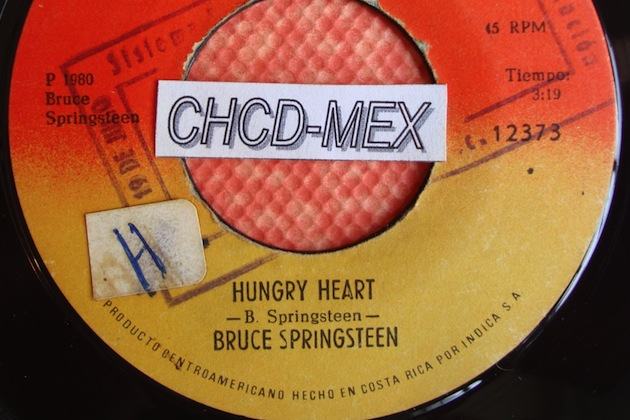
An unusual Costa Rican version of Bruce Springsteen’s 1980 single ‘Hungry Heart’ has sold for $1,310 after 25 bids on eBay. The sleeve even boasts an ink stamp from a local radio station.
Springsteen originally wrote ‘Hungry Heart’ for the Ramones, who were at work their Phil Spector-produced ‘End of the Century’ project, but was ultimately convinced to keep the song for himself at the behest of his manager and producer Jon Landau.
That would prove to be a fortuitous decision: The track would shoot to No. 5 on the Billboard charts, remaining Springsteen’s biggest single until ‘Dancing in the Dark’ reached No. 2 four years later.
Dave Marsh, in his 1996 book ‘Glory Days: Bruce Springsteen in the 1980s,’ called ‘Hungry Heart’ the No. 1 song of 1980.
This ‘Hungry Heart’ single is backed by Springsteen’s ‘Held Up Without A Gun,’ a previously unreleased song from his sessions for ‘The River.’ The A-side remains a regular part of Springsteen’s concert setlists. Springsteen’s current tour is in Ireland for the remainder of July.
Honduras vs. Costa Rica, 2013 Gold Cup quarterfinals: Final score 1-0
Costa Rica had numerous chances to net a late equalizer, but Honduras sealed a semifinal date with the United States, somehow holding on to a clean sheet
Costa Rica had most of the ball and laid siege to the Honduras goal in the dying minutes of their Copa de Oro (Gold Cup) quarterfinal, but the Catrachos were the only ones who were able to make anything of their chances. Some very effective, albeit frantic defending from Honduras in the closing minutes allowed them to make the most of their one goal and hold on for a 1-0 win, advancing Honduras to the Gold Cup semifinals.
The first 30 minutes of the match was slow, as both teams tried to find their footing and struggled to create clear chances. Around the half-hour mark, things picked up considerably. Jorge Claros went close with a shot in the 31st minute and Costa Rica had a shot blocked on the other end just a second later. Honduras turned right around and attacked quickly, with Alexander Lopez forcing a save out of Patrick Pemberton.
Andy Najar was one of the Hondurans’ most lively and dangerous players at the end of the first half. Early in the second, his aggressive and persistent runs off the ball paid off with the winning goal. Lopez set it up with a brilliant cross from the right flank and Najar made the perfect run, cutting inside from the left to get his head on the ball and nod past Pemberton, giving Honduras a 1-0 lead.
That goal sparked Costa Rica — and more specifically, Alvaro Saborio — to life. Saborio was brilliant from then until the end of the match and came close to scoring on three occasions shortly after Najar’s goal. He had a shot blocked in the 56th minute, headed just wide in the 60th minute and had a shot saved two minutes after that.
Costa Rica had all of the possession in the final 30 minutes as Honduras started to play more defensively, only committing men forward on the counter. While the Ticos had all of the possession, they struggled to do much with it between Saborio’s dangerous spell and the dying minutes of the match, when they got desperate.
In stoppage time, Costa Rica absolutely laid siege to the Honduras goal, but the Catrachos were able to hold on to their clean sheet. A Costa Rica free kick in the 90th minute was barely cleared away, and that was only the beginning of the eventual losers’ late push. Yendrick Ruiz had a header barely saved by Donis Escober in the 93rd minute, with the Honduran keeper fumbling before he recovered on the line. With his team’s final effort of the game, Mauricio Castillo ripped a shot wide from 12 yards in the 94th minute as his teammates put their heads on their hands.
Street Racing or “Picones” are common in many areas of San José, mostly due to the lack of enforcement by the Policia de Tránsito (traffic police) during night hours.
Street racers can easily find straightaways and other sites that naturally lend to street racing and without fear of traffic cops showing up and cutting their dangerous fun short.
However, an “anti-picones” unit made its debut Thursday night, with the objective to curtail street racing.
According to the Policia de Transito in their first action they issued 39 “boletas” (traffic tickets) for drivers with fake license plates, for not carrying a drivers license, for reckless driving and driving altered vehicles.
In addition to Tránsitos (traffic officials), the anti-picones unit includes officials of the Organismo de Investigacion Judicial (OIJ) and Fuerza Publica (police).
Areas that are common for street reacing including Pavas, San Francisco de Dos Rios and Desamparados.
In less than two weeks hundreds of thousands will be making their way to Cartago, as Catholic faithfuls embark in the annual pilgrimage to celebrate the apparition of the Virgen de los Angeles.
Although the masses will head to the Basilica de los Angeles on August 1 and 2, it was evident that some took the good weather this weekend to make their journey early.
“Romeros” could be spotted on Saturday and this morning Sunday in the area of Tres Rios, Ochomogo (all east of San José) and at the Basilica de los Angeles itself.
The Fuerza Pública and the Cruz Roja (police and Red Cross) have begun to set up checkpoints between Curridabat and Cartago.
For now, romeros are being asked to be extremely careful as they will have to share the roads with cars and trucks until such time as the Policia de Transito (traffic police) apply road closures, which will depend on the number of romeros ahead of the anticipated August 1 date.
The existing corruption and the lack of judicial safety in Panama’s financial sector are the main reasons that prevent Panama from consolidating as a regional financial center, according to the Association of Business Executives (APEDA).
Regarding the institution, some sectors of the market note that Panama has have not enough willingness to become a financial center, according to the results of a forum on this issue organized by APEDA, where the limitations to project regionally were analyzed.
According to the results of the forum, so that the country becomes a regional financial center, it requires the joint willingness of the regulator, the judicial body and private enterprises, reaffirmed Ana Lucrecia Tovar, representative of the Superintendency of Stock Market.
Roberto Brenes, who is with Panama’s Stock Market, considers there are obstacles for being a regional financial center and notes that in other financial centers, the banks can liquidate other banks, something that does not occur in Panama.
In Costa Rica it is an offence to seduce a child by electronic means.
Grooming is another extremely serious Internet threat that is causing great concern. This type of threat is aimed mainly at young people. Typically, an older person will use the Internet and its services to communicate with younger people. The groomer will not give accurate information about themselves and in many cases will pretend to be a younger person.
Grooming is defined as “actions deliberately undertaken with the aim of befriending and establishing an emotional connection with a child, in order to lower the child’s inhibitions in preparation for sexual activity with the child”. To “groom” a child a paedophile must have a way of communicating with a child effectively in private. To do this they are exploiting the popularity with children of chat rooms and social networking websites.
Once the groomer has made on-line contact with their victim they will spend time becoming their friend and trying to get as much personal information as they can. This process could go on for weeks or even months. The eventual aim of the groomer is to arrange to meet the victim in person in order to carry out some type of illegal activity, usually of a sexual nature.
Some abusers will pose as children online and make arrangements to meet with them in person. Facebook has been involved in controversy as to whether or not it takes enough precautions.
Sexual grooming of children over the internet is most prevalent (99% of cases) amongst the 13-17 age group, particularly the 13-14 years old children (48%). The majority of them are girls. The majority of the victimization occurs over the mobile phone support. Children and teenagers with behavioral issues such as higher attention seekers have a much higher risk than others.
In Costa Rica, since April 2013, the Criminal Code section 167bis, makes it an offence to seduce a child by electronic means. With penalties from one to 3 years of imprisonment for a person that, by any means attempt to establish an erotic or sexual communication with a child under 15 years old.
According to ESET-Latinamerica, a global IT security software solutions throughout Latin America, 26.3% of those consulted said to know a child who has been the victim of grooming and 68% said they feel that these situations are very often online.
The UK based Child Exploitation and Online Protection (CEOP) Centre says there were 1,145 public reports in 2012 relating to incidents of online grooming. 7% of these reports related to attempting to meet a child offline, a drop from 12% in 2011. A cluster of grooming reports from the public in 2010 led to a CEOP-led international investigation called Operation Hattie, spanning 20 months and 12 countries. This led to the arrest and conviction in December 2012 of two brothers in Kuwait who had targeted 110 children worldwide, including 78 in the UK, and forced them into performing sexual acts online. There was no evidence of an offline meeting with victims ever being a motivation.
Risk-taking by young people is the key factor in their vulnerability to grooming and potential contact with child sex offender.
Adolescents who take risks online by having sexualized chats or exchanging sexual images are particularly prone to the increasingly sophisticated, coercive and sinister tactics of online predators.
Smart phone ownership has increased by 21% among 12-15 year olds in just a year and six out of ten (62%) now have one*2. With built-in cameras, these devices and a new generation of apps are giving children the ability to easily communicate with strangers online and share images on the move. The Centre also knows that instant messaging on smart phones and other devices is a popular method of communicating and is used by groomers to approach potential victims. Instant messaging was used by offenders to make contact with children in around third of public reports of grooming in 2012/13.
The leader and founder of the Partido Acción Ciudadana (PAC), Ottón Solís, said that he probably would cast a”en blanco” (blank vote) at his group’s convention to choose a presidential candidate on Sunday.
But he said he would got to the polls and participate in the internal party process.
Solís has led the PAC party in the last three presidential elections.
After the 2010 defeat he said he would sit out the 2014 presidential elections. And despite his firm stand that he would not run, stepping aside for new leadership possibilities, rumours persisted of him leading the party into one more election. The rumours were quieted as the party convention date neared.
On Sunday, the PAC party will choose between Epsy Campbell, Juan Carlos Mendoza, Luis Guillermo Solis and Ronald Solis as the presidential candidate for the February 2014 elections.
As to Ottón he has publicly stated will maintain a position of neutrality and will assert his right to vote, but “will not choose” any of the candidates.
Churches throughout Costa Rica are expecting 30,000 people to join in on a march in defense of traditional marriage slated for August. The gathering is meant to counter attack recent legislations allowing same-sex civil unions, abortion, in vitro fertilization and challenges to the ban on the morning-after pill.
Organizers are calling for Evangelicals and Catholics to unite against what they say is a “combination of death” and hope that Costa Rican families can be restored according to “God’s design.”
“We are in favor of the traditional family of father, mother, siblings and grandparent’s and against civil unions and all that goes against what the Bible says,” said Justo Orozco, a Costa Rican evangelical legislator, according to the Hispanic news site, Mundo Cristiano.
“We want to demonstrate that we should not go against the Constitution, family and God’s word. We are a democratic country without discrimination, but majority rules,” he added.
The announcement of the march comes weeks after Cost Rica “accidently” voted to approve gay marriage, which caused an uproar among Costa Ricans and conservative lawmakers. The issue was brought to light when Orozco demanded President Laura Chinchilla veto the legislation, but she decided to sign it into law.
In addition to gay marriage, people are demonstrating against the Costa Rican abortion law, which is only permissible if a women’s life is at risk. Meanwhile, the Catholic Church is leading the charge against the overruling of Costa Rica’s IVF ban, arguing that embryos created in the process of IVF are oftentimes discarded or left frozen. And while it is currently illegal to sell the morning-after pill in Costa Rica, the law banning its sales has been challenged in previous years.
Planned Parenthood has pointed a finger at the Catholic Church for being a major reason for restrictions on abortion and the use of contraceptives in Costa Rica.
“…The strong presence of the Roman Catholic Church, as well as the continued use of abstinence-only-until-marriage curricula in schools, make abortion under any circumstance highly stigmatized and may hinder the likelihood of contraceptive use among unmarried adolescents,” the organization wrote on their website.
In spite of several controversial issues within the country, the upcoming demonstration aims to take place without causing social upheaval. “It’s a peaceful march with music and prayer for the country,” said Juan de Dios Calderon, general coordinator and president of the Network of Evangelists and Prophets in Costa Rica, Mundo Cristiano reports.
Calderon also said organizers will gather signatures to send a declaration in defense of families to President Chinchilla and the President of the legislative assembly, Luis Fernando Mendoza.
In this photo taken April 11, 2007, Egyptian cleric Hassan Osama Nasr, also known as Abu Omar, walks down a Cairo street after a news conference. (Amr Nabil / Associated Press)
Interpol advised Costa Rica Seldon Lady should be detained in Panama
Fugitive former CIA Base Chief in Italy , detained in Panama this week, was denied entry into Costa Rica Thursday, when an immigration check triggered an interpol alert.
In this photo taken April 11, 2007, Egyptian cleric Hassan Osama Nasr, also known as Abu Omar, walks down a Cairo street after a news conference. (Amr Nabil / Associated Press)
Immigration spokeswoman, Andrea Quesada, confirmed that Seldon Lady, tried to cross from Panama to Costa Rica at Paso Canoas around 10:30am, when a Costa Rican border official called Interpol, which advised that Lady shouldn’t be detained in Costa rica, which has limited extradition powers, but could be held in Panama.
Costa Rica sent Seldon Lady back across the border, where his passport didn’t trigger any alert when checked by Panamanian authorities, Quesada said. The former CIA officer tried to cross back into Costa Rica again, where he was sent back for a second time. On his return to Panama, an Interpol alert was triggered and police detained him.
Costa Rican records show Seldon Lady had entered Costa Rica in December 2012, but stayed in the country less than 24 hours.
In Panama, after barely a day in detention, he was put on a plane to the U.S. by the Panamanian government, a close U.S. ally, instead of Italy, which wanted him to serve prison time in the 2003 abduction of a terror suspect, the Obama administration said Friday.
“It’s my understanding that he is in fact either en route or back in the United States,” State Department spokeswoman Marie Harf told reporters. She declined to disclose other details about his case.
Italy’s deputy foreign minister, Lap Pistelli, said in a statement that Italy “acknowledges” Panama’s decision, adding nothing more about the case. Italy and Panama have no extradition treaty, Italian diplomats said, but Panama would have been free to send Seldon Lady to Italy if it wanted.
Panamanian Public Safety Minister Jose Mulino said later in the day that Seldon Lady was sent to the United States because Italy didn’t formally request his extradition within the allotted time.
“The man was detained for 48 to be extradited but the extradition request was never made formally in that span of time and he had to be released,” Mulino said.
Lady, the former Milan base chief, was sentenced in absentia last year by an Italian appeals court to nine years in prison in the kidnapping of cleric Hassan Osama Nasr. Lady was one of 23 Americans tried for their alleged roles in the operation, all but one of them CIA officers or contractors. Three other Americans indicted in the case, including Jeffrey Castelli, the former CIA station chief in Rome, were given diplomatic immunity and acquitted in 2009. But this year, a Milan court vacated the acquittals and convicted them in absentia. Castelli, who works for a Los Angeles firm, PhaseOne Communications, was sentenced to seven years in prison, and the other two received six years.
Nasr, also known as Abu Omar, was seized under a procedure known as extraordinary rendition, in which the CIA secretly detained terrorism suspects abroad and transferred them to third countries for interrogation. He was flown by the CIA to Egypt, where, he says, he was tortured, and was released in 2004.
In December, Italy’s then-justice minister, Paola Severino, authorized an international warrant for the arrest of Lady, according to the Corriere della Sera newspaper. But warrants were not issued for other CIA operatives convicted in the case because their prison sentences did not meet the minimum for an extradition request.
In April, Italy’s president, Giorgio Napolitano, pardoned U.S. Air Force Col. Joseph L. Romano, who had been convicted of involvement in the kidnapping.
Italy’s secret services were complicit in the operation, Italian courts found, and a former intelligence chief, Nicolo Pollari, was sentenced to 10 years in prison in February. His former deputy got nine years, and three other officials got six years each. Under Italian law, the men remain free while the verdicts and sentences are appealed.
Nasr was suspected of recruiting militants to fight in Iraq and was under surveillance by Italian authorities when he was thrown into a CIA van and driven to Aviano, the U.S. Air Force base in Italy.
An independent Italian prosecutor, Armando Spataro, uncovered the CIA’s involvement in the kidnapping through a detailed analysis of cellphone records and other trails that former CIA officers attributed to sloppy tradecraft.
July 18, not a date where too much happened except the usual world fight for freedom, the killing of kids, etc. (Nothing terribly important for Costa Rica) but perhaps not a total surprise but certainly of deep international consequence, Detroit, Michigan in the United States has declared Chapter 9 bankruptcy. The largest ever in the history of that country followed by vilified Stockton, California.
What does this have to do with Costa Rica?
Maybe not much in the total scope of things, but it does demonstrate, clearly demonstrate, that we are on the same road to hell…The road to debt to default.
For years, Detroit has been living on borrowed time and money. Pretty much the same strategy and amount per capita as US, albeit perhaps more so for Costa Rica.
Associated Press : “The City of Detroit has paid its bills for years with borrowed money.”
Does this sound familiar, sort of like being at home in Pura Vida?
We borrow money to pay for roads, we borrow money to pay for health care, we borrow money to support massive government bureaucracy, we borrow money to modernize our ports of entry and we even borrow money to develop tourism which is not developing at all according to CANATOUR…
In short, much like Detroit, the largest bankruptcy ever in the United States, Costa Rica is living in a Pollyanna world of the same order.
We do not raise revenues except by a multitude of goofy and annoying taxes on income generated from telephones bills , television, water, gasoline/diesel and those other essential costs of life that then, in turn, deprive us of more gross salaries to pay out in “income” taxes. (Personal net revenue)
In the case of Detroit, Mich. there are limited sources of revenue. In the case of Costa Rica the required income has always been here, but not really and seriously never collected. Ergo, a limited source of revenue.
Exit to politics and soccer; avoiding taxes is the national sport and practiced by most Ticos in that order.
Being paid in cash, Costa Rica seems always short on recorded purchase receipts as in medical facilities, to gas stations, and especially to condos who rent out to international tourists as well as national vacationers.
While the U.S. Congress argues the merit of having a massive, but really massive Internal Revenue Service (Taxes), Costa Rica is trying to figuring out how to create an inefficient and complicated tax income service. They call it the “Fiscal Plan.”
Now, why would you create another Frankenstein’s monster
In the most simplistic of terms, much like a having more than multi – credit cards, we cannot continue much longer to borrow on one side in order to payback on the other absent of generating tangible revenue. But as with the IMF, our new best friend the Chinese, along with a variety of development banks…that is exactly what we are doing: Ala Detroit.
We are Detroit Part II but far more south and with better weather.
One of the less visited National Parks of Costa Rica: Marino Ballena. Here you can find the famous ‘Whales Tale’ and you can see why it’s named so. When the tide goes down this amazing scenery appears!
The world’s most famous and legendary male erotic dancers will perform for the first time in Costa Rica in a little more than a month, and for many Ticas the next few weeks are going to feel like an excruciatingly long wait. Chippendales is a renowned dance troupe based in Las Vegas that has been touring since the 1980s. The troupe is famous for their male strippers, who not only have buff and chiseled physiques but also continuously practice and rehearse the Broadway-style choreography.
On Facebook and other online social networks, discussion about the upcoming Chippendales visit to Costa Rica kicked up a few notches when local production house RPM TV announced the event last month. The dancers are scheduled to make five appearances at the Convention Center of the Wyndham Hotel – Herradura, near the Real Cariari Mall . Chippendales will be in Costa Rica from August 30th to September 1st. With tickets starting at 27,000 colones (about $55), many Ticas are wondering whether they can score a quick glimpse at the dancers if they visit our beaches.
The 27,000 colones tickets are being sold as the “Shy Girl” experience, which means that Ticas will be on foot and will also have to jockey for position to get close to the stage. The “Naughty Girl” tickets go for 37,000 colones; these tickets are for seats at tables near the stage and are ideal for “Girls’ Night Out” groups up to ten. For 47,000 colones, the “Tender Torture” tickets guarantee Ticas a very close interaction with the male dancers. All tickets have a 3,000 colones surcharge, and the venue will offer 2,000 in food and drinks to the women who attend.
When the Chippendales dates in Costa Rica were first announced, it was the first time for many Ticas to learn about the dance troupe. The news were certainly well received, especially among older Ticas who wonder whether the ticket prices are justified. To this end, it is important to note that Chippendales shows always feature high production values; the lighting and stage equipment alone weigh about a ton. And though some Ticas will feign ignorance about this kind of entertainment, let’s not forget that trend of male strippers appearing at steamy divorce parties in Costa Rica.
The show is for adults only, and only women are allowed. It would be interesting to see if members of the LGBT community in Costa Rica have something to say about that longstanding Chippendales policy. To be sure, many admirers of the male physique who are not female would probably enjoy going to one of their shows, which sometimes feature celebrities. For example, actor Ian Ziering of 90210 and Sharknado fame is currently a Chippendales dancer, but it is not clear whether he will tour with the troupe when they come to Costa Rica; however, the former teenage heartthrob, who is in amazing shape at 49 years of age, recently name-dropped our country during an interview with The Hollywood Reporter while talking about his 90210 character:
I think Steve Sanders is busy in the cloud forest of Costa Rica where he’s the personal life coach to the World’s Most Interesting Man.
There is another connection as well, Sharknado was written by Thunder Levin, who directed scenes of his film AE Apocalypse Earth right here in Costa Rica. AE Apocalypse Earth is a mockbuster hit that emulates the After Earth movie starring Hollywood Star Will Smith, his son and the cloud forest near the Arenal Volcano.
Things seem to be going really well in the Central American region for Starbucks. According to a report by Luis Diego Quiros of Revista Summa, the Seattle-based coffee Goliath plans to open three more of its iconic coffeehouses in Central America by the end of 2013: One in Guatemala, one in El Salvador, and one in Costa Rica.
In fact, if things go better than expected, there may be a fourth Starbucks location in Costa Rica just in time for the holidays. According to Monica Bianchini, Operations Manager for Starbucks in our country,
“Our Costa Rican customers have shown great acceptance for consuming our excellent products in a pleasant environment. We have planned a third opening in October and we are contemplating a fourth at the end of the year.”
The third, and probably fourth, Starbucks retail locations in Costa Rica will arrive in the wake of the company’s acquisition of a farm near the Poas volcano for agricultural research purposes. The first two Starbucks stores were received with a mixture of contempt, scorn and disbelief at the fact that Costa Rica -a country known for her quality coffee that is often served in Starbucks- would yield to the machination of the world’s foremost coffee leviathan.
Coffee, Tea or Haterade?
Although there are very good reasons to dislike Starbucks, the knee-jerk reaction against their foray into Costa Rica has been largely overblown. The contempt seems to emanate from the fear that Starbucks presence will somehow manage to steal away the significant cultural and economic connections that Ticos have forged with quality coffee throughout history.
Others point to Starbucks’ invasion as one more nail in the coffin of Americanization that Costa Rica has been subject to for the last few decades. Those who venture into this kind of commentary are often the same who claim that the first McDonald’s restaurant opened outside of the United States is the one across from the Central Bank and next to the flower market in San Jose, which is incorrect -it’s not even the first in Latin America. The same kind of irrational opinion is applied to those who claim that the English language is gaining over Spanish in Costa Rica.
When the first Starbucks in Costa Rica opened in trendy Avenida Escazu in June of last year, there was a considerable amount of media coverage about the 30 or so people who lined up outside of the coffeehouse as early as 4:30 AM. They wanted to be among the first to purchase a cup of what is undeniably the most popular coffee in the world in a country that produces some of the best coffee in the world. But while those 30 or so people were enjoying their Caramel Crunch Double Grande Venti Au Lait Macchiato Strawberry-Chai Frappuccino, or whatever concoction is prepared therein, Ticos across social media circles seemed to be drinking copious amount of Haterade®.
For those of you who don’t know about Haterade, here’s the definition from Urban Dictionary:
“a figurative drink representing a modality of thought. those who consume it are themselves consumed by the negativity which with they speak.”
What transpired on the opening day of Starbucks in Costa Rica was elegantly summed up by Diego Delfino in an essay published by online Tico community 89 Decibeles. He defended those 30 people who lined up early outside of the cafe:
“I am actually surprised by that number. A line of 30 people is nothing. That’s just three more persons than those who got a job thanks to that establishment [Starbucks]
Do you want a relevant number? Published by El Financiero: between 2007 and 2011 Costa Rica increased its annual per capita coffee drinking from 4.45 kg to 5.54 kg. Looking good thus far, right?
Do you want a truly important statistic? Costa Rica is one of the three main providers of coffee beans to Starbucks, which has coffeehouses in 60 countries.”
To sum up Mr. Delfino’s essay: One Starbucks cafe or ten are not going to steal away the cultural identity of Ticos. In fact, Mr. Delfino cites another interesting statistic:
“I’ve heard that, in 2008, Starbucks opened in Argentina. Months later, the lines of people lining up from the register out to the sidewalk continued.”
This is in a country where yerba mate, a South American holly herb that is drank in a fashion similar to tea, is the national drink instead of coffee. What about those Starbucks locations in New York City where the line in front of the register is at least a dozen deep from the time the store opens until it closes? Those baristas must be kept on their toes by those caffeine-loving New Yorkers. So, the question is: Are those Argentinians or New Yorkers at risk of losing their cultural identity by being Starbucks customers?
What makes Starbucks superfluous in Costa Rica is the fact that, at just about any soda (cafeteria) in the country, you can get a fresh cup of excellent morning coffee plus a gallopinto for the price of one of the most elaborate drinks in the Starbucks menu. In the end, drinking at Starbucks or eating at McDonald’s is just a matter of personal preference and has nothing to do with national identity.
On Thursday Costa Rica’s leading newspaper, La Nacion announced the purchase of the Autódromo La Guácima speedway for US$12 million dollars, with the prospect of investing another US$28 million to turn the site into a centre for large-scale events.
Located on 28.2 hectares in La Guácima, Alajuela – twenty minutes from the San Jose International Airport and just thirty minutes from downtown San José – the Autodromo La Guacima is widely recognized as one of the finest racing facilities in Latin America. Inaugurated in 1974, it is in operation twelve months of the year and frequently hosts high profile international auto and motorcycle racing series.
Antonieta Chaverri, official spokesperson for La Nacion, said the speedway will be remodeled to faciliate more than just motorshports, but also exhibitions, concerts and conventions, among other events.
The opening of the new centre will be for the summer 2015, subject to construction and operating permit approvals.
Chaverri added that the purchase was approved by the La Nacion board of directors earlier this month and the company is using its owns resources to pay for the purchase.
Carlos Rodríguez, former owner of the speedway, said he had had seveal suitors for the property.
The decision for La Nacion to buy the property and invest in the remodelling is a decision “seeking to maintain and strengthen the solidity of the company and increase profitability in the medium term”, said Chaverri.
La Nacion sees the Autódromo La Guácima as an ideal place for marketing events and fairs.
Immigration Director Kathya Rodriguez has filed a report that indicates that seven people were lured into this country to sell an organ for surgical transplant and then abandoned. The director said that his her department feels a responsibility to the immigrants to offer protection for these victims under new legislation.
All these cases have been referred under the new Immigration Law of 2009. She said Immigration has given the victims medical, psychological and other attention. Among those attended are Costa Ricans.
“There are those who were fooled into giving up an organ in exchange for economic gain and thereafter abandoned,” she added. “Accredited victims receive special protection by the State and access to support services; moreover, if they are foreigners they get provisional documentation.”
Recent economic figures show that poverty in Central America is a stunning 50%. The Legislative Assembly is preparing a bill that will keep rings from preying on these desperate people in order to obtain organs, especially kidneys, for transplant surgery.
A Mexican newspaper recently charged that Costa Rica was a hotbed of illicit activity simply because, according to one local doctor, the country lacks sufficient legislative to prevent organ traffic.
Commentary: The fact that only seven have been reported so far is an indication that the traffic is not widespread but does exist and the lawmakers are right to pay attention. We cannot confirm Rodriguez’s figures but they do come from an authoritative source.
Although it would be easy for the press to sensationalize this story, La Nacion should be complimented on reporting just the facts. The new Immigration law, by giving aid to victims, shows the real core of this country’s people and their human sympathy.
U.S. expats flock to one of Latin America’s safest places
By Catey Hill, MarketWatch.com – Not long after you arrive in Costa Rica, you’ll likely hear at least one Tico (that’s what Costa Ricans call themselves) calling out a greeting. “Pura Vida,” he’ll say, which means “life is good.” Indeed, that’s likely to be true for many residents: Costa Rica frequently ranks at the top of lists on the happiest countries on earth (including in studies by researchers from Yale and Columbia universities and the New Economics Foundation, an independent think tank that focuses on economic change).
Among those expats were Gloria and Paul Yeatman, ages 56 and 66, respectively, who moved to Costa Rica 4½ years ago. The couple, who had been living in Baltimore, was hoping for somewhere warmer and less expensive where they still felt at home and safe.
They considered the southern U.S. and Mexico, but ultimately opted for Costa Rica in part because of the natural beauty, the decent and affordable health care and the “friendly people—both expats and Ticos,” says Gloria. They liked that the country has had a stable democracy for years, says Paul: “We just wouldn’t feel comfortable in a place where the government is unstable or there is a strong anti-American sentiment.”
Indeed, compared with most of its neighbors in Central America and the Caribbean, Costa Rica has been relatively drama-free for a long time. The country has been peaceful since 1949, when then-president Jose Figueres Ferrer abolished the army following an outbreak of military violence; his government and subsequent have redirected military funding toward the police force, education, environmental protection and cultural preservation.
To be sure, the U.S. Department of State notes that “the incidence of crime in Costa Rica is higher than in many parts of the United States.” But violent crime is relatively infrequent; Costa Rica’s homicide rates, for example are lower than anywhere else in Central America, according to the United Nations Office on Drugs and Crime, and considerably lower than those in Puerto Rico and the U.S. Virgin Islands.
Today Costa Rica is one of the most popular countries for American retirees, hosting about 50,000 U.S. citizens. (The total population is roughly 4.7 million.) “There are expats in nearly every town,” says Josh Linnes, the founder of Viva Tropical, a resource on retiring in Latin America—something that isn’t true in many other Latin American countries.
Many people are initially drawn to the area because of its natural beauty and wildlife. “You don’t come to Costa Rica for culture like a New York or Paris, you move to Costa Rica because the outdoors and nature is your museum,” says Dennis Easters, a real-estate broker who moved to the country in 2007 from Tampa. Costa Rica offers everything from Caribbean and Pacific beaches to lush rain forests to towering volcanoes. More than 10% of the country is protected national parkland, and it is one of the most biologically diverse countries in the world.
Costa Rica also offers generally drinkable tap water, high-speed Internet and good phone service in most places, and a taxi and bus system that makes it easy to get around even without a car. Plus, the health care is high-quality and affordable, says Gloria Yeatman, who has had a number of procedures in the country. The Yeatmans pay about $55 per month for health insurance.
Americans who obtain residency status—which you can do by proving you have at least $1,000 in monthly income from Social Security, a pension or retirement fund—can enroll in Costa Rica’s public health-care system, where you pay a small monthly stipend based on your income and can get access to more than 30 hospitals and 250 clinics. International Living, a magazine and website devoted to living abroad, estimates that health care here is about a third to a fifth of its cost in the U.S. and that doctor’s rarely charge more than $60 per visit, even for house calls; private health insurance typically only costs about $60 to $130 per month.
While the cost of living in Costa Rica is generally more affordable than in the U.S., “it’s not as cheap as you might think,” says Erin Van Rheenen, author of Living Abroad in Costa Rica. “Health care and labor costs are a true bargain, but food is about the same, and cars are more expensive down here.”
The Yeatmans, who live in San Ramon in central Costa Rica, live on about $1,900 a month all included (they break down their living expenses here). But Linnes points out that other places that are more popular with tourists will likely be more expensive.
In some of the posh Pacific beach towns, you can expect to pay $4,000 a month or more to live in average accommodations near the water, and there are multimillion-dollar properties. While there are no taxes on foreign retirement income, gasoline in this country is expensive (often more than $5 per gallon) and though the country is small (about the size of Vermont and New Hampshire combined), it can take a long time to get around, as the roads aren’t the best, says Linnes: “As the crow flies, it’s all close together, but as a car drives is a whole other story.”
Still, it’s no accident that Costa Rica has become one of Latin America’s most popular retirement locales.
An unidentified farmer in Golfito, a community located in the southern Pacific coast of Costa Rica and near the southern border with Panama, recently saved the life of a female sloth that had been subject to a horrific attack by two men thought to be in their 30s. According to news reports by daily newspaper La Teja, the sloth was hit by rocks and fists, particularly in her head and stomach.
The farmer confronted the despicable men, rescued the sloth and contacted local wildlife protection agents. Despite the farmer’s heroic intervention, the sloth was left in a delicate condition and was evacuated by aircraft from Golfito to Base Two of the Juan Santamaria International Airport (SJO) in Alajuela. The arboreal creature flew aboard a Sansa commuter flight.
Once at SJO, the sloth was rushed to Zoo Ave Animal Rescue in La Garita. Zoo Ave is one of the premier wildlife refuge centers in Costa Rica; it is dedicated to rescue, research, rehabilitation, education, habitat conservation, and more. The sloth, which has been named “Sansita” by the Zoo Ave staff, is currently quarantined in a space that measures 20 meters in length. According to Sergio Gonzalez, spokesman for Zoo Ave, Sansita requires assistance with feeding and could end up blind. She requires dressing changes and antibiotic applications every two hours.
Caring for Sansita will probably cost Zoo Ave almost a million colones (about $2,000). She will eventually leave her quarantine space, but she will remain in the Zoo Ave rehabilitation forest.
The Sad Reality of Wildlife Abuse in Costa Rica
The abundant and diverse wildlife of Costa Rica enjoys certain protections; but, unfortunately, there are always a few irrational and inconsiderate humans who will prey on animals with abuse. Case in point: A porcupine under the care of Zoo Ave that was victim of three swift machete strikes. This two-year old animal was found in Heredia and underwent a four-hour lifesaving surgery; still, it lost an eye.
Sansita is not the only sloth at Zoo Ave that was victimized by humans; she is the fifth in recent months. One sad case is that of Florecita, a young, three-toed Bradypodidae female sloth that became an orphan when her mother was killed by soulless humans in San Isidro of Heredia. Florecita arrived at Zoo Ave in a state of confusion, disorientation and depression. She is slowly (no pun intended) growing up without her mother, and Zoo Ave staff believe that she could improve to the point of becoming a candidate for release in Guanacaste.
Sloths are gentle animals that have become emblematic among Costa Rica’s numerous forest species. They have done a lot in terms of promoting our country’s rich diversity and have even achieved celebrity status. They deserve better than to be attacked by insensitive humans.
Two important things to note:
Zoo Ave’s main source of revenue to fund their noble work is their ticket booth. This place is highly recommended for anyone to visit; kids in particular love learning about, and interacting with, the animals. Visiting one of the many sodas and restaurants in La Garita that specialize in ethnic Costa Rican cuisine after touring Zoo Ave has become a 21st century family tradition.
Despite La Teja’s reputation as a trashy tabloid that resorts to crude slang, sensationalism and photo spreads of scantily-clad curvy Ticas, the news daily does a great job of reporting animal abuse in addition to educating its readers about prevention and promoting respect for Costa Rica’s wildlife.
The Drug Treatment Program under Judicial Supervision aims to reduce prison overcrowding in Costa Rica. The prison system holds 13,213 inmates in 15 prisons, 3,400 more than its maximum capacity, according to the Social Services Department. (Courtesy of the Ministry of Public Safety)
Government program will provide assistance to inmates through expedited judicial proceedings and medical help.
SAN JOSÉ, Costa Rica – Infosurhoy.com – To get the US$2 he needed to satisfy his crack addiction, Juan Carlos Alemán thought he had no choice but to steal a woman’s purse in Costa Rica’s capital of San José.
Costa Rica’s Drug Treatment Program under Judicial Supervision will provide treatment to addicts who commit crimes under the influence of drugs. Above, law enforcement agents arrest suspects on drug charges. (Courtesy of the Ministry of Public Safety)
On the afternoon of July 13, 2012, after smoking crack with one of his friends, Alemán found himself without any money and needing more drugs, so he started begging on the streets of the Barrio Cuba in San José. Frustrated by his inability to get the US$2 to feed his addiction, he threatened a woman and snatched her purse.
Alemán, 23, was arrested a few minutes after the victim alerted police.
He has spent eight months of his 20-month sentence in the minimum security block of San Sebastián Prison in San José.
“What people don’t understand is that you need to buy drugs,” he said from prison. “I had never assaulted anybody like that, but I didn’t have money and nobody would give me any because they could see that I was so high. The only thing I wanted was the money ($1,000 Costa Rican colones, or US$2) to buy a dose of crack.”
While authorities do not keep records on the number of drug addicts who commit crimes, many of them who wind up in prison do not receive treatment for their addictions, according to the government.
But that changes in September.
Since February, the Ministry of Justice and Peace, the Costa Rican Drug Institute (ICD) and the Institute on Alcoholism and Drug Dependence (IAFA) have been implementing the Drug Treatment Program under Judicial Supervision, which officially will start offering treatment to addicts in September.
“The system offers [incarcerated drug addicts] a three-pronged approach: treatment, assistance with the criminal system [with reduced sentences and medical assistance] and social reinsertion,” Mauricio Boraschi, the country’s former drug commissioner, said when the program was introduced.
The plan, which costs $10.022 billion colones (about US$20.09 million), is financed through agreements with Brazil and the Organization of American States (OAS).
The Drug Treatment Program under Judicial Supervision aims to reduce prison overcrowding in Costa Rica. The prison system holds 13,213 inmates in 15 prisons, 3,400 more than its maximum capacity, according to the Social Services Department. (Courtesy of the Ministry of Public Safety)
The program is training judges and evaluating potential candidates for treatment.
The pilot plan will begin with 10-15 prisoners in the San Sebastián Prison and will eventually be implemented in the country’s 15 prisons, according to Judge Doris Arias, who heads the program.
Boraschi said the treatment will be provided by the IAFA, the governing body for drug prevention and treatment policies in Costa Rica.
The patients first will be evaluated to determine their levels of addiction. Relatives and friends also will be contacted to create a support network and facilitate reintegration.
Finally, when they complete the treatment, the IAFA will certify to the court the patient has completed the program and can return to society.
“This program manages to avoid recidivism and offers the possibility of social reintegration, which reduces our crime problem and overcrowding in our prisons,” Boraschi said.
From January to April of this year, San José registered 197 complaints of assaults, though there is no record specifying whether the assailants were under the influence of drugs, according to the Judicial Investigation Department (OIJ).
Marijuana consumption at the country’s prisons has reached 12.9%, which is 43 times higher than the overall population, while crack consumption is 6.6%, ,which is 66 times higher than the overall population, according to IAFA.
“[In prison], people get worse because there always is someone who can get you the drugs you want,” Alemán said. “I mind my own business, but there are other inmates who you have to watch out for. When you least expect it, they’ll be all over you. If you don’t give them what they want, they’ll cut you to teach you a lesson.”
The program also should help the Ministry of Justice decrease prison overcrowding. Costa Rica’s 15 penitentiaries collectively hold 13,213 inmates, which is 3,400 over capacity, according to Costa Rica’s Social Services Department.
“People who come in for relatively minor misdemeanors are mixed with others who have long sentences, and they become criminals,” Ofelia Taitelbaum, Costa Rica’s ombudsman, told reporters. “That’s why, once they’re released, they go on to commit more serious crimes.”
In Costa Rica, the criminal process is divided into five stages. A case can take, on average, four months to reach the third phase, the trial.
However, the new program will shorten this process through pre-trial agreements, according to the Ministry of Justice.
“The measures passed down by the judge at the end of the process can range from in-patient treatment to a gradual detoxification,” Boraschi said. “In the event that [the accused] abandons the process, they must return to the judicial phase.”
The initiative is part of the Drug Treatment Court program of OAS, which is being carried out in Argentina, Canada, Chile, Costa Rica, the Dominican Republic, Jamaica, Mexico, Suriname and Trinidad and Tobago.
“Next year, I plan on applying to see whether they can help me get out,” Alemán said. “This isn’t the life I wanted. I want to get cured so I can go home to my mom and my sister.”
Article 52 of Title V -”Social Rights and Guarantees”- of the Constitution of Costa Rica states that:
“Marriage is the essential foundation of the family; it rests upon the equal rights of spouses.”
As clear and elegant as the above statement is, a civic group in Costa Rica would like to see it change by means of a proposed amendment to our Constitution. The group is called Civic Movement for the Rescue of Marriage, which goes by the initials REMA in Spanish; it is an amalgamation of other like-minded civic groups that share the same reactionary view against recent political inroads made in Costa Rica by supporters of the lesbian, gay, bisexual and transgender (LGBT) groups.
Alexandra Loria, one of the leaders of the REMA group, told online news site CRHoy.com that they are seeking to amend the Constitution of Costa Rica to ensure that Article 52 specifically states that
“Marriage is the union between a man and a woman, it rests upon the equal rights of spouses, and it is the essential foundation of the family.”
REMA is busy collecting the 155,000 signatures needed to take this matter to the National Assembly, where legislators such as the controversial, ultra-conservative and reactionary Justo Orozco Alvarez will probably welcome such constitutional amendment. Legislator Orozco is the leader of the Renovacion Costarricense (Costa Rican Renovation) political party, which is an ultra-conservative Protestant movement. Oddly enough, Orozco also presides over the Human Rights Commission of the National Assembly in Costa Rica, a title that was bestowed upon him by means of backroom wheeling and dealing between the powerful National Liberation Party (PLN in Spanish).
It is important to remember that the PLN is opposed to just about everything that legislator Orozco supports, but PLN legislators need him out of the way on some other issues -hence his bizarre naming to preside a Human Rights legislative group.
Legislator Orozco is also the loudest voice among those who claim to have been duped by the PLN and Broad Front parties when their amendment to support the rights of Costa Rica’s youth, including young LGBT Ticos, was “accidentally passed” by the National Assembly. Orozco immediately called foul, insinuating that his fellow legislator Jose Maria Villalta -presidential candidate and Broad Front’s leader- had pulled a fast one on the assembly by sneaking a line about eliminating discrimination of young Tico couples, without regard to their gender or sexual orientation. Orozco asked for a veto from President Laura Chinchilla, who declined to use her veto powers and signed the law.
Legislator Orozco fears that allowing young LGBT Ticos to form “common law” unions opens the door to future passing of legislation that will approve gay marriage in Costa Rica. REMA does not take such an extreme view. REMA leader Loria explains that they are not opposed to LGBT unions; they are rather defending the importance of traditional marriage in Costa Rica as the basis to bring new life in the country. Loria added that:
“What we defend is not a matter of religious principle; it is a principle that has been around in the greatest civilizations throughout soicety’s [history]“
Should REMA be successful in amending Article 52 of the Constitution, the movement in support of gay marriage in Costa Rica would suffer a major setback. REMA has thus far collected 20,000 signatures of the 155,000 they need to take the matter to the National Assembly. Many of the signatures have been collected on REMA’s Facebook Timeline.
I’m going to “switch gears” and write about what I consider to be a moral, rather than a legal issue. I have long commented that Multiplaza (Escazú) Shopping Mall must be virtually the only suburban shopping mall, as opposed to an inner city shopping mall, which charges customers for parking private vehicles.
Until recently, the paid parking has been limited to underground, or covered parking.
I have now noticed parking ticket dispensing machines have been located at all parking lot entrances on the Multiplaza property and they will obviously be put into operation shortly. When this happens, any customer who arrives in a private vehicle to shop at Multiplaza will be forced to pay for parking.
This will undoubtedly lead to chaos on the streets immediately surrounding Multiplaza, with the majority of shopping mall patrons looking for opportunities to park without paying. This is clear from the efforts made to date by patrons to avoid parking in the existing paid parking areas of the shopping mall (parking on sidewalks, blocking emergency vehicle access, etc.).
If I was a tenant of Multiplaza, paying the exorbitant rents that are levied by the landlord, I would be outraged at the negative effect that this will have on my business at the shopping mall, especially if the Municipality of Escazú puts additional parking controls in effect for on-street parking in the vicinity of the shopping mall. The Administration of Multiplaza Shopping Mall charging for patron parking at the shopping mall is nothing less than “greed gone wild” in my opinion.
To contact Attorney Rick Philps about hiring him as your Costa Rican Attorney, please use the following information: Lic. Rick Philps – Attorney at Law, Petersen & Philps, San Jose, Costa Rica Tel: 506-2288-4381, Ext. 102; Email: rphilps@plawcr.com Website: www.plawcr.com
The crew, who identified themselves as missionaries and distributed bibles among the indigenous also carried topographic equipment, hi-tech mountaineering gear, sophisticated digital cameras, altimeters, GPS equipment, assault weapons, and machetes.
Accordig to resident eye-witnesses the so-called missionaries wore woodland pattern camouflage uniforms similar to the M81 Battle Dress Uniform (BDU) worn by United States military forces until 2006. This kind of uniform is also worn by several military groups around the world.
The men who descended from the helicopter identified themselves as Alejandro Cetrulo, Rodolfo Ortíz, Roque Revilla Candiotti, Isaias Romero Acuña, Travis Reid, Brian Bucek, Nual Richardson, and Josh Hyatt; their nationalities were later ascertained as one being Peruvian, two from Costa Rica, and five Canadians.
According to Bribri leaders who followed the men from a distance after they went door-to-door in the village distributing bibles, the visitors were clearly skillful in mountain survival. They did not carry water and did not drink from the rivers -they knew how to extract it from bamboo. They even caught a deadly fer-de-lance, killed it and tasted its meat, but not before taking some topographical measurements. At some point, the Bribri asked the men to lead them in Christian prayer, which they were obviously not trained for since they were unable to. The indigenous decided to call the police and the men scurried.
The COECOCEIBA press release explains that two Fuerza Publica officers arrived and checked the passports of the paramilitaries as they returned from the jungle, where it is suspected they cached their weapons for later retrieval. The police officers took away their machetes, knives and a pellet rifle. The villagers complained that the fake missionaries then became upset, retrieved their weapons, and threatened the community with returning at a later date. They said: “If the cops return, we will shoot.”
COECOCEIBA believes that these paramilitary visitors could be part of a reconnaissance unit sent by drug traffickers or Canadian mining interests looking to start prospecting for gold or other precious metals in the area. According to online news site CRHoy.com, however, the Ministry of Public Safety in Costa Rica maintains that the men were missionaries on a charitable mission.
The signs remain, but the cameras haven't operated since 2010.
It was almost two years ago (September 2011) that the traffic cameras went dark, after the Consejo de Seguridad Vial (Cosevi) found it could not “legally” notify speeding drivers.
Since there have been several attempts to revive the program, the latest involving a proposal with the autonomous state agency, the Radiográfica Costarricense (Racsa).
The traffic camera program involves installing a series of video radar cameras at strategic locations along the major highways, mainly in the greater metropolitan area of San José. With the reforms to the traffic law last year, the COSEVI now has the “legal” tool to notify speeding drivers picked off by the cameras.
The Racsa proposal is simple, Racsa would install and maintain the cameras and notify drivers of their infraction. The cost to Cosevi is US$5.500 dollars per month. The proposal calls for the installation of 150 cameras, for a monthly cost of US$825.000 dollars to Cosevi, which would keep 100% of the the fines collected.
Carlos Rivas, legal advisor to the Cosevi, explained that the roads council rejected the Racsa proposal for being too costly. Rivas explained that it would be “unsustainable” for the Cosevi to pay that amount each month.
The Racsa proposal is quite different than the deal signed in 2011 where Racsa would retain 70% of all traffic fines collected from the traffic cameras, the Cosevi would be left with the balance.
That deal was terminated in 2011 by mutual accord when Cosevi suspended the program, unable to legally collect on the fines during the six weeks of operation that saw more than 15.000 vehicles picked off by the cameras. Some 3.000 drivers “did the right thing” by paying their fines on time, the balance did not and the tickets were nulled.
Despite the latest setback, the Cosevi says it plans to have the cameras working in 2014.
Here we are forced into buying new license plates for our vehicles, not because the existing plates need to be replaced, but for the inefficiency and inability of the Registro Nacional to have maintained a secure registration system.
So, rather than work on fixing the problem on their end, the solution is to force every vehicle owner to buy new license plates, each pair costing ¢15.000 colones (US$30) dollars.
If you do the math, more than 1 million vehicles multiplied by ¢15.000 equals ¢15.000.000 colones in revenue.
For ¢5.000 colones (US$10) – total cost for the new plates ¢20.000 – the BCR will process your order at any of its branches. The post office charges ¢4.600 (¢400 colones less for the same process) at any of its post office loations in the Gran Área Metropolitana (GAM) – Greater San José Area and ¢5.570 at all other post offices. In San José, for ¢10.000 they will deliver the new plates to the customer.
Several delivery companies have also gotten into the game, though their cost is on average more than double that the BCR or Post Office. One company will come to your home or office to pick up the order and the deliver the plates.
In reality, it makes sense – if you can afford it – to spend a little extra and avoid the mayhem of long lines and save the time to go to the Registro.



 As if doctors in Costa Rica did not have enough to worry about with a rising tide of dengue victims checked into the hospitals, the ninth victim of the AH1N1 flu virus has died. So far, there have been 258 persons have been treated with Type A flu virus, 156 of them with the AH1N1 type.