Health Minister Daniel Salas led the Wednesday press briefing on the coronaavirus emergency in Costa Rica, today day 20 of the first confirmed case.
The Health Minister, Dr. Daniel Salas, confirmed in the mid-day virtual briefing from Casa Presidencial, announced the country has 201 confirmed cases of the coronavirus covid-19.
Health Minister Daniel Salas (center, no tie) led the Wednesday press briefing on the coronaavirus emergency in Costa Rica, today day 20 of the first confirmed case.
The age range of the infected is between 2 and 87; 117 men and 84 women, of which 183 are Costa Rican and 18 foreigners.
There are cases throughout the country, concentrated in 39 cantons. Of those confirmed with covid-19, 194 are adults (of which 17 are seniors) and 7 minors.
Seven patients are in hospital, four of them in the Intensive Care Unit.
Eight people suspected of the virus are also hospitalized.
Vehicular restrictions
The Minister of Security, Michael Soto, confirmed that 274 traffic tickets were issued in the first night of the vehicular restrictions that apply countrywide, of 159 tickers were for a violation of the restriction and 115 for various other traffic offences.
“We would expect much less tonight, Wednesday,” Soto said.
The restrictions will continue nightly from 10 pm to 5 am until April 12, at which time it will be reassessed.
Soto reiterated that the restrictions apply “from border to border, from sea to sea.”
The minister said that what he wants is to restrict ordinary traffic, and “we do not intend to affect the productive, emergency or police sector.”
While COVID is devastating New York, California, and Washington State in the U.S.and the rest of the orbe with more than 438,000 cases and 19,000 deaths, Costa Rica is taking a whole series of extreme measures to stop this invisible enemy.
1. A restriction of vehicles between 10 pm and 5 am. Anyone who does not comply will be fined. Exempted are trucks delivering food and other necessary supplies, emergency vehicles and a defined list.
2. All beaches and public parks have been closed until further notice.
3. All churches and other religious temples were ordered closed, despite Ester Week being around the corner. This goes for all denominations.
4. No large gatherings like entertainment venues or soccer games will be permitted.
5. The closure all borders to tourists. American Airlines and others announced that they will not be flying here for the time being.
6. The closing of all bars, casinos and nightclubs.
7. Foreign residents cannot leave the country during the emergency, those who defy this ban will lose their residency as a result.
8. In conjunction with these measures, banks and supermarkets have special restricted hours for senior citizens, who are the most vulnerable.
That said, the U.S. is in a complete state of chaos trying to care for the ill and get medical supplies to its hospitals. Wartime measures have even been enacted to cope with this dire situation. Once again, the old adage proves to be true, especially when referring to the current pandemic and ensuing economic downturn, “The bigger they are, the harder they fall.” Indeed, small is better which is another advantage of living in a country like this.
I must commend the Costa Rican government for taking the appropriate action to stem this horrible scourge. Yes, we have been encouraged to practice social distancing and stay indoors, but I feel blessed to be living here and not in countries like the U.S. that have been so adversely affected. I only venture out of my home to walk for an hour and stock up on groceries. Since it is now the height of summer I regret not being able to spend more time outdoors to enjoy the fantastic weather here in the Central Valley.
As most people know Costa Rica’s Central Valley has one of the best year-round climates in the world. So, there is no need for air conditioning or heat in homes.
The good news is that when this crisis is over Costa Rica will once again be one of the world’s premier travel and retirement destinations.
If your travel plans or reservations have been delayed then just postpone your trip. Be sure to view the video below.
Christopher Howard has been conducting monthly relocation/retirement tours and writing retirement guidebooks for more than 30 years. See www.liveincostarica.com.He has a relocation/retirement blog at: http://www.liveincostarica.com/blog and is also the author of the one-of-a-kind bestselling e-book, “Guide to Costa Rican Spanish,” that can be purchased through Amazon
It has been 20 days and Allison is still missing. Yendry Vásquez, Allison’s mother hasn’t given up, she still continues to search her daughter, who has been missing since March 4 in Ujarrás, Cartago.
Allison has been missing since March 4.
With a lump in her throat, she claims to continue her search using the little energy she has left to leave the house on a daily basis, risking infection of the covid-19, and try to obtain some clue that sheds light on the strange disappearance of her 18-year-old daughter.
However, for her, the greatest fear of her life, one that she never imagined even in her worst nightmare, not ever seeing her daughter alive again.
“I am very afraid of not seeing Allison again, I feel like I can’t handle this anymore, I wake up every day before 4 in the morning thinking, we don’t sleep anymore in my house, this has definitely come to destroy my life and don’t know when I am going to wake up from this nightmare”, said Vásquez.
She constantly keeps ties with the Cartago office of the Organismo de Investigacion Judicial (OIJ), however, the answer she gets is that there is nothing new and that the case is still open.
Currently, there is no official search for the young woman, but Allison’s family continues to leave the house to move about the Ujarrás area, hoping to find some trace. Some clue.
“We have been close to the Cachi dam, also through the Ujarrás viewpoint, and nothing, right now because of the country’s situation as it is more difficult, but we cannot stop looking,” says doña Yendry.
The disappearance
On the night of March 4, Allison Bonilla Vásquez left the Colegio Nocturno de Cachí for her home in Ujarrás, but in the lapse of 10 minutes to reach her destination, she informed her family that there were two people she felt were following her.
The path Allison would take to get home from night school
She sent a voice message to her boyfriend, in which she said that “dos pintas estaban atrás” – two unsavory men were behind – and that she was going to hurry because she was afraid of their presence.
After that, the young woman was never of again, she did not make it home nd to this day, her whereabouts are unknown.
The OIJ with the help of the Fuerza Publica (National Police) did a canvas of the area where Allison lives.
After a week, the OIJ withdrew from the site and keep the case open in the event of any new information.
For now, there are no suspects. No possible hypotheses. And the anguish of Allison’s famil grows day by day.
The four people hospitalized in different Intensive Care Units (ICU) of Costa Rica, due to complications in their health from COVID-19, are young adults. They are two men and two women, 36, 38, 49 and 54.
The data was provided this Tuesday, March 24, by Román Macaya, president of the Caja Costarricense de Seguro Social (CCSS), who called on the country’s young and adult population to take extreme measures of hygiene and protection against the pandemic.
According to Macaya, since the beginning of the pandemic, the discussion has been that seniors were the ones at greatest risk. This data is still true. People over the age of 65 have greater difficulties in recovering from COVID-19. In fact, the only two deaths from the virus in Costa Rica have been two 87-year-old men.
However, there are other conditions that can also complicate patients, underlying conditions such as diabetes, hypertension and asthma. Even the type of food consumed, driving and smoking can result in risk factors.
“This call forces us to redouble our efforts for this social isolation. This is obviously a higher risk issue, we have already lost two (seniors) but again, it does not mean that younger adults are not at risk,” said Macaya.
There are 14 people in the country interned by COVID-19. Six have already been confirmed and another eight are suspected.
In addition, the majority of the confirmed cases are of young adults, of the 177 confirmed cases, on Tuesday, March 24, only 16 are seniors. In the confirmed cases of covid-19, included are 7 minors.
Spain’s Iberia joins the list of airlines that have suspended flights to and from Costa Rica that it has been operating since 1973, with daily flights for more than a decade. The last flight between Madrid and San Jose will on Friday, March 27.
Aeris, the manager of the Juan Santamaría International Airport – San Jose airport – confirmed that the suspension and said the Spanish airline will resume flights on April 26.
The route between Madrid and San José is key, in the midst of the emergency, for the return of dozens of Costa Ricans trapped in Europe by the crisis caused by the covid-19 infections, especially in Spain and Italy.
Last Sunday, the Costa Rican ambassador to Italy, Ronald Flores, reported that 26 Costa Ricans remained stranded in that country. Furthermore, they were trying to help two nationals in Malta and Croatia, as there are no Costa Rican consulates in those European nations.
The Costa Rican government prohibited the admission of foreigners starting on Wednesday March 18 until next Sunday, April 12, during which time only nationals, foreigners with resident status and members of diplomatic corps can enter Costa Rica.
Almost 300 respirators are on their way to the Caja’s hospitals, increasing the capacity to attend to the most complicated patients with covid-19 from 440 respirators at present to more than 700 in the coming days.
The stretchers and body bags for corpses will also be increased because it is probable that the coronavirus covid-19 will increase the number of deaths in Costa Rica.
In addition, the Caja Costarricense de Seguro Social (CCSS) – Costa Rican Social Security Fund – with the support of other State institutions, practically built a new hospital, retrofitted National Rehabilitation Center (Cenare) building, in record time, exclusively for the care of the most seriously ill.
In less than a week, the Comptroller General approved US$15 million dollars for the CCSS to face the blow of the wave caused by the new coronavirus in the world, that is just beginning to be felt in Costa Rica.
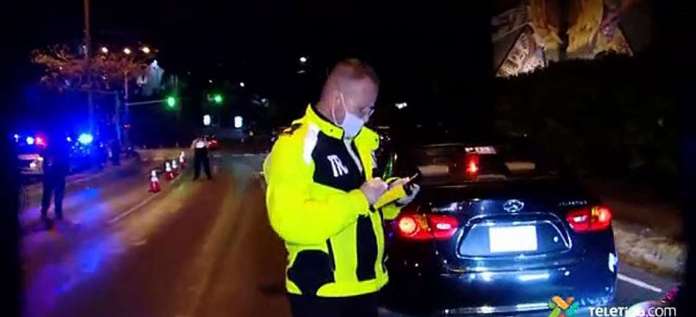
It went into effect at 10 pm, and within a few minutes, some 30 drivers had been fined for violating the nationwide vehicular restrictions that will now be part of Costa Rican every day until 5 am.
The Policia de Transito (traffic police), backed up by authorized officers of the Fuerza Publica (National Pollice) and municipal police forces are tasked with enforcing the night measure to keep people off the streets.
The Minister of Security Michael Soto, as well as the director of the Traffic Police Germán Marín, and the director of the Fuerza Publica, Daniel Calderón, ask the population to be respectful of the measure aimed at avoiding the contagion that exists in the country.
When the clock struck 10 p.m. the officers of the different police forces, who, with gloves and face masks, began the task of stopping passenger cars and issuing fines to drivers who were not exempt, for example, people working during the restricted hours, providing an essential service or in an emergency situation. See the full exemption list below.
In addition to issuing fines for violating the restrictions, drivers face fines and or confiscation of license plates and or the vehicle if in violation of other traffic rules, such as not carrying a driver’s license, not having the Marchamo (circulation permit) or Riteve (vehicle inspection) current, among others.
Director Marín explained that drivers can be fined multiple times in the same evening, that is if they continue to drive and run into multiple inspections.
Though the major concentration of the police forces last was in the central valley, the 10 pm to 5 am restriction is countrywide.
The silence and total absence of Daniel Ortega during coronavirus pandemic and government action to promote open borders and tourism, and the limited information provided by the authorities, is questioned by many Nicaraguans.
Daniel Ortega has been silent and absent since the coronavirus pandemic
Without voicing too publicly, many are surprised by Ortega’s lack of efforts to confront the pandemic.
While the covid-19 is spreading across Central America, from Guatemala to Panama, and confirmed cases increasing daily, Nicaragua sits at only two cases, announced last week by Ortega’s wife and vice-president, Rosario Murillo.
The first case, according to Murillo, was of a soldier who returned from Panama and who, according to the Minister of Health, Carolina Davila, is recovering; the second is a Nicaraguan who returned from Colombia and suffers from chronic diseases.
While the official line holds, people in supermarkets, work, bus stops, in small towns as in the capital city, criticize the government’s inaction.
Many question the absence of Daniel, but few are willing to publicly speak out like Fabiola Tercero, a writer, told Confidencial, “It’s a lack of respect, of ethics because we see that we are in the absence of a leader who can’t lead. It’s disrespectful to those who voted for him.”
“Raquel”, not her real name, said that she is not surprised at President Ortega’s “not very human” attitude. She recalled that what had been happening since 2018, with the crackdown on the April Rebellion, to date “is a reluctant attitude to prevent loss of life and is ultimately an irresponsible action”.
Nelson Navarrete, in charge of a bus cooperative in the Roberto Huembes market, believes that “every president has his way of governing”, so it’s not a surprise that Ortega doesn’t give press conferences, as he is a man who “gives very few interviews”.
To date, the Government of Ortega and Murillo has made short press releases informing generally what has happened with the positive cases of COVID19 and the “strategies” they are carrying out to curb the spread of the virus.
However, the weak effort is causing a lot of speculation.
People are getting sick but the government of Daniel Ortega is seen doing nothing
Michelle Polanco, a journalist of the News Action 10, believes that this lack of information is generating a lot of speculation among the population to the point of creating rumors that do not make sense and in the worst case leave more doubt than certainty.
“In this sense, the Government should be transparent and tell the truth that this is a global pandemic that affects us. They should be clear so that everyone is more aware of this virus,” said Trinidad Hernandez, a checker at a bus cooperative.
Psychologist Willhem Hernandez noted that this misinformation can be interpreted as an attempt to spread covid-19. “Prevention measures have not been taken, not a single one, and contrary to what the World Health Organization (WHO) is saying, they send crowds of people to march,” he said.
Polanco, the action 10 journalist, added that while some believe that quarantine is a good option, in the country this will have a serious economic impact. However, she said it is a measure that needs to be applied.
“And along with quarantine the Government will have to take other economic measures to support those who live day-to-day, that is another dilemma that many have,” she concluded.
The average price of the U.S. dollar in the Monex market, where amounts greater than $1,000 are traded, rose ¢10.50 in the last four sessions, going from ¢568.06, on Wednesday, March 18, to ¢578.64, this Tuesday, March 24.
The Banco Central (Central Bank) decided to intervene in this market on Tuesday with a sale stabilization operation, which is a direct sale of foreign currency, with almost US$1.8 million.
The last time the entity used this tool was on February 3 with a sale of US$500,000.
The increase remains close to the normal fluctuation range that the currency has had this year, where it has reached a minimum value of ¢564.61 and a maximum value of ¢578.64.
At the banks, the price of the currency has also risen. The average buy to the public went from ¢563.22, on Wednesday, March 18, to ¢572.33, for today, March 25, and the sell went from ¢568.70 to ¢579.70, in that period.
Economist José Luis Arce, director of FCS Analisis y Estrategia, considers that it reflects the uncertainty that exists due to the situation of the coronavirus pandemic and also points out that the Central Bank has enough reserves in dollars to make an orderly adjustment, if required.
“It seems to me that it is expected at this juncture for several reasons: there is uncertainty and people are dollarizing and because there is an external shock that affects the economy, which strongly hits two of the channels through which foreign currency enters the country: tourism and external financing flows (loans, etc.),” commented Arce.
“So far this year, the exchange rate (Monex weighted average) has shown stability, during 2020 the colón observed a slight devaluation of the order of 0.06% (0.36 colones per dollar) and has fluctuated between ¢564.6 and ¢577.6 per dollar. For their part, the financial institutions show a positive balance (what they buy is greater than what they sell), which indicates the existence of a sufficient supply of dollars in the economy,” said Luis Diego Herrera, economic analyst at Grupo Financiero Acobo.
“The situation that the country is going through due to the coronavirus, could make us think of a possible impact on the price of the dollar. However, on the one hand, the country is paying less for the oil it imports and that represents savings; but, on the other hand, with the closing of borders, tourists who contributed dollars to the economy will stop entering; which are the two great scenarios that we face regarding the price of the US currency,” explained the analyst.
Florida Ice and Farm (Fifco) reported Sunday, March 22, that the two hotels that operate in its Reserva Conchal tourist complex, located in Santa Cruz de Guanacaste, will be closed for three months due to the new coronavirus.
These are The Westin Golf Resort & Spa establishments and the W Hotel employing more than 800 people.
The company, that also owns the Cerveceria (brewery), bottles and distributed Pepsi products, Cristal water, juices and liquors among other products, said that it all of its workers will maintain employment.
“35% of these workers will keep their current salary. An additional 59% will have a reduction in their salary to a maximum of 21% of their current salary. In other words, 94% of employees will be taking home a salary,” explained Gisela Sánchez, director of Corporate Relations at Fifco.
“The other 6%, mainly the high salaried employees, will also keep the salaries, but reduced as much as 35%,” the director added.
The temporary closure will be three months, but the company indicated that over time it will be evaluated according to the evolution of the covid-19.
Sánchez emphasized that most employees will be at home, the hotels will maintain only a skeletal staff, ie security, and maintenance.
Fifco is the second major hotelier to announce temporary closure, on Saturday, the owners of the Hotel Dreams Las Mareas, in La Cruz, Guanacaste, announced it was sending its 640 employees home at full pay during the closure.
More hotels are expected to make similar announcements during this “zero season” that began last week when the country closed its borders to foreigners, and airlines shutting down operations in the country during the national emergency.
The Instituto Costarricense de Investigación y Enseñanza en Nutrición y Salud (Inciensa) – Costa Rican Institute for Research and Teaching in Nutrition and Health – says it has more than 6,000 tests to diagnose the coronavirus COVID-19.
The Minister of Health, Daniel Salas, explained that the previous Monday the Incense received a package with more than 4,000 units and to this must be added a remnant of 2,000 tests.
In addition, he commented that through the Chancellery they are receiving donations such as diagnostic kits and face masks for Health personnel and confirmed patients from the government of China and Jack Ma and the Alibaba Foundation.
Health authorities are continuing their effort so that the test kits reach the regional hospitals. At the moment, the tests are only available at Inciensa, located in Tres Rios, east of San Jose, the Children’s Hospital, Hospital Mexico and Hospital San Juan de Dios, all in San Jose.
“We are fully aware that we have to have the capacity to make diagnoses closer to where, eventually, the phenomenon is occurring. And that has been the priority that we have established in the epidemiological matter,” emphasized Minister Salas.
Starting this evening at 10 pm and continuing to 5 am and every day forward during the national emergency, for now until April 12, there is a nationwide vehicular restriction in effect.
The vehicular restrictions form 10 pm to 5 am apply every night, all across the country. The Policia de Transito will have the support of the Fuerza Publica and municipal police forces
The fine for violation is ¢22,187 colones, and although the Policia de Transito (Traffic Police) is the main enforcing agency, authorized officials of the Fuerza Publica and municipal police forces will be enforcing the restriction.
Again, the night restriction is for EVERY NIGHT and ALL OVER THE COUNTRY and to EVERY VEHICLE except:
Vehicles for the transport of merchandise or cargo.
Public transport vehicles in the form of a taxi, buses, minivans to transport workers, transportation to and from airports, as well as a cargo taxi, all authorized by the Consejo de Transporte Publica (CT) – Public Transport Council.
People in the public or private sector with working hours that coincide with the 10 pm to 5 am restriction; whether they travel in a private vehicle “debidamente accreditada” (duly accredited) or any of the mentioned modalities.
Vehicles that provide service and fuel supply, garbage collection and construction companies.
Official emergency care vehicles, police forces.
The public service support or maintenance staff of the ICE, AyA, Incofer, Civil Aviation, CNFL, Correos de Costa Rica and Recope.
Vehicles of the MOPT and Conavi.
The funeral service vehicles.
Vehicles for the provision of home delivery services for food, pharmacy, and veterinary emergencies, duly accredited.
The provision of the service of private surveillance or transport of securities.
private vehicles of the staff of the emergency services, the Red Cross, the Fire Department, the National Emergency Commission (CNE), the Costa Rican Social Security Fund (CCSS), the Ministry of Health, or international organizations that participate in the attention of the national state of emergency or for the attention of an emergency proper to their work, who must wear their respective uniform or their institutional identification.
The people belonging to the executive, legislative and judicial powers (courts), for the exercise of their respective tasks.
Vehicles belonging to the international missions, diplomatic corps and the consular service.
The personnel of the Judiciary with working hours included or that coincide with the time slot of the restriction, duly demonstrated.
Health services personnel with working hours included or that coincide with the restricted hours.
The personnel essential for the operation of operators and providers of telecommunications services, duly accredited.
The indispensable personnel for the operation of the press and distributors of the media, duly accredited.
The private vehicle that due to an emergency related to the life or health of a person, requires moving to a health facility or pharmacist.
The official list of exemptions
The Minister of Security, Michael Soto, said that people must verify that they are subject to any of the exceptions mentioned, either through official ID, proof of employment stating their working hours and “the relationship with the exception”.
In the case of independent workers, ie sales and marketing, they must carry some support on their work that justifies their mobilization during the restricted time.
The director of the Policia de Transito, Germán Marín, that work schedules have been arranged to have between 200 and 240 working the night shift.
Typically a skeleton crew is on the night shift, mainly to respond to emergencies.
they made adjustments to the officers’ days in order to arrange between 200 and 240 traffic during the hours that the night restriction applies.
Marín insisted that the intention is not to generate a large number of traffic tickets, but that people understand the need to stay home as much as possible.
American Airlines announced Tuesday it will suspend all flights to and from Costa Rica as of Thursday, March 26, in the framework of the global pandemic by COVID-19.
The airline said in a statement, flights to and from Costa Rica will resume on May 6.
“The information on the available flights will be updated, so we ask you as this situation evolves to stay informed in our different media,” the airline reported.
Other airlines had already announced the closure of their operations in Costa Rica after the government announced the total closure of borders, are Panama’s Copa Airlines and Colombia’s Avianca.
“This is without a doubt the biggest crisis in the airline industry in history. The decisions we are making hurt us, they are extremely difficult, but we must be flexible and face the situation,” said Anko van der Werff, President and CEO of Avianca Holdings.
Avianca will only maintain domestic operations in Colombia.
The Ministry of Health launched a request to supermarkets and suppliers to restrict the sale of some products as a measure to deal with the coronavirus COVID-19.
Pricesmart in Santa Ana. Photo Rico / QCR
In the update of the health guidelines, which was published Monday, March 23, Health requests that a consumer can only purchase 6 units of the following products:
Toilet paper
Disinfectants
Cleaning towels
Antibacterial soap
Alcohols
Gel alcohol
Bleach
Long-lasting products such as milk, milk formulas, pasta, basic grains and cereals.
In addition, as some businesses have already been applying, it is requested that different hours be established for vulnerable people (seniors, chronically ill or those with special needs) between 7:00 am and 9:00 am, after that, for the general public.
Incidentally, the Ministry of Health requests that purchases be made by a single person, that is one family member from a household to limit the number of people in supermarkets. In case of customers with special needs, they may be accompanied by someone else.
Other measures requested are that the personnel of the stores use gloves while cleaning and disinfecting the most manipulated surfaces. All bathrooms are stocked with sufficient toilet paper, antibacterial soap, and gel alcohol.
Furthermore, the general population is asked to maintain the application of appropriate sneezing and coughing protocols and social distancing.
On March 19, Costa Rican health authorities held a video conference with Chinese experts to share measures on the prevention and control of the spread of the epidemic by the new coronavirus, as well as the treatment of those infected with covid-19. Photo: Chinese Embassy in CR
The People’s Republic of China donated a significant amount of test kits to detect covid-19 in Costa Rica, which will arrive in the coming days, the Costa Rican Foreign Ministry reported Monday.
On March 19, Costa Rican health authorities held a video conference with Chinese experts to share measures on the prevention and control of the spread of the epidemic of the new coronavirus, as well as the treatment of those infected with covid-19. Photo: Chinese Embassy in CR
In addition, Costa Rica will receive medical supplies such as surgical masks, additional test kits and five ventilator machines, thanks to the contribution of Jack Ma and Alibaba Foundation.
“These donations are a gesture of solidarity that reflects the strength of the ties that have united Costa Rica and the People’s Republic of China since June 1, 2007,” the Foreign Ministry said in a statement.
Upon learning of the scope of the donation, Costa Rica President, Carlos Alvarado, stated: “The Strategic Alliance that Costa Rica and China promote has borne multiple fruits, and this cooperation represents a manifestation of the closeness that both peoples maintain. The excellent state of bilateral relations is manifested in the permanent exercise of the principles of equality, mutual trust, cooperation and mutual benefits. ”
Aliss announced it will temporary closed all its 11 stores in Costa Rica and will remain closed until further notice. The decision is made for the health and well-being of its 419 employees, customers and the general population, the company said.
The chain, although it has complied with the Health guidelines, considers that the temporary closing will help reduce the traffic and interaction of people, and thus minimize the chances of having more coronavirus infections.
“In our case, we have not had any case of Covid -19 and at all costs we prefer to take extreme measures of prevention, sensitizing our collaborators to stay at home, abiding by the prevention protocol,” the company announced.
The measure was also taken in Panama, Honduras, the United States, the Dominican Republic, Puerto Rico, Greece and Venezuela operations.
On Monday, March 23, the government of Costa Rica ordered the closure of all beaches, days closed all parks.
Costa Rica has new season, “Zero Season”, for the state of the tourism sector, as the last groups of foreign tourists who remained in the country have left, returning to their countries of origin, after the closing of borders due to the emergence of the new coronavirus, reports the Cámara Nacional de Turismo (Canatur) – National Chamber of Tourism.
On Monday, March 23, the government of Costa Rica ordered the closure of all beaches, days closed all parks.
The previous week some foreigners, who had entered our country before the border closing measure was announced, were still around; however, with the passing of the days, practically, all of them have already left.
Added to this is the call by authorities for everyone to stay home and, more recently, the nationwide vehicle restriction, as well as the order for the total closure of beaches and national parks.
Even foreign residents who are a source of tourism in the country and one of two groups who can enter the country (along with Costa Rican nationals) may rethink it, in the face of the new measure that if they do come and then leave would lose their migratory status.
These changes confirm an unprecedented zero-income season in the sector, one of the fastest-growing economic sectors of the country, which has forced hotels and other tourist centers to paralyze their operations completely.
Canatur projects that the “Zero Season” will last at least 3 months and take another 12 months or more to recover.
The recovery will depend on multiple factors, such as the decisions of the main tourist source markets for the country, such as the North American and the European, the recovery of the airline industry and international promotion efforts, among others.
Given this situation, Canatur said it is negotiating with the Instituto Costarricense de Turismo (ICT) – Costa Rica tourism board – and the ministries of Planificación Nacional y Política Económica (Mideplan) – National Planning and Economic Policy (Mideplan) and the Hacienda – the Treasury, the urgent approval of a subsidy to support those workers who are affected by the reduction in working hours, suspension of the contracts, or, in the worst case, layoffs.
“Our highest priority is to avoid the layoffs of our workers as much as possible. However, it will be inevitable to dispense with some, suspend contracts or reduce working hours; the truth is that income will be affected in some way or another, so one of our requests to the State is the creation of a subsidy that allows them to meet their basic needs,” said the president of Canatur, Rubén Acón.
Canatur says it has seen a supportive attitude from many businessmen who have chosen to send their workers on vacation as a temporary measure; in other cases, they have decided to reduce the working day to ensure that they receive a part of their income; however, not all companies are able to apply these measures to retain them.
At this point it is impossible to determine the actual volume of layoffs; However, it is clear that, given the reduction in income, companies are already taking some of these measures to reduce wages, thereby increasing the number of people left in a vulnerable condition.
“Our second priority is to protect all the subsectors that make up our industry. Canatur has proposed various tax, financial, labor, legislative and executive level solutions that allow all actors in the tourism industry to overcome this crisis, some of which are already in place. In the course of the following days, new measures are expected to be finalized,” Acón added.
“Today, more than ever, we ask for the tools to protect and save the national tourism industry from this crisis, so that we are prepared when world tourism resumes its course, but only with understanding and working together in the public, private sector, and above all, the banking system, we will be able to achieve it ”, concluded the Canatur president.
Yesterday, the President of Costa Rica, Carlos Alvarado, announced that as of today, March 24, any foreigner resident in the country that leaves will lose their migratory status, that is their legal residency.
Although I am still working on getting the full details, the loss of status appears to be only temporary, while the national emergency continues. That is, once the emergency is over, status is restored.
It’s not what the president Alvarado said, but bear with me, he never said legal residency would be revoked, his words were ‘would lose their immigration status’. Then, in the evening news on Telenoticias, Ignacio Santos (not my favorite anchor) stated the loss of status was only temporary.
I still have to verify all of this, but it unleashed a sh*tstorm in the expat community with resident status in the country. Mostly the Nicaraguans.
Semana Santa (Easter Week) is around the corner. In the midst of an expanding pandemic Costa Rica needs to contain the spread of the covid-19, ‘flatten the curve’.
As of yesterday, we have 158 confirmed cases (154 active when taking into account the 2 deaths and 2 recoveries).
Nicaraguans, the single largest foreign resident (legal and illegal) community in Costa Rica, if tradition holds, will head north for the holidays.
Every year at this time the northern border is “repleto”. It is the busiest border crossing season, even more than Christmas.
At the start of Semana Santa thousands on thousands of Nicaraguans head for the homeland. Days later, the same tens of thousands make their way back to Costa Rica. And then some.
This year. there are two major problems, the first a continuing, the second the virus.
In the first, Costa Rica has, has always had, a problem of controlling its border. The president knows this. Everyone knows this. The reasons why are many and not really important in the face of the second, the covid-19.
Given that the coronavirus in the country is an import, the first case of an American woman from New York and the rest from Costa Ricans and residents bringing it back from their travels abroad, having border control is very important.
Then there is the fact that the regime of Daniel Ortega is not taking the pandemic seriously, the only country in the Americas and perhaps beyond that is inviting tourists to visit, it can’t afford to lose out on Semana Santa dollars and taking advantage of everyone else closing its borders.
While the official report has only two confirmed cases in Nicaragua, unofficially reports pour in from all corners of the country, the virus is spreading, as it has all over, people are getting sick, people are scared, they are hoarding, they are relying on community action to protect themselves.
Threatening taking away residency may be the only effective way to control the seasonal migration, given the problems, albeit different, of the governments on both sides of the border.
It is shitty, threatening a sector of the population – all foreign residents. I don’t agree with it. I didn’t expect it.
What I did expect was the Colombia solution to the Venezuelan situation and the spread of the virus in the country that has 306 confirmed cases and 3 deaths: close the borders to everyone, including its own citizens, from in and out.
I believe the Alvarado government should rethink this or at least make it absolutely clear that the removal of migratory status is only a temporary measure and will be restored once we are out of this.
Bridgestone in Costa Rica announced the temporary closure of its plant in the country from March 26 to April 11, as a preventive measure in the face of the world situation of COVID-19 and for the benefit of protecting the health and safety of its collaborators and communities.
“Every year, on a regular basis, a scheduled shutdown of our plants in the region is contemplated during Easter.
“This time at Bridgestone we decided to anticipate it as a measure to minimize the risk of contagion, mainly among our workers,” said Alfonso Zendejas, President and CEO of Bridgestone Latin America North.
The company reported in a press release that it has a sufficient supply of products to meet customer demand and its distribution centers.
Therefore, he added, the warehouses of plants and logistics services will continue to fulfill the orders, but operating only with essential personnel, following all the preventive measures and appropriate hygiene recommendations to avoid any unforeseen event.
The Bridgestone plant is located in San Antonio de Belen, Heredia, fronting on the autopista General Cañas, east of the San Jose airport.
Employers can reduce hours if there is a drop in business, but not result in layoffs
Costa Rica President Carlos Alvarado signed into law the recently approved bill that allows the reduction of working hours, which will prevent nearly 2,800 people from losing their jobs.
The new law allows employers to reduce working hours if there is a drop in business and protects employees from layoffs
Lawyer Álvaro Aguilar, explained the new law in an interview on Monday on the Teletica Radio (91.5 FM) program “Malas companies”, from .
“The previous week, many companies reacted with fear and what this law avoids is that employers suspend work contracts or dismiss their workers. Thanks to the law, nearly 2,800 people were rescued (will not lose their jobs) in light of the law,” Aguilar said.
The labor law specialist answered a series of queries related to this new law, which was approved by the legislators during the week, and on Saturday was signed into law by Alvarado.
Aguilar said that the law will be very good law for the country, it was born our of COVID-19, but it is not limited to COVID-19. “If at another time the country declares a national emergency, the law can be used for companies,” said the lawyer.
President Carlos Alvarado, in his office, signing the law on Saturday
“What the law allows is that companies reduce their working hours and apply a reduction in wages and thus not go to contract suspension. Many companies were forcing workers to keep working hours and reduce wages, and that is illegal,” explained Aguilar.
Briefly, the law allows employers to reduce working hours based on a reduction in business, the more business drops, the more hours they can cut, but not resulting in layoffs, during a national emergency.
Robert Allen Wright, 50, who since March 2005 posed as the Costa Rican José Humberto Howell Brokke. Photo: OIJ
The American who stole a Tico’s identity for 12 years received three years of conditional discharge, in other words, he will not go to jail but during this time if does not commit any other crime
Robert Allen Wright, 50, in custody in this photo, lived as a Tico for 12 years as the Costa Rican José Humberto Howell Brokke. Photo: OIJ
Robert Allen Wright, 50, accepted responsibility for posing since March 2005 as José Humberto Howell Brokke.
Wright even married a Colombian with the last names Hernández Narváez, who acquired Costa Rican nationality through a previous marriage to a Costa Rican. The couple even had a child.
Although the gringo pleaded guilty, it remains unknown why he acted in this way. The sentence does not clarify it.
The OIJ disclosed identity theft on October 26, 2018, and the case was closed on Friday, December 20, 2019, when the sentence was final, but nothing was known before then.
Identity theft was discovered by the person affected himself in October 2017, when he came to Costa Rica after four decades living in Aruba.
According to the court documents, the usurper knew that the Tico had been born in San José in 1963 and had left Costa Rica on January 19, 1971, when he was 8 years old when his parents had taken him to the Caribbean island.
The gringo did not count on José Humberto Howell returning to Costa Rica, when he came to renew his passport and Immigration, in the process asked him for his cedula (Costa Rican national ID), as he did not have one, he went to request it from the Civil Registry (Tribunal Supremo de Elecciones – TSE), where they denied it because he had already requested the cedula twice and in the photo was someone very different from him.
That was of the false José Humberto who had first requested a cedula on March 17, 2005, and renewed it on March 6, 2015.
The identity theft was discovered in 2017 when the real José Humberto Howell Brokke returned to Costa Rica after a 47-year absence and could not get a passport or cedula.
Surprised, the real José Humberto filed a complaint with the TSE and with the Organismo de Investigacion Judicial (OIJ) on October 15, 2017. There were two José Humberto Howell Brokke, but only one was the real one.
The Costa Rican learned that in the Civil Registry he appeared as married to a Colombian woman, that there was a child registered with his last name and in addition, a permit to carry arms was taken out, appeared as the owner of a gun, and his passport.
“The investigation carried out by the Superior Election Tribunal corroborated what was said by Mr. Howell Brokke (the real one) in the sense that he had not come to Costa Rica for forty-seven years, therefore, the application for the cedula and the renewal in his name had never been by him,” said in the document of the final judgment.
The American was detained on October 25, 2018, in the San Francisco neighborhood, in La Guácima de Alajuela, where the false documents were found.
Costa Rican authorities received the real identity of the usurper from Florida authorities, as Robert Allen Wright, born on July 10, 1969.
The Ministerio Publico (Prosecutor’s Office) charged Wright with four counts of ideological falsehood (by the cedula, the passport, the permit to carry arms and the pistol in his name).
The Costa Rica Penal Code establishes a sentence of one to six years for each count, but the Prosecutor’s Office requested a sentence of 10 months be imposed for each count, for a total of 40 (three years and four months).
But the judges decided that the sentence should be 30 months (two years and six months).
The American’s lawyer asked that the sentence be served with public service, but the judges rejected that measure, giving him a conditional discharge.
“The sentenced person has a job, home and family stability in our country, a minor and the child’s mother depend on their income. Furthermore, it has been considered that the defendant stated that he is sorry for the behavior that he carried out in this country, that he wishes to adjust his conduct and worked with the justice administration acknowledging having committed the acts,” states the sentence.
In addition, the court ordered that the false identity be deleted from the records of the immigration service, civil and firearms registries.
The man detained in San Vito now faces criminal charges.
The OIJ – judicial police- arrested on Monday afternoon a man for making death threats against people with coronavirus in an audio that circulates on WhatsApp.
The man detained in San Vito now faces criminal charges.
In the audio the person flaunts his nickname and that he is well known in the southern area, in addition in other messages the audio is accompanied by a photo with the identity of the person.
“The one who knows me knows that what I am going to say is not bs, I need them to find out where the people infected with COVID-19 live, if in Sabalito, in La Ceiba, in San Vito, wherever, exact location because I was born and raised in that town and I need to defend what is left of my family.
“I will be thanking you with a financial reward where the person infected with COVID-19 lives in San Vito de Coto Brus. Because I plan to go visit him and give him some “confiticos” (referring to bullets) that I sometimes gift, some caliber 38 and AK-47, so that they cannot continue infecting our beloved Saint Vito,” says part of the audio.
President Carols Alvarado, during the Monday mid-day briefing on the coronaviurs covid-19 in Costa Rica, announced several measures aimed at preventing the spread of the virus and an increase in the number of confirmed cases – 158 as of Monday – in the country.
One of those measures affects legal residents in Costa Rica.
The president said that residents or refugees who “abandon” (leave) Costa Rica during the national emergency will lose their residency status.
This measure applies to all residents of all nationalities, though many feel it is aimed at the large Nicaraguan population in Costa Rica who may leave the country for lack of employment or during the Semana Santa, a major travel period for Nicaraguans to visit their families in the homeland.
Under the previous measure, residents who left the country would be subject to a mandatory 14-day quarantine.
Under the new measure, having lost residency, would not be allowed in due to measure that allows entry only to Costa Rican nationals and legal residents in the country.
The measure affects all residents of all nationalities.
The Minister of Security, Micheal Soto explained: “People (foreigners) who have a status (residency) in the country, if they leave, that condition will be eliminated. With this what we intend is to prevent people from leaving the country, it is not convenient, we want everyone to have it very clear: the person who has a status (residency) even when they an applicant, will not be able to return to the country because that condition will be removed.”
The leaving applies to air, land and sea departures.
At this time we have yet to get a clear understanding if this measure applies only to those who leave the country after today, Monday, March 23, 2010, and if to residents who currently out of the country.
This is in development and this report will be updated as more information is made available.
The government of Carlos Alvarado dictates four new measures against the increase in the coronavirus in Costa Rica: a nationwide vehicular restriction; closure of all beaches; closure of all churches; and foreigner residents who leave the country will lose their legal residency status.
Health Minister, Daniel Salas, informed that this Monday there 158 cases of covid-19 confirmed in the country, with an age range of 2 to 87, the average around 41.
The infected are 68 women, 90 men; 141 are Costa Rican and 17 foreigners. The number of deaths is maintained at 2.
The measures announced by President Alvarado in an effort to prevent the spread of covid-19, were announced Monday at the daily covid-19 briefing from Casa Presidencial.
Starting Tuesday, all private vehicles will NOT be able to circulate between 10 pm and 5 am, with the exception of emergency vehicles (police, ambulance, fire), the press, Ministry of Health officials and transport of cargo.
President Carlos Alvarado said the full list of exceptions will be published on Tuesday, along with the decree, and the fine for non-compliance is more than ¢22,000 colones for each violation.
Effective immediately, all beaches and all churches, irrespective of belief or creed are under mandatory closure.
“People (foreigners) who have a status (residency) in the country, if they leave, that condition will be eliminated. With this what we intend is to prevent people from leaving the country, it is not convenient, we want everyone to have it very clear: the person who has a status (residency) even when they an applicant, will not be able to return to the country because that condition will be removed”, explained the Minister of Security, Michael Soto.
A message to seniors
Both Minister Salas and President Alvarado had a special message for seniors: stay home.
“For seniors, stay home, don’t go out. Take care, do not have contact with other people, apply distance. Find someone to help you with purchases,” said the president.
“Let’s not allow this population (group) to go out. Globally, they are the most likely to become seriously ill and eventually require intensive care,” added Salas.
Don’t waste water
President Alvarado appealed to one an all not to waste water.
“this is not the time to wash the car, water plants for nothing else better to do, it is time to take short showers, turn off the taps while lathering hands; we have to take care of the water. The water you waste is going to be lacking for someone else,” he said.
“This is not the time to use swimming pools, it is a sacrifice that we are all making to stay at home, in the case of water we are very aware that we are in a drought and that handwashing is essential,” he said.
Likewise, the Minister Health lashed out at people who stay at home and have get-togethers without understanding the call for social distancing.
“This is going on for quite a few weeks and we have to be strong and prepare ourselves mentally for what is to come,” said the minister.
He stressed that if were are carless there may be an abrupt spike in cases, and if so, there would be people with little chance of accessing health services.
Health Minister Dr. Daniel Salas led the virtual press briefing this Sunday afternoon from Casa Presidencial
The number of confirmed infections of coronavirus covid-19 in Costa Rica amounted to 134, as reported on Sunday afternoon by the Ministry of Health during a virtual conference.
Health Minister Dr. Daniel Salas led the virtual press briefing from Casa Presidencial this Sunday afternoon
The number is an increase of 17 cases more than Saturday, March 21, when the figure was117 infections.
Costa Rica has two deaths reported.
Affected are 55 women and 79 men with ages between 2 and 87 years, including 14 seniors and 7 minors, explained Daniel Salas, Minister of Health.
There are also three people in intensive care.
The Puntarenas province reported a case in Coto Brus, in the southern part of the country. The virus is now spread throughout all seven provinces, with the majority of cases in the province of San Jose.
The breakdown by cantons is in the following infograph.
There are among the 17 new cases, are seven foreigners and 10 Costa Ricans, for a total of six contagion conglomerates in Costa Rica, explained Rodrigo Marín, director of Health Surveillance.
Health Minister Daniel Salas also asked the population for the rational in the use of water to wash hands. “Let’s not use the open jet at full pressure when washing our hands. I am seeing that the population is being responsible.”
Costa Rica is at the height of the dry season, when fresh water sources dry up.
The minister applauded the country because, he assured, “I have never seen the country respond with such unity before.”
“Frequent hand washing, sneezing or coughing into your forearm or using a tissue as a permanent habit and not just measures to prevent AH1N1 flu.” This text is from a 2009 report, written by the journalist Vanessa Loaiza.
Dr. Daniel Salas Peraza became Minister of Health in 2018, appointed by Carlos Alvarado.
The source for this information: Daniel Salas Peraza, a doctor who at that time was already working at the Ministry of Health, as director of Mercadotecnia (marketing).
Today, the epidemiologist and head of the Ministry of Health commands the actions to control and mitigate the covid-19 pandemic. And one of his messages is still asking, rather imploring, washing our hands and covering when sneezing.
Apparently few are listening.
Salas assumed the Health portfolio in 2018, and today he is facing a pandemic with very different characteristics from those he saw in 2009 with the AH1N1.
How did this 43-year-old man come to command the governing body in health at a key moment?
His path has been long, but constant.
La Nación spoke with María Luisa Ávila and Ana Cecilia Morice, who were the minister and vice-minister of Health, respectively, when Salas was in Mercadotecnia and they know his career well.
Both describe him as a serious person, extremely hard-working and with a big heart. Both refer to him as Dani or Danielito, and they assure that this affection they have for him is similar throughout the ministry.
First steps in immunizations
“Daniel was recommended for Immunizations (the national coordination of Immunizations of the Ministry of Health) when Rocío Sáenz was minister (in the Abel Pacheco government, 2002-2006). We made a very good friendship. He was very serious, very studious, very responsible. He was gaining a lot of experience within the same institution,” highlights Ávila.
Dr. Salas back in 2009 when he was director Mercadotecnia de la Salud, in 2009.
Morice complements: “I was out of the country at that time, I think in Colombia. He approached me and introduced himself, he told me that he worked with Immunizations. He seemed to me a super serious young man and eager to learn.”
For Morice, the fact that his first steps were specifically in this area gives him great insight into how epidemiology is applied in the analysis of the country situation and in decision-making.
“Immunizations are not just vaccines. It gives a very big vision. It is to see what the role of immunity is in a community, in a country, how the most vulnerable are protected. The role of immunity as a measure of the health of a population. That is a whole school,” stressed the former vice-minister.
Ávila said that when she arrived at the head of the Ministry in 2006, Salas already had a position close to her office. I was at the Dirección de Promoción de la Salud (Health Promotion Directorate).
“Being there generated a great experience for him at the institution, tools that gave him a lot for what he has to face today,” said the former minister.
Morice agrees: “Promoción de la Salud is not so much education, it was data, he had to analyze how people’s health was to do that promotion. They were not only acute diseases like those of vaccines, now they were also chronic diseases and more difficult to manage.”
A short time later, he arrived at the Mercadotecnia Department. That’s where the AH1N1 pandemic surprised him.
“It is a key job. It’s up to him to change attitudes, change practices, connect with people. These tools are undoubtedly very useful to him today,” says Morice.
For Ávila, the work accomplished in the previous pandemic in this area helped him a lot.
“He did a remarkable job with AH1N1 … He did a lot, he was a person always ready to collaborate, “stressed the ex-hierarch.
A surveillance exercise
When he took over the role of Minister, Salas was the director of Health Surveillance. There he carved the weapons that today allow him to know how to also lead this issue.
Public health surveillance is responsible for collecting, analyzing, interpreting, updating and disseminating data on different diseases and health conditions. Watch for outbreaks or epidemics, or to see numbers of chronic noncommunicable diseases on the rise. Based on this, decisions are made and public health policies are drawn up.
Both interviewees agree that Salas is an ideal person for the position of Minister and that he has known how to make decisions.
“Luckily he accepted. I know he did it because he knows the commitment to the country. I know that he is confident of everything he has learned in this time,” says Morice.
Ávila concludes: “I like that they are letting him work. Daniel has an important role. He is the visible face of the fight in Costa Rica with the pandemic. The President of the Republic recognizes that Daniel is the one who knows and is letting him work, that is vital”.
Ministry of Public Health
The Ministry of Health is the Costa Rican ministerial portfolio in charge of ensuring public health. Its duties include managing the country’s health system, supervising public hospitals and the Costa Rican Social Security Fund (CCSS), known popularly as the “Caja”, as well as issuing health permits for businesses, and public events.
The majority of businesses and public establishments must comply with the regulations that the ministry requests in the proper resources for opening premises and corporate groups, to provide a service suitable for the health and stability of the Costa Rican public citizen.
Likewise, this group administers the CCSS to promote and offer comprehensive care for the inhabitants, through various methods and programs that the Ministry develops. These programs include control plans against drug addiction, smoking, and alcoholism, as well as the promotion of a healthy lifestyle and outside of diets and routines outside of being healthy.
Colombia’s health ministry late on Saturday confirmed Colombia’s first death attributed to the coronavirus, as the disease continues to spread worldwide.
Arnold de Jesús Ricardo Iregui is the first victim of coronavirus covid-19 in Colombia
The victim was a 58-year-old man, Arnold de Jesús Ricardo Iregui, who worked as a taxi driver in the coastal city of Cartagena.
“We regret to inform Colombians of the first death of a citizen from coronavirus,” health minister Fernando Ruiz said.
The taxi driver had transported Italian tourists in his vehicle on March 4 and two days later presented the first symptoms, the ministry said in a statement, adding the man had untreated hypertension and diabetes.
He was first treated on March 13 and died three days later. Two tests for coronavirus came back negative, the statement said, but one was taken incorrectly.
The patient’s sister, a doctor who cared for him and one of his taxi passengers have all tested positive for the virus.
“Despite the laboratory results, it is conclusive to attribute the death to the new virus,” the statement said.
Arnold de Jesús Ricardo Iregui was buried last Monday night by a handful of friends and by his sister, Liliana Ricardo. Neither his three children nor his mother could reach Cartagena for the last goodbye, because the virus that plagues the planet is also slowing down internal mobility in Colombia.
“We were living together, and he told me that he picked up two Italian tourists, according to him because of the language, and took them to a hostel. On the tour they sneezed several times,” says Liliana Ricardo, the sister.
Colombia has so far recorded 210 cases of COVID-19.
The country will enter a nationwide quarantine from Tuesday night, as the government seeks to prevent the spread of coronavirus.
Colombia will block incoming international flights from Monday and has ordered people aged 70 and over to stay indoors until the end of May. The government has closed terrestrial borders, schools and bars and will halt domestic flights from Wednesday.
Bogota began holding an obligatory quarantine drill on Friday. Originally set to last four days, it will now continue straight into the national quarantine.
More than 300,000 people have been infected by the coronavirus worldwide and over 13,000 have died.
Passengers in Quito's international airport were left wondering whether they would be able to fly out of the country
When 23-year-old Kara boarded her plane from Lima, Peru, to Quito, Ecuador, last Sunday morning, she had no idea if she would be able to board her next connecting flight. It remained entirely uncertain whether she would be able to get a flight back to Europe or if she would be stuck at the airport indefinitely.
Sunday was also the day that a 30-day ban on all foreign air traffic to and from Peru was to go into effect. The goal: fighting the spread of the coronavirus. For Kara, a university student from Hamburg, the flight to Quito was her last chance to get back home.
“Airline staff in Lima said they thought the same flight restrictions were also in place in Ecuador,” Kara said. “One LATAM Airlines employee told me I was taking my chances by flying to Quito. She told me I might have to go into a 14-day quarantine there.”
Kara decided to take her chances. She had quickly booked a connecting flight that night from Quito to Spain. Her gamble paid off. She found out that the quarantine only applied outside the airport. Later that evening — after having her temperature taken and enduring a three-hour delay — she boarded the Iberia flight to Madrid.
Passengers in Quito’s international airport were left wondering whether they would be able to fly out of the country
Latin America closes its borders
Right now, many Germans in Latin America face the same fate as Kara. From Tijuana to the Tierra del Fuego, travel restrictions are being tightened by the hour. These range from 14-day mandatory quarantine to total travel bans. Rules covering departures to Europe are also becoming increasingly restrictive.
Argentina, Peru, Panama, Honduras and El Salvador have already closed their borders. Haiti closed its border with its next door neighbor, the Dominican Republic, and Colombia closed its border with its neighbor, Venezuela. On Wednesday, Chile will ban all foreign nationals from entering the country for the next 15 days. A number of countries have also declared states of emergency.
The chain of events has started a race against time for German businesses, tourists and travelers. When rumors of possible border closings began making the rounds last week, many Germans in Latin America hurriedly attempted to book return flights to Europe. But there were few tickets to be had and hotlines were overloaded with coronavirus inquiries. Eventually, computer systems crashed from sheer overload, making it impossible to successfully complete online bookings.
Then came the weekend and things got even more complicated: Airlines were even more difficult to reach, and one airport after another was crossed off the list of possible points of departure as country after country followed the lead El Salvador had taken on Thursday and closed their borders.
Empty flights to Latin America, full ones to Europe
German Foreign Minister Heiko Maas announced on Tuesday that nearly €50 million ($55 million) would be spent on repatriation flights for the thousands of German nationals abroad. But until this gets organized, many people’s only hope remains the empty planes arriving in Latin America empty that are then loaded to capacity on the return to Europe, like the 15 charter jets Lufthansa recently used to fly some 4,000 travelers out of Barbados and the Dominican Republic. Lufthansa was contracted for the job by a number of cruise ship and tourism companies.
Ultimately, the airlines will have to determine whether it is financially feasible to operate this way. They also face the added difficulty of putting together extra flight crews on short notice.
On Monday night, however, Kara was happy to be back in Hamburg. “The past three days were pretty stressful,” she said, “but of course I know I am privileged because I could afford a return flight.”
She said it’s no surprise that people like her are getting caught up in the panic over the coronavirus when countries — whether in South America, Europe or elsewhere — close their borders. But, the student said, it hits others far harder, “The people that want to flee Venezuela but now can’t are in a much more miserable situation than I am.”
In the 1930s, a zoologist used funds from the Nazi regime to travel through the Brazilian Amazon. The expedition inspired a movie, a book and left behind a massive cross with a swastika in the jungle.
“Mr. Schulz-Kampfhenkel is a brilliant example of the modern generation. He is in his twenties, speaks various languages, has a biography marked by triumphs and has already made a name for himself in the European science community.”
In the 1930s, a zoologist used funds from the Nazi regime to travel through the Brazilian Amazon. The expedition inspired a movie, a book and left behind a massive cross with a swastika in the jungle.
This is how the Rio de Janeiro newspaper Gazeta de Noticias described Otto Schulz-Kampfhenkel on August 9, 1935. The young, German zoologist and geographer was about to embark on his expedition through the Brazilian Amazon.
The German government financed the trip along with German-Brazilian newspapers that published exclusives about Schulz-Kampfhenkel’s experiences. He was part of the Nazis’ paramilitary organization: The SS.
In his article “On the eve of the sensational expedition to Jari Valley,” Schulz-Kampfhenkel highlighted his supposed scientific achievements and the fact that he was traveling by plane to study the region. It was the world’s first-ever research trip of this kind, he claimed.
German media celebrated the trip through the Jari Valley in northern Brazil with just as much fervor.
Schulz-Kampfhenkel (r) next to the aviator Gerd Kahle as they left Berlin for the expedition
An expedition to unite Germany and Brazil
From September 1935 to March 1937, Schulz-Kampfhenkel traveled with the aviator Gerd Kahle, the engineer Gerhard Krause and the German-Brazilian Joseph Greiner. Twenty-one local assistants not only showed the foreigners the route, but they also established contact with indigenous communities and collected information about the region’s fauna, geography and ethnography.
The expedition spread cultural propaganda, according to André Felipe Cândido da Silva, a historian with the scientific research foundation Oswaldo Cruz. That is because it happened at a time when Germans, Americans and the French were fighting to influence the Brazilian government and intellectuals.
“The trip continued to bring together Brazil and Germany on a diplomatic, commercial, military and also scientific level,” said Silva.
“But it didn’t prevent conflicts in 1938 from causing diplomatic ruptures and tensions. These happened in part because of (Brazilian President Getulio) Vargas’ nationalization politics which stopped German from being taught in schools and prohibited the Nazi Party in the country.”
Thousands of samples and one swastika
As he followed the Jari River to Brazil’s border with French Guyana, Schulz-Kampfhenkel collected about 1,500 animal specimens, of which 500 alone were from mammals. He found 1,200 ethnographic objects from the Aparai, Wayana and Wajãpi indigenous communities, took more than 2,500 photographs and filmed more than 2,700 meters of 16mm film.
He gave the majority of this material to Berlin’s Ethnographic Museum and its Museum of Natural History.
In turn, the Amazon inherited a massive wooden cross with a swastika, which was placed on Greiner’s burial site at the shores of the Jari River. The German-Brazilian died of malaria in the early stages of the journey, on January 2, 1936.
The expedition also made Schulz-Kampfhenkel famous. He launched the 1938 movie Rätsel der Urwaldhölle (Mystery of the Jungle Hell), published a popular book by the same name and organized an exhibition.
Appropriating a plan for invasion
Some believe the expedition had the secret mission of designing a plan to invade and occupy the Guyanas through northern Brazil — but historians discard this theory.
According to Holger Stoecker of Humboldt University in Berlin, Schulz-Kampfhenkel became a Nazi regime specialist to Brazil after his Amazon trip.
That is why in 1940, SS leader Heinrich Himmler asked him to give his opinion on a plan to annex the Guyanas presented by author and adventurer Heinrich Peskoller.
Taken by surprise, Schulz-Kampfhenkel appropriated Peskoller’s idea, saying he had thought of a similar scheme during his trip. He would present it to his superior “soon.”
“It was typical for Schulz-Kampfhenkel to appropriate others’ ideas to promote himself,” said Stoecker, highlighting that the plan was created way after the Amazon trip.
There is no empirical evidence proving that the expedition served to put together an invasion plan, according to Stoecker.
Lots of marketing, little science
Germans organized many other expeditions to Brazil during the Third Reich. Researchers of diverse backgrounds visited various regions around the country, from the southern state of Paraná to the northern state of Amazônia.
Among these travelers were Hans Krieg, who was the director of Munich’s Zoology Museum, the researchers of the Institute of Tropical Diseases in Hamburg Gustav Giemsa and Ernst Nauck as well as the ornithologists Adolf Schneider and Helmut Sick.
“The German expeditions were the most numerous after the American ones,” said Silva, citing numbers by the Council of Fiscalization of Artistic and Scientific Expeditions.
But Schulz-Kampfhenkel’s expedition was by far the most popular. That is because of the publicity it received by the press as well as the movie and book that were published after the trip.
Indigenous people stand in front of the cross at the burial site of Joseph Greiner
“This work emphasized the exoticism, the adventure, the pioneering spirit and the conquest of the ‘last white spot on Earth,'” said Silva. “That is how he described the trip in diverse narratives in an attempt to portray the region as completely unexplored, isolated from contact with Western society.”
“Schulz-Kampfhenkel was an active marketer of his expeditions. He always valued commercializing his trips in the media,” said Stoecker.
Scientifically speaking, the expedition added abundant material to a collection, but it did not contribute to any new discoveries. Schulz-Kampfhenkel did not even analyze the samples he brought back to Germany or write any scientific articles about the trip.
“Schulz-Kampfhenkel did not have any real scientific interest,” said Stoecker. “He was not motivated to make discoveries, but apparently these expeditions helped him promote his career and network in political circles, in scientific institutions, in museums.”
Superman, Batman and now Susana Distancia! Mexico is trying a novel approach to try and get its citizens to listen to coronavirus health advice and it looks like she’s caught people’s attention.
Mexico has invented a superhero cartoon character to remind people to keep apart to prevent the spread of the new coronavirus.
Susana Distancia, whose name means “a healthy distance” appears in a public health video in a see-through bubble wearing blue and pink clothes, reminding people to keep a safe distance of 2 meters (about 6 feet) to stop the spread of coronavirus in the country.
There have been 203 recorded cases of COVID-19 in Mexico and two deaths, according to figures from Johns Hopkins University.
The superhero went viral on Twitter over the weekend, triggering a variety of responses.
Some pointed out its government was failing to follow their own superhero’s health advice after President Andres Manuel Lopez Obrador shook hands and kissed a child at recent political rallies.
Vamos a ver si Susana Distancia tiene el superpoder de lograr que el presidente siga las indicaciones que emite su propio gobierno. pic.twitter.com/gmZYtun2Sh
“Mexicans are used to joking whenever it is,” Ruben Dario Vaázquez, a professor of Communication and Journalism at the National Autonomous University of Mexico (UNAM), told the daily El Pais, commenting on the success of the character.
Susana Distancia is not the only social media health campaign that has proved successful. Vietnam’s health authorities released a coronavirus health advice video called Ghen Co Vy that triggered a TikTok dance challenge and has millions of views on YouTube.
Health Ministry personnel along with members of the Sandinista Leadership Committee undertook the suicide task this Saturday, March 21, of visiting home-to-home in the neighborhoods of the capital to report on the coronavirus, without using a protective measure to avoid alarming the population, as they were oriented.
Part of the health brigades that visited house to house in neighborhoods of Managua regardless of the spread of the pandemic. Photo from El19digital
La Prensa reports, given this, the Blue and White National Unit (UNAB) criticized the dictatorship’s negligence, not only in continuing to deny access to real-time information about what happens to suspected cases of coronavirus, but also for compelling personnel from State health to make these visits without a single measure of protection.
“The explicit instruction was not to use face masks or alcohol gel for the prevention of the virus, under the excuse that it is only a campaign to calm the population and under threat of dismissal and political retaliation,” read the statement sent by UNAB.
This type of activity does not adhere to the recommendations of the World Health Organization (WHO), to avoid mass meetings to avoid contagion, on the contrary, it exposes people to danger and threatens the health of the entire population, especially that of those who work for the State, emphasizes this social organization.
“The National Unit will denounce these events before the Inter-American Commission on Human Rights (IACHR), since the gravity of the situation shows, once again, the murderous vocation of the dictatorship and the lack of political will of the regime to dispose of the State resources to prevent and contain the pandemic and, in this way, take care of people’s health, ”the statement read.
Minsa staff and members of the Sandinista Leadership Committee visited the neighborhoods to report on the coronavirus, without using protective measures. Photo La Prensa
Complaints were also received from public health personnel where they were told not to wear face masks inside hospitals so as not to alarm the population.
Until this Saturday, March 21, the designated vice president Rosario Murillo has only reported two positive cases and a third suspected of the coronavirus. It is unknown in what sector these people live in and how many people they had contact with before being detected, so there is uncertainty with the number of people infected so far.
The regime also promoted tourist activities and recreations throughout the country, contradicting the WHO’s recommendations on remaining in quarantine.






 A message to seniors


