The race to find a vaccine against Covid-19 is well underway. It has to be—without one, the Before Time is never coming back. More than a hundred candidates are cooking, most still preliminary. A handful are in early human studies, three in Phase II clinical trials designed to see if they actually confer immunity to the disease.
Two work hands riding in the back of a pickup truck lost their lives early this Monday in Cartago, when the driver swerved, expelling the two men from the truck, hitting a parked truck and onto the pavement.
The incident occurred in San Juan de Chicuá, in Cartago, at 6:50 am.
The victims were identified as Rodolfo Sánchez Ramírez, 25, and Juan Carpio Gómez, 23.
“We are dispatched for a crash on the way to the Irazú volcano. Upon reaching the site, we found 2 male men lying on the road, apparently having fallen from a vehicle. They had no vital signs,: said Jorge Serrano of the Tierra Blanca Red Cross.
Transito official, Edwin Navarro, who was first on the scene theorizes the driver may have been blinded by the morning sun, hitting him head-on, and swerving. “This made him do a sudden maneuver, causing two people to fall out of the back of the truck and impacted another truck that was parked,” he said.
In rural areas and small towns, with little traffic police patrols, carrying passengers in the back of a pickup is not an unusual practice, despite it illegal. And deadly.
(QCOSTARICA) The Nicaraguan government ordered the closure of traffic through the Peñas Blancas border post, in protest at the measures taken by Costa Rica in the transfer of goods, within the framework of controls against the new coronavirus.
Hundreds of trucks line up in Nicaragua to enter Costa Rica through Peñas Blancas. Photo: Courtesy of Canatrac
The Nicaraguan measure was confirmed by the Costa Rican Minister of Finance, Rodrigo Chaves, after communicating with Customs authorities of that border post, in the northern zone.
The decision of the government of Daniel Ortega was also known at the urgent meeting of the Council of Ministers of Central American Integration (Comieco), which took place this Monday morning (May 18) to analyze the crisis at border posts, as Chaves confirmed.
In a written message, the Treasury chief said that the Nicaraguan customs administrator at said border point communicated to his counterpart at the Costa Rican customs office “that they will not let anything pass through that post towards Nicaragua or Costa Rica.”
The closure carried out by the Nicaraguan government originated amid protests by Central American drivers, which began on Sunday, May 17, against new measures adopted by Costa Rica for the entry of truckers into the country, which has been applied starting today.
Through a decree signed the previous Friday, Costa Rica established tuckers not enter Costa Rica, rather their loads would be dropped at a defined secure area, it would be then hitched by a trucker in Costa Rica, for delivery to the final destination.
This would eliminate the truckers from the northern country entering Costa Rica, reducing the risk of contagion.
The same is true of exports. The truck reaches the primary area, where it will be unhooked; a new tractor with its driver will take it to take it into Nicaragua.
Last Friday, Costa Rica allowed truckers with no intent of permanence in Costa Rica, to travel to the southern border (Panama) by convoy under a police escort and vice versa.
The measure was to reduce the covid-19 testing (and waiting of results) of truckers intending to enter Costa Rica, creating a tremendous backlog on the Nicaragua side.
The Nicaraguan truckers’ association estimated the line of trucks on Sunday was as much as 20 kilometers. Marvin Altamirano, president of the trucker’s association, asserted to La Prensa, on Sunday, May 17, that the government of his country should also close the border to Costa Rican merchandise, alluding to the consequences of the decisions made by Costa Rica.
Truckers from the region applied what is called a “technical closure” at the border crossings of Peñas Blancas, with Nicaragua, and Paso Canoas, with Panama, in protest at Costa Rica’s measures to control the new coronavirus.
Mario Montero, executive vice president of the Costa Rican Chamber of the Food Industry (Cacia), and Francisco Quirós, executive director of the National Chamber of Freight Forwarders (Canatrac), pointed out that a “technical closure” is equal to a total blockade in the practice.
“If you see, read and analyze the decrees, Costa Rica did not close the border to cargo, but in practice what it did was a technical closure, a measure that should have been the last option after analyzing protocols to manage health risk,” Montero explained.
Quirós explained that in terms of the measures of the truckers, they also call it a technical closure because the drivers are refusing to comply with the measures when they reach the two border crossings, thereby slowing down the transit of goods.
“It is not a question of placing units on the roads to avoid the passage, it is a question of not applying the imposed measures, which stops border traffic,” Quirós explained.
At the time of this report, there is a lot of confusion as whether the border is closed to all movements or just the truckers; are non-carriers of goods be allowed to leave Nicaragua or enter.
President Daniel Ortega is expected to speak to the nation this Monday afternoon.
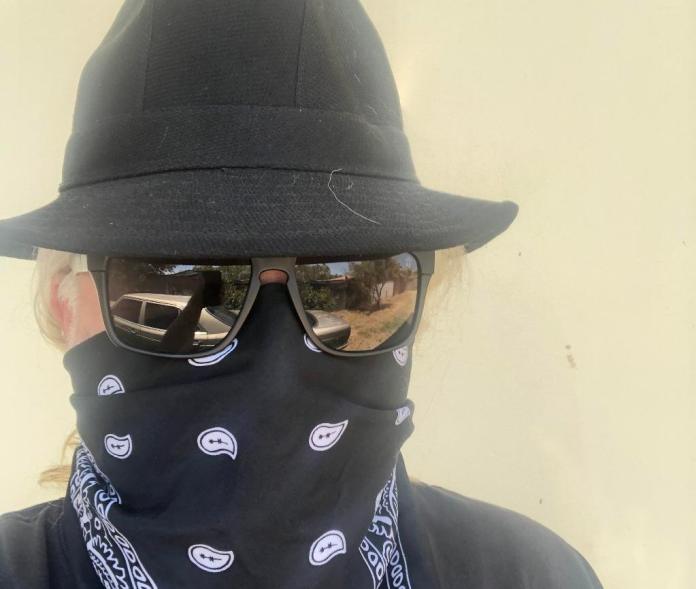
Was ready to go to the bank, but then decided, maybe just a little much? So I ditched the glasses and the hat
Rico’s Digest – “I Didn’t think it would happen to me” is a phrase I have not yet heard and hope never to hear from of any of my family or friends, especially the few who are taking the pandemic in stride, even one who has on more than one occasion declared “it’s all a lie, all made up.”
“Look, I am out and about, I don’t wear a mask, nothing has happened to me,” words I have heard from him before.
Was ready to go to the bank, but then decided, maybe just a little much? So I ditched the glasses and the hat
Things between us came to a head-on confrontation, when, for whatever reason he decided, in a public place, to show off his bravado, a side of him I had not seen before, in the almost decade of knowing him.
On this day, he decided, in front of others, to ‘sacar pecho’, a Spanish term I translate to, “look at what an idiot I am”, forgo social distancing, and mock my personal choices. The mistake was mine, I should have driven straight home from the supermarket instead.
His choice is his and thought I don’t agree with, I respect it. All I ask is for the same respect in kind.
My choice to take the situation seriously, that includes wearing a mask when leaving my house, gel in pocket, and in the have wipes, spray and gloves for any occasion in the car, is mine, a personal one, one that I don’t give a flying monkey if others agree to it or not.
That choice is also taking an attitude of suspicion of others, yes, I am protecting you from me, but, better I protect myself from you. The same thing, but not the same.
On this visit, as I had done before, meeting at a shop of a mutual friend, it didn’t go so well. Being both Italian, our heated conversations are often mistaken by others around us (other than other Italians) as arguments.
Raised voices, hands flying are not arguing in our culture, they are merely expressive conversation. Arguments are another level. And this was not the time, nor the place, or the reason for an argument.
On this visit, I was accompanied by my wife, who is also taking the pandemic with seriousness. I would even say more than I.
Once heads cooled we discussed the situation via messaging.
I reminded him that I am in the risk group, he is not. I have family at a distance, he does not. My wife has family and though not such a distance, but in a country where the dictatorship shares ‘his’ similar views, and he does not.
In fact, one of the reasons for my semi-blow up was just that, “look what’s happening in Nicaragua,” he tells my wife. Insensitive ignoramus.
Although he agreed with my points, even agreeing to my suggestion that we talk to our mutual friend who just returned this very morning, from Brazil.
Once again I repeated my message, my reasons for wearing a mask, my social distancing and other precautions I am taking, my being “precavido” (cautious).
I fear the message will not get through. But I have hope, hope that I will not have to hear from him the words “I didn’t think it would happen to me”.
An asymptomatic positive Costa Rican man with COVID-19 boarded a bus to Siquirres, which caused the isolation of the other passengers. The man had been in Chontales, Nicaragua since last February, and tested when he entered the country through the La Tablillas border.
As he was arriving at his parents’ house located in Siquirres, he received a call from Health authorities indicating that he had tested positive for coronavirus.
The bus, traveling from San José to Siquirres was stopped in the Guácimo sector and boarded by the Fuerza Publica (national police) and the Ministry of Health personnel.
The bus was placed under security protocol at the area hospital, where tests were carried out on the passengers two rows ahead and two rows behind the positive man and were issued a preventive isolation order.
A total of 54 passengers were traveling on the bus, all were issued a health order to self isolation and will be under surveillance for the next 14 days.
The patient who tested positive does not present symptoms and was transferred to Santa Ana where he must comply with the quarantine order at home.
It was shortly after 9/11 and the bombing of the Twin Towers nearly 20 years ago. My wife and I had made the decision that life was too short and we were going to sell everything we owned and retire.
Everyone applauded our decision. We were undergoing tough times with our printing company and the advent of personal computers and printers was eating into our profits. And we were both working 60 hour weeks just trying to stay even.
At first we didn’t have a clue… we just had a vague idea that we wanted to enjoy life before it killed us. And everyone said “boy, I wish we could do that.”
And we didn’t know much beyond that.
Then one day I was searching online and I saw an article about Costa Rica… and I said to Rhonda “maybe we should consider Costa Rica?”
She thought I was crazy.
But then she remembered the vacation we took there a few years past.
And she changed her tune.
“I always wanted to be a beach bum”… she said.
And I started my mission to learn everything possible about Costa so that IF we did move there… ( and IF we even really moved at all… ) we wouldn’t be blindsided by anything sneaking up on us.
Keep in mind, the internet was still a “teenager” and my tech skills with a computer were on a par with a ten year old ( at best ).
But I read all of the websites… and the books… And I deluded myself into thinking that we knew it all.
And we sold everything…
Now… during this time all of our friends told us that we were crazy…
“You can’t leave your kids…”
“Costa Rica doesn’t even have running water?”
“Will you be living on the beach or in the jungle?”
“Aren’t you afraid of catching malaria?”
“Will you be able to get electricity where you are living?”
“Will you have a car?”
“What will happen if you get sick?”
“What about snakes and scorpions?”
The questions went on and on.
But it was my father that was the worst…
He never really came out and said that he would miss us but he came at us from damn near every other direction.
Mom stayed quiet.
Candidly, a lot of people were envious but these were people that we knew would never take the risk… for them it was just a dream.
And eventually, we sold everything, including the house and the business.
And then we had the “garage sale to end all garage sales”… complete with a section labeled “Adult Books” by the kids. ( I think we still have a picture of it )
The kids didn’t say much and we really couldn’t tell if they were planning on coming with us or choosing one of the alternatives which included finishing their last year of high school or moving to Costa Rica with us. The other two were finished and were in transition with the “rest of their lives.”
Most of the relatives were supportive but behind our backs they agreed that we probably belonged in an institution.
We finally did leave… everything was set up , but our parents made it plain that they expected that we had no real idea what we were doing and that they expected that we would return within six months… but a year at the outside.
And when we finally did arrive… with two suitcases apiece and our two dogs… things started slowly and seemingly never went according to plan.
We didn’t speak Spanish and we know no one in the country nor did we have any kind of a support group or group of expats we could count on for advice. ( there really weren’t any back then… )
But in our minds, we were prepared.
This was “our last great adventure.”
After landing in Juan Santamaria airport in Costa Rica we were taken by taxi to our hotel… and Rhonda was already suffering from a severe sinus headache.
I loved it… even with all of the “rundown” areas on the way to the hotel and the hot, humid weather… and of course, it was still winter in Minnesota.
Within a couple of days we had made contact with a couple of realtors that we found online and we agreed to meet them for showings. Of course, we knew absolutely nothing about ANY of the areas and geography and ANYTHING about the country yet, except what we had read.
The first realtor didn’t show.
The second showed us a house where the toilets had overflowed and had been sitting for at least a week. Of course, he told us that the price was negotiable.
Discouraged?
Of course not.
We hired a tour guide from the hotel to drive us around to look at properties… and of course he took us to his home town…
And we loved it.
Then we tried to find a realtor and there were none in town that spoke any English so we relied on our guide.
His name was Wady.
And we thought that we were getting “the inside scoop” on property in Grecia.
Ha.
But we did end up buying a property… a small coffee farm in the mountains overlooking the town with a river at the bottom. And we loved it. ( It took us two years before we finally realized exactly how much we overpaid and how much Wady put in his pocket… )
Then he found us a rental in the area that we could live in until we finished building our new home.
It was a small Costa Rican home not far from where we were building and it had everything we needed… and we loved it.
Until we found that Wady had doubled the price that the owner told him he wanted.
It was at that point that we figured that “maybe” everything wasn’t going to be as easy as we thought.
But we loved the country.
And we went sightseeing in our new adopted country.
And we found out a few more negatives.
And a few months later, during the building of our new home… we found out a LOT more negatives.
But it was a foreign country after all.
What else could go wrong…
To be continued…
( to be brief… a lot more went wrong… and if you, the reader, recognize yourself in any of my writings… please know that it is VERY IMPORTANT that you do learn as much as possible about the positives and negatives of Costa Rica… you definitely do not want to be blindsided. AND yes, it is worth it.
And next time… you’ll find out what my Dad said when he and Mom visited us and saw our new house.
And I also will share with you the most common complaints that expats have AFTER they have lived in Costa Rica for a while. And how some adapted… and some didn’t. AND what you can do to improve your odds.
And know that IF you do it right and take preparations, the odds are pretty damn good that moving to Costa Rica will be the “smartest” thing you could ever do for yourself.
Today Nicaragua, Managua. Inhabitants and doctors of Nicaragua fear that the country is on the verge of chaos due to the rapid spread of COVID-19, due to the lack of measures to contain it and official secrecy regarding infections in the country.
The independent media, Despacho505.com records more than 1,200 cases. Managua and Chinandega are the most affected.
“We are entering a phase of rapid community spread of the virus. As the exponential curve continues to increase and produce more affected, a chaotic situation is going to get”, warned epidemiologist Dr. Álvaro Ramírez.
The health emergency worries Nicaraguans, amid complaints from hospitals collapsed by patients with respiratory illnesses and killed by “atypical pneumonia“, according to records, who are buried in sealed boxes, in “express burials”, without funerals or mass funerals.
This situation has become especially evident in the city of Chinandega (northwest), considered the epicenter of contagion.
Unofficially, it is estimated that the country has between 5,000 and 6,000 hospital beds and 160 ventilators. There is no official data.
Police and other non-uniformed security keep guard around hospitals and cemeteries to ward off journalists trying to take photos, videos, or speak to relatives of patients.
Like many others isolated from their loved ones interned, the relatives of the popular former softball player Alberto Paraíso Mendoza, were prevented from accompanying him in the 11 days he spent hospitalized until his death in a Chinandega hospital.
74-year-old Mendoza was admitted on May 2 with “fever, cough and dirty lungs,” said his wife, Consuelo Mendoza.
That was the last day she saw her spouse. After his death, she had three hours to prepare the funeral and only one daughter was able to attend, she said.
The death certificate says Mendoza died of “respiratory failure and atypical pneumonia,” but his family suspects that he was killed by the coronavirus.
Gravediggers wearing clothing to protect themselves from the spread of covid-19 buried a person in the Jardines del Recuerdo cemetery, in Managua, on Friday, May 15, 2020.
There is community transmission
The president of the Nicaraguan Medical Association, Gretel Solís, assured that the country is in an instance of “community transmission” of covid-19; that is, it spreads among the population locally.
The Despacho 505 a civil society initiative, counted up May 13, 266 deaths and 1,270 suspected cases of coronavirus.
Officially, the Ministry of Health recognizes only 8 deaths and 25 infections.
The National Coalition (Coalición Nacional), which groups several opposition organizations, issued a statement denouncing the handling of information by the Daniel Ortega administration: “The families of those killed by covid-19 face a government that is lying to them, delivers them notices of death that do not correspond to the diagnostic truth ”.
According to this group, “the mourners need to follow trucks with the coffin to know where they are going to bury their loved ones”, and “they are threatened by police or paramilitaries so that they do not tell the truth about the causes of death” .
The alarm has been triggered by the dissemination of videos in the media and social networks of “men in white”, as the population calls the health personnel who guard the coffins for the so-called “express burials”, generally carried out at night.
Vice President Rosario Murillo believes that there is an opposition campaign to put the population against the government.
Murillo, who is also the wife of Daniel Ortega, also accuses the independent media and social networks of “creating false realities”, and that they use videos from other countries to “make believe that they are from Nicaragua”, alluding to the express burials.
This week, also the head of US diplomacy for Latin America, Michael Kozak, said that there are several credible reports that the advance of the coronavirus in Nicaragua is much greater than the government’s figures, and asked Ortega to “be honest.”
Family members removed the body of a patient who died with symptoms similar to those of the new coronavirus. They removed him from the Germano-Nicaragüense Hospital, in Managua, on May 13, 2020.
According to the pulmonologist Dr. Carlos Quant, many doctors “are working blindly” without precise diagnoses due to the lack of evidence, and “obviously they cannot give patients the treatments that exist.”
“Many patients are coming to hospitals with suggestive data on covid-19, both clinically and radiologically, but the tests are not available (…) so many of these cases end up with a diagnosis of atypical pneumonia,” said Quant, who works in a private medical center.
Covid-19 testing
Only the health ministry has powers to test covid-19. Private hospitals, clinics, etc are not authorized to acquire the test, Quant added.
Another doctor, who preferred anonymity, regretted that, in addition to the threat of layoffs or losing their title, health professionals face the fear of catching the virus and affecting their loved ones.
The Nicaraguan Medical Association records at least 74 infections among doctors, nurses and support staff in hospitals.
Aeroméxico: Suspended operations until further notice.
Air Canada: To resume operations in July. Waiting for information from the airline.
Air France: Suspended operations until further notice.
Air Panama: Suspended operations until further notice.
Air Transat: Suspended operation until further notice.
Alaska Airlines: Waiting for information from the airline.
Albatros Airlines: Suspended operations until further notice.
American Airlines: Resumes operations on July 7 towards Miami and Dallas.
Avianca: Waiting for information from the airline.
British Airways: To resume operations on June 27 to London.
Condor: To resume operations on June 29.
Costa Rica Green Airways: (Domestic) Available for charter flights.
Copa Airlines: Flight arrives from Brazil on May 18. Waiting for information from the airline.
Delta Airlines: To resume on June 19 towards Atlanta and Los Angeles.
Edelweiss: Waiting for information from the airline.
Iberia: Waiting for information from the airline.
Interjet: Waiting for information from the airline.
JetBlue: Waiting for information from the airline.
KLM: Suspended operations until further notice.
Latam: Waiting for information from the airline.
Lufthansa: Waiting for information from the airline.
Skyway: (Domestic) Suspended operation until further notice.
Sansa: (Domestic) Suspended operation until further notice.
Southwest: To resume on August 30 towards Fort Lauderdale and Houston.
Spirit: To resume on July 5 towards Fort Lauderdale and Orlando.
United: Rescue flight May 18 and 20 to Houston. Waiting for information from the airline.
Volaris: Suspended operations until further notice.
West Jet: Take up options until further notice.
Wingo: Suspended operations until further notice.
The preceding information can change at any time. All passengers should contact the airline directly and through official channels, ie their website or call centers.
New Survival Rate Calculator to help you better understand the risks of existing and pre-existing conditions.
This calculator estimates your risk of infection and mortality from COVID-19. To do this we use the data you are about to enter on this page and your location (derived from your IP address). There is no other data being collected.
On Sunday, the Ministry of Health reported 10 new cases of covid-19 over the previous day., bringing the total to 863.
There are 725 Costa Ricans and 138 foreigners, of whom 470 are men and 393 women. The age range of those infected is from three months to 87 years of age. A total of 801 are adults (of which 43 seniors) and 52 minors.
According to the report issued by the Ministry of Health, 565 patients have already been recovered, dropping the number of active cases to 288.
17 patients are currently hospitalized, of which only 3 are in Intensive Care (ICU).
Costa Rica reports 10 deaths, with ages between 45 and 87 years; nine men and one woman.
Roman Macaya, executive president of the Costa Rican Social Security Fund (CCSS) explained that the institution is now testing for the covid-19 at 500 fixed and mobile points, which include hospitals, border points and even ports. With this, he said, a constant flow of samples to the laboratories for their respective analysis is guaranteed and results provided typically within 24 hours..
“We have purchased 152,750 covid-19 tests which allow us to do a large number of tests, if we have the deliveries promised by the companies. We can do about 3,000 tests per day if we have the reagents,” said Macaya.
Those tests are not done on the general population, but only on those suspected of carrying the virus.
The Government announced that both ministries and public institutions began to develop sectoral protocols for the reopening of the economy.
According to the Vice Minister of the Presidency, Silvia Lara, the governing heads of each sector will be in charge of endorsing these health protocols for the reactivation of productive activities.
These programs will be carried out based on the general guidelines issued by the Ministry of Health. However, it will be that authority that determines when restrictions are lifted in each area of the national economy.
“This is very important because we want to avoid a bottleneck in the approval of sectoral protocols. Imagine the Ministry of Health in the midst of all the work it has, which also has to review 200 sectoral protocols,” said Lara.
For example, the Minister of Tourism will be in charge of endorsing the protocols for its sector, as well as the ministers of Agriculture, Sports, Foreign Trade, Labor, among other areas.
The School of Public Administration of the University of Costa Rica (UCR) and the Institute of Technical Standards of Costa Rica (Inteco) will prepare a toolbox for the ministers to prepare said protocols together with representatives of their economic sectors.
“The fact of having a sectoral protocol is not an authorization to open. We want to be prepared for when the Ministry of Health so defines it,” said Lara.
(Screendaily) Owners of the first arthouse cinema to reopen in Costa Rica say they have been encouraged by the response from audiences as they head into the second week of business.
Cine Magaly in the capital San José opened its doors on Monday (May 11) with a first-run presentation of The Lighthouse after the ministry of health said patrons could return to theatres that demonstrated sufficient safety and hygiene protocols in light of the ongoing coronavirus pandemic.
Programming director Anabelle Carcheri said the family-run business – sister Jessica is manager of operations, and father Luis runs sister company and distributor Distribuidora Romaly – had already been working on protocols alongside distribution and exhibition association CADEC and got approval in late April.
Costa Rica has kept the impact of the pandemic relatively low compared to other parts of Latin America – at time of writing there were 843 reported cases and eight deaths – yet the Carcheris knew they had to reassure customers it was safe to return.
Ahead of the reopening day, Cine Magaly issued a press release notifying the public that it was about to reopen. “That was important to let people know what we were doing and it is going to help generate audiences for when other theatres reopen,” said Carcheri. “This is the new normal.”
Staff training, face shields, social distancing… and a flower
Cine Magaly staff received a day of training to bring them up to speed with new hygiene and safety protocols. These include enhanced cleaning, face shields and gloves for staff, and stickers on the lobby floor to ensure customers remain two metres apart upon entry and line up for concessions in accordance with social distancing measures.
Available seating is indicated by yellow bands, and unavailable seats are marked clearly. Staff check for compliance routinely during shows.
“We don’t want everybody exiting the theatre at the same time so we call people by row to leave separately so people can keep their distance,” explained Carcheri. “That has been quite easy to implement.” As a bonus, returning audience members each received the gift of a flower on the first two days.
The Lighthouse, whose planned March release had to be scrapped when Cine Magaly and every other theatre closed, is currently playing once a day at 4pm on the larger of the venue’s two screens, a 557-seat auditorium.
Monday’s screening sold out all 99 seats, which due to social distancing restrictions represented 17.8% capacity.
On successive days Eggers’s black-and-white Cannes 2019 selection drew 55 people on Tuesday, 39 on Wednesday, 52 on Thursday, and 88 on Friday.
The daily presentation enables patrons to return home before the 7pm curfew. Carcheri said the curfew is about to get rolled back to 10pm, and once that happens Cine Magaly will expand to two presentations a day, 4pm and 7pm, starting on Monday May 18.
“We feel very encouraged because it’s been a start,” Carcheri told Screendaily. “There have been many questions: do people trust the theatre, do people want to leave their homes, can people leave work to get to the show, can they get home before the curfew? And did they like the film?”
Monday’s show was for “single” customers only, however on the same day the ministry of health said it would allow “bubbles” of people to sit together. Cine Magaly reconfigured seating to accommodate bubbles starting on Tuesday, when it made 140 seats available in the larger auditorium.
’We didn’t want a big opening with thousands of people flocking to the theatre’
Carcheri said they have been cautious not to open too fast while operating within the 25% maximum occupancy stipulated by the Costa Rican government. “It’s been very contained and careful. We didn’t really want a big opening with thousands of people flocking to the theatre. We wanted to test it and see if there were any adjustments we needed to make.”
Cine Magaly’s smaller, 72-seat cinema, opened on Friday (May 15) at 25% capacity or 18 seats and will alternate between screenings of Bong Joon ho’s Cannes Palme d’or and Oscar best picture winner Parasite, and Jan Komasa’s Polish Oscar nominee Corpus Christi.
Weekends are currently off-limits at Cine Magaly, however Carcheri is working with CADEC and in talks with the authorities to move up the June 21 start date.
The major exhibitors are eyeing a reopening some time in June in Costa Rica.
By that time Cine Magaly will have been open for six weeks. Carcheri said the goal is to build on a solid foundation of mutual respect with patrons.
“Our audiences are faithful to our theatre and trusted us to come to our site at a time like this.”
Upcoming releases include Alejandro Landes’s Colombian thriller Monos, Autumn de Wilde’s period drama Emma, and Soheil Beiraghi’s Iranian drama Cold Sweat.
On the first day of the relaxed measures of the national emergency, downtown San Jose and in many communities and in particular the ferias (markets), one could say, what pandemic?
Despite still being in the midst of the health emergency due to COVID-19 and the increase in cases over the last few days, a large number of people decided to go out and enjoy the Saturday morning, before the rains.
Photos posted on social networks told the story, like those of the streets of downtown San Jose and the Pavas feria and reports of crowds in different parts of the country.
On Friday, for the third day in a row, the number of new COVID-19 cases in the country was higher than the number of people who recovered. In addition, that day, two patients lost their battle with the virus, bringing the number of deaths to 10.
The two deaths on Friday were of four in the past week.
But many just didn’t care or just wanted to get back to normal, tired of being at home. What is even more worrisome is the few who were observed wearing masks.
The number of confirmed cases on Saturday, since the first on March 6, reached 853.
(QCOSTARICA) The death of a loved one, a spouse, close relative, a good friend is always difficult, and even more so if it is a death from covid-19, where due to the characteristics of the disease, there can be no hugs, kisses, or even holding hands at the time to say goodbye.
“My wife died in peace and I was able to sing to her,” Rosmy Quirós, husband of the first woman to die by the pandemic in Costa Rica, told Lizeth Castro (lizethcastro.tv) in an interview.
Don Rosmy said he got the call Friday morning by the psychiatrist who supports the relatives of the victims of this pandemic but did not imagine it was to give his last goodbye.
In a room, “far but close” to her, he was allowed to stay the morning. He sat in an armchair, in a room where he could see his wife’s bed and from there began to sing to her.
“It is not that I sing very well but I began to sing the psalms that she loved so much, those we learned in Church and that fascinate her,” he said.
Mari Rodríguez, 58, passed away in the Intensive Care Unit (ICU) of Hospital México later in the afternoon. He was ould be 9th victim and the first woman to die due to the covid-19.
It was the hospital staff who made the arrangements for the husband to say goodbye to his two-decade-old life partner and mother of two.
When Doña Mari died, her husband narrated, he could only express: “Love, you beat me, I had to go first, but God chose you first.”
Doña Mari had a situation that complicated her infection. In February, she was diagnosed with lymphoma of the small intestine, a rare type of cancer.
“The cancer diagnosis was very hard. I was on a work trip to China and when I returned she told me that she had felt very sick all those days when I was not there. It was when after tests we were told it was cancer. It was a great blow, but you still had to fight and put yourself in God’s hands,” he said in his interview.
Don Rosmy Quirós and Doña Mari Rodríguez are the parents of a 20-year-old son and a 19-year-old daughter, both university students.
A man of impressive faith. “I am at peace, I feel pain for the children, but I am convinced that my wife is in the lap of the Lord,” he said.
Doña Mari if from Tambor de Alajuela. According to the Ministry of Health, Rodríguez was detected with covid-19 on April 24.
Don Romsy explained that following her hospitalization for cancer, when she returned home, she began to feel very bad, so they returned to Hospital México where they tested her.
“After being hospitalized for cancer, God only knows why, when she returned home she began to feel very bad. She had a high fever and I took her back to Hospital México even though she didn’t want to. But it had to be done and Mari tested positive,”
The next day, April 25, she was moved to the ICU.
Friday morning, May 15, the situation was complicated and that was when he was called to say goodbye.
Curiously, although Don Rosmy went to the country where the Coronavirus originated, both he and his children tested negative in the various tests that were carried out on them.
On Friday, with the death Doña Mari and that a 73-year-old man, who also had high-risk factors, who was also in the Hospital Mexico ICU, also since April 25, the death toll in Costa Rica rose to 10.
As of Saturday, May 26, the number of confirmed cases of covid-19 reached 853, ten more than the previous day, of which 551 have fully recovered.
(QCOSTARICA) The Estadio Nacional (National Stadium) is working to return national soccer (futbol) during the national emergency due to covid-19, offering up its facilities to major league clubs for US$2,500 per game without fans in the stands.
Ricardo Chacón, administrator of the stadium assured that he has already made the proposal to the 12 clubs.
Being a stage with capacity for 35,000 people, it has large dressing rooms and benches, making it the ideal to fully comply with the protocol approved by the Ministry of Health.
“We make a proposal that is quite simple,” said Chacón.
The administrator explained the US$7,500 or 10% of the box office, soccer clubs can fill the stands at 50% capacity. “But with the current situation, things can change,” said Chacón.
Major clubs such as Herediano and Alajuelense, as well as the Unafut (the national soccer association), have been in talks with Chacón about possibly using the stadium. The administrator added that the two clubs from Heredia and Alajuela, had been in talks prior to the national emergency.
Chacón added that perhaps they will not use the national stadium for all the games, but possibly for important or playoff games.
“The turf has been given the maintenance and conditions and that the stadium presents the level of space and distancing in dressing rooms that is ideal,” said Chacón.
(QCOSTARICA) A total of 13,529 license plates have been seized since the Health vehicular restrictions measures began in March.
Although the main objective of the restrictions was to keep drivers off the roads, many, as the data of the Policia de Transito reveals did not need to the call.
In addition to driving while under restriction, many drivers have also been caught driving with other traffic violations such as driving without or an expired license, not having the circulation permit (Marchamo) current or the vehicular inspection (Riteve), among others. But perhaps the worst is driving under the influence.
On Saturday the Minister of Security, Michael Soto, explained that, along with the Ministry of Transport, are working to streamline the procedures for returning the plates because the large number of seizures have delayed a backlog.
“This number of the seized plates is constantly increasing, probably at this very minute someone (police official) is taking down plates. This situation has been so extraordinary that the number of plate seizures has probably been the most extensive or large in the history of the country, without a doubt, the administrative capacity for the return has also been affected and collapsed.
“The people of the MOPT who are in charge of this area have been doing important, extraordinary work to make that process (SIC) more efficient, but it is so much that there has been some type of problem that is being addressed,” said Minister Soto.
While a Transito or any other police body authorized to enforce the vehicular restrictions can also seize the vehicle, in the majority the plates are seized, one for the lack of tow trucks (the Policia de Transito trucks must be used) and patios (lots) to store the seized vehicles.
Drivers violating the vehicular restrictions are also issued a ¢110,000 colones fine and six points on their license, meaning driver-ed when renewing the license, in addition to fines or any other traffic violation.
The Tarcoles river spa is open and free to anyone who stops by. No quarantine here, but social distancing must definitely be respected if you’re not a croc.
The experience is unforgettable. Stopping to see the crocodiles at the “crocodile bridge” is one of the most anticipated activities of foreign tourists traveling through the central Pacific coast.
Ten new cases were added to total confirmed cases of covid-19 in Costa Rica, bringing the total to 853, explained the Minister of Health, Daniel Salas, Saturday afternoon.
Of that number, however, there are 551 recovered, bringing the number of active cases to 292.
Salas also reported the number of truckers turned away at the borders from entering the country for testing positive with the covid-19 is now a36.
According to the report provided by the Ministry of Health, among those affected since the first cases on March 6, they are 387 women and 466 men. Of these 717 are Costa Rican and 136 foreigners.
The cases of coronavirus have been confirmed in 69 of the 82 cantons of the country.
Currently, 17 patients remain in hospital, four of which are in the Intensive Care Unit (ICU). The number of deaths remains at 10, two patients, a 58-year-old woman (the first) and a 73-year-old man died on the same day, on Friday, at the Hospital Mexico. Both had risk factors and both had been elevated to the ICU on the same day, April 25.
The two deaths were four in the same week, prior to that there had not been a death since April 20.
Salas recalled that as of Monday the easing measures are implemented, however, he asked people not to forget that the pandemic is not over and could hit the country if discipline is not maintained.
On Monday, beaches will re-open between 5:00 am and 8:00 am, though social distancing is being asked to be maintained. Twelve national parks will also re-open with limited operation and at parks with beaches, such as in Manuel Antonio, people will be permitted to walk the beach, but no stay in place, ie sunbathing, etc.
Having their license plates confiscated is one of the sanctions drivers violating the restrictions face
On Monday, the vehicular restrictions are eased as well, the day time will be in effect from 5:00 am to 10:00 pm, from Monday to Friday, with restriction applying to the last digit of the license plate, 1 & 2 on Mondays, 3 & 4 on Tuesdays, 5 & 6 on Wednesdays, 7 & 8 on Thursdays, 9 & 0 on Fridays; the nighttime, from 10:00 pm to 5:00 am, is applicable to all vehicles.
On Saturdays and Sundays, the daytime restrictions are from 5:00 am to 7:00 pm, even-numbered plates (0,2,4,6,8) restricted on Saturdays and off (1,3,5,7,9) on Sundays. The nighttime restrictions, from 7:00 pm to 5:00 am, applies to all vehicles.
On the issue of truckers
To alleviate the backlog on the other side of the border (Nicaragua and Panama), waiting on the required testing to enter Costa Rica, two important changes were announced and put in place starting Friday night:
Truckers who are in transit, ie will move from border to border – north to south and south to north – without permanence in Costa Rica will be able to travel by police escort – convoy.
In the alternative, to avoid entering the country, starting Monday, May 18, foreigner truckers can hand off their container, in a restricted area, for then to be picked up and transporter from a trucker inside the country.
From border to border
Nuestra Benemérita Fuerza Pública continúa su enorme despliegue operativo, en cumplimiento de las múltiples funciones asignadas durante la emergencia nacional sanitaria #LaPoliciadelosTicoshttps://t.co/Nkdh0oebTJ
— Fuerza Pública CR (@fuerzapublicaCR) May 16, 2020
Both measures are to lessen the loss to drivers waiting for the 2 to 3 days to confirm the test results. On the Nicaragua side of the border, the truckers’ association there said the single line of trucks waiting to cross the border was more than 10 kilometers.
Miss Costa Rica 2018, Natalia Carvajal, is learning to ride a bicycle, but she already got her first big scare.
The beauty scraped the ground on Tuesday and suffered a cut that sent her to hospital. But the accident isn’t going to stop her from getting on the bike again.
The former Miss said she wanted to make something of her biking, “I was super excited and right now I can’t do anything for at least a few days” but says she is fine, “they already sewed me” (got stitches) of her somewhat deep cuts, so she had to be more careful.
“It was a big scare because I’m literally learning, but I think it was overconfidence,” said Natalia.
She explained that everything was going well, almost at the end of her ride, on a flat area, going a little too fast, feeling confident, didn’t see the tree stump.
The bike handle dug into her groin. “There was nothing I could do, luckily the clinic was close by,” said the former Miss and TV host.
The accident occurred in Guanacaste, in the area of Pinilla, near Tamarindo.
Natalia said that she never had a bicycle or learned to ride one as a little girl, then as she grew up never found the time, so she is learning from zero.
She decided to take up cycling now that she has more free time and can enjoy her time in Guanacaste, where there are few cars on the roads.
Natalia has more than 539,000 followers on Instagram
“I laugh because I said to my friend: ‘I have it mastered’ and five minutes later I was on the ground,” said Natalia.
As soon as she’s healed she’ll be back in the seat again, “Because I feel that if you do not do it quickly, after you get the scare, you can get a little phobic. I don’t know when it will be,” said the former Miss Costa Rica.
Officers from the Drug Control Police (PCD) detained a group that hid 778 packages of cocaine inside a container loaded with a thousand bags of refined industrial salt.
Photo: PCD
The find was made this Wednesday, May 13, during a container inspection at the AMP Terminal, in Limón.
The Ministry of Public Security (MSP) said the 778 packages, each weighing one kilogram, were distributed in 26 bags camouflaged between the refined salt packages.
“This is another blow against transnational criminal organizations and effective work very well done by the PCD,” said Michael Soto, minister of public security.
The container had arrived this week at the Costa Rica terminal from Cartagena, Colombia.
According to the MSP, so far this year, the PCD has seized a total of 7,716 packages of cocaine at the Moin container terminal.
Rico’s TICO BULL – Have you checked your water bill lately, other than just paying it? If you haven’t do so. If you dd you must have noticed that despite your lowered water consumption, the bill still high?
That is because the Acueductos y Alcantarillados (AYA) – water and sewer utility – since March 20, has stopped reading the meters located in each house or business premises, as an immediate response to the COVID-19 pandemic, not wanting to expose its employees doing field readings.
That means that all this time, the Aya used their default formula for water bills based on the average user consumption of the last 12 months.
This formula is applied, for example, when a user complains of a high water bill in the current billing period. The utility examines the previous usage providing the consumer an adjusted bill.
Now, this may be to your benefit, with the staying at home more water is being used, yet not being billed for. But, it may not be for the user who, say has used more water in a billing period or two, due to a leaking faucet or toilet, watering the garden more than normal or what have you.
To protect its employees in the field, the AyA suspended since March 20 the reading of water meters
Complaining – that is filing a complaint – is of no use since the utility would apply the same formula it did to produce your current bill. And you cannot go backward, that is have the AyA adjust your extremely high bill for January, for example. No, no, you had to have filed a complaint then.
Your next bill, however, may be more realistic to your consumption as the AyA resumed, as of May 14, reading meters.
But wait, I can see a problem, the meter readout show the consumption for the last 2 months, yet you have already been billed. And most likely paid it.
“In the event that the actual consumption in that period is different from that billed by average, the difference will be reflected in the following receipt from the user,” the AyA told the Q.
Do you trust the utility? Best not. Look closely at your next billing and put in your claim if you were affected.
Don’t just not pay it, for despite the AyA directive not to suspend water (cut) your water service during the national emergency, the data indicated that between March 20 and May 14, it made 1,798 reconnections throughout the country, most of them after payment of the current bill. It has also formalized 876 payment arrangements.
The AyA director or guideline does not eliminate the obligation to pay for the service, nor does it imply the forgiveness of past bills, hence the importance of making a payment arrangement if you can’t pay due to the pandemic.
And don’t just wait for next month’s bill, as I said before, the AyA has a policy of only accepting and adjusting claims for the current billing period. There are exceptions to every rule and you may get an adjustment, but don’t bet the farm on it.
In my personal example, years ago, when I rented a house in Rohrmoser when one month my water billing went through the roof, almost doubled. When I complained, I was told that the high amount was due to an increase in commercial water and sewer rates. What?
I discovered that the landlord had used the house as an office, and as such the water service was based on commercial rates. Before the increase, the water bill for big house in San Jose seemed normal. But went it went to more than double.
The end result I got the service converted to residential, after providing evidence the house was not being used for commercial and my water and sewer bills were more than half of what I had been paying for years.
When I asked about a rebate or refund for what I believed was their mistake, I learned about the differences in billing, how to read the bill correctly and yes, I could file a complaint, hire a lawyer and go up against the AyA. In the end, I sucked if up to experience.
I did get my revenge years later, when the old house I was renting in Santa Ana had an internal leak. The bills for a couple of months were 20 times normal. The Aya said I had a leak – I didn’t, I had already repaired it.
They sent an inspector. He wouldn’t come in the property, I had dogs. They sent another inspector, a month later. Same thing. Finally, now in the third month, they had no choice but to adjust my billing and to save face made a symbolic change of the meter.
For any billing query or request to adjust the current bill, you can contact the AyA by way of the 800 REPORTE phone line (800 737 6783), email to linea800@aya.go.cr, WhatsApp: 8376 5103, website www.aya.go.cr or visit the local AyA office to where the meter is located.
(AFP & QCOSTARICA) Two policemen and a military officer escort two young men off the horses on the Honduran shore of the bordering Guasaule River, in their mission to block the entry of Nicaraguans trying to enter Honduras, in the face of their country’s apparent indifference to the COVID-19 pandemic.
Two young men enter Honduras from Nicaragua on horseback through a crossing point in Guasaule, on May 13, 2020. AFP / ORLANDO SIERRA
The riders turn out to be Hondurans crossing from Nicaragua through a blind spot on the border, carrying blocks of cheese to sell in their communities.
“We are all hungry,” justifies a Honduran police officer who lets the two young men through, without penalty, involved in the so-called “petty smuggling.”
The mission of Honduran officials deployed at the border is “to avoid contagions, of Nicaraguans entering with the virus,” Lt. Carlos Wilfredo Cruz, armed with an M-16 rifle, told AFP while accompanying the policemen in the operation.
People walk through the dry riverbed of the Guasaule River, the natural border between Nicaragua and Honduras, on May 13, 2020. AFP / ORLANDO SIERRA
Both Honduras and Costa Rica have tightened border surveillance in recent weeks to protect themselves against what both governments consider an inadequate response by the government of Daniel Ortega to the COVID-19 pandemic.
While everyone adopts restrictive measures, including forced quarantines and border closures to contain the coronavirus, in Nicaragua no limitations have been decreed and on the contrary, the Ortega government has called for mass marches and celebrations.
Ongoing concerns
In Honduras, the police and military deployment extends from customs to a dozen blind spots across the river, turned into a bed of rocks by the severe drought. Also in the middle of the undergrowth, where illegal trade flows in both ways, such as cheese.
A doctor at the Guasaule border post, in Honduras, on May 13, 2020. AFP / ORLANDO SIERRA
While Honduran police and military prevent Nicaraguans from entering through blind spots, customs, health and immigration authorities have also reinforced epidemiological surveillance at the customs office.
“We are concerned that the sister republic of Nicaragua is not taking any protection measures” against the pandemic, said border customs administrator Rosana Ventura.
“The concern is latent because we are at a border post with a country that is not taking protection measures,” he stressed.
He said that about 900 trucks that transport goods cross every 24 hours through that customs office.
Honduran agents search vehicles from Nicaragua at the Guasaule border crossing, on May 13, 2020. AFP / ORLANDO SIERRA
The doctor who examines the truckers, José Alfredo Sánchez, says that the truckers inform him that in Nicaragua there are no protection measures like in the rest of Central America.
“We do not know what number of those infected are in Nicaragua, because Nicaragua is not doing any tests, so that does not guarantee that the number they are giving is real,” the doctor warned.
Testing and drones in Costa Rica
Nicaragua officially reports 25 confirmed cases and eight deaths of coronavirus, a number that has not changed for days, although civil organizations have reported more than a thousand infections and nearly 200 deaths.
Sánchez is in charge of approving the entry of truckers into Honduran territory after taking their temperature, asking them if they have symptoms of COVID-19 and alerting them to the risk that they are running from the disease.
Photo: Ministerio de Seguridad Publica (MSP)
After passing the consultation with Sánchez, Guatemalan trucker Edy Roberto Taltique, 50, who carries a shipment of reels of paper from Costa Rica to Guatemala, stressed that the Costa Rican authorities are taking the best measures against contagion from the disease.
“In Costa Rica, at the border, at the entrance, the mandatory testing before entering the territory and from there (the sample) goes to the laboratory, they give the results and you can enter,” the country, he said.
Costa Rica began testing, both at the southern border with Panama, but with particular and reinforced attention to the northern border with Nicaragua, all truck drivers who want to enter the country with cargo.
Those with symptoms such as nasal congestion or cough or test positive for the covid-19 are not allowed to enter, according to Costa Rica’s Health Minister Daniel Salas.
In the 8 days of testing, 23 drivers coming from the Nicaragua side of the border tested positive.
Additionally, Costa Rica, not having an army, mobilized its six police forces, including the Organismo de Investigacion Judicial (OIJ), to strengthen border surveillance and contain the entry of Nicaraguans.
Photo; Ministerio de Segurida Publica (MSP)
Costa Rica has an estimated 500,000 Nicaraguans living in and working in the country, among many with legal residency refugees, illegals, and migrants, who regularly move between the two countries.
Although not aimed specifically at the Nicaraguan residents in Costa Rica, it prohibits the re-entry of any resident who left the country after March 23. In addition, any resident who is found having entered the country illegally will lose their migratory status.
In addition, to stop many of the permanent residents from leaving and returning, Costa Rica prohibits any resident who left the country after March 23 from entering.
Additionally, it uses drones to monitor the border from the air and installed an airbase in the border area to carry out air patrols, according to the Ministry of Public Security.
Photo; Ministerio de Segurida Publica (MSP)
Moving truckers by convoy
The testing of drivers resulted in a backlog, trucks lining up for kilometers in Nicaragua. To reduce the losses to the drivers, including spoiled merchandise, on Friday (May 15), Costa Rica, in lieu of testing that takes from 2 to 3 days for the results, will escort truckers moving from north to south and south to north, that is not remaining in Costa Rica, in a police convoy.
Photo; Ministerio de Segurida Publica (MSP)
The drivers will move convoys of 50 trucks, escorted by the Fuerza Publica (National Police), making only one supervised stop along the route.
All other truckers whose destination is within Costa Rica will continue to be tested.
(QCOSTARICA) Just as we expect to resume activities under the so-called “new normal” due to the COVID-19 pandemic and when the country’s productive and industrial sectors beg for a stimulus to recover from the crisis, a new announcement of an increase in electricity rates looms.
The increases will be between 1.10% and 2.57%, and will be in effect between July and next September, just in the months when people’s lives are expected to resume a path of greater stability in their finances.
The increases correspond to the compensation that the subscribers of the electric service must make to the Instituto Costarricense de Electricidad (ICE) for using fuels to generate electricity during the summer, as well as for resorting to energy imports during that period. It is called Variable Generation Cost, or CVG factor (Costo Variable de Generación in Spanish).
This was a cost that users had to pay for the second quarter, but due to the emergency it was decided to postpone its validity for the third quarter, at the request of ICE and the Ministry of Environment as the governing body of the sector.
Just at time when other payments kick back in, for example, the moratorium on VAT and income tax will have expired, and utilities will have ended the benefit of not applying service cuts due to the crisis.
The management of delaying the increase until the third quarter is the only one carried out so far and at the moment there are no new intentions to establish a new postponement of the new rates.
(QCOSTARICA) By now you would think that every driver in Costa Rica is aware of the nationwide vehicular restrictions, the times and the day or days they can or cannot drive their vehicle.
But that is not the case. Every day almost 200 drivers end up getting ticketed, with points and their license and having their license and/or vehicle confiscated.
Every day.
For example, the 24 hours of 5:00 am to 7:00 pm Thursday and 7:00 pm Thursday to 5:00 am Friday, when 58 drivers were caught violating the daytime restrictions and 111 the night, for a total of 169, reported the Policia de Transito.
The number was a reduction from the 205 for the previous 24 hour period.
The majority were motorcyclists.
Starting Saturday, May 16 to May 31, new vehicular restrictions go into effect. The major change is during the weekdays, while weekends stay the same.
From May 16 to May 31 weekdays:
The daytime restrictions will be from 5:00 am to 10:00 pm, based on the last digit of the license plate: 1 & 2 Mondays, 3 & 4 Tuesdays. 5 & 6 Wednesdays, 7 & 8 Thursdays and 9 & 0 Fridays.
The nighttime restrictions for all vehicles (save for those on the exempt list above) is from 10:00 pm to 5:00 am.
From May 16 to May 31 weekends:
The daytime restrictions are from 5:00 am to 7:00 pm, even-numbered plates (0, 2, 4, 6, 8) on Saturdays and odd-numbered (1, 3, 5, 7, 9) on Sundays.
The nighttime restrictions for all vehicles (save for those on the exempt list above) is from 7:00 pm to 5:00 am.
(QCOSTARICA) A 3-month-old became the youngest positive with COVID-19 in Costa Rica.
On Friday, Health Minister Daniel Salas released the new case report, which added 13 more cases and a total of 843 since the first occurred on March 6.
Salas announced that one of these new infections is the 3-month-old baby. No further details were given, as the authorities do not provide information on the patients.
Up to Friday, the younger case had been that of a one-year-old, who has already recovered.
In the more than 2 months in which Costa Rica has been affected by the respiratory virus, 49 minors have been affected by the disease.
Costa Rica so far registers 843 cases with an age range of 0 to 87 years, of which there are 293 active as of Friday, May 15.
Nine of the 18 people hospitalized by COVID-19 are smokers, according to a report by the Costa Rican Social Security Fund (CCSS).
Román Macaya, executive president, indicated that 5 of the interned are in the Intensive Care Unit (ICU) and 13 in wards of state medical centers.
The main risk factor for hospitalization when having a coronavirus is hypertension (the most frequent) followed by smoking, explained Dr. Macaya.
According to the doctor, five of the hospitalized for covid-19 are obese, 4 are diabetic, and 2 have dyslipidemia (cholesterol). At the moment, none of the hospitalized are asthmatic.
The CCSS data reveals that 10.5 days is the average hospitalization, while for patients in ICUs it is 23 days.
“People who enter the hospital have a 20% chance of ending up in an ICU,” added Macaya.
According to data revealed this Friday by the Ministry of Health, as of May 15, 843 positive cases are registered (13 more than on Thursday), with 8 deceased (two more deaths occurred in the day, for a total of 10) and 542 people recovered.
A 3-month-old infant became the youngest Costa Rican to have the coronavirus.
A couple in Bijagua de Upala were arrested Friday morning
A couple was arrested this Friday, May 15, accused of smuggling migrants into the country, through the Upala area.
A couple in Bijagua de Upala were arrested Friday morning
Officials from the Immigration Police raided a home in Bijagua de Upala, in which two Costa Ricans, were arrested for transferring and accommodating five Cuban nationals, including two minors.
The foreigners entered the country through mountainous and difficult-to-access places, and hiding them in a house located in the same town of Upala, for at least 21 days.
According to the confidential information received, the migrants were under the prohibition of maintaining contact with people in the area, and they also had to pay the traffickers the sum of US$1,700.
According to the immigration police, since March 19, when the “secure borders” operation began, there have been 14 cases of migrant smuggling, where 17 people have been arrested.
(QCOSTARICA) This Friday, something unusual happened in the middle of the pandemic: two people died in a single day from coronavirus and the two at Hospital México, in San José.
First, in the afternoon, a 58-year-old from Alajuela. And at 8 pm, according to the Ministry of Health, a 73-year-old man.
Also another exceptional fact: in a matter of six days there have been four deaths.
Both people who died this Friday had risk factors and there is another coincidence: they had been in the Intensive Care Unit since April 25.
The 58-year-old from Alajuela had lymphoma and high blood pressure. She was diagnosed with covid-19 on April 23 and hospitalized from that date in the Hospital Mexico and transferred to intensive care on April 25.
The 73-year-old man also had high blood pressure and had aortic valve heart disease. He was diagnosed on April 25.
These deaths total 10 in Costa Rica in two months: nine men and one woman, with an age range of 45 to 87.
Last Wednesday, a 75-year-old patient died at the San Juan de Dios Hospital and on Sunday, at the Enrique Baltodano Hospital in Liberia, another 80-year-old man.
Four other deaths occurred in April and two in March.
Media advances death prematurely
In a press release, the Ministry of Health said on Friday night that “the media reported a few hours ago about the apparent death of the now deceased (73-year-old man), who, at that time, according to a medical report, was in critical condition.
“Health authorities reiterate prudence in the communication of sensitive information such as deaths, in an effort to respect the pain of the affected family.”
NOTICIA FALSA
La verificación de la fuente oficial es vital, mucho más cuando hablamos de temas con alta sensibilidad.
Siempre les informaremos de forma oportuna los lamentables fallecimientos producto de la emergencia por COVID-19, respetando el dolor de las familias afectadas. pic.twitter.com/m3TnYj21a0
— Ministerio de Salud de Costa Rica (@msaludcr) May 16, 2020
The statement referred to the information aired shortly after 6:30 pm by television news, Noticias Repretel, the death of a “72-year-old patient who suffered from high blood pressure and cardiac disease at the Hospital Mexico.”
*Al ser las 8:00 p.m. se registra la décima víctima mortal de COVID-19 en Costa Rica* pic.twitter.com/RvspTajbod
— Ministerio de Salud de Costa Rica (@msaludcr) May 16, 2020
The Ministery of Health confirmed the death was at 8:00 pm.
It’s been 70 days since the first case of coronavirus was confirmed in Costa Rica, today, Friday, May 15, the number of infections reached 843, adding 13 more than the previous day, according to the report of the Ministry of Health.
The new infections include that of a child under three months of age, who, Salas said, is in good condition.
In this way, the age range of the population infected since March 6 and to date extends from 3 months to 87 years.
At 1:00 pm, the Dr. Salas reported that 542 have recovered, the active cases dropping to 301, with 18 people hospitalized, five of which are in the intensive care, and 8 deaths.
The number of fatalities was updated later in this afternoon with the death of a 58-year-old woman, the first woman and the 9th person to die in the country.
Truckers to move in convoy
Given the urgency of not stopping the movement of goods, starting this Friday evening, truckers will move from the northern border to the southern and back by way of a convoy, and under police escort.
The first group, about 50 trucks, will leave Peñas Blancas at 10:00 pm headed for Paso Canoas. Truckers will have one supervised stop.
“To guarantee less exposure of carriers and more agile handling, as of today a measure will be taken, which is that those who are in transit from north to south or from south to north will have a mobilization in convoys, that is, groups of vans in an operation coordinated with the Public Force, the idea is that they go directly with an escort,” said Salas.
The new measure eliminates the requirement of truckers who will not be staying in Costa Rica – only moving through the country headed for Panama to the south or Nicaragua to the north – of submitting to a covid-19 test and waiting for a negative result.
The testing has caused long lines of trucks, losses for the truckers who have had to spend days to complete border crossings, in poor sanitary conditions and spoiled merchandise in the case of perishables.
As of today, Friday, truckers in transit from north to south of the country, will move in convoys, escorted by the Fuerza Publica (National Police)
Archive photo
A negative test for the coronavirus will not be required of them, the decision coming after complaints by carriers of spending days stuck at the borders to enter the country, affecting their income and spoiled loads.
In addition, the truckers will have a supervised stop.
“Starting today, a new measure will be taken. The carriers who are in transit from North to South or from South to North will have a mobilization in convoys; that is, in groups of different vans or trucks, in an operation coordinated with the Fuerza Publica that will try to minimize their exposure. The idea is that they travel with that escort that they are going to be provided and that greatly facilitates the operation in the border area, in addition to minimizing the risk of possible exposures in Costa Rican territory”, explained Health Minister Daniel Salas.
“Trade cannot stop. Today 50 transport units will be accompanied by an escort, so that there is no greater impact on the health of our population,” said Dyalá Jiménez, Minister of Foreign Trade.
Jiménez stated that the convoy program will begin tonight, Friday, at 10:00 pm, with fifty trucks. “They will be accompanied by an escort and will leave Peñas Blancas, on the northern border, to Paso Canoas, on the southern border. Tomorrow we will start the test in the opposite direction,” explained the minister, who also stressed that the idea is to have “the greatest traceability and avoid a greater impact on the health of our people.”
The announcement was made by Ministers Salas and Jiménez at the press conference on the state of the situation of the Covid-19 this Friday. In it, the health authorities announced the diagnosis of 13 new cases of the virus, for a total of 843 people in the country. Of that total, 18 people are hospitalized (five in intensive care) and eight people have died.
Many of these carriers have already had previous tests, taking into account that they were waiting to enter the country.
Last week, the Ministry of Health instituted a policy that all truckers were required to submit to covid-19 testing and would be allowed entry only they tested negative; 31 truckers tested positive, the majority at the northern border with Nicaragua.
The testing caused a tremendous backlog of trucks. On the Nicaragua side, the Nicaragua Truckers Association said the line on Thursday was about 13 kilometers.
A resident of Alajuela, 58, is the ninth fatality since March 6, when the first case was detected in the country and the first woman to die as a result of covid-19.
The confirmation was made by the Ministry of Health.
The woman, was diagnosed with covid-19 on April 23 and was admitted on April 25 to the Intensive Care Unit (ICU) of the Hospital Mexico, in San Jose, had other risky conditions, suffered from a type of cancer known as lymphoma, as well as high blood pressure.
Until now, the eight victims of the covid-19 had been all men, between 45 and 87. Only the youngest of them had no risk factors.
This is the third death in less than a week; Four deaths occurred in April, and two in March.
(TODAY NICARAGUA) While the Daniel Ortega regime urges its supporters (fanatics) to normality amid the pandemic of the new SARS-CoV-2 virus, the Nicaraguan Army prepares and calls its members and the population to abide by the preventive measures made by the national and international health organizations to prevent the spread of the virus.
Through a video that was broadcast on its YouTube channel, Ejercito TV, the military institution calls on the importance of constant handwashing with soap and water for more than 20 seconds, social distancing, the use of masks, the protocol when sneezing or coughing and surface cleaning.
“Avoid close contact with people, especially in public places and confined spaces. If possible, keep a distance of 1.5 meters between yourself and others,” the video explains.
This measure has not been promoted by the Ortega regime, despite being one of the key actions to prevent the spread of the virus and the disease, which has already left, according to the Ministry of Health (Minsa) count, 25 cases of Covid -19 and eight deceased.
Instead, the Ortega regime has promoted mass political and recreational activities, allowing sporting events and agglomeration among its supporters.
Since the SARS-CoV-2 pandemic was reported, the Ortega regime has not implemented concrete measures to prevent outbreaks in the country, which are already being registered according to complaints made by relatives of patients and specialists in the subject. Including unofficial reports of medical health personnel who have been infected by the lack of protective equipment.
La Prensa, the last remaining independent print newspapers in Nicaragua, reports that it has learned that the Nicaraguan Army for weeks has been preparing its Military Medical Corps, the Civil Defense, the Humanitarian Rescue Unit, although there is no official confirmation from the institution, to respond to the Covid-19 threat.
A video of the facilities of the military field hospital (hospital militar de campaña), the “Dr. Oscar Danilo Rosales Argüello” and other similar facilities are being prepared in the country, in total six, circulates on social networks.
(QCOSTARICA) The 37 Organisation for Economic Co-operation and Development (OECD) countries approved the entry of Costa Rica, confirmed this morning President Carlos Alvarado.
“The OECD Secretary General, José Ángel Gurría, gave me great news: Costa Rica has been invited to be member 38. The 4th Latin country to join!” said the president.
OECD secretay-general Ángel Gurría (left) with Costa Rica President Carlos Alvarado in this file photo.
The other 3 Latin American member countries are: Chile (2010), Colombia (the OECD’s 37th Member country in 2020) and Mexico (1994).
“We completed an arduous path of an extraordinary country effort. I applaud the great work of the government team of former President Luis Guillermo Solís and former President Laura Chinchila who also did their best. We are the first Central American country to join the OECD!”, de added.
The president also thanked the work done by the ministries of Foreign Trade, Economy, Planning and the Legislative Assembly.
The incorporation process took five years. Costa Rica underwent examinations by 22 committees of that international organization.
Alvarado explained that now what remains are some procedures to formalize the entry.
According to the Casa Presidencial, “the incorporation will allow the country to participate in more than 300 committees and groups to decide on equal terms in the development of innovative solutions for common challenges, such as the emergency in the face of the covid-19, issues associated with climate change and the fourth industrial revolution, among others”.
The OECD is an international organization founded in 1961 whose purpose is to promote policies for social and economic well-being.
This “club” of partner countries moves 60% of world trade, 80% of the planet’s gross domestic product and manages 75% of world foreign direct investment.
Joining the OECD is a rigorous process not only having to pass the 22 tests but because the unanimous vote of all the members is required to accept a new member.
Costa Rica’s path to the “club”
The Organisation for Economic Co-operation and Development (OECD) – Spanish: Organización para la Cooperación y el Desarrollo Económicos (OCDE) – is an intergovernmental economic organization with 37 member countries, founded in 1961 to stimulate economic progress and world trade.
It is a forum of countries describing themselves as committed to democracy and the market economy, providing a platform to compare policy experiences, seek answers to common problems, identify good practices and coordinate domestic and international policies of its members.
Most OECD members are high-income economies with a very high Human Development Index (HDI) and are regarded as developed countries.
As of 2017, the OECD member countries collectively comprised 62.2% of global nominal GDP (US$49.6 trillion) and 42.8% of global GDP (US$54.2 trillion) at purchasing power parity. The OECD is an official United Nations observer.
In 1948, the OECD originated as the Organisation for European Economic Co-operation (OEEC). In 1961, the OEEC was reformed into the Organisation for Economic Co-operation and Development by the Convention on the Organisation for Economic Co-operation and Development and membership was extended to non-European states.
The OECD’s headquarters are at the Château de la Muette in Paris, France. The OECD is funded by contributions from member countries at varying rates and had a total budget of €386 million euros in 2019.






 This is the official information of the Juan Santamaría International Airport (SJO) provided by the airport manager, Aeris, as at May 17.


 The bike handle dug into her groin. “There was nothing I could do, luckily the clinic was close by,” said the former Miss and TV host.


 From May 16 to May 31 weekdays:


 Truckers to move in convoy


