As of today, Monday, April 6, between 60% and 80% of the 227 Intensive Care Units (ICU) beds available in Costa Rican Social Security Fund (CCSS) hospitals already have a patient. But, what would happen if the number of patients with covid-19 that requires the ICU support begins to rise?
In Costa Rica, the number of covid-19 patients in ICU is now 14, but the number has been increasing almost daily in the past week.
Though the number seems small, representing only 3.1% of the active cases (in other countries, it is around 5% to 10%), and 6.17% of the beds currently available in Intensive Care.
If these figures increase exponentially in the coming days as Health authorities warn if the population doesn’t take seriously the stay-at-home request and obey the Health orders to quarantine and isolation, “There would be no capacity, just as there has not been in Europe or the United States, to support the weight of that demand”.
This would mean the beginning of the collapse of health services, as has already been seen in other countries in the world.
The medical director of the CCSS, Mario Ruiz Cubillo, reiterated that, for this reason, it is so important for the population to understand the need to respect the social distancing and other measures issued by the Ministry of Health since the beginning of March.
Only by abiding by these measures will it be possible to contain a wave of seriously ill patients, which is what could ultimately lead to exceeding the limit on health services.
The institution, Ruiz clarified, has done everything possible to lower the load in services, but besides covid-19, there continue to be victims of traffic accidents or heart attacks, which are the normally require ICU care.
According to Ruiz, in normal times (no covid-19), the ICUs have an occupancy rate of between 80% and 90%. With measures that have been applied in recent weeks, such as the suspension of elective surgeries, that occupation rate is between 60% and 80%.
The experience in other countries is that covid-19 patients spend up to 18 days, on average, in ICU care.
“Chinese specialists advise us to avoid to the maximum that patients in mild or moderate state progress to severity because it is in this state that they will require an Intensive Care Unit, and that is where the costs and risks rise,” said the doctor.
For now, the situation in Costa Rica is still manageable. The Caja’s executive president, Román Macaya, explained that, until now, the vast majority of people with the coronavirus in Costa Rica have not required hospitalization.
Of the 467 confirmed as of today, only 26 have needed hospital support, and of them 14 Intensive Care.
“We have had patients who have left the ICU for covid-19 and who not only left the ICU but the hospital. That is, they fully recovered. Our hospitals are the centers of hope for those who need that level of care,” Macaya said at Sunday’s briefing.
One month from the first case, today April 6, Costa Rica has 467 confirmed cases of the covid-19, 13 more than the day before.
According to the Ministerio de Salud, there are 227 women (49%) and 240 men (51%); 435 are Costa Rican and 32 foreigners, spread out in 55 of the 82 cantons of the seven provinces of the country.
The provinces of San Jose and Alajuela account for 75.4% of all the cases (San Jose, 45.8% and Alajuela, 29.6%). Heredia province is third with 10.9% of the confirmed cases and Cartago has 6.9%. The Pacific coastal provinces of Puntarenas, 3.9% and Guanacaste, 2.8; the Caribbean province of Limon is with the lowest, 0.2%.
By canton, Alajuela leads with 66 cases, followed by San Jose, 59; Santa Ana with 28; Desamparados, 23; and Escazu with 19, rounding out the top five.
Meanwhile, by age, the confirmed cases are 451 adults (of which 29 are seniors) and 16 minors.
To date, the Ministry of Health reports 18 have recovered and 2 deaths, leaving 447 active cases; 26 are hospitalized, of which 14 (between 35 and 85) are in intensive care.
“I want to take stock. Costa Rica so far has not had an intense increase in cases, and that has a lot to do with the measures we have previously taken. But it has a lot to do with the response of the population because, in this, we are a team and when we see that these numbers have not increased, it does not mean, at all, that we have to relax and say that we won this war”, stated Health Minister Daniel Salas.
Once again, Salas insisted that there are still several weeks to go and persistence and discipline are necessary.
“We do not lose that sense of national unity because at this moment Costa Rica is doing well, but very important weeks ahead are expected, we know that there is still a significant percentage that has not had exposure to the virus.
“I appreciate that the people have responded, and we can feel proud that this country team has prevailed, but we cannot relax, we cannot let our guard down, not yet,” warned Salas.
He recalled that Easter is key in the behavior of the curve. This time, he said, “can make the difference” between “maintaining what has been achieved” and having an unfavorable outlook.
Border closure continues until April 30
Security Minister Michael Soto announced that the closing of borders to the arrival of foreigners is extended until Thursday, April 30. Initially, the entry ban expired on Sunday 12.
Likewise, any Costa Rican who returns to the country in this period will receive a 14-day quarantine order. In the case of disrespect, they are exposed to a fine of up to ¢2.5 million.
To date, 6,713 Health orders of this type have been issued.
The Security Minister reiterated the immigration policy of suspending the residency status of legal residents who leave the country prior to April 30.
Regarding the fines, Soto said that 3,754 drivers have been sanctioned for disrespecting the vehicle restriction, both daytime and night time. As of Saturday, April 4, the fine is ¢110,400 colones, plus six points on the driver’s license and subject to seizure of the plates and/or vehicle.
At the borders Nicaragua, Minister Soto reported that 4,830 people have been prevented from entering Costa Rica illegally, the majority at the northern border with Nicaragua.
The government of Carlos Alvarado is askig that people not to make excessive purchases, assuing the country (supermarkets, supplies, drug stores, etc) are well stocked.
In the last several days, with the stricter measures to avoid contagion of the covid-19, there has been a rush on supermarkets and supply stores fueled by false reports of shortages or possible shortages.
Ferry services is suspended for tourists from April 8 to 12; ferry service will be only for emergencies and food and supply trucks
For the second day, the residents of Paquera are blocking the passage of vehicles that arrive by ferry and that they consider to be visitors to the area, tourists if you will. The measure was takenSaturday and repeated on Sunday.
Ferry services is suspended for tourists from April 8 to 12; ferry service will be only for emergencies and food and supply trucks
Greivin Vindas, a resident of Paquera center and participating in the activity, said they detected 3 vehicles with tourists, which they did not let pass and offered to pay them for the return passage of the ferry to leave the area.
“One accepted, the other 2 did not and they are detained,” Vindas told CRHoy.com.
There are between 20 and 25 people who are blocking the passage at the ferry exit, both of vehicles and people whose ntent is to vacation this week in the Nicoya Peninsula.
“People are not obeying the government’s orders (to stay at home) and putting the residents of the area at rsik,” Vindas said, referring to the coronavirus COVID-19.
During this week, there are strict measures in place for the Puntarenas – Paquera ferry service: only 2 approved trips per day; which is supposedly only for cargo and area residents.
The fear of area resisdents is the arrival of the covid-19 imported by tourists to their community which so far has not been affected
The residents insist they will keep blocking visitors to the area, not wanting to let tourists pass, stopping them from hitting the beaches of the Nicoya Peninsucal, such as Tambor, Montezuma and Santa Teresa and others, which also are closed and surfing is prohibited. Also no bars and restaurants are open.
As part of the government measures to contain contagion of the covid-19, from April 8 – 12, 2020: ferry service will be only for emergencies and food and supply trucks are allowed. No visitors will be allowed boarding on the ferry.
To ensure that visitors don’t arrive in the area by land, the residents have also blocked the road from Playa Naranjo that leads to Paquera.
Sunday morning, a pedestrian found Allison Pamela Bonilla Vásquez’s cedula (ID), who was last seen on March 4 when she was on her way to her house, in a coffee plantation in Ujarrás de Paraíso, in Cartago.
Allison (right) with her mother who refuses to give up on her daughter
The Organismo de Investigacion Judicial (OIJ) confirmed the find and said they are in possession of the plastic ID card. “A person found, in a coffee plantation, the girl’s cedula, so the document,” said the Judicial Police through its press office.
The location of the find is about one kilometer from place where the identity card of the young woman was located, is one kilometer from the home of the only person under investgation for Allison’s disappearance.
The find was part of the ongoing search by the girl’s family and friends who have refused to give up finding her alive. The coffee plantation had already been searched before, and nothing had been found.
In addition to the cedular, Allison’s prescription glasses have been found. Sunday last (March 29), authorities raided a home of the only suspect, a 28-year-old man surnamed Sánchez Ureñ, in Ujurras based on confidential information, but came up empty.
18-year-old Allison went missing after heading home from school, a short distance from where she lived with her parents. Her last message was to her boyfriend, telling him that two guys were following her. Allison hasn’t been seen or heard of since.
The OIJ are asking for any information about her whereabouts, to call the confidential line at 800-8000-645 or WhatsApp 8800-0645.
UPDATE: Plates ALLOWED to circulate today, Sunday, April 12, from 5 am and 5 pm, only for local shopping (supermarket/pharmacy) are:
Since Friday, April 3 at 5:00 pm and in effect until Sunday, April 12, at 11:59 pm, strict vehicular restrictions have been put in place.
The fine for violating the vehicular restriction is 110,400 colones, plus six points on the driver’s license and possible seizure of license plates and/or vehicle.
Stay at home, don’t drive. But, if you must, unless it is an emergency – in that case ask the officer if you stopped to provide you an escort to the nearest hospital.
The above graphics translated to English by Micheal Strahan and posted on Facebook. Thank you for your contribution.
Another version of the same message.
The exemptions. The restrictions apply to all passenger vehicles, including electric vehicles and motorcycles. Basically, the exemptions are for all emergency vehicles, cargo transport, pubic transport (buses and taxis) and getting to and from work (must have proof of your working hours and employement).
Almost a month after confirming the first patient with covid-19 in Costa Rica, the Ministry of Health reported 454 positive cases; 19 more than Saturday.
Roman Macaya, (left) president of the Caja Costarricense de Seguro Social and Rodrigo Marín, director of Health Surveillance, of the Ministry of Health reported the status of the coronavirus in Costa Rica during Sunday noon virtual briefing
According to the most recent report, issued at noon on Sunday, April 5, at a virtual press conference, of the confirmed cases to date, 232 are men, 222 women, between one and 87 years.
Of the total, 439 are adults (including 28 seniors) and 15 minors, who live in 55 cantons of the country.
In this group, there are 31 foreigners of 13 different nationalities, however, details on the different nationalities is not being provided publicly.
Health also reported that there 26 people hospitalized, of which 14 are in Intenvise Care; and 16 people who have fully recovered.
Rodrigo Marín, director of Health Surveillance, of the Ministry of Health, reminded those who do not abide by the measures that Costa Rica is making an enormous effort, and that “it is not worth affecting others.”
The director reported that during Saturday the vehicle restriction by license plate number, between 5 am and 5 pm, 381 drivers were fined, plus 594 more tickets issued for different infractions of the traffic law.
During the night restriction, between Saturday 5 pm and Sunday 5 am, 308 tickets were issued for disobeying the order. The fine for violating the restrictions is ¢110,400 colones.
Seattle policemen wearing protective gauze face masks during influenza epidemic of 1918 which claimed millions of lives worldwide (Photo by Time Life Pictures/National Archives/The LIFE Picture Collection via Getty Images)
(CNN) When the novel coronavirus pandemic hit Asia, people across the region were quick to wear masks, with some places like Taiwan and the Philippines even making them mandatory in certain scenarios.
Red Cross volunteers wore face masks during the flu pandemic of 1918.
But in the West, mask adoption has been far slower, with England’s Chief Medical Officer Chris Whitty, for example, going so far as to claim mask-wearing is unnecessary.
Yet it hasn’t always been the case that mask-wearing is an Asian proclivity.
It certainly wasn’t during the influenza pandemic of 1918, which lasted from January 1918 to December 1920, and infected one-third of the world’s population, or about 500 million people, leading to about 50 million deaths — about half a million of which were in the United States.
There are many parallels between the two pandemics.
While origin theories about the 1918 virus still abound, it was assigned a country specific name: the Spanish Flu. Globalization facilitated its spread as soldiers fighting in World War I took the flu around the globe. Then as now, warehouses were repurposed into quarantine hospitals. And an ocean liner with infected patients became a talking point.
But one notable difference is that it was the United States which led the world in mask wearing.
In October 1918, as San Francisco received the pandemic’s second wave, hospitals began reporting a rise in the number of infected patients.
On October 24, 1918, the city’s elected legislative body, the Board of Supervisors of San Francisco, realizing that drastic action needed to be taken with over 4,000 cases recorded, unanimously passed the Influenza Mask Ordinance.
The wearing of face masks in public became mandatory on US soil for the first time.
Adoption of masks
After San Francisco made masks mandatory in public, an awareness campaign began.
The city’s mayor, along with members of the Board of Health, endorsed a Red Cross publicity blitz which told the public: “Wear a Mask and Save Your Life! A Mask is 99% Proof Against Influenza.” Songs were written about mask wearing, including one ditty that featured the lyrics: “Obey the laws, and wear the gauze. Protect your jaws from septic paws.”
Warehouses were converted to house the infected people quarantined.
Anyone found outdoors without a mask could be fined or even imprisoned.
The campaign worked and other Californian cities followed suit, including Santa Cruz and Los Angeles, followed by states across the US.
And it wasn’t just America.
On the other side of the Atlantic similar steps were being taken — the Committee of the Academie de Médicine of Paris recommended the wearing of face masks in the French captial in early November 1918. So did Dr. Niven, the medical officer of health for Manchester, in northern England.
In a case of history repeating itself, this week the mayor of Los Angeles asked people to wear masks when out in public shopping.
As mask use gained pace across Europe and North America the issue of supply became acute.
There were only a small number of specialist mask manufacturers, such as the Prophylacto Manufacturing Company of Chicago, and they could not meet the surge in demand.
Home production was the answer. In parts of America, churches, community groups, and
Red Cross chapters came together, acquiring as much gauze as they could find, and held mass mask-making sessions.
Newspapers, and various state governments in the US, linked masks to the ongoing war on the battlefields of Europe in October 1918 — “Gas Masks in the Trenches; Influenza Masks at Home” promised the Washington Times newspaper on September 26, 1918, reporting that 45,000 masks would be provided to US soldiers to ward off “the Spanish Flu.”
When the First World War ended on November 11, gas-mask manufacturers fulfilling government contracts switched to influenza masks.
Policing mask wearing
Mask-wearing laws largely had public support and were mostly policed by consent.
Tucson, Arizona, issued a face mask ordinance on November 14, 1918, with exemptions for preachers, singers and actors in theatres and schoolteachers — all thought to be far enough away from their audiences. Soon after, Police Chief Bailey told the Tucson Citizen not that he was threatening arrest to miscreants but rather that, in his opinion: “No gatherings will be considered fashionable unless the attendees are attired in masks.”
Seattle policemen wearing protective gauze face masks during influenza epidemic of 1918 which claimed millions of lives worldwide (Photo by Time Life Pictures/National Archives/The LIFE Picture Collection via Getty Images)
Back on the West Coast, San Francisco was still ahead of the curve when it came to promoting face mask use. On October 25, 1918, the San Francisco Chronicle ran front page pictures of the city’s top judges and leading politicians all wearing face masks.
Soon there was no escaping wearing a mask. All trains arriving at west coast stations were to be met by mask encouragement committees, groups of female volunteers with masks for those who had not managed to procure one out of state.
Of course, there were some who flouted the rules. At a boxing match in California, a photograph taken with a flashlight showed that 50% of the men in the audience weren’t wearing masks. Police enlarged the picture and used it to identify the mask-less.
Each man was warned to make a “voluntary contribution” to a charity for the men fighting overseas, or face prosecution.
Did mask wearing work?
During the 1918 flu pandemic, scientific research around mask use was still largely anecdotal — and the compelling story of one ocean liner caught people’s attention.
In early December 1918, the Times newspaper in London reported that it had been established, by doctors in the United States, that the influenza was “contact-borne and consequently preventable.”
The Times noted that in one London hospital all staff and patients had been issued with, and instructed to constantly wear, face masks. The newspaper cited the successes of face masks on one ship.
The ocean liner sailing between the United States and England had suffered a terrible infection rate coming from New York, the Times reported. When returning to the United States, the captain instituted a face-mask order for crew and passengers, after having read about their use in San Francisco.
An article in the San Francisco Chronicle on October 25, 1918.
No infections were reported on the return trip, despite high infection rates at the time in both Manhattan and Southampton, from where the ship departed. It was impossible to know if the rules on masks on the return voyage were responsible for the lack of infections, but that was how the press interpreted it.
There was some precedent behind the mask guidance.
During the Great Manchurian Plague of 1910-1911, which saw Chinese, Russian, Mongolian and Japanese scientists come together to combat a widespread outbreak of bubonic plague in northern China, face masks had been deemed effective.
Science journalist Laura Spinney, author of the 2017 book “The Pale Rider: The Spanish Flu of 1918 and How it Changed the World,” notes that after their experiences in Manchuria in 1911, the Japanese took swiftly to wearing masks in public in 1918.
The Japanese authorities argued that masks were a courteous gesture in protecting others from germs and had been effective in previous, more localized, outbreaks of disease in Japan.
And mask wearing did seem to have a flattening effect on infection rates.
By late December, cities and states in America were feeling confident enough to lift the mask wearing ordinances, as new infections dwindled to single figures in most places.
“Today is the last time for the little gauze face pest,” announced a Chicago newspaper on December 10, 1918.
A New York Street cleaner wearing a mask to check the spread of the influenza epidemic.
“Better be ridiculous then dead,” is the view of one official.
A century later
In 1918, America adopted mask wearing with a vengeance.
But a century later, it is Asian countries which have remembered the lessons the US learned about the benefits of mask wearing in slowing the spread of infection.
Perhaps that is because in the intervening years Asia has dealt with ongoing outbreaks of cholera, typhoid and other transmittable diseases, right up to SARS in 2003 and avian flu more recently.
Those outbreaks have helped to maintain a mask-wearing culture.
America and Europe have not seen similar outbreaks with such regularity.
So, it seems, the notion of masks as a prophylactic measure has skipped the consciousness of several generations. The coronavirus might be about to change that.
The accumulated dead in the city of Guayaquil, Ecuador, are so many that they are building”camp for the dead” as it struggles with one of the worst COVID-19 outbreaks in Latin America.
This family has their dead on April 1, 2020, in front of the Guasmo Sur General Hospital in Guayaquil, Ecuador, without being able to bury them.Many deceased are from Covid-19. Photo Vicente Gaibor del Pino / Reuters
Guayaquil and the province where the city is located, Guayas, are being hit hard by the outbreak, as nearly 70% of Covid-19 infections in all of Ecuador are concentrated there.
The Ecuadoran Ministry of Public Health on Saturday raised the number of confirmed cases of the novel coronavirus to 3,465, with 172 deaths.
During the pandemic, the government reduced the paperwork to be able to bury a dead person and now only requires that there be a death certificate in which a doctor specifies the cause of death. In addition, the Police are required to endorse the removal and that a funeral home disposes of the body. In the health contingency, if the family has not contracted a funeral service, the State will bury the body.
“There are three cremation companies in Guayaquil and they all collapsed because the cremations are one by one. You can’t do a cremation like this when you have like 100 dead. You have to act like in times of war and more because the dead also spread the virus,” Francisco Andino, former Minister of Public Health of Ecuador and epidemiologist present at several of the technical panels of health professionals seeking solutions, told France 24.
A coffin with the body of a person who is supposed to have died from COVID-19 disease lays wrapped in plastic and covered with cardboard, outside a block of family apartments in Guayaquil, Ecuador, Thursday, April 2, 2020.
In order to stop the spread of the disease, starting April 6, new mobility restrictions will be put into place that will allow vehicles to run only one day per week depending on their license plate number. With certain exceptions, no vehicles will be allowed to run on the weekend.
The streets of Ecuador’s western city of Guayaquil are deserted, with few residents in sight — and a few dead, as bodies are being left in the streets of this overwhelmed place.
Amid the announcement of a new cemetery in Guayaquil, Ecuador, lines of cars continued to go to the cemetery with their own coffins to find a space for the dead, many infected by Covid-19. Photo Vicente Gaibor del Pino / Reuters
Hospitals and morgues are at a breaking point in the largest city.
It’s unclear how many of the deceased are dying because of Covid-19. Many families say their loved ones had symptoms of the virus, while others only know the ill were unable to be treated at Guayaquil’s overwhelmed hospitals.
National figures show that Ecuador’s authorities have collected more than 300 bodies from private homes, in the city of almost 3 million, between March 23-30.
Guayaquil’s mayor Cynthia Viteri has desperately begged for help from the national government in a video posted to her Twitter account last week. “What is happening in the country’s public health system? They are not taking away the dead from houses, they’re leaving them on the sidewalks, they’re falling in front of hospitals. No one wants to pick them up,” she said, adding later, “we need to know the causes of why people are dying in their homes.”
A video grab from AFP TV shows relatives waiting outside of a hospital for information on family members infected with Covid-19 in Guayaquil, Ecuador, on April 1, 2020.
President Lenin Moreno during an address to the nation Thursday called for transparency at all levels of government regarding the numbers caused by the crisis. “It’s important to tell the truth,” Moreno said, adding that in “both the number of cases and deaths, the records fall short.”
Wated, the task force chief, has said that experts expect between 2,500 and 3,500 deaths in the coming months in Guayas province alone.
Several containers have arrived in Guayaquil to serve as temporary morgues to accommodate the influx of bodies, and authorities say they plan to create space for “dignified burials.”
But for now, some of the living in Guayaquil remain trapped in a nightmare, with no way to mourn their loved ones, not even through a proper burial.
The number of confirmed cases of coronavirus covid-19 in Costa Rica keeps rising, the Ministry of Health reported 435 cases as of April 4, a total of 19 more than the previous day.
Of the confirmed cases, 212 are women and 223 men; 404 are Costa Ricans and 31 foreigners; ages ranging from 1 to 87.
There total of 420 active cases of which 25 are currently hospitalized, 13 in intensive care, between the ages of 24 and 85.
The number of recovered cases is 13 and there 30 patients waiting for diagnostic results to clear them of the infection.
The number of deceased remains at 2.
Mario Ruiz, medical director of the Caja Costarricense de Seguro Social (CCSS) explained the concern of the Health Ministry to be able to handle the number of cases that are likely to grow exponentially in the coming weeks.
Along the same lines, Rodrigo Marín, director of the Health Surveillance, urged the population not to fall into the error of thinking that there will continue to be few people requiring ICU care.
“This is an ongoing disease, every day the cases increase, it is a disease that does not last long, to recover people we need 14 to 21 days (…) In Costa Rica, thank God, we only have 9.4% of hospitalized, but the percentage of hospitalizations will be increasing, global statistics indicate that 20% of cases need to be hospitalized,” said the director.
The concern of both men is the number of ICU cases expected and despite the opening of the CENARE, the exclusive 88-bed center for covid-19 patients, there could be a shortage of specialized ICU staff if the numbers get too out of hand.
Costa Rica is now in Semana Santa mode, a time of year traditionally for family get-togethers, trips to the beaches, and other recreational activities. This year, measures to control the contagion have been put in place, but authorities fear that not enough people will heed to the recommendations to stay at home.
“Look at the case of Panama, it is a hot spot it has a warm climate and it has many cases (infections and deaths). It is not about where we are, but about the measures we take,” said Marín.
Police operation at the entrance to Paseo Colon in San Jose
Four drivers have already broken in the new fine for violating the extended vehicle restriction that began to apply Friday (April 3) night at 5:00 pm.
Police operation on Paseo Colon in San Jose
According to the Ministry of Security, form 5:00 pm Friday to 5:00 am Saturday 789 drivers were fined for violating the vehicular restriction: 785 got away with the old fine of ¢23,000 colones, the other four got the jackpot prize (ticket) of ¢107,000 colones (¢110,400 with costs). The report did not indicate if the plates or vehicles were seized.
You can bet that starting at 5:00 pm today, Saturday, April 4, all will get the new fine, points and have their plates or vehicle seized.
In addition, the Fuerza Publica (national police) reports that 4 drivers were arrested for driving intoxicated and 888 tickets were issued for other traffic violations.
In Costa Rica, getting stopped on one traffic violation does not exclude getting a ticket for other violations.
For example, a driver stopped for violating the restriction could also be ticketed for not having their driver’s license on hand, driving with an expired license, not having the Marchamo, Riteve current or the vehicle’s documentation, driving under the influence and so on. The traffic official can keep on piling it on.
Remember, the vehicular restrictions – daytime, from 5 am to 5 pm, the restriction is based on the last digits of the license plate; at night, from 5 pm to 5 am – are in place until 11:50 pm April 12.
The restrictions for Semana Santa are countrywide.
Rico’s Digest – Costa Rica has joined the other countries of the Americas, Colombia, Panama, El Salvador, many of the states in the US and Europe issuing “stay-at-home” orders or lockdown, but Costa Rica’s is a little different, “a la Tica” (Costa Rican style), if you will.
A stay-at-home order is an order from an authority to restrict movements of the population as a mass quarantine strategy for suppressing or mitigating an epidemic or pandemic by ordering residents to stay home except for essential tasks or going to work in essential businesses. Similar measures have been used around the world, but the term lockdown is used instead.
What is the difference in Costa Rica you ask?
The governors of Ticolandia know perfectly well that most Costa Ricans will NOT respect any order to stay-at-home, not to go to the mall, the beach, the park, eating out. Ticos also need to stay close together in just about everything and staying at home limits the agglomeration.
So, how do you keep your populace at home, stop them from going out when you know well it would be listened to.
Every day, Health Minister Dr. Daniel Salas and Costa Rica President Carlos Alvarado repeat the same message, over and over, at ad nauseam.
Has it worked? No.
For example, everyone seems to have made the last-minute mad dash to head to the supermarket before the 5:00 pm closing, creating congestion well past the witching hour.
So, how do you get the Tico to listen? Hit him or her where it hurts the most, the “carrito”.
You won’t stay home because I tell you, then you will if you can’t drive has to have been the concept of the Executive Branch in drafting the vehicle restrictions, limiting the number of cars that can circulate during the day and a total ban at night.
By hastily getting a bill approved, signed and in effect in less than a week was key to this plan, a bill that in an instant upped the violation of the restrictions from the joke of ¢23,000 colones to a now more substantial amount, ¢107,000, points of the driver’s license and the seizure of plates or vehicle, now made it serious.
Serious enough, probably not.
You say, but not everyone has a car?
Yes, that is true. But times have changed. Many today in Costa Rica have a car. And almost everyone knows of someone who has a car or someone that knows someone who has a car.
And to be complete in this restricting of vehicles, the governors have also choked off access to public transportation (buses) and ride apps like Uber. During the coming days, buses will still run, albeit at a limited capacity and runs and distance. Come Wednesday, April 8, there will be no buses either. Only taxis, the red cars that once used to be the favorite mode of transportation of Ticos.
Closing of the malls, beaches, parks, restaurants, hotels, resorts, basically any commercial venture that requires a Health permit to have face-to-face dealing with customers, and with the vehicular restrictions, you have effectively locked down the country, putting under a stay-at-home, without calling it a lockdown or stay at home.
Will it work? I can only hope so. Although the strict vehicular restrictions are for Semana Santa, from 5:00 pm April 3 to 11:59 pm April 12, if the number of infected keeps on climbing out of proportion, the number of sick keeps increasing, you can bet that the tight restrictions will most likely be continued past April 12.
You read it here first. Spread the word, not the virus.
We will get through this as long as we maintain the distance that unites us.
Italian luxury carmaker Lamborghini announced it has reconverted some departments of its production plant in Sant’Agata Bolognese (Italy) in order to produce surgical masks and protective medical shields for the Sant’Orsola-Malpighi Hospital in Bologna, which is involved in the fight against the Covid-19 pandemic, in collaboration with the University of Bologna.
Image from the Lamborghini website
The Department of Medical and Surgical Sciences will oversee validation testing of the medical devices made by Lamborghini, prior to their delivery to the hospital.
The company said it will make one thousand masks a day in the Upholstery Department, the department that produces the interiors and customizations for Lamborghini cars. At the same time, 200 protective medical shields in polycarbonate a day will be made inside the composites production plant and at the Research and Development department with the use of 3D printers.
Stefano Domenicali, Chairman and CEO of Automobili Lamborghini, commented on the company’s website: “During an emergency such as this one, we feel the need to make a concrete contribution. We have therefore decided to support the Sant’Orsola-Malpighi Hospital, an institution with which we have had a collaborative relationship for years, through both professional consultancy in promoting programs to protect our workers’ health, and in research projects. We will win this battle together by working in union, supporting those who are at the forefront of fighting this pandemic every day.”
Other Italian companies, from the world of luxury or clothing, have converted their factories to produce material for the medical world.
Panama registered its first case of the new coronavirus three days after Costa Rica, on March 9, but as of Friday, April 3, the neighboring country has four times more cases and 20 times more deaths.
Why so much difference between the two countries?
In Costa Rica, 9.3% of the total tests have been positive, while in Panama the tests of cases confirmed by covid-19 represent 18.5% of the total tests performed. According to experts, this may be because the southern neighbor is already experiencing community infections.
In the following interactive graphic from the Americas Society with data from the World Health Organization (WHO) and from Johns Hopkins University in the United States, we can see that Costa Rica stands out for having the most moderate contagion curve in the region, along with Uruguay.
The graph shows the evolution of the contagion curves after the first 100 registered cases. The Panama curve, as of day 14 from those first 100 cases, competes with infections registered in Mexico and Colombia, much more populated countries.
From the Explainer by La Nacion, we explore the reasons why there are so many differences between two small and neighboring countries.
Number of tests carried out and percentages of positive tests
Consulted, Costa Rica’s pediatric infectious medicine expert, Dr. María Luisa Ávila, Minister of Health between 2006 and 2011, recommends focusing on one specific piece of information: the number of covid-19 tests that have been carried out in each country, and the percentage of tests that come out positive.
This is what was found, with data as of April 3, 2020:
For Dr. Ávila, the figures indicate that in Panama, there is already community transmission, many people are becoming infected and the traceability of the infection cannot be identified.
Imported case: people who become infected with covid-19 abroad and return to the country with symptoms.
Non-imported case: people who are infected in the country, after having direct contact with someone who belongs to the group of imported cases.
Community transmission case: a person who is contagious in the country, but without having had contact with imported cases.
“I think Panama realized that it had the virus with the first case, a 64-year-old man who died,” says Ávila.
The infectious disease specialist explained that “when a person dies and we realize that is due to the virus that is pandemic at that time, it is because perhaps the virus has been circulating in Panama for a long time. I would believe that they lost the transmission chain. They did not initially realize the index case, and that caused the increase in the number of cases in Panama exponentially greater and the number of deaths greater than in Costa Rica.”
Dr. Avila said that the study of this data is the reason why it is not necessary to “go around doing a nasopharyngeal swab of the entire population to know what is happening.”
That swab is the test for the covid-19 that is done in Costa Rica.
What Ávila analyzes is that 9.3% of positive tests, out of 4,460 that have been made, functions as a general representation of the situation in the country. If the percentage were higher, as in Panama, we will face a more severe and uncontrolled transmission situation, and other measures would have to be taken.
“This is when the authorities must start with other surveillance strategies,” says Ávila. “Panama is practically twice as positive as Costa Rica.”
At the Friday, April 3, press briefing, Health Minister, Daniel Salas, explained that in Costa Rica the epidemiological they have linked 97% of the 416 positive cases of coronavirus. Yhe remaining 3% is under investigation, but a registered community contagion has not yet been reached.
Panama announced its first case of the new coronavirus on March 9, but it was a 64-year-old man who died on March 8. On March 10th, his death was officially linked to the disease. The country was already taking measures. The deceased ran a school, and in the two days after his death, the country had 8 positive cases and 66 suspicious.
Rapid growth of cases in Panama: travel and evidence
With 5,000,000 and 4,100,1000 inhabitants, respectively, Costa Rica and Panama are small nations. But Panama has more infections and more deaths from covid-19 than Colombia (1,267 confirmed and 25 deaths), a country with 50,000,000 people; and it has practically the same data as Mexico (1,1,688 confirmed cases and 60 deaths), whose population is 129,000,000.
Beyond the promptness with which Costa Rica adopted prevention and control measures in the face of the imminent arrival of the disease, the case of the Panamanian capital requires singular attention, since it is a hub of world trade.
Up to before the emergency, Panama City connected with 90 cities in Europe and the Americas with multiple flights every day, and 5% of world maritime trade passed through its canal.
The Tocumen International Airport (PTY) received 16,000,000 travelers in 2019, on 5,900 weekly flights.
Being a hub of connections exposed the country to “greater risk than other countries without so much movement,” Israel Cedeño, deputy director of Planning at the Ministry of Health of Panama, told Reuters on March 31.
According to Panamanian experts consulted by Reuters, the high number of patients who test positive for covid-19 is also due to the fact that they have performed more tests for every million inhabitants than other nations in the region.
As of April 3, Panama had performed 1,936 tests per million; Costa Rica 892; and Mexico 73 (as of April 1).
However, it is important to contrast and remember that the positivity of the cases in Panama is higher: 18.5%. Positivity in Mexico is 12.8% (data from April 1); Costa Rica, 9.3%.
Taking into account that the evolution of the covid-19 in all countries is changing, and that it is most likely that the vast majority of nations will experience community contagion, the main difference between Costa Rica and Panama is just that: at beginning April of 2020, in our country, we have not yet reached this type of transmission.
According to the virologist Christian Marín Müller, the contrast between the data from Costa Rica and Panama shows the speed with which we can go from having few cases to having many.
“Whatever the reason, it shows that this virus is really something that can get out of hand very quickly,” says Müller. “And it requires that all of us put in the effort, that we all abide by and all of us pay attention and heed the rules. I think we (in Costa Rica) are well prepared. We are better prepared than many other countries, but if we do not all comply, it will not work.”
We have to know these measures by heart, by now. Wash your hands, practice good hygiene when sneezing or coughing, maintain social distancing and stay at home.
A man named Vega Carmona was expelled from the country on Friday by the Immigration Police after having served out his sentence for the crime of sexual abuse of minors and handicapped persons, the Dirección General de Migración y Extranjería (DGME) – immigration service – Press department reported.
According to the DGME, Vega Carmona also had his permanent resident of Costa Rica since 2000 canceled.
As reported, the foreigner had been held in the Central Region Apprehension Center since March 1, 2020, under immigration orders, waiting for the expulsion.
In addition, the man cannot enter country for a period of 25 years.
The expulsion was carried out at the Las Tablillas border post with Nicaragua, as the immigration agents handed over to their counterparts in his native country.
Classes in classrooms will not resume on April 13 as originally planned; all classrooms will remain closed indefinitely to prevent the spread of the new coronavirus in Costa Rica, announced the Ministry of Public Education (MEP).
The Minister of Education, Giselle Cruz,
The measure applies to both public and private schools.
“In a pandemic, there is an economic, emotional crisis, education almost passing into the background. At this moment, the important thing is health (…) Under the norms established by the Ministry of Health, we made our decision,” said the Minister of Education, Guiselle Cruz, who also announced that the school year for 2020 ends on December 23rd.
Students will continue with their lessons from home under the “Aprendo en Casa” program that the MEP will make available to students and teachers.
The teacher will choose how to proceed depending on whether the student has access to the Internet and computer, one of the two, or neither.
Teachers must report the program that will apply to their students to the school principal through open communication between teachers, principals, and supervisors.
The measure applies even to indigenous people who are from there, but who are outside the area for any reason. Photo: Alfonso Quesada
The indigenous of the territory known as Bajo Los Indios, in the South Pacific, decided to close all accesses to their territory to prevent the new coronavirus from arriving in the community located in the canton of Corredores, in Puntarenas.
The measure applies also to indigenous people in the community, but who are outside the area for any reason. Photo: Alfonso Quesada
All three routes of access will be blocked, mainly during Semana Santa (Easter Week).
Benito Montezuma, a member of the indigenous association in the area, said that the locals are quite concerned, especially since they have many older adults and that is the population most at risk from COVID-19.
Due to the holiday week, the residents decided that neither their own indigenous people, working or studying in another part of the country, will be allowed to enter the community.
“This has been communicated through family members that they will not be allowed to enter our territory for Semana Santa,” said Montezuma.
“Only allowed is the entry and exit of emergency, police and cargo vehicles with food. We are a very vulnerable population due to the way we live and that is why we made the decision to protect ourselves,” said the member of the area indigenous association.
He added: “Our indigenous population is very old and we many have chronic diseases.”
As of this Friday, there are 416 confirmed cases of the new coronavirus in Costa Rica. Of those, 13 are in intensive care.
Since the first case emerged, on March 6, two people, both 87 years of age, have died from the covid-19.
Although the Nicaraguan government currently reports only 5 positive cases, the true number of COVID-19 cases remains unknown. Testing, along with social distancing and contact tracing has been the cornerstone of the strategy for combatting the pandemic.
Thus, after only five days of the epidemic being declared a pandemic, Dr. Tedros Adhanom Ghereyesus, director-general of the World Health Organization (WHO) made an urgent call for all countries to consider diagnostic testing for coronavirus a major priority.
The use of the technique known as Polymerase Chain Reaction (PCR) for the diagnostic testing of COVID-19 has been key. Due to being a highly versatile technique invented some decades ago, some of even the poorest countries now have the capability to use this kind of diagnostic tool.
In Nicaragua, the Ministry of Health (MINSA) began employing techniques using PCR for detecting various pathogens beginning in the 1990s with the aid of international financing and has benefited from decades of collaboration with prestigious United States’ laboratories.
It is therefore beyond all reason that despite having the technical capacity to detect coronavirus, the government has opted to not implement systematic, comprehensive and timely diagnostic testing, which should have begun this past February when the virus appeared in the region.
The situation became even more grave when Nicaragua was left totally exposed as a result of the failure to establish containment measures such as closing borders, restricting the arrival of tourists from affected countries or establishing quarantines, such as other Central American governments have done.
Although the government recognizes only 5 positive cases, the true number of COVID-19 cases in Nicaragua remains unknown.
The scarcity of cases can only be explained by a lack of sufficient testing. It is deplorable that MINSA officials admitted 4 days ago that only some 200 tests have been carried out, when, at this stage they should have carried out at least 3,000 to 5,000 tests if one considers the testing capacity of even one modest laboratory.
Activating the national research system to address the epidemic would serve to improve
patient primary care and survival in Nicaragua, and the in urgent need of producing specialized protective equipment so that health professionals can safely confront the escalating surge of infection that could occur within a few weeks.
Hopes are that measures adopted by neighboring countries, such as closing borders, reducing international flights, and lower numbers of tourists has reduced the spreading of the virus toward Nicaragua, resulting in a delay of the COVID-19 impact.
As testing becomes more generalized and the number of confirmed cases increases, a clearer image of the rate at which the virus is spreading in Nicaragua will appear.
U.S. President Donald Trump speaks to the press as White House Senior Advisor Kellyanne Conway looks on before boarding Air Force One on March 28, 2020, at Joint Base Andrews, Maryland. Photo by Jim Watson-Pool/Getty Images
(OPINION) WASHINGTON, DC – For the first three years of his administration, US President Donald Trump focused on consolidating power. And yet, as the United States approached its greatest domestic peril in a century, he refused to use that power. Instead, as a deadly coronavirus was poised to invade the country, the president opted for denial and delay.
Trump is precisely the wrong person to lead the US at such a moment. Neither the brightest nor the most focused of presidents, he’s clearly out of his depth.
But toward the end of March, Trump’s science advisers presented him with evidence from a voluntary 15-day experiment indicating that where social distancing measures were taken seriously, the disease spread less rapidly than in places where such restrictions were not observed.
At the time, the number of COVID-19 infections was over 100,000 and deaths exceeded 1,000. Science advisers’ models indicated that if people behaved perfectly, 100,000-240,000 US residents would die, and Trump’s political advisers told him that polls showed the public wanted to extend social distancing. For once, he took the sensible approach, extending the federal government’s recommendation of social distancing for another 30 days, until the end of April.
At long last, Trump, who just days earlier proclaimed that he would lift all restrictions and “reopen” the US economy by Easter (April 12) – which he couldn’t do because the business shutdowns had been ordered by state governors – seemed to be taking the pandemic seriously. Earlier, he had also dismissed the Democrats’ criticism of his handling of the crisis as “their new hoax.” He took over the daily news briefings when he noticed that Vice President Mike Pence, whom he had put in charge of the emergency task force, was winning praise for conducting the sessions. And then he bragged about the TV ratings. But his behavior remained uneven, and he continued his harsh attacks on reporters who pressed him on his slow response.
In denying responsibility for the appalling state of unreadiness the country was in, Trump sometimes claimed, falsely, that “nobody knew” there would be a pandemic or epidemic of this proportion (at another point he claimed that he had known all along a pandemic was coming). As usual, he blamed his predecessor, Barack Obama. In fact, as early as January, intelligence agencies had warned the Trump administration of the imminent approach of the coronavirus.
U.S. President Donald Trump speaks to the press as White House Senior Advisor Kellyanne Conway looks on before boarding Air Force One on March 28, 2020, at Joint Base Andrews, Maryland. Photo by Jim Watson-Pool/Getty Images
But despite persistent efforts over this period, administration officials were unable to get the president to focus on the looming crisis. To the public as well, he dismissed the coronavirus and the resulting disease, COVID-19, as less deadly than the seasonal flu. When he had reason to know better, on February 24, he assured the public that the coronavirus rampage “is very much under control in the USA.” Trump said on March 31 that he had been upbeat previously because he “wanted to give people hope,” but according to press reports he was just as dismissive of the problem privately as he was in public.
Trump is precisely the wrong person to lead the US at such a moment. Neither the brightest nor the most focused of presidents, he’s clearly out of his depth. His resistance to reality left doctors and nurses without sufficient personal protective equipment, and as a result, some have died. Moreover, the stunning lack of test kits left policymakers flying blind about where and how many infections were occurring. Trump’s bottomless need for praise led him to make preposterous claims, such as that the number of tests being performed in the US was “very much on par” with that of other countries.
This denial of reality affected the administration’s working relationships with state governors. Donald Trump listened too much and for too long to his economic advisers, who for weeks convinced him to put business interests ahead of the public’s health. And he refused to invoke the Korean War-era Defense Production Act, which allows a president to order a business to meet a national emergency, before finally relenting on March 27 and ordering General Motors to begin manufacturing desperately needed ventilators.
There were also signs of political favoritism, with certain governors – such as Trump’s fellow Republican, Ron DeSantis of Florida – receiving more federal assistance than Democratic governors, with whom Trump picked fights. The US federal system has been both an obstacle and a salvation in dealing with the coronavirus: it has led to policy confusion and has also been a smokescreen for Trump’s incompetence.
Donald Trump still refuses to nationalize the crisis, leaving the states to take different approaches and bid against one another for emergency equipment. The key to his approach may well lie in something he said when asked at a mid-March press conference if he took responsibility for the shortage of face masks. “No,” he said, “I don’t take responsibility at all.” In other words, let the governors take responsibility for any failures.
Such blame-shifting has become the norm for Trump and Republican leaders, Pence, for example, blamed China, as well as the Centers for Disease Control and Prevention. By late March, Republicans had begun arguing that the Democrats’ January impeachment of Trump had distracted him from the pandemic threat. But the timing doesn’t work: the impeachment episode was over by early February. Bill Clinton was legislatively active while he was being impeached.
We may never know what Donald Trump actually thinks about the pandemic. What we do know is that COVID-19 is taking an ever-increasing toll. By April 2, the death count in the US had climbed to more than 5,000, and the number of infections had risen to nearly 217,000. Worldwide, nearly one million people have been infected by the virus, about which much remains a mystery – including how long it will torment us.
On the economic front, US unemployment claims increased by a stunning 6.6 million in the week ending April 1 (a figure that includes only those who filed for benefits, which is increasingly difficult to do, because labor offices have been overwhelmed). A deep and long recession is all but certain.
Whenever the crisis has passed, there will be numerous studies of what happened and why. The hardest question to face, and one that will be long debated, is how many people died needlessly as a result of Donald Trump’s leadership.
Despite the recommendations of the different international health authorities in the face of the coronavirus COVID-19 pandemic, the Government of Nicaragua continues without decreeing sanitary measures such as social isolation, closure of public places and borders, or suspension of the school year.
Quite to the contrary, the Daniel Ortega regime promotes calls for marches to inform the population about the spread of this virus, at the same time that it carries out social, cultural activities and even the massive events.
Such as the “Carazo Summer Carnival”, which invites the Nicaraguan population to be part of the event that began on Friday, April 3, with the Carnaval Verano de Amor (Summer Carnival of Love).
Comparsas (marching bands), beauty pageants to choose Miss Carazo 2020 and a lot of partying are the promises that will culminate in the La Boquita tourist center in the Diriamba district.
The activity has the backing of the Government and the Nicaraguan Tourism Institute.
Like good Ticos, where everything is left to the last minute, this Friday afternoon was no different, with a difference, the vehicular restrictions began at 5:00 pm.
Photo courtesy of Tomepalpinto.com
In the Central Valley, for the most part, minutes before the restrictions, with its new sanctions (¢107,000 colones fine, 6 points and seizure of vehicles/plates), it didn’t look any different than any other Friday.
Especially around supermarkets – malls and most other retailers had to close at 5 – with their own measures of not allowing too many people to be inside at any one time.
In case you haven’t heard it yet, every night starting tonight and continuing into Sunday, April 12, there is a complete vehicular restriction in place. And tomorrow and continuing into Wednesday, vehicles with even and odd plates face daytime 5 am to 5 pm restrictions.
Come Wednesday, April 8, the restrictions become even more severe, only two plates per daytime are allowed to circulate and then only to do a local supermarket or pharmacy run.
Best is to stay at home. if you need to go out, unless it is a medical emergency like taking someone to a hospital or clinic, if to a doctor appointment have proof handy, mind the restrictions.
A violation will not only hurt your pocketbook (fine), but will face driver-ed when you renew your license and will be walking, literally, until well into the following week, when the Cosevi offices re-open on Monday, April 13, to retrieve your plates or vehicle.
Rico’s Covid-19 Digest – A team of researchers from the Universities of Costa Rica has made a stunning discovery, Costa Rica is an island country.
Usually, when we talk about islands in our country the first ones that come to mind are Del Coco, Tortuga, San Lucas, and Chira. But did you know that the country has many islands? Surprising, right?
Photo from Whitneyswonderland.com
Now that I have your attention, stay at home!
Island or not (mostly not), in the face of the coronavirus covid-19 pandemic we need all to exercise social responsibility and stay at home.
That means no going to the mall (it will be closed starting at 5 pm Friday and continues to April 12).
No to the beaches (closed also).
No sitting in the park (yep, closed as well).
No taking in a movie (you guessed it, cines are closed).
No going out for dinner (restaurants can only offer home delivery).
The number of people infected with the coronavirus covid-19 in Costa Rica rose to 416 reported the Minister of Health this Friday, an increase of 20 cases compared to the previous day.
Minister Daniel Salas, during the usual mid-day conference, explained that among the sick there are 201 women and 215 men. Of the total, 385 are Costa Rican and the remaining 31 are foreigners.
By age, there are 400 adults (of which 27 are seniors) and 16 minors. Those affected reside in 54 of the 82 cantons of the seven provinces.
In addition, there are 11 people who have fully recovered (five more than reported on Thursday); the deaths remain at two.
Salas drew attention to the increase in people hospitalized and in serious condition, this Friday there are 23 people (11 in intensive care, of which only 4 are seniors, that is over 65) in different centers state hospitals.
Dr. Salas took the opportunity to remind people to stay at home, although the Executive Branch has not issued a ‘stay at home order’.
As of 5 pm today, Friday, the countrywide vehicular restrictions took effect. All vehicles, including motorcycles and 100% electric cars are restricted from circulation. Exempt are the transport of cargo, public transit such as buses and taxis, emergency vehicles. See the full restrictions here.
Friday afternoon, President Carlos Alvarado, announced that legislators approved in second debate and he signed into law the bills that increase the fines for violating the vehicular restrictions and the Health order to mandatory isolation.
As to the vehicle restrictions, the fines as now are ¢107,000 colones, plus six points, for each infraction and confiscation of the vehicle or license plates. The latter most common.
As to the Health order, the fine ranges from ¢450,000 to ¢2.3 million colones, depending on the severity of the case.
For his part, the Minister of Security, Michael Soto, posted a Tweet with a photo, with the director of the Policia de Transito and the Head of the Fuerza Publica (national police, and the many police that will be on duty starting tonight to enforce the vehicular restrictions.
The Peñas Blancas border post with Nicaragua has been a ghost town since the closing of the border on March 18
The immigration service – Dirección General de Migración y Extranjería (DGME) – in Costa Rica has confirmed that legal residents can leave the country without losing their residency status.
The Peñas Blancas border post with Nicaragua has been a ghost town since the closing of the border on March 18
However, as it stands now, non-citizens will not be allowed to re-enter the country until at least April 13.
“This restriction will last until Sunday, April 12 at 11:59 pm at which time an analysis of the situation will be carried out to determine if the measure ends at that time or extends for a longer time,” read the DGME website.
Last month, President Carlos Alvarado announced that residents leaving Costa Rica after the shut down of the borders on March 18, would lose their residency status and not be able to re-enter.
For the most part, it was believed that loss of status was temporary and once the national emergency due to the covid-19 was over, all would be back to normal.
The U.S. Embassy in San José has also confirmed with the Costa Rican government that “legal residents who depart Costa Rica … will not have to begin the residency process again.”
The measure and the President’s statement may have been geared towards a large Nicaraguan population that traditionally do their exodus from Costa Rica during Semana Santa and back, sometimes with friends and relatives, at the end of the holidays; and the fact that Nicaragua has yet to take the covid-19 seriously, not placing any restrictions of movements across the border and effectively leaving its people to fend for themselves for lack of government action.
About the only action by Nicaragua to limit movement across the border is to deploy its army on its southern border to detect and restrict the undocumented (illegals) to leave or enter its country.
Two prototypes of assisted breathing for patients with COVID-19 were subjected to clinical tests. Image courtesy of the UCR image.
The two prototypes of respirators designed by the University of Costa Rica (UCR) to assist people sick with COVID-19, have passed clinical tests and are almost ready to start production.
Two prototypes of assisted breathing for patients with COVID-19 were subjected to clinical tests. Image courtesy of the UCR image.
Both prototypes were subjected to tests this week with robotic models and other resources at the Health Simulation Center of the UCR School of Nursing. The purpose was to verify that these devices are safe, practical and that they meet their ventilatory capacity.
One of the devices is electric and the other is powered by compressed gas. The advantage they have is that both can be used non-invasively in patients.
“We are now close to manufacturing respirators. The idea is that both devices are completely safe and that we can incorporate as many improvements as possible,” said Ralph García, director of the UCR school of physics.
“The objective was to prove that all respiratory parameters were achieved with said devices, in accordance with established international standards,” said Jaime Caravaca, director of the Center for Health Simulation.
So far, many companies have shown interest in the production of respirators. For this, they hope to soon have the approval of the Costa Rican Social Security Fund (CCSS), to be able to continue with the process.
We may soon see the return fo the carreta for daily use and not only for parades
Rico’s DIGEST – Will the national emergency due to the coronavirus covid-19 and the mobility restrictions to stop the spread of the contagion lead to the return of “La Carreta” in Costa Rica?
We may soon see the return fo the carreta for daily use and not only for parades
The carreta or ox cart today is a symbol of Costa Rica culture. In its time it became a significant means of transportation for rural Costa Ricans after it was introduced to the area circa 1840.
Farmers used ox carts in order to transport valuable crops like coffee beans or sugar cane. The carreta was valued for its ability to maneuver over all types of hazardous terrain. In spite of the name, originally it was human beings, not oxen, who pulled the carretas until the loads became too heavy.
Inevitably, cars and other motorized vehicles have replaced the ox cart as transportation, in time ox carts taking on life as a celebrated form of artwork.
While I doubt we will see the carretas on the streets of the big city anytime soon, it could happen if the Semana Santa nationwide vehicular restrictions are expanded beyond April 12, they could make a comeback in the small towns and rural Costa Rica.
This came to me this morning when one of my neighbors here in Santa Ana, in a built-up urban area, decided to stroll the calle on a horse. Why not?
It was a significant means of transportation in Costa Rica not too long ago
I can see the Ruta 27 become a route for horses and the carretas interspersed with a few cars here and there.
There is (up to now) any restrictions of the carretas. They are practical. They have a beauty of them, not only visual but also auditory.
The carreta, for the most part, is only for show
So, in these times of change, this symbol of Costa Rican culture may become yet once again, a significant means of transportation in the country.
Los modelos eléctricos deben adaptarse a la restricción vehicular. Shutterstock/La República
Despite the fact that 100% electric cars are exempt from the vehicle restrictions of San Jose, they ARE NOT exempt from the new restrictions due to the Coronavirus.
100% electrical vehicles exempted from the daytime restrictions of downtown San Jose, will have to respect the vehicular restrictions for Semana Santa
The Semana Santa and nocturnal restrictions after will also apply to these zero-emission vehicles.
Starting today, Friday, April 3, at 5:00 pm, ALL vehicles that are not in the exemption list – electrical vehicles are not exempt – must stay off the road.
Starting at 5:00 am tomorrow and until 5:00 pm, only the vehicles with the corresponding last number place can circulate. At 5:00 pm Saturday and until 5:00 am Sunday, again ALL vehicles restricted.
From Wednesday 8 to April 12 public transport is also suspended.
Busch Beer is supplying beer for three months to anyone who adopts a dog during the Coronavirus crisis. This idea came from the company for those who give a home to a pet from the Midwest Animal Rescue in Minnesota, United States.
From Twitter
The first 500 people to adopt or pick up a dog will be rewarded with free beer.
Animal shelters across the US are making the hard decision to close their doors to the public because of the coronavirus pandemic. As more people are staying home, shelters and human societies are trying to place as many animals as quickly as possible.
Everyone could use a companion for the couch right now. So if you foster (or adopt) a dog from Midwest Animal Rescue, we’ll give you 3 months’ worth of Busch to enjoy by their side. Go to https://t.co/S58CM3Z6OM to learn more.
“Social distancing is best with a furry friend by your side and a cold beer in hand,” added the Busch spokesman. After completing the adoption or adoption process, you will receive a confirmation email from the animal shelter, which you will then need to send to Busch via Facebook, Twitter, or Instagram by April 25.
Maybe we can get the Cerveceria de Costa Rica, brewers of the Imperial, Pilsen, Bavaria, Rock Ice, Heineken (under license in Costa Rica), to do the same?
Doubts about which retail stores, commercial centers, and businesses may remain open, their hours and mode of operation and who may circulate the roads next week, have generated a lot of anxiety among the population, as authorities clamp down in its strategy to stop the spread of the covid-19 in Costa Rica.
Image for illustrative purposes
We’ve compiled a list of retail stores that may stay open during Samana Santa respecting the Health measures that apply from 5:00 pm Friday, April 3 to 11:59 pm Sunday, April 12.
Businesses that should not close are:
Home delivery services.
The institutions that, due to the nature of their functions, must remain open, such as the immigration, customs, phytosanitary services, land, sea, and air border posts, among others.
Public and private health (clinics, pharmacies, hospitals, laboratories, doctor’s offices, diagnostic radiology services, emergency services, among others), as well as veterinary services.
Supermarkets, bakeries, butchers, greengrocers, and pulperias (corner stores).
Businesses that must operate at 50% of their capacity:
Establishments for the sale of agricultural supplies.
Hygiene supply establishments.
Public or private banking services.
Funeral homes and/or chapels for funeral services.
Public and private establishments where there is the commercialization of agricultural, livestock, fishing and aquaculture products, such as fairs and markets.
The child care centers.
Attention centers for people in vulnerable conditions.
All those other establishments with sanitary operating permits that do not provide attention to the face-to-face public.
Starting at 5:00 pm today, Friday, April 3, the Ministry of Health ordered the closure of all other retail shops, including shopping centers and malls, in order to prevent and mitigate the risk of COVID-19 contagion during Easter, days when people are used to go out more.
Merchants who fail to comply with this measure may be closed by the Police and sanctions imposed.
Given the confusion, we answer some of the more frequently asked questions:
Does the vehicle restriction apply to bicycles and motorcycles?
– Yes, fo motorcycles, the restriction is based on the last number of the license plate (click here for help in that); No, bicycles are not restricted from circulation.
Can producers who bring their fruits and vegetables to fairs circulate any day?
– Yes, but the call is that they try to do it as little as possible and take the opportunity to stay at home for the holidays.
Can truckers or people who move construction supplies move?
– Yes, but they must demonstrate with relevant documentation such as a sales order for the product they are delivering or just delivered.
Can caregivers of terminally ill patients or the elderly travel in their private vehicle?
– Yes, but they must demonstrate their employment in the field.
What should the working document indicate for those who must work on the days that the extended restriction applies?
– Those persons who have to work during the restriction can do so without incurring sanctions as long as they have a letter from their employer. The Minister of Security, Micheal Soto, confirmed the confusion found during the nocturnal restrictions during the past week, calling on all authorities to accept the employer letter that must include information on the workplace, the employee’s address and their hours of work.
A handy guide prepared by La Nacion
Will there be public transport for Semana Santa?
– There will be public transportation between Saturday, April 4 and Tuesday, April 7. However, buses traveling on routes of more than 75 km are restricted to two trips a day (one going and one coming). Starting Wednesday, April 8, there will only be official taxi services – the red taxis and orange taxis of the airport, authorized cargo taxis, and transportation of employees authorized by the Public Transportation Council (CTP).
Can motorcyclists who make home deliveries circulate during the restricted days?
– Yes, as long as they demonstrate that they are carrying out said delivery activity. All other motorcycles are prohibited.
How can officers ensure that a driver goes to the supermarket or pharmacy (between Wednesday the 8th and Sunday the 12th, when he will only be able to move for those purposes and by license plate number)?
– The driver will have to give a convincing explanation to the official. For example, if you are detained far from your place of residence or in a sparsely populated area, the officer could fine you.
The objective is here for people to visit their nearest supermarket, grocery store, pulperia, bakery, butcher, etc. You can expect a fine if you live in Santa Ana and are shopping in Escazu or San Pedro, for example.
The criteria and experience of the traffic police will apply. Have the store receipt handy.
What if I have to take a family member to work and they stop me when I no longer have that family member?
– You could be fined as the supporting documents for the working hours cover only the person who is going to work.
Will the ferry services that operate in the peninsular area be enabled?
– Starting Wednesday, April 8, there will be one service per day per direction, only for cargo transport and official vehicles.
Can greengrocers, butchers, grocery stores or bakeries that operate independently of a supermarket open?
– Yes, they are considered supply businesses.
What about the supermarkets and pharmacies that are inside shopping malls?
– Given that malls are ordered closed, the supermarkets, pharmacies and banks inside malls may reach an agreement with the mall administration so that they can remain open, even though the other premises are closed.
The official exemptions to closures by the Ministry of Health
Will veterinary clinics, pharmacies and private centers that provide services such as dental and others be open?
– Yes.
Will the town fairs or farmer’s markets where agricultural or livestock products are sold open next week?
– Yes, they can operate, maintaining their capacity at 50% and complying with the Health recommendations.
Can public and private banking services operate?
– They can operate maintaining their capacity at 50%. Most will be open until Wednesday, April 8 and the closed on Thursday, April 9 and Good Friday, April 10, being legal holidays.
Can self-service restaurants work?
– No. Only for home delivery.
Can greengrocers, butchers, pulperias (corner stores) or bakeries that operate independently of a supermarket open?
– Yes, they are considered supply businesses.
Will gas stations be open?
– Yes, some apply voluntary closures in full others only partially in response to traffic volume due to the vehicular restrictions. It would be fair to say that most will not likely operate on a 24 hour basis, closing nightly while maintaining service during the day.
If I have to go to a medical appointment or a health emergency, can I go in my vehicle?
– Yes, you must demonstrate such an appointment. In an emergency to a clinic or hospital, you should, if stopped, explain the emergency and request an escort if warranted.
Thursday afternoon, the Ministry of Health updated the list of Health provisions related to the temporary closure of establishments that have Health operating permits.
It was included that “car rental” establishments may open only for the purpose of providing assistance services to already rented vehicles, as well as receive returning vehicles.
In addition, hotels can stay open only to:
Foreign tourists who are already in the country.
Flight crews or special services cases.
Long-stay tourists or residents of the hotel.
Provide services to the Public Administration for the attention of the crisis by national emergency.
Provide services to embassies.
The closures and vehicular restrictions are countrywide.
The vehicular restrictions announced for Semana Santa that goes into effect at 5:00 pm Friday, April 3 and continues until 11:59 pm on Sunday, April 12, left many scratching the heads.
The strict vehicular restriction measures were established because many drivers do not want to listen.
On Wednesday, President Carlos Alvarado read out the restrictions for this day and that day, and at this hour, or that, and if, but, ok, when can I drive my car or motorcycle? And when not? Especially that fine will be ¢107,000 colones, 6 points and/or have your vehicle and/or license plate confiscated?
Pablo Paniagua and his simple to use app to the rescue.
“I made this app to know the days when you can drive your vehicle, using only the last digit of your license plate. This app is only a guide and always consult official sources to decide whether or not you can drive your vehicle. If possible, stay home :),” says Paniagua on his design-challenged app that can be found at https://quedeseencasa.anvil.app/.
Either version is simple to use: just type or click on the last digit of you vehicle’s license plate and the app will tell you on what days and times you can and cannot drive your vehicle.
Hint, you cannot drive, unless you are exempt (see here the full list of exemptions), between 5:00 pm and 5:00 am on any night starting on Friday.
The entanglement comes during the day, because you can only drive depending on the last number of the license plate and for the period between April 8 and April 12, only to go to the local supermarket, bakery, butcher, corner store (pulperia) or pharmacy.
And in case you have any doubt, the vehicular restriction for the Semana Santa period is countrywide. On Monday, April 13, only the nocturnal restrictions from 10 pm to 5 am weekdays and 8 pm and 5 am on weekends apply to all parts of the country; the daytime weekday restrictions only to San Jose.
Although President Alvarado made a valiant effort to explain it well, many got a headache just listening to it.
It should be remembered that the Government took these measures in the face of the emergency in the country due to the COVID-19, but above all because Semana Santa is a traditional time in Costa Rica for many to head to the beaches, mountains and resorts or hang out at the mall, parks, and so on.
Why most countries have issued “stay at home” orders or put their country on “lockdown”, the heads leading this crisis decided to hit Costa Ricans where it hurts them most, restrict their ability to drive somewhere, anywhere.
PS: bookmark the page larestriccion.com for easy reference. Or print out the following chart and stick it to the dash or your car or do a screen save on your mobile.
They say that when we overcome the coronavirus pandemic nothing will be the same as before.
Parishioners responded to the call of their priest to send in their photos
Well, there are many already changing and one of these is Catholic priest Víctor Jiménez, known as Father Toto and who is in charge of the Nuestra Señora de Fátima (Our Lady of Fatima) parish, in Hatillo 3.
The priest had a really good idea to liven up Mass last Sunday, March 29, filling the pews with photos of parishioners to feel a little company with the people who used to go to mass, while he officiated and broadcast on the church’s official Facebook profile.
Catholic priest Víctor Jiménez, known as Father Toto
Days earlier, he had invited the faithful to send their photos and the response was very great.
That exercise was only for this 29 because the priest intends to vary the idea from one Sunday to another.




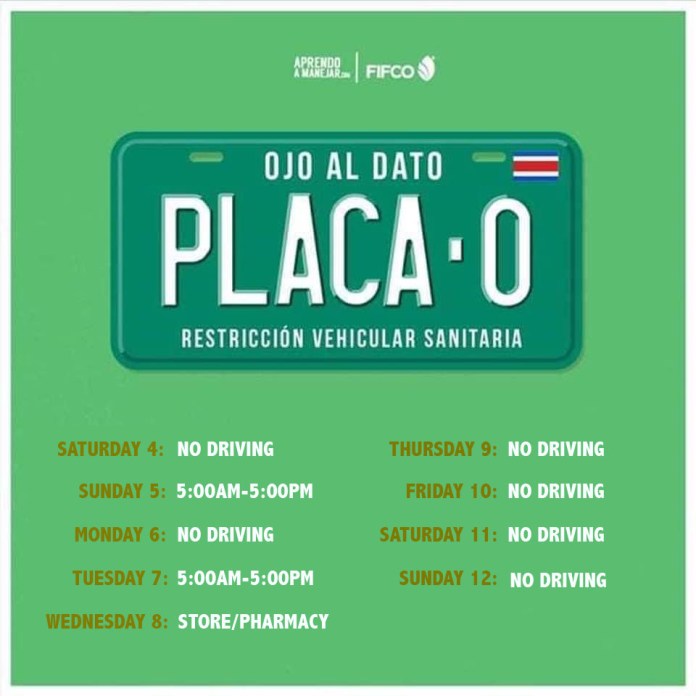


 So, how do you get the Tico to listen? Hit him or her where it hurts the most, the “carrito”.